The Trump administration is gearing up to expand federal forfeitures, a law enforcement tool that enables the government to confiscate people’s property before they are convicted of a crime.
Policy Analyst Jarrett Skorup writes in Forbes that this is a bad move:
(Editor’s note: The following is taken from a letter written to supporters of the Mackinac Center.)
The governor who once called corporate welfare “the heroin drip of state government” now seems ready to countenance a full-scale opioid crisis of sweetheart deals for big companies.
 By Jack McHugh
The Legislature is on a summer break with no sessions scheduled until Aug. 16. Rather than votes this report contains some interesting or noteworthy legislative proposals to amend the constitution. To become law these require a two-thirds vote in the House and Senate and approval by voters.
Local government retiree liabilities in Michigan have grown to at least $17 billion. Retirement debt costs are the fastest-rising expense for many municipalities, crowding out spending on core government services and have led to higher taxes.
Gov. Rick Snyder created a task force early this year that produced a new report. There is agreement that local debt is a problem, but there was little consensus from the task force on how to fix it. Union representatives seem to think this problem can be solved simply by getting more revenue from the state or by raising taxes. Local government groups similarly see tax hikes as a solution to the problem and want the power to more easily raise taxes.
The passage of the 2017 public school pension reform is a transformational change for Michigan. The new reform places Michigan at the forefront of states that have gotten a grip on out-of-control government employee legacy costs.
Michigan had accidentally made school employees its largest creditors and this imposed huge costs on taxpayers. The new law limits that damage by making it much harder for lawmakers and state officials to promise pension benefits to new school employees and then push the costs onto tomorrow’s taxpayers.
Hardly a week goes by when we don’t see an article or news story about America’s crumbling infrastructure and utilities. Contractors say it’s bad and getting worse; so do engineers, universities and think tanks. People experience it too, driving on bad roads, dealing with water main breaks and unreliable utilities. And it upsets nearly everyone to see America’s infrastructure falling apart.
 By Kahryn Riley
It’s common to have a conversation about criminal justice reform that includes an anxious reference to the “mass incarceration crisis.” But as legal academic John Pfaff points out in his new book “Locked In,” the phrase might actually be meaningless because we don’t know the right number of offenders to incarcerate. For instance, there are 43,000 people occupying Michigan prisons right now. Is that “mass incarceration?” If so, what is “normal incarceration” and how do we get there? There’s no clear answer to these questions, but here’s how to approach the issue.
In 2015 I was graciously invited to testify before a Minnesota state committee on taxes regarding an automatic tax inflator for cigarettes. The invitation was a result of my decade long investigation — in partnership with professor and economist Todd Nesbit — of cigarette excise taxes and their impact on illicit activity, most notably tax evasion. I told the committee what it apparently did not want to hear: that their recent tax increase and associated tax inflator would lead to rampant smuggling.
Lawmakers agreed on July 12 to deliver $200 million of taxpayer dollars to businesses selected by politicians, an idea the governor is expected to sign into law. This gift is a waste of money. Ostensibly, it is to create jobs, but it won’t work and creates an unfair playing field.
The Legislature met for one day this week, for the purpose of authorizing a new round of state subsidies for certain corporations. The next session day is scheduled for Aug. 16.
Senate Bill 242, Authorize giving state revenue to a few particular corporations: Passed 71 to 35 in the House
Great power and funding entail great responsibility. This principle needs broader application to Michigan’s 56 intermediate school districts, which wield big budgets but tend to operate outside the limelight.
ISDs have grown responsible for a steadily larger share of the state’s public school finances, though most are run by boards that aren’t democratically elected. These education agencies combined spent more than $1.6 billion in 2015-16, nearly 10 percent of all K-12 current operating expenditures. Yet these agencies serve less than 1 percent of the state’s public school students directly.
State lawmakers are considering a new package of legislation that would provide fiscal favors to companies selected by Lansing bureaucrats for special treatment. Among the arguments made in favor of the program is that it is costless because without the incentive the jobs wouldn’t be created in the first place. In other words, it’s performance-based.
Gov. Rick Snyder is hoping that a package of corporate handout bills already passed by the state Senate (Senate Bills 242-244) will likewise be adopted by the House as early as next week. The proposal reads a lot like the old, failed Michigan Economic Growth Authority that cost taxpayers billions of dollars with little to show, at the expense of perhaps more wisely funded programs.
 By Jason Hayes
After President Trump’s decision in June to withdraw the United States from the Paris climate agreement, various environmental groups, celebrities and politicians engaged in a string of hysterical condemnations. Former President Barack Obama characterized the decision as an “absence of American leadership,” while former Vice President Al Gore called it “reckless and indefensible.”
The people who live in the outer ring of Detroit suburbs, especially areas like Lapeer and northern St. Clair County, have the longest drives to work in Michigan.
The Grand Rapids area does not see as long of commutes on average, though there are some areas in Newaygo County where people make longer commutes.
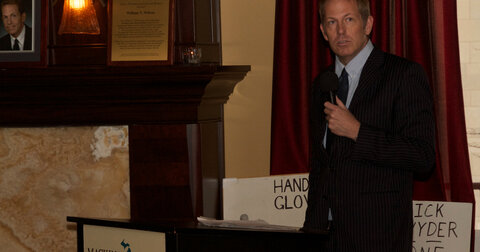
Dr. William Wilson, former senior policy analyst with the Mackinac Center for Public Policy, died last April of cardiac arrest, according to his official obituary. He was 54. Bill Wilson was a longtime friend to the Mackinac Center, a talented scholar and economist and recipient of the Mackinac Center’s Lives, Fortunes and Sacred Honor Award.
Less than five years after Gov. Rick Snyder and the Legislature pulled the plug on the state’s Michigan Economic Growth Authority corporate handout program, many Lansing politicians are eager to increase the size and number of favors they can provide.
By Jack McHugh
Note: The House and Senate are adjourned until July 12 (at the earliest). There will be no Roll Call Report next week (July 7).The Roll Call Report will resume July 14.
House Bill 4759, Sell Senate's former office building in Lansing: Passed 26 to 9 in the Senate
“The models are used in ways that systematically exaggerate the public benefits of proposed government projects, thus biasing government decision making in the direction of excessive government spending and expansion into areas that should be left to the private sector.” – Edwin Mills, author of “The Misuse of Regional Economic Models.”
Last week, several areas in Mid-Michigan experienced heavy rains and near-record flood conditions. As the rain fell and water levels rose, basements began to fill with water and untreated sewage from the area’s overloaded sewer systems. Throughout the streets of Mid-Michigan towns, the impacts are clear. Sewage and water damaged carpet and furniture; boxes of ruined property are piled high on city streets, waiting for sanitation crews to pick them up.
Forty.
That is our count for the number of times a group of 14 lobbyists and a handful of Republican lawmakers referred to corporate welfare as a needed “tool” (or some variation thereof) at a state House Tax Policy committee hearing on June 14.
In this instance, corporate welfare means unelected bureaucrats at the Michigan Strategic Fund or Michigan Economic Development Corporation picking and choosing select large companies with at least 250 new employees to bestow up to $200 million in tax incentives over the next decade — foregoing revenue that would otherwise go to state government.
(Editor’s Note: The following is a modified version of a presentation given by James Hohman, assistant director of fiscal policy, as part of a debate hosted by the Midland Chamber of Commerce on June 19, 2017.)
So there are some things that I think the [Michigan Municipal League] and I are going to agree on. For instance, that unfunded liabilities for pension benefits and retiree health care are a huge cost driver for local governments. But we are not here to talk about the things we agree on but instead the things that we disagree on. So I am going to talk about our remarkably robust municipal finance system, while I assume that Anthony [Minghine] is going to talk about the broken municipal finance system.
By Kahryn Riley
The federal justice department has launched a new Public Safety Partnership that aims to help 12 U.S. cities, including Lansing, Mich., with what Attorney General Jeff Sessions calls “their serious violent crime problems.”
Sessions announced the program on Tuesday, June 20, at a criminal justice summit in Washington, D.C. He cited a “staggering” increase in the national violent crime rate and touted the PSP as fulfilling President Trump’s promise to “make America safe again.” The program will make additional federal resources available to help cities fight violence. A U.S. Department of Justice spokesman explained that to be considered for inclusion in the program a city “must have levels of violence that far exceed that national average.”
Michigan would join the vast majority of states in freeing prospective painters from needless government licensing requirements and fees if it passes proposed changes. That’s a good move, and would be another step towards right-sizing regulations.
The state requires anyone who wants to earn a living as a painter to complete 60 hours of courses, pay nearly $300 in fees and pass an exam. The would-be painter must be at least 18 years old — meaning two high schoolers can’t legally team up to paint barns for the summer.
By Jack McHugh
House Bill 4323, State budget for fiscal year that starts Oct. 1 2017: Passed 26 to 11 in the Senate
The non-education portion of the state government budget for the fiscal year that begins on Oct. 1, 2017. This would appropriate $39.9 billion, compared to $38.7 billion authorized the year before. Of this, $21.2 billion is federal money. When combined with the education budget (next bill), the state will spend $56.5 billion next year, vs. $54.9 billion last year, or a 2.9 percent increase.



