 By Jack McHugh
Senate Bill 242, Transfer state revenue to certain business owners: Passed 32 to 5 in the Senate
To authorize giving up to $250 million of state revenue to certain developers and business owners selected by political appointees on the board of a state Strategic Fund agency. Owners of selected firms would get cash subsidies for up to 10 years equal to half or all of the income tax paid by their employees. The Senate has also passed bills authorizing another $1.8 billion in subsidies for big developers (SB 111 to 115).
When lawmakers last considered offering new school employees in Michigan only a defined-contribution retiree plan, the system’s administrators said that the newer “hybrid” plan being offered to new employees has fixed the pension system. They are wrong.
 By Ben DeGrow
Editor's Note: This article was originally published in The Detroit News on March 22, 2017.
Hoping to reverse a trend that has put our state in the bottom 10 in academic achievement, Gov. Rick Snyder’s 21st Century Education Commission issued a broad series of recommendations.

Government transparency tools like the Freedom of Information Act are one of the best ways to hold public officials and employees accountable for their actions. But they only work when government agencies respond quickly and efficiently.
In November, Mark Schlissel, president of the University of Michigan, generated press with some disparaging comments about then President-elect Donald Trump and those who had voted for him. Curious about the thought process behind those remarks, Michigan Capitol Confidential reporter Derek Draplin submitted a FOIA request to the university for any emails Schlissel had sent between July 1 and Nov. 16, 2016, that included the word “Trump.”
By Ben DeGrow
Legislators have been increasingly interested in Michigan’s intermediate school districts. The increasing financial footprint of these agencies calls for greater public oversight.
A bill that got a committee hearing last legislative session would have given local school districts greater freedom to choose which services they want to receive from ISDs. These services typically include special education and career education, as well as back office and transportation support.
This week, the Mackinac Center for Public Policy, Michigan Press Association and Michigan Coalition for Open Government published an online, searchable database of government workers and their salaries.
It was immensely popular. The Michigan Government Salaries Database almost immediately garnered thousands of views. But many of the people employed by schools, various arms of the state and judges have questioned why we made public information more readily available.
By Jack McHugh
Senate Bill 223, Create process for disclosing police firing to other agencies: Passed 37 to 0 in the Senate
To establish a process and liability exemption for a police agency disclosing information to another agency about a former officer who may have been fired. A separating officer could review the official record and make his written explanation a permanent part of it. Police job applicants would have to give prospective employers a waiver allowing them to get the separation records, and the former employer would be immune from liability for revealing this.
Editor's Note: This article originally appeared in Crain's New York on March 24, 2017.
New York has ostensibly made the health of its people and its treasuries a priority by maintaining high cigarette taxes, but these taxes come with a cost.
The state’s high cigarette taxes have led to rampant tax evasion and avoidance and other ugly, unintended consequences.
 By Derk Wilcox
(Editor's note: The following is testimony given by Derk Wilcox, senior attorney for the Mackinac Center Legal Foundation, to the U.S. House of Representatives Subcommittee on Economic Opportunity of the House Committee on Veterans' Affairs.)
Chairman Arrington, Ranking Member O’Rourke, and Members of the Committee:
Both in its culture and in its ability to prepare students for college, Wellspring Prep is anything but typical.
Located only a couple miles from the heart of downtown Grand Rapids, Wellspring Preparatory High School is tucked just off the beaten path on the city’s northeast side. The school opened in fall 2010 with only a freshman class, taking time to make itself known.
A person who has a criminal record or has served time in prison has a very hard time getting a job in Michigan. Private employers may often reject such an individual, and the state may withhold the occupational license required for a job. This frequently results in people returning to criminal activity and eventually heading back to prison.
By Jack McHugh
Senate Bill 46, Revise emergency vehicle flashing lights requirement: Passed 37 to 0 in the Senate
To eliminate a requirement that flashing lights be mounted on the roof of an authorized emergency vehicle. These vehicles would still have to have flashing emergency lights; they just wouldn’t have to be on the roof.
Business Leaders for Michigan president and CEO Doug Rothwell points to economic competition between the states to justify a proposal for new Michigan taxpayer subsidies to certain businesses.
"But the reality is if they've got a machine gun and we've got a pistol, my gosh we're going to get killed here,” Rothwell told the Associated Press.

 By Jason Hayes
Editor’s note: This is an edited version of remarks prepared for the Michigan Pipeline Safety Advisory Board.
I would like to thank the Michigan Pipeline Safety Advisory Board, and co-chairs Valerie Brader and Heidi Grether for the opportunity to comment.
In support of a new business subsidy program, Business Leaders for Michigan writes, “Michigan can no longer afford to be the only state besides Alaska with a corporate income tax – without a program to attract large projects.” But this misleading, because Michigan has dozens of programs that deliver select favors to certain businesses.
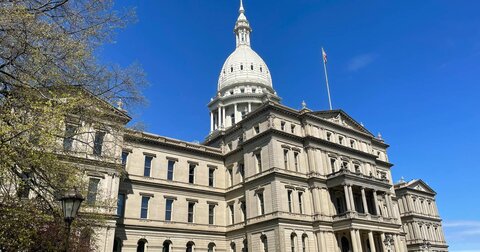
The Michigan Legislature is considering a package of bills that would give a few lucky developers special subsidies. Senate Bills 111-115 are unfair, ineffective and irrational and lawmakers should reject them.
These bills allow a handful of well-connected builders to get subsidies paid for from money that would otherwise fund government programs. Someone who starts a development — say, a sports stadium — would be selected by Lansing and, after putting up the initial capital, be able to take money from taxes paid by nearby individuals and taxpayers and keep it.
Editor's Note: The following was authored by Madelyn Harwood, a policy writer for the Illinois Policy Institute, and originally posted on the blog of the Illinois Policy Institute. It is reposted here with permission.
Illinois once enjoyed an annual population boost from Michigan. But in Illinois’ downward economic spiral, migration between Illinois and Michigan has tipped to favor the faster-growing Wolverine State.

On March 6, members of the House Science, Space, and Technology Committee introduced the Honest and Open New EPA Science Treatment Act of 2017 (HONEST Act). At the same time, Reps. Frank Lucas, R-OK, and Lamar Smith, R-TX, proposed legislation to reform the Environmental Protection Agency’s Science Advisory Board.
In simple terms, government is a group of people using resources that belong to the public. Since these funds were earned by taxpayers, they have a right to know exactly how their government is using their money.
Sometimes government entities do things that conflict with what’s in the best collective interest of the public, many times in secret. In the wake of the Watergate scandal, there was an increased interest in making governments more transparent. In response, politicians created the Freedom of Information Act, or FOIA, as it’s commonly called. FOIA is perhaps the most important tool that journalists and the public have to keep governments accountable. These laws differ by state, but they all give citizens the right to request and receive information from public entities.
Editor's Note: This piece was originally published in The Detroit News on March 9, 2017.
Michigan Republicans own a unique moment in this state’s political history. If you are a member of the GOP, your party controls the White House, Congress, the governor’s office and the state legislature. The last time this occurred? The Hoover administration. Given this opportunity, policymakers should pursue their agenda with gusto.
By Ben DeGrow
In his 2017-18 budget, Gov. Rick Snyder has proposed reducing funding for certain types of public schools: cyber schools, which are charter schools that provide students with full-time online instruction.
Currently, all public charter schools receive the same minimum foundation allowance as most traditional districts: $7,511 per student. While all other districts and charters funded at that minimum level would receive a $100 increase in their foundation allowance, cyber school financing would drop to $6,089 per student, a 19 percent hit.
By Jack McHugh
Senate Bill 129, Regulate small copper mines different than big ones: Passed 24 to 11 in the Senate
To establish a separate and more streamlined regulatory regime over small ("native") copper mining operations.
Who Voted "Yes" and Who Voted "No"
Senate Bill 19, Cut off parole absconders from welfare: Passed 101 to 6 in the House
 By Kahryn Riley
It seemed everyone was ready to tackle criminal justice reforms after the Council of State Governments released its study of Michigan in 2013.
The Legislature, Gov. Rick Snyder and the Supreme Court issued a joint invitation to the CSG to observe Michigan’s criminal justice system, and the House of Representatives introduced several proposals the following year based on the council’s findings.
We’ve written a lot about ridesharing over the last year, explaining why services that use smartphone apps to link people who have cars with people who need rides are good for Michigan.
Two companies stand out in the ridesharing business in Michigan: Uber and Lyft. When we started talking to drivers a year ago, Uber was operating in six cities (metro Detroit, Ann Arbor, Lansing, Flint, Grand Rapids and Kalamazoo). Lyft was operating in only two (metro Detroit and Ann Arbor), although it expanded in summer 2016 to include the Lansing and Grand Rapids areas.
Although the current political climate is fraught and divided, there are a handful of ideas that people and groups across the spectrum can and should be able to agree on.
Mackinac Center Executive Vice President Michael Reitz recently wrote an op-ed in the Detroit Free Press describing a few potential consensus-building ideas for Michigan: licensing reform, a better school ranking system, criminal justice reform, an income tax cut and FOIA reform.



