 By Jack McHugh
Senate Bill 702, Prohibit school districts from discriminating against charter schools: Passed 60 to 47 in the House
To expand the definition of “deed restriction” in a 2017 law that prohibits a school district or local government from refusing to sell property to a competing charter or private school. The bill would close a loophole that the Detroit school district has used in refusing to sell a shuttered primary school to a charter.
 By Ben DeGrow
The Coston family scrapes together funds to pay the monthly bill to send their children to Calvary Baptist Academy. They love the school's challenging academics and emphasis on faith and character.
"Our family has needed to make some really big sacrifices, because we believe this is important," said Nate, father of three. "And so we're basically going to do whatever it takes."
The most popular Uber destination in Michigan in 2017 was the student bar Scorekeepers in Ann Arbor. The app makes it very easy for students to order a car when traveling over a mile from Michigan Stadium on game day.
But if it were up to the city council in Ann Arbor, the service would be banned or regulated to the point of ineffectiveness. The evidence suggests this would mean more students involved in alcohol-related car crashes.

There is a lot of pressure to underfund pensions, and the promises that guarantee them, whether moral or constitutional, are only as strong as the money that is set aside to pay for them.
In researching the history of some state business subsidies, I came across some talking points from a 2003 speech by former Gov. Jennifer Granholm at a Delphi plant (now Nexteer) in Saginaw. She made this point:
In Michigan alone, about 4 million people have some type of criminal record and 50,000 more people are convicted of a felony every year. Another 10,000 are released from prison each year back into our communities.
A state’s criminal justice system is driven in large part by the laws on its books and how it polices its citizens to enforce those laws. But it’s also important to consider how state policies affect how those people are treated after they pay the penalty for their crimes. Mike Jandernoa is the former CEO and board chair of Perrigo, a pharmaceutical company in West Michigan. In a recent essay for Fox News, he made a strong case for “Why hiring people with criminal records benefits us all.”
Michigan businesses and residents continue to produce more and employ more people, and the economic well-being of residents increased in 2017.
The available economic data that has been released so far is optimistic, though much of the information about the state’s 2017 performance won’t be released until later in the year.
Editor’s note: This article first appeared in The Detroit News on Nov. 9, 2017.
I recently installed a new roof on my house. Before doing so, I did what any responsible homeowner does — I got bids from different companies and made a decision by balancing quality and costs and using market competition to my advantage.
The conventional school district in Detroit is, by most measures, the worst performing district in the United States. Students have been fleeing for years, leaving for schools in other districts or charter schools in the city. To prevent that, the district is doing everything it can to stop parents from making this choice.
 By Kahryn Riley
Michiganders who usually idle their cars to warm them up before driving in the winter will be pleased to know they will no longer be breaking the law by doing so.
Last winter, we reported on the case of Nick Trupiano, who was ticketed $128 for leaving his car idling unattended in his driveway, in violation of the state vehicle code. A judge upheld the ticket and agreed with the ticketing officer that the rule was justified by the public safety threat of leaving running vehicles unattended.
In the debate about the condition of Michigan and America’s infrastructure, the doomsayers seem to have the loudest voices. Yes, more investment is needed, and there are some high profile disasters, but the news isn’t all bad — far from it.
Many who claim the sky is falling do so because they have a financial interest in more funding for infrastructure. Taxpayers will never spend enough to satisfy these folks. It’s easier to identify problems than to recognize successes. Exactly zero headlines read: “Water treatment plant working just as it should.”
The newest edition of Regulation magazine from the Cato Institute features a piece on licensing co-written by Mackinac Center Director of Marketing and Strategy Jarrett Skorup.
The chapter is titled “The Latest on Occupational Licensing Reform” and notes that “at the federal level and in the state of Michigan, there have been encouraging moves toward market liberalization.” It is co-authored with Thomas Hemphill of the University of Michigan-Flint. An excerpt is below.
By Jack McHugh
Supporters of free markets had little to cheer for based on what Michigan’s 99th Legislature did in 2017. There were certainly positives – such as public school pension reform – but lawmakers also indulged in a corporate-welfare potlatch party. Here’s a round-up.
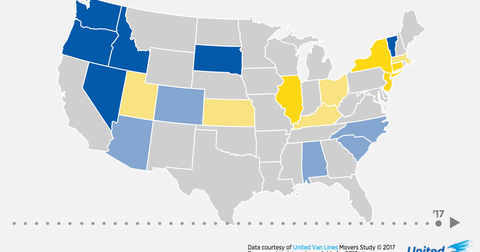
State-to-state migration may be the single greatest tool for comparing the quality of life in different states. Through moving, people reveal their preferences for where they wish to live. Opportunity is a major reason people move between states. That’s what makes the annual United Van Lines report on client moves so interesting.
The Mackinac Center for Public Policy’s legal arm files lawsuits on behalf of Michigan citizens wronged by some level of government or unions. As an example, the Mackinac Center has represented hotel and motel room providers seeking to defend their free speech rights against government intrusion into their business. Legislation introduced Dec. 5 by two Republican senators, Wayne Schmidt and Ken Horn, could thwart similar lawsuits in the future. Such a move would cement government-coerced speech into place. Rather than do that, however, lawmakers instead ought to strip the offending parties of their state-granted power to compel speech.
This year the Michigan-based Mackinac Center for Public Policy celebrates its 30th anniversary. What started out in 1987 as an experiment grew into one of the nation’s largest and most influential state-based think tanks. Although our methods have evolved over time — once a traditional white paper shop, we’re now a multifaceted change agent — we’ve never wavered from our guiding principle: Freedom makes all the difference.
This article was originally published by the Institute for Justice. To see more Michigan-specific work on forfeiture, please visit www.mackinac.org/forfeiture.
Crime doesn’t pay, but being innocent in the wrong place can cost you big time under Michigan’s civil forfeiture laws. The sheriff’s department of Oakland County, Michigan (in suburban Detroit) froze more than $10,000 in the bank account David Barnes shared with his mother after a November 2014 raid on a building their family owned. Officials allegedly thought a company operating inside the building was involved in drug trafficking. According to ABC 7 Detroit, all charges later filed against Barnes were dropped. But through civil forfeiture, the department continued to freeze his bank account.
By Jack McHugh
Senate Bill 702, Ban school districts and local governments from discriminating against charter schools: Passed 26 to 11 in the Senate
To expand the definition of “deed restriction” in a 2017 law that prohibits a school district or local government from refusing to sell property to a charter or private school, or from taking other actions designed to keep these potential conventional public school competitors from using property for a lawful educational purpose. The bill would close loopholes that cities and school districts have used to discriminate against charter schools.
The Fraser Institute recently published “Economic Freedom of North America 2017,” an annual report that ranks Canadian provinces as well as the states of Mexico and the USA in terms of economic freedom. A state’s place in this index is important because economic liberty is associated with higher personal income and other important measurements of human well-being, and so where Michigan falls in the rankings should be important to policymakers.
By Kahryn Riley
The state Senate passed a bill on Nov. 29 to continue a policy that keeps Michigan drivers from renewing their license if they have three or more outstanding parking tickets. Under a law set to expire on Jan. 1, 2018, the Secretary of State does not renew the license belonging to a driver with three or more unpaid tickets until that person pays the tickets — and a $45 “clearance” fee.
By Ben DeGrow
Opponents of school choice seem to be working overtime to discredit programs that give students in tough circumstances a better chance to succeed. These critics would be well-advised to ensure their own house is in order first.
One of the latest lines of attack is a dubious Associated Press claim that public charter schools are increasing segregation because they are more “racially isolated.” How richly ironic that school board member Christopher Profeta from Grosse Pointe, a wealthy district that actively works to keep Detroit kids out of its schools, trumpeted the article on social media.
Legislation that creates funding requirements for local government pensions and retiree health insurance benefits recently passed both Michigan chambers. This package is an attempt to address the billions in retirement debt faced by local governments. But the law is problematic because it conflates pension and retiree health care benefits — two things that should not be lumped together — and opens the door to tax hikes in local governments.
Your house is on fire. Worse, your house is located in a drought-stricken area so the fire department’s resources are oversubscribed and undersupplied. You do have a well; it just needs a source of power for the pump.
You ask yourself: Should I pay for the electricity to run the pump or wait until the fire department has replenished its water supply and let them put it out, at no direct cost to me? A rational person would opt to turn the pump on and begin to fight the fire, given the potential catastrophic consequences. And they’d be right.
By Jack McHugh
Senate Bill 544, Create framework for 'enhanced education savings accounts': Passed 23 to 14 in the Senate
To create an enhanced education savings accounts program that would allow individuals to make tax-deductible contributions to an account used to pay for public school extracurricular activities, vocational programs or other services that schools are not required to provide. Note that while the Senate passed this and some related bills, it did not pass a bill authorizing the tax deductions (Senate Bill 549), without which this and the other bills in the package appear to be moot.
By Ben DeGrow
Michigan’s new state education plan finally got the green light from D.C. Yet while the approved system ranks schools more fairly, the Legislature will have to act to ensure that information about school performance is made clear and useful to parents and other local decision-makers.
By Kahryn Riley
Many advocates of criminal justice reform describe their ideas as ones that would modernize the justice system, or bring it into the 21st century. Nowhere is that description more apt than when considering how to use computers to accomplish things that would normally be done by people. Using technology instead of people can be cheaper and sometimes even more effective. But while it makes sense to automate some interactions, there are others that require the human element – even if that costs more.



