 By Jack McHugh
Now with one click you can approve or disapprove of key votes by your legislators using the VoteSpotter smart phone app. Visit votespotter.com and download VoteSpotter today!
The House and Senate have not cast any votes in recent weeks. Therefore, this report contains several recently introduced bills of interest.
On Sept. 1, Mackinac Center Director of Labor Policy F. Vincent Vernuccio joined the Heritage Foundation as a panelist for their event "Do Right-to-Work Laws Really Reduce Wages? Examining the Evidence." He compared and contrasted Michigan and other right-to-work states against without right-to-work policies:
Click here to find the full results from our 2015 school privatization survey.
This commentary originally appeared in the Austin American-Statesman on September 1, 2015.
Money that could be spent on classroom supplies and textbooks is being lost to the educational bureaucracy, according to a new survey of Texas school districts.
Legislation permitting counties to increase the excise tax on cigarettes was approved by the California Senate Thursday, Aug. 27. Another bill — introduced the day before — would hike the state excise tax by $2.00 per pack. The state legislature should prevent both bills from passing.
The Washington Post’s “Wonkblog” recently ran a piece titled, “What it’s like to be a part of the world’s richest 1 percent, in 15 incredible photos.” This features photos of a man floating in a swimming pool on top of a skyscraper, an in-home cinema, maids, the Opéra de Monte-Carlo, the Hollywood Walk of Fame, a patient about to undergo plastic surgery, a personal chef at a luxury lodge and a gated community.
A recent survey of Pennsylvania’s conventional public school districts by a Michigan-based research institute indicates that 75.2 percent of those districts contract out with private vendors for at least one of the three major noninstructional services.
State law requires the managers of Michigan’s school employee retirement system to base annual pension contributions on an assumption that its investments will generate an average return of around 8 percent per year. If the actual returns don’t reliably meet or beat that level over time, it means contributions into the pension fund will be insufficient to pay for the retirement benefits of employees. The result is a long term unfunded liability that taxpayers eventually have to pay.
Now with one click you can approve or disapprove of key votes by your legislators using the VoteSpotter smart phone app. Visit votespotter.com and download VoteSpotter today!
The House and Senate are not in session until Sept. 9 and Sept. 1, respectively. Therefore, this report contains several recently introduced bills of interest.
Authors’ note: The following was first posted by the Georgia Public Policy Foundation August 27, 2015.The Mackinac Center’s annual survey of conventional public school district contracting was expanded this year to include four other states.
More than a third of all conventional public school districts in Georgia contract out one of the three major noninstructional services, according to survey data collected this summer by a the Mackinac Center for Public Policy, a Michigan-based research institute.
By Jack McHugh
Perhaps no two human activities are more antithetical to each other than politics and the business of insurance. Insurance is all about prudence and taking the long view, while politics is — not.
An example is House Bill 4560, introduced by Rep. Peter Lucido, R-Shelby Township. To provide a one-time infusion of road repair money this would authorize a $1 billion raid on the reserve fund that the Michigan Catastrophic Claims Association draws on to reimburse auto crash victims for very expensive medical costs.
Grand Rapids’ public bus system, The Rapid (or Interurban Transit Partnership), and its union are negotiating over a plan to freeze and close its employee retirement system. Union president Larry Hanley is adamant that the plan remain open.
"This is not contract negotiation; this is a political attack on working people with no good financial reason. It's not that the agency's in trouble," Hanley told the Grand Rapids Press. "The system's not in any state of crisis. The benefits have been established for many years."
Gas stations have heavy competition. There are stations all over the place and everyone publicly displays their prices. Owners operate on very thin profit margins, and there is lots of incentive to keep prices as low as possible. Almost everyone uses gas and nobody likes paying higher prices. So when prices increase, politicians on both sides of the aisle demand and promise investigations. Oil companies are roundly demonized. (Of course, nobody is sending them a thank-you card when prices come down).
There are over 3,000 criminal statutes in Michigan, but a recent unanimous vote in the Michigan House will trim that number, eliminating several outdated laws in the first step toward simplifying the state’s enormous penal code.
Overcriminalization has recently come into the spotlight in Michigan as part of a larger movement pursuing criminal justice reform. In 2014, the Mackinac Center and the Manhattan Institute published a study on the topic, Overcriminalizing the Wolverine State. The study advocated for clarification and consolidation of the current criminal code, guidelines to govern the creation of new criminal offenses and enactment of a default mens rea provision — requiring the state to consider a person’s intent before convicting them of a crime.
At a recent Americans for Prosperity event in Ohio, Mackinac Center Director of Labor Policy F. Vincent Vernuccio discussed right-to-work policies and how states have fared with them in recent years with Watchdog.org.
His interview begins in the video below at 2:44.
Since the passing of right-to-work legislation in 2012, Michigan's largest teachers union, the Michigan Education Association (MEA), has gone to extraordinary lengths to keep unwilling members in the union, first by extending contracts, then by enforcing a scarcely-publicized "August Window." Members who fail to opt out of the union during the month of August have had their membership dues sent to collections, despite multiple authorities calling the August Window illegal.
On August 18 and 19 the Michigan House and Senate met in an unsuccessful effort to negotiate the differences between road funding bills each has passed. In the end they appointed a House-Senate conference committee to craft a compromise.
This edition of the Roll Call Report repeats the latest key road funding votes by each body, which were taken in June and July.
In 2013, the Michigan Legislature passed a bill expanding Medicaid, a core component of the federal Affordable Care Act, aka Obamacare. Given Republican control of the state House, Senate and governor’s office, the move surprised many. Two years earlier, referring to another ACA provision (the insurance exchange), Chuck Moss, then the chairman of the House Appropriations Committee, said GOP lawmakers would “rather be caught sacrificing to Satan than voting for Obamacare.”
A union-sponsored group called Citizens for Fair Taxes is organizing a signature-gathering petition campaign for a November 2016 ballot initiative that would nearly double the state’s main business tax. The new money would be earmarked to state and local road projects. The proposal would increase Michigan’s Corporate Income Tax from the current rate of 6 percent to 11 percent.
In an article published August 20, Bridge Magazine discussed recent collaborative efforts toward criminal justice reform in Michigan.
The Mackinac Center has been at the head of this movement, joined by such organizations as the ACLU of Michigan and Fix Forfeiture, advocating for civil asset forfeiture reform.
The Senate Judiciary committee unanimously passed five bills that establish strong transparency requirements for property forfeited in Michigan.
The bills have are House Bill 4499, 4503, 4504, 4505, and 4506. They were supported by Senators Rick Jones, R-Grand Ledge, Tonya Schuitmaker, R-Lawton, Patrick Colbeck, R-Canton, Tory Rocca, R-Sterling Heights, and Steve Bieda, D-Warren.
This summer, the Mackinac Center conducted its annual school privatization survey, finding that more than 70 percent of school districts in Michigan contract out for services such as food, transportation, and custodial work.
The findings have been publicized across the state. Michigan Radio wrote the following:
For years the Mackinac Center for Public Policy has argued that — done right — governments could save money and improve services through privatization. That is, through selling assets or competitively contracting out services such as food, janitorial or busing services in conventional public school districts, governments can get better services with lower costs.
(Editor’s note: A version of this article appeared on the Illinois Policy Institute Blog.)
National Employee Freedom Week started on August 16th and celebrates the freedom of choice employees have when it comes to union representation.
The Mackinac Center joined over 99 organizations in 42 states in what is called “a national effort to inform union employees about the freedoms they have to opt out of union membership and let them make the decision that's best for them.”
Click here to find the full results from our 2015 school privatization survey.
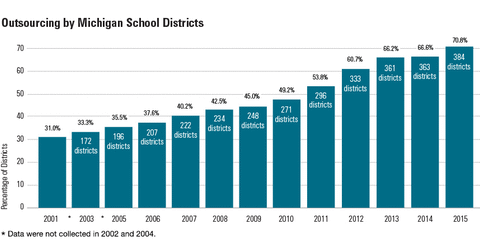
There are more Michigan public schools contracting out food, custodial or transportation services than ever, according to the Mackinac Center’s latest survey of school districts. This year, 70.8 percent of school districts use private-sector vendors to clean buildings, get kids to school, or cook and serve school meals. This is up from 66.6 percent the previous year.
Bridge Magazine has a piece on “Michigan’s stumbling middle class” and says, “today’s workers are part of the first generation in Michigan history who, taken as a whole, are not better off than their parents.”
The main economic data point put forth is that adjusted for inflation, Michigan’s median household income is lower than it was in 1969. That’s true: Household income has declined from $64,778 in 1969 to $49,418 in 2013.



