As health care gets more expensive and Michigan struggles to fill positions, lawmakers have explored different ways to make it easier to work. This includes easing some licensing burdens, expanding scope of practice and creating some sub-categories of licensing.
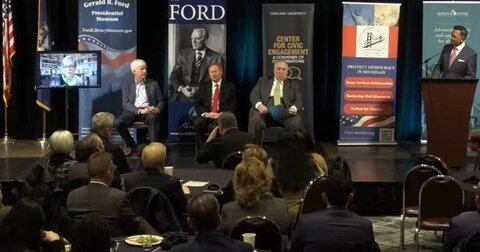
All living former Michigan executives teamed up to discuss civility with the Mackinac Center for Public Policy Wednesday. Former Gov. Jennifer Granholm remotely joined former Govs. Rick Snyder, James Blanchard and John Engler at the Lansing Hilton DoubleTree to demonstrate the value of communicating clearly, respectfully, and truthfully in a hotly contested political environment.

Texas power grid faces potential new crisis
Nearly five years after the Lone Star State’s historic power outage, the Electric Reliability Council of Texas, Inc. is increasingly vulnerable to winter power outages, the Texas Public Policy Foundation reports, and the state’s risky gamble on solar power is to blame. “The core problem is a mismatch between the types of generation being added and what the grid needs for winter reliability,” writes Brent Bennet. “Since 2021, ERCOT has added 31 GW of solar and 17 GW of battery storage but only 3 GW of natural gas generation. By 2030, approximately 60 GW of new solar, batteries, and wind will be added at a cost exceeding $60 billion, yet these resources will contribute only about 9 GW of firm power during peak winter hours.”

This article orginally appeared in The Washington Post January 29, 2026.
Public officials in Indiana drew attention and applause last month when they claimed that cigarette use had declined by 40 percent. They credited a $2 per-pack tax hike that took effect in July.

This article originally appeared in The Detroit News January 13, 2026.
This year marks the 250th anniversary of the United States. This is an opportunity to celebrate America and what she represents, and to reflect upon the essential values and liberties we all cherish.

A recent viral essay claims that a typical household needs $140,000 per year to live. The current official poverty line of $32,000 for a family of four, writes Wall Street portfolio manager Michael W. Green, amounts to “measuring starvation.”
The claim is startling, but economists say it doesn't add up.
Trust in the federal government is eroding, and that’s clear in nearly every way it can be measured. But many of us still have confidence in our state and local governments. Leaders could use that advantage by adopting a solution that’s available to every town in Michigan.

Housing demand in Michigan has steadily increased for more than a decade and then spiked during the COVID-19 pandemic, but the number of builds barely increased. In the meantime, inflation rose and interest rates on loans skyrocketed. That’s a summary of a recent report from economists at the University of Michigan.

At the Detroit Auto Show, Gov. Gretchen Whitmer called on the Legislature to expand the Michigan Reconnect program, which covers the cost of community college for eligible participants. "They might be changing careers, looking to make more money or pursuing a lifelong dream. No matter the reason, I'm really proud of every Reconnecter for betting on themselves," Whitmer said.

President Trump recently urged Congress to cap credit card interest rates at 10%, arguing that rates of 20% or 30% are abusive and that the government should step in to protect families.
The good news is that, at least for now, many Republicans in Congress are pushing back. Lawmakers are warning that government price controls on credit would restrict access and hurt consumers rather than help them.

Is online learning a substitute for the classroom or a distinct form of education in its own right?
Barbara Oakley joins the Overton Window podcast to discuss how attitudes toward online education have shifted over the past decade and what research suggests about how people actually learn.

Michigan lawmakers responded late in 2025 to the federal One Big Beautiful Bill Act by putting a three-year pause on the implementation of five new federal tax provisions, including one for expensing of research and development costs. This “decoupling” from the federal tax reforms is aimed at saving revenue for the state budget, but it puts Michigan businesses at a competitive disadvantage. Michigan should revisit this decision, just as Congress did last year.

The state government now spends $1.8 billion more on transportation than it did when Gretchen Whitmer entered office, a 30% increase when adjusted for inflation. This level means roads will likely be repaired faster than they fall apart. Yet the governor deserves little credit for the solution and plenty of blame for years of holding the road fix hostage to her quest for higher taxes.

This article originally appeared in Bridge Michigan March 26, 2021.
Taxpayers should expect more for $1.5 billion.
Taxpayers will spend around $1.5 billion on Michigan’s 15 public universities this year. State support varies among the schools from a low of $3,100 per student at Oakland University to a high of $8,900 at Wayne State. While these amounts are determined each year by lawmakers, very little consideration is given to the performance or efficiency of each university.

The Overton Window, developed by Joseph Overton here at the Mackinac Center, describes the principle that at any given time, policies can fall within a window of possibility. This window is set not by politicians but by public opinion. To learn more about Joseph Overton or the Overton Window, you can visit this Overton page.
The University of Michigan hospital system says it uses a federal program to buy discounted medicine from drug companies in order to provide charity care and help the uninsured. But new research suggests the program is not being used as intended.
The 340B drug pricing program gives certain nonprofit hospitals the ability to buy medicine at a steep discount, charge patients and insurers for it, and pocket the difference. Hospitals benefiting from this program say they use the money for charity care, better equipment and other purposes.

The Minnesota Somali day care scam ought to outrage people on both the left and the right. Seeing money intended to help poor parents allegedly taken by bad actors is a reminder that we have much to do to improve government efficiency.
But there is a lot to be gained from fixing public spending decisions. While partisan debates focus on how much the government will spend on a program, what often matters more is how that money gets spent.

 By Derk Wilcox
This article originally appeared in The Detroit News Nov. 2, 2025.
SEIU Healthcare Michigan announced in November that it had won an election allowing the union to represent nearly 32,000 home health caregivers who assist people with disabilities in their homes. But only 4,025 of the 31,616 eligible caregivers voted to be represented by the union — a mere 12.7% of the group.

Some Michigan lawmakers pushed for more business subsidies at the end of 2025 but were unsuccessful. They are likely to try again in 2026. Lawmakers should start the debate with a healthy skepticism about their ability to drive economic outcomes. And there’s a way to focus the debate.

This article appeared at JohnLocke.org January 8, 2025. We are grateful to reproduce it here with permsission.
As we begin a new year, it is worth reflecting on the institutions that shape public policy in America — and the principles that ought to guide them. For the John Locke Foundation, that reflection is especially fitting. Since opening its doors in February 1990, Locke has worked to define and defend the proper role of a nonprofit research institute in a free society. Nonprofit think tanks occupy a distinctive place in our civic life, serving as sources of ideas and analysis rather than instruments of political power — a role that is often misunderstood and, at times, unfairly caricatured.

Chris Surprenant’s path from traditional academic philosophy to hands-on public policy work reflects a deep sense of responsibility to the community he serves. Now a professor of ethics, strategy, and public policy at the University of New Orleans and Director of the university’s Urban Entrepreneurship and Policy Institute, Surprenant spoke on The Overton Window Podcast about how his academic career shifted from traditional philosophy toward financial literacy and education reform rooted in local needs.

This article originally appeared in The Detroit News December 23, 2025.
My great-uncle George Pancio — Uncle Bud to us — was the Santa Claus in the Macy’s Thanksgiving Day Parade in New York City.
Growing up in western New York, my siblings, cousins and I simply knew him as the town Santa Claus.

Michigan law mandates ever-increasing use of solar photovoltaic cells to replace reliable, affordable, coal, natural gas and nuclear power. Consider that after decades of mandates, tax breaks, and subsidies that add to your taxes and electricity bills, solar is only generating a bit over 2% of Michigan’s electric demand.

This article originally appeared in The Detroit News December 16, 2025.
Trust in government is falling. Only 17% of Americans believe the federal government will do the right thing “just about always” or “most of the time.” The Pew Research Center says this is nearly the lowest level ever recorded. But policymakers and public employees can help rebuild trust by emphasizing integrity, competence and the rule of law.

This article originally appeared in The Detroit News December 9, 2025.
Alex Tokarev grew up in Bulgaria during the Cold War. Life under socialism, he says, was “miserable.” Twenty-five years ago, he and his wife moved to the United States, and he now teaches economics at Northwood University in Midland. Tokarev offers a blunt warning for Americans flirting with socialism.



