Since April 2008, Michigan has given qualified film productions up to 42 cents on the dollar for every expense they incur in the state. While the state is able to point to a number of films and projects given assistance from this program, the state's motion production and sound recording industries employ fewer people now than when the subsidy began.
A news report from Detroit TV station WDIV seems to indicate that a $146 million film production studio has instead become a boondoggle for the city of Allen Park. The official news release from the governor's office touted that Unity Studios would create up to "121 new jobs" initially, then as many as 3,000 new jobs when the facility is "at full operation." Backers also boasted it would include "a village where people can live, shop and find entertainment options" at the proposed 104-acre site on the privately owned land that once housed the Visteon Technical Center.
Michelle Malkin said it best when she said, "The Culture of Corruption has never hit so close to home."
The prominent author, blogger and commentator was referring in a recent blog post to a shady scheme to shanghai Michigan's home day care providers into a newly-formed, dues-paying labor union. Last month, the Mackinac Center Legal Foundation exposed this scheme in its first lawsuit, Loar v. DHS. A Mackinac Center news release explains the Sept. 16 filing:
Frank Beckmann, host of "The Frank Beckmann Show" on WJR AM760, cited the Mackinac Center in his weekly Detroit News column today.
He referenced a study by Paul Kersey, director of labor policy for the Center, that found Michigan's public schools could save about $250 million a year if the state's prevailing wage law was overturned.
This chart might be called the "Political Class Desperation Index." The need for transformational reform of Michigan's tax, spending, labor and regulatory environments is indicated by the skyrocketing unemployment rate. The failure of the political class to buck special interests — including government employee unions — and finally undertake those reforms makes its members increasingly desperate to create the appearance of "doing something." Thus the massive increase in futile picking of winners (and losers) for receipt of discriminatory tax breaks and subsidies. These create diversionary "feel good" stories for local newpapers, but do nothing to reverse the state's economic decline — and may even accelerate it. ("MEGA" is the flagship program of Michigan's bureaucratic "economic development" empire.)
I am a registered nurse at Genesys hospital near Flint, where the RNs and licensed practical nurses who do direct patient care are represented by the Teamsters. I believe the union-fostered attitude at our hospital works against teamwork. While Genesys is a great place to work, it would be even better if the union acted more professionally.
The Michigan Economic Growth Authority, the state's lead business incentive program, is primed for new amendments to raise the cap on the number of credits it can award this year. While there are some good transparency efforts in the bill, the state would be better served by eliminating the program and lowering taxes for every business.
The strong economy bore its fruits Tuesday as lawmakers happily allocated hundreds of millions for needs in the health and welfare budgets while passing out other money to cultural institutions around the state.
Few legislators sounded any objections to the $321.6 million general fund bill ($530.6 million from all sources) as it passed HB 4075 on an 89-13 vote, but there were some complaints about "pork-barrel" spending for pet projects.
This week, The Wall Street Journal published another critical examination of Michigan's political leadership, economy and budget. In a delicious irony, the online version posted a Michigan Economic Development Corp. advertisement (click on the image at right to enlarge) featuring actor Jeff Daniels alongside the piece.
A roundup of recent Mackinac Center media citations.
Paul Kersey, director of labor policy, was cited in the Detroit Free Press regarding a push in Oakland County to pass a prevailing wage ordinance. Kersey's 2007 study on the issue showed that Michigan's prevailing wage law increased costs needlessly, especially for public schools.
Forty-five percent of registered voters rated the economy as the most important issue in deciding their vote if the congressional election were held today, according to a news story in Politico; only 4 percent ranked climate change as the top issue. The poll conducted by Public Strategies Research Practice Group, a business advisory firm located in Austin, Texas, is consistent with other recent polling that shows global climate change low on the priority list of most Americans.
The Detroit Free Press is reporting that the City of Detroit has stopped collecting dues on behalf of 16 unions that have yet to reach new agreements with the city of Detroit. This is a provocative but much-needed step that serves to discipline city employee unions. While exact numbers of employees covered are not available, this action covers AFSCME, one of the largest unions in city government which covers several bargaining units, as well as the Amalgamated Transit Union representing city bush drivers. The city sent notice of its intentions back on October 9, giving the unions involved 10 days to agree to terms.
The Michigan "Legislative Commission on Government Efficiency" has released a draft of its final recommendations that fully meets the expectations raised by the "overarching conclusions" that were the subject of a post on this blog two days ago. (Short version: "Bureaucratic gobbledygook won't fix Michigan.")
The Bureau of Labor Statistics today released the September state-by-state unemployment rates. Michigan remains the highest in the country at 15.3 percent unemployment. This is the 43rd month in a row that Michigan has been the worst state for finding a job.
Cigarette smuggling and student achievement drew two recent media mentions for Mackinac Center scholars.
An Op-Ed on cigarette smuggling by Michael LaFaive, director of fiscal policy, and Todd Nesbit, a Penn State professor and adjunct scholar with the Center, appeared in the Providence (Rhode Island) Journal. The piece pointed out that states that raise or have high tobacco taxes also have higher rates of cigarette smuggling.
The Michigan "Legislative Commission on Government Efficiency" has come out with a set of "overarching conclusions" that includes this gem:
Cross-cutting and underlying principles are the foundation of our recommendations
— Look to optimize across all levels and units of government
— Address underlying structural issues
— Be holistic in the approach (look at all aspects of the budget and government operations)
— Create a roadmap to fiscal stability
— Be of sufficient magnitude to make a difference
Another home-based day care owner forced into a union has been highlighted by the media.
The Mackinac Center Legal Foundation filed a lawsuit in mid-September on behalf of two other day care operators who faced the same fate after the Michigan Department of Human Services and Mott Community College formed a "shell corporation" for the purpose of siphoning union dues from state child care subsidy checks meant to help low-income families. Some 40,000 home-based day care providers are affected, with about $3.7 million being redirected to the UAW and AFSCME.
Gov Jennifer Granholm has actually outdone the Mackinac Center with a cost saving measure enacted on Monday. Specifically, she line-item vetoed the so-called "Section 20(j)" appropriation in the Fiscal Year 2009-2010 K-12 School Aid Budget, which would have granted $54 million to 51 particular school districts that tend to be wealthier ones, with some exceptions.
Last friday I received the following email message from the Detroit Tigers:
TIGERS NEWS ALERT
October 16, 2009
VOICE YOUR OPINION ABOUT THE TICKET TAX
Dear Tigers fans,
As you may have heard by now, the Governor and the Michigan Legislature are seriously considering charging sports fans a 6-percent luxury tax on all professional and college sports tickets sold in Michigan.
A new study by the Center's Michael LaFaive, director of fiscal policy, and James Hohman, fiscal research analyst, figured prominently in media coverage across Michigan Sunday and today highlighting Michigan's inability to create jobs, despite various programs, subsidies and other give-aways.
Among the forms of posturing by the political class is for its members to wrap themselves in a mantle of virtue by imposing the tenets of the latest trendy or politically correct social movement on students and others.* Nowhere is the sanctimony more evident than in propagating "green" orthodoxy. Sometimes this carries real economic consequences, such as recent laws imposing new recycling fees on computer makers, permit requirements for groundwater use and higher electricity rates to pay for mandated levels of "renewable" energy generation.
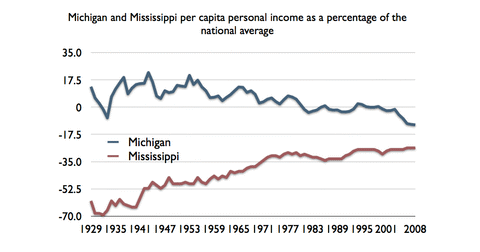
Reporting Michigan and other Lansing-based newsletters reported last week that while scolding the legislature for not raising taxes Gov. Jennifer Granholm took a gratuitous swipe at the state of Mississippi. The comment raised the eyebrows of economists who actually follow and care about statistical reality and truth. Some Mississippi legislators and bloggers also took umbrage at the sneer, and rightfully so.
Hundreds and maybe even thousands of young people in Detroit apparently had to stand in lines and in the rain for up to four hours to receive paychecks for their summer jobs. Others did not know where to find their checks. Still others didn't get their paychecks at all. And on several occasions, police were called in for crowd control.
The Bureau of Economic Analysis released 2nd quarter personal income growth data. The figures include revenue from all wages, dividends, benefits and transfer payments, and shows which states are growing the most.
Michigan grew to a remarkable 7th among the states — positive news considering the state's long economic decline. At .7 percent, it wasn't much growth, but the US average was .2 percent.
A recently released Mackinac Center study about the ineffectiveness of the Michigan Economic Development Corp. is receiving state and national media attention.
The Michigan Senate voted to allow the MEDC to award more special favors and subsidies to hand-picked companies — rather than reforming the state's tax, regulatory and labor climate in a way that would benefit all businesses — despite the fact that Center research shows fewer than one-third of the jobs promised by the MEDC come to fruition. The study also found that every $1 million in manufacturing tax credits given in a particular Michigan county is associated with the loss of 95 manufacturing jobs in that county. The Senate approved the additional money despite the fact the MEDC used up its allotment of tax credits for 2009 several months ago.