



 Font size:
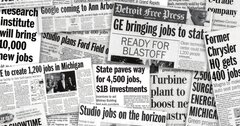
The Michigan Economic Development Corporation should be put out of its — and our — misery. The state’s jobs agency is mired in a misuse-of-funds scandal, has presided over costly development failures, and has little to show for decades of promises about growth.
Several candidates for governor now want it closed. The Legislature should get ahead of them and pull the plug now. The state’s economic-development programs are ineffective and expensive, for which critics have supplied ample evidence. The MEDC either cannot or will not produce independent or credible evidence to the contrary.
The latest scandal involves Fay Beydoun, a former MEDC executive committee member, who was charged with 16 felony counts tied to a $20 million grant. She allegedly used the grant to pay for a $4,500 coffee maker, $6,000 in Tunisian rugs, and her own salary of more than $500,000. The MEDC’s CEO remains a potential target of the investigation.
This is not the MEDC’s first embarrassment. In 2010, the agency approved a business tax credit worth more than $9 million for a convicted felon who was still on parole. Under the terms of his parole, he was not even allowed to possess a credit card. A basic Google search would have revealed his name in the state’s offender tracking database, as well as earlier news coverage of his prison stint. The MEDC’s troubles have continued; over the years, the auditor general of Michigan has repeatedly chastised it for poor oversight.
As embarrassing as these episodes are, the bigger failure is economic. Six rigorous studies examined the Michigan Economic Growth Authority business tax credit program administered by the MEDC. Five found zero or negative effects. A seventh study, published in the academic journal “Growth and Change,” called MEGA a “debacle.” The state’s $500 million film incentive program, which the MEDC ran from 2008 to 2015, created no long-term jobs. The Good Jobs for Michigan program performed poorly as well, and lawmakers let it expire after just two years. These various efforts to jump-start the economy through granting favors have been costly. To take one example, from 1995 to 2011, the Michigan Economic Growth Authority offered $14 billion in business tax credits. The credits were “refundable,” meaning their recipients could cash them in even if they had no taxable income.
More recently, lawmakers stopped putting money into the MEDC-administered Strategic Outreach and Attraction Reserve fund, created in 2021. The program was beset with controversial projects and high-profile failures. One part of the program awarded large subsidies to fewer than 10 corporations and has so far been credited with creating just 1,846 jobs. Even then, the MEDC cannot show that those companies would not have expanded in Michigan without subsidies.
A 2020 Mackinac Center study used a database of more than 2,300 state subsidy deals dating to the early 1980s and compared them with actual employment at subsidized firms across nine state programs or program areas. We found no effect in five and a negative effect in a sixth. Three programs were associated with job gains, but the costs were so high — in one case, $125,000 offered per year for each job — that the benefits could not justify them.
For decades, the MEDC has sold itself as a driver of jobs and growth. The evidence says otherwise. Since the pandemic, Michigan has ranked 45th among the 50 states for job growth. It held the same rank over the past year. Since its birth, the MEDC has presided over an epic tumble in the state’s economic well-being, as measured by per-capita gross domestic product. State GDP is a measure of the value of all goods and services produced within its borders. When the MEDC was born in 1999, we were 18th best among the 50 states; through 2025, we’re 41st.
When Gretchen Whitmer ran for governor, she said she would “unleash the MEDC” to create jobs. She did. The result has been more scandal than success. This year’s candidates to replace her are notably less enamored of the agency. Republicans Aric Nesbitt and Mike Cox say they would shut it down. Independent Mike Duggan has called the state’s job-chasing performance a “national embarrassment” and promises reform. Democrat Jocelyn Benson has also called for reform and greater transparency.
The MEDC should be closed. The surest path to growth is a policy of a fair field and no favors, not political subsidies and special deals. Michigan would be better served by lowering barriers to work, investment, and enterprises through lighter taxes and regulation. Removing obstacles to abundant and reliable energy would help, too. Government should discard efforts to improve the economy by showering cash on a few. It should instead focus on its proper role: providing genuine public goods such as sound infrastructure, public safety, courts, and the protection of property rights.
Get insightful commentary and the most reliable research on Michigan issues sent straight to your inbox.

The Mackinac Center for Public Policy is a nonprofit research and educational institute that advances the principles of free markets and limited government. Through our research and education programs, we challenge government overreach and advocate for a free-market approach to public policy that frees people to realize their potential and dreams.
Please consider contributing to our work to advance a freer and more prosperous state.


