



 Font size:
I am grateful for Michigan Economic Development Corporation CEO Quentin Messer’s response to my op-ed in The Detroit News pointing out how few jobs result from major subsidy deals. State spending deals made during Gov. Gretchen Whitmer’s term promised 20,595 jobs and have delivered just 602 so far. In his defense of subsidies, Messer suggests that we just haven’t waited long enough for these deals to pay off:
In reading a recent op-ed in the Detroit News, I was reminded of the story of a man hired for a job with an advertised salary of $100,000. He opens his first paycheck after the first pay period and stomps into his supervisor’s office. “I was promised a hundred thousand, but this check is only a few grand! Where’s my money? I quit!”
This would be more like landing a $100,000 job and immediately having your supervisor reduce the salary to $24,000. The eight subsidy deals covered by my study promised 20,595 jobs. Four of these deals were cancelled. Only two might possibly meet already lowered expectations. Even if existing deals met expectations in the future, they would only get to 4,900 jobs.
Messer continues:
As one example, look at the LG Energy Solution battery plant in Lansing. A recent report by the W.E. Upjohn Institute for Employment Research found a baseline benefit-cost ratio of 2.53 for its state incentives. This means for every dollar of state support, the project will create $2.53 in economic benefits to state residents, mostly as higher wages.
The Upjohn study models the effects of projects that deliver on their expectations. This rarely happens. The state spent $666.1 million for 408 jobs at this project. It’s tough to say that benefits exceed costs when so much of the cost has occurred but the benefits have not.
The Upjohn study included five deals in Michigan. Authors expected two of the deals to have a negative value, even on the inflated expectations of economic outcomes. If state administrators like the methods of this study, though, they ought to note that the authors recommend lowering amounts offered in deals and targeting subsidies to high-unemployment areas.
Often, a project will exceed initial plans without additional financial support.
The state has a record that can be used to see how often this happens. Of all the announcements of job deals between 2000 and 2020, only four out of 42 examples produced more jobs than stated. Including the added jobs from these deals, officials still only turned 9% of job announcements into actual jobs. It’s not the case that some subsidy deals overperform and make up for the ones that underperform. Job deals are overstated.
Incentives recommended by the MEDC are milestone-metered and performance-based.
Some of the state’s deals require companies to create jobs. Others do not. My review of Whitmer’s record showed that $2.7 billion was offered in job deals. Of this amount, $1.1 billion is for site preparation that is not based on company performance.
If there is no performance, then none of the committed dollars will ever leave the state treasury.
Some of the state’s deals ensure that payments are not made until jobs are created. But that is not how most of the major job deals are structured. For instance, General Motors and LG Energy Solution have received $600 million in direct payments from taxpayers, the entire amount authorized. The companies have created a reported 408 jobs so far. If the companies do not create 3,200 jobs, taxpayers will have to wait until 2030 to ask for their money back.
While some might wish to live in a world without government intervention in the markets, the reality is that Michigan competes every day against other intervening governments.
People should not assume that selective subsidy programs are effective or necessary. Indeed, in one ongoing business subsidy program, lawmakers give out money to companies regardless of whether they would do anything differently without the money.
Spending billions of taxpayer dollars on selective subsidies is a net loss for the state. When tempted to behave badly because others behave badly, remember what moms say about friends jumping off bridges.
Lawmakers tempted to compete with states that offer selective business subsidies should realize that they can make a contract with lawmakers in other states to stop the race to the bottom. Bipartisan legislation has been introduced in Michigan to start this process.
My team is focused on ensuring companies choose Michigan, not philosophical debates on perceived market distortions. Our focus means having the tools that allow companies to make risk-taking investment decisions that deploy capital in our state, spurring employment, entrepreneurship and community revitalization. The result? Look at the CNBC Top States for Business rankings, where Michigan reached #6 in 2025 and earned that spot again in 2026.
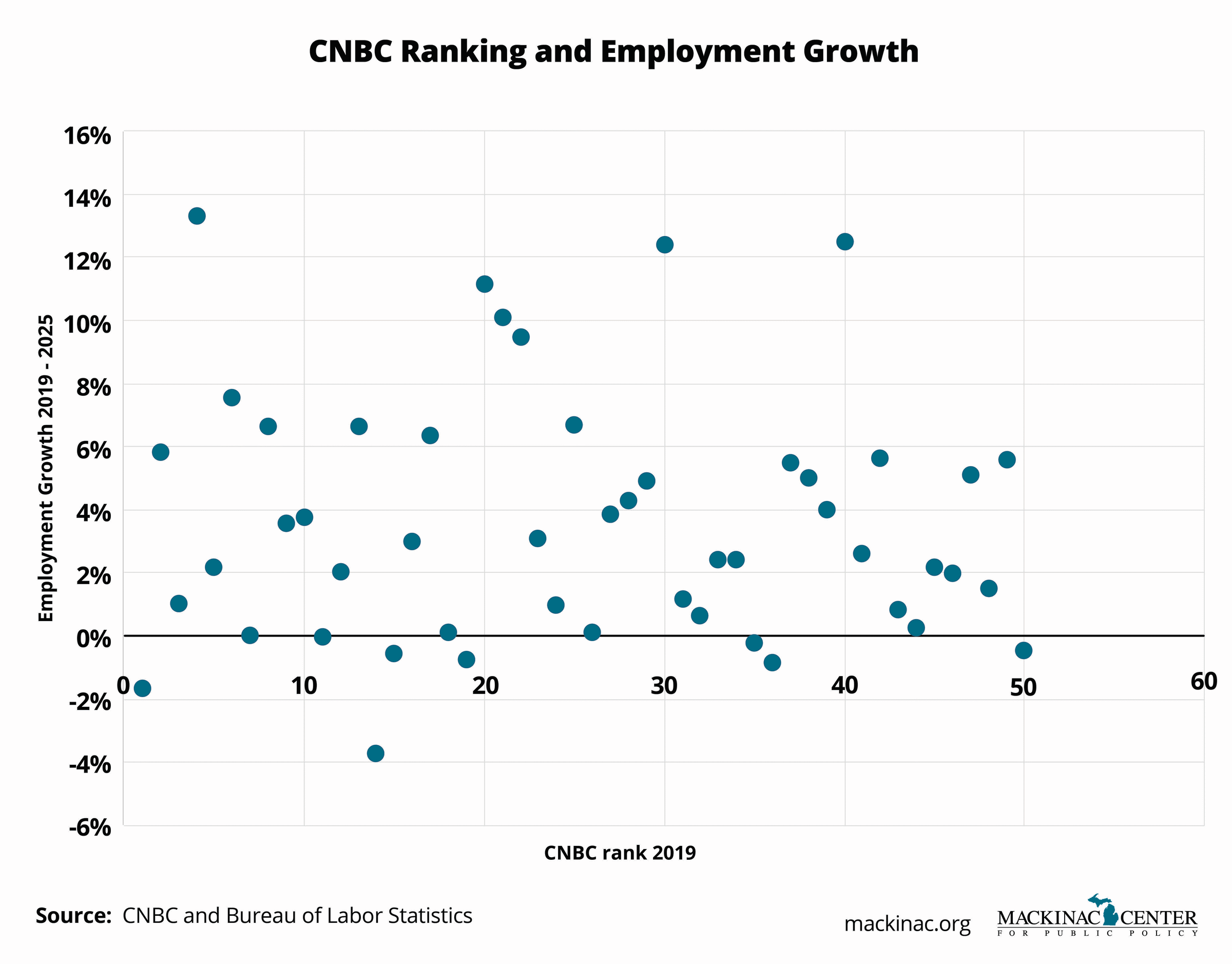
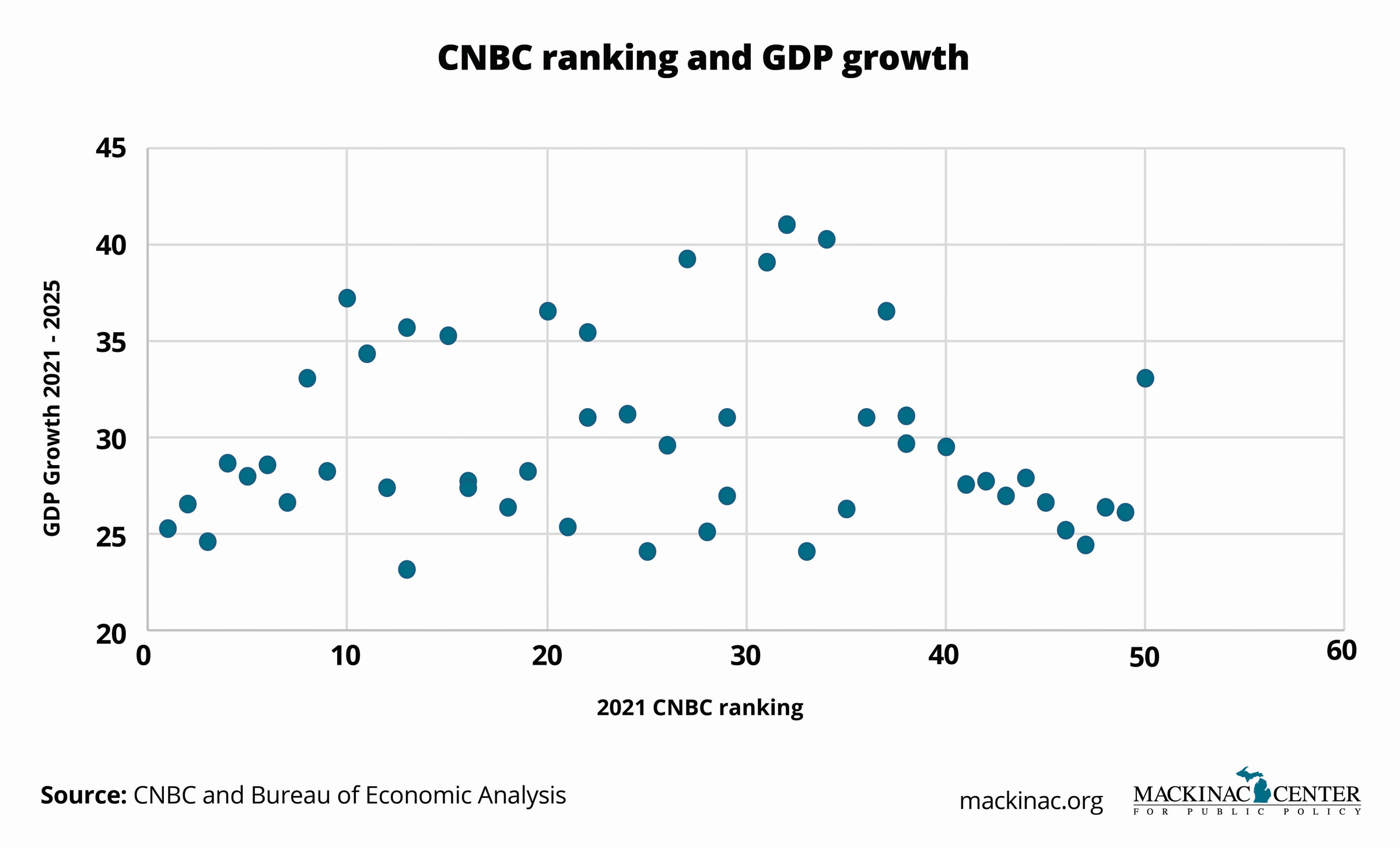
You’d think that a measure of business friendliness would have some connection to economic performance, but it doesn’t.
The chart below plots each state as a dot, with the dot’s location based on the state’s CNBC rank in 2019 and the rate at which state employment grew from 2019 to 2025. If higher ranking in 2019 led to strong employment growth over the next six years, the dots would organize in a line that leads from the top left to the bottom right. No such trend line exists.
It’s the same with gross domestic product, another measure of economic growth. The chart below also uses a different time period, comparing a state’s 2021 rank with its GDP growth from 2021 to 2025, in order to check whether there might be a stronger connection if we use a different year’s rankings and a different period where it might have an effect. There isn’t.
Lawmakers should care about whether state economic development programs develop the economy. Michigan’s rank by a news agency is irrelevant when the rank is unconnected with economic growth.
Also, observing the failure to turn job announcements into actual jobs is an empirical critique, not a philosophical observation.
It is good that lawmakers will spend the money from the state’s largest subsidy programs on other things. It is good that lawmakers authorized no new business subsidies throughout 2025. There is a growing bipartisan skepticism toward offering taxpayer money to select businesses.
The spokesman for the state’s subsidies provides a weak defense of the inability to turn job announcements into actual jobs. The programs he administers make large promises that don’t happen and fail to drive the economic growth necessary to justify their existence.
Get insightful commentary and the most reliable research on Michigan issues sent straight to your inbox.

The Mackinac Center for Public Policy is a nonprofit research and educational institute that advances the principles of free markets and limited government. Through our research and education programs, we challenge government overreach and advocate for a free-market approach to public policy that frees people to realize their potential and dreams.
Please consider contributing to our work to advance a freer and more prosperous state.