

 Font size:
MIDLAND, Mich. — A new report from the Mackinac Center for Public Policy finds that Gov. Gretchen Whitmer’s most prominent business subsidy deals have fallen far short of expectations, producing only a small share of the jobs promised while costing taxpayers billions.
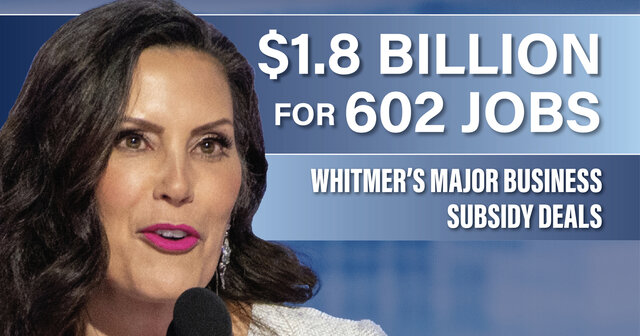
In total, Whitmer has authorized approximately $6.9 billion in subsidies to select businesses since 2019. Of that, $2.7 billion was committed to eight major projects that received widespread media attention and were promoted as “generational” investments capable of transforming Michigan’s economy. To date, the state has actually transferred to companies or local economic development agencies $1.8 billion in taxpayer funds.
The results have been abysmal. According to the report, the eight projects pledged to create 20,595 jobs when, in reality, they have produced just 602 jobs as of today — roughly 3% of the original projections.
“These deals were supposed to reshape Michigan’s economy, but they’ve delivered only a tiny fraction of the promised jobs while costing taxpayers billions,” said James Hohman, director of fiscal policy at the Mackinac Center for Public Policy and author of the report. “Business subsidies are often sold as necessary for growth, yet they consistently fall short, and lawmakers should be skeptical that handing out large incentives to select companies will produce broad economic benefits.”
The report highlights the limited outcomes of the state’s most high-profile subsidy agreements:
Two projects were canceled outright.
Two resulted in little more than vacant sites.
Two supported existing auto plants.
Two battery plants remain under construction but have already reduced their projected job totals.
The findings reflect a broader pattern. Previous Mackinac Center research on Michigan subsidy deals between 2000 and 2020 found that companies delivered just 9% of the jobs they promised. The Whitmer administration’s major deals are performing even worse than that already low benchmark.
The report examines each of the eight major subsidy deals in detail, comparing initial promises to actual outcomes and evaluating the return on taxpayer investment.
The full report is available at www.mackinac.org/S2026-08.
.

The Mackinac Center for Public Policy is a nonprofit research and educational institute that advances the principles of free markets and limited government. Through our research and education programs, we challenge government overreach and advocate for a free-market approach to public policy that frees people to realize their potential and dreams.
Please consider contributing to our work to advance a freer and more prosperous state.


