

 Font size:
David Stevenson grew up in Camden, New Jersey, just across the river from Philadelphia. His parents and grandparents all lived in New Jersey, and for most of his life, he assumed he would too.
He learned the value of work early. His mother and sisters ran a ceramics business out of the family basement, which gave him an early start in work. As a preschooler, Dave earned 10 cents each time he wrapped a carton full of finished pieces. He later mowed lawns, shoveled snow, delivered newspapers and, at age 16, worked at a gas station. “I pretty much always had work,” he says.
That work ethic extended to investing. At 15, Dave bought his first share of stock after being inspired by an exceptional high school economics teacher who emphasized free-market principles. When the stock – Communications Satellite Corporation – doubled in two months, Dave wanted to invest those earnings in Texas Instruments. His father told him no. “That was a costly mistake,” Dave notes wistfully.
At Rutgers University, Dave initially studied engineering before switching to economics. Its blend of analytical thinking and real-world application suited him. Agricultural economics, which combined science and markets, was especially attractive.
After getting his degree, Dave spent 23 years at DuPont, starting in inside sales in the Empire State Building before moving to the company’s corporate headquarters in Delaware. Over time, he worked in polyethylene manufacturing, technical services and business management, helping launch seven new markets. One of those products generated more than $1 billion in profit.
The offer of a corporate buyout caused Dave to move to southern Delaware and start six service businesses aimed at the tourism industry. Today, his adult children run them, and a third generation is already involved.
Public policy eventually pulled him in a new direction. In 2011, Dave began leading energy and environmental work at the Caesar Rodney Institute, where he helped stop costly regional carbon taxes and exposed wasteful renewable subsidies. Two news outlets, including Bloomberg News, declared him to be the man who killed offshore wind. His research on the EPA’s Clean Power Plan played a role in West Virginia v. EPA, a landmark decision.
In it the U.S. Supreme Court ruled that only Congress can grant agencies explicit authority for actions of vast economic and political significance. Dave later served on President Trump’s EPA transition team in 2016.
Now at the Mackinac Center for Public Policy, Dave is focused on energy, particularly the case for nuclear power as a reliable, low-emissions alternative to wind and solar. He doggedly works to solve long-standing challenges such as what to do with spent nuclear fuel.
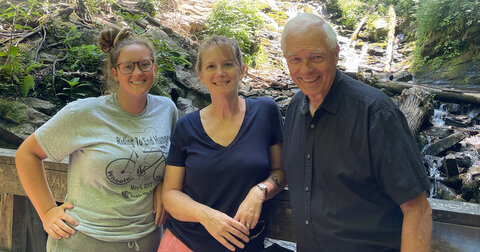
Dave’s life outside of work is as full as his life in it. He and his wife Kimberley, a former journalist, have seven children and 19 grandchildren. He climbed Washington’s Mount Rainier and Peru’s Machu Picchu, biked across the United States and has visited six continents.
“A big reason we both came to Michigan is we like adventure,” Dave says. “My life has been a series of adventures, and I’m excited to continue that at the Mackinac Center.”