WNEM-TV5 in Saginaw reports that questions have been raised regarding an "alleged preferential tax deal" involving the Michigan Economic Growth Authority and GlobalWatt Inc.
A Mackinac Center investigation by Fiscal Policy Director Mike LaFaive and Communications Specialist Kathy Hoekstra produced an essay and this video examining the details of the agreement and paperwork filed by the company to obtain state subsidies.
This is worth plucking from a Capitol Confidential story today:
State employees get a 3 percent pay hike this Friday, because lawmakers in the House and Senate failed to veto it earlier this year. This will be the 11th raise they've received since 2002. In addition, individual employees are constantly getting "step" or seniority pay hikes, longevity boosts, and more.
Tim Greimel, D-Auburn Hills, of the Oakland County Board of Commissioners recently wrote in an Op-Ed for The Oakland Press that he embraces the Mackinac Center's transparency initiative and wants Oakland County to post expenditures online.
House Bill 6458, introduced by Reps. Gabe Leland, D-Detroit, and Mike Huckleberry, D-Greenville, is the latest assault on private property rights to come out of Lansing. The bill exempts property owners in Michigan cities with a population of 900,000 or more (read: Detroit) from protection under Michigan's Right to Farm Act.
At the end of last August the National Labor Relations Board began the process of reconsidering its decision in a case known as Dana Corp., issuing a request for briefs from interested parties on the effects of the Dana ruling on unions, employers and workers. This is a process that Michigan, with its still-powerful union movement, will want to watch closely.
The Oakland Press and Macomb Daily reported recently that school privatization of noninstructional services increased over last year.
Citing the Mackinac Center's 2010 School Privatization Survey, the Press and Daily reported that nearly half of all public school districts in Michigan contract out for food, custodial or transportation services.
Legal problems and a family squabble continue to surround the failed film studio known as Hangar42, according to The Grand Rapids Press.
The Mackinac Center broke the story after a months-long investigation by Communications Specialist Kathy Hoekstra and Mike LaFaive, director of the Morey Fiscal Policy Initiative, which raised questions about the efficacy of the deal. In May we posted this essay and video with our findings. The research and reporting ultimately led to an Attorney General investigation and a criminal charge against the primary buyer of the studio, Joseph Peters.
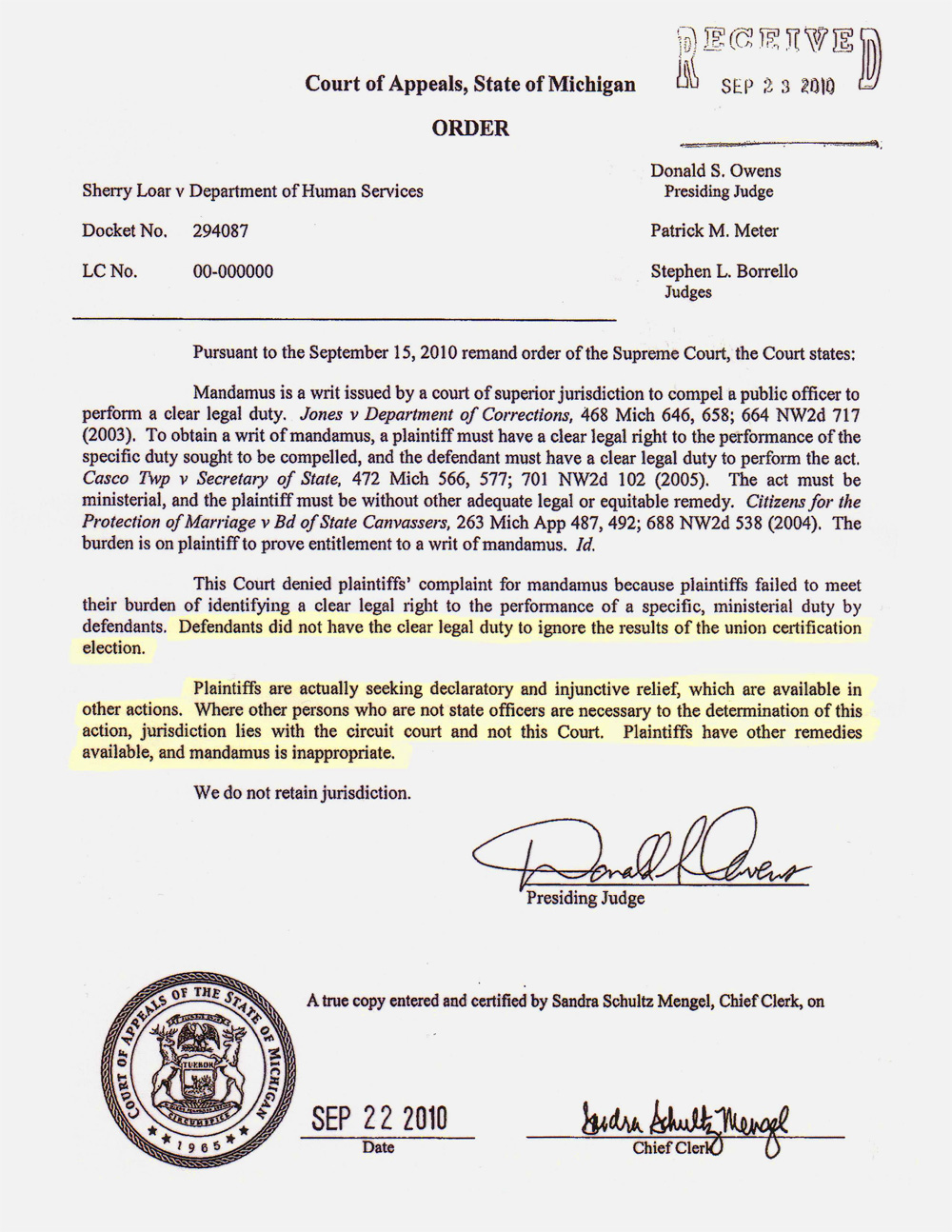
The Michigan Court of Appeals for a second time dismissed a lawsuit filed by the Mackinac Center Legal Foundation on behalf of three small-business owners who object to being forced into a union, according to the Livingston Daily Press & Argus.
"For the second time, the Court of Appeals failed to discuss how private business owners can be made to pay dues to a government employees union," Patrick J. Wright, MCLF director, said according to the Livingston Daily. "In fact, the Court of Appeals entered just four sentences of legal assertions, and those managed to avoid the key legal questions. This is surprising, given that the Michigan Supreme Court unanimously ordered the Court of Appeals to explain its first dismissal of the lawsuit."
Michigan State Parks officials often complain that there is insufficient revenue to adequately operate and maintain the system. The legislative response to the problem? Add more revenue-losing rustic campgrounds to the State Park system. According to an article in MIRS, a deal was cut in a late night joint House-Senate conference committee to keep six rustic campgrounds open that were closed by executive order of Gov. Jennifer Granholm in 2009.
Every week, MichiganVotes.org sends a report to newspapers and TV stations showing how just the state legislators in each publication's service area voted on the most important and interesting bills and amendments of the past seven days. The version shown here instead contains a link to the complete roll call tally in either the House or Senate. To find out who your state senator is and how to contact him or her go here; for state representatives go here.
Last night, Channel 2 News in Detroit busted a group of about half a dozen workers at Chrysler's Jefferson North plant drinking and apparently smoking pot during their lunch break. Reporters Bob Wolchek and Huel Perkins got a little riled up and laid it on a little thick with the judgmentalism, but there’s a problem here, all right.
Merit pay didn't raise the test scores of students in Nashville, Tenn., during a three-year period when it was tried in an experiment that ended in 2009. This is the story beneath a raft of "Merit Pay Doesn't Work" headlines attached to news reports around the country this week describing a new study about the limited experiment.
In late 2008, the auto industry was in dire straits. With two companies filing bankruptcy, and another nearly in the same state of affairs, the nation collectively debated what missteps had brought this once powerful pillar of the national economy to its knees. Some argued that excessive executive pay was to blame, while others pointed out the above-market compensation of the average domestic auto employee, especially when health and retirement benefits were factored in. While the real reason consisted of a mixture of both of these shortcomings, the end result was a $700 million taxpayer-funded bailout. In effect, the citizens of the United States undertook the ownership of both General Motors and Chrysler. Since the bailout, both companies began to climb out of bankruptcy, and Chrysler was sold to Fiat.
Mark Adler, a lobbyist for the Michigan Production Alliance, and Carrie Jones, the director of the Michigan Film Office, defended the state's film subsidy program in a Senate Finance Committee meeting today. To do so they employed a long-recognized economic fallacy, the "Broken Window" theory, which only considers economic activity that is "seen" while ignoring unseen economic costs.
The ruling class in Washington and Lansing has determined that for our own good motorists should be driving electric cars. House Bill 6435 would grant a $20,000 credit against the Michigan Business Tax for gas stations that put in public charging points for electric vehicles. Washington has already lavished tax credits of up to $7,000 for purchasing electric vehicles such as the Nissan Leaf and the soon to be released Chevy Volt.
Michigan lawmakers are considering a package of bills that would reverse an anti-competitive energy policy that Mackinac Center scholars warned about in a study more than two years ago, according to The Detroit News.
The Gongwer Michigan Report newsletter that is primarily read by Lansing insiders (subscription required) recently did a story on the status of welfare programs today compared to past recessions. The gist was that cash welfare is much reduced compared to the past, but Medicaid and food stamps are much increased, which generates challenges for both welfare recipients and state policymakers trying to balance the budget.
The Detroit Free Press reports today that Michigan's film subsidy program is "a big loser for Michigan taxpayers," according to a new Senate Fiscal Agency Report.
Michael LaFaive, director of the Morey Fiscal Policy Initiative, pointed that out nearly 18 months ago.
The Michigan Supreme Court ruled unanimously Wednesday that the Michigan Court of Appeals must explain why it rejected a lawsuit regarding the forced unionization of small-business owners, according to the Detroit Free Press.
The Mackinac Center Legal Foundation filed the lawsuit a year ago, on Sept. 16, 2009.
Every week, MichiganVotes.org sends a report to newspapers and TV stations showing how just the state legislators in each publication's service area voted on the most important and interesting bills and amendments of the past seven days. The version shown here instead contains a link to the complete roll call tally in either the House or Senate. To find out who your state senator is and how to contact him or her go here; for state representatives go here.
Mackinac Center President Joseph G. Lehman addressed the disparity in benefits between the private and public sectors in Michigan as a main reason for the state's economic turmoil at the West Michigan Policy Forum Thursday, according to the West Michigan Business Review.
A federal district judge in Grand Rapids has ruled that a class action lawsuit brought by the National Right to Work Legal Defense Foundation aimed at ending the forced unionization of small-business owners can proceed, according to The Grand Rapids Press.
WKZO AM590 in Kalamazoo and WSJM AM1400 in Lansing both report that privatization of support services in Michigan public schools is up 8 percent over last year.
The reports cite the Mackinac Center's 2010 School Privatization Survey, which Fiscal Policy Analyst James Hohman said shows nearly half of all districts in Michigan outsource food, custodial or transportation services.
This past Saturday, Sept. 11, there were somber ceremonies, moments of silence and prayers in remembrance of the nearly 3,000 people killed in the terrorist attacks on that date in 2001. American Flags fluttered in abundance — many at half staff — outside homes and businesses throughout the nation.