


 Font size:
The year 2025 produced little agreement between Michigan’s Republican-controlled House and the Democratic-controlled Senate. That’s not bad news for Michigan taxapyers. Lawmakers went an entire year without approving more spending on select business subsidy programs. That is the first time lawmakers have avoided giving corporate welfare to local favorites since at least 2000, when the Mackinac Center began its Business Subsidy Scorecard.
Lawmakers have approved $23.2 billion in business subsidies since 2000, an average of $930 million per year. This includes money for developers, filmmakers, battery manufacturers, “green energy” projects and other handpicked businesses.
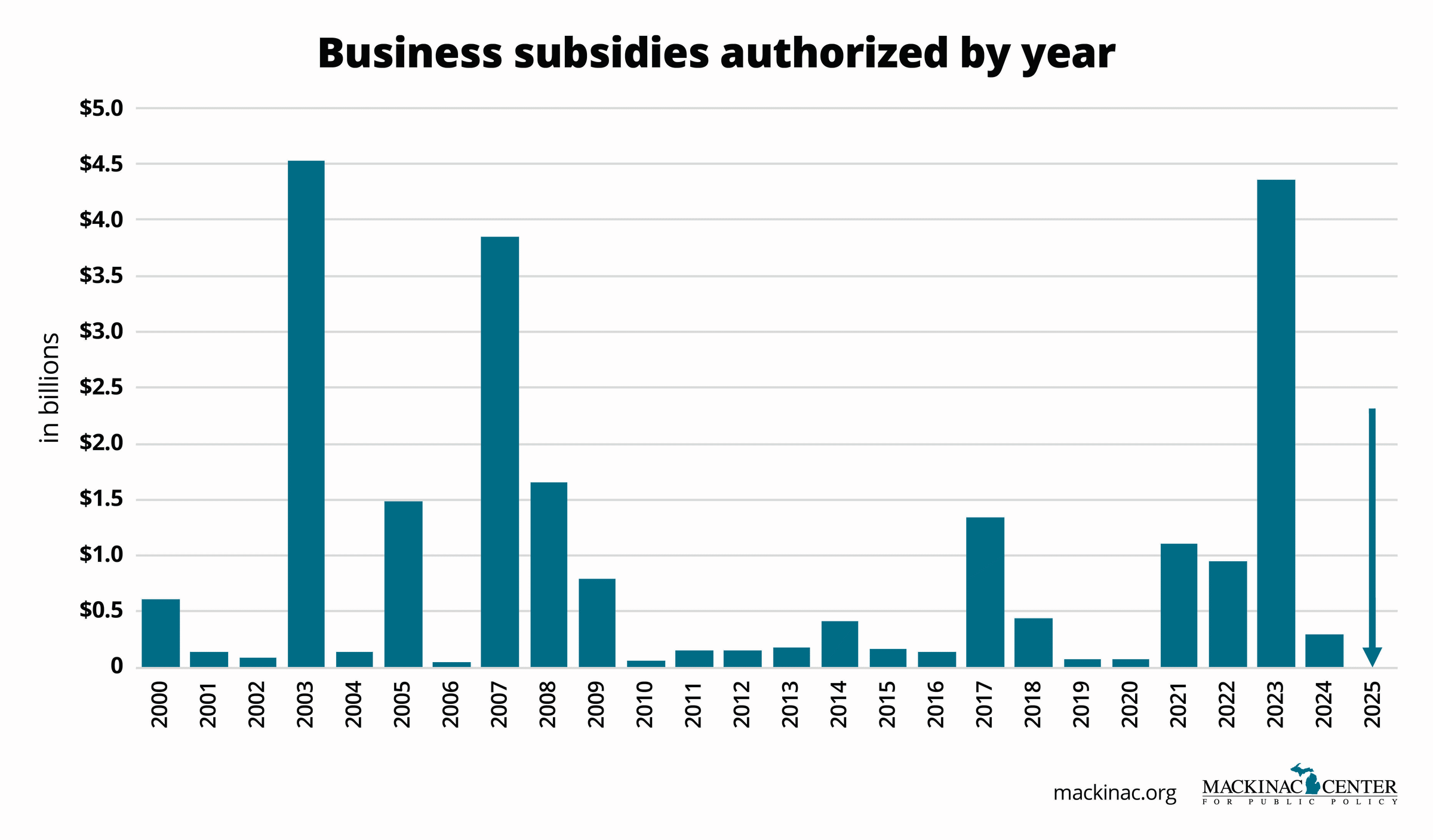
Zero subsidies passed this year is a welcome number, and an overdue change from the last two years, when the legislature approved a combined $4.7 billion in business subsidies.
The subsidies are ineffective at creating jobs, worthless for taxpayers, unfair to other businesses, and expensive to maintain. Lawmakers in some years have spent more money on select business subsidies than on the Michigan State Police.
They haven’t gotten much for all this money. The subsidies are ostensibly needed to create jobs. But Michigan is the only state to lose jobs from 2000 to 2024, despite being a national leader in corporate welfare.
The state’s business subsidies fail to bring the broader economic benefits lawmakers intend. They don’t even deliver the company-specific jobs supporters claim subsidies will create. Politicians and government officials said that the major deals done between 2000 to 2020 would create a total of 123,000 jobs. They created just 11,000 jobs, a 9% success rate.
It’s an atrocious record and a clear failure. However, lawmakers feel compelled to authorize more business subsidies for political reasons. Subsidies show that elected officials are doing something about jobs, regardless of whether the strategy works. Politicians want to say “yes” when important businessmen ask for favors. They feel they have to match offers being made to select businesses by politicians in other states.
When tempted to fight fire with fire, remember that the fire department uses water. Instead of enabling politically connected businesses to shop around for the most freebies at the expense of state taxpayers, legislators should collaborate with other states to end corporate welfare.
Why did lawmakers authorize at least some business subsidies every year for 24 years straight? Politics drives policy. Many of the subsidies are administered through indirect methods, like refundable tax credits that give recipients more in credits than they owe in taxes. Because these favors show up on the taxing side rather than the spending side, they do not have to be approved in annual budgets. Even so, there is typically some business subsidy money approved in the state budget.
But not this year. There will be some money directed to existing programs, but that money was authorized in 2023 when legislators reauthorized the 21st Century Jobs Fund to spend $75 million each year. That spending is already included and accounted for in the Business Subsidy Scorecard.
Legislators also ended their most egregious program this year. Lawmakers opted to stop putting $500 million a year into the Strategic Outreach and Attraction Reserve. The program made nine deals that offered companies $1.45 billion to create 15,000 jobs. Companies have collected $720 million so far and have not created any jobs, according to the latest state report. Good riddance.
Some legislators have expressed interest in authorizing more business subsidies. There was a vote in the Senate to spend $1.9 billion more on subsidies to developers. But none passed in 2025.
Legislators on both the right and the left are skeptical of business subsidies. They were successful at stopping new spending this year and ending some of the state’s worse programs. They deserve credit. There ought to be more years like this one. Corporate welfare is just plain bad policy, and it’s great to see lawmakers go a year without wasting taxpayers’ money on bad policy.
Get insightful commentary and the most reliable research on Michigan issues sent straight to your inbox.

The Mackinac Center for Public Policy is a nonprofit research and educational institute that advances the principles of free markets and limited government. Through our research and education programs, we challenge government overreach and advocate for a free-market approach to public policy that frees people to realize their potential and dreams.
Please consider contributing to our work to advance a freer and more prosperous state.