

 Font size:
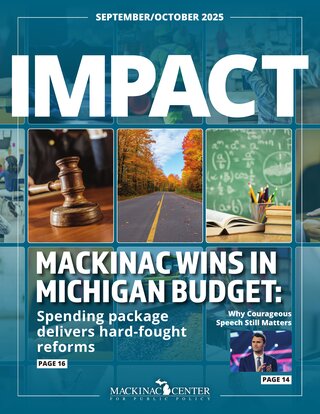
Michigan’s budget for fiscal year 2025-2026 was passed by a divided Legislature and signed by a Democratic governor, but it contains important elements that will help all Michigan residents. Reforms in road funding, school spending and corporate welfare reflect ideas the Mackinac Center has supported for many years.
There are thousands of influential people whose livelihoods rely on state spending, and they lobby elected officials for more. We don’t. We call for restraint. The Mackinac Center supports budgets that do not reach deeper into taxpayers’ pockets (or as tax hikers say, “look for revenue options”).
But even with all of those people who stand to gain from spending hikes, elected officials do hear our voice. The latest budget agreement has a lot of what we’ve called for.
The budget spends more on the roads — likely getting the state on pace to repair roads faster than they deteriorate — and it does so mostly without raising taxes. Lawmakers were very close to this point in 2019, but Gov. Gretchen Whitmer’s insistence on a tax hike led to a stalemate on road funding.
That changed this year. The Republican-majority House was able to get agreement with the Democratic-majority Senate and the governor to substitute the sales tax levied on fuel purchases with an equivalent per-gallon tax on fuel. The sales tax largely goes to schools, while per-gallon taxes go to roads. Michigan is one of the few states to have levied both, and substituting one for the other is a way to spend more on roads without raising taxes.
The road debate is old, and one of the Mackinac Center’s long-standing arguments is that the poor condition of the roads is no excuse to force people to pay the government more. The state economy is growing, and this generates more revenue for lawmakers to keep roads in good working order.
School interest groups attacked this reform idea because they’d be left with less. However, the 2026 budget substantially increases funding for schools. Elected officials authorized $510 million more in education funding than they did in last year’s budget.
One reason lawmakers had more money for schools is that they stopped funding the state’s largest business subsidy program. Officials have used the program to give just nine companies $1.45 billion in taxpayer >money to create 14,779 jobs. To date, the companies have received $720 million but have yet to create a single job, according to the latest state report. These companies are unlikely to meet expectations: Subsidy deals from 2000 to 2020 delivered just 9% of the number of jobs promised.
Let’s hope that lawmakers have learned that they’re not going to improve the state economy by taking money from taxpayers and giving it to select companies. The basics of the business climate are what matter to job growth, not whether the state writes the biggest checks to the biggest companies. Lawmakers moved in that direction with their latest budget.
These are wins for taxpayers, and they show the Mackinac Center’s influence. It comes not from the conventional modes of power, from having an army of supporters engaged in politics, but through years of research, arguments and advocacy. We have shown that lawmakers can fix roads without raising taxes, that business subsidy money can be better spent elsewhere. And the political environment allowed for these ideas to be enacted. Lawmakers had to come together across the political divide to get a budget approved, and neither side got everything it wanted. I could gripe about a lot of what got passed.
But the new budget shows the progress the Mackinac Center has made by patiently moving the window of political possibilities in the direction of freedom.