


 Font size:
What motivated a group of British colonists to pledge their lives, fortunes, and sacred honor to a rebellion against the most powerful empire in the world 250 years ago? The answer is complicated, but an undeniable driving factor was their ideas. The colonists believed deeply in selfrule, individual liberty and the dangers of concentrated government power. These ideas propelled them to risk it all and create this nation.
History bears witness to the power of ideas. Behind every important historical development are beliefs in certain principles. As historian Arthur Schlesinger Jr. said, “Ideas are the great forces of history.” But the American Revolution deserves special attention because it is a prime example of how ideas shape history.
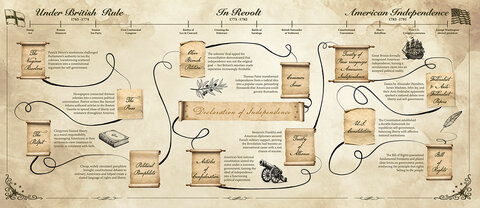
Pre-revolutionary colonial America was fertile ground for ideas. Society was highly literate, so much so that printers like Benjamin Franklin could become famous. The colonists distributed and digested pamphlets, journals, sermons, newspapers and more. Discussions and debates about politics, government and society were common and widespread.
As a result, when the British asserted their imperial authority after the Seven Years’ War, many colonists could articulate precisely how their rights as British citizens were being violated. Many believed that without checks and balances, government power would consolidate in a strong executive. The actions of the British crown were warning signs to this end for the colonists. This is why relatively small taxes and other minor regulations incited the colonists to rebel.
John Adams knew how important these ideas were to the Revolution. “The Revolution was affected before the war commenced. The Revolution was in the minds and hearts of the people,” Adams wrote to the famous publisher Hezekiah Niles in 1818. “This radical change in the principles, opinions, sentiments, and affections of the people was the real American Revolution.”
The 250th anniversary of America’s founding is a perfect time to remember the importance of ideas, especially for think tanks. Ideas are the lifeblood of the Mackinac Center and similar organizations. We defend and uplift the most important ideas, such as those about free markets, limited government, the rule of law, and individual freedom.
The Mackinac Center’s late Executive Vice President Joe Overton recognized another crucial way think tanks use ideas. He showed that think tanks are important because they can expand the range of ideas that become part of the political discourse. Unlike politicians who can only support beliefs that are politically popular in the moment, think tanks can introduce new concepts into the public consciousness. That range of ideas is known today as the Overton Window.
Shifting the Overton Window is often how important policy changes happen. We can see this phenomenon in education policy. Fifty years ago, no state allowed parents to use public support to send their child to a private school >of their choice. Today, more than half the states do. This came about because think tanks, including the Mackinac Center, introduced these policy ideas to the public. Once voters began favoring these ideas, politicians started paying attention and supporting them.
This is why think tanks, universities and other research organizations are so important for policy reform and, in turn, for improving society. Without them, new policy ideas would rarely see the light of day. They would have to come from politicians, and few are the politicians who would willingly risk their next election on supporting an dea that is not already politically popular.
Much has changed in America in its 250 years — some for the better and some for the worse. But one thing that remains and that all Americans should remember is that this is a nation founded on ideas. These ideas of selfgovernment, the rule of law and individual freedom are what make this country worth celebrating every year.