“All sensible people in England are persuaded that the colonies are lost to the homeland,” Pierre-Augustin Caron de Beaumarchais informed Louis XVI in September 1775, nearly a year before the signing of the Declaration of Independence.
The king of France may have ended up regretting that he listened to the republican-minded playwright, but Beaumarchais was correct. Why were most of the Whig Party and much of the British population ready to let the colonies go just a few months after the Shot Heard ‘Round the World?
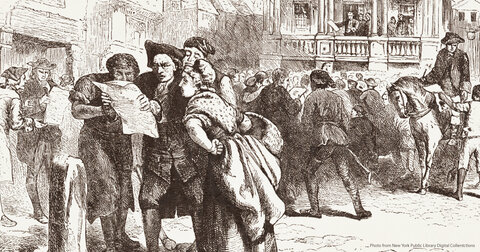
We are familiar with the way newspapers and pamphlets stirred up revolutionary fervor on this side of the Pond, but the real battle for hearts and minds was fought and lost back in England. And one important reason was that British subjects had new access to what we now call public information.
Until 1771, sessions of Parliament were not published. Journalists occasionally wrote up disguised records of the “Magna Lilliputia” Parliament with legislators’ names “filleted” or turned into aliases, but for the most part the public was left in the dark about what lawmakers were debating. In 1775, after the collapse of a high-profile attempt to prosecute a London printer, Englishmen first got access to a regularly published “Parliamentary Register.” The legislative debate over the American War would be a hot topic for the next eight years, and for the first time, people were able to follow it closely.
As a result, the pro-independence views of the Whig Party got much wider distribution throughout the war, and the case for letting the colonies go became stronger. Even in those blessedly polling-free days, there was a clear and steady decline in public support for spending additional blood and treasure to hold onto an unwilling population. The American Revolution succeeded in part because the details and issues of the conflict were open for discussion in the British media.
Reporting news can be a discouraging job; governments will always try to hide the truth from their own citizens, and often the biggest bombshells receive only a yawn from the masses. But years of chiseling away at official secrecy does have an effect.
Michigan Capitol Confidential has a far more modest purview than that of Edmund Burke or Thomas Paine, but we stand in a tradition of people who do the work to make information free. With your support, we look forward to our mission of bringing accurate facts to a candid world.