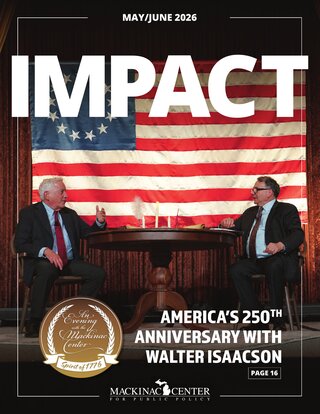
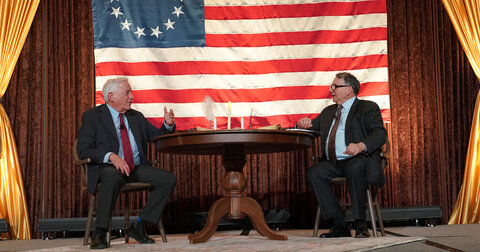
More than 250 years after America’s founders declared that government exists to secure individual rights, nearly 500 lawmakers, business leaders, policy advocates and community members gathered in Grand Rapids to reflect on the enduring debate over liberty, self-governance, and the proper role of government at the Mackinac Center’s annual Evening with the Mackinac Center.
This year’s event, held June 5 at the Amway Grand Plaza, commemorated America’s 250th anniversary through historical exhibits, reenactor performances, and a conversation between Mackinac Center President Joseph G. Lehman and acclaimed biographer Walter Isaacson.
The audience included more than 30 current and former elected officials, among them former governors John Engler and Rick Snyder, U.S. Representatives Tom Barrett and John James, former Attorney General Mike Cox, and state Senator Aric Nesbitt.
Guests were greeted throughout the cocktail reception by reenactors representing John and Abigail Adams, Benjamin Franklin, and Thomas Jefferson before being led into the ballroom by military field music played by the Tittabawassee Valley Fife and Drum Corps.
Lehman addressed the audience before inviting Walter Isaacson to the stage.
“Two hundred and fifty years ago, a small group of men did something that changed the world. They didn’t just declare independence from a king. They declared independence from the idea that government gets to decide how much freedom people deserve,” Lehman said.
“That argument didn’t end in 1776. We’re still having it.”
Lehman reflected on the enduring relevance of America’s founding principles and the responsibility of each generation to preserve them. He noted that the debates surrounding individual liberty, limited government, and self-governance remain as important today as they were when the Declaration of Independence was first signed.
In Joe Lehman’s discussion with Walter Isaacson, they marinated on Isaacson’s latest book, “The Greatest Sentence Ever Written”. In it, he explores the confrontation of ideas that produced the foundational statement of the Declaration of Independence, as recited by our Thomas Jefferson reenactor to open our program:
“We hold these truths to be self-evident, that all men are created equal, that they are endowed by their Creator with certain unalienable rights, that among these are Life, Liberty and the pursuit of Happiness.”
This sentence represented a revolutionary idea at the time: that individual rights do not come from governments but exist inherently in every person. Isaacson highlighted the influence of Enlightenment thinkers while emphasizing the uniquely American conviction that legitimate government derives its authority from the consent of the governed.
A large part of Isaacson’s craft as a biographer is providing a deep sense of knowing the subject he is writing about. It’s with this unique sense of knowing that Isaacson talked with Lehman about figures he came to know well through his research on Thomas Jefferson and Ben Franklin.
Throughout the conversation, Lehman and Isaacson explored how the founders struggled to reconcile universal ideals with the imperfections of their own time. Yet the enduring power of the Declaration lies not in the founders themselves, but in the principles they articulated.
Two hundred and fifty years later, Americans are still debating, defending, and redefining what it means to secure the rights to life, liberty, and the pursuit of happiness — evidence that the revolutionary ideas of 1776 remain very much alive.