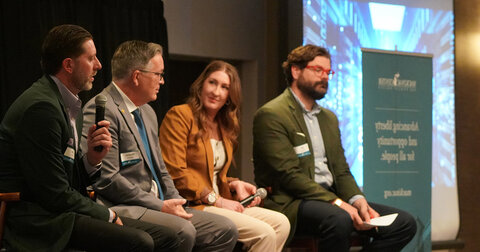
Few topics hold more public interest these days than data centers, and a recent Mackinac Center event brought clarity to thousands.
Data centers have existed since the dawn of computing, but our world uses more data than ever, and the equipment required to store it can no longer fit in a single room in an office building. Companies are building large data centers to store information millions of people use for cellphones, videos, photos, healthcare, social media, banking, artificial intelligence and other purposes.
An April 22 Mackinac Center panel discussion in Ann Arbor drew a full-house crowd of 90 people, with thousands more watching a livestream presentation. The audience was concerned about water, energy use and infrastructure but also about the potential for technological advances, future industries and new revenue sources. The panel tackled it all.
Tyler Marie Theile of Anderson Economic Group reminded the audience that nearly everyone already relies on data centers. “Do y’all have a phone in your pocket today? You’re using data centers,” she said. “If you have a home computer, you’re using data centers. If you have health insurance, you’re using a data center.” Cloud computing, artificial intelligence, telecommunications, banking, healthcare and countless everyday services all depend on the infrastructure these facilities provide.
But the forum also explored trade-offs. Data centers can bring investment, jobs and tax revenue, but they also require large amounts of electricity and, in some cases, water. Stephen Mackey of Oakland University framed the concern from the perspective of utility customers: “The question is how do we ensure that in the future, as these new sources of demand come online, we can do it intelligently so that consumers don’t have to bear that burden.”
Dustin Walsh of Crain’s Detroit Business has covered community pushback and zoning disputes, and he shared insights on why many of these debates play out in smaller communities. “(Data center companies) picked these smaller townships because of their availability,” he said, noting that some local zoning rules were written long before modern data centers were contemplated. In some cases, he added, “township boards actually have no choice but to approve these.”
Will Rinehart of the American Enterprise Institute noted that Michigan has strong laws protecting the environment. Data centers are getting better about using less water and energy, with most using less water than a typical golf course. The answer is not simply to block new development. There are many ways to do environmental protection wisely, he said.
That was the central theme of the discussion: Michigan should not ignore the costs of data centers, but it should not overlook the opportunities either. State rules should protect residents, ensure that energy service is reliable and affordable, and allow Michigan to compete for the next generation of digital investment.