


 Font size:
This article originally appeared in The Detroit News February 17, 2026.
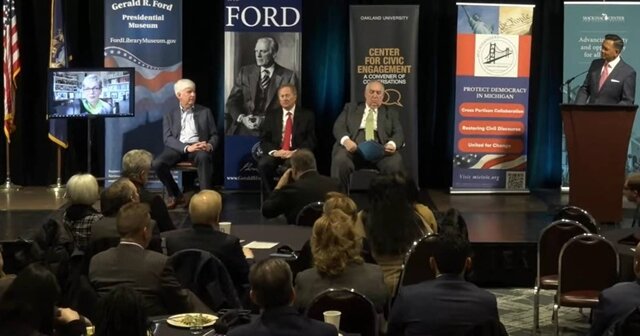
Four Michigan governors, Jim Blanchard, Jennifer Granholm, Rick Snyder and John Engler, gathered on Feb. 4 to talk about civility in American life. Their conversation explored what civility looks like and its importance in self-government.
The question about civility in political or policy contexts is never, “Do we need it?” (Yes.) The question is never, “Do people want to be treated with respect?” (Yes.) Rather, the question is always, “How? How do we demonstrate civility?”
Lawmakers vote on bills, and judges rule on cases. But for most of us, when it comes to influencing others, we rely on good information, aided by persuasion. Working in the public policy world, I’ve thought a lot about civility and communication. There are instructive books on the topic, including, “Talking to Strangers” by Malcolm Gladwell, “Radical Candor” by Kim Scott and “The Righteous Mind” by Jonathan Haidt.
What these books show is that civility isn’t a slogan or a feeling. It is a set of behaviors that anyone can model.
Here are the seven habits of highly civil people.
One: Presume that other people act with good intentions. We all expect to be treated in this way. Civility does not speculate about the motives of other people.
Two: Ask questions. Incivility jumps to conclusions about what the other person wants, what they’re saying or what they mean. Clarifying questions help reveal the truth. If you hear an opinion you disagree with, try asking, “How did you get there?”
Three: Interact with a wide circle of people who have different opinions, backgrounds and experience. One way to do this is to visit new countries. But you don’t have to travel to experience new perspectives. Join a local effort. Local associations such as the Rotary Club are excellent venues for community engagement.
Four: Work hard to understand the other side’s argument in a dispute. Lawyers are trained to do this, as are people in debate clubs. You should be able to state the other side’s position in a way they would agree with. What’s the best criticism of your position? Be ready with a thoughtful response.
Five: Expect disagreement. Civil people are not surprised or discombobulated when disagreements happen. Of course disagreements happen. A person can react with irritation or with calm acceptance, and showing respect builds trust between people.
Six: Respect the process. One of the functions of government is to create processes for making decisions. Elections work this way. The process assumes a wide array of opinions, weighs the tradeoffs and gets to a final decision. Consensus on any issue — let alone unanimity — is difficult to achieve. So, we have a process for deciding major questions through representative government.
Seven: Civil people focus on persuasion, not force. They don’t bully, belittle or silence their opponents. As former President Joe Biden said after the 2024 assassination attempt on President Donald Trump, who was a candidate at the time, we settle our disagreements with ballots, not bullets.
Who is the most courteous, civil person you know? I suspect you can see these seven behaviors in that person’s actions and words.
Ultimately, civility is inseparable from free speech. People have a right to their own thoughts and conclusions, and civil people understand this. At the event with the four governors, my colleague Joe Lehman, president of the Mackinac Center, provided concluding remarks. He pointed out that free speech, coupled with civility, is essential.
“Free speech is to social progress as the scientific method is to scientific progress,” Lehman said. “You don’t get one without the other.”
~~~~~
A streaming of the event with four governors:
Get insightful commentary and the most reliable research on Michigan issues sent straight to your inbox.

The Mackinac Center for Public Policy is a nonprofit research and educational institute that advances the principles of free markets and limited government. Through our research and education programs, we challenge government overreach and advocate for a free-market approach to public policy that frees people to realize their potential and dreams.
Please consider contributing to our work to advance a freer and more prosperous state.