

 Font size:
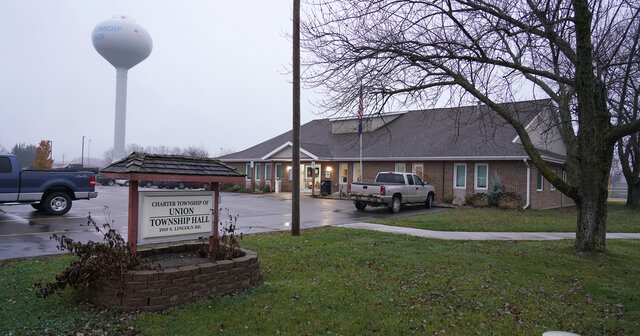
Officials in Union Township held their usual meetings in July and August and discussed economic development, but a new analysis of economic data shows that the township in Isabella County needs to recognize it’s not an attractive place to live or do business.
Summer discussions covered housing, new business starts, street banners, and a program that subsidizes recent Central Michigan University graduates in the hope they won’t leave. These items are small, especially for a township that lags in growth by several measures. Trustees, planning commissioners and members of the economic development authority need to do more to promote growth. They should revisit the township’s tax and fee burdens, regulations and its day-to-day management.
Municipalities vary significantly in population, proximity to major highways, property values and many other factors. To measure Union Township’s economic performance with comparable municipalities, I examined how property values and population changed in 14 local governments, then ranked the local governments by their growth. Union Township repeatedly scored at or near the bottom in nearly every ranking.
I found data for each municipality’s State Equalized Value, or SEV, from 2010 through 2025, published by the state of Michigan. The SEV represents 50% of a piece of property’s true cash value — the market or usual selling price. I also downloaded population figures. A growing population can signal community well-being as people vote with their feet.
Each of the 14 townships had similar or nearly similar characteristics. Some were near Union Township, and others were far away. The data allowed me to measure:
Population growth
SEV growth
SEV per capita
SEV per square mile.
I calculated those measures for two periods: 2010 to 2025 and 2020 to 2025.
The chart below shows the 2010-2025 results. Union Township ranked 13th out of 14 townships in three of the four categories. Only Madison Township, in Lenawee County, did worse. Union Township’s composite score, an average of its ranking in each category, was second-to-last.
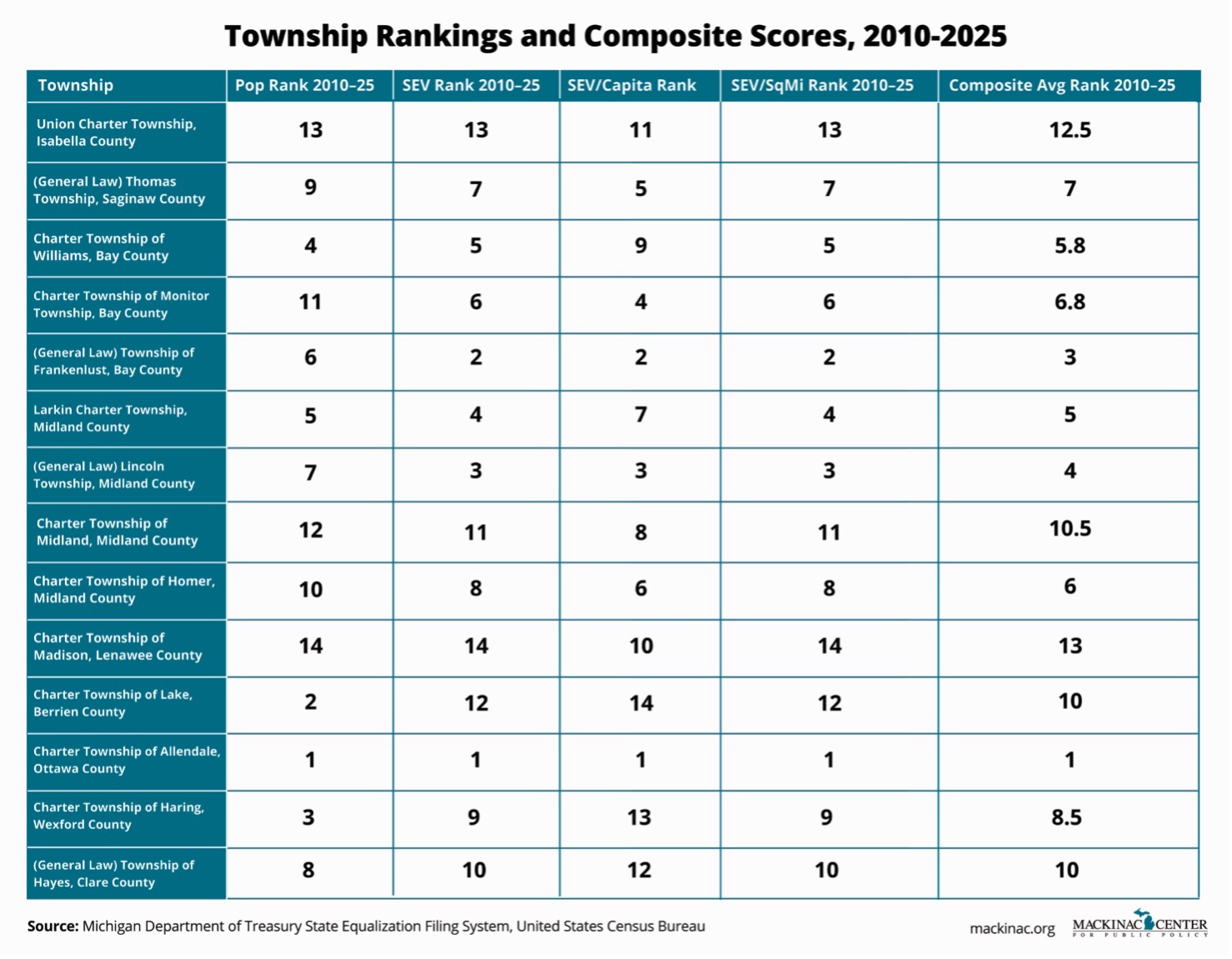
Union Township’s results for 2020-2025 were only slightly better, with a composite rank of 12 out of 14.
When each time period’s composite scores were averaged out, Union Township finished 14th among 14 townships.
The median township saw its SEV per capita grow by more than 50% from 2020 to 2025. Union Township’s growth was 29%, or next-to-last. A sharp population decline did not cause this drop, as the population remained stable.
The strongest performer among the 14 was Allendale, home to Grand Valley State University. But having a nearby university does not guarantee growth — Union Township surrounds Mt. Pleasant, home to Central Michigan University — and some townships did well without a university. Hayes Township, in Clare County, saw SEV per capita growth of nearly 78%. The same highway that runs through Union Township, U.S. 127, runs through it. Homer Township, next to the city of Midland and connected to Union Township by M-20, saw its SEV per capita grow by 60%. These same townships perform better than Union Township in SEV per square mile, too.
Union Township’s problem is not that it is a low-value township. It’s the lack of momentum. From 2020 to 2025, comparable communities that did not have as much property wealth expanded their property tax bases much faster. Over time, these differences will make it harder for Union Township to compete with peer or near-peer communities.
Township comparisons are inherently imperfect because each community is different. No analysis can control for every variable that influences growth. That is why I built a cross-section of plausible comparator townships and then compared them on a per-population and per-square-mile basis. This approach ensures that the analysis does not unfairly compare densely populated or geographically expansive areas with those with far fewer people and land.
The comparison group includes both charter and general law townships. Charter townships have broader authority under state law. Some of the 13 comparators own their water and sewer systems, as does Union Township. Some, however, contract with other units of government for those services. Some are near state trunklines, U.S. highways or interstates. Some, including Haring and Madison, match Union Township by being part of a micropolitan areas, while others lie in larger metropolitan statistical area, such as Midland. Some, such as Allendale, have a college or university.
Union Township’s poor showing across multiple categories should surprise no one. Previous analyses using other metrics have also found Union Township to be a growth laggard. Last year, I used population growth, taxable value growth, commercial and new-building permits, and emergency service calls to examine the township’s trajectory. Each measure pointed in the same direction: weak growth.
A University of Michigan-Dearborn eCities analysis reached a similar conclusion. It reviewed 277 communities across 54 counties and found that Union Township performed below the benchmark average in eight of 11 categories.
How much more evidence do Union Township officials need before they change course? They have an economic development officer and an Economic Development Authority, so it’s hard to believe they prefer stagnation. Yet that’s what they’re getting, according to the data.
The Board of Trustees should take the lead. Trustees should hire an outside consultant, without direction from current full-time township staff, to conduct a fresh benchmark analysis of economic growth. The consultant should select the comparison group independently, perhaps even reviewing all Michigan townships. The work should also benchmark the costs of government (permitting and other fees) each township imposes on its people and businesses. The results could give township leaders a clearer path toward policies that foster growth.
Trustees also should improve oversight of key staff and the costs their decisions impose on entrepreneurs, investors and residents. I have previously cataloged examples of such costs, and in the past two months alone, learned of others.
No single statistic can capture the economic health of a community, and no benchmarking exercise can control for every factor that influences growth. But the consistent findings of history are difficult to ignore.
Union Township trails its peers and state averages. It doesn’t matter whether the comparison involves population growth, property market values, taxable values, permit activity, emergency service demand or the comparative rankings presented here. Union Township lags.
The point of this analysis is straightforward: Union Township’s policy, governance and management approach does not appear to produce robust growth. If township leaders want to compete more effectively for residents, investment and economic opportunity, maintaining the status quo is unlikely to be enough.
Township leaders and others may consult related publications from the Mackinac Center for Public Policy:
Union Township Receives Recognition, but Its Performance Underwhelms
Union Township Metrics Point to Stagnation, Decline
An Open Letter to Union Township Planning Commission
Open Letter to Union Township Board of Trustees
There’s Something Wrong with Union Township Part 3
There’s Something Wrong with Union Township Part 2
There’s Something Wrong with Union Township Part 1
Get insightful commentary and the most reliable research on Michigan issues sent straight to your inbox.

The Mackinac Center for Public Policy is a nonprofit research and educational institute that advances the principles of free markets and limited government. Through our research and education programs, we challenge government overreach and advocate for a free-market approach to public policy that frees people to realize their potential and dreams.
Please consider contributing to our work to advance a freer and more prosperous state.