


 Font size:
Michigan’s policymakers cannot do much to change the world price for petroleum, but they can take two steps to help lower gasoline prices. They could reduce the state gasoline tax, which is almost 40% higher than Ohio’s comparable tax. Doing this could save up to $650 million per year. A second step would be to work with federal officials to enact a federal law that could save Detroit-area residents $95 million per year by helping them avoid a mandate that requires a high-priced summer blend of gasoline.
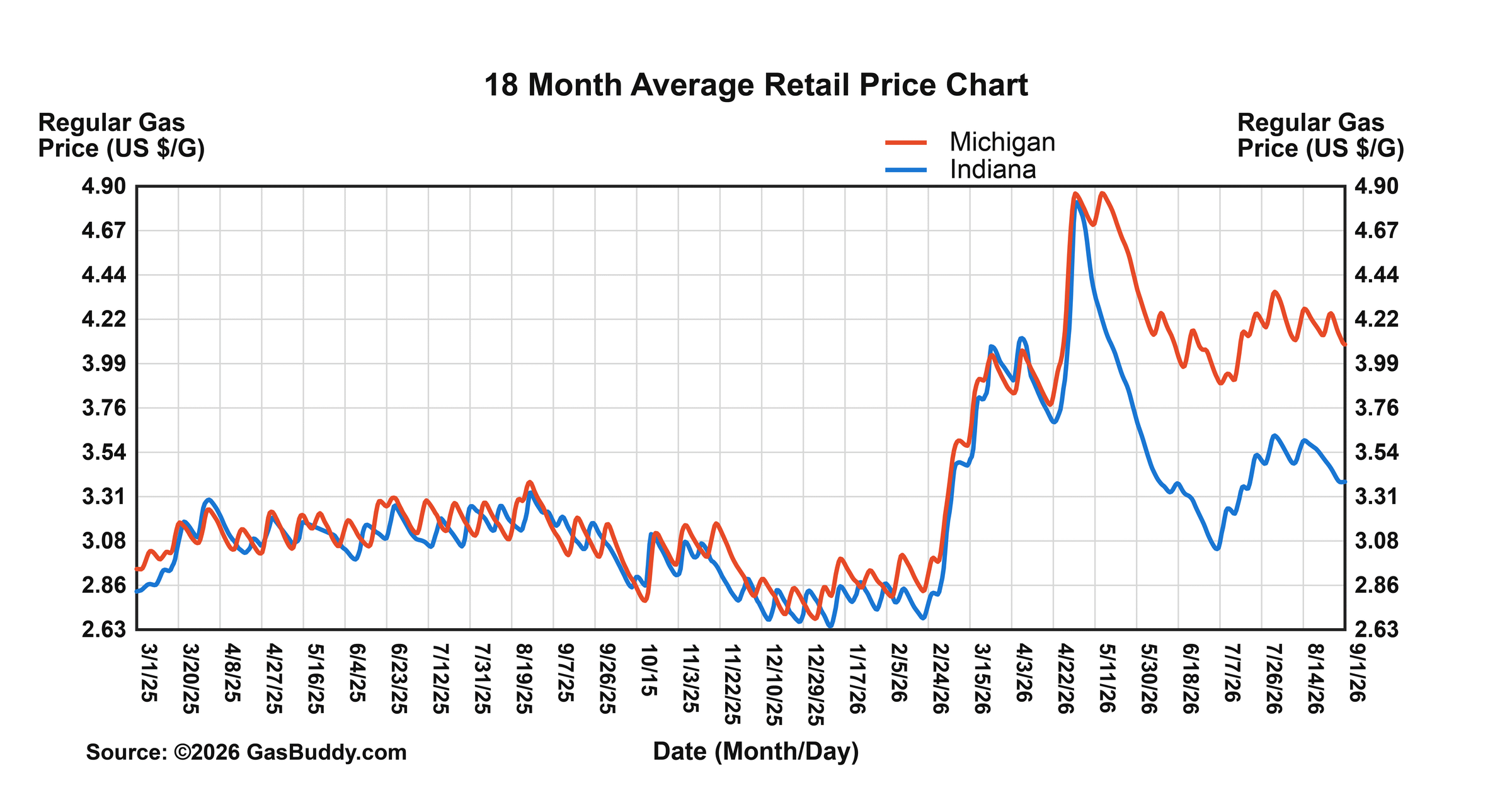
Recent gasoline prices in Michigan have greatly exceeded those in neighboring Indiana, which has recently had the lowest prices in the country. Michigan’s average price for regular gasoline was $4.26 per gallon on Aug. 28, compared to $3.46 in Indiana, according to Energy Factbook. A quick look at 18 months of price history from Gas Buddy shows that this 23% premium did not exist five months ago.
The Michigan economy demanded 4.4 billion gallons of gasoline in 2024, while Indiana demanded 3 billion gallons, according to the U.S. Department of Energy. One big difference is that Indiana, unlike Michigan, can refine a large portion of the gasoline it uses. Michigan’s one oil refinery does not refine gasoline. Indiana, by contrast, has two refineries, and they can produce 1.6 billion gallons of gasoline a year — 54% of the amount used in the state, according to the U.S. Energy Information Agency. Both states import gasoline by pipeline from Gulf Coast refineries, with Michigan being farther away.
For most of the last 18 months, gas prices have been higher in Michigan than in Indiana, but only by a few cents per gallon. That changed in May, however. The war with Iran has caused petroleum prices to rise, but that does little to explain the increased divergence between prices in the two states.
State gasoline taxes are essentially 52.4 cents per gallon in Michigan and 53.5 cents per gallon in Indiana. Indiana consumers and businesses, however, got some relief when Gov. Mike Braun suspended the fuel tax from April 8 to Oct. 5. The tax holiday accounts for two-thirds of the difference in prices.
Ohio has an even lower tax — 38.5 cents per gallon. That 15-cent difference makes a real impact. On Sept. 2, the average gasoline price in Ohio was $3.80 compared to $4.09 in Michigan. Half that difference came from Ohio’s lower tax rate.
Michigan needs to consider lowering its tax. The tax has doubled since 2021 because it goes up automatically with inflation and because a 2025 law removed the sales tax on gasoline but increased the gasoline tax. Michigan consumers spent $14 billion on gasoline in 2023, paying an average price of $3.29 per gallon, according to the U.S. Energy Information Administration. Reducing the gas tax by 15 cents per gallon would save gas buyers about $650 million a year statewide and about $75 per driver. (This assumes that the average driver uses 500 gallons per year.)
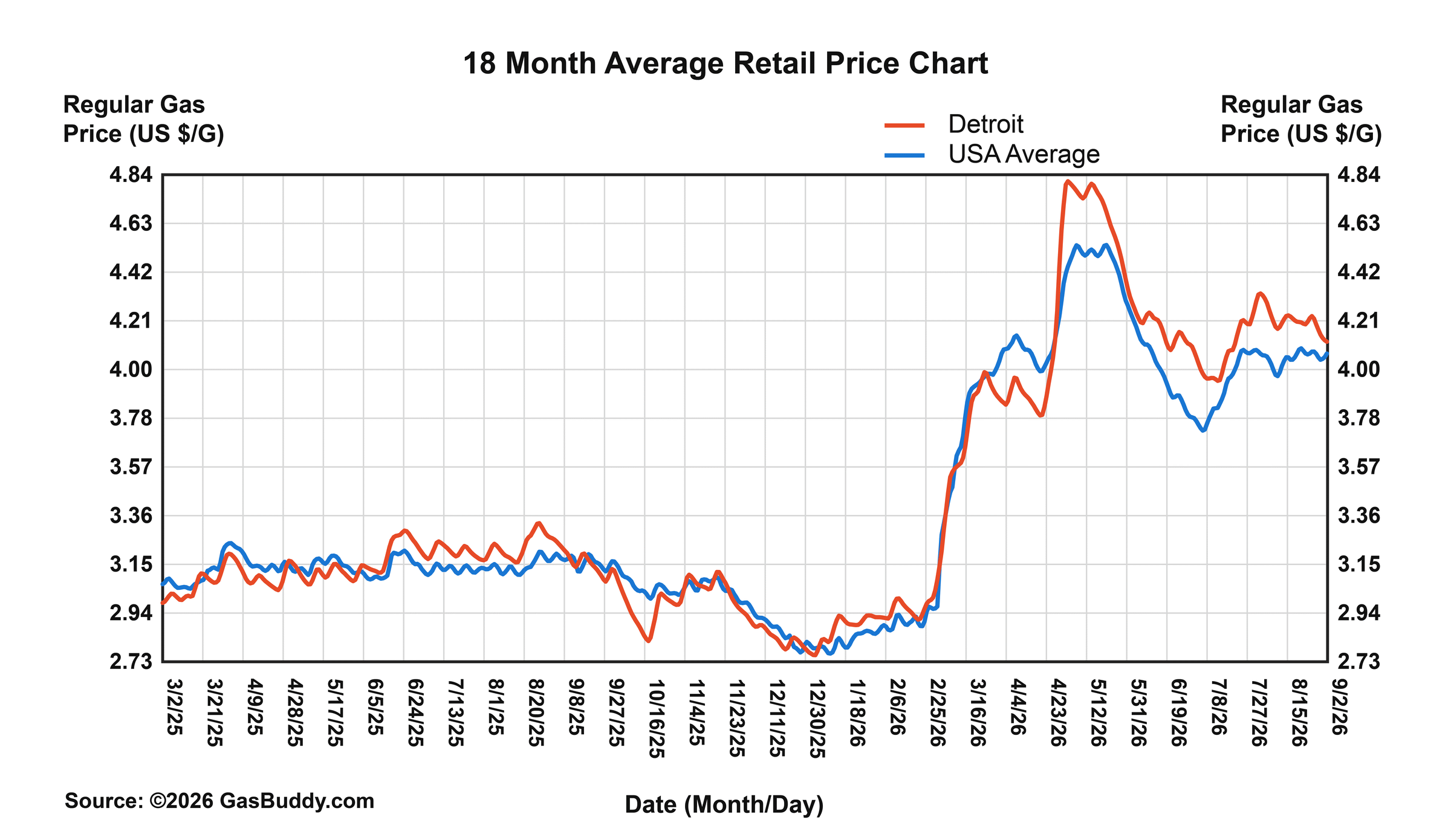
Beyond lowering the gas tax, Michigan policymakers can make gas more affordable by pursuing federal action. Each summer, gas prices in the Detroit area exceed the national average even more than they do the rest of the year. That’s because the U. S. Environmental Protection Agency requires motorists in Southeast Michigan to use a more expensive summer blend of low-volatile ethanol, called SIP 7.0. The required blend, meant to reduce ozone levels, typically adds about 10 to 20 cents per gallon.
The requirement to use low-volatile ethanol stems in part from something Michigan can’t control: Canadian wildfires. The EPA considers a state's ozone rating in determining whether it must comply with high-vapor standards in the summer. Smoke from Canada causes Michigan to be out of compliance with EPA standards.
The ozone National Ambient Air Quality Standard allows a maximum of 70 parts per million total of ozone. Each state’s record is calculated by taking a three-year average of the fourth-highest ozone readings of the year. Excluding the days when wildfire smoke puts Michigan above the standard would eliminate the need for low-volatile gasoline. This, in turn, would mean lower gas prices in Michigan.
Two pieces of federal legislation, the FENCES Act and the FIRE Act, would empower governors to petition the EPA to exclude high-smoke days from its calculations under ozone standards. These bills, which have passed the U.S. House of Representatives, would be a fix for Michigan, which cannot control smoke from another country. They would help reduce gasoline prices in Michigan.
The Detroit metro region has about 4.4 million people, or 44% of Michigan’s 10.1 million population, according to USAFacts.org. Saving 15 cents per gallon would save almost $95 million a year. Reducing the gas tax would add to that.
Two pieces of federal legislation, the FENCES act the FIRE act, would empower governors to petition the EPA to exclude high-smoke days from its calculations under ozone standards. These bills, which have passed the U.S House of Representatives, would help Michigan, which cannot control smoke from another country. They would help reduce gasoline prices in Michigan.
The Detroit metro region has about 4.4 million people or 44% of Michigan’s 10.1 million population, according to USAFacts.org. Saving 15 cents per gallon would save almost $95 million a year. Reducing the gas tax would add to that.
Get insightful commentary and the most reliable research on Michigan issues sent straight to your inbox.

The Mackinac Center for Public Policy is a nonprofit research and educational institute that advances the principles of free markets and limited government. Through our research and education programs, we challenge government overreach and advocate for a free-market approach to public policy that frees people to realize their potential and dreams.
Please consider contributing to our work to advance a freer and more prosperous state.