

 Font size:
Michigan’s Transportation Asset Management Council expects roads to be repaired as fast as they fall apart, according to its latest report on the conditions of Michigan’s roads and bridges. That’s an improvement from the previous year.
This chart shows the projections made about the percentage of roads in good or fair conditions from reports in 2011, 2018, 2024 and the most recent year, 2025.
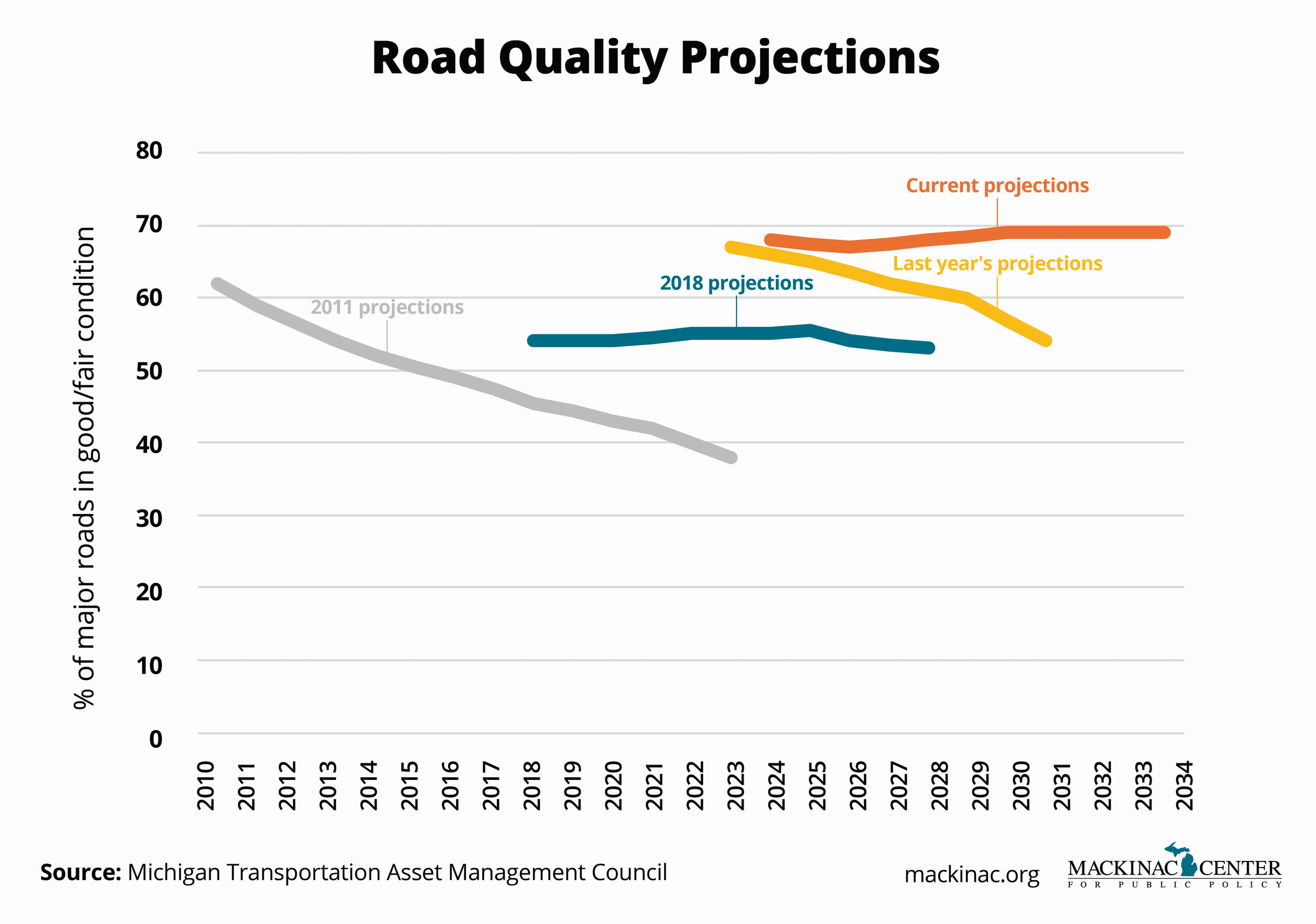
The chart shows that road managers in 2011 expected quality to deteriorate for the foreseeable future. Lawmakers subsequently spent more on roads, and by 2018 managers expected roads were being repaired as fast as they fell apart. Road quality improved between 2018 and 2024, but quality was expected to decline from there. Then lawmakers passed a road funding deal and were back to replacement levels in 2025.
Note also that these projections are only for federal aid-eligible roads. Basically, these are all of the state’s highways plus roads that people might drive on besides people that live on the road, trash collectors and deliverers.
Much of the improvement is due to funding. Lawmakers did not spend enough on roads to keep conditions constant in 2011. But they made roads a priority for the state’s growing revenue and brought funding back to replacement levels. Gov. Gretchen Whitmer was unable to get consensus for more road funding during much of her term, but extra temporary money from the federal government plus borrowing improved road conditions. Then the 2025 road funding deal brought the state back up to the point where roads are being replaced as fast as they fall apart.
Lawmakers averted the declines expected in 2011 by spending more on roads. But extra money hasn’t improved overall conditions. Road quality did decline from 2011 to 2020. This happened even though road funding increased from $3.5 billion to $5.3 billion, a 38% increase when adjusted for inflation. Road quality has since improved, and spending increased to $7.9 billion, a further 17% increase when adjusted for inflation.
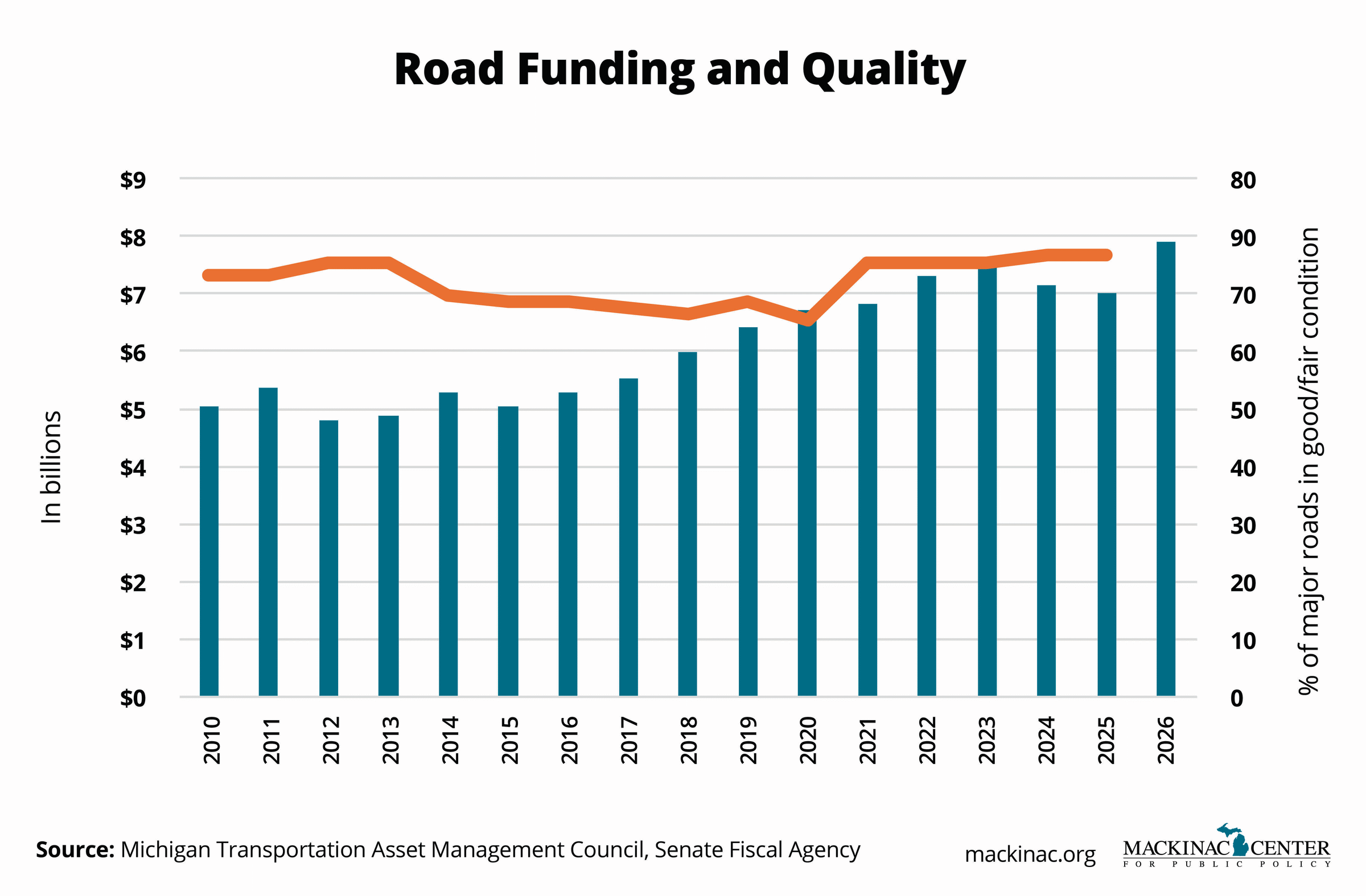
State residents use roads to get where they want to go. The roads are owned by the state and local governments, and it has been the state’s responsibility to ensure that they are kept in good working order. Lawmakers have made progress in meeting this responsibility, getting to replacement levels of road funding. With a bit more funding or a small decrease in costs, roads will be fixed faster than they fall apart, which ought to be the state’s goal.
Get insightful commentary and the most reliable research on Michigan issues sent straight to your inbox.

The Mackinac Center for Public Policy is a nonprofit research and educational institute that advances the principles of free markets and limited government. Through our research and education programs, we challenge government overreach and advocate for a free-market approach to public policy that frees people to realize their potential and dreams.
Please consider contributing to our work to advance a freer and more prosperous state.