

 Font size:
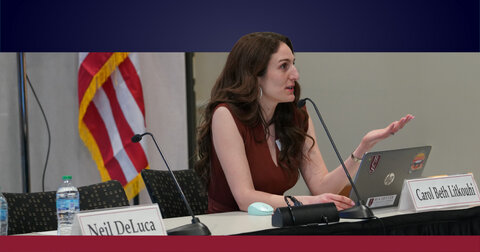
Carol Beth Litkouhi ran for the Rochester Community Schools Board of Education because she wanted to serve her community. Earlier this year, that commitment led her to court.
Litkouhi is an elected trustee on the Rochester board. Last fall, various officials in Oakland County began considering a countywide tax increase. Several school districts discussed the proposal openly with their communities. Rochester took a different approach: The superintendent and board majority elected to support the proposed increase and keep the matter away from the public.
Litkouhi disagreed with that approach. Believing her constituents had a right to know about a potential tax increase, she wrote an op-ed for The Detroit News.
The board swiftly accused her of disclosing confidential information, then voted to censure her and remove her from all board committees. She retains her seat and her vote, but the message was clear.
In February, the Mackinac Center Legal Foundation filed a lawsuit on Litkouhi’s behalf in the 52nd District Court of Oakland County.
The lawsuit names the Rochester Community Schools District and the individual trustees, acting in their official capacity, who voted to censure her. At issue is a newly revised board bylaw that restricts what trustees may say publicly. The Mackinac Center argues that the bylaw is unconstitutionally overbroad and violates Litkouhi’s First Amendment rights.
The question is: Does taking elected office mean giving up your right to speak freely with the people who elected you?
The Mackinac Center’s position is that it does not.
Elected officials retain their First Amendment rights, and those rights matter most when officials speak on issues of public concern, such as a potential tax increase affecting every family in the district. A bylaw that punishes a trustee for writing an opinion piece in a local newspaper raises serious constitutional questions, regardless of whether the board agrees with what she wrote.
“Elected officials do not surrender their First Amendment rights when they take office,” said Derk Wilcox, senior attorney at the Mackinac Center Legal Foundation, in the press release announcing the lawsuit. “Rochester’s policy attempts to silence trustees and keep their constituents in the dark about decisions that directly affect them.”
For Litkouhi, the case is also personal. She didn’t write the op-ed to create conflict. She wrote it because she thought residents deserved to know what was being discussed at the county level before decisions were made on their behalf. The censure and committee removal followed anyway.
“I ran for this office because I care deeply about our community and our schools,” Litkouhi said in the press release. “Silencing trustees only hurts the families we’re supposed to serve. I will always choose openness over secrecy, because the people who elected me deserve transparency from their officials.”
This isn’t a case about a trustee going rogue or undermining her colleagues for political gain. It’s about whether a school board can use a bylaw to discipline an elected official for communicating with her constituents on a matter of public interest. The board never specified what confidential information Litkouhi supposedly disclosed. They simply didn’t like that she spoke.
Cases like this one tend to attract attention because they sit at the intersection of local governance and constitutional rights, two areas where the rules are usually unclear until they’re tested. School board politics can move quickly, and informal pressure can often substitute for careful deliberation. What’s less common is a trustee who is willing to push back through legal channels, and an organization positioned to help her do it.
The Mackinac Center Legal Foundation exists for situations like Carol Beth’s, where an individual faces institutional pressure and needs someone willing to make the constitutional argument. The goal isn’t to win every political dispute that plays out in a school board meeting but to ensure that when government bodies overstep, there’s a mechanism to hold them accountable.
The case of Litkouhi v. Rochester Community Schools District is ongoing. The outcome could have implications beyond Rochester, touching on how much latitude school boards and other local bodies possess to regulate their members’ speech.
For now, Carol Beth Litkouhi still has her seat, her vote, and her willingness to speak.