

 Font size:
This article originally appeared in The Detroit News February 10, 2026.
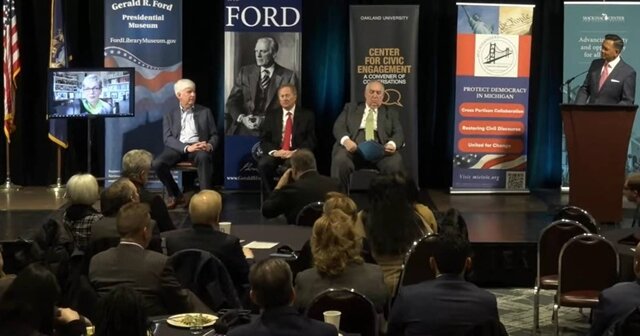
Four former Michigan governors, two Democrats and two Republicans, appeared last week to discuss civility in American life. Jim Blanchard, John Engler and Rick Snyder spoke in person in Lansing, while Jennifer Granholm joined by video.
My takeaway from their discussion: Civility is boring.
I am not saying civility is dull or tiresome. Rather, civility is not hard to define or recognize. It is not flashy or dramatic. Civility happens when people behave with decency and goodwill.
The event in Lansing, sponsored by the Michigan Civility Coalition, was itself a good demonstration of civility. Engler said it was the first time the four governors had appeared to speak in this way. Several groups promoted the historic event — Michiganders for Civic Reliance, Oakland University Center for Civic Engagement, Democracy Defense Project, the Mackinac Center for Public Policy, the Carter Center and the Gerald R. Ford Presidential Foundation.
Despite today’s political violence, clashes over immigration policy and civic unease, four governors with sharp policy differences expressed respect for each other and reminisced about ways they had collaborated. They showed us that disagreement doesn’t have to turn into contempt. It was remarkable to watch.
The former governors tried to diagnose what’s driving civic discord today: cable news, smartphones and negative campaign ads. There were a couple of pokes at President Donald Trump. Several demonized social media. As Granholm called it, “sniveling vitriol from the internet swamps.”
It’s easy to blame algorithms, news media or politicians for our lack of civility. But civility is practiced by individuals, not a vague concept of “society.” It happens in everyday interactions between people.
To that end, the former governors emphasized personal responsibility.
“The greatest threat to America, in my view,” said Snyder, “is us.” Granholm admitted she was guilty of raging at the president. Blanchard told the audience they were “part of the solution.”
How do we achieve civility? Not complicated.
“I’m a proud nerd,” said Snyder, invoking his nickname in office, “but this isn’t rocket science.”
Engler argued that well-run elections reinforce public confidence, and called for televised election debates throughout 2026. Blanchard said people shouldn’t assume betrayal when a politician crosses the aisle and co-sponsors a bill with the other party. Granholm called on political candidates to model civility. Snyder said he tries to treat political opponents as if they were “a family member sitting at my dining room table.”
Civility is easy to define. It is not the absence of disagreement. It does not require you to lay down your principles. Civil people need not ignore uncomfortable topics or naively sugarcoat them. Civility is the decision to persuade your neighbor rather than ignore or silence him.
My colleague James Hohman has written that civility is an American virtue. Two hundred and fifty years ago, when the founders made their case for independence, they explained themselves to the world because they held a “decent respect to the opinions of mankind.” America’s founders also prized free speech, enshrining it in the Bill of Rights. Civility is a companion of free speech. It helps us persuade rather than provoke.
There is a great temptation to define civility as something other people lack. George Carlin joked, “Have you ever noticed that anybody driving slower than you is an idiot, and anyone going faster than you is a maniac?”
That’s how we talk about civility. It becomes something we demand rather than something we practice. But civility is not what you owe me. It’s what I owe you.
Get insightful commentary and the most reliable research on Michigan issues sent straight to your inbox.

The Mackinac Center for Public Policy is a nonprofit research and educational institute that advances the principles of free markets and limited government. Through our research and education programs, we challenge government overreach and advocate for a free-market approach to public policy that frees people to realize their potential and dreams.
Please consider contributing to our work to advance a freer and more prosperous state.


