

 Font size:
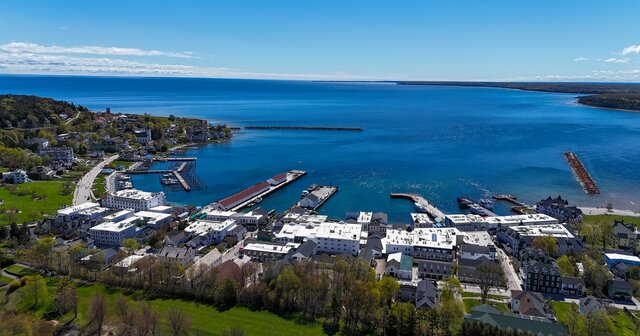
Attorney General Nessel has decided to join in the long-running litigation and legislation campaign against Mackinac Island ferry operators. Nessel’s new lawsuit alleges that ferry operator Hoffman Marine and its affiliated companies are illegally monopolizing the market for passenger ferry service to Mackinac Island and also for vehicle parking near the ferry docks in St. Ignace and Mackinaw City. This case was litigated before and rejected by a federal district judge.
Mackinac Island visitors and residents until relatively recently were served by three ferry companies: Star Line, Arnold, and Shepler’s. Star Line acquired and merged with Arnold in 2016. Shepler’s was acquired by Hoffman Marine in 2022, and then Hoffmann acquired Star Line in 2024, giving Hoffman a controlling interest in all three ferry lines. While Hoffman continues to operate Shepler’s as a separate entity from the other two ferries, Nessel claims that the common ownership makes the ferry services an illegal monopoly.
The City of Mackinac Island previously sued, claiming that the current arrangement among the ferry companies is an illegal monopoly. That case was tossed out before going to trial. The judge in that case relied on a well-established principle of antitrust law that having a monopoly is not the same thing as illegal monopolization. As the Supreme Court explained in U.S. v. Grinnell Corp., which also involved a common owner of competing companies, a company accused of monopolization must also be guilty of “the willful acquisition or maintenance of power as distinguished from growth or development as a consequence of a superior product, business acumen, or historic accident.”
The judge ruled that Hoffman may have a monopoly market share but has not monopolized the market. He that “Hoffman’s control of the two leading ferry services understandably raises monopoly concerns,” U.S. District Judge John J. Jonker wrote, “but unless and until Hoffman or the Ferry-Companies begin to abuse that power with anticompetitive actions, the City does not have a viable Section 2 [monopolization] claim.”
Specifically, the judge pointed out that the city’s allegations about how Hoffman acquired or maintained its market power all described market conditions that existed before Hoffman’s acquisitions and, most importantly, did not allege that Hoffman is trying to exclude any competitors from the market.
If anything, Nessel’s monopolization claim against Hoffman is even weaker now than when the City of Mackinac Island filed its lawsuit. That is because the Michigan legislature has enacted SB 304, which gives the City of Mackinac Island authority to regulate parking rates and other business activities both on the island and on the surrounding mainland. The City already had regulatory power over ferry rates, and much of its lawsuit focused on claims that Hoffman was evading the ferry rate regulations by charging passengers more for parking. But now parking rates are no longer controlled by Hoffman and cannot be set without city approval.
Most ferry services are monopolies, because their markets are not large enough to support competing services. There are currently 18 ferry services operating in Michigan, including ferries that cross Lake Michigan to Wisconsin and ferries to destinations like Beaver Island, Bois Blanc Island, and Drummond Island. All of them arguably are monopolies too, and none of them are subject to the kind of rate regulation Mackinac Island has over Hoffman.
One might ask why Nessel waited until her final months in office to sue Hoffman, rather than doing so at the time of the second acquisition in 2024. Her entire claim is about the monopoly power of Hoffman, which is no different now than in 2024 when she could have sued to stop the merger. At the press conference announcing the lawsuit, Nessel deflected, saying this merger showed the need for a premerger filing process in Michigan, similar to the federal Hart-Scott Rodino filings. But the Hoffman acquisitions were hardly secretive, and the monopoly issue was covered by Michigan media at the time.
Nessel is essentially bringing the same claim that was rejected when it was brought by the City of Mackinac Island. But this time Michigan taxpayers will foot the bill while the ferry operators pay a second time to defend themselves.
Get insightful commentary and the most reliable research on Michigan issues sent straight to your inbox.

The Mackinac Center for Public Policy is a nonprofit research and educational institute that advances the principles of free markets and limited government. Through our research and education programs, we challenge government overreach and advocate for a free-market approach to public policy that frees people to realize their potential and dreams.
Please consider contributing to our work to advance a freer and more prosperous state.


