


 By Molly Macek
Michigan’s public education system fails to prepare enough students with basic literacy skills. Reading scores on the National Assessment of Educational Progress, also known as the Nation’s Report Card, markedly declined over the last couple decades. The state’s fourth grade reading score now ranks 44th in the nation.[*]
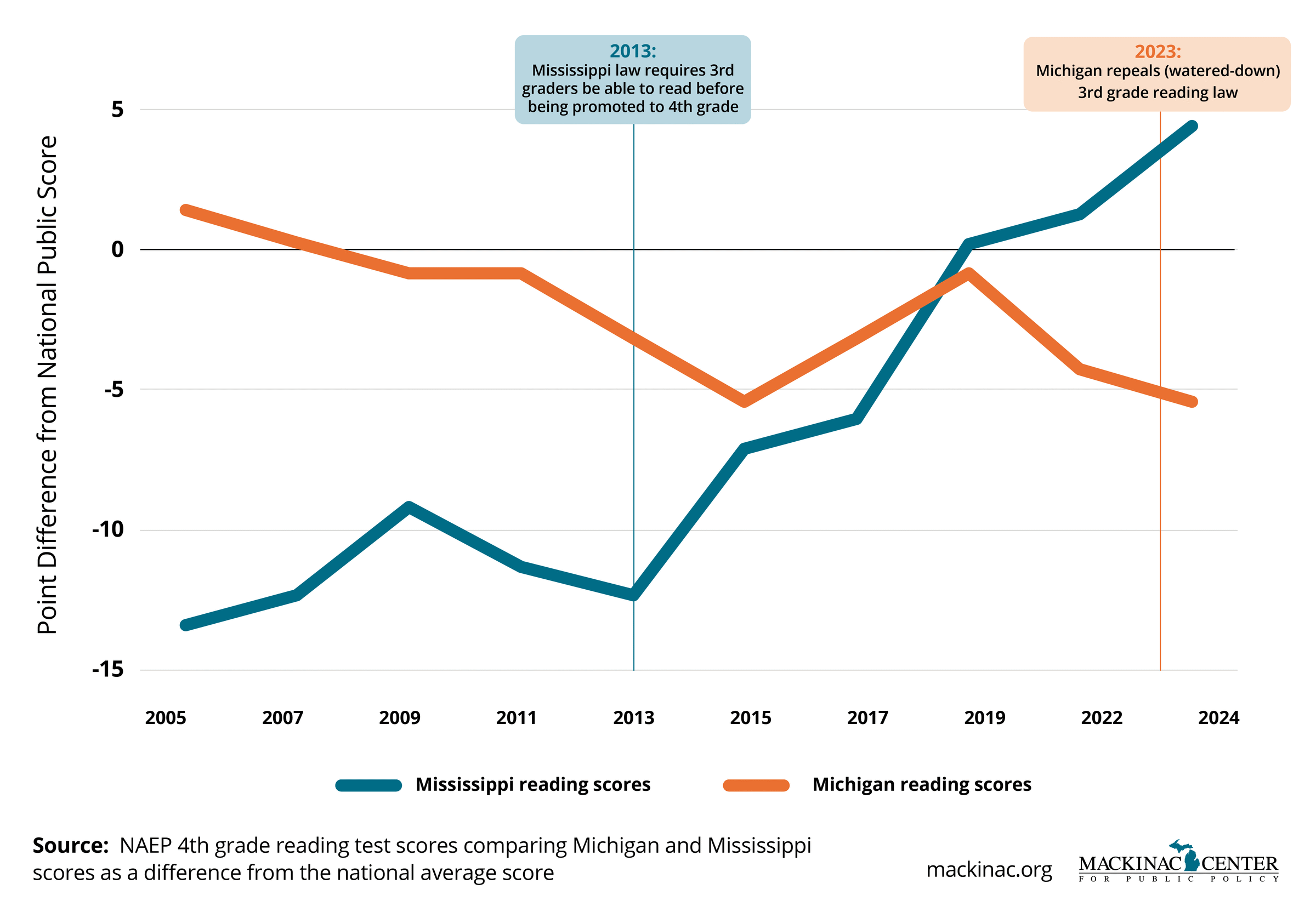
Mississippi’s trajectory looks quite different, as Graphic 1 below demonstrates. The Magnolia State’s performance on the fourth grade reading test landed in ninth place — up from 49th in 2013. Its average reading score increased from 12 points below the national average to five points above it. Michigan’s score dropped from four to five points below the national average over the same period.
All students appear to have benefited from Mississippi’s improvements in literacy. Students from low-income households scored higher in fourth grade reading than similarly situated students in any other state. In fact, Mississippi’s low-income students scored three points better than Michigan’s average score for all students. Michigan’s low-income students scored fifth worst relative to other states.
While Mississippi’s achievement in fourth-grade reading had gradually improved since the NAEP was first administered, its most significant gains occurred after 2013, when the state passed the Literacy-Based Promotion Act. The percentage of the state’s fourth graders who tested at a proficient level or higher increased by 11 percentage points between 2013 and 2024. Conversely, the national average on the reading test decreased by four percentage points during that period.[1] The state’s remarkable success in improving reading achievement since the legislation’s adoption has been dubbed the “Mississippi Miracle.”
A closer look at Mississippi’s literacy legislation — and its rigorous implementation — suggests the outcomes were not the result of divine intervention. Instead, Mississippi’s success can be attributed to public school leaders who committed to implementing an improvement strategy and the untold hours of hard work by dedicated teachers, administrators, parents and public officials.
Their coordinated efforts led to the statewide adoption of the legislation’s high-impact policies targeting reading proficiency in the early grade levels. The effective implementation of literacy law, in turn, contributed to dramatic achievement gains on state and national reading assessments, especially among economically disadvantaged students.
This report examines the steps Mississippi took — especially the adoption and implementation of the Literacy-Based Promotion Act in 2013 — to improve reading proficiency across the state. Mississippi’s process should serve as a model for lawmakers interested in improving student literacy in Michigan.
[*] Statistics about NAEP scores cited in this report, unless indicated otherwise,
come from the National Center for Education Statistics’ “NAEP Data Explorer,” which is accessible here: https://nces.ed.gov
Mississippi passed the Literacy-Based Promotion Act in 2013 in an effort to turn around the state’s literacy crisis. It took effect in the 2014-2015 school year. The act was then amended in 2016 to add clarity to its requirements, with changes taking effect for the 2018-19 school year.[2] The literacy law helps ensure every student can read at grade level by the end of third grade. It does this by preventing schools from socially promoting students who are not proficient in reading.
Mississippi lawmakers passed three other laws in 2013 that aimed to improve student achievement and school accountability. They created an ‘A’ to ‘F’ school grading system to increase transparency of school performance.[3] School grades, based primarily on student achievement and growth, are published openly in the Mississippi Succeeds Report Card. Lawmakers passed a charter school law to increase access to a broader array of diverse and innovative public schooling models.[4] They also enacted the Early Learning Collaborative Act to improve access to preschool programs for four-year-olds.[5]
The key elements of Mississippi’s success include its focus on early prevention and intervention and the bottom-up, coordinated efforts to support the adoption and effective implementation of the law by teachers and school leaders.
There are four main components to the
Literacy-Based Promotion Act:
(1) Schools screen all students in kindergarten through third grade for reading deficiencies and immediately provide extra instruction to students with deficiencies.
(2) School districts communicate with parents to support their students’ reading proficiency.
(3) A “gate” prevents students from being promoted to fourth grade if they fail to demonstrate reading proficiency by the end of third grade.
(4) Schools provide intensive interventions to students retained in third grade.
The purpose of screening is to identify struggling readers and intervene with extra learning support. Federal law requires states to administer reading tests beginning in third grade, so literacy policies tend to focus on performance at that level.
Mississippi lawmakers, however, decided to intervene in the earlier grade levels. They recognized that preparing students for the critical transition from third to fourth grade would require screening and intervening beginning in kindergarten. In the early grade levels, learning focuses mostly on developing a child’s reading proficiency. By fourth grade, however, children are increasingly tasked with using their reading skills to learn about different subject areas.
To prepare students for the transition to fourth grade, the literacy law requires schools to screen every student for reading deficiencies beginning in kindergarten. Schools may administer the screening test within the first 30 days of the school year and then two more times throughout the year, if needed. They must provide interventions and extra instruction for students with reading deficiencies until those students become proficient.[6]
The 2016 amendments to the law added specific steps school districts must take when a student demonstrates a reading deficiency on the screening test. Supplemental reading instruction and interventions must be documented in an individual reading plan. This plan must include the specific deficiencies identified by the screening test, the goals and benchmarks for growth, a description of how progress will be monitored, the types of instructional services and interventions the student will receive, strategies the parents can use to help support the students’ reading proficiency, and more.[7]
The amended law also identifies the type of reading instruction teachers must use for students with reading deficiencies. The instruction must address “the areas of phonemic awareness, phonics, fluency, vocabulary and comprehension.”[8] This approach is based on the science of reading, a body of research that consists of evidence-based practices for teaching students how to read.[9]
Mississippi recognized the importance of establishing a strong school-parent partnership to achieve its literacy goals. The state’s literacy law requires school districts to notify the parents in writing of any student who demonstrates a reading deficiency. The communication must include a description of the services currently provided and the additional support the district plans to administer to remediate the student’s reading deficiency.[10]
Schools must also inform parents that their child will not be promoted to fourth grade unless the deficiency is remedied by the end of third grade. Parents are presented with strategies they can use at home to help their child improve in reading. This communication helps establish partnerships between schools and parents to work together to support students’ reading goals.[11]
Mississippi’s literacy law states, “A public school student may not be assigned a grade level based solely on the student's age or any other factors that constitute social promotion.”[12] This provision makes clear the expectation that achieving proficiency must be prioritized when deciding whether to advance a student to the next grade level. It deviates from the long-standing, conventional approach to move children along from grade to grade based solely on their age.
Mississippi lawmakers recognized that students must develop a strong foundation in certain skills to be successful in the higher grades. The most important of these are reading and math proficiency. Beginning in kindergarten, students are expected to grow in their skill development and reach a prescribed level of proficiency by the time they complete each grade level. Their reading and math ability is measured via state assessments for the first time in third grade, and every year thereafter until eighth grade.
Students must demonstrate reading proficiency by the end of third grade in order to be promoted to fourth grade, according to the state’s literacy law. The initial law in 2013 defined proficiency as scoring a level 2 (out of 5) or higher on the state’s annual reading assessment. Students who did not meet the proficiency standards on the first try were given two opportunities to retake the reading assessment.[13]
The first year the law took effect, in 2014-15, 85% of third-grade students passed the reading assessment on the first try. Another 7% passed the retest, so about 8% of third graders were retained that year. Students in earlier grades were retained, too, to help them develop the requisite literacy skills before advancing to the next grade. Another 9% of students in kindergarten, 8% of students in first grade and 6% of students in second grade repeated those grade levels.[14]
The third-grade retention rate declined over the next three years as the percentage of students meeting the proficiency requirements grew. Fewer than 5% of students were retained in the 2017-18 school year. More than 95% of students passed the third grade reading assessment in 2017-2018.[15]
Lawmakers amended Mississippi’s literacy law in 2016 to narrow the gate for advancing to fourth grade. They raised the bar for reading proficiency by requiring students to score a level 3 or higher on the state reading assessment. The more rigorous promotion criteria took effect in the 2018-2019 school year.[16]
Third-grade retention rates increased as districts adapted to the higher standards for promotion to fourth grade. Only 86% of third-grade students met the new proficiency requirements in 2018-19, and 10% were retained.[*] Reading performance has held steady since then, with about 85% of third graders passing the test in 2024-25.[17]
Retention rates dropped each year after the law was amended, with just 6% of third graders retained in the 2024-25 school year. Improved performance on the state’s reading assessment cannot explain the entire decline, however. An increasing number of students who failed to meet the proficiency standards were promoted to the fourth grade with “good cause exemptions.” Mississippi’s literacy law permits schools to promote students who lack the requisite proficiency if they meet other criteria.[18]
For example, in 2014-15, 818 students, about 2% of all third-grade students and 28% of retention-eligible third graders statewide, were promoted to fourth grade using good cause exemptions. Most were students with disabilities who were previously retained in an earlier grade.[19]
Students who demonstrate proficiency on an approved alternative assessment or are English Language Learners may also be exempt from the retention requirement. Parents have the option to request that their child be retained in third grade despite meeting the criteria for a good cause exemption.[20]
Mississippi’s literacy law helps ensure students receive sufficient time and support to develop the reading skills needed to be successful in fourth grade. It focuses on prevention and intervention to promote students’ proficiency beginning in kindergarten. Third-grade retention is a last resort for students who neglect to achieve the required proficiency standards despite receiving rigorous and ongoing intervention to address their reading challenges.
A study performed by Boston University found a significant positive effect of test-based promotion on future reading achievement for the first cohort of students retained under Mississippi’s literacy law. The state’s retention policy led to substantial gains in English-Language Arts in sixth grade for students who had repeated third grade in 2015-16, according to the findings.[21]
The retention provision in state law prevents students who do not qualify for good cause exemptions from being socially promoted when they have not yet developed the literacy skills needed to succeed in the next grade level. It also helps ensure that districts’ interests align with the state’s emphasis on reading instruction. Schools are more likely to adhere to the law’s requirement that they provide early interventions for struggling readers. If they fail to do so, they’ll be required to devote more time and resources to an extra year of interventions for every student who is retained.
[*] The other 4% of students who were not held back despite not meeting the proficiency requirements were promoted to fourth grade with a good cause exemption.
Mississippi requires public schools to provide students retained in third grade with intensive intervention to remediate the reading deficiency. This ensures students receive additional literacy support and not just repeat their third-grade instruction. This increases their chance of becoming proficient and advancing to fourth grade.
The literacy law prescribes at least 90 minutes of reading instruction every school day for each retained student. The strategies for delivering the instruction may include small group instruction, smaller classroom settings, tutoring, extended school days and summer reading camps. The law also requires districts to assign any retained third-grade student to a high-performing teacher in the area of literacy development. This helps ensure that struggling readers receive quality instruction to support their reading growth and success.[22]
Mississippi’s law requires that districts notify parents when their child is identified for retention and communicate in writing the interventions they propose to use to remedy their child’s reading deficiency. Districts must partner with parents to support students’ reading development. Parents of retained students must be provided with a “Read at Home” plan outlined in a parent contract. By committing parents to read with their children regularly and be involved in the remediation process, the reading plan helps students continue their skill development outside the school day.[23]
Passing a law is only the first step toward producing an intended outcome. The law must also be implemented with fidelity for it to have the desired effect.
Lawmakers in Mississippi created the literacy law to improve reading proficiency, especially in the early grades. But the law would not have produced the achievement gains demonstrated by Mississippi’s fourth graders over the years if not for the concerted, statewide effort to ensure it was implemented effectively.
Mississippi used a comprehensive approach that engaged multiple stakeholders in the implementation process. After the law passed, the Mississippi Department of Education hired a literacy director and created an office dedicated to implementing it.
Months after the literacy law passed in 2013, the literacy director and her team visited schools and worked with teachers and administrators in an effort to set them up for success. They helped schools understand the new literacy law and addressed their questions and concerns about it. The team focused on the prevention and intervention components in its messaging. It emphasized diagnosing reading deficiencies and intervening early to ensure as many students as possible achieve the required literacy standards.[24]
Early intervention was driven by the use of universal screening tools to diagnose and address reading deficiencies in kindergarten through third grade. Each district must administer the universal screening assessment to all students at least three times during the school year, according to the Mississippi Department of Education.
The law requires the department to curate a list of approved universal screening tools for districts to use to assess students’ reading proficiency. With all districts using universal screeners from an approved list, every student in kindergarten through third grade can be assessed consistently and efficiently.[25]
The state also hired literacy coaches and assigned them to the lowest-performing schools, known as Literacy Support Schools. The literacy coaches work with the state department of education and district officials to support the effective and consistent implementation of the literacy law at the state, district and school level. They assist teachers with using evidence-based reading instruction, analyzing data, developing interventions, documenting student progress and creating individual reading plans for struggling readers. They also design professional development training to fill learning gaps and support administrators lacking expertise in early literacy development.[26]
All teachers in kindergarten through third grade and principals at Literacy Support Schools are required to participate in training on instructional strategies grounded in the science of reading. The training is also open to similar teachers in non-literacy support schools, special education teachers through grade eight and all elementary-school principals.[27]
For the first several years the literacy law was in place, educators and administrators participated in Language Essentials for Teachers of Reading and Spelling, or LETRS, training. The state now partners with the AIM Institute for Learning & Research to provide the training. Both programs prepare educators to teach reading based on scientifically supported best practices.[28]
Even with literacy coaches, training opportunities and ample guidance, the retention law produced some anxiety among teachers, especially those who taught third grade. The state addressed their apprehensions by stressing that prevention and intervention would be an ongoing, collaborative effort among all early elementary teachers. Kindergarten teachers would use the prescribed strategies to prepare students for first grade, communicate any remaining learning gaps to the first-grade teacher, and so on. Retention would serve as a last resort for students who still demonstrate reading deficiencies even after receiving intervention and support from multiple educators.[29]
Buy-in from parents was also critical to the literacy law’s success. The education department’s literacy team used a grassroots approach to engage with parents and address their concerns. In spring 2014, the team partnered with district officials to host parent meetings in eight regions across the state. These meetings, titled “Parents as Partners Parent Nights,” served to inform parents about the new literacy law and empower them with knowledge and tips to help their children succeed.[30]
The Mississippi Department of Education also launched an online platform called Strong Readers, Strong Leaders to help parents understand the literacy law and improve their children’s reading proficiency. The platform provides information about universal screenings and interpreting the results. It explains the ways schools intervene for struggling readers and provides parents with grade-level resources to support their children’s reading development at home. The department also developed a platform called “Communication Toolkits” that provided parents with regular updates on their children’s progress.[31]
The state department of education, under the leadership of the state superintendent, created a comprehensive guide to support educators and district officials with the implementation of the literacy law. The guide provides assistance on implementing the legislation’s requirements, including the use of the literacy coaches, assessing reading deficiencies, administering interventions, documenting student progress, making retention decisions, communicating with parents, and more.[32]
Though some sources have referred to the state’s unprecedented achievement gains as the “Mississippi Miracle,” a closer look at the implementation process suggests the scores did not rely on a miracle. Instead, Mississippi achieved these results through careful planning, hard work and collaboration among multiple stakeholders to promote the successful implementation of the law and support student success.
Michigan has made some attempts over recent years to address its downward trend in reading proficiency. The Legislature passed the Read by Third Grade Law in 2016. Like Mississippi’s law, it included provisions for intervening early when students with reading deficiencies were identified. It also aimed to retain third-grade students who did not meet the state’s proficiency standards. Michigan’s reading performance on state and national tests, however, has declined since the law was passed.[33]
There are a few likely explanations for the law’s failure to improve reading outcomes. The law was slowly implemented, with its retention rules not taking effect until the 2019-2020 school year. That turned out to be bad timing as schools were forced to close as part of the state’s response to the COVID-19 pandemic. State assessments were not administered that year, so there was no data to inform retention decisions.[34]
The first year any third-grade students were retained in accordance with the law was the 2020-2021 school year. As in Mississippi, state testing in reading and math begins in third grade in Michigan, and the test results were used to determine a student’s eligibility for retention. Students could be retained in third grade if they performed at a level that was more than one year behind in reading proficiency.[35]
In both 2020-21 and 2021-22, when the retention provision was in effect, most districts (60%) promoted all their retention-eligible students, according to a Michigan State University report. Statewide, only 0.6% of tested third graders were retained in 2021-22, even though nearly 6% of them met the criteria to be retained. Only 43% of third graders passed the reading test in 2020-21 and 42% passed the following year.[36]
Michigan’s Read by Grade Three Law included several good cause exemptions to the retention policy, similar to Mississippi’s literacy law. This was meant to allow some students in unique circumstances to be promoted to fourth grade despite demonstrating reading deficiencies. But Michigan’s law included an exemption unlike any used in Mississippi: It allowed superintendents to bypass the retention requirement if a student’s parents requested it. This was the good cause exemption that districts used most often to promote third-grade students who could not read proficiently.[37]
Michigan’s Legislature repealed the Read by Grade Three Law in 2023, though it had taken effect just four years earlier and its implementation was disrupted by the COVID-19 lockdowns and school closures. The following year the Legislature passed new literacy laws, but this time without the retention provision.
Michigan’s new literacy laws are only slowly being implemented — they do not go into effect until the 2027-2028 school year. Some of the provisions are similar to those in Mississippi’s law, but they lack the accountability measures and implementation support needed to make it successful.
The new literacy laws include some promising provisions. They focus on prevention and intervention, require curriculum and instruction to be grounded in the science of reading, and mandate screening of all students in kindergarten through third grade for dyslexia and other reading deficiencies. Michigan’s law requires literacy coaches to support teachers in using evidence-based reading strategies. It also requires all teacher preparation programs in the state to include training in dyslexia, instructional accommodations, and research-based support for students’ literacy development.[38]
The new laws fail to hold districts accountable for implementing the legislation with fidelity, because they do not include a requirement to retain third graders who cannot read at grade level. A retention provision gives the law teeth, increasing the likelihood that students will receive the instruction and interventions prescribed by law.
There is nothing stopping Michigan schools from promoting all students to fourth grade, regardless of their reading ability. A strong reading foundation is critical to a student’s ability to learn more complex material. Students who struggle to read yet continue to advance through the school system are less likely to graduate on time, enroll in a postsecondary program, or reach their potential.
Michigan should learn from Mississippi’s success and pass policies that produce significant gains in reading proficiency. The two main elements of such an effort are legislation and implementation. Both are described in detail below.
Amend Michigan’s literacy law to include a retention provision that prohibits promoting third graders who fail to meet the proficiency standard on the state reading assessment or an approved alternative assessment.
The good cause exemption must not allow retention-eligible students to be promoted at the request of parents.
Good cause exemptions, such as those in Mississippi’s literacy law, should still be included.
Mandate that districts provide rigorous instruction and intervention grounded in the science of reading to every student retained in third grade due to a reading deficiency. Districts should record intervention strategies and monitor student progress in an individual reading plan. Retained students should be assigned to a high-performing teacher as determined by the district’s teacher evaluation system.
Provide obligatory professional development in the science of reading, such as LETRS, to all teachers in kindergarten through third grade and elementary school administrators.
Require districts to assign a literacy coach trained in the science of reading to every elementary school.
Make implementation a primary focus. Policymakers should support all stakeholders during the rollout and application of the legislation. This includes performing process and impact evaluations to measure the implementation and effectiveness of the literacy law.
Designate a representative from the Michigan Department of Education to lead the charge. The person should be an expert in literacy-based instruction grounded in the science of reading and have demonstrated success in leading large-scale change initiatives.
Develop a strong communication plan to inform schools, teachers and parents of the literacy law’s requirements and the role that each stakeholder plays in supporting student success. Messaging should focus on prevention and intervention, beginning in kindergarten. Retention should be viewed as a last resort.
Cultivate a strong parent-school partnership. Districts should empower parents with the knowledge and tools they will need to support their children’s reading development.
This includes updating parents regularly on their children’s progress and individualized reading plan.
Districts should maintain parent engagement through online platforms, social media, community meetings and other grassroots efforts to answer questions, address concerns and provide helpful resources.
Michigan needs urgent and evidence-based solutions to turn around its literacy crisis. The state’s new literacy laws include some promising provisions aimed at improving reading proficiency. But they lack key components that would increase their likelihood of success.
Mississippi’s literacy law, the Literacy-Based Promotion Act, provides model legislation for Michigan and other states. Its focus on early intervention and prevention, and the use of retention as a last resort, has developed students’ reading proficiency in the early grades.
But simply including these components in the legislation is not enough to produce literacy gains like those achieved by Mississippi on state and national tests. The literacy laws must also be implemented with fidelity to produce the intended outcomes. By following Mississippi’s lead and working with key players to ensure the effective implementation of the legislation, Michigan can promote meaningful change in early literacy, too.
[1] “Mississippi’s 2024 National Assessment of Educational Progress,” (Mississippi Department of Education, 2025), https://perma.cc
[2] “Literacy-Based Promotion Act,” (Mississippi Department of Education, 2025), https://perma.cc
[3] “Understanding the Mississippi Accountability System for Grading Schools and Districts,” (Mississippi Department of Education, September 2022), https://perma.cc
[4] “House Bill 369,” (Mississippi Legislature, July 1, 2013), https://perma.cc
[5] “Early Learning Collaboratives and State Invested Pre-K Programs,” (Mississippi Department of Education, 2025), https://perma.cc
[6] Miss. Code Ann. § 37-177-1.
[7] “Senate Bill 2157,” (Mississippi Legislature, July 1, 2016), https://perma.cc
[8] Miss. Code Ann. § 37-177-1(2)(e).
[9] For more information, see: “The Science of Reading: An Overview,” (National Center on Improving Literacy, April 1, 2025), https://perma.cc
[10] Miss. Code Ann. § 37-177-3.
[11] Miss. Code Ann. § 37-177-3(e).
[12] Miss. Code Ann. § 37-177-9.
[13] “Mississippi Literacy-Based Promotion Act: Frequently Asked Questions,” (Mississippi Department of Education, January 2024), 6, https://perma.cc
[14] “Literacy-Based Promotion Act Annual Report of Performance and Student Retention (2014-2015),” (Mississippi Department of Education, 2015), https://perma.cc
[15] “Literacy-Based Promotion Act Annual Report of Performance and Student Retention (2017-2018),” (Mississippi Department of Education, 2018), https://perma.cc
[16] “Senate Bill 2157,” (Mississippi Legislature, July 1, 2016), https://perma.cc
[17] “Literacy-Based Promotion Act Annual Report of Performance and Student Retention (2018-2019),” (Mississippi Department of Education, 2019), https://perma.cc
https://perma.cc
[18] Miss. Code Ann. § 37-177-11.
[19] “Literacy-Based Promotion Act Annual Report of Performance and Student Retention (2014-2015),” (Mississippi Department of Education, 2015), https://perma.cc
[20] Miss. Code Ann. § 37-177-11; “Mississippi Literacy-Based Promotion Act: Frequently Asked Questions,” (Mississippi Department of Education, January 2024), 18, https://perma.cc
[21] Kirsten Slungaard Mumma, and Marcus Winters, “The Effect of Retention Under Mississippi’s Test-Based Promotion Policy,” (Boston University Wheelock College of Education & Human Development, Winter 2023),
https://perma.cc
[22] Miss. Code Ann. § 37-177-13(a),(c).
[23] Miss. Code Ann. § 37-177-13(b),(d).
[24] Author’s interview with Dr. Kymyona Burk, former state literacy director at the Mississippi Department of Education, December 4, 2025.
[25] “Universal Screener and Diagnostic Assessment – Student Assessment,” (Mississippi Department of Education, 2025), https://perma.cc
[26] “Literacy-Based Promotion Act Implementation Guide,” (Mississippi Department of Education, 2016), 29–39, https://perma.cc
[27] “Literacy-Based Promotion Act Implementation Guide,” (Mississippi Department of Education, 2016), 32–33, https://perma.cc
[28] For more information, see: “LETRS professional learning for Mississippi K–3 teachers,” (Lexia, 2026), https://perma.cc
[29] Author’s interview with Dr. Kymyona Burk, former state literacy director at the Mississippi Department of Education, December 4, 2025.
[30] Kymyona Burk, “The Perfect Storm: Mississippi’s Momentum for Improving Reading Achievement,” The Reading League Journal (May 2020), 30, https://perma.cc
[31] “Strong Readers, Strong Leaders,” (Mississippi Department of Education, 2026), https://strongreadersms.com; Kymyona Burk, “The Perfect Storm: Mississippi’s Momentum for Improving Reading Achievement,” The Reading League Journal (May 2020), 30, https://perma.cc
[32] “Literacy-Based Promotion Act Implementation Guide,” (Mississippi Department of Education, 2016), https://perma.cc
[33] “Public Act 306 of 2016,” (State of Michigan, October 6, 2016), https://perma.cc
[34] John Westall, Tara Kilbride, and Katharine O. Strunk, “Read by Grade Three Law Initial Retention Decisions,” (Education Policy Innovation Collaborative at Michigan State University, October 2021), https://perma.cc
[35] J. Hunault, Jenny McInerney, Bethany Wicksall, and Samuel Christensen, “Legislative Analysis: Smart Promotion: 3rd Grade Reading Proficiency, Early Literacy Coaches, & Reading Assistance Programs,” (Michigan House Fiscal Agency, October 4, 2016), 7, https://perma.cc
[36] John Westall, Andrew Utter, Tara Kilbride, and Katharine O. Strunk, “Read by Grade Three Law Initial Retention Decisions,” (Education Policy Innovation Collaborative at Michigan State University, December 2022), 6, https://perma.cc
[37] John Westall, Andrew Utter, Tara Kilbride, and Katharine O. Strunk, “Read by Grade Three Law Initial Retention Decisions,” (Education Policy Innovation Collaborative at Michigan State University, December 2022), 13, https://perma.cc
[38] MCL § 380.1280f.



