

Michigan is entering one of the largest electric infrastructure investment cycles in its history. Over the next two decades, DTE and Consumers Energy plan to add nearly 30 gigawatts of new generation, storage, wind, solar and natural gas at an estimated cost of $39 billion. That investment could triple electricity rates for everyone, according to estimates published by the Mackinac Center. New generation resources may not be built fast enough to keep up with increased electricity use. But there are ways to meet rising demand while protecting electric customers from higher electricity rates.
Under Michigan's current regulatory framework, new generation infrastructure is financed through utility investment and recovered through electric rates, subject to oversight by the Michigan Public Service Commission. Utilities will need to make substantial long-term investments to replace retiring generation and serve future demand, and these costs would be passed on to ratepayers. But Michigan's Electric Customer Choice Program could help.
This program has allowed qualifying customers to purchase electricity from licensed Alternative Electric Suppliers for more than two decades. Utilities continue to own and operate the transmission and distribution system, offer default service (provider of last resort), and maintain responsibility for reliability. Michigan’s electric choice program is saving electricity customers $185 million a year in rates while providing reliable service, with 30% savings for commercial customers and 12% for industrial customers, on average.
This report shows how expanding this program can reduce the amount of future utility-owned generation that must be paid through higher electric rates. Michigan's electric choice program would allow participating customers and private capital to finance a greater share of new electricity supply.
Michigan's Electric Customer Choice Program has operated successfully for more than two decades.
In 2025, 2,172 megawatts of demand was served to 5,518 customers through alternative suppliers rather than utility-owned generation financed through electric rates.
State law has capped participation in the program since 2008 at 10% of utility sales.
More than 5,100 customers remain on the waiting list.
Choice customers continue paying utilities for transmission, distribution and other regulated services. The only difference is how they procure the generation portion of their electric service. Instead of relying on utility-owned generation that ratepayers pay for, choice customers get their supply from alternative providers who privately finance their own generation.
As Consumers Energy and DTE prepare for a major investment cycle, expanding Michigan's Electric Customer Choice Program and increasing the 10% cap would allow participating customers and private capital to finance a larger share of future generation investment.
Analysis based on historical Michigan utility generation costs indicate that:
20% choice participation would lower utilities' infrastructure investment needs by $3.5–$4 billion.
30% choice participation would lower utilities' infrastructure investment needs by $7–$8 billion.
Ratepayers would save if utilities' investments decrease. They would no longer need to finance this infrastructure through higher electricity rates.
Every megawatt financed by participating choice customers is one less megawatt utilities need to finance and recover costs through increased electric rates.
The Michigan Legislature should:
Expand the Electric Customer Choice participation cap from 10% to 30% through immediate or phased implementation.
Require utilities to incorporate expected alternative supplier use when forecasting future generation needs.
Allow new and expanded customer load to participate in the choice program without increasing utility procurement obligations. When electricity demand grows, customers joining the Electric Customer Choice Program reduce the amount of new generation utilities must build.
Allow the so-called renewable resources, including nuclear power, used by Alternative Electric Suppliers to count towards Michigan’s “net zero” mandates.
Act before the current generation investment cycle is substantially committed.
Michigan will need substantial new generation regardless of the policy path chosen. Expanding the Electric Customer Choice Program does not eliminate the need to build new generation, but it does change who will finance it and reduce costs for Michigan taxpayers.
Rather than requiring all future generation to be financed primarily through higher electric rates charged to consumers, Michigan can expand a proven program that would create a more diverse and balanced investment model. This could be done while preserving utility responsibility for reliability and the state's vertically integrated regulatory framework.
Michigan's electric system is entering one of the largest infrastructure investment cycles in state history at a time when electricity rates already exceed neighboring states. Over the next two decades, investor-owned utilities are planning approximately 30 gigawatts of new generation, storage, wind, solar and natural gas with carbon dioxide capture and sequestration while retiring nearly six gigawatts of existing generating capacity.
There’s no doubt that Michigan’s electricity demand will increase. The question policymakers should consider is how they can reduce the cost to ratepayers for the new generation needed to meet growing demand.
Michigan households and businesses already face some of the highest electricity prices in the Great Lakes region. Over the past two decades, Michigan's rates have increased faster than many neighboring states, impacted largely from adding wind, solar, batteries and supporting transmission lines, on top of needed grid modernization.
Many factors contribute to electricity rates, including fuel costs, transmission infrastructure investments, grid reliability spending, and state energy policies. No single factor is responsible for current electricity prices, but as Michigan prepares for a major generation investment cycle, financing decisions will play an important role in determining future costs for ratepayers.
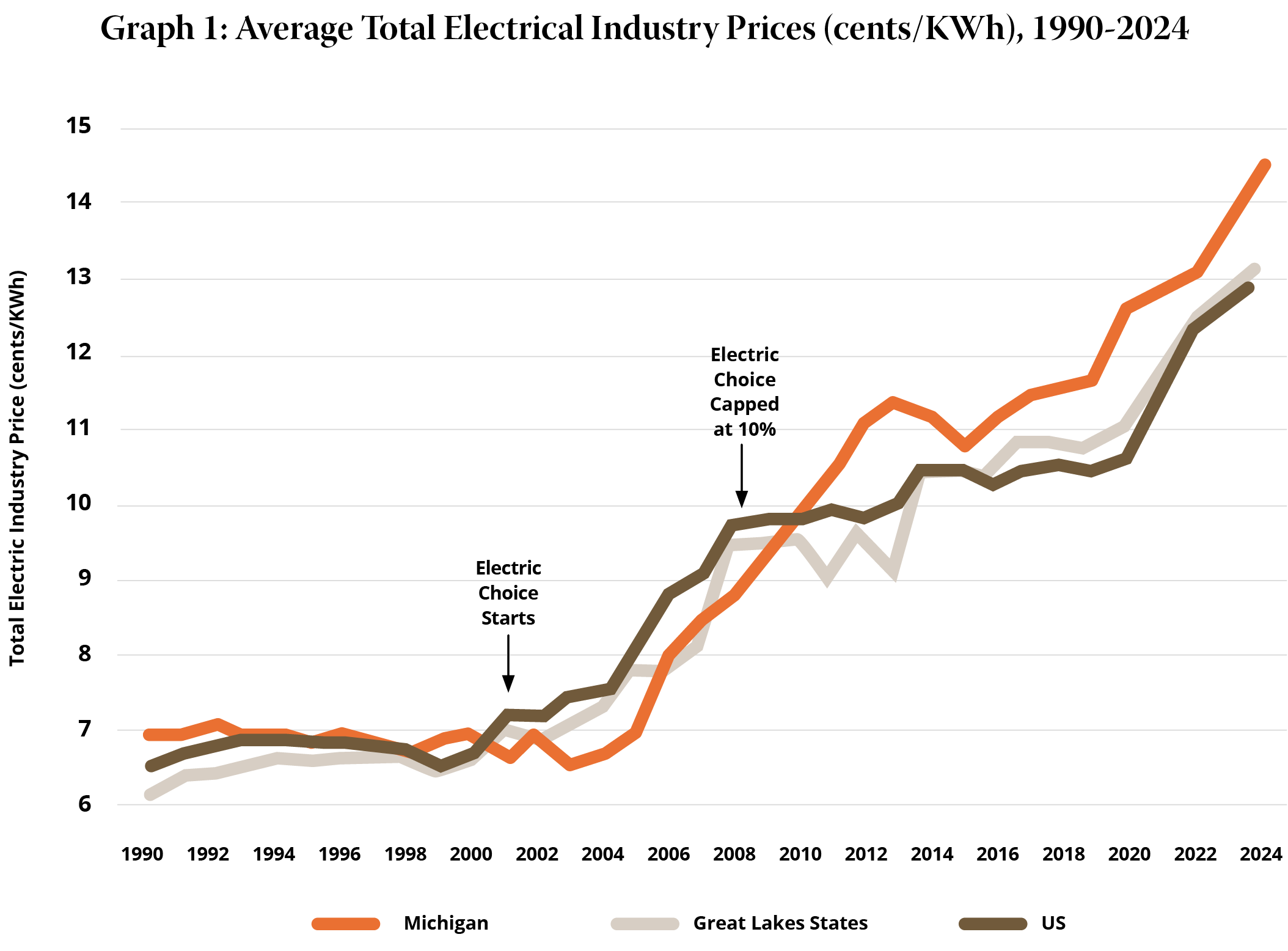
When Michigan approved a policy to allow market competition for electricity generation in 2000, its average rates began to drop relative to prices in the other Great Lakes states and the national average. By the time the policy was fully implemented in 2002, Michigan’s rates had dropped below the U.S. average and almost matched those in nearby states.
| Year | Residential | Commercial | Industrial | Michigan | Great Lakes States | % difference | National | % difference |
|---|---|---|---|---|---|---|---|---|
| 1990 | 7.83 | 8.14 | 5.85 | 7.1 | 6.37 | 11.50% | 6.57 | 8.10% |
| 1991 | 8.06 | 8.19 | 5.89 | 7.21 | 6.55 | 10.10% | 6.75 | 6.80% |
| 1992 | 8.11 | 8.28 | 5.9 | 7.23 | 6.63 | 9.00% | 6.82 | 6.00% |
| 1993 | 8.16 | 8.02 | 5.34 | 7.14 | 6.76 | 5.60% | 6.93 | 3.00% |
| 1994 | 8.28 | 7.93 | 5.25 | 7.09 | 6.8 | 4.30% | 6.91 | 2.60% |
| 1995 | 8.34 | 7.86 | 5.13 | 7.05 | 6.79 | 3.80% | 6.89 | 2.30% |
| 1996 | 8.47 | 7.94 | 5.08 | 7.1 | 6.8 | 4.40% | 6.86 | 3.50% |
| 1997 | 8.57 | 7.84 | 4.97 | 7.04 | 6.8 | 3.50% | 6.85 | 2.80% |
| 1998 | 8.67 | 7.81 | 5.03 | 7.09 | 6.74 | 5.20% | 6.74 | 5.20% |
| 1999 | 8.73 | 7.85 | 5.03 | 7.12 | 6.6 | 7.90% | 6.64 | 7.20% |
| 2000 | 8.52 | 7.9 | 5.09 | 7.11 | 6.77 | 5.00% | 6.81 | 4.40% |
| 2001 | 8.26 | 7.54 | 5.08 | 6.97 | 7.16 | -2.70% | 7.29 | -4.40% |
| 2002 | 8.28 | 7.79 | 5.02 | 7.09 | 7.01 | 1.10% | 7.2 | -1.50% |
| 2003 | 8.35 | 7.55 | 4.96 | 6.85 | 7.23 | -5.30% | 7.44 | -7.90% |
| 2004 | 8.33 | 7.57 | 4.92 | 6.94 | 7.43 | -6.60% | 7.61 | -8.80% |
| 2005 | 8.4 | 7.84 | 5.32 | 7.23 | 7.9 | -8.50% | 8.14 | -11.20% |
| 2006 | 9.77 | 8.51 | 6.05 | 8.14 | 7.91 | 2.90% | 8.9 | -8.50% |
| 2007 | 10.21 | 8.77 | 6.47 | 8.53 | 8.26 | 3.30% | 9.13 | -6.60% |
| 2008 | 10.75 | 9.17 | 6.73 | 8.93 | 9.52 | -6.20% | 9.74 | -8.30% |
| 2009 | 11.6 | 9.24 | 6.98 | 9.4 | 9.52 | -1.30% | 9.82 | -4.30% |
| 2010 | 12.46 | 9.81 | 7.08 | 9.88 | 9.65 | 2.40% | 9.83 | 0.50% |
| 2011 | 13.27 | 10.33 | 7.32 | 10.4 | 9.03 | 15.20% | 9.9 | 5.10% |
| 2012 | 14.13 | 10.93 | 7.62 | 10.98 | 9.71 | 13.10% | 9.84 | 11.60% |
| 2013 | 14.59 | 11.06 | 7.72 | 11.21 | 9.19 | 22.00% | 10.07 | 11.30% |
| 2014 | 14.46 | 10.87 | 7.68 | 11.03 | 10.38 | 6.30% | 10.44 | 5.70% |
| 2015 | 14.42 | 10.55 | 7.02 | 10.76 | 10.48 | 2.70% | 10.41 | 3.40% |
| 2016 | 15.22 | 10.64 | 6.91 | 11.05 | 10.4 | 6.30% | 10.27 | 7.60% |
| 2017 | 15.4 | 11 | 7.19 | 11.28 | 10.78 | 4.60% | 10.48 | 7.60% |
| 2018 | 15.45 | 11.15 | 7.1 | 11.4 | 10.82 | 5.40% | 10.53 | 8.30% |
| 2019 | 15.74 | 11.39 | 7.07 | 11.56 | 10.72 | 7.80% | 10.54 | 9.70% |
| 2020 | 16.39 | 11.77 | 7.49 | 12.37 | 10.95 | 13.00% | 10.66 | 16.00% |
| 2021 | 17.54 | 12.31 | 7.69 | 12.93 | 11.2 | 15.40% | 11.1 | 16.50% |
| 2022 | 17.86 | 12.55 | 8.33 | 13.2 | 12.63 | 4.50% | 12.36 | 6.80% |
| 2023 | 18.84 | 13.4 | 8.16 | 13.68 | 12.87 | 6.30% | 12.68 | 7.90% |
| 2024 | 19.3 | 14.01 | 8.08 | 14.16 | 13.16 | 7.60% | 12.94 | 9.40% |
| 2025 | 20.01 | 14.48 | 8.59 | 14.73 | 14.36 | 2.60% | 12.94 | 13.80% |
Source: U.S. Energy Information Form EIA-861 "Average Price (Cents/kilowatthour) by State by Provider, 1990-2024." 2025 data came from EIA Electric Power Monthly.
Viewed another way, three nearby states also adopted electricity choice around the same time as Michigan but have kept their programs open. Ohio has 58% of its residential customers, 65% of its commercial and 67% of industrial customers participating.[1] In Pennsylvania 24% of residents, 42% of commercial, and 80% of industrial users participate.[2] In Illinois the numbers are 25% for residential and 31% for commercial and industrial combined. Electric choice programs are in healthy demand.
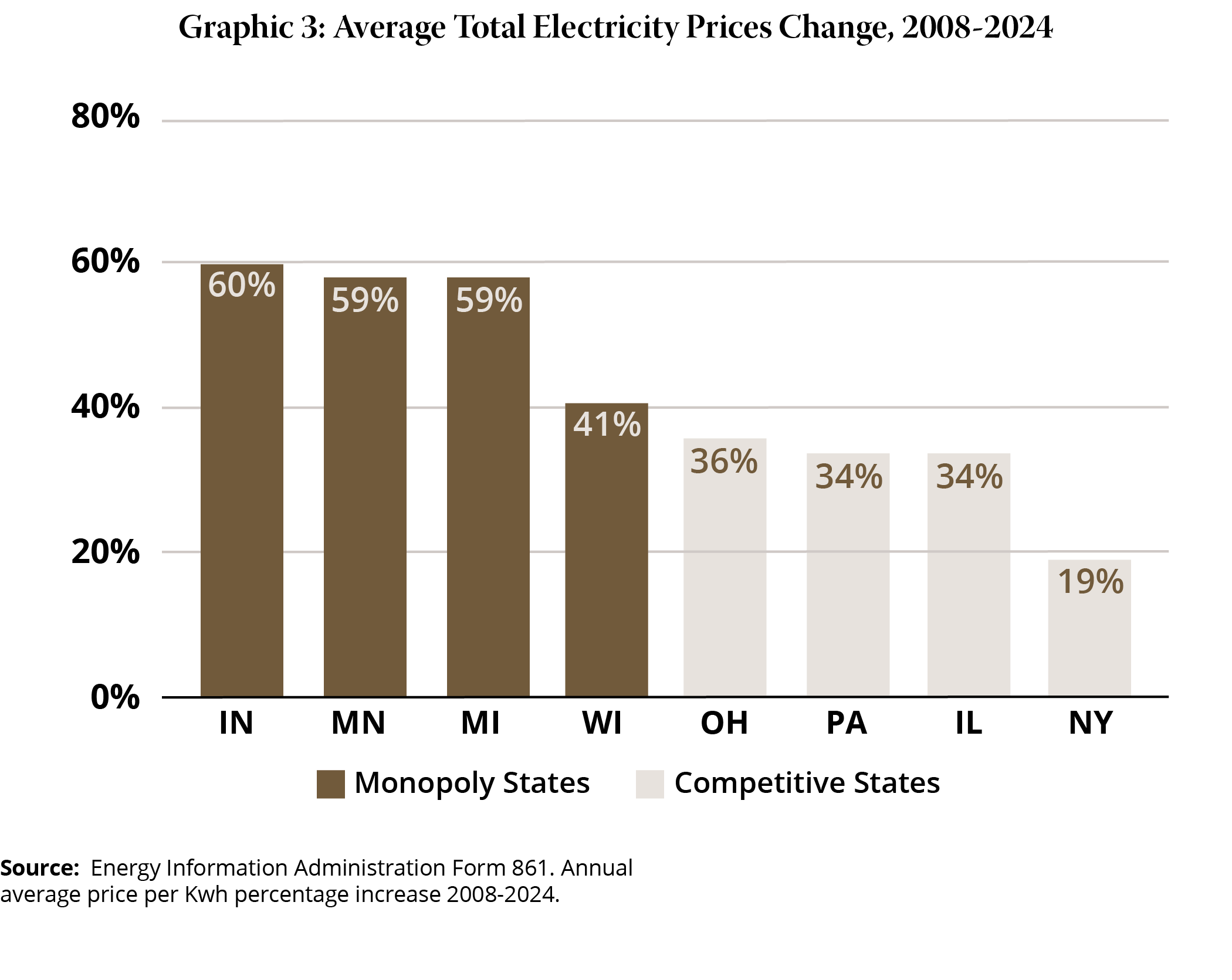
In 2024 residential electricity rates in those three states averaged 16.54 cents per kilowatt-hour while the Michigan rate was 19.30 cents. The average Michigan household uses 7,416 kilowatt-hours a year and pays an extra $205 a year compared to states with electric choice.[3] Since 2008 when the electric choice program was capped, electric rates have risen 59% compared to only about a third for the three nearby electric
choice states.
The states that maintained a full, competitive market on the generation and sale of electricity have fared better on price performance than the states that legalized monopolies. When Michigan created a 90% monopoly for investor-owned utilities, the average electricity price rose above those in nearby states and nationally. It has stayed in that position ever since.
In fact, a recent report on Pennsylvania’s experience found that the lowest retail electricity prices in 2024 were less than they were in 1996, after adjusting for inflation.[4]
[1] Author’s calculations based on data from EIA Table 5.8 and “Electric Choice Aggregation Activity” (Ohio Public Utilities Commission, June 2026), https://perma.cc/L2GF-MELZ.
[2] “PA PowerSwitch Monthly Update - April 2025” (Pennsylvania Public Utility Commission, April 2025), https://perma.cc/7HC9-ZG7C.
[3] Kelly Bedrich, “Average Electricity Bill, Usage and Price per kWh by State (August 2026)” (March 12, 2025), https://perma.cc/ZN25-P5GF.
[4] This includes just fixed-rate prices. John Hanger, “Pennsylvania’s Continued Success: Competition Maintains Low Electric Prices For All Residents” (June 2, 2025), https://perma.cc/J7JB-VQLS.
Rising costs have not resulted in improved reliability for ratepayers. Michigan is the fourth worst state for the number of blackouts and total outage duration from 2008 to 2017, according to the Eaton Blackout Tracker.[5] The System Average Interruption Duration Index combines the frequency of blackouts and the duration. Consumers Energy and DTE were both found to be in the worst performance quartile in a study published by the Michigan Public Service Commission.[6]
Giving regulated utilities a monopoly for 90% of the market did not improve reliability. As a result of the study, the commission ordered the utilities to improve their reliability.[7]
[5] “Eaton Blackout Tracker Annual Report 2018” (Eaton, February 2019), https://perma.cc
[6] “MPSC Releases Utility Audit Results of State’s Two Largest Electric Utilities, Data That Will Help Improve Reliability in Michigan” (Michigan Public Service Commission, September 23, 2024), https://perma.cc
[7] “MPSC Orders Reliability Improvements Guided by Major Audit of Consumers Energy Co., DTE Electric Co.” (Michigan Public Service Commission, June 12, 2025), https://perma.cc
When the Legislature established the current 10% cap on electricity choice in 2008, Michigan's electric system looked very different. Demand had remained relatively flat for years. Large data centers were not yet major electricity consumers, the existing power generation fleet was relatively young or at mid-life, and today's wave of energy-intensive industries — such as semiconductor facilities, battery production and advanced manufacturing — had not yet emerged. These projects require abundant, reliable electricity and long-term price certainty.
At the same time, utilities continue replacing aging generation resources while maintaining reserve margins required by the Michigan Public Service Commission and the Midcontinent Independent System Operator.[8] The result is one of the largest anticipated generation investment cycles in decades, and it is already underway.
For example, Consumers Energy expects 2026 demand to grow to 38 million megawatt-hours and then to increase 2%-3% a year, or to about 42 million by 2030. Consumers Energy plans to spend $8.8 billion over the next five years to build about 5,000 megawatts of new solar generation, 1,500 megawatts of wind power, and 1,500 megawatts of new natural gas power.[9] That amounts to about $1.1 million per new megawatt of generation.
Graphic 4 shows Consumers Energy 2025 generation data and estimates these figures for 2030 based on the utility’s announced plans.
| GENERATION | 2025 | 2030 |
|---|---|---|
| Dan E Karn | 82,624 | 82,624 |
| J H Campbell | 7,669,044 | 0 |
| New Natural Gas | 0 | 6,942,000 |
| Zeeland | 5,314,363 | 5,314,363 |
| Jackson | 1,958,496 | 1,958,496 |
| New Covert | 7,338,967 | 7,338,967 |
| Hydro | 434,845 | 0 |
| Wind | 2,156,052 | 5,758,728 |
| Solar | 6,816 | 8,335,721 |
| Total Generation | 24,961,207 | 35,730,899 |
| Electric choice | 3,645,499 | 4,200,000 |
| Demand | 36,515,417 | 42,000,000 |
| MWh % pf Demand | 78% | 95% |
| New MW | 8,000 | |
| New Investment | $8,800,000,000 | |
| Investment/MW | $1,100,000 |
Source: EIA Form 923, “Status of Electric Competition in Michigan” (Michigan Public Service Commission, February 1, 2026), https://perma.cc
It is unlikely that Consumers Energy's plan for new electricity generation will be built in time to meet the forecasted increase in demand. The utility may struggle with reliability as a result. New natural gas power plants are taking five to seven years to build, so new plants would likely not be available until 2031 to 2033.[10]
Up until 2022 Consumers Energy had built 547 megawatts of wind power and four megawatts of solar.[11] It added 200 megawatts of wind by completing the Heartland Project in 2024.[12]
Consumers Energy’s plan depends on building 1,300 megawatts of new wind and solar per year, two-and-a-half times the five-year, statewide rate. Strong local opposition often deny or delay construction. Large projects rejected locally go to the state commission for approval, but it has approved only one project since 2024.[13]
The rate of wind and solar construction per year in Michigan is shown in the graph below. Total solar power capacity grew by about 35 megawatts per year between 2020 and 2025 and wind by an annual average of about 230 megawatts.
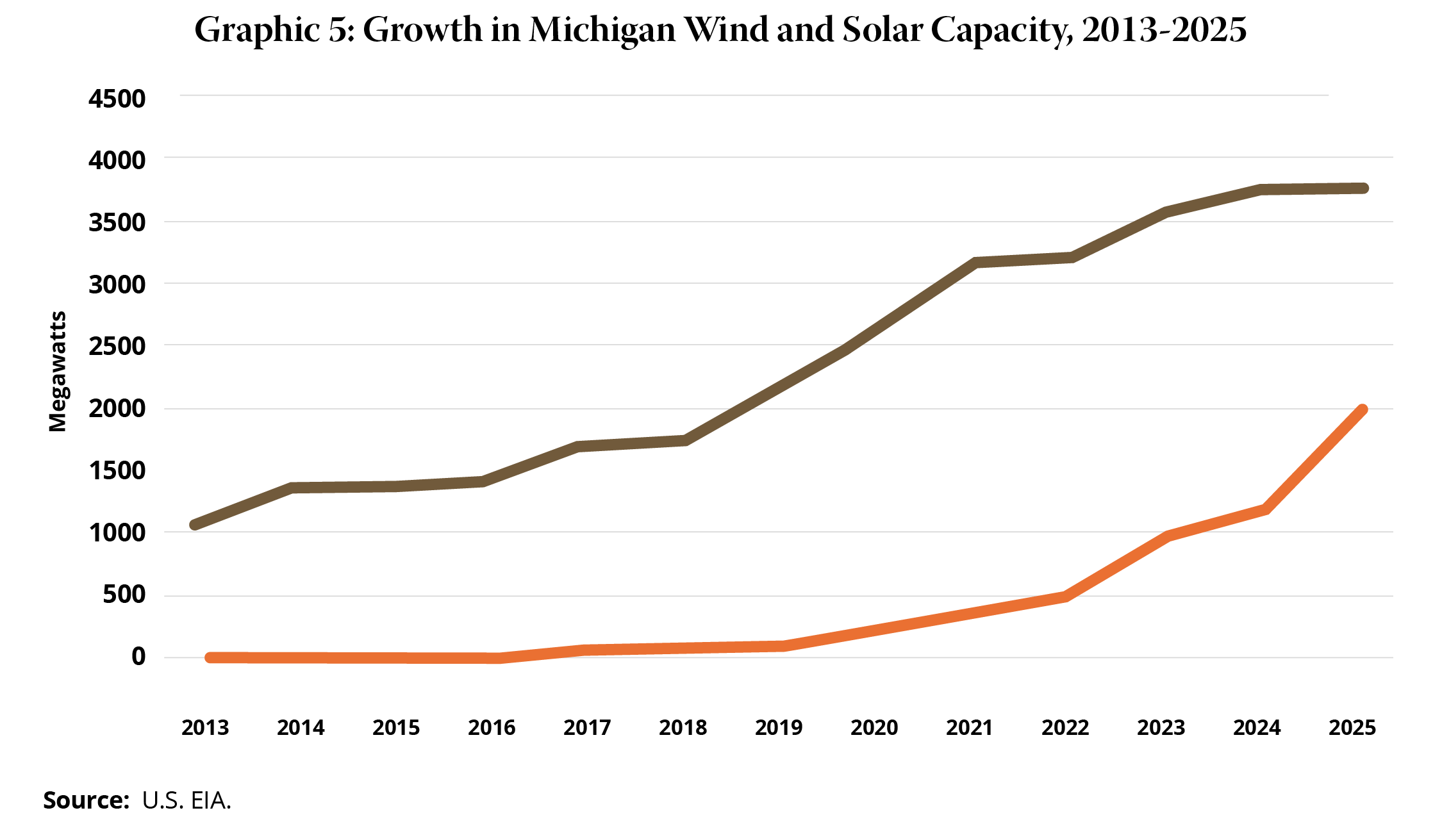
DTE aims to build 1,600 megawatts of wind and solar per year by 2030, about three times the most recent five-year rate statewide.
DTE is plan for 2030 compared to its 2025 position are shown in Graphic 7. DTE expects demand to grow by 27 million megawatt hours by 2030, driven primarily by data centers, according to EAM Vision. DTE expects to invest $30 billion by 2030 to build 2,500 megawatts of battery storage, 8,000 megawatts of wind and solar and 1,500 megawatts of natural gas generation capacity.[14] The planned new generation might total 28.6 million megawatt hours covering expected new demand.
By 2022, DTE had built 1,381 megawatts of wind capacity. It had only 53 megawatts of solar capacity. Over the past three years, it has added just 225 megawatts of wind and 150 of solar.
| DTE | 2025 | 2030 |
|---|---|---|
| Fermi | 9,947,689 | 9,947,689 |
| Monroe | 16,375,217 | 13,755,840 |
| St. Clair | 4,561 | 4,561 |
| Belle River | 6,490,002 | 1,000 |
| Greenwood | 1,249,363 | 1,249,363 |
| Bluewater | 8,350,867 | 8,350,867 |
| Dean | 704,817 | 704,817 |
| Renaissance | 1,234,095 | 1,234,095 |
| Other Natural Gas | 417,756 | 417,756 |
| New Natural Gas | 6,942,000 | |
| Wind | 4,245,834 | 16,692,112 |
| Solar | 412,187 | 4,550,036 |
| Total Generation | 49,432,653 | 63,822,529 |
| Electric Choice | 4,357,885 | 7,150,786 |
| Demand | 44,507,863 | 71,507,863 |
| MWh % of Demand | 121% | 99% |
| New MW | 9,500 | |
| New Investment | $30,000,000,000 | |
| Investment/MW | $3,157,895 |
Source: EIA Form 923, “Status of Electric Competition in Michigan” (Michigan Public Service Commission, February 1, 2026), https://perma.cc
[8] MCL § 460.6t
[9] Brian Martucci, “Consumers Energy Plans over $17B in Capital Spending in next 5 Years” (Utility Dive, February 6, 2026), https://perma.cc/229H-M747; Lucas Smolcic Larson, “Consumers Energy Wants to Build 2 New Gas Power Plants, Scale up Clean Energy” (MLive.com, March 12, 2026), https://perma.cc/L3BZ-QBML; “Michigan Commission Approves Consumers Energy Clean Energy Plan” (T&D World, June 12, 2019), https://perma.cc
[10] Gianna Murphy and Abraham Silverman, “Natural Gas Generator and Energy Storage Timelines in PJM” (Johns Hopkins - Ralph O’Connor Sustainable Energy Institute, May 11, 2026), https://perma.cc
[11] Author’s calculations based on EIA 923 data.
[12] “Heartland Farms” (Cleanview, 2026), https://perma.cc
[13] Blace Carpenter, “Some Green Energy Projects Struggle in Michigan amid Local Opposition” Bridge Michigan (June 3, 2026), https://perma.cc/X8XC-2Z9M; “MPSC Approves Siting Settlement on Ingham County Solar Project, Ensuring Protections, Benefits for Impacted Communities” (Michigan Public Service Commission, August 27, 2026), https://perma.cc
[14] Darren Holt, “DTE’s Data Center Gamble: 25% Load Growth in One Deal” (EAM, November 2, 2025), https://perma.cc
Under Michigan's current model, the costs of producing more utility-owned generation are paid by increased electricity rates. Those costs generally include construction or acquisition, financing, operations and maintenance, depreciation, taxes, and an authorized return on equity, or profit, for the utilities.
Michigan does not need to create a new plan to diversify how future electricity supply is financed. Michigan's existing Electric Customer Choice Program provides an option. Participating commercial and industrial customers can procure electricity through licensed Alternative Electric Suppliers, allowing private capital — not utility ratepayers — to finance the generation needed to serve those customers.[15]
The electricity is still produced. Utilities continue providing transmission, distribution, default service, and reliability. All that changes is who finances a portion of the new generation needed.
The program is not a proposal. It is an established part of Michigan's electric system.
[15] “Status of Electric Competition in Michigan” (Michigan Public Service Commission, February 1, 2026), 4, https://perma.cc
There are currently 20 licensed Alternative Electricity Suppliers primarily serving large electricity users, including commercial, industrial, and school systems. Only seven suppliers are actively supplying electricity to Michigan customers. They serve only a “negligible” number of residential customers, according to the Michigan Public Service Commission.[16]
Constellation Energy serves about half of choice customers (54%), while Calpine (19%) and Direct Energy (18%) supply a little more than a third of the market. Alternative supplier CMS ERM MI serves another 7%, and three small suppliers provide for the remaining 2% of customers. Constellation recently acquired Calpine so Constellation’s share could grow to 72% of the market.[17] All the suppliers already offer power with zero carbon dioxide emissions to meet Michigan "net-zero" goals. Licensed suppliers must follow the following rules:
Demonstrate adequate generation resources to meet needs four years forward.
Supply transmission and generation services while regulated utilities maintain local distribution services.
Customers cannot be forcibly enrolled or switched to alternative suppliers.
Choice customers must give reasonable notice to return to regulated utility service.
Electric bills must be clear and itemized.
Contracts must show any early termination fees and service terms.
[16] “Status of Electric Competition in Michigan” (Michigan Public Service Commission, February 1, 2026), 4, https://perma.cc
[17] “Constellation to Acquire Calpine; Creates America’s Leading Producer of Clean and Reliable Energy to Meet Growing Demand for Customers and Communities” (Constellation, January 10, 2025), https://perma.cc
Michigan passed a law in 2000 that allowed all retail electricity customers to choose their energy supplier beginning in January 2002. It also required investor-owned utilities to use private capital, not ratepayer dollars, if they continued to build, own and operate power plants.
That meant that electric customers could shop around for other options from a list of suppliers certified by the Michigan Public Service Commission. The utilities would have to compete with other companies to provide the best power generation.
But, only a few years later, in spite of the program’s success in reducing rates, the Legislature reinstated the investor-owned utility monopoly over 90% of the retail electricity market.[18] This allowed the utilities to again build power plants and recover those costs, plus return on equity, from ratepayers, without the need to compete for all but 10% of customers in their service territories.
The customers in the capped choice program purchase electric supply outside of the utility while still paying all other costs related to transmission and distribution to the investor-owned utility.
If the program is fully subscribed, customers may join a waiting list managed by the Michigan Public Service Commission. There were 5,518 electric customers participating in the electric choice in 2025, with 5,101 on waiting lists.[19] While significant, this does not represent the full interest in this program, but rather just those willing to go through the process to wait in the queue.
Participating customers rarely leave the program. If all the waiting list customers were accepted, the program would grow from the 10% of utility sales to 18% on average.[20]
| Description | Consumers Energy | DTE | Indiana Michigan Power | Upper Peninsula | UMERC | Cloverland Cooperative | Total |
|---|---|---|---|---|---|---|---|
| Weather Adjusted Sales | 36,515,417 | 44,732,199 | 2,957,236 | 675,524 | 2,053,842 | 792,985 | 87,727,203 |
| Participation Level | 3,645,499 | 4,357,885 | 318,289 | 84,430 | 237,562 | 71,511 | 8,715,176 |
| Participation % | 10% | 9.74% | 10.76% | 12.50% | 11.60% | 9% | 10% |
| Customers in Service | 957 | 4,390 | 48 | 64 | 57 | 1 | 5,517 |
| Customers in Queue | 3,009 | 2,030 | 31 | 29 | 2 | 0 | 5,101 |
| Total Load in Queue | 5,206,828 | 1,583,781 | 92,108 | 23,112 | 78,220 | 0 | 6,984,049 |
| % without cap | 24.24% | 13.88% | 13.88% | 15.90% | 15.40% | 9% | 18% |
Source: “Status of Electric Competition in Michigan” (Michigan Public Service Commission, February 1, 2026), https://perma.cc
[18] “Public Act 286 of 2008” (State of Michigan, October 6, 2008), https://perma.cc
[19] “Status of Electric Competition in Michigan” (Michigan Public Service Commission, February 1, 2026), 2, https://perma.cc
[20] “Status of Electric Competition in Michigan” (Michigan Public Service Commission, February 1, 2026), https://perma.cc
For many manufacturers, hospitals, universities, retailers, schools, and other large employers, electricity is a large operating expenses. Alternative Electric Suppliers provide customers with procurement options that traditional bundled utility chose not to provide, including:
Long-term fixed-price contracts.
Customized procurement strategies.
Nuclear power.
Demand response programs.
Flexible risk management tools.
These services allow customers to better manage electricity costs while aligning procurement with long-term business planning.
In 2024, participating customers saved more than $185 million in generation costs compared to what they would have paid to monopoly utilities.[21] The Michigan Schools Energy Cooperative aggregates schools into a pool for increased buying power. For the schools that were able to get into the 10% cap in each service territory, from 2008-2016, it helped Michigan school districts save over $121.4 million in electric costs.[22]
[21] Author’s calculations based on EIA Form 861 data.
[22] “A Policy Guide to Energy Choice in Michigan” (Mackinac Center for Public Policy, 2021), https://www.mackinac.org
A common misconception about the Electric Customer Choice Program is that participating customers leave the utility system and no longer contribute to the electric grid. That is not the case. Customers continue paying the utilities for the cost of transmission, distribution, energy efficiency programs, and other regulated charges approved by the Michigan Public Service Commission. Utilities continue operating the electric grid, maintaining reliability, and providing default service.
The only difference is how participating customers procure the generation portion of their electric service. This distinction is important because it demonstrates that Michigan already has a framework capable of supporting greater private investment without changing the state's vertically integrated utility model.
Michigan's Electric Customer Choice Program is no longer an experiment. After more than two decades of successful operation, it has demonstrated that private capital can finance electricity supply for participating customers while utilities continue providing reliability services to the program participants.
When more customers finance their own electricity supply, the amount of new generation needed to be financed by all ratepayers is reduced.
Most discussions of Michigan's Electric Customer Choice Program focus on the benefits received by the customers who participate. Those benefits are real. Participating customers save money and gain access to customized energy products that help them better manage long-term electricity costs and risks. But those are not the only customers who benefit.
The program benefits every household, small business, school, local government, nonprofit organization, and other customers who remain on bundled utility service. When a customer purchases electricity through a licensed Alternative Electric Supplier, the utility no longer must build or procure as much generation to serve that customer's demand. That means the rest of the utility's customers do not have to finance that generation through electric rates.
The electricity is still produced, and the utility still delivers it. Reliability rates do not change, and utilities are still compensated for providing these services. The only change is who pays to supply the generation, and that distinction drives the central argument in this report.
Approximately 2,172 megawatts of demand in 2025 was served through Michigan's Electric Customer Choice Program, which was capped at 10%.[23] Utilities did not need to build or procure generation for this demand. Instead, those customers financed the generation portion of their electric service through private contracts with licensed Alternative Electric Suppliers. They are paying their own way, instead of having the costs to serve them spread across all ratepayers (plus the utility’s return on equity).
To put that in perspective, 2,172 megawatts is approximately equivalent to the output of three modern combined-cycle natural gas power plants. Supplying an equivalent amount of new utility-owned generation today would likely require approximately $3 billion to $4 billion in regulated utility investment, depending on the technologies ultimately selected.
Under Michigan's utility model, those investments would be recovered through customer electric rates over the life of the assets or contracts, including financing costs, depreciation, operating expenses, taxes, and an authorized return on equity.
Because those customers procure their own electricity supply, that generation has not had to be financed through utility rates for those customers. In other words, households, small businesses, schools, local governments, and every other bundled utility customer already have less utility generation to finance because the existing program is in place.
[23] “Status of Electric Competition in Michigan” (Michigan Public Service Commission, February 1, 2026), 2, https://perma.cc
Michigan's investment needs have expanded, but the cap on electric choice restricts the benefits of the program expanding to help meet Michigan’s future energy demand at affordable prices.
Since the current 10% participation cap was established in 2008, Michigan's investor-owned utilities have:
Added or contracted for approximately 7,300 megawatts of new generation and capacity resources.[24]
Identified more than $12 billion in publicly available generation investments and long-term contractual commitments.[25]
Continued proposing additional generation.
These investments were made to maintain reliability under Michigan's existing regulatory framework. However, they also illustrate the scale of generation investment that may have been financed differently had more commercial and industrial customers been permitted to procure electricity through Michigan's existing Electric Customer Choice Program.
Michigan could have mitigated rate increases over the last decade by simply expanding the program. As utilities prepare for another major generation investment cycle, modernizing this existing program provides an opportunity to shift billions of dollars of future generation investment from regulated utility financing to private capital — reducing the amount of future utility-owned generation that the rest of Michigan's ratepayers must finance.
[24] Estimates based on author’s calculations of EIA Form 860 data, MPSC orders, utility filings and Integrated Resource Plans, and other publicly available records.
[25] Estimates based on author’s calculations of EIA Form 860 data, MPSC orders, utility filings and Integrated Resource Plans, and other publicly available records.
The information in this section is informed by Integrated Resource Plans, rate cases, and other filings submitted to the Michigan Public Service Commission by Michigan's investor-owned utilities.
Collectively, those filings project:
Continued retirement of existing generating resources.
Growing electricity demand.
Significant investment in new generation and purchased power.
Continued recovery of approved investments through customer rates.
Michigan's investor-owned utilities are planning approximately 30 gigawatts of new wind and solar generation, and storage over the next two decades. DTE alone expects to invest roughly $30 billion in its electric system between 2026 and 2030, while Consumers Energy has announced a new resource plan that includes adding more than 13 gigawatts of wind, solar and batteries, supported by 1.5 gigawatts of new natural gas generation, over the next two decades.[26]
These costs are specific to investments in new power generation and do not include other significant costs increases all ratepayers will bear over the next 20 years for:
Transmission.
Distribution.
Information technology.
Vegetation management.
Reliability investments.
There are two primary drivers for the need for new power generation:
To replace the existing power generation that is retiring that serves customers today.
To serve increases in customer demand.
[26] “Energy Supply Plan | Consumers Energy” (Consumers Energy, 2026), https://perma.cc
Approximately six gigawatts of existing power generation is scheduled to retire and will need to be replaced over the next two decades. Utilities must choose between investing to extend the life of existing plants or replacing them with new generation, storage, or long-term power purchase agreements. Both approaches require significant investment and involve tradeoffs between cost, reliability, and long-term system planning. Both approaches will require significant funding from all ratepayers.
Every major generation project carries uncertainty:
Under the traditional utility model, many of these risks are ultimately reflected in customer rates through cost recovery approved by the Michigan Public Service Commission. This might result in ratepayers paying for decades for a generation asset that has inefficient or outdated technology. It might also result in stranded costs, if some generation become redundant or useless before ratepayers are down paying for it.
Under the existing Electric Customer Choice Program and a customer-directed procurement model, a larger share of these risks is assumed by private investors and participating customers. The electricity is still generated. Those customers still receive supply. Additional investments are made in power generation. What changes is who finances — and bears the financial risk associated with — new power generation.
Large generation projects routinely involve significant financial uncertainty. Projects such as Plant Vogtle in Georgia demonstrate that cost escalation and schedule delays can occur despite prudent planning. The original cost estimate was $14 billion but actual cost reached almost $37 billion.[27] These examples are not predictions for Michigan, but they do illustrate a broader policy principle: When utilities finance generation, customers ultimately bear much of the long-term investment risk. When generation is financed privately, much of that risk shifts to private investors and participating customers instead.
[27] Paul Hockenos, “The Billion-Dollar Boondoggle: How Vogtle Became the US’s Monument to Nuclear Folly” (EnergyTransition.org, April 29, 2026), https://perma.cc
The following analysis illustrates how expanding Michigan's Electric Customer Choice Program could reduce future utility-owned generation investment while preserving Michigan's existing regulatory framework. Significant investments, financed by ratepayers, are needed to replace retiring generation and meet demand.
Based on historical Michigan utility generation costs:
Expanding participation to 20% could have shifted approximately $3.5–$4 billion of generation investment from utility financing to private capital.
Expanding participation to 30% could have shifted approximately $7–$8 billion of generation investment from utility financing to private capital.
Those estimates are illustrative, but they demonstrate that financing decisions can materially affect the amount of utility generation recovered through electric rates.
| Scenario | Current 10% Cap | Expanded 30% Cap |
|---|---|---|
| Forecast new load | 4,130 MW | 4,130 MW |
| Baseline growth | 2,750 MW | 2,750 MW |
| Announced hyperscaler datacenter load | 1,383 MW | 1,383 MW |
| Planned retirements | 5,916 MW | 5,916 MW |
| Total new generation need | 10,050 MW | 10,050 MW |
| Generation financed by private customers | 2,172 MW | 6,500 MW |
| Remaining utility generation obligation | 7,878 MW | 3,550 MW |
| Illustrative utility investment that will still need to be financed through rates | $12.9 billion | $5.8 billion |
| Illustrative avoided generation investment for ratepayers | — | $7.1 billion |
| Reduction in utility investment financed through rates | — | 55% |
Under an expanded 30% electric choice program, Michigan could meet projected load growth and retirements while avoiding an estimated $7.1 billion in utility generation investment that would otherwise be recovered in part by ratepayers.[28]
[28] These estimates for this 2035 scenario are based on publicly available utility Integrated Resource Plans, other announced plans, and MPSC filings. Total new generation need equals projected load growth (including publicly announced large-load customers where identified) plus planned retirements. The 30% scenario assumes Electric Choice participation expands proportionally from approximately 2,172 MW today to approximately 6,500 MW of privately financed generation. Illustrative utility investment financed through rates estimates the amount of new utility-owned generation that would still need to be recovered from ratepayers under each scenario by applying the historical average cost per megawatt of Michigan IOU generation additions and long-term PPAs since 2008 to the remaining utility generation obligation. This analysis is intended to illustrate the relative amount of future utility investment that could be financed by private customers rather than recovered from all ratepayers.
Michigan's electric system will require substantial new investment regardless of the policy path chosen. This report argues that Michigan can diversify how a portion of that investment is financed by building upon an existing program that has successfully operated for more than two decades while preserving utility responsibility for reliability and Michigan's vertically integrated regulatory framework.
The following recommendations modernize — not replace — that framework.
Lawmakers should increase the statutory participation cap from 10% to 30%, either immediately or through phased implementation.
Why: Allow more commercial and industrial customers to finance their own electricity supply, reducing future utility-owned generation investment recovered through electric rates.
Policymakers should require Integrated Resource Plans to account for expected participation in the Electric Customer Choice Program when forecasting future generation needs.
Why: Utilities should plan for the customer load they are expected to provide, improving planning accuracy and reducing the potential for unnecessary generation investment.
Michigan policymakers should allow Alternative Electric Suppliers to satisfy Renewable Energy Standard obligations using qualifying resources located throughout the MISO region.
Why: A regional approach expands procurement options, increases competition and better reflects how electricity is produced and delivered across the regional transmission system.
Lawmakers should modernize Michigan's Electric Customer Choice Program before additional long-term generation investments are approved.
Why: Once major generation projects are financed and placed into service, opportunities to finance those resources differently become increasingly limited.



