

 Font size:
 By Jack Belcher
Two new Michigan House bills backed by the American Civil Liberties Union seek to ease concerns about license plate readers by limiting how the government can use the data networked camera systems acquire. The bills also impose transparency rules on government agencies.
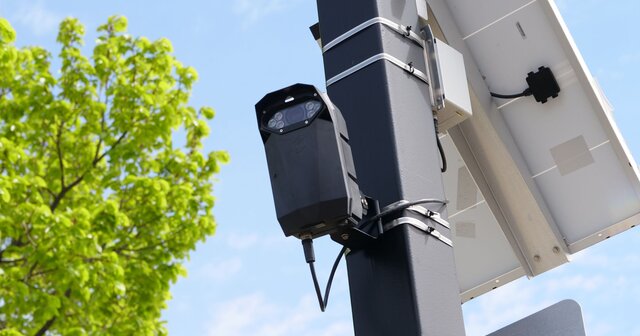
Automatic license plate readers are widely deployed in Michigan, but these systems are coming under increasing fire from opponents of government surveillance. The ACLU, Electronic Frontier Foundation, Institute for Justice, and other groups have reported on potential security breaches, improper installation, and misuse of networked surveillance by rogue police officers. The Los Angeles Police Department, citing “serious concerns” about privacy and civil liberties, will allow its contract with Atlanta-based Flock Safety to expire in mid-July, according to multiple news reports.
In January, the ACLU and allied organizations helped get Michigan House bills 5492 and 5493 to the Legislature. These bills seek to regulate how police departments can use data collected by the devices, often referred to as “Flock ALPRs.”
The bills also seek to prevent government access to the data, usually maintained by the system operator, without a warrant. HB5492 allows the government to ask Flock and other camera companies to preserve data for at least 14 days after the date it specifies. This would apply if the information requested were proven to a court of competent jurisdiction to be relevant to an ongoing investigation or court case. If a governmental body obtained information without first satisfying legal requirements, the person whose data was captured could sue for $1,000.
HB5493 is a companion measure that imposes requirements on how a unit of government uses the data. Governments that rely on data from plate readers must, under this bill, post policies on usage, data deletion and other matters. The bill declares that government agencies may use this technology only to enforce parking rules, identify uninsured and stolen vehicles, and assist with matters and materials relevant to ongoing criminal investigations.
The two bills are tie-barred, meaning one cannot pass without the other. They remain in the House Committee on Judiciary.
Flock, the industry leader, was created to support community policing, the company says on its website. By 2019 it had captured 10 million images in a single day. By 2020 it helped solve its first AMBER Alert, and by 2024 the company’s technologies were so widespread that they helped solve more than 10% of all crimes committed nationwide, according to Flock.
There is no single account for the number of Flock and similar cameras in use. Users of the website DeFlock have reported more than 106,000 such cameras in the United States and about 4,000 in Michigan. More than 125 cities and counties in Michigan use Flock or a similar company, according to Bridge Michigan.
Flock sells more than automatic plate readers, according to its website. It also offers AI-powered video cameras, mobile security trailers and drones, which customers often pair together. A suburb of Columbus, Ohio, for example, pairs Flock’s critical sound detection systems with plate readers.
Flock’s automatic plate readers are more technologically advanced than earlier police cameras. Unlike those cameras, Flock systems can convert routine observations into coordinated searchable databases, which they supply to law enforcement. Rather than simply recording a specific geographic area, they capture and store information on a vehicle’s make and model, color and license plate number. They also record the time a vehicle passes by, and often its speed. This information is then uploaded into searchable data collections that law enforcement can easily access and use to investigate a variety of crimes. Flock advertises its products as a connected ecosystem of data management that allows for “acting in real time, not after the fact.”
In a section of its website called “Solved Stories Public Sector,” the company maintains that its products, including plate readers, help law enforcement prosecute existing crimes and prevent future crimes. In Shelby Township, Michigan, the site claims, police used Flock products to identify a stolen vehicle and arrest a suspect in a double homicide.
Flock systems have faced a skeptical reception in some quarters. Residents in Pontiac and Kalamazoo have raised concerns about their respective local governments’ contracts with Flock. After the Oakland County Board of Commissioners in April approved a Flock contract with the county sheriff, opponents condemned the program in a spirited six-hour comment period. While these communities failed to prevent officials from approving contracts, residents in Ferndale and Bay City succeeded.
The American Civil Liberties Union closely monitors Flock systems and criticizes the company’s licensing rules. The ACLU posts significant changes Flock has made to its terms and agreements, including language addressing data protection, and claims that Flock has failed to give citizens the accurate data it promised.
Some of the new terms expand Flock’s legal rights to use and retain the data it collects — granting it a perpetual license to use stored data even if its relationship with a city ends. The new terms also enhance Flock’s legal protections, making it increasingly difficult to prosecute the company criminally. These changes were published in February 2026. According to critics, the changes suggest that Flock is making it difficult to hold these automated plate readers — and the company that operates them — accountable under the law.
The current legal debate around plate readers, including Flock’s, centers around whether an individual can have a “reasonable expectation of privacy” in public spaces, such as on roadways, or in using cellphones. The 2018 Supreme Court case Carpenter v. United States considered whether government could use historical cellphone tower data or location information from carriers without a warrant supported by probable cause.
The high court determined that the data provided a map of an individual’s movements that could reveal extremely sensitive information about a person’s life beyond easily obtainable information involving movement and attendance patterns. The majority concluded that government agencies would need a search warrant to access any Flock location data.
The ruling was intentionally narrow and didn’t address plate readers. But it showed that the Supreme Court considers certain types of modern information gathering to be intrusive enough to require a warrant supported by probable cause. The limits on tracking enabled by plate readers may reach that court in a few years.
The Supreme Court addressed another controversy involving personally identifying data in the recent case Chatrie v. United States. Police had used cellphone data and a geofence warrant to ask Google to identify devices that had been in a specific area within a certain time frame. From there, police identified approximately 20 users who had been in the location when a crime took place.
The court ruled that, once again, cellphone data was highly revealing of a person’s movements and actions, implicating privacy concerns. By a 6-3 vote, the court decided that the police had conducted a Fourth Amendment search by obtaining a warrant. Its decision suggests that individuals have a reasonable expectation of privacy regarding detailed location information. But the court did not decide if the search was unreasonable and sent that question back to the lower court.
Lawsuits involving plate readers have been surprisingly rare. In the 2026 Mississippi case United States v. Porter, a federal appeals court held that the use of plate readers was not a Fourth Amendment search and thus did not require a warrant. The court’s rationale was that the cameras collected only limited location data with a small, fixed number of cameras and thus did not reach the level of intrusiveness required to constitute a Fourth Amendment violation. This ruling suggests that courts could determine that broader and denser surveillance measures raise strong Fourth Amendment concerns. With the number of readers growing exponentially, courts will soon have to decide what this threshold will be.
Each day, public officials consider whether to use automated license plate readers, so citizens need to educate themselves on how they work and what safeguards should apply. The bills introduced earlier this year in the Michigan Legislature are a step in the right direction. Michigan has a unique opportunity to become a national leader by honoring citizens’ concerns, ensuring this new technology does not violate Fourth Amendment freedoms.
Get insightful commentary and the most reliable research on Michigan issues sent straight to your inbox.

The Mackinac Center for Public Policy is a nonprofit research and educational institute that advances the principles of free markets and limited government. Through our research and education programs, we challenge government overreach and advocate for a free-market approach to public policy that frees people to realize their potential and dreams.
Please consider contributing to our work to advance a freer and more prosperous state.


