

 Font size:
The state government now spends $1.8 billion more on transportation than it did when Gretchen Whitmer entered office, a 30% increase when adjusted for inflation. This level means roads will likely be repaired faster than they fall apart. Yet the governor deserves little credit for the solution and plenty of blame for years of holding the road fix hostage to her quest for higher taxes.
Gov. Whitmer vetoed additional road funding, pretended fake solutions would address the problem and refused to press her Democratic allies in the Legislature for more road funding when they held majorities. Lawmakers got to a road funding goal despite her recommendations, not because of them.
Whitmer’s first proposal to increase road funding was to raise fuel taxes. This would have increased taxes by $2.5 billion and spent $1.9 billion on transportation, with $600 million going to other priorities.
The Legislature, then controlled by Republicans, did not approve her plan. Whitmer asked them to devise a different $2.5 billion tax hike if they did not like hers. “Show me the plan. If you don’t have one, let’s get serious about talking about this one, because it is real,” she said at a March 25, 2019, press conference in DeWitt.
The governor also posted an image on social media networks, including Facebook.
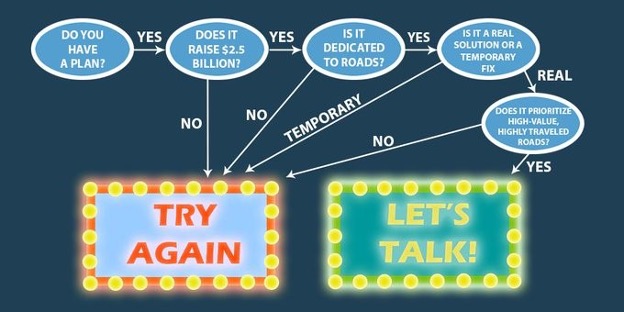
Legislators did not give her a $2.5 billion tax hike. Instead, they found $375 million more to spend on roads — without raising taxes. Whitmer vetoed the funding.
The following year she took the state into debt to pay for extra road repair. All told, Whitmer issued $2.8 billion in bonds for the purpose. The bondholders are paid with money that would otherwise be spent on roads, plus interest costs. Extra debt results in fewer resources available for long-term road funding.
Debt-financed repairs improve road quality over the short term at the expense of the long term. The state’s problem was that it did not spend enough money to fix roads faster than they fall apart over the long term, so debt makes the problem worse.
Not much happened in state road funding policy between 2019 and 2025. The federal government increased its road funding as part of COVID-19 pandemic relief, and it has remained at elevated levels.
Whitmer had a chance in 2023 to act when Democrats took majorities in both the Michigan House and Senate. She no longer had Republican-led chambers to stymie her proposals. Yet she did not advocate any tax hikes for roads, and both budgets enacted during the Democratic trifecta had little extra money for transportation.
Republicans took a majority in the House in the 2024 election and set out to do something that had been discussed for a long time: change the tax code as it relates to fuel. Michigan was a rare state that levied per-gallon taxes on fuel and an additional sales tax on the sale of fuel. The per-gallon tax was designated for transportation while sales taxes were earmarked for education. This left the state with the 6th-highest tax on fuel but without commensurate road funding. Republicans voted to replace the sales tax levied on fuel with a per-gallon tax on fuel, increasing road funding by substituting one tax for another.
House Speaker Matt Hall insisted on getting a road funding package as part of a budget deal. Democrats said that they would do this if the package included a tax hike, any tax hike. Republicans agreed to raise marijuana taxes.
The deal will increase road funding by $2 billion when phased in, and only $400 million will come from tax hikes. Exempting fuel purchases from sales taxes might have meant less funding for education, but lawmakers found more money for schools as well.
Michigan can now get to the point where roads are fixed faster than they fall apart. It is on a pace to keep improving roads steadily over the long term. After 15 years of debate on road funding, it looks like lawmakers finally made it to the goal.
The question is how much credit goes to Whitmer. She asked for more spending on roads and didn’t veto an increase when the Republicans’ budget delivered it. It was her preference to raise taxes to pay for roads rather than use the state’s existing resources. It was Hall’s preference to fix roads without raising taxes. Both officials compromised. Eighty percent of the money came without tax hikes and 20% came from tax hikes. So 20% credit seems appropriate for Whitmer.
Get insightful commentary and the most reliable research on Michigan issues sent straight to your inbox.
The Mackinac Center for Public Policy is a nonprofit research and educational institute that advances the principles of free markets and limited government. Through our research and education programs, we challenge government overreach and advocate for a free-market approach to public policy that frees people to realize their potential and dreams.
Please consider contributing to our work to advance a freer and more prosperous state.


