

 Font size:
More than a dozen bills are pending in the Michigan Legislature to expand regulation of the electricity industry and to impose new environmental requirements on energy production and sales. As a group, these legislative proposals assume the necessity of government intervention in the production and distribution of energy. This report details the drawbacks for consumers and the economy of substituting political forces for market forces in electricity service.
A series of bills in the Michigan Legislature would increase regulation of the state’s electricity industry, decrease competition between suppliers and mandate greater use of "renewable energy," such as solar, wind and hydroelectric power. Such regulation would mark a departure from the mild deregulation of electricity markets initiated by the Legislature in 2000, when passage of Public Acts 141 and 142 permitted new competition among electricity suppliers.
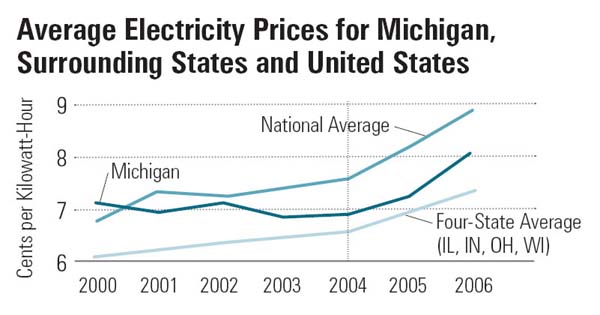
These reforms were meant to reduce the state’s historically high electricity costs and improve service to consumers. At first, the new laws achieved these goals. From 2000 to 2004, industrial and commercial electric rates fell by approximately 3 percent and 4 percent respectively in Michigan, while rising by about 13 percent and 10 percent nationwide. The state’s average rates for all customers displayed a similar trend.[*] Just as telling, Michigan’s electricity prices, which are typically higher than those of Illinois, Indiana, Ohio and Wisconsin, fell enough to diminish the gap and make the state more competitive with its neighbors.
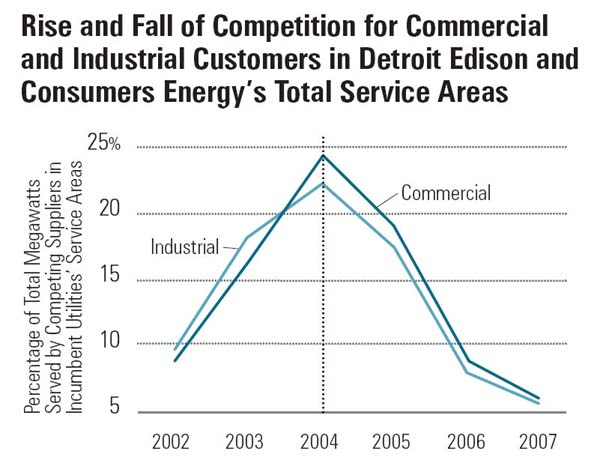
These trends ended after 2004. State government began providing a large subsidy to the "incumbent utilities" — Detroit Edison and Consumers Energy — in the form of a state loan guarantee backed by a surcharge on their own and their competitor’s customers. This infusion of cash, meant to indemnify the incumbents against possible losses from competition and compensate the companies for the cost of regulatory mandates, undercut the price advantage of their competitors, who were simultaneously hit by rising natural gas prices. The nonincumbents’ market share, which had been skyrocketing, plummeted, and Michigan’s electricity prices started rising once again.
Source: Michigan Public Service Commission.[†]
Note: Data for 2007 does not include December 2007.
Source: U.S. Energy Information Administration.[**]
One proposed House bill would cap nonincumbent sales at 10 percent of an incumbent supplier’s previous year’s sales. Proponents argue that incumbents need a guaranteed market share to finance new generating facilities. Still, power companies nationwide have financed new generating facilities in competitive markets; LS Power, a nonincumbent, plans to invest $2 billion in a new plant in Midland. Nonincumbents have also shown they can meet rapidly growing demand: Their share of Detroit Edison’s customer base increased by nearly 104 percent annually between 2001 and 2004, reaching 17,341 customers and 2,378 megawatts of load.
Others bills would force electric companies to provide a certain percentage of their power through renewable energy. While there is no reason to object to the private development of such energy, a state mandate would lessen the market pressure on renewable energy providers to reduce the cost, inefficiency and environmental impact of their product. The mandate would also disadvantage suppliers that use other fuels, such as natural gas, and raise electricity rates for Michigan residents and businesses already pinched by a weak economy. Michigan’s electricity markets have been trending toward cleaner fuels without renewable energy mandates; between 1990 and 2006, the percentage of Michigan’s electric capability fired by coal declined by 22 percent.
Instead of mandating costlier energies and turning toward monopolized markets, policymakers should expand Michigan’s limited experiment with deregulation. Specifically, they should stop providing incumbent utilities with the large subsidies that have undermined competition;[‡] eliminate capacity mandates that unnecessarily burden incumbent utilities and reduce their competitiveness; and terminate regulatory cross-subsidies that favor residential customers, discourage residential energy conservation and reduce competition in the residential marketplace. The evidence indicates that competition will be more effective than regulated monopolies at providing clean, reliable and inexpensive energy.
[*] Less change occurred in residential electrical rates, partly because residential rates remained regulated at an artificially low price, discouraging competition.
[†] Authors’ calculations based on Orjiakor N. Isiogu, Monica Martinez, and Steven A. Transeth, "Status of Electric Competition in Michigan: Report for Calendar Year 2007," (Michigan Public Service Commission, Department of Labor & Economic Growth, 2008), Chart 3, Chart 5, www.dleg.state.mi.us/mpsc/electric/restruct/reports/compreport2007.pdf, (accessed May 9, 2008).
[**] "Electric Power Annual 2006 - State Data Tables: 1990 - 2006 Average Price by State by Provider (EIA-861)," U.S. Energy Information Administration, www.eia.doe.gov/cneaf/electricity/epa/epa_sprdshts.html (accessed May 10, 2008).
[‡] The subsidies are known in the industry as "stranded-cost recovery."
More than a dozen bills are pending in the Michigan Legislature to expand regulation of the electricity industry and to impose new environmental requirements on energy production and sales. As a group, these legislative proposals assume the necessity of government intervention in the production and distribution of energy. This report details the drawbacks for consumers and the economy of substituting political forces for market forces in electricity service.
Energy policy is critically important to Michigan households and businesses, which collectively spent nearly $8.8 billion dollars in 2006 on electricity.[1] Electricity rates in the state typically have exceeded both regional and national averages, raising the state’s business costs and residents’ cost of living.
It is important to note that the current policy debate is driven largely by special interests, not consumer interests. DTE Energy and Consumers Power Co., the state’s two largest utilities, are seeking to regain much of their state-sanctioned monopoly status after eight years of Michigan’s limited experiment with competition in energy supply. As this report details, competition produced cost savings for both commercial and industrial firms, and attracted investment in new electric generating capacity to the state.
Gov. Jennifer Granholm is pursuing expanded tax breaks and subsidies for wind power and other "renewable" energy sources as the remedy for Michigan’s moribund economy. In her 2008 State of the State address, for example, she pledged to make Michigan "the alternative energy epicenter of America," making her one of several governors to covet that title for their states. But as we explain below, Michigan taxpayers will not benefit if forced to subsidize energy firms that cannot attract private capital or compete on the merits of their products.
Many of the legislative proposals go well beyond the conventional regulatory framework. For decades, energy policy has focused on maintaining a reliable and affordable supply of electricity. In contrast, many of the pending bills focus on energy policy as a means of job creation, economic development or state promotion of a favored industry. As documented elsewhere by the Mackinac Center, such schemes are speculative and usually counterproductive.
Energy affordability and innovation are crucial to Michigan’s future. Lawmakers and voters alike would do well to recognize that a vibrant energy market requires less government involvement — not more. As noted by renowned economist Alfred E. Kahn: "Policy makers confronting pressures to undo the restructuring of the electricity industry would be well advised to base their decisions on the longer-term benefits that will flow from properly implementing competitive markets."[2]
Historically, the provision of electricity in Michigan was considered to be a "natural monopoly." The theory of natural monopoly, now largely questioned, presumes that building competing electricity infrastructure would be too costly for a second electricity supplier to afford. The customer base and price of electricity supposedly are insufficient to recover the capital investment required to construct competing facilities. Consequently, the state bestowed regional monopoly status on select utilities and imposed price controls and other regulations to temper their monopoly market power.
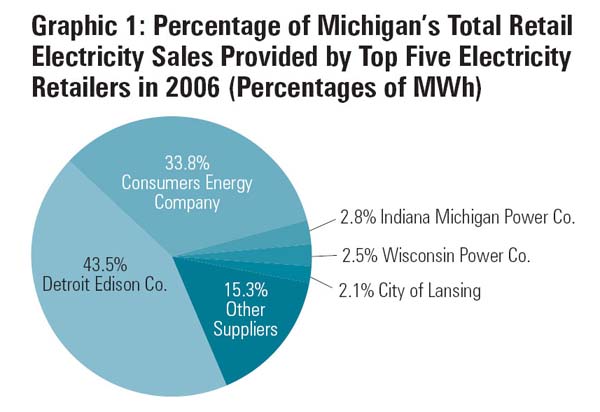
According to the Michigan Public Service Commission, "As of December 31, 2007, about 4,835 commercial and industrial customers were participating in Michigan’s electric choice programs. This represented over four percent or 311,310 megawatt-hours (MWh) of the total [average monthly] sales in energy usage of the combined Detroit Edison and Consumers Energy service territories (down from about six percent in 2006)."[*][3] The remaining customer base is served by smaller utilities, electricity cooperatives or municipal systems.
Source: U.S. Energy Information Administration.[4]
Coal-fired power plants dominate electricity generation in Michigan, fueling about 60 percent of the nearly 113 million megawatt-hours produced in the state in 2006, the latest year for which figures are available.[5] Most of the coal is transported by rail from Wyoming and Montana and distributed by ships to power plants largely located along the Great Lakes shores. Some coal is obtained from West Virginia, Kentucky and Pennsylvania as well.
Nuclear power from three plants provides about 26 percent of the electricity generated in Michigan, while natural gas accounts for about 10 percent.[6] At present, three utility-scale wind turbines also operate in Michigan, generating a small fraction of the state’s electricity.

Source: Energy Information Administration.[7]
(Note: A miscellaneous category, amounting to 0.5 percent of the total, is omitted above. The percentages in the graphic total more than 100 because they do not include small losses attributed to pumped storage.)
[*] This sentence has been altered since the original Web posting of this study. The words “average monthly” have been inserted to remove an ambiguity in the MPSC’s original quote.
In the late 1990s, Michigan’s high energy costs and aging infrastructure prompted the Michigan Legislature to restructure the electricity industry. Two principle goals guided the Legislature: 1) to encourage investment in new, more efficient generating capacity and 2) to introduce competition in energy supply as a means of controlling electricity rates. However, the statute that emerged actually undermined competition and investment by maintaining rate regulation and service mandates on Detroit Edison and Consumers Energy (commonly referred to as the "incumbent utilities"[*]). Simply put, the "Customer Choice and Reliability Act of 2000," popularly known as P.A. 141, constituted a change in regulation more than it did deregulation.
The new law "unbundled" the three elements of electricity service — generation, transmission and distribution. It also established a schedule by which competitive suppliers could market electricity to residential, commercial and industrial customers. (As a practical matter, power suppliers cannot direct the electricity they produce to specific customers. But the total volume of power they add to the transmission grid represents the load specified by their customer contracts.)
However, P.A. 141 also cut by 5 percent the residential rates charged by the incumbent utilities and froze them at that level for five years, which reduced customers’ incentive to seek service alternatives. At the same time, commercial customers of the incumbent utilities were forced to pay artificially high rates to subsidize residential service. Thus, commercial customers had an incentive to opt for an alternative supplier.
Two other elements of P.A. 141 undermined prospects for a competitive market. First, the incumbent utilities were required to maintain at all times enough power capacity to serve the peak demands of all customers in their regions. This required the utility to maintain infrastructure for which it had no current demand. Second, the incumbents were required to restore service at a regulated rate to any customer who left a competing supplier.[†]
DTE Energy and CMS Energy, parent companies of Detroit Edison and Consumers Energy, successfully argued that the incumbent utilities should be compensated for their costs in transitioning to competitive markets. They asserted that competition would pit them against newer, more nimble and efficient competitors unburdened by the costs of less efficient equipment and more expensive overhead. They also claimed that competition would shrink their customer base and deprive them of revenue needed to pay the debt costs of the infrastructure necessary to provide mandated services such as maintaining excess generating capacity necessary to serve all customers during periods of peak demand, as well as a range of programs to assist low-income customers. Thus, they secured in Public Act 142 of 2000 a substantial stream of revenue to recover these "stranded costs," which the Michigan Public Service Commission defined as "(1) costs that were incurred during the regulated era that will be above market prices during competition and (2) costs that are incurred to facilitate the transition from regulated monopoly status to competitive market status."[8]
Executives of DTE and CMS Energy can hardly be faulted for representing the interests of their shareholders, for whom competition would undoubtedly have proved disruptive. For decades the utilities were guaranteed profits from their captive customer base irrespective of efficiency or economic discipline. Indeed, under "rate-of-return" regulation, the utility’s income rose with every dollar the utility spent.
The two utilities were granted state loan guarantees totaling $2.2 billion with which to refinance their debt through the sale of securities.[**] In so doing, the incumbents received a huge infusion of cash to offset future — hypothetical — losses. To ensure repayment, lawmakers imposed a surcharge on all electricity customers in the DTE and CMS Energy service territories, including those who would opt for a competing supplier.
Some investments and commitments by the incumbent utilities may well have been unrecoverable outside of rate regulation. Under federal law, for example, utilities across the country were required to enter into long-term purchase contracts with independent power producers irrespective of price considerations. In other words, they had to purchase and transmit electricity generated by third parties at a cost that did not reflect future market prices. Still, some of the costs defined as "stranded" in Public Act 141 and Public Act 142 were probably not the result of the regulatory environment, but nonetheless were eligible for recovery under the state’s revenue subsidies.
[*] The phrase “incumbent utilities” reflects the two companies’ dominance in the marketplace prior to passage of the reforms in P.A. 141 and P.A. 142.
[†] The MPSC later instituted requirements on returning customers seeking regulated rates.
[**] With the state as a “co-signer,” the utilities were able to refinance their debt based on the credit rating of the state. Michigan’s credit rating was the highest among the states in 2000.
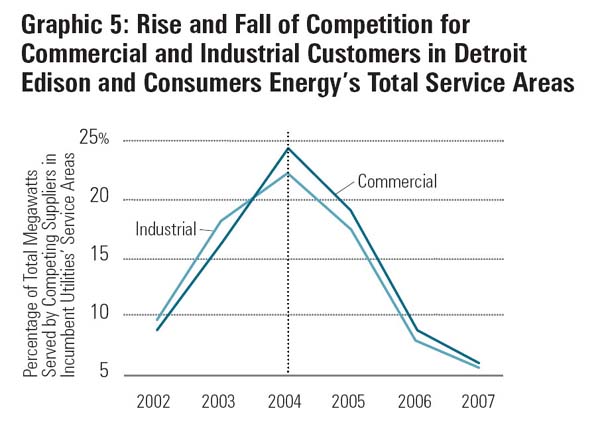
P.A. 141 and P.A. 142 were passed in 2000, but because of phase-in provisions in the legislation, significant competition among electricity providers did not really begin until 2002. This competition peaked during the next two years, but diminished considerably after November 2004, when "stranded-cost recovery" commenced.
Before Stranded-Cost Recovery
Between 2000 and 2004, nonincumbent suppliers captured well over 20 percent of Michigan’s industrial and commercial retail customers by volume in the combined Detroit Edison and Consumers Power service areas.[9] The results were impressive: During that period, average industrial rates in the state dropped by about 3 percent at the same time that the average industrial rates in the United States as a whole increased by around 13 percent.[*] Meanwhile, commercial rates dropped by about 4 percent in Michigan, even as the average commercial rates in the country as a whole increased by around 10 percent. In fact, Michigan’s total electricity prices across all sectors dropped by about 2 percent, while the nation’s total electricity prices rose by about 12 percent.[10]
There was much less change in the state’s residential sector, however. The incumbent utilities’ residential rates during this period were regulated at an artificially low level, making price competition difficult. This constraint reduced the potential for profit and rendered the residential sector less attractive to new suppliers. Moreover, the residential market was not a natural niche for these suppliers: They were seeking to establish themselves in the marketplace, and they focused first on attracting higher-volume customers, such as schools, retail stores and manufacturing plants. Not surprisingly, then, few residences switched to alternative suppliers.
Regardless, all Michigan residents benefited either directly or indirectly from the lower electricity prices spurred by competition, and this competition brought Michigan’s business rates closer to those of surrounding states, thereby ameliorating a competitive disadvantage.
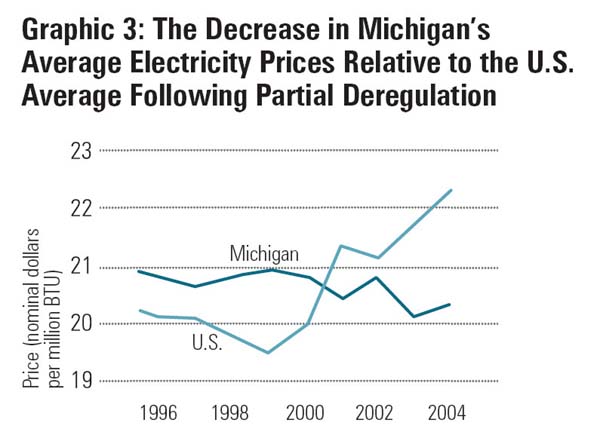
Source: U.S. Energy Information Administration.[11]
Public Act 141 also succeeded in drawing investment in new generating capacity to Michigan — primarily in natural gas-powered facilities that burned cleaner than coal.[12] The incumbent utilities did not, however, contribute as much to the expansion of capacity. As the Michigan Public Service Commission noted in a 2003 report on electric competition, there was substantial investment in capacity across the United States, but only about 10 percent in 2002 was by investor-owned utilities.[†]
Contrary to the predictions of their executives, neither DTE nor Consumers Power experienced undue financial hardship. Indeed, the stock of DTE outperformed the utility average during the years of peak competition (see Graphic 4).[**]
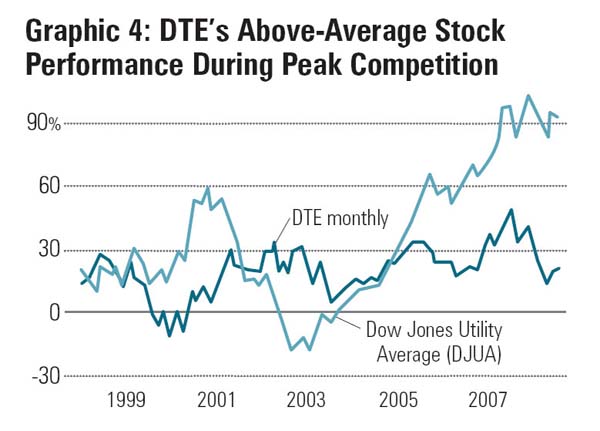
Source: The Wall Street Journal.[13] Calculations begin May 8, 1998.
After Stranded-Cost Recovery
There was considerable opposition to P.A. 141’s stranded- cost recovery scheme. Flush with cash, the incumbents held a competitive advantage. Further, critics noted that the premise of stranded costs was belied by the incumbent utilities’ ownership of valuable power plants, for which there continued to be market demand. And to the extent competition might diminish the incumbents’ market share, they could sell surplus electricity on the spot market (allowing them to export electricity elsewhere) or by private contract — as long as the energy was produced at competitive prices. Moreover, utility investors had enjoyed the considerable fruits of monopoly status for decades; covering stranded costs arguably prolonged that advantage.
There was no bailout of incumbents in the deregulation of other industries, such as rail, aviation, trucking and telecommunications. Under this view, consumers would have been better served had the Legislature eliminated the burdensome service and capacity mandates on the utilities and left them to compete freely with other producers.
As a variety of experts predicted, the stranded-cost scheme and various regulatory mandates ultimately undermined competition. For example, the state loan guarantees provided the incumbent utilities with a marked competitive advantage over prospective competitors in both better access to capital and lower debt costs. Moreover, the surcharge imposed on competitors’ customers narrowed the price differences between new, more efficient electricity suppliers and the incumbents.[‡] Simply put, customers of competing suppliers were effectively subsidizing the former monopolies.
The advent of stranded-cost recovery in 2004 essentially stalled competition by eliminating the price advantage that alternative suppliers had acquired over the incumbent utilities. Meanwhile, the rising price of natural gas hit alternative suppliers hard. Taken together, these factors led many customers to return to the incumbents for service. Graphic 5 shows the result.
Source: Michigan Public Service Commission.[14]
(Note: Data for 2007 does not include December 2007.)
Stranded-cost recovery also undermined the rate discipline that partial deregulation had stimulated. The average price of electricity for industrial customers in Michigan jumped 23.0 percent between 2004 and 2006 (the last full year for which data are available), while industrial rates rose 17.3 percent for the nation as a whole.[15] The state’s commercial rates fared a bit better, rising 12.4 percent, compared to 15.8 percent for the nation as a whole, but overall, Michigan’s electricity prices rose 17.3 percent, compared to a national increase of 17.0 percent.[16][***] Thus, after 2004, the state’s electricity rates were no longer rising less than the national average; instead, they were rising at about the same rate as the national average.
Similarly, Michigan’s electrical rates improved and then lost ground compared to electricity prices in the surrounding four Midwest states (Illinois, Indiana, Ohio and Wisconsin). Although Michigan’s prices were high compared to the four-state average from 2000 to 2006, they declined relative to that average from 2000 to 2004. This decline ended after 2004, however, with Michigan trending up again at a faster rate than the four-state average.[17]


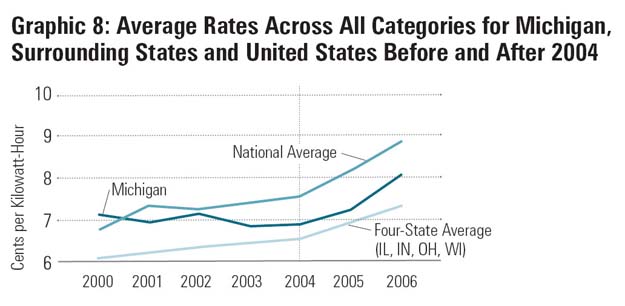
Source for Graphics 6-8: U.S. Energy Information Administration.[18]
[*] Authors’ calculations based on "Electric Power Annual 2006 - State Data Tables: 1990 - 2006 Average Price by State by Provider (EIA-861)," U.S. Energy Information Administration, www.eia.doe.gov/cneaf/electricity/epa/epa_sprdshts.html (accessed May 10, 2008). The figures are slightly imprecise because of changes in the way the U.S. Energy Information Administration classified these data in 2003. Nevertheless, the reclassification involved less than 3 percent of the entire market and affected the data for all of the United States, so that the large difference between the price trends for Michigan and for the country as a whole remain significant.
[†] Laura Chappelle, David A. Svanda, and Robert B. Nelson, "Status of Electric Competition in Michigan," (Michigan Public Service Commission, Department of Consumer & Industry Services, 2003), 10, www.dleg.state.mi.us/mpsc/electric/restruct/reports/compreport2002.pdf, (accessed May 10, 2008). The report noted that there is considerable uncertainty about some of the capacity investment, including significant delays and cancellations. Regulatory uncertainty is presumably contributes to these delays.
[**] Note that DTE’s stock performance during this period cannot be explained simply by the subsidies DTE received under the rules of the partial deregulation. The subsidies did not begin until 2004, well after DTE’s stock price began exceeding the industry average. Nor could investors have incorporated all of the anticipated subsidies into the DTE stock price in 2001, because the MPSC had not yet written the rules that would determine the size of the subsidies.
[‡] The surcharge was levied on the customers of incumbents and nonincumbents alike. Incumbents, however, were better able to keep prices down to ease the burden on their customers, since the incumbents could offset any paper losses with the benefits they received from the surcharge in return. Nonincumbents, in contrast, still had to cover their costs and make a profit, despite a surcharge that raised prices for their customers and helped finance their competitors.
[***] As in the previous section of this brief, we omit computations of residential rates here, which were largely determined by state regulation that placed them at an artificially low level (see discussion under "Before Stranded-Cost Recovery"). For the record, however, residential rates rose about 17.3 percent, compared to the national average increase of 16.2 percent.
At present, Michigan law does not limit the market share of nonincumbent electricity suppliers. One House bill currently under consideration, however, would restrict nonincumbent suppliers to providing no more than 10 percent of an incumbent utility’s average weather-adjusted retail sales for the preceding calendar year.[*]
Executives of the incumbent utilities object to the characterization of this legislation, which they endorse, as "remonopolization," arguing that this 10 percent share of the market would still be subject to competition. In reality, there would be very little incentive for energy suppliers to invest in Michigan and compete for such a small slice of the customer base.
Advocates of this legislation claim that Michigan’s partial deregulation of electricity supply will rob Michigan of energy reliability and rate stability. According to this view, the incumbent utilities cannot secure capital to build new generating facilities without a secure customer base.
It is understandable, perhaps, that executives of DTE and Consumers Energy would much prefer to recover infrastructure costs through regulated rates rather than the expenditure of shareholders’ money. After all, these utilities incurred huge cost overruns in plant construction in previous years. For example, Consumers Energy reportedly experienced cost overruns of nearly $5 billion when it attempted to build a nuclear power plant in Midland, while Detroit Edison realized cost overruns of about $4 billion when building a nuclear power plant in Monroe.[19][†] In the regulated monopoly energy market of the time, these costs were passed on to consumers.
But nonincumbent utilities have managed to secure capital to build new facilities without guarantees of either market share or rates of return. LS Power, for instance, is preparing to invest approximately $2 billion in a new power plant in Midland.[**] The nonincumbents’ uncertainty about the market appears to have helped, not hurt, consumers by forcing businesses to minimize costs and maximize service quality. Precisely the opposite seems to occur under the regulated monopoly regime.
Capping competition in electricity generation in Michigan may instead undermine reliability by centralizing energy supplies and driving away new entrants. Absent the prospect of meaningful profits, investors would have a strong incentive to skip the state for more advantageous environs.
Proponents of curtailing competition also claim that Michigan cannot rely on nonincumbent electrical plants to meet the state’s energy needs. But there was no shortage of willing and able suppliers — or demand for them — when the choice program peaked in 2004, before imposition of stranded-cost recovery. In Detroit Edison’s service territory between 2001 and 2004, nonincumbent suppliers increased the number of customers they served at a whopping rate of 104 percent annually, amassing a 69 percent annual gain in megawatts served.[20] In 2004, these nonincumbents peaked at 17,241 customers, representing 2,378 megawatts of load.[21] Similarly, in Consumers Energy service territory between 2001 and 2004, nonincumbent suppliers increased their customer base at a clip of 65 percent annually, producing a 60 percent annual gain in megawatts served.[22] In 2004, they reached 1,473 customers, representing 926 megawatts of load.[23]
There currently exists considerable debate about the future direction of energy demand in Michigan. A report by former MPSC Chairman Peter Lark estimated that energy demand would grow an average of 1.3 percent per year through 2025, requiring the construction of at least one large coal-fired power plant by 2015.[24] That forecast was about 40 percent less than an MPSC capacity-needs report issued only one year earlier.[25]
Other forecasts are more negative. A December 2006 report prepared for the Michigan House of Representatives by the East Lansing-based Anderson Economic Group characterized existing capacity as "adequate,"[26] while Mackinac Center Senior Economist David Littmann is forecasting a drop in demand over the next decade due to Michigan’s declining population, jobs and income.
These divergent scenarios indicate the value of allowing the market — not government — to make decisions about generating capacity. With their own investment at stake, suppliers have much greater incentive than government officials to produce accurate forecasts. Nonetheless, there is a proposal in the Michigan Legislature to authorize the MPSC to control the amount of electricity produced in the state.[‡]
Some argue that curtailing competition would reduce the volatility of energy rates. But such reasoning is flawed. For example, regulated rates have fluctuated dramatically with the price of natural gas (a fuel recommended by state and federal governments because it burns more cleanly than coal). However, retail rates among all customer classes progressively declined during the peak years of competition.
A recent regulatory filing by the U.S. Federal Trade Commission directly disputed the premise that curtailing competition is necessary to promote price stability and investment in energy markets. According to the FTC, "We believe that a focus on removal of regulatory obstacles to efficient real-time price signals and demand response at the federal and state levels can be an important step toward appropriate, efficient reliance on conventional price mechanisms to handle scarcity and guide investment. [The absence of such pricing] or other mechanisms to moderate demand during periods of scarcity is one of the most serious flaws in organized electricity markets."[27]
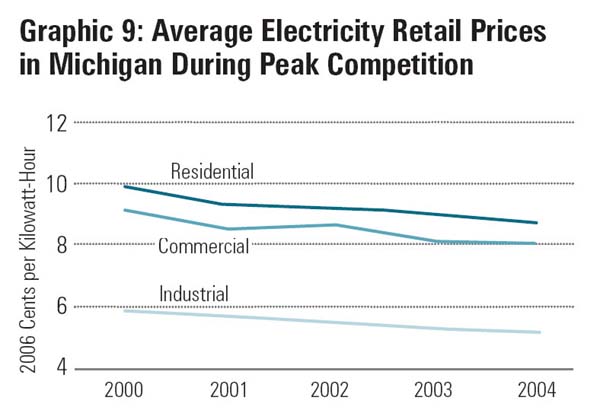
Source: Energy Information Administration.[28]
Lawmakers would do well to remember that their predecessors pursued competition because, as the National Economic Research Associates put it, "[R]egulation was producing unacceptable outcomes, including large price differences between proximate utilities, large plant cost overruns, rate shocks and phase-ins, and customer dissatisfaction with lack of control over their electricity costs."[29]
[*] See House Bill 5524, Section 10a(1)(A). According to www.MichiganVotes.org, House Bill 5524, which has passed the state House, would "mostly end the state’s electric competition law that allows customers to choose an alternative provider; allow the utilities (primarily DTE and Consumers Power) to impose surcharges on customers so they can recoup the ‘costs’ incurred from Michigan’s experiment with competitive electricity markets; and gradually phase out current cross-subsidization of residential customers by commercial and industrial ones. The proposed law would prohibit competing power companies from garnering more than 10 percent of the electricity market, even if they offer lower prices."
[†] The Michigan Public Service Commission later ordered that the Consumers facility be converted to a gas-fired unit at a cost of $600 million.
[**] MIRS Capitol Capsule, "Power Plant Company Defends P.A. 141," Michigan Information & Research Service Inc, www.mirsnews.com/capsule.php?gid=923#14273 (accessed May 1, 2008). The article quotes Lynne Mackey, LS Power’s director of regulatory policy, as saying, "Power plants can and are being financed all over the country right now without having the protection — or what I would call the ‘lock’ on providing that service."
[‡] According to www.MichiganVotes.org, House Bill 5525, which has passed the Michigan House, mandates that "electric utilities reduce the amount of energy they provide by 1 percent each year beginning in 2012, and that gas utilities reduce production by 0.75 percent per year. To accomplish this goal, the companies would be required to charge higher rates to pay for programs that ‘target customer behavior, equipment, or devices without reducing the amount or quality of energy services.’ Utilities that fell short of the energy production reduction mandates could potentially be ordered by the [Michigan] Public Service Commission to reduce their prices."
Gov. Jennifer Granholm’s current economic agenda rests upon the energy sector. In myriad speeches and appearances in recent months, the governor has touted renewable energy, such as solar power, wind power and landfill methane, as a wellspring of new jobs and investment for the state.
There is certainly nothing wrong with individuals, entrepreneurs or interest groups pursuing the idea of renewable energies and finding ways to make them economically viable. Hydropower, wind and biomass generation have been established in Michigan for many years and are economically viable sources of electricity in some instances.
But the governor has called for a significant subsidy to achieve this goal: imposition of a "renewable portfolio standard" to require that energy suppliers obtain a quota of electricity supply from "renewable" sources. At least three bills currently being considered by the Michigan Legislature would impose RPS mandates.[*]
An RPS is fashionable policy to be sure, one adopted by some 25 states and the District of Columbia. But renewables are not necessarily environmentally benign.[30] Meanwhile, the rising popularity of RPS policies among legislators has been accompanied by a dramatic rise in the cost of renewable energy components.
Not surprisingly, renewable energy currently costs more than conventional energy. According to the Michigan Electric and Gas Association, "Fossil units and nuclear power have a huge inherent cost and deliverability advantage over renewables due to the concentrated energy in the fuel compared to the diffuse and variable energy of wind, solar or hydro."[31]
Moreover, the requirement to purchase renewable energy no matter what the cost is an invitation to higher prices. An analysis by the Michigan Chamber of Commerce, for example, concluded that a 10 percent quota by 2015 would cost Michigan ratepayers more than $6 billion.[†]
Typical RPS proposals would, if enacted, constitute a dramatic expansion of the powers of the Michigan Public Service Commission. There are instances in which this expanded authority would usurp legislative functions — granting, for instance, the MPSC the power to determine what quota of total energy production should be supplied by renewable sources. This is a policy decision, not an interpretation of a statute, and as the Michigan Supreme Court has written, "Policy determinations are fundamentally a legislative function" — not the prerogative of an agency of unelected officials.[32]
Were renewable energy affordable and efficient, a government mandate would not be needed to make people buy it. Under an RPS, the principal winners would be the alternative energy suppliers who have otherwise been unable to attract capital investment or consumer interest based on the merits of their product.
To subsidize only select forms of energy would disadvantage other rich sources of power in the state.[**] For example, Michigan has more natural gas reserves than any other state in the Great Lakes region. The Antrim natural gas fields, in the northern Lower Peninsula, are among the largest in the nation.[33]
Despite the governor’s promises of job creation and investment, there has been a notable lack of explanation for her numbers. Lawmakers need to consider whether such a major public investment can be justified given the financial stress experienced by a great many Michigan families, who would pay higher electricity bills to subsidize renewable energy producers. As noted by the Michigan Electric and Gas Association, "(I)f the public is going to be asked to make a major financial commitment to a particular generating technology, there should be some consideration of alternative uses for that money."[34]
Proponents also contend that a renewable quota would benefit the environment as well as the economy. According to Lark, "Every MWh that is generated by a renewable resource or that is avoided through use of efficiency measures displaces a MWh of fossil-fuel-fired generation and its associated emissions."[35]
But that reasoning is flawed. Most renewables at present can only produce intermittent power and, therefore, cannot be relied upon during periods of peak demand. Under the current regulatory framework, utilities must maintain a conventional unit in standby mode, which means that emissions and fuel use are not displaced.
As it is, considerable progress has been made in reducing power plant emissions. According to the U.S. Environmental Protection Agency, the electricity industry will spend nearly $48 billion between 2007 and 2025 for new controls on emissions of nitrogen oxides, sulfur dioxide and mercury.[36] Meanwhile, the use of coal as a feedstock is decreasing. Between 1990 and 2006, the percentage of Michigan’s electric capability fired by coal declined by 22 percent. Likewise, the percentage of the state’s capability powered by petroleum decreased by 64 percent, even as the percentage fueled by natural gas increased by 249 percent.[37]
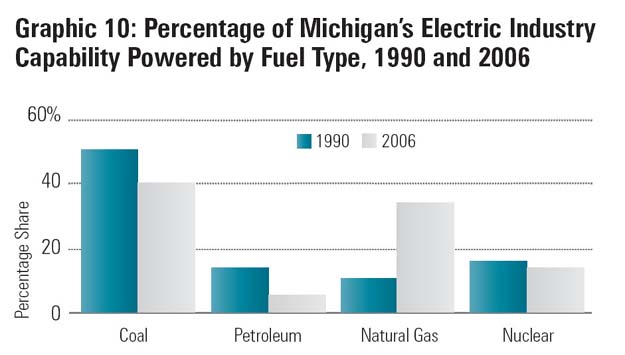
Source: Energy Information Administration.[38]
In the absence of renewable-energy quotas, advances in demand-size efficiency are ongoing. New and improved technologies are expected to increase the energy efficiency of the economy overall at an average annual rate of 1.8 percent through 2030.[39]
There is also reason to believe that an RPS will fail to revive the state’s economy — just as a multitude of other government jobs programs have failed. According to recent analyses by Michael D. LaFaive, director of fiscal policy for the Mackinac Center, the Michigan Economic Development Corp. received appropriations of more than $1.6 billion from federal, state and other sources since 1999. But between 1999 and 2006, Michigan still lost 244,000 jobs, and the unemployment rate is the highest in the nation at 7.2 percent.[40]
Moreover, an extensive econometric evaluation of the Michigan Economic Growth Authority, the MEDC’s primary economic development program, indicated the authority’s tax breaks to favored firms had no statistically significant impact on employment or per-capita income at the state or county level.[41] State officials’ failure to promote economic growth through favors to specific companies does not bode well for the governor’s attempt to improve the economy by subsidizing producers of renewable energy.
[*] House Bill 5548 and House Bill 5549 have passed the Michigan House. According to www.MichiganVotes.org, they "mandate that Michigan electric utilities acquire 4 percent of their power from ‘renewable’ sources by the end of 2012, and 10 percent by the end of 2015. The mandate would be reduced to the extent it increased residential rates by more than $3 per month, and on commercial customers from $15.83 to $187.50 per month. Utilities could meet the mandate by producing or purchasing renewable energy, or purchasing ‘credits’ from a firm that exceeded the mandate. The provisions creating this regime are divided between [the two bills]." Senate Bill 1000, which has passed the Michigan Senate, would create similar requirements. According to MichiganVotes.org, the bill would "mandate that utilities from which the state acquires power to obtain 10 percent of their energy from ‘renewable’ sources (not including nuclear) by 2010, and 25 percent by 2025. However, the requirement would be waived if the cost of the renewable energy is more than 5 percent greater than conventional or nuclear power."
[†] Doug Roberts Jr., "Memorandum to Members of the House Committee on Energy and Technology," (Michigan Chamber of Commerce 2007), http://www.michamber.com/docs/ homepage/hb4562.pdf, (accessed May 11, 2008). The Chamber’s estimate focused on wind power, excluding the proposed use of wood chips and switchgrass to generate electricity, but the omission is understandable. At present, the process of converting these plant fuels into electricity is only experimental; there are no cellulosic plants in normal operation.
[**] House Bill 5972, House Bill 5977 and House Bill 5898, for example, would provide subsidies to certain businesses involved with solar power. According to www.MichiganVotes.org, House Bill 5972 would "grant a business tax break based on the price it pays for electricity to the Hemlock Semiconductor company and perhaps other producers of polycrystalline silicon used in solar cells and semiconductor chips." House Bill 5977 would allow the state’s Michigan Economic Growth Authority to provide tax credits to the same company (or companies). Both bills have passed the state House, and both are currently tie-barred to House Bill 5524, which would establish a cap on the amount of competition that nonincumbent suppliers can provide (see first footnote in “Remonopolization”: Ending Partial Deregulation). House Bill 5898 would, according to MichiganVotes.org, "authorize a refundable Michigan Business Tax credit equal to 50 percent of the amount invested or expended on research, development, and manufacturing of photovoltaic energy by a firm for whom this is its primary activity. ‘Refundable’ means that if the credit exceeds the firm’s tax liability the state would send it a check."
When unconstrained by price controls and regulatory mandates, competition in energy supply has delivered benefits to Michigan. Capacity needs vary across the state, which argues against a sweeping legislative response. In fact, the most direct way to expand generating capacity is to make the state more attractive for energy investment. Costly new regulation and restrictions on competition in electricity supply would actually harm rather than benefit Michigan consumers and the businesses that employ them.
Recommendations
Reject any attempt to curtail competition in energy supplies. Limits on competition would raise energy prices and deepen the state’s economic woes, while dissuading investors from building new generating capacity in Michigan.
Eliminate peak capacity requirements. Ratepayers could be freed from the stranded-cost regime, and incumbent utilities would be better positioned to compete. Energy suppliers have every incentive to meet market demand for electricity.
Rationalize rates. Subsidies of one customer class by another, such as artificially high rates for commercial service to subsidize residential rates, should be eliminated from the regulated rates of incumbent utilities. Such skewed rates interfere with the price signals necessary for energy conservation and effective competition.
Reject purchase quotas for renewable energy. Subsidizing renewable energy facilities could actually delay development of cost-effective alternatives by easing the competitive pressures on renewable energy suppliers to improve their product. Moreover, forcing ratepayers to buy higher cost energy constitutes an energy tax that Michigan families can ill afford.
Amend state law to allow yard waste deposits in landfills; the deposits produce methane that can be tapped to generate electricity. There is no reason for the state to maintain regulatory barriers to the use of alternative energy sources, especially when state officials are calling for increased use of renewable energy.
Resist attempts to empower the Public Service Commission to control development of new power plants. Market competition can produce the appropriate supply of energy far more efficiently and affordably than government regulators.
Reject proposals to empower the Public Service Commission to block mergers and acquisitions of energy firms. Such authority would duplicate the merger review powers already exercised by the U.S. Department of Justice, the Federal Energy Regulatory Commission, the Federal Trade Commission, the U.S. Nuclear Regulatory Commission (if nuclear power plants are involved) and the Michigan Attorney General’s office. It is unlikely that Michigan ratepayers would gain any benefit from allowing the MPSC to intervene in merger cases under review by federal and state agencies. Even worse, one House bill would, if enacted, give the MPSC free rein to determine the standards of review.[42] This would invite even more arbitrary regulation, further eroding Michigan’s ability to attract investment and job creation.
Reject attempts to impose state efficiency standards on appliances and other household products. Such mandates can raise the prices of new appliances, leading many homeowners to delay new purchases and continue to operate older, less efficient models.
|
Senate or House Bill Number |
Sponsor |
Date Introduced |
Summary from MichiganVotes.Org |
|
HOUSE BILL 5524 |
Rep. Frank Accavitti, Jr |
December 4, 2007 |
The bill would “mostly end the state’s electric competition law that allows customers to choose an alternative provider; allow the utilities (primarily DTE and Consumers Power) to impose surcharges on customers so they can recoup the ‘costs’ incurred from Michigan’s experiment with competitive electricity markets; and gradually phase out current cross-subsidization of residential customers by commercial and industrial ones. The proposed law would prohibit competing power companies from garnering more than 10 percent of the electricity market, even if they offer lower prices.” |
|
HOUSE BILL 5525 |
Rep. Kathy Angerer |
December 4, 2007 |
The bill would “mandate that electric utilities reduce the amount of energy they provide by 1 percent each year beginning in 2012, and gas utitities reduce production by 0.75 percent per year. To accomplish this they would be required to charge higher rates to pay for programs that ‘target customer behavior, equipment, or devices without reducing the amount or quality of energy services.’ Utilities that fell short of the energy production reduction mandates could potentially be ordered by the Public Service Commission to reduce their prices. See also House Bill 5525, which caps competition between electricity providers in Michigan.” |
|
HOUSE BILL 5548 |
Rep. Jeff Mayes |
December 6, 2007 |
The bill would “mandate that Michigan electric utilities acquire 4 percent of their power from ‘renewable’ sources by the end of 2012, and 10 percent by the end of 2015. The mandate would be reduced to the extent it increased residential rates by more than $3 per month, and on commercial customers from $15.83 to $187.50 per month. Utilities could meet the mandate by producing or purchasing renewable energy, or purchasing ‘credits’ from a firm that exceeded the mandate. The provisions creating this regime are divided between this and House Bill 5549” |
|
HOUSE BILL 5549 |
Rep. David Palsrok |
December 6, 2007 |
The bill would “mandate that Michigan electric utilities acquire 4 percent of their power from ‘renewable’ sources by the end of 2012, and 10 percent by the end of 2015. The mandate would be reduced to the extent it increased residential rates by more than $3 per month, and on commercial customers from $15.83 to $187.50 per month. Utilities could meet the mandate by producing or purchasing renewable energy, or purchasing ‘credits’ from a firm that exceeded the mandate. The provisions creating this regime are divided between this and House Bill 5548.” |
|
HOUSE BILL 5898 |
Rep. John Moolenaar |
March 13, 2008 |
The bill would “authorize a refundable Michigan Business Tax credit equal to 50 percent of the amount invested or expended on research, development, and manufacturing of photovoltaic energy by a firm for whom this is its primary activity. ‘Refundable’ means that if the credit exceeds the firm’s tax liability the state would send it a check.” |
|
HOUSE BILL 5972 |
Rep. Andy Coulouris |
April 10, 2008 |
The bill would “grant a business tax break based on the price it pays for electricity to the Hemlock Semiconductor company and perhaps other producers of polycrystalline silicon used in solar cells and semiconductor chips. The bill is tie-barred to House Bill 5524, which would end electric power provider competition in Michigan.” |
|
HOUSE BILL 5977 |
Rep. Tim Moore |
April 10, 2008 |
The bill would “authorize Michigan Economic Growth Authority tax credits for the Hemlock Semiconductor company and perhaps other producers of polycrystalline silicon used in solar cells and semiconductor chips. The bill is tie-barred to House Bill 5524, which would end electric power provider competition in Michigan.” |
|
SENATE BILL 213 |
Sen. Patricia Birkholz |
February 20, 2007 |
The bill would “mandate that electric utilities acquire at least 4 percent of their power from ‘renewable’ sources, growing to at least 8 percent by 2013. The Public Service Commission would be authorized to regulate the duration and terms of contracts under which utilities obtain such power, in general mandating that the contract be for at least 20 years (to allow the provider to get financing to establish the renewable source). The bill would also authorize trading of renewable energy ‘credits’ between utilities that exceed or fall short of the mandated quantity, and would impose fines of $50 for each megawatt hour that a utility falls short in production or credits. Finally, it would require utilities to provide rebates to solar electricity generation providers, and to pay for these by tacking extra fees onto the electricity bills of customers. ‘Renewable energy’ is defined as that generated by biomass, geothermal, solar, wind, hydroelectric, and gas captured from the decomposition of waste. It does not include nuclear power.” |
|
SENATE BILL 219 |
Sen. Roger Kahn |
February 20, 2007 |
The bill would “require electricity suppliers to immediately generate or acquire 4 percent of the electricity they sell with renewable sources, at least 1 percent of which must be solar. This would increase to 7 percent of power sold by 2015. The Michigan Public Service Commission could establish a system of energy credits that providers could use to meet the new standards, and would be authorized to waive the mandate if renewable sources of power are not available in the amounts necessary to comply. The bill would allow utilities to charge higher rates to cover the additional costs of using such alternative energy sources.” |
|
SENATE BILL 385 |
Sen. Jim Barcia |
March 29, 2007 |
The bill would “mandate that electric utilities acquire at least 9 percent of their power from ‘renewable’ sources by 2009, growing to at least 20 percent by 2020, at least five percent of which must be solar. The Public Service Commission would be authorized to regulate the duration and terms of contracts under which utilities obtain such power, in general mandating that the contract be for at least 10 years (to allow the provider to get financing to establish the renewable source). The bill would also authorize trading of renewable energy ‘credits’ between utilities that exceed or fall short of the mandated quantity, and would impose fines of $55 for each megawatt hour that a utility falls short in production or credits. ‘Renewable energy’ is defined as that generated by biomass, geothermal, solar, wind, hydroelectric, and gas captured from the decomposition of waste. It does not include nuclear power.” |
|
SENATE BILL 426 |
Sen. Jason Allen |
April 24, 2007 |
The bill would “require certain larger electric utilities to provide billing service for alternative providers selling power to residential customers though the utility’s own power lines. The utility would be allowed to use some of the amount billed to cover its own ‘bad debt’ expense incurred to provide bundled power and transmission services in the past, if it can prove that this amount is not already included in its distribution charge. See Senate Bill 427.” |
|
SENATE BILL 427 |
Sen. Wayne Kuipers |
April 24, 2007 |
The bill would “give the Public Service Commission the authority to determine the electric power demands of large utilities, and order them to acquire power from additional or alternative sources, under procedures specified by the bill.” |
|
SENATE BILL 428 |
Sen. Michelle McManus |
April 24, 2007 |
The bill would “require certain electric utilities to provide billing service for alternative providers selling power to customers though the utility’s own power lines. The bill establishes the formula for determining the distribution charges it would be allowed to tack on. See Senate Bill 427.” |
|
SENATE BILL 947 |
Sen. Bruce Patterson |
December 5, 2007 |
The bill would “mandate that electric utilities acquire at least 3 percent of their power from ‘renewable’ sources, growing to at least 20 percent by 2025. The Public Service Commission would be authorized and given discretion to grant exemptions. The bill would authorize trading of renewable energy ‘credits’ between utilities that exceed or fall short of the mandated quantity, and would impose fines of $50 for each megawatt hour that a utility falls short in production or credits. It would allow utilities to pay for these more costly forms of energy by increasing the electricity bills of customers. ‘Renewable energy’ is defined as that generated by biomass, geothermal, solar, wind, hydroelectric, and gas captured from the decomposition of waste. It does not include nuclear power. Additionally, the bill would require all utilities to maintain a minimum annual 15 percent power reserve margin and impose certain ‘reliability’ standards.” |
|
SENATE BILL 1000 |
Sen. Patricia Birkholz |
December 12, 2007 |
The bill would “mandate that utilities from which the state acquires power to obtain 10 percent of the their energy from ‘renewable’ sources (not including nuclear) by 2010, and 25 percent by 2025. However, the requirement would be waived if the cost of the renewable energy is more than 5 percent greater than conventional or nuclear power.” |
American PowerNet Management LP
c/o New Page
7100 County Road 426
Escanaba, MI 49829
CMS ERM Michigan LLC
One Energy Plaza, Suite 1060
Jackson, MI 49201
Commerce Energy Inc.
32991 Hamilton Court
Farmington Hills, MI 48334
www.commerceenergy.com
Constellation NewEnergy Inc.
1000 Town Center, Suite 2350
Southfield, MI 48075
www.newenergy.com
Exelon Energy Company
4300 Winfield Road
Warrenville, IL 60555
www.exelonenergy.com
FirstEnergy Solutions
395 Ghent Road
Akron, Ohio 44333
www.fes.com
Integrys Energy Services Inc.
3520 Green Court, Suite 200
Ann Arbor, MI 48105
www.integrysenergy.com
Metro Energy LLC
414 South Main Street, Suite 600
Ann Arbor, MI 48104
MidAmerican Energy Co.
39555 Orchard Hill Place, Suite 600
Novi, MI 48375
www.midamericanchoice.com
Powerone Corporation
6850 North Haggerty Road
Canton, MI 48187
www.poweronecorp.com
Sempra Energy Solutions
100 West Big Beaver Road, Suite 200
Troy, MI 48084
www.SempraSolutions.com
Spartan Renewable Energy LLC
10125 West Watergate Road
P.O. Box 209
Cadillac, MI 49601
www.spartanrenewable.com
Strategic Energy LLC
17197 North Laurel Park Drive
Livonia, MI 48152
www.sel.com
U.P. Power Marketing LLC
29639 Willow Road
White Pine, MI 49971
Wolverine Power Marketing Cooperative Inc.
10125 West Watergate Road
P.O. Box 100
Cadillac, MI 49601
www.wpmc.coop
Diane S. Katz is an adjunct scholar with the Mackinac Center for Public Policy and director of risk, environment and energy policy for The Fraser Institute.
Theodore Bolema is an adjunct scholar with the Mackinac Center for Public Policy and an attorney in the Finance and Law Department of Central Michigan University’s College of Business Administration, where he specializes in regulatory law and economics.
1 "Electric Power Annual 2006 — State Data Tables: 1990 — 2006 Revenue from Retail Sales of Electricity by State by Sector by Provider (EIA-861)," U.S. Energy Information Administration, www.eia.doe.gov/cneaf/electricity/epa/epa_sprdshts.html (accessed May 12, 2008).
2 National Economic Research Associates, Inc., "Competitive
Electricity Markets: The Benefits for Consumers and the Environment,"
February 2008.
3 Orjiakor N. Isiogu, Monica Martinez, and Steven A. Transeth, "Status of Electric Competition in Michigan: Report for Calendar Year 2007," (Michigan Public Service Commission, Department of Labor & Economic Growth, 2008), 2, www.dleg.state.mi.us/mpsc/electric/restruct/reports/compreport 2007.pdf, (accessed May 9, 2008).
4 "State Electricity Profiles 2006: Table 3. Top Five Retailers of Electricity, with End Use Sectors, 2006: Michigan," (U.S. Energy Information Administration, Office of Coal, Nuclear, Electric and Alternate Fuels, U.S. Department of Energy, 2007), 112, http://tonto.eia.doe.gov/FTPROOT/electricity/06292006.pdf, (accessed April 18, 2008) and "State Electricity Profiles 2006: Table 1. 2006 Summary Statistics: Michigan," (U.S. Energy Information Administration, Office of Coal, Nuclear, Electric and Alternate Fuels, U.S. Department of Energy, 2007), 111, http://tonto.eia.doe.gov/FTPROOT/electricity/06292006.pdf, (accessed April 18, 2008).
5 "State Electricity Profiles 2006," (Energy Information Administration, Office of Coal, Nuclear, Electric and Alternate Fuels, U.S. Department of Energy, 2007), 113, http://tonto.eia.doe.gov/FTPROOT/electricity/06292006.pdf, (accessed April 18, 2008).
6 Ibid.
7 "State Electricity Profiles 2006: Table 5. Electric Power Net Generation by Primary Energy Source and Industry Sector, 1990, 1995, and 2001 Through 2006: Michigan," (U.S. Energy Information Administration, Office of Coal, Nuclear, Electric and Alternate Fuels, U.S. Department of Energy, 2007), 113, http://tonto.eia.doe.gov/FTPROOT/electricity/06292006.pdf, (accessed April 18, 2008).
8 "Staff Report on Electric Industry Restructuring," (Michigan Public Service Commission, Department of Labor & Economic Growth, 1996), www.cis.state.mi.us/mpsc/reports/elerstrc.txt, (accessed May 9, 2008).
9 Isiogu, Martinez, and Transeth, "Status of Electric Competition in Michigan: Report for Calendar Year 2007," Chart 3, Chart 5.
10 Authors’ calculations based on "Electric Power Annual 2006 — State Data Tables: 1990 — 2006 Average Price by State by Provider (EIA-861)."
11 "State Energy Price and Expenditure Estimates 1970 Through 2005: Table 1. Energy Price and Expenditure Estimates by Source, Selected Years, 1970-2005, United States," (U.S. Energy Information Administration, 2008), 23, www.eia.doe.gov/emeu/states/sep_prices/notes/pr_print2005.pdf, (accessed May 13, 2008) and "State Energy Price and Expenditure Estimates 1970 Through 2005: Table 1. Energy Price and Expenditure Estimates by Source, Selected Years, 1970-2005, Michigan," (U.S. Energy Information Administration, 2008), 163, www.eia.doe.gov/emeu/states/sep_prices/notes/pr_print2005.pdf, (accessed May 13, 2008).
12 J. Peter Lark, Robert Nelson, and Laura Chappelle, "Status of Electric Competition in Michigan," (Michigan Public Service Commission, Department of Labor & Economic Growth, 2005), Attachment 8, www.michigan.gov/documents/elec-comp05_115196_7.pdf, (accessed May 1, 2008).
13 The Wall Street Journal, WSJ.com, Markets Data Center, Interactive Charting (monthly frequency, single decade, start date May 8, 1998), https://www.wsj.com/quotes/stock_charting.html?symbol=DTE&type=usstock&osy.
14 Authors’ calculations based on Isiogu, Martinez, and Transeth,
"Status of Electric Competition in Michigan: Report for Calendar Year 2007,"
Chart 3, Chart 5.
15 Authors’ calculations based on "Electric Power Annual 2006 — State Data Tables: 1990 — 2006 Average Price by State by Provider (EIA-861)."
16 Ibid.
17 Authors’ calculations based on Ibid.
18 Ibid.
19 Mark Hornbeck and Charlie Cain, "Deregulation Shorts Out: Electric Choices Falter in Michigan," The Detroit News, www.detnews.com/2005/specialreport/0506/05/A01-203814.htm (accessed May 11, 2008).
20 Authors’ calculations based on Lark, Nelson, and Chappelle, "Status of Electric Competition in Michigan," Attachment 4.
21 Ibid.
22 Authors’ calculations based on Ibid., Attachment 1.
23 Ibid.
24 J. Peter Lark, "Michigan’s 21st Century Electric Energy Plan," (Michigan Public Service Commission, Department of Labor & Economic Growth, 2007), www.michigan.gov/documents/mpsc/21stcenturyenergyplan_ 185274_7.pdf, (accessed May 1, 2008).
25 Judy Palnau, "News Release: MPSC Staff Issues Report on Michigan’s Future Electric Capacity Needs, Finds Additional Electric Generation Capacity May Be Needed after 2009," Michigan Public Service Commission, Department of Labor & Economic Growth, www.michigan.gov/mpsc/0,1607,7-159--133381--,00.html (accessed May 11, 2008).
26 Caroline M. Sallee and Patrick L. Anderson, "Benchmarking for Success: A Comparison of State Infrastructure," (Anderson Economic Group, LLC, December 2006), 2, www.andersoneconomicgroup.com/modules/Content/dl.php?format=application/pdf&filename=Doc2013.pdf(accessed May 14, 2008).
27 "Wholesale Competition in Regions With Organized Electric Markets: Comment of the Federal Trade Commission before the United States of America Federal Energy Regulatory Commission, April 17, 2008, in FERC Docket No. Rm07-19-000 and Docket No. Ad07-7-000," (Federal Trade Commission, 2008), 33, www.ftc.gov/be/v070014b.pdf, (accessed May 11, 2008).
28 "Michigan Electricity Profile, 2006 Edition: Table 8. Retail Sales, Revenue, and Average Retail Price by Sector, 1990 Through 2006," U.S. Energy Information Administration, www.eia.doe.gov/cneaf/electricity/st_profiles/michigan.html (accessed May 13, 2008).
29 National Economic Research Associates, Inc., "Competitive
Electricity Markets: The Benefits for Consumers and the Environment,"
February 2008.
30 For discussion of the environmental impacts of renewable energies, see Diane Katz, "The Trade-Offs of Renewable Energy," MichiganScience, November 15, 2006, 10-15, www.mackinac.org/archives/2006/ms2006-01.pdf (accessed May 1, 2008).
31 Michigan Electric and Gas Association, "MEGA Position on 21st Century Energy Plan (Draft)," 5, March 6, 2007.
32 Blank v. Department of Corrections, 462 Mich 103, 116.
33 "Official Energy Statistics from the U.S. Government: State Energy Profiles: Michigan," U.S. Energy Information Administration, http://tonto.eia.doe.gov/state/state_energy_profiles.cfm?sid=MI (accessed May 1, 2008).
34 Michigan Electric and Gas Association, "MEGA Position on 21st Century Energy Plan (Draft)," 12, March 6, 2007.
35 Lark, "Michigan’s 21st Century Electric Energy Plan," 2.
36 U.S. Environmental Protection Agency, Office of Air and Radiation, October 2005.
37 Authors’ calculations based on "Michigan Electricity Profile, 2006 Edition: Table 4, Electric Power Industry Capability by Primary Energy Source, 1990 Through 2006 " U.S. Energy Information Administration, www.eia.doe.gov/cneaf/electricity/st_profiles/michigan.html(accessed May 13, 2008).
38 Ibid.
39 "Annual Energy Outlook 2006," Energy Information Administration, Office of Integrated Analysis and Forecasting, www.eia.doe.gov/bookshelf/brochures/aeo2006/aeo%20brochure5-12-2006.pdf (accessed May 14, 2008).
40 Diane S. Katz, personal communication with Michael D. LaFaive and James Hohman, May 5, 2008.
41 Michael D. LaFaive and Michael J. Hicks, "MEGA: A Retrospective Assessment," The Mackinac Center for Public Policy, April 12, 2005, www.mackinac.org/7097 (accessed April 20, 2008).
42 House Bill 5524.