

 Font size:
An Assessment of What Michigan Public School Districts Can Do to Save Money Without Laying Off Teachers or Other Essential Staff
Michigan’s public education system is now forever changed because of a new, competitive environment. Not only are many school districts losing enrollment because of demographic changes in their communities, but parents are increasingly able to select alternative education options such as cross-district public schools, charter schools, private schools, and home schooling.
At the same time, the business of operating public schools in Michigan has changed substantially, with public schools steadily increasing the number of services they provide to students outside the classroom. Today, school districts across the state operate kitchens and cafeterias, buses and comprehensive maintenance services that have little to do with the direct education of children. Further, school districts must perform a host of administrative activities, such as negotiating contracts, acquiring school buildings, and managing employee benefit programs.
Without commenting on whether or not school districts should be engaged in all of these ancillary duties and occupations, this study details how to manage effectively and efficiently the non-instructional aspects of public education while remaining competitive in this new school choice environment. To that end, public school districts can be fiscally responsible in providing these ancillary services by following the six “habits” outlined in this study.
Habit 1: Minimize Administrative Costs. The first hallmark of fiscal responsibility starts with front office functions. Many school districts employ a small phalanx of consultants, administrators, assistant superintendents, etc. Does the existence of this sometimes-extensive front office staff help educate children, or could this money be better used in the classroom?
Habit 2: Take Advantage of Cost Savings from Outsourcing Non-Instructional Services. Most schools currently run a broad range of non-instructional services, such as janitorial, food, transportation, etc. When these services are opened up for competitive bidding, many school districts find they can either improve the quality of the services, save money on comparable services, or both.
Habit 3: Manage Employee Health Benefits Effectively. The cost of staff and teacher health benefits has skyrocketed over the past few decades for a number of reasons. First, some districts have allowed the Michigan Education Special Services Association (MESSA), a third-party insurance administrator controlled by the Michigan Education Association, to administer insurance benefits without a competitive bidding process. Second, the negotiated union health benefit structure is far superior to other locally available health plans. Even the most generous corporate benefits do not compare with the ones typically enjoyed by school employees. School districts that have reformed their benefit structure have saved millions of dollars while offering high-quality benefits for their employees.
Habit 4: Structure Capital Costs Effectively. With many districts needing new school facilities to cope with growth or to replace substandard ones, now is the ideal time to consider innovative and fiscally responsible ways to acquire classroom space. Instead of constructing new school buildings, some schools have opted to lease facilities, which can save the schools money in the long run, while leaving maintenance and major repair expenses to the private owners.
For those schools that decide to purchase or construct new buildings, more effective debt management and bonding policies would allow them to save money on their debt service.
Habit 5: Participate in Michigan’s Schools-of-Choice Program. Participation in schools-of-choice provides the proper incentives for school districts to adopt reforms, because it spurs inter-district competition. Additionally, public schools that can successfully attract and retain students through Michigan’s schools-of-choice program can see more funding flow into their district.
Habit 6: Reform Collective Bargaining. School employee unions can and often do limit the ability of school districts to enact needed reforms. Schools should have more authority to hire and fire teachers, remove mandatory support/exclusive rights to bargain clauses, and strengthen other management rights that are often unwittingly ceded to the unions.
School districts that can effectively incorporate these six habits into their overall strategies will see cost savings in their programs, savings that can be used to alleviate budgetary shortfalls, improve instructional programs, or return funds to the taxpayer. Implementing these sound business ideas is a way to return a large portion of school budgets to the classroom, and thereby improve public education across the state.
Debate on state and local education finance policy over the past few decades has focused on expending increasing amounts of money for education. Here in Michigan, as in the rest of the country, school budgets have ballooned over time. In the 1969–70 academic year, Michigan spent $3,665 per student for elementary and secondary education (in constant 1998–99 dollars). By the end of the century, the average per-pupil expenditure had more than doubled,[1] leaving many to wonder why school budgets have swelled so significantly.
Even though per–pupil public school spending has increased every year, many districts are facing budget shortfalls. Not only are many school districts losing enrollment because of demographic changes in their communities, but parents are increasingly able to select alternative education options such as cross–district public schools, charter schools, private schools, and home schooling. Although these districts are experiencing very real problems, some are needlessly laying off teachers or other essential staff rather than analyzing their overhead and other non–instructional budgets.
Parents, school boards, and district administrators should take a hard look at their local public school district’s budget to make sure that the maximum amount of public school funds are spent on classroom instruction instead of non-instructional overhead. Effective management of school resources is especially needed as public school districts are competing for students, not only with private and parochial schools, but now with other districts in the public schools–of–choice program and with public charter schools.
Providing non–instructional services has taxed many a public school district budget. Public school districts now are offering more busing/transportation services, food services, counseling/social services, and staff benefits than ever before. In recent years, the amount of money expended on these non-instructional expenses has begun to eclipse classroom expenses. Michigan is now only one of seven states that employ more non–teachers than teachers.[2] Consequently, the state spends less than 50 cents of every education dollar in the classroom (see Figure 1), less than the national average.
***Figure 1: About 48.3 Percent of Michigan’s Education Budget is Spent on Teachers
|
Expenditures |
Total Expenditure |
Per $1000 Spent |
|
|
|
|
|
Total Spending, All Types |
$15,964,197,000 |
$1,000.00 |
|
Total Capital Spending |
$1,866,666,000 |
$116.93 |
|
Construction |
$1,052,262,000 |
$65.91 |
|
Land and Existing Structures |
$234,617,000 |
$14.70 |
|
Instructional Equipment |
$95,823,000 |
$6.00 |
|
Other Equipment |
$483,964,000 |
$30.32 |
|
Interest on Debt |
$535,815,000 |
$33.56 |
|
|
|
|
|
Total Current Spending |
$13,561,716,000 |
$849.51 |
|
Total Instructional Spending |
$7,709,336,000 |
$482.91 |
|
Instructional Salaries and Wages |
$5,367,206,000 |
$336.20 |
|
Instructional Employee Benefits |
$1,807,464,000 |
$113.22 |
|
Other Instructional |
$534,666,000 |
$33.49 |
|
Total Support Services Spending |
$5,109,653,000 |
$320.07 |
|
Pupil Support Services |
$850,657,000 |
$53.29 |
|
Instructional Staff Support Services |
$626,729,000 |
$39.26 |
|
General Administration |
$302,312,000 |
$18.94 |
|
School Administration |
$785,336,000 |
$49.19 |
|
Operation and Maintenance |
$1,417,121,000 |
$88.77 |
|
Pupil Transportation |
$542,621,000 |
$33.99 |
|
Other/Nonspecified Support |
$584,877,000 |
$36.64 |
|
All Other Functional Spending |
$742,727,000 |
$46.52 |
|
|
|
|
|
Total Other Spending |
$535,815,000 |
$33.56 |
|
Source: U.S. Census Bureau, Annual Survey of Local Government Finances (1999-2000 Academic Year) |
||
Two issues are central to this discussion of financing non–classroom expenditures. First, how are these goods and services provided? Historically, most schools and districts have provided these services themselves; for example, they have purchased their own school buses and hired their own drivers. They have sold their own municipal bonds and have built their own buildings. They have built their own central kitchens and cooked their own lunches.
Alternatively, school districts could outsource these services to private companies who specialize in transportation, food services, or janitorial services. In many cases, this simple task of re–assigning who performs these functions – the public school district or a private company – can save the public school district from a few thousand to several millions of dollars per year, depending on the size of the district. The Michigan Legislature in 1994 gave school districts broad latitude to make unilateral decisions on outsourcing these non-instructional services by enacting Public Act 112.[3]
Second, and perhaps more importantly, are there institutional impediments to reform in school districts? Collective bargaining agreements with school employees unions can hamper effective reform because the unions may object to any change in the status quo. Also, school districts that limit local competition for students may be slow to reform because of a lack of incentive to do so.
Public school districts of all sizes are experimenting with innovative ways of managing their schools, their contracts, their benefits, and their services. This report will highlight the best examples of innovative programs and solutions to common non–instructional problems districts face. From this research, six broad “habits” emerge that school districts should adopt to be fiscally responsible with their allocated tax dollars.
Habit 1: Minimize Administrative Costs. The first hallmark of fiscal responsibility starts with front office functions. Many school districts employ a small phalanx of consultants, administrators, assistant superintendents, etc. Does the existence of this sometimes–extensive front office staff help educate children, or could this money be better used in the classroom?
Habit 2: Take Advantage of Cost Savings from Outsourcing Non–Instructional Services. Most schools currently run a broad range of non–instructional services, such as janitorial, food, transportation, etc. When these services are opened up for competitive bidding, many school districts find they can either improve the quality of the services, save money on comparable services, or both.
Habit 3: Manage Employee Health Benefits Effectively. The cost of staff and teacher health benefits has skyrocketed over the past few decades for a number of reasons. First, some districts have allowed the Michigan Education Special Services Association (MESSA), a third–party insurance administrator controlled by the Michigan Education Association, to administer insurance benefits without a competitive bidding process. Second, the negotiated union health benefit structure is far superior to other locally available health plans. Even the most generous corporate benefits do not compare with the ones typically enjoyed by school employees. School districts that have reformed their benefit structure have saved millions of dollars while offering high–quality benefits for their employees.
Habit 4: Structure Capital Costs Effectively. With many districts needing new school facilities to cope with growth or to replace substandard ones, now is the ideal time to consider innovative and fiscally responsible ways to acquire classroom space. Instead of constructing new school buildings, some schools have opted to lease facilities, which can save the schools money in the long run, while leaving maintenance and major repair expenses to the private owners.
For those schools that decide to purchase or construct new buildings, more effective debt management and bonding policies would allow them to save money on their debt service.
Habit 5: Participate in Michigan’s Schools–of–Choice Program. Participation in schools–of–choice provides the proper incentives for school districts to adopt reforms, because it spurs inter–district competition. Additionally, public schools that can successfully attract and retain students through Michigan’s schools–of–choice program can see more funding flow into their district.
Habit 6: Reform Collective Bargaining. School employee unions can and often do limit the ability of school districts to enact needed reforms. Schools should have more authority to hire and fire teachers, remove mandatory support/exclusive rights to bargain clauses, and strengthen other management rights that are often unwittingly ceded to the unions.
The following case studies document some of the experiences of schools and school districts in adopting these habits. The financial penalties for not following these practices are also discussed. This report will show how these habits can be applied to all Michigan school districts so that more money can be freed up and returned to the classroom.
One of the benefits of Michigan’s system of limited local control of education is that great ideas in how to educate children and administer non–instructional services abound. School districts from across the state are “thinking outside the box” and enacting money–saving reforms. This study has found some of these reforms and categorized six “habits” of fiscally responsible school districts.
Not all of these habits will be applicable for every public school district. For example, the recommendations in Habit 4 deal with leasing school buildings instead of buying them. This policy recommendation may not make financial sense for all districts, due to a number of factors: local market conditions, availability of appropriate space, willingness of private property owners to deal with school districts and the relative cost of leasing.
The fiscally responsible school district will explore all available options, analyze the costs and benefits, and make an informed decision. In short, business managers in the central administrative offices, working with the local school board and superintendent, should find the most efficient and effective way to maximize classroom resources and minimize non–instructional overhead.
This study strives to include examples of fiscal responsibility throughout the state, although some of the examples showcase innovative ideas that have worked in other states or even other countries. Also, this study is not a comprehensive assessment of how all of Michigan’s school districts are operating; rather, this report is a selection of good ideas and their implementation.
The report also provides examples of fiscally irresponsible districts where costly policies continue in effect, despite evidence that there could be dramatic savings by implementing one of more of these habits. These cases demonstrate the financial penalty districts unfortunately bear when they do not enact sound fiscal policy.
As noted above, this report documents examples from every corner of the state, including the largest and smallest of the state’s 554 public school districts. Adopting one or more of these habits can help save money no matter what the size or location of the district, so there is little excuse for districts not to explore one or more of these habits. As school districts in many areas of the state find their budgets in “crisis,” school boards should look to these habits for ideas on how to shore up budgetary shortfalls before resorting to tax increases or teacher layoffs.
For public school districts, as with any venture, fiscal responsibility starts at the top. This means controlling administration costs in Michigan’s public schools, particularly since expenditures on administration have risen faster than other budgetary areas over the past three years. According to the S&P School Evaluation Services, central administration costs have increased more than twice as fast as instructional expenses, including teacher salaries.[4] Building administration (principals and school directors), grew at about 5 percent, more than the 3 percent that teacher salaries increased over the same period. Combined, these administrative expenditures make up 10 percent of total annual education spending, or $1.4 billion. This translates to more than $846 per–pupil in administrative spending.
There are ways of trimming administrative costs through outsourcing, while potentially alleviating some of the problems associated with district-run administration. For example, Detroit Public Schools’ payroll system has been fraught with problems, mostly stemming from employees not being paid correctly; outsourcing this to a private company that has a pecuniary interest in its accuracy would likely solve the problem entirely.[5]
School districts of all sizes, though, could benefit from outsourcing administrative functions such as payroll services. The Texas State Comptroller of Public Account’s office (the state auditor) has been conducting school district performance reviews over the past few years.[6] In these performance reviews, the Comptroller’s office estimates how much money could be saved through outsourcing certain administrative functions, among other fiscal recommendations. One example is the Eagle Pass Independent School District in the Rio Grande valley. The Comptroller’s office estimates that the 12,500-student school district could enjoy a net savings of nearly $43,000 per year if they outsourced their payroll functions. Mid–size districts in Michigan could realize similar savings.
Other administrative areas in which school districts should consider outsourcing include records management, benefits administration (flexible spending accounts, some insurance benefits, etc.) and even candidate recruitment.
Another way administrative costs can be reduced is by contracting out administrative functions entirely, which is precisely what happened a few years back in Minneapolis. That city’s school district became the first public school entity to name a private company to the position of school superintendent.[7]
Minneapolis Public Schools (MPS) originally hired Public Strategies Group (PSG), a private consulting firm, in February 1993 to help balance its books. The district was $5 million in debt when PSG was hired. Around that time, MPS also hired a search firm to help locate a new superintendent. The district authorized the search firm to consider nontraditional candidates and even asked PSG if it would be interested in the position.
Peter Hutchison, PSG’s president, took the district’s suggestion to heart and offered himself as a candidate, intending to hold the position of superintendent temporarily. In 1994, the 45,000–student district accepted Hutchison’s proposal, but with a twist. It hired the entire PSG firm to serve, in the district’s words, “in the capacity of superintendent.”
Thus began a unique public–private partnership that ultimately resulted in four contracts between PSG and the district, beginning January 1994 and ending in June 1998. In Minneapolis, an entire firm’s expertise was brought to bear on a school district’s management for a mere $72,000 per year, far less than the average annual superintendent’s salary and benefits.
The Minneapolis school district paid PSG a total of $431,000 for its work during the first contract and its initial extension. This payment included just over $70,000 in base salary, with the rest being bonuses for meeting 60 percent of the school district’s goals. This outcome–based contract allowed the school district to pay most of PSG’s compensation only after the firm had thoroughly proven itself.
Local media also were impressed with PSG’s performance. According to the St. Paul Pioneer Press, PSG “made fundamental changes in a district that was desperately in need of direction and competence. [Hutchison] streamlined some ancient bureaucratic practices and brought about improved test scores in elementary grades.” The editorial continued, “Staff morale has improved, and administrators are encouraged to admit failure as well as success.”[8]
The public–private partnership of Minneapolis Public Schools and PSG contains a lesson for school districts everywhere who wish to improve education while freeing scarce resources for other purposes. As Hutchison told the Minneapolis Star Tribune, privatization gave PSG “a chance to share ... our success and the elements that have gone into that success, so that we can all learn how to get better.”[9]
Clearly, minimizing administrative costs can reap savings for public school districts of all sizes. Districts should therefore analyze their administrative expenditures first when they look to maximize classroom spending.
One of the most straightforward ways school districts can save money or improve services is to evaluate how they provide non–instructional services, such as transportation, food services, and maintenance. If private companies could provide these non–instructional school services better and/or cheaper than the school district itself, there is little reason for the district to continue providing these services.
Note that this is different from blindly privatizing these services. Districts should know their service costs and compare them to alternatives by soliciting and evaluating bid contracts. This process alone is beneficial to public school districts for two basic reasons. First, the bids show districts what options are available to them saving money or improving services. Second, districts can compare the bids to their own internal costs of providing these services. If districts are providing non-instructional services for less than it would cost to hire a private businesses (to perform the same services) then it would be fiscally irresponsible to outsource those services.
Outsourcing school-related operational services through competitive bidding is common throughout the nation. According to a 1997 survey by American School & University magazine, more than 40 percent of the nation’s school districts are contracting out for bus transportation and more than 21 percent are contracting out for food service.[10] Philadelphia’s school district alone saved over $29 million in just two years by relying on privatized transportation, food service, custodial, and other functions. In a similar fashion, Chicago’s school district saved $20 million over three years by contracting out its bus service.[11]
The Detroit Public Schools, under CEO Kenneth Burnley, have aggressively outsourced a number of operational services, beginning with maintenance and janitorial services. In January of 2002, Detroit Public Schools (DPS) signed a 10–year, $78.5 million contract with Aramark ServiceMaster Facilities Services to manage its 3,000–employee maintenance operations department.[12]
Whether or not the Aramark contract will save the district money will be determined over time, but the move signals a wholesale change in the way school maintenance is handled in Detroit. This is the kind of outsourcing that has the best chance to save money and improve services.
Aramark claims that the contract will save DPS a substantial sum of money because the company will be able to eliminate a layer of bureaucracy by sending 43 sub–foremen back to labor positions. Aramark ServiceMaster also will revamp the district’s maintenance department to provide higher quality service. Among the planned improvements are putting a deadline on work orders (there was a backlog of 20,000) with a new software program, selling the maintenance warehouse and buying smaller, more centrally located buildings, and giving workers district vehicles stocked with supplies so they do not have to drive back to the warehouse for parts.
Similar maintenance contracts were granted by DPS in 2001 to two firms, B&L Landscaping and Torro & Braglio Landscaping, for snow removal,[13] and Jackson Public Schools’ recent outsourcing of painting services is projected to net the district about $150,000 per year.[14]
The Pontiac School District in Oakland County made statewide headlines in 1993 when it sold its buses and hired Ryder Student Transportation Services to transport its 4,000 students to and from school. Designed to net the district savings of about $500,000 annually, the Pontiac plan spurred other school bus privatizations across the state.[15]
To handle its busing, the Climax–Scotts School District in Kalamazoo County hired Cincinnati–based Laidlaw Transit Corporation in 1996. “We’ve never been happier,” says the district’s business manager Lou Wade. “Drivers get more in–service training and the company helps educate our students about bus safety too.”[16]
Chartwells, a subsidiary of United Kingdom–based Compass Group that operates offices in Grand Rapids and other U.S. cities, won a contract to manage food service for Mt. Pleasant Public Schools in the late 1990s. Under the agreement, all school food service employees except one manager from Chartwells remained employees of the district, complete with unchanged salaries and fringe benefits.[17]
In the first full year, Chartwells has saved the Mt. Pleasant district $113,000. The first $100,000 in savings came because Chartwells, being a large multinational company, can buy larger stores of supplies at a time than any single school district, and suppliers will charge the company less because it buys in bulk. Another $13,000 in savings was achieved simply by streamlining certain operations, such as food preparation and delivery, something the district had been unable to do as effectively as Chartwells.
The food is better, too, and healthier choices such as a salad bar are now available. Student use of the high school cafeteria is up dramatically.
Food service is a popular target for competitive bidding and contracting. In addition to Chartwells, Michigan school districts also have contracted for food services with Aramark–Gourmet, Sodexho Marriott, Canteen Services, and Diamondback Catering.
In 2001, Detroit Public Schools and Compuware signed a $90 million contract to manage the district’s information technology services. The deal is expected to save the school district approximately $10 million over the five–year term of the new contract.[18]
Detroit Public Schools CEO Kenneth Burnley anticipates that the Compuware deal also will put a significant dent in problems with outdated hardware and software, payroll, the telephone system, cost overruns, and other technology–related issues that have plagued the district for years. The benefits will then spill over into a number of areas, just through one contract.
Compuware beat offers by Ameritech; Celt Corporation, an educational technology and services firm; and EDS, a business solutions company. The Compuware offer was not the lowest, but according to DPS administrators, it was the best value for the district. The deal was criticized, however, because some suspected the deal was compensation to Compuware for moving its corporate office to the city of Detroit.[19]
The savings from the various competitive contracts will help Detroit reprioritize its spending and direct more money into classrooms. In 2000, the district spent 68 percent of its budget at the school level; the rest provided for administration. In 2001, the district’s budget slated 76 percent to be spent in schools. In short, competitive bidding has proved it can put more dollars back into the classroom in one of the most problem–ridden school districts in the nation.
These privatization contracts are not a new phenomenon in Michigan. Some districts have been outsourcing non–instructional services for years and even decades. For example, the Morrice and Millington school districts have contracted for food services for more than 15 years. The Lincoln Park school district has contracted for transportation services and Coloma has contracted for janitorial services for even longer.[20]
School employee health benefits represent an enormous cost for Michigan’s school districts. Behind employee salaries, health benefits are the second largest personnel cost in the typical school budget. Naturally, school districts are keenly interested in containing these costs while providing benefit levels that enable districts to recruit, reward and retain the best and brightest employees.
Even though health insurance costs have been rising faster than inflation nationwide over the past 20 years,[21] these costs can be controlled through a few effective management techniques. There are two basic issues to consider for effectively managing employee health benefits. First is the structure of the benefits themselves (benefit design). The second is the company that will administer the benefit program. Without attending to both of these cost factors, public school districts can easily find their budgets unnecessarily bloated.
The first issue school districts should address is health benefit design. Health benefits should be in line with those of other major area employers. Michigan’s public school employees unions have over time, however, pressed for health benefits that are lavish even by top corporate standards, and many public school districts have acquiesced to these demands. Because these benefits are out of line with Michigan’s competitive health insurance marketplace, few insurance administrators, except one of the MEA’s own affiliates, the Michigan Education Special Services Association (MESSA), can offer those benefits.[22]
Health benefits should have a managed care element that connects cost with utilization of benefits. The vast majority of health maintenance organizations, preferred provider organizations, and point of service plans have some co–insurance rates, co–pays, and/or deductibles that bring some market incentives into health care utilization. If an employee knows that it will cost him or her $50 deductible to go to a relatively expensive emergency room but only $30 to see their regular physician for a common non–emergency ailment, that employee may opt for the cheaper alternative. A well–designed benefit structure can help contain costs, even in the absence of other cost–saving measures.
Health benefits should include provisions for shielding employees against catastrophic losses due to illness and provide coverage for uninsured dependents. It should also require a coordination of benefits if the spouse is working and has health insurance.
Once a school district decides upon a benefit design, it must select the insurance provider and/or “third–party administrator” of the insurance benefits. Third–party administrators implement the health plan designed by the school district. Often, an insurance provider such as Blue Cross/Blue Shield of Michigan will serve as the administrator as well, but this is not always the case. If the insurance provider is selected as administrator, then it obviously precludes the need for a third–party administrator.
School districts should solicit competitive bids for the insurance provider and the third–party administrator (if needed) among the various insurance providers available. Currently, many school districts almost blindly grant MESSA a contract to administer benefits, rather than opening up the process for competitive bidding. If competitive bidding were implemented, there certainly would be cost savings. Districts that have switched from MESSA to other insurance carriers have saved from 6 percent to 28 percent on the cost of providing identical coverage to their employees, which has translated to savings of as much as $500,000 per year.[23]
In short, employee benefits should reward the good work of teachers and other school staff, allowing districts to recruit and retain quality individuals, but not be so lavish that districts price themselves out of the insurance market. With just a few effective reforms, districts can start to control their health benefit costs.
The fourth habit of fiscally responsible public school districts is effective capital cost management. Capital costs include a host of fixed school resources, including classroom buildings, administrative offices, some durable school equipment, and the land underneath school buildings.
As school districts have aged, so have many of their older structures, leading many to wonder what to do about the many school buildings that are literally crumbling beneath some students’ feet. The National Education Association estimates that Michigan needs some $10 billion in capital improvements, a figure that Michigan state Superintendent Thomas D. Watkins, Jr. believes is low, given that Detroit alone needs an estimated $5 billion and school buildings in several areas of the state are more than 75 years old.[24]
The infrastructure problem has prompted many local school districts to push for increased millage taxes to pay for these increased expenditures. Patrick Anderson of the Lansing–based Anderson Economic Group recently found that since 1994 when voters passed Proposal A, which changed the public education funding system, spending on school infrastructure has increased by a total of $500 million.[25]
School districts have two basic choices in dealing with infrastructure issues:
Purchase new land to construct additional facilities (or, renovate existing facilities).
Lease space from private developers or property owners.
Both strategies have advantages and disadvantages. If school districts opt to purchase buildings themselves and maintain full public control of school property, they need to implement a sound debt/bonding policy. On the other hand, if they want to lease property from private land owners, they need to properly negotiate the terms of the lease.
The cornerstone of developing a fiscally responsible capital cost management system is a solid debt policy. A debt policy is a formal document governing when, how, for what purposes, and to what extent school districts (or other government agencies) may issue debt. A sound debt policy offers many benefits to schools that want to better manage their capital improvement programs. Districts should engage in competitive bidding for the actual building and site as well, but instituting an effective debt policy can save a school district literally millions of dollars. Debt policy:
helps schools avoid common pitfalls of debt issuance and management;
promotes long–term financial stability;
sends a message of responsibility to taxpayers;
can help schools earn better bond ratings from rating agencies;
enhances regulatory compliance; and
assures that borrowing is done at the lowest cost to taxpayers .[26]
An effective debt policy should be firm but not onerous, flexible but not loose. Elements should include the purposes for which debt may or may not be used and the standards for debt issuance. Many municipalities and local governments have adopted formal debt policies, and there are a number of resources available to school districts seeking to prepare their own.[27]
There is no one “model policy,” since the needs and circumstances of each school district are unique. The following is a set of debt policy elements that are remedies to costly problems, government regulations, or are Wall Street requirements. In addition, some of these recommendations are simple common sense.[28]
Long-term debt should not be used to finance current operations or to capitalize expenses. Operational expenses should be completely covered through the current–year budget. Capital debt should not be used as a credit card to pay for teacher salaries, transportation services, or other recurring school district expenses.
Long–term debt should be used only for capital projects that cannot be financed from current revenue sources. Capital debt should be used only for large “one–time” projects, such as school buildings that will last for decades.
Total district indebtedness should not exceed 15 percent of the district taxable valuation for any given year. The legal debt limitation is 15 percent,[29] though it should be noted that qualified school bonds are exempt from this limit under Michigan law. Qualified school bonds are general obligations of the school district, while they are budgetary (sometimes called “moral”) obligations of the state in the event of default. It is arguable as a matter of local district policy and of honesty to taxpayers and bond buyers that qualified bonds should be included in the limitation. This limitation is a maximum; however, fiscal prudence and the financial situation of the district may warrant a lesser percentage.
Retire 50 percent of the total principal on debt within 10 years. This policy encourages repayment of debt in the shortest possible time without creating undue hardship for the taxpayers. In order to retire 50 percent of the principal within 10 years, the term of the debt should not be more than 16.5 years.
Avoid variable–rate debt and back–loading and balloon repayment schedules. Level or declining repayment schedules incur less interest cost. Delayed repayment schedules, typically used in an over–optimistic expectation of strong long–term growth of the tax base, incur greater interest cost. Delayed or back–loaded repayment schedules also lock future taxpayers into unnecessarily high debt repayment taxes. Variable–rate debt, dependent upon external rates and indices, is arguably a form of speculation.
Bonds should only be re–issued (for the purpose of interest rate savings) under limited circumstances. There should be at least a three–percentage points savings when re–issuing bonds.
Avoid capital leases, certificates of participation, or similar instruments for the acquisition or use of facilities or equipment. This is different from proposal below on leasing buildings. Capital leases (also called certificates of participation) are a form of obligation whereby a government enters into a lease agreement with a third party, usually a private developer. The third party then uses the lease payments as security for obligations (“certificates” or conduit securities) that it issues for the acquisition of the facility or equipment to be leased. The government makes lease payments as a first budgetary obligation and no additional tax is imposed to secure the obligation. Therefore voter approval is unnecessary.[32] But avoidance of voter approval creates suspicion, which is the main source of controversy for capital leases. Also, the government may vacate the lease through non–appropriation, and although capital leases are not considered “debt,” such termination of the lease can have a serious impact on the government’s creditworthiness.[33]
Limit capital fund investment instruments to reliable sources. Government bond buyers demand absolute safety. Investments should only be in U.S. Government securities, local government trusts, or fully insured bank certificates of deposit (CDs).
Issue debt through a competitive bidding process. Competitive bidding can reduce interest costs, and it avoids questions of unfairness and favoritism in the debt underwriter selection process. General obligation school bonds are typically not so complex, and marketing or timing considerations not so critical, as to warrant anything but competitive bidding for most bond issues.
Seek independent debt counsel through formal requests for proposals. This policy prevents conflict of interest and incorporates and exceeds the requirements of Municipal Securities Rulemaking Board Rule G-23 (which permits financial advisor/underwriter relationships if such relationships are disclosed to the issuer).
The district and its financial advisors should comply with all applicable financing and full disclosure reporting rules. Under SEC regulations, full and continuing disclosure is mandatory for issuers of debt. An explicit policy statement stresses its importance to the issuer.
Public funds, property and resources should not be used, directly or indirectly, to influence the outcome of ballot questions. Bond professionals and others should be barred from “pay to play” practices – that is, making political contributions to those involved in the issuance of public debt.[34]
Another option for public school districts is leasing. In leasing, districts sign contracts with private developers or other entities that own land and/or multipurpose buildings that could be used for schools. Optimally, such leases should be medium to long term, as schools would not want to move very often, and the private property owner would want to assure a return on the investment. In effect, this arrangement is a good example of a public–private partnership.[35]
These partnerships allow communities to upgrade their public school facilities at substantially lower costs and in less time than purely governmental efforts typically require. Although few, if any, traditional public schools in Michigan have leased school buildings, many charter schools have done so.
For example, the Morey Charter School in Shepherd, Michigan has signed two leases for its buildings from a private foundation. The leases are timed to coincide with the charter renewal, so the leases are only for a few years. Maintenance agreements are negotiated annually; currently, the landlord takes care of major maintenance and repair as well maintaining well and septic systems and yard upkeep. This year, the charter school itself is taking care of snow removal.[36]
Nova Scotia offers the clearest example of how public–private partnerships facilitate school construction. By the end of 1998, as many as 41 new schools had been either completed or approved for construction under their Public Private Partnership program. The schools are “turnkey” operations – the facility is fully operational when the lease begins, complete with all classroom furnishings, such as desks, shelves and chalkboards; computers wired to the Internet and the inter–school electronic network; furnished administrative offices; landscaping; and athletic facilities. The school system provides the teachers, aides, principal and administrative staff and maintains full control over the curriculum and all other educational services and decisions.
The chief advantages of this arrangement for Nova Scotia’s school system is the speed with which it is able to upgrade its school facilities and the average 15 percent savings it achieves through leasing arrangements with the private developers/owners. The school system leases the facilities for 20 years at a predetermined rent that is lower than the capitalized cost of construction and furnishings.
If such an approach were implemented in the United States, the potential savings could be greater than the 15 percent Nova Scotia realizes, because private financing and ownership of the structure would allow school systems to avoid additional costs imposed by federal and state mandates. Such mandates include prevailing wage laws, environmental regulations, and minority set–asides, which often add substantially to the costs of design and construction of publicly funded buildings.
Florida provides an example of such an arrangement. Using an approach similar to Nova Scotia’s plan, plus money provided by the community to build the school, the per–student construction costs for a single charter school in Florida fell between 22 percent and 34 percent below the state average for constructing public elementary schools. These savings were due largely to a series of innovative design efficiencies.
If school districts want to lease facilities, they should be especially mindful of four important issues. First, leases should be at least three to five years, and even longer if the lease provisions are sufficiently good for the school district. In return for a 10 to 20 year lease, most districts should be able to have a new school built, since the developer should be able to recoup the cost of the building in that amount of time.
A second issue to consider is maintenance. One of the allures of leasing is that if the facility becomes rundown or otherwise unacceptable for educating children, then the district does not have to sign another lease. Facility maintenance can and should be negotiated either into the lease or negotiated competitively with an outside company. Most property owners would insist on this, as they have a financial interest in the upkeep of the property. In the Morey Charter School case, the owner does most of the maintenance work.[37]
Third, lease costs should not be financed through bonding. Rather, they should be paid out of current operational funds, the same way as debt service would be paid if a new building were financed through bonds. Capitalizing lease payments through bonding defeats the potential cost savings of leasing, as school districts would have to pay interest on top of the full–capitalized cost of the lease.
Finally, an obscure provision of the 2001 federal tax cut bill allows private developers limited access to tax–free bonds to pay for this kind of building activity.[38] Michigan could allow up to roughly $10 million worth of these bonds to be used for school building purposes, but this would likely require a vote of the Michigan legislature. Other states, such as Virginia, have enacted such legislation.[39]
In short, leasing may be less expensive than buying, and leasing space protects school districts from future enrollment changes and allows flexibility in facility acquisition.[40] Leasing also has the advantage that the private sector may be able to provide these facilities more efficiently than the public sector. On the negative side, leasing assures building expenses in perpetuity, while school bonds used for purchasing buildings will be paid off after a length of time.
The fifth habit that characterizes fiscally responsible school districts is participation in the schools–of–choice program. In 1996, the state of Michigan made it easier for parents to choose their child’s school from among those in their own and neighboring public school districts. Previously, parents wanting to send their children to schools other than their assigned district school were required to pay tuition to the school district of the desired school unless they obtained permission for the transfer from their assigned school distict.[41]
For participating districts, the law now allows students to transfer between public schools in the same local district, to public schools in the same intermediate school district, or to public schools in contiguous intermediate districts without paying tuition, provided the desired district has space.
The number of students exercising public school choice is increasing; however, the number of schools involved in the schools–of–choice program is limited because districts control whether or not they participate, and to what extent.
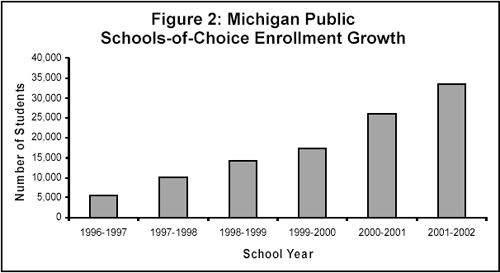
According to the Michigan Department of Education, a total of 463 out of 554 districts participated in Michigan’s state schools–of–choice plan last year. Of those that participated, 169 districts adopted their own plans, offering very limited forms of choice. Ninety–one districts do not permit choice at all. Overall, the number of students participating statewide in the choice program has grown from 5,611 in the 1996–97 school year to 33,506 in 2001–02,[42] less than 2 percent of Michigan’s 1.7 million K–12 public school children.
Participation in the schools–of–choice program is fiscally responsible for two reasons. First, competition creates incentives, which in turn gives rise to reform. The Dearborn City School District is a case in point. “We welcome competition. The reforms we’ve enacted would not have happened, at least not as fast, without competition,” says Jeremy Hughes, the district’s superintendent.[43]
During the 1990s, as choice increased through the growth of charter schools and public school choice, Dearborn began preparing to retain and attract students. New, specialized programs were developed, with parents’ wants and needs becoming the primary focus. Second, participation in the schools–of–choice program is fiscally responsible because it financially rewards successful school districts. Concurrent with Dearborn’s aggressive efforts to recruit students, enrollment at Dearborn public schools increased from 13,857 in 1994–95 to 17,075 in 2000–01 even as competition from neighboring school districts and charter schools has increased. Each out–of–district student brings with them $6,700 in state per–pupil funding.
In other words, even with such limited choice, parents are beginning to see the potential these programs have to improve schools. Dearborn parents say the district must show improvement and offer better educational services to lure students to the district. Districts that do not participate in the program or respond to consumer demand face the possibility of losing students, and funding, to other districts.
“People are going to have to see the improvements in the curriculum,” Rose Starks, a parent of three children in the Detroit school system, told the Detroit News. “If you can satisfy the parents and the children here now, you can then attract new ones. If you don’t meet the needs of a basic and challenging curriculum, clean and safe buildings, you will not retain the students you have,” she said.[44]
Public school choice options are a reality across Michigan – whether it be through interdistrict choice or charter schools. Fiscally responsible districts face this reality and the consumer demand it enjoins with confidence by participating in choice programs, offering options to their consumers and seeking to improve services. The environment of choice provides an incentive for change and the impetus for schools to improve, reduce excessive costs and direct more money into services for students.
The sixth and final habit of fiscally responsible public school districts is collective bargaining reform.[45] Michigan’s compulsory union law, the Public Employment Relations Act (PERA) requires collective bargaining where employees have unionized, but many of these collective bargaining agreements restrict school administrators’ ability to do their jobs, and therefore unnecessarily block fiscally responsible reforms.
This is not to say that individual employees should not be free to associate in any organization they choose. At the same time, school boards should not necessarily be forced to negotiate collective bargaining agreements and should be free to negotiate individually with teachers, if they so desire.
Every school day, the current widespread collective bargaining regime makes a financial difference in school’s operations, educational environment, and the ability of children to learn. School districts therefore have a fiduciary interest in assuring that collective bargaining is not so burdensome that it diverts precious resources from student learning.
From a 1998 analysis of more than 500 collective bargaining agreements, seven improvements (not already suggested in previous sections) are recommended to assure that these agreements allow effective school management. Many of these problems may be avoided by demanding well–worded contract language. Implementing the seven improvements will dramatically enhance the ability of public school districts to enact needed reforms.
Every collective bargaining agreement should specifically detail the rights and responsibilities that remain vested in the school board. As elected officials, school board members form the only public body with the legitimate responsibility and authority to operate a school district; neither teachers nor school employee unions have been granted authority by the electorate to undertake this responsibility.
The management rights contract language, or “rights of the board of education,” is the contract provision that establishes school board control over the operation of the school district. School districts should adopt strong management rights clauses that explicitly designate the specific, exclusive rights reserved to the school board, administrators and management.[46]
When a public employer recognizes a collective bargaining representative as the agent representing the employees in a defined bargaining unit, PERA grants exclusive recognition to that agent to act for those employees in issues involving wages, hours, and terms and conditions of employment.[47] In addition to including such recognition, more than 500 contracts contain a separate provision by which the school board agrees not to negotiate with any other teacher organization.
In other words, if a school board wished to contract with a math, science or professional teacher organization for the purposes of professional development for its staff members (a term of employment), it would first require the union’s permission. School boards should remove exclusive bargaining representative clauses that require such permission before employees can explore opportunities with other professional organizations.
Many school board members and other citizens mistakenly believe that union membership is required for all teachers working under a collective bargaining agreement. The truth is that there is no statute that requires teachers to either become union members or pay union dues in the absence of a contractual agreement between a school district and a union.
The mandatory support clause (sometimes called a “union security” clause), if included in a collective bargaining agreement, is what forces school employees to pay union dues. School boards that agree to such a clause become union financial enforcers, often by agreeing to fire any employee who fails to pay dues.
School boards should negotiate mandatory support clauses out of their collective bargaining agreements. The coercive and unfair nature of such clauses negatively affects school employees’ morale, productivity and professionalism. Unions that excel in representing their members will have no difficulty attracting and keeping the voluntary support of those members.
“Just cause” refers to contractually established standards of conduct that an employee must breach before he can be disciplined or discharged. Due process is the legal procedure instituted when an employer wishes to discipline or discharge an employee who has breached the “just cause” standard.
“Just cause” is distinct from an “at will” employment arrangement. “At will” means either party may terminate the employment relationship at any time for any reason. The “just cause” standard, on the other hand, is typically applied to employees who have a property interest in the employment relationship. Teachers who have received tenure status, for example, enjoy property rights in their employment relationships.
The “just cause” standard and the resulting due process proceeding for employee discipline or discharge is a burdensome and time–consuming process for districts that wish to remove ineffective, unproductive or even criminal teachers from the classroom. Under this standard, a school board can face increased and unplanned expenses in processing employee discipline and discharge matters, including substantial liability for teacher re–instatement or back pay in the event of an unfavorable arbitration or tenure ruling.
School boards should limit the “just cause” standard to include only tenured teachers and provide a less rigid standard for probationary teachers, who are still being evaluated for their competence. Boards are legally obligated to provide “just cause” employment only to tenured teachers, so they should carefully review their collective bargaining agreements for any language that makes a “just cause” standard applicable to probationary teachers.
School boards and administrators should carefully follow the established seven–point test when building a case for the “just cause” discipline or discharge of a tenured teacher. The seven points include:
Did the employer forewarn the employee of possible disciplinary consequences of conduct?
Was the rule or directive involved reasonably related to the orderly, efficient operation of the business?
Before administering discipline, did the employer properly investigate to determine that the employee did violate or disobey the rule or directive?
Was the employer’s investigation done in a fair and impartial manner?
Through the investigation, did the employer obtain enough evidence to prove the employee was, in fact, in violation of the rule or directive?
Was the rule, directive, and penalty applied fairly and without discrimination?
Was the discipline applied reasonably related to the gravity of the offense and was the amount of discipline reasonable given the employee’s overall record?[48]
Arbitrators are unlikely to uphold the discipline or discharge of an employee if the school district does not properly follow and document the steps showing “just cause.” School boards and administrators who adhere to the requirements for “just cause” will avoid unnecessarily costly and unfavorable arbitration rulings.
The teacher evaluation plays an important part in a school’s ability to effectively educate its students. School officials must be able to evaluate the competency and performance of each teacher in order to judge how well he or she uses professional skills to help students learn and achieve.
Because each evaluation is part of a continuum that builds over time, a proper teacher evaluation must go beyond the mere “performance” of an instructor in the classroom and address a teacher’s overall ability to establish and maintain a positive learning environment for students. School boards and administrators must keep this focus in mind as they bargain over contract language that affects these evaluations.
Collective bargaining agreements in Michigan, with few exceptions, place more restrictions on school administrators’ rights to evaluate their teachers than do any statutory requirements. Former NEA President Bob Chase acknowledged that, “The heart of education is this: the daily engagement between teacher and pupil, and the commitment that both parties bring to the task.”[49] Yet unions such as the MEA (the NEA’s Michigan affiliate) often demand uniformity in the teacher evaluation process, a cookie–cutter approach that ignores the differences in goals, objectives, standards and style between elementary and secondary teaching.
School board members and administrators should use the five points established under the Michigan Teacher Tenure Act when evaluating a teacher’s competency. Unsatisfactory performance in any one of these five points is sufficient to determine that a particular teacher is not competent:
knowledge of the subject;
ability to impart the subject;
manner and efficiency of discipline over students;
rapport with parents, students, and other faculty; and
physical and mental ability to withstand the strain of teaching.[50]
The course of action pursued by the school district with regard to a poorly performing teacher must be based on the extent or severity of the poor performance.
School boards should also remove from their collective bargaining agreements any language that allows teachers grievance rights over the content of a teacher evaluation. The content of teacher evaluations should be left to the sole discretion of school administrators, not to arbitrators in lengthy and expensive grievance proceedings. By making evaluation content a grievable matter, school boards wind up placing the judgment of arbitrators, who do not work with or see the teachers being evaluated, above the judgment of the school administrators, whose responsibility it is to observe and evaluate the teachers’ abilities.
Most public school teachers in Michigan are paid according to a seniority–based salary schedule, which awards compensation according to a teacher’s years of experience and level of education. This is in contrast to most other areas of commerce and industry, where employees working under a “merit–based” schedule receive compensation that is commensurate with their job performance and productivity.
Under a seniority–based, or “single salary schedule,” system, individual teachers have a reduced incentive to innovate or excel in the classroom since their level of compensation is not tied to their performance. Most collective bargaining agreements in Michigan establish teacher salary schedules based solely on a teacher’s level of education and years of experience.
These salary schedules are organized into a “grid” which provides for automatic pay increases based upon the number of years a teacher has spent in the district and the kind of college degrees or number of additional academic credit hours he or she has accumulated or both (commonly referred to as “step” increases).
In most school districts, entry level teachers with only a bachelor’s degree and no prior teaching experience receive the base negotiated salary; few districts reserve the unrestricted right to establish the starting salary for a teacher on any step of the pay scale. This makes it difficult for schools to hire high–demand positions such as special education, math or science teachers.
School districts attempting to establish performance–based pay schedules for their teachers have invariably met with union resistance. However some districts, such as Saginaw, have been successful in bargaining a portion of their teachers’ salaries based on the requirement that teachers meet certain district–wide goals adopted by the school board.[51]
The Michigan Legislature strengthened school districts’ right to create performance–based salary systems when it passed Public Act 289 in 1995, which states in part that, “A school district or intermediate school district may implement and maintain a method of compensation for its employees that is based on job performance and job accomplishments.”[52]
The number of students per teacher in a classroom has been an issue in collective bargaining since the first contract negotiations began in Michigan more than 30 years ago. Unions maintain that smaller classes allow teachers to spend more time with each student, thus boosting educational achievement. Consequently, many of Michigan’s school districts have negotiated language that affects class size into their bargaining agreements.
Over a third of collective bargaining agreements in Michigan currently establish a maximum number of students for each class and provide for mandatory teacher salary bonuses any time this maximum is exceeded.
Negotiating smaller class sizes has proven to be a costly arrangement for school districts, especially those with growing student populations. Further, there is little good evidence suggesting that small classes predictably and systematically yield higher student achievement.[53] Establishing class size requirements within a collective bargaining agreement restricts the school administration’s decision–making about the most effective use of staff, space and scarce financial resources.
In short, every school district now has the ability through careful collective bargaining to effect reforms that will help meet the demands of parents, taxpayers, students and teachers. School board members in all of Michigan’s school districts must seize the opportunity to transform the bargaining process from an adversarial one into one more focused on cooperatively improving the educational product, increasing value, and protecting the rights of all concerned.
For too long, Michigan school districts have not considered the needs of their two customers: the taxpayer and the parent. Parents, of course, want their children to be well educated, and taxpayers rightly expect that education be fiscally responsible, not wasting precious tax dollars. With parents increasingly able to select alternative education options such as cross–district public schools, charter schools, private schools, and home schooling, traditional public school districts must be innovative in their spending in order to compete effectively for students.
Financial responsibility starts with school boards and district officials working together to develop new ways of thinking about school finance. Three overarching questions emerge for school districts when considering financially responsibility:
Are public dollars being used most efficiently and effectively in the provision of non-instructional school services?
Can these same services be provided alternatively at a lower cost, or improved services be bought for the same cost?
Are the proper incentives and institutional environment in place to enact these changes?
The fiscally responsible school district will continually revisit these three issues on a regular basis to assure that both parents and taxpayers are getting their money’s worth. This study has analyzed six habits where funds can be saved through proper management. In many cases, various school districts in Michigan already are taking fiscal reforms to heart by implementing one or more of these six habits of fiscally responsible school districts.
Habit 1: Minimize Administrative Costs. The first hallmark of fiscal responsibility starts with front office functions. Many school districts employ a small phalanx of consultants, administrators, assistant superintendents, etc. Does the existence of this sometimes–extensive front office staff help educate children, or could this money be better used in the classroom?
Habit 2: Take Advantage of Cost Savings from Outsourcing Non–Instructional Services. Most schools currently run a broad range of non–instructional services, such as janitorial, food, transportation, etc. When these services are opened up for competitive bidding, many school districts find they can either improve the quality of the services, save money on comparable services, or both.
Habit 3: Manage Employee Health Benefits Effectively. The cost of staff and teacher health benefits has skyrocketed over the past few decades for a number of reasons. First, some districts have allowed the Michigan Education Special Services Association, a third–party insurance administrator controlled by the Michigan Education Association, to administer insurance benefits without a competitive bidding process. Second, the negotiated union health benefit structure is far superior to other locally available health plans. Even the most generous corporate benefits do not compare with the ones typically enjoyed by school employees. School districts that have reformed their benefit structure have saved millions of dollars while offering high–quality benefits for their employees.
Habit 4: Structure Capital Costs Effectively. With many districts needing new school facilities to cope with growth or to replace substandard ones, now is the ideal time to consider innovative and fiscally responsible ways to acquire classroom space. Instead of constructing new school buildings, some schools have opted to lease facilities, which can save the schools money in the long run, while leaving maintenance and major repair expenses to the private owners.
For those schools that decide to purchase or construct new buildings, more effective debt management and bonding policies would allow them to save money on their debt service.
Habit 5: Participate in Michigan’s Schools-of-Choice Program. Participation in schools–of–choice provides the proper incentives for school districts to adopt reforms, because it spurs inter–district competition. Additionally, public schools that can successfully attract and retain students through Michigan’s schools–of–choice program can see more funding flow into their district.
Habit 6: Reform Collective Bargaining. School employee unions can and often do limit the ability of school districts to enact needed reforms. Schools should have more authority to hire and fire teachers, remove mandatory support/exclusive rights to bargain clauses, and strengthen other management rights that are often unwittingly ceded to the unions.
School districts that can effectively implement these six habits in their annual budgeting will see cost savings in their programs, savings that can be used for alleviating budgetary shortfalls, funneling money back into the classroom, or returning funds to the taxpayer. Implementing these ideas to the business of educating Michigan’s children is a meaningful way to improve public education across the state.
U.S. Department of Education, Digest of Education Statistics 2001 (Washington, D.C.: Government Printing Office, 2002), Table 169.
Anonymous, “Michigan Teachers Get Smallest Slice of Personnel Pie: Michigan Teachers are Outnumbered by Non-Teachers” Michigan Education Report, Winter 1999 at http://www.educationreport. org/pubs/mer/1574.
La Rae G. Monk, “Collective Bargaining: Bringing Education to the Table” Mackinac Center for Public Policy Report, August 1998 at https://www.mackinac.org
For more on this issue, see Anonymous, “Michigan administrative expenses top $1.4 billion: School administration costs rise over two-times faster than instructional expenses” Michigan Education Report, Spring 2002 at https://www.mackinac.org
See Anonymous, “Detroit Teachers Not Receiving Paychecks: Privatization of Payroll Service Could Fix Problem, Say Observers” Michigan Education Report, Winter 2000 at https://www.mackinac.org
A list of the schools reviewed may be found at http://www.window.state.tx.us
For more on this, see Brennan Brown, “Minneapolis Public Schools Teach a Lesson in Privatization” Michigan Privatization Report, Winter 1998 at https://www.mackinac.org
Anonymous, “Minneapolis Schools’ Chief Hutchinson Brought Stability, Change” St. Paul Pioneer Press, Monday, June 2, 1997, pg. 6A.
Duchesne Paul Drew, “33 Minneapolis schools lauded for efforts to improve quality” Minneapolis Star Tribune, Oct. 29, 1996, p. 1B.
Joe Argon “Changing the Guard” American School & University, Sept. 1, 1997 at http://asumag.com
Joseph Lehman, “Privatization Can Teach New Detroit School Board a Lesson.” Audio commentary transcript from June 7, 1999, available at https://www.mackinac.org
Anonymous, “Detroit schools privatize maintenance department” Michigan Privatization Report, Spring 2002 at https://www.mackinac.org
Brian Harmon, “Plow Plan a Success for Detroit Schools” Detroit News, Dec. 13, 2000, at https://www.detroitnews.com
Anonymous, “Privatization Paint-by-Numbers” Michigan Privatization Report Fall 2000 at https://www.mackinac.org
Anonymous, “Will Detroit’s Reform School Board Learn Its Lesson?” Michigan Privatization Report, Fall 1999 at https://www.mackinac.org
Ibid.
Michael LaFaive, “Mt. Pleasant Schools Taste Success with Cafeteria Privatization” Michigan Privatization Report, Summer 2001 at https://www.mackinac.org
Elizabeth H. Moser, “Computing the Savings: Detroit Schools Privatize Information Technology” Michigan Privatization Report, Spring 2001 at https://www.mackinac.org
See Brian Harmon, “Compuware wins $90 million school deal in Detroit: Contract is second in cash-saving privatization drive” Detroit News, Aug. 16, 2000 at https://www.detroitnews.com
Mackinac Center for Public Policy telephone survey of school districts, Summer 2001. See Michael LaFaive, “Survey Says: Privatization Works in Michigan Schools” Michigan Privatization Report, Fall 2001 at https://www.mackinac.org
Some of these deal directly with school employee collective bargaining, which will be discussed below under Habit 6.
For more on MESSA, see Andrew Bockelman and Joseph P. Overton, “Michigan Education Special Services Association: The MEA’s Money Machine” Mackinac Center for Public Policy study, January 1993 at https://www.mackinac.org
Frank Webster, “Teachers Deserve Good Benefits; Schools Deserve to Know What They Cost,” Viewpoint on Public Issues No. 98-20, July 6, 1998, Mackinac Center for Public Policy at https://www.mackinac.org
Tom Watkins, “Has Michigan spent enough on school buildings? No: State must repair savage inequities in infrastructure to protect kids” Detroit News, Sept. 15, 2002 at https://www.detroitnews.com
Patrick Anderson, “Has Michigan spent enough on school buildings? Yes: Investment in structures explodes, so don’t break word on limiting taxes” Detroit News, Sept. 15, 2002 at https://www.detroitnews.com
Michael Arens, “The Need for Debt Policy in Michigan Public Schools” Mackinac Center for Public Policy Report, March 1998, at https://www.mackinac.org
See for example, Ben Hayllar, “Preparing a Municipal Debt Policy,” Government Finance Review, June 1994, pp. 34-35, Municipal Treasurers’ Association of the United States and Canada, Debt Policy Handbook, 2nd edition, (Washington, D.C.: Government Finance Officers Association, 1994), Debt Management Recommended Practices, cited Apr. 27, 1998, available at http://www.gfoa.org/practice/rp_debt.htm, and Lennox L. Moak and Albert M. Hillhouse, Concepts and Practices in Local Government Finance, (Chicago, IL: Municipal Finance Officers Association, 1975).
For a longer report on these recommendations, see Michael Arens, “The Need for Debt Policy in Michigan Public Schools” Mackinac Center for Public Policy study, March 1998, at https://www.mackinac.org
MCL 380.1351.(3).
J. Flanigan, M. Richardson, D. Stollar, Managing School Indebtedness: A Complete Guide to School Bonding, 2nd edition (Lancaster, PA: Technomic Publishing Co., 1995), p. 83.
A standard amortized debt repayment schedule (as one might find in a mortgage loan), would retire just over half the principal at the end of the 10th year if the note were amortized over 16.5 years. A shorter term bond would, naturally, retire more principal faster.
Arguments in favor of certificates of participation may be found in Michael DeArmond, Sara Taggart and Paul Hill, The Future of School Facilities: Getting Ahead of the Curve (Seattle, WA: Center on Reinventing Public Education, May 2002), pp. 20-23 at http://www.crpe.org
James C. Joseph, Debt Issuance and Management (Washington, D.C.: Government Finance Officers Association, 1994), pp. 33-35.
See Lynn Stevens Hume, “ABA Task Force to Finish Pay-to-Play Report by Early June,” The Bond Buyer Online, April 21, 1998.
For more on leasing school buildings, see Ronald D. Utt, Ph.D., “New Tax Law Boosts School Construction with Public-Private Partnerships” The Heritage Foundation Backgrounder No. 1463, Aug. 8, 2001 at https://www.heritage.org
Email Correspondence with Ralph Crosslin, CEO of Morey Charter School, Oct. 9, 2002.
Ibid.
Section 422 of the Economic Growth and Tax Relief Reconciliation Act of 2001 extended the privilege of using tax-exempt private activity bonds to qualified public education facilities. See Ronald D. Utt, Ph.D., “New Tax Law Boosts School Construction with Public-Private Partnerships” The Heritage Foundation Backgrounder No. 1463, Aug. 8, 2001 at https://www.heritage.org
Earlier this year, passage of Virginia Senate Bill 681, the “Public-Private Educational Facilities and Infrastructure Act” authorized these kinds of bonds. For a description of this legislation, see http://leg1.state.va.us
For more on this enrollment issue, see Anonymous, “Don’t Overbuild School Districts” Detroit News, Oct. 6, 2002 at https://www.detroitnews.com
Much of this section is adapted from “Thousands of students switch public schools under choice law,” Michigan Education Report, Fall 2001 at https://www.educationreport.org
Email Correspondence from Michigan Department of Education. Jan. 11, 2002.
Matthew J. Brouillette and Dr. Matthew Ladner, “The Impact of Limited School Choice on Public School Districts,” Mackinac Center for Public Policy, July 2000, pp. 15.
Jodi S. Cohen, “Student Exodus Drains Detroit,” Detroit News, Mar. 11, 2001 at https://www.detroitnews.com
Much of this section is adapted from La Rae G. Monk, “Collective Bargaining: Bringing Education to the Table” Mackinac Center for Public Policy Report, August 1998.
Ibid, pp. 23-24.
MCL 423.211.
Grief Brothers Cooperage Corp, 42 LA 555 (1964).
Bob Chase, “Running on Empty: Why Our New Unions Must Put Teacher Quality First,” Education Week, Jan. 21, 1998, p 14.
MCL 38.101, et. seq.; MSA 15.2001 et seq.
Saginaw Public School Master Agreement, 1995-1998, Appendix A, p 70.
1995 PA 289, MCL 380.1250.
See, for example, Kirk A. Johnson, Ph.D., “Do Small Classes Influence Academic Achievement? What the National Assessment of Educational Progress Shows” The Heritage Foundation CDA Report #00-07, June 9, 2000 at https://www.heritage.org
Kirk A. Johnson, Ph.D. is the director of education policy at the Mackinac Center for Public Policy. His research focuses on student achievement, testing, accountability, teacher quality, funding, and choices in educational alternatives.
Before joining the Mackinac Center in 2002, Dr. Johnson was Senior Policy Analyst for The Heritage Foundation’s Center for Data Analysis in Washington, D.C. where he conducted statistical research on academic achievement issues. Prior to that, he worked at the U.S. Census Bureau, George Mason University, the University of North Texas, and taught economics at a college in Fort Worth, Texas.
Dr. Johnson’s research has been featured in a host of publications across the nation, including the New York Times, Washington Post, Chicago Tribune, Los Angeles Times, Investor's Business Daily, and the Detroit News. His Ph.D. is in Public Policy from George Mason University.
Elizabeth H. Moser is education research associate at the Mackinac Center for Public Policy. Ms. Moser also serves as the Managing Editor of Michigan Education Report, a quarterly journal focused on K-12 education issues in the state of Michigan, and Managing Editor of Michigan Education Digest, a weekly email education news update.
The authors wish to thank the public school officials who shared their experiences for this publication. The authors also acknowledge the assistance of Mackinac Center staff: Communications Specialist Samuel Walker, Graphic Arts Manager Daniel Montgomery, Senior Managing Editor of the Michigan Privatization Report Michael LaFaive and education intern Neil Block.



