

 Font size:
Privatization is a time-tested management tool used by governments around the world. It can take many forms, but competitive contracting is the most prevalent in the United States whether in municipalities or within the realm of public education. In some regards, Michigan is a national leader in competitive contracting in education; in other areas it is a laggard.
From April 25 through June 30, 2007, the Mackinac Center for Public Policy conducted its fifth survey of the privatization of bus, food and janitorial services among Michigan’s 552 conventional public school districts. All Michigan school districts responded.
Privatization of at least one of these "big three" school support services rose to 221 districts, or 40.0 percent of all conventional public school districts. This figure represents a 7.1 percent increase from 2006, when the percentage was 37.4 percent, and an estimated increase of nearly 29.1 percent since 2001, when the percentage was 31.0 percent.[*]
According to the 2007 survey, 164 conventional public school districts in Michigan — 29.7 percent of all districts — contract for food services of some type. Some districts simply hire companies to manage the existing staff, while others allow the staff of the vendor to provide every aspect of the service. Food service contracting increased 3.6 percent from the 2006 survey.
In 2007, the Mackinac Center also conducted a nationwide survey of state education departments to determine the rate at which U.S. school districts contract with food service management companies.[†] Only 13.2 percent of conventional public school districts in the nation contract with such companies — less than half the Michigan rate. Indeed, among the states, Michigan’s food service contracting rate is fourth, behind only Rhode Island, New Jersey and Pennsylvania.
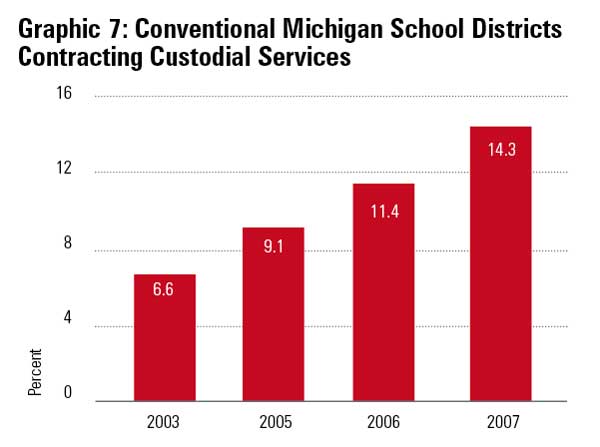
The 2007 Michigan survey also found that 14.3 percent of Michigan districts said that they were contracting for custodial services to some degree. This figure indicates a higher rate of growth for this service than for the other two. For the second year in a row, the number of districts contracting for janitorial services increased by a staggering 25.2 percent.
According to the 2007 survey, privatization of school bus transportation is an area in which Michigan lags the nation. Only 4.3 percent of Michigan’s conventional public school districts contract for transportation services, compared to estimates exceeding 30 percent for the nationwide rate. The Mackinac Center excluded from its calculations those districts that ended busing altogether and those that contract only for special education and field trip busing services.
Of the 221 conventional public school districts that contract for at least one of the big three services in Michigan, 172, or 77.8 percent, reported savings from privatization. Only 4.1 percent said that the contract had not saved them money. The remainder reported being unsure, in part because the contracts were too new.
A whopping 89.1 percent of the 221 contracting districts reported that the district was satisfied with its privatization experience. Less than 1 percent of respondents were dissatisfied. The remainder of districts were unsure if they were satisfied or not; this, too, may be a function of contracts being too new to be assessed.
The survey indicated that as of June 30, 2007, an additional 42 districts were considering privatization of food, custodial or transportation services for the 2007-2008 school year. Following completion of the survey, two districts contracted their custodial services, but those numbers are not included in this year’s survey totals.
[*] Note that not all of Michigan’s school districts responded to the 2001 survey, making the results an estimate. All districts ultimately responded in the surveys for 2006 and 2007.
[†] State education departments keep such figures as part of the federal government’s school lunch programs. States do not typically keep similar data for bus and custodial services privatization.
Privatization is a time-tested management tool used by governments around the world. It can take many forms, but competitive contracting is the most prevalent in the United States whether in municipalities or within the realm of public education. In some regards, Michigan is a national leader in competitive contracting in education; in other areas it is a laggard. Nationwide research can be highly detailed and scholarly or very generalized, depending on the privatized service and sometimes on the state in question.
At the state level, the Mackinac Center for Public Policy possesses what are likely the most thorough data on school support service privatization anywhere. In school districts across Michigan, competitive contracting for at least one of the "big three" noninstructional support services — food, busing and custodial — continues to increase: Through June 2007, 40.0 percent of Michigan’s 552 conventional public school districts reported contracting one of these services to some degree — a 7.1 percent increase in the contracting rate since 2006, with 15 net new districts choosing to contract.i
i The number of operating conventional school districts in Michigan is not always the same from year to year. In 2007, there were 552 operating districts, but in 2006, there were only 551, since White Pine Public Schools enrolled no students that year. In this study, we have used the number of operational school districts to calculate and compare school district contracting rates in different years, meaning that the contracting rate in any given year may not be based on the typical 552 school districts. As a practical matter, the number of operating districts has fluctuated very little in recent years.
School districts across the country contract with private businesses for all manner of goods and services as a routine part of their education work. No district can afford to be a "Robinson Crusoe" and produce everything it consumes in-house. Nor does it have the expertise. Imagine the employment difficulties schools would have if each were required to produce its own chalk, desks and textbooks. Such a scenario is implausible.
But districts still work to produce a great deal of the services that are not within their core function of educating children. Fixing boilers, serving lunches and driving buses need not be unnecessarily expensive components of school operations. Unfortunately, they often are, and the money spent providing these expensive, ancillary services is money that isn’t getting into the classroom. Saving money is just one reason districts turn to competitive contracting.
This is the fifth time the Center has attempted to survey school districts in the state about their privatization practices and experiences, and the second survey that has achieved a 100 percent response rate. (Achieving a perfect response rate is important because it theoretically reduces the sampling error common in surveys to zero.) The Mackinac Center goes to great lengths to conduct this survey and for several reasons.
First, the data is not centralized in any other location. Obtaining and publishing this information is useful for simply understanding and educating the public about the degree to which school support service privatization occurs. Second, knowledge is power. District officials may not fully appreciate the degree to which sister districts use the management tool of contracting. Indeed, many officials may often be inspired to investigate privatization simply because of reports of its effectiveness in other districts. Last, the trends that emerge from annual or biennial research on school privatization statewide underscore a revealed preference in districts for or against support service contracting. The notion that privatization can’t be successful is belied by its continued expansion.
This policy brief takes the Center’s research a step further than its traditional reporting by breaking out several key responses for more detailed analysis. For example, in the section titled "District Contracting by Pupil Population," the reader will find the tally of district contracts broken out into six pupil population categories.
In late 2006 and early 2007 the Mackinac Center conducted a nationwide survey of state education departments about the number of conventional public school districts that contract with a food service management company. As part of the National School Lunch Program, states keep records on participating institutions that contract with an FSMC for food services. For the purposes of our survey, charter schools, private and parochial schools and residential child care institutions were excluded from the tally.
The results can be seen below.
Graphic 1
Number of Conventional Public School Districts in the National School Lunch Program That Contract With Food Service Management Companies, by State
|
State |
NSLP Districts Contracting Food Services |
Total NSLP Districts |
Percentage of
Food |
|
Alabama |
1 |
131 |
0.8 |
|
Alaska |
5 |
50 |
10.0 |
|
Arizona |
44 |
198 |
22.2 |
|
Arkansas |
0 |
245 |
0.0 |
|
California* |
2 |
894 |
0.2 |
|
Colorado |
11 |
178 |
6.2 |
|
Connecticut |
40 |
169 |
23.7 |
|
Delaware |
0 |
19 |
0.0 |
|
Florida |
6 |
67 |
9.0 |
|
Georgia |
1 |
180 |
0.6 |
|
Hawaii |
0 |
1 |
0.0 |
|
Idaho |
4 |
109 |
3.7 |
|
Illinois |
160 |
873 |
18.3 |
|
Indiana |
14 |
294 |
4.8 |
|
Iowa |
8 |
345 |
2.3 |
|
Kansas |
4 |
295 |
1.4 |
|
Kentucky |
0 |
175 |
0.0 |
|
Louisiana |
1 |
69 |
1.4 |
|
Maine |
2 |
231 |
0.9 |
|
Maryland |
1 |
24 |
4.2 |
|
Massachusetts |
47 |
299 |
15.7 |
|
Michigan |
159 |
552 |
28.8ii |
|
Minnesota |
42 |
339 |
12.4 |
|
Mississippi |
1 |
202 |
0.5 |
|
Missouri |
97 |
524 |
18.5 |
|
Montana |
6 |
325 |
1.8 |
|
Nebraska |
17 |
254 |
6.7 |
|
Nevada |
1 |
17 |
5.9 |
|
New Hampshire |
25 |
467 |
5.4 |
|
New Jersey |
349 |
542 |
64.4 |
|
New Mexico |
12 |
89 |
13.5 |
|
New York |
149 |
680 |
21.9 |
|
North Carolina |
4 |
115 |
3.5 |
|
North Dakota |
0 |
188 |
0.0 |
|
Ohio |
50 |
613 |
8.2 |
|
Oklahoma |
15 |
541 |
2.8 |
|
Oregon |
32 |
196 |
16.3 |
|
Pennsylvania |
184 |
501 |
36.7 |
|
Rhode Island |
31 |
36 |
86.1 |
|
South Dakota |
16 |
168 |
9.5 |
|
South Carolina |
11 |
85 |
12.9 |
|
Tennessee |
1 |
136 |
0.7 |
|
Texas |
96 |
1,054 |
9.1 |
|
Utah |
2 |
40 |
5.0 |
|
Vermont |
42 |
280 |
15.0 |
|
Virginia |
7 |
132 |
5.3 |
|
West Virginia |
0 |
55 |
0.0 |
|
Washington |
51 |
282 |
18.1 |
|
Wisconsin |
61 |
416 |
14.7 |
|
Wyoming |
3 |
48 |
6.3 |
|
Total |
1,815 |
13,722 |
13.2 |
Source: State education departments, author’s calculations
* The California data reflect the number of districts that had official contracts with an FSMC to provide services in conventional public school districts. This figure, however, probably understates the role of FSMCs in California. Districts frequently turn to FSMCs through consulting agreements, rather than official contracts. Such agreements were excluded by the state of California when it responded to the survey, while essentially similar agreements were included by other states participating in the survey.
As can be seen from the total of the fourth column, the nationwide average was just 13.2 percent, or less than half of the rate in Michigan. Since the Center’s nationwide survey was completed, however, the total number and percentage of school districts that contract for food service have changed. The new data on these changes is discussed further in the detailed "2007 Survey Results" section, below.
Food service privatization is one area of school competitive contracting where Michigan is a national leader, though Rhode Island (86.1 percent), New Jersey (64.4 percent) and Pennsylvania (36.7 percent) still outpace the Great Lake State. The Northeast corridor appears to dominate America’s food service contracting landscape. Indeed, almost 75 percent of all contracts between conventional public school districts and FSMCs are located in just 10 states, seven of which are located in the Northeast.
These are not the only sound statistics that exist on this topic. For more information, see "A School Privatization Primer for Michigan School Officials, Media and Residents." Also, this fall the Centers for Disease Control and Prevention will release its own survey research which will include data on the degree to which schools contract out for food services.
ii This survey was completed in early 2007 and thus has a different percentage total for Michigan than the data tallied in a second, separate survey by the Mackinac Center completed June 30.
The only nationwide survey of custodial contracting of which the authors are aware is the 2001 American School & University survey. According to AS&U, 8 percent of those public school districts responding to the survey contracted for janitorial services. The marketplace for janitorial services is extremely fragmented and varied. In Michigan, as can be seen in the 2007 Survey Results section, below, custodial services have been a noticeable growth area for competitive contracting in conventional public schools.
The small amount of national data that exist in published form on school bus contracting suggest that as much as 31.8 percent of school districts contract for busing services to some degree. This statistic is from a 2001 American School & University survey of 1,000 representative conventional public school districts. An industry trade publication, School Bus Fleet, puts the figure at about 30 percent, but the magazine’s own editor qualifies the figure because of the difficulty in compiling accurate data in an industry as fragmented as school busing. Robin Leeds, an industry expert with more than 25 years of experience, explains why:
“How large a fleet constitutes a ‘company’ or a ‘contractor’? There are thousands of one-bus owners who contract with school districts to drive one route; are they included in the count? In Louisiana, for example, 35% of the fleet is privately owned, but it is primarily these independent owner-operators. One school district, Lafayette Parish, has 150 contractors. So you see the problem. Even if you limit the universe to corporations, for example, or owners of ten or more buses, there is no central repository of data beyond the 50 or 100 largest companies. It’s a guessing game.”[2]
Leeds and others report that in Connecticut and Massachusetts more than 90 percent of pupils using school bus transportation ride on privately owned or managed buses. This figure includes private and parochial school students. These states have long traditions of private school bus operations. Michigan school districts, by contrast, maintain a very small contingent of busing contracts statewide.
The privatization survey was conducted by telephone between April 25 and June 30, 2007. The vast majority of respondents were either district superintendents or school business officers. After concluding the initial series of interviews, one of the authors [Smith] called every district that reported having contracted with a private firm for either food, busing or custodial services and confirmed their responses.
A cutoff date of June 30 was chosen to coincide with the end of the 2006-2007 fiscal school year. At this cutoff date, there were a significant number of districts still looking at contracting for the 2007-2008 school year. Please see the section titled "2007 Survey Results" for more detail on this subject.
To ensure accurate comparisons from year to year, the Mackinac Center has developed a framework for what constitutes privatization in each of the three primary services that were examined. In general, a school district is considered to have privatized if it had moved responsibility for one of the big three non-teaching services (food, custodial and transportation) from district provision to private provision to some degree.
For example, a district was counted as having privatized its food service regardless of whether the FSMC simply managed an existing program and staff or took over an entire program, including providing its own employees. A few districts share their food services or food service director. If the shared food service director is obtained under contract through an FSMC, the Center counted it as a privatized service for both districts.
There were four districts in 2007 operating under this scenario. Summerfield Schools and Whiteford Agricultural Schools share a Sodexho School Services food service manager.[3] As district food service employees retire, they are to be replaced with employees of the private company, thus expanding the responsibility of the FSMC over time. On June 26, 2007, the Homer Community Schools Board of Education voted 7-0 to share a Chartwells School Dining director with Litchfield Community Schools.[4]
Custodial services were viewed as having been privatized if the district hired a private vendor to clean at least one of its buildings. One district, Paw Paw Public Schools, contracts for its custodians through a temporary employee service.[5] The Center included this district as having privatized its services.
Transportation was counted as having been privatized if at least one bus route was operated under contract with a private vendor. Only one district, Potterville Public Schools, reported contracting for busing services for just one route.[6] There were three districts that effectively privatized their transportation by eliminating transportation altogether, though two of these districts contract with a private, for-profit vendor for special events. The Mackinac Center did not count eliminating district busing wholesale or simply contracting for special events in its privatization tally.iii
Nor did it include as privatized (in 2007) any district that contracted with another unit of government for busing services.There are six districts statewide that contract for transportation with some form of a transit authority. They include Baldwin Community Schools, Ionia Public Schools, Manistee Area Public Schools, Kalkaska Public Schools, Rapid River Public Schools and the Saginaw City School District.iv
The Center survey also excludes busing contracts related to special education.In the course of conducting this year’s survey, the authors learned that several districts that had reported privatized services were actually contracting with other units of government. The Center has revised its past figures to accommodate these changes, which are reflected in the modestly different year-to-year totals presented below.
iii Districts that effectively privatized by eliminating transportation but were not counted as contracting transportation are Lincoln Park Public Schools, Lakeview Public Schools and Hager Township School District 6.
iv Several of these districts contract with a private, for-profit firm for either food or custodial services.
For the fourth survey in a row, privatization of the three major noninstructional services in Michigan increased over the previous year’s total. In 2007, 40.0 percent (221 districts) of Michigan school districts reported contracting for at least one of the three major noninstructional services: food, custodial or transportation. This is up from a revised 37.4 percent (206 districts) in 2006. Since our original survey in 2001, the district contracting rate for at least one of the three major services to some degree appears to have increased by 29.1 percent.

Not all of the surveys conducted by the Mackinac Center included every district. The 2001, 2003 and 2006 original survey populations fell short. Survey 2001 included 228 of the 554 districts, while Survey 2003 included 517 of the 552 districts. The 2006 survey originally reached 550 of 551 operating conventional school districts. The 2006 survey was ultimately revised to include all 551 districts because the lone district that had not responded during the survey window (Detroit) later provided the Mackinac Center with the information the Center had been seeking.
One qualification is in order: The 2005 and 2007 surveys had response rates of 100 percent, but the 2001 survey had a response rate of 41.1 percent. The incomplete response in 2001 introduces some potential sampling error and non-response error to our calculation of the percentage change from 2001 to 2007 in the number of districts that contract in Michigan. Still, even if one measures the change just since 2005, the states’ privatization rate increased by an impressive 12.8 percent in just two years. Moreover, "incomplete" is a relative term here. A survey that yields responses from 41.1 percent of the survey population is generally considered reasonably good in survey research.
There are 21 districts in the state that are new to contracting in 2007.v
Graphic 3
Conventional Michigan School Districts New to the Annual Survey's List of Districts Contracting for Food, Bus or Custodial Services
|
District |
County |
Service |
|
Arenac Eastern School District |
Arenac |
Food |
|
Big Bay de Noc Schools |
Delta |
Custodial |
|
Buchanan Community Schools |
Berrien |
Custodial |
|
Decatur Public Schools |
Van Buren |
Food |
|
Dryden Community Schools |
Lapeer |
Food, Custodial, Transportation |
|
Fitzgerald Public Schools |
Macomb |
Food |
|
Forest Area Community Schools |
Kalkaska |
Custodial |
|
Gwinn Area Community Schools |
Marquette |
Custodial |
|
Harbor Beach Community Schools |
Huron |
Custodial |
|
Homer Community Schools |
Calhoun |
Food |
|
Inland Lakes Schools |
Cheboygan |
Food |
|
Lakeshore Public School District |
Berrien |
Custodial |
|
L’Anse Creuse Public Schools |
Macomb |
Food |
|
L’Anse Area Schools |
Baraga |
Custodial |
|
Lansing School District |
Ingham |
Food |
|
Mancelona Public Schools |
Antrim |
Food |
|
Mattawan Consolidated School |
Van Buren |
Food |
|
Midland Public Schools |
Midland |
Food, Custodial |
|
Oakridge Public Schools |
Muskegon |
Food |
|
Saranac Community Schools |
Ionia |
Transportation |
|
Whitehall District Schools |
Muskegon |
Custodial |
In addition to finding a dramatic increase in competitive contracting, the Mackinac Center closed out this year’s survey (on June 30) with the understanding that 42 additional districts were still considering contracting for the 2007-2008 school year, and six of those districts reported being on the cusp of approving new privatization deals. Several districts requested that they not be profiled in print by the Mackinac Center for fear of stirring up greater opposition to privatization than they might otherwise face.
In addition, another 18 districts (beyond the 42 mentioned earlier) reported having already begun to explore contracting out for the 2008-2009 school year. This figure does not include a group of several districts in the Copper Country Intermediate School District which are in ongoing discussions to jointly contract for transportation services with a private firm.[7]
v This is not the net total for the increase in privatization statewide because a net six districts brought services back in-house from 2006 to 2007. A total of eight districts brought services in-house, but two of these ultimately contracted for a different function which kept them in the privatization category for the overall tally.
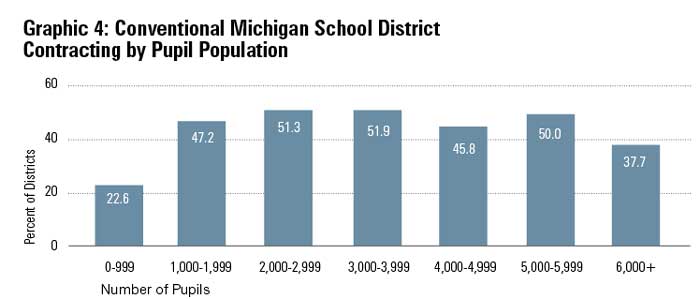
New to this year’s survey is the breakout of contracting as measured by the number of pupils in each district group. Medium-sized districts tend to contract more than large and small districts. More than half of districts that are between 2,000 and 4,000 students contract for food, custodial or transportation services.
In Appendix A, the reader will also find a breakdown of the number of districts that outsource one of the big three noninstructional services by county.
According to respondents to the Mackinac Center’s 2007 summer survey, 29.7 percent (164 districts) reported contracting for food services to some degree. That represents a 3.6 percent (six districts) increase in the contracting rate over 2006 (see Graphic 5). Food service privatization remains the most popular service for districts to outsource; however, it is not the fastest growing arena (see "Custodial Privatization").
Graphic 5

Graphic 6 shows the districts that are new to food service contracting in the Mackinac Center survey.vi
Graphic 6
Conventional Michigan School Districts New to the Annual Survey's List of Districts Contracting for Food Services
|
District |
County |
|
Arenac Eastern School District |
Arenac |
|
Decatur Public Schools |
Van Buren |
|
Dryden Community Schools |
Lapeer |
|
Fitzgerald Public Schools |
Macomb |
|
Homer Community Schools |
Calhoun |
|
Inland Lake Schools |
Cheboygan |
|
L’Anse Creuse Public Schools |
Macomb |
|
Lansing School District |
Ingham |
|
Mancelona Public Schools |
Antrim |
|
Mattawan Consolidated School |
Van Buren |
|
Midland Public Schools |
Midland |
|
Oakridge Public Schools |
Muskegon |
|
Reese Public Schools |
Tuscola |
Chartwells School Dining holds the vast majority of these contracts and has provided food management services to some Michigan school districts for more than 30 years.vii
Schools are increasingly asking FSMCs to provide the labor as well as the management as part of their contracts with the districts. For example, for the 2007-2008 school year, both the Lincoln Consolidated Schools and the Ann Arbor Public Schools voted to expand a contract already held with two FSMCs, respectively, for management of their food programs to include labor as well. In the coming school year the districts will no longer employ their own food service workers. The expansion of the Ann Arbor contract is expected to save the district an additional $400,000 annually, a little over $23.50 per student per year.[8]
vi This is not the net total for the increase in food service contracting because a total of seven districts brought their food service back in-house. See "Districts That Brought Their Services Back In-House" below for more details.
[vii] Please see the section "Competitive Contracting over Time" for more detail.
Custodial work was the top growth area of school support service privatization in the Center survey. Statewide, 14.3 percent of districts outsource for custodial services. The custodial contracting rate increased by 25.2 percent (16 districts) over last year’s total. In 2006, 63 districts were contracting for custodial services, and this privatization rate was up an impressive 26.2 percent (13 districts) from 2005.
The following 17 new districts are entirely new to custodial service contracting in the Mackinac Center survey.
Graphic 8
Conventional Michigan School Districts New to the Annual Survey's List of Districts Contracting for Custodial Services
|
District |
County |
|
Big Bay de Noc Schools |
Delta |
|
Buchanan Community Schools |
Berrien |
|
Coldwater Community Schools |
Branch |
|
Dryden Community Schools |
Lapeer |
|
Forest Area Community Schools |
Kalkaska |
|
Gwinn Area Community Schools |
Marquette |
|
Harbor Beach Community Schools |
Huron |
|
Holly Area Schools |
Oakland |
|
Kent City Community Schools |
Kent |
|
Lakeshore Public Schools |
Berrien |
|
Lakeview Community Schools |
Montcalm |
|
L’Anse Area Schools |
Baraga |
|
Midland Public Schools |
Midland |
|
Napoleon Community Schools |
Jackson |
|
Portage Public Schools |
Kalamazoo |
|
Whitehall District Schools |
Muskegon |
Every survey uncovers interesting anecdotes and evidence about competitive contracting in the state. For instance, in the Coldwater Community Schools the superintendent showed the Mackinac Center’s 2006 Michigan map of districts that have contracted to her school board as evidence that school support service privatization is neither a unique nor rare concept.[9] She also instilled courage in her colleagues with inspiring quotes from famous leaders and by reminding them of the savings that could be generated through privatization for reinvestment in the classroom.
Following are just three examples of districts that have recently outsourced custodial services, along with estimated savings:
In 2007, 4.3 percent of respondents (24 districts) were contracting for the management or operation of their transportation systems with private vendors (see Graphic 9). This tally does not include special education busing.
Graphic 9
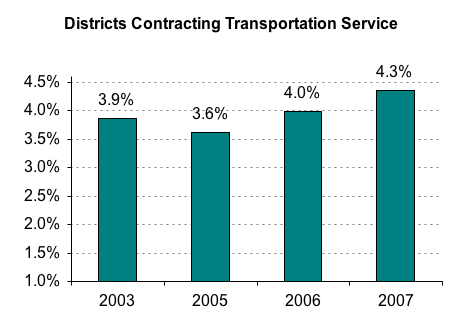
Graphic 9 represents data acquired over the course of surveys since 2003. It should be noted that the Center has revised its final bus privatization tallies for 2003, 2005 and 2006. In the course of conducting this year’s survey, the Mackinac Center discovered that several districts that were counted as having contracted for busing services in past years were doing so with another government entity. The Center has since removed these districts from the total of those previously recognized as having privatized this service, which changed the figures modestly. There were a total of three new districts that contracted for transportation services since last year’s survey was completed (see Graphic 10). One district brought the service back in-house.
Graphic 10
Districts New to the Annual Survey's List of Districts Contracting for Transportation Services
|
District |
County |
|
Dryden Community Schools |
Lapeer |
|
Inkster Public Schools |
Wayne |
|
Saranac Community Schools |
Ionia |
Between 2005 and 2007 there has been a 20.0 percent increase in the number of school districts contracting for busing services statewide. That increase may sound dramatic, but it must be juxtaposed against the relatively small number of contracts between districts and private vendors for busing services. Compared to states in the East, Michigan does very little pupil transportation contracting. This suggests that it is an area ripe for growth.
Privatization of school support services isn’t necessarily a permanent fixture in school districts. Some district officials, having contracted for services with private vendors, choose to allow district employees the opportunity to provide the service again. Since the 2006 survey was completed last August, eight districts brought services back in-house.
Graphic 11
Conventional Michigan School Districts Bringing Previously Contracted Services In-House in 2007
|
District |
County |
Service |
|
Allegan Public Schools |
Allegan |
Food Service |
|
Eaton Rapids Public Schools |
Eaton |
Food Service |
|
Lakeview Community Schools |
Montcalm |
Transportation Mgt. |
|
Madison Public Schools |
Oakland |
Food Service |
|
Napoleon Community Schools |
Jackson |
Food Service |
|
Owosso Public Schools |
Shiawassee |
Food Service |
|
Tawas Area Schools |
Iosco |
Food Service |
|
Williamston Community Schools |
Ingham |
Food Service |
Madison, Napoleon, Owosso and Tawas all brought their services back in-house because officials believed it would be less expensive. Williamston Community Schools chose to share their food service program with Okemos Public Schools, which does not contract.[13] Lakeview Community Schools lost their contracted manager for transportation and chose to promote a district employee to take over management of the system.[14] Allegan and Eaton Rapids did not indicate why they brought their services back in-house.
A striking 77.8 percent of respondents (172 of the 221 districts that contract) reported savings from privatization.
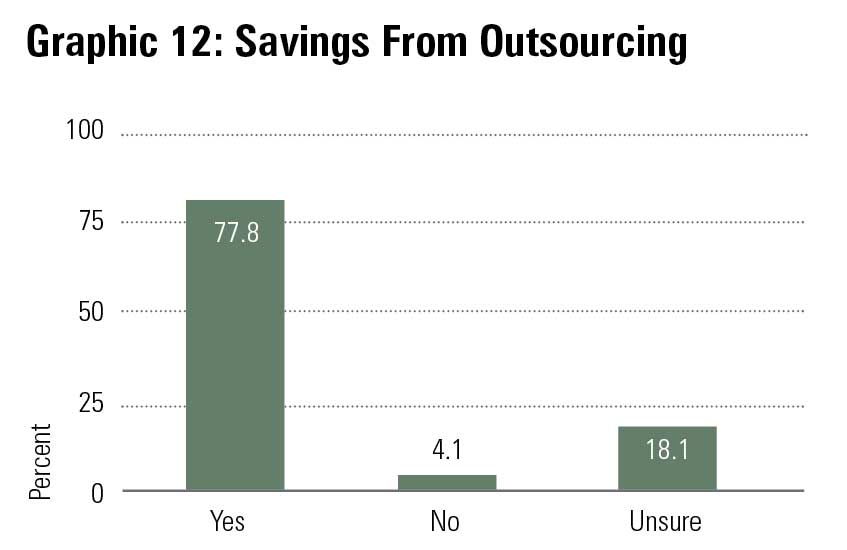
A total of 40 districts (18.1 percent) reported being unsure as to whether or not any savings resulted from their contracts.
Only nine districts (4.1 percent), reported that they derived “no savings” as a result of contracting for services. Of these nine districts, only two of them reported that their primary purpose for privatizing was to achieve “financial savings.” These districts were Fennville Public Schools and Summerfield Schools.[15] Despite the lack of savings, both districts reported being satisfied with their overall contracting experience. While this survey did not probe for more detailed explanations, it does not strain the bounds of credulity to speculate that the newly hired private vendors may have reduced district management headaches, improved quality or both.
Examining the percentage of districts reporting savings by the number of pupils in each district shows that savings can be found regardless of district size. Indeed, the smallest sized group generated savings from privatization at a higher rate than any other size category.
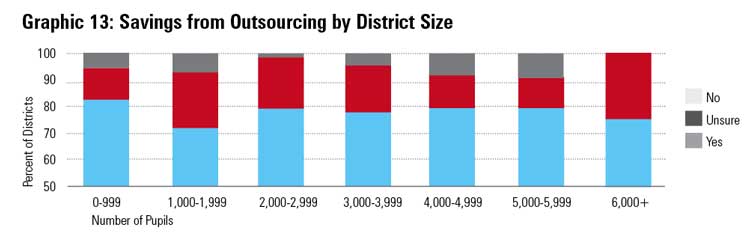
Only two of the seven districts that reported having “no savings” in our 2006 survey had the same response in 2007. Of the 42 districts that were “unsure” of savings in 2006, 28, or 66.7 percent, said that they achieved savings in 2007. A total of seven, or 16.7 percent, of the districts unsure of savings in 2006 remained unsure of savings in 2007. Only four districts unsure of savings in 2006 reported no savings in 2007.viii
Looking at the number of districts reporting savings by the type of function contracted reveals that all but one of the nine districts that reported no savings in 2007 were contracting for food service. Among districts contracting for bus services, all reported having achieved savings to some degree. Only one district contracting custodial services, Fennville Public Schools in Allegan County, reported no savings.[16]

viii Four of the 42 districts that were unsure of savings in 2006 were among the eight districts bringing services back in-house in 2007.
Of the districts contracting for food, busing or custodial services, an impressive 89.1 percent (197 of the 221 contracting districts) reported being satisfied with their respective contracting experiences (see Graphic 15).
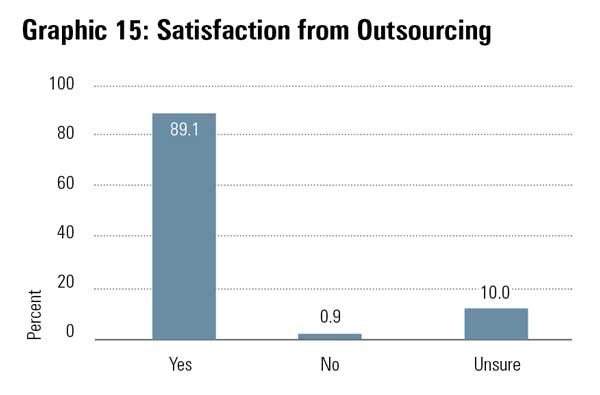
Of the remaining districts, 10.0 percent (22) of them reported being unsure as to whether or not they were satisfied with the contracting experience and only two districts (less than 1 percent) said they were dissatisfied.
There were a total of 11 districts that were not satisfied with their contracting experience in 2006. Of these, nine reported that they were satisfied in 2007. This suggests that districts have the flexibility to improve on their delivery of services in some way. Also, while exact figures are unavailable, a number of districts have changed vendors from last year. The ease with which districts can extricate themselves from a contractual relationship (many districts have short escape clauses built into contracts with their vendors) probably makes vendors more sensitive to performance issues than district employees would be.
Districts are also exploring diverse and novel approaches to private contracting, outside of the more traditional food, busing and janitorial sectors. The authors were surprised, for instance, to hear about the degree to which districts are hiring companies to provide substitute teachers.
Other areas that haven’t garnered much publicity include contracts for athletic coaches,ix administrative services (secretaries),[17] business services (accountants)[18] and principals.x Other unique approaches included contracting for psychology services[19] and even a school nurse.[20] Mattawan Consolidated Schools in Van Buren County signed a three-year contract with Ralph Moyle, Inc. to clean district buses at a rate of $7 per cleaning per bus.[21]
ix Districts contracting for athletic coaching include Belding Area Schools, Capac Community Schools, Holton Public Schools, Jackson Public Schools, Meridian Public Schools, Marenisco School District and White Cloud Public Schools.
x Districts that indicated that they contract for at least one principal include Armada Area Schools, Beaverton Rural Schools, Clawson Public Schools, Jackson Public Schools, Marlette Community Schools and Rapid River Public Schools.
Although the Mackinac Center included no formal question about the lengths of time that various districts have been outsourcing services, many volunteered the information. The authors found much of the data to be fascinating, especially in the context of opposition to using private, for-profit vendors in Michigan school districts. The fact is competitive contracting has been part of school operations across the state for decades. Consider the following examples.
Graphic 16
Examples of Conventional Michigan School Districts That Have Contracted for Decades
|
District |
County |
Service |
Time |
|
Bedford Public Schools |
Monroe |
Food Service |
30 Years |
|
Clio Area Schools |
Genesee |
Food Service |
25 Years |
|
East China School District |
St. Clair |
Food Service |
More than 30 Years |
|
Fulton Schools |
Gratiot |
Food Service |
More Than 20 Years |
|
Harper Creek Schools |
Calhoun |
Food Service |
25 Years |
|
Jackson Public Schools |
Jackson |
Food Service |
More than 20 Years |
|
Monroe Public Schools |
Monroe |
Food Service |
Since 1970s |
|
Muskegon Public Schools |
Muskegon |
Food Service |
More than 20 Years |
|
Pinckney Community Schools |
Livingston |
Food Service |
30 Years |
|
River Rouge School District |
Wayne |
Food Service |
Since 1970s |
|
South Redford School District |
Wayne |
Food Service |
More than 20 Years |
|
Sterling Community Schools |
Arenac |
Food Service |
More than 20 Years |
|
Stockbridge Public Schools |
Ingham |
Food Service |
More than 30 Years |
|
Vulcan Area Schools |
Dickinson |
Transportation |
Since 1940s |
|
Wayland Union Schools |
Allegan |
Food Service |
More than 20 Years |
Privatization is becoming an increasingly popular management tool for school districts throughout Michigan. Across the Great Lake State many school districts are looking to save money to balance their budgets, invest more in classrooms and improve non-teaching support services. Competitive contracting for noninstructional services is just one way districts hope to accomplish these goals.
The success of school support service privatization in Michigan is hard to dispute. This is the fourth Center survey in a row that showed an expansion of privatization. Districts are showing something of a "revealed preference" in favor of the practice by engaging in it at ever-increasing rates.
Not only has privatization of the big three services — food, custodial and transportation — increased since 2006, it increased by an eye-catching 7.1 percent (15 districts) between August 2006 and the end of June 2007. At the close of the Mackinac Center for Public Policy’s research window on June 30 another six districts were in the final stages of contracting at least one service each. In addition, 18 other districts reported exploring support service privatization for the fiscal 2009 school year.
Food service privatization has remained a perennial favorite as measured by the absolute number of districts contracting at 164. Custodial privatization grew to a modest 14.3 percent of all districts; however there was a significant 25.2 percent increase (16 districts) in the contracting rate for janitorial services since 2006. The 2005 to 2006 increase was 26.2 percent. The number of districts contracting out for busing services also increased, but by only three districts.
For an in-depth assessment of school privatization in Michigan, see "School Privatization Primer."
|
County[22] |
Districts Contracting |
Total Number of Districts in Each County |
Percent of Total Districts |
|
Alcona |
0 |
1 |
0.0% |
|
Alger |
1 |
4 |
25.0% |
|
Allegan |
7 |
10 |
70.0% |
|
Alpena |
0 |
1 |
0.0% |
|
Antrim |
2 |
6 |
33.3% |
|
Arenac |
2 |
3 |
66.7% |
|
Baraga |
2 |
3 |
66.7% |
|
Barry |
1 |
3 |
33.3% |
|
Bay |
2 |
4 |
50.0% |
|
Benzie |
0 |
2 |
0.0% |
|
Berrien |
7 |
16 |
43.8% |
|
Branch |
3 |
3 |
100.0% |
|
Calhoun |
6 |
11 |
54.5% |
|
Cass |
3 |
4 |
75.0% |
|
Charlevoix |
2 |
5 |
40.0% |
|
Cheboygan |
1 |
4 |
25.0% |
|
Chippewa |
0 |
6 |
0.0% |
|
Clare |
3 |
3 |
100.0% |
|
Clinton |
1 |
6 |
16.7% |
|
Crawford |
0 |
1 |
0.0% |
|
Delta |
2 |
6 |
33.3% |
|
Dickinson |
3 |
4 |
75.0% |
|
Eaton |
3 |
9 |
33.3% |
|
Emmet |
3 |
4 |
75.0% |
|
Genesee |
10 |
21 |
47.6% |
|
Gladwin |
1 |
2 |
50.0% |
|
Gogebic |
1 |
4 |
25.0% |
|
Grand Traverse |
0 |
3 |
0.0% |
|
Gratiot |
3 |
6 |
50.0% |
|
Hillsdale |
2 |
8 |
25.0% |
|
Houghton |
3 |
9 |
33.3% |
|
Huron |
2 |
14 |
14.3% |
|
Ingham |
5 |
12 |
41.7% |
|
Ionia |
4 |
9 |
44.4% |
|
Iosco |
2 |
4 |
50.0% |
|
Iron |
0 |
2 |
0.0% |
|
Isabella |
1 |
3 |
33.3% |
|
Jackson |
5 |
12 |
41.7% |
|
Kalamazoo |
5 |
9 |
55.6% |
|
Kalkaska |
2 |
3 |
66.7% |
|
Kent |
11 |
19 |
57.9% |
|
Keweenaw |
0 |
1 |
0.0% |
|
Lake |
1 |
1 |
100.0% |
|
Lapeer |
4 |
5 |
80.0% |
|
Leelanau |
0 |
4 |
0.0% |
|
Lenawee |
2 |
12 |
16.7% |
|
Livingston |
2 |
5 |
40.0% |
|
Luce |
0 |
1 |
0.0% |
|
Mackinac |
0 |
6 |
0.0% |
|
Macomb |
9 |
21 |
42.9% |
|
Manistee |
0 |
4 |
0.0% |
|
Marquette |
2 |
8 |
25.0% |
|
Mason |
1 |
4 |
25.0% |
|
Mecosta |
0 |
3 |
0.0% |
|
Menominee |
1 |
4 |
25.0% |
|
Midland |
2 |
4 |
50.0% |
|
Missaukee |
1 |
2 |
50.0% |
|
Monroe |
7 |
9 |
77.8% |
|
Montcalm |
2 |
7 |
28.6% |
|
Montmorency |
1 |
2 |
50.0% |
|
Muskegon |
9 |
12 |
75.0% |
|
Newaygo |
3 |
6 |
50.0% |
|
Oakland |
9 |
27 |
33.3% |
|
Oceana |
1 |
4 |
25.0% |
|
Ogemaw |
1 |
1 |
100.0% |
|
Ontonagon |
0 |
3 |
0.0% |
|
Osceola |
0 |
4 |
0.0% |
|
Oscoda |
1 |
2 |
50.0% |
|
Otsego |
0 |
3 |
0.0% |
|
Ottawa |
3 |
9 |
33.3% |
|
Presque Isle |
0 |
3 |
0.0% |
|
Roscommon |
2 |
2 |
100.0% |
|
Saginaw |
2 |
13 |
15.4% |
|
Sanilac |
3 |
7 |
42.9% |
|
Schoolcraft |
0 |
1 |
0.0% |
|
Shiawassee |
3 |
8 |
37.5% |
|
St. Clair |
5 |
7 |
71.4% |
|
St. Joseph |
2 |
9 |
22.2% |
|
Tuscola |
4 |
9 |
44.4% |
|
Van Buren |
5 |
12 |
41.7% |
|
Washtenaw |
6 |
10 |
60.0% |
|
Wayne |
15 |
35 |
42.9% |
|
Wexford |
1 |
3 |
33.3% |
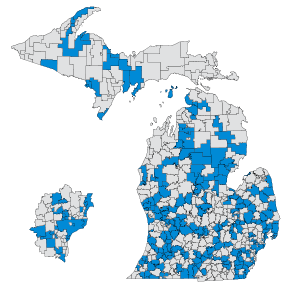
Map of Michigan school districts that contract for at least one of the three major noninstructional services as of June 30, 2007.
District Map
1 Michael LaFaive, "A School Privatization Primer: For Michigan School Officials, Media and Residents," (Mackinac Center for Public Policy, 2007).
2 Ibid.
3 John Hewitt, superintendent of Summerfield Schools, telephone interview, May 14, 2007.
4 Brent Holcomb, superintendent of Homer Community Schools, telephone interview, June 6, 2007.
5 Mark Bielang, superintendent of Paw Paw Public Schools, telephone interview, May 14, 2007.
6 Carolyn Gruber, business manager of Potterville Public Schools, telephone interview, May 14, 2007.
7 Pat Rozich, interim superintendent of Adams Township School District, telephone interview, May 14, 2007.
8 Robert Allen, deputy superintendent of operations at Ann Arbor Public Schools, telephone interview, April 30, 2007.
9 Milli Haug, superintendent of Coldwater Community Schools, telephone interview, May 17, 2007.
10 Ibid.
11 Amy Louma, business manager of Gwinn Area Community Schools, telephone interview, May 21, 2007.
12 Angela Lackey, "Midland School Outsourcing Decision Nears," Midland Daily News, April 24, 2007.
13 Thomas Tebeau, assistant superintendent of business and operations of Williamston Community Schools, telephone interview, May 22, 2007.
14 Dixie Pope, business manager of Lakeview Community Schools, telephone interview, May 9, 2007.
15 Delores McMullen, director of finance and business of Fennville Public Schools, telephone interview, May 17, 2007.
16 Ibid.
17 Rozich and Pete McFarlane, superintendent of Portage Public Schools, telephone interview, May 14, 2007.
18 McMullen.
19 Charles Schnetzler, superintendent of Ithaca Public Schools, telephone interview, May 8, 2007.
20 Kathleen Viegelahn, business and personnel services coordinator of Rogers City Area Schools, telephone interview, May 14, 2007.
21 James Weeldreyer, director of finance at Mattawan Consolidated Schools, telephone interview, May 29, 2007, and "Recovery School District Legislatively Required Plan " (State of Louisiana, 2006), http://www.louisianaschools.net/lde/uploads/8932.doc (accessed March 22, 2007).
22 Michigan Education Directory (Michigan Education Directory, Incorporated) (2006): 23-116.
Daniel J. Smith is an adjunct scholar with the Mackinac Center for Public Policy and a Ph.D. candidate in economics at George Mason University. Smith’s expertise lies in Austrian economics and public choice theory. He has twice served as a Mackinac Center research intern.
Michael D. LaFaive is director of the Mackinac Center’s Morey Fiscal Policy Initiative. He is the author of dozens of commentaries and studies on such fiscal policy issues as state government spending, privatization, economic development and unfunded federal mandates. His Op-Eds have appeared in numerous Michigan newspapers, and he is regularly quoted in television, radio and newspaper stories. Since 1995, LaFaive has served as managing editor of the Mackinac Center periodical Michigan Privatization Report.



