Font size:
Citing a threat to national security from U.S. dependence on foreign oil, Gov. John Engler recently instituted state management of alternative energy research and development. A newly created agency and a variety of subsidies supposedly will enhance development of non-fossil fuel technologies.
But even the best of intentions don't necessarily produce sound policy, and the governor's "NextEnergy" initiative is, unfortunately, flawed.
In unveiling his proposal in April, Engler vowed to position Michigan as the "world leader" in alternative energy sources such as hydrogen fuel cells to power vehicles. Absent state intervention in automotive re-engineering, he said, Michigan risks the loss of 200,000 manufacturing jobs.
Promoting energy R&D in Michigan does not require yet another government bureaucracy allocating favors to select firms. Privatization of state and federal research programs would make Michigan the economic powerhouse the governor envisions.
It's true that the United States imports more petroleum today than 30 years ago-54 percent of American consumption compared to 35 percent in the 1970s. But more oil is now available from a wider variety of sources than ever before. To artificially restrict energy to domestic or so-called renewable sources in the name of "security" would only make the United States more vulnerable to energy disruptions, not less. And to embrace the notion of an energy crisis when none actually exists imperils Michigan jobs by emboldening the automobile bashers.
Regardless of the supply outlook, the immediate issue is whether the Next-Energy initiative will advance R&D. The state's new authority will be governed by a hand-picked board to finance, direct, or otherwise aid in the central planning, construction, and design of alternative energy technology business and infrastructure. The authority is also empowered to issue revenue bonds and grant a variety of tax credits and exemptions based on very broad criteria.
To generate operating revenue for the venture, the Legislature has transferred to the authority control of more than 700 prime acres in Washtenaw County that can be leased or sold to energy-related enterprises. However, should the authority run short of cash with which to repay the notes or bonds sold to underwrite its projects, the taxpayers would have to cover the debt.
Government involvement in R&D is well established. National labs with multi-billion dollar budgets have long augmented academic and commercial research. But states and the federal government have largely failed in attempts to commercialize nascent technology-despite trillions of dollars in public R&D expenditures.
In the 1970s, for example, the Carter administration created the Synthetic Fuels Corp. to develop renewable energy sources (in the name of energy independence). But the Synfuels program was discontinued in 1982 without generating a dime's worth of new power-despite taxpayers' $1 billion bill. Congress then formed the Partnership for a New Generation of Vehicles with the intent of producing an affordable zero-emissions family sedan by 2004. Despite $2.5 billion from taxpayers and The Big Three, the program's chief goal was ultimately deemed unrealistic by the National Academy of Sciences.
The U.S. Department of Energy, meanwhile, administers a variety of alternative energy programs upon which hundreds of billions of dollars are annually lavished.
Myriad institutional problems confound government R&D-foremost among them the aversion to risk generally found in government ranks. The incentives under which well-intentioned government scientists operate can make it harder for them to distinguish between pipe dreams and real technological promise. Officials routinely allocate public funds to the least-risky projects in order to minimize the potential failure of pet bureaucracies. But those tend to be the projects most likely to draw private capital, thus supplanting privately funded R&D.
As it is, the automotive industry already is heavily invested in fuel-cell research. BusinessWeek reports that General Motors Corp. hopes to unveil its "Autonomy" prototype by 2010, while DaimlerChrysler is testing hydrogen powered busses in 10 European cities while perfecting its "Natrium" minivan. Ford Motor Co., meanwhile, has developed its "Focus FC5," which relies on hydrogen extracted from methane.
To the extent that automakers foresee a competitive advantage in fuel-cell technology, they are unlikely to share their research findings. (After all, advocates of alternative energy have insisted for years that the internal combustion engine is headed for extinction.) Appearing last month at a Lansing press conference to tout the NextEnergy plan, Doug Rothwell, head of the Michigan Economic Develop Corp. (MEDC) acknowledged that it's unlikely that GM, DaimlerChrysler, or Ford would directly participate. In other words, the most prominent players in the field prefer to keep their findings out of government's hands.
The whole notion of "dominance"-whether state or national-is, in fact, largely outdated. Consider, for example, the case of computer chips. As chronicled by Everett Ehrlich in The Globalist, Japan's supposed domination of chip production provoked deep anxiety within the United States. But desperate to cover the enormous capital costs of chip redesign and manufacturing, the Japanese unleashed cheap chips the world over. This allowed the United States to focus instead on powerful, productive, and entertaining software.
As Ehrlich notes: "In a world in which you can have access to any resource, product, service good, input, component, or factor, the key to corporate competitiveness is to determine how best to add value to the assortment. It matters far less to control all the steps along the value chain as long as there is easy access to the various components."
State interference also risks limiting potential advances by effectively endorsing one technology over another through special tax and regulatory treatment. This was precisely the case with California's electric vehicle mandate, which diverted years of attention and billions of R&D dollars from more promising technologies. The Engler plan poses a similar risk in prohibiting subsidization of gasoline or diesel-powered hybrids, for example, while a "bio-diesel" mandate is also pending in the Legislature.
If the governor and lawmakers are adamant about promoting new energy technologies, the more effective approach would be to promote as much experimentation as possible.
This is especially important given the tangled technical challenges facing fuel-cell development, which will take decades to unravel. These challenges include the potential environmental threat caused by increased concentrations of hydrogen in the atmosphere, which could exacerbate the build-up of greenhouse gases. According to the Center for Automotive Research (CAR), "Significant invention and refinement still remain before the fuel cell can be considered a viable candidate for mass production vehicles."
To produce a kilowatt of energy with current fuel cell technology costs about $300. The internal combustion engine does it for $30. And building the fueling infrastructure needed to service a fleet of hydrogen fuel-cell vehicles would cost in excess of $100 billion, according to CAR.
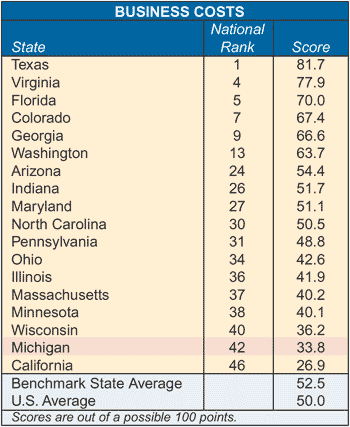
Also to be considered are the consequences of the discriminatory subsidies granted by the Legislature. As it is, Michigan ranks second-to-last among peer states in business cost competitiveness. This is largely a consequence of the state's Single Business Tax. But NextEnergy's implicit subsidies would increase this tax burden for non-favored firms. And there is concern that the credits and exemptions could so deplete the state's "rainy day fund" that the scheduled cuts in the SBT would not take effect. If the governor wishes to underwrite R&D, why not simply sell off surplus state land to fund across-the-board tax cuts? This would eliminate the "need" for a costly new bureaucracy and scores of new tax consultants.
As the MEDC's own benchmark study recently noted, "True economic competitiveness is the sum result of a state's overall business, social, and economic climate."
Alternative energy sources will evolve when the prices of conventional fuels exceed the research and development costs for alternative sources. As Cato Institute scholars Ronald Sutherland and Jerry Taylor have pointed out, private firms may underinvest in "good" R&D, but government is far more likely to overinvest in "bad" R&D.
At the very least, the Michigan Legislature should re-examine the Governor's initiative, although Mr. Engler does have a relative solid overall economic record. Lawmakers must carefully consider whether NextEnergy will be the next energy boondoggle.
Diane Katz is director of science, environment, and technology policy with the Mackinac Center for Public Policy.