


 Font size:
More than a third of Michigan students leave high school without possessing basic academic skills including reading, writing, and arithmetic. This forces employers and post-secondary schools to take up the slack. This study conservatively estimates that Michigan businesses and institutions of higher education spend over $600 million annually to teach employees and students skills they should have learned in high school. The comparable national figure is $16.6 billion, but the human costs of K-12 educational failure are incalculable, according to experts' essays included in the study's appendices.
More than a third of Michigan students leave high school without possessing basic skills in reading, writing, and arithmetic. This forces post-secondary schools and employers to teach these individuals basic skills.
Providing post-secondary remedial education is just one expense society must shoulder to make up for the failure of students to learn these minimal competencies. Other costs—the cost of coping with those who never acquire these skills—include everything from lost productivity to more expensive criminal justice and social welfare systems.
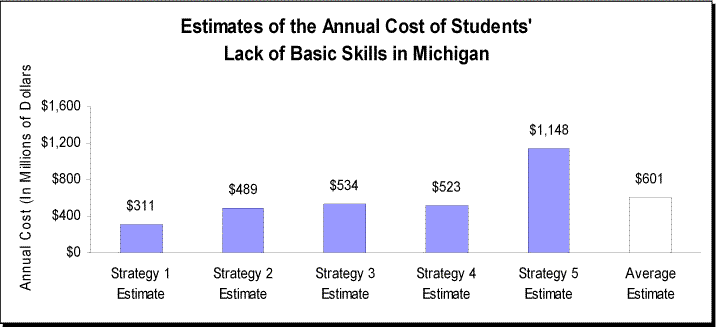
This study calculates the financial costs incurred by Michigan business and institutions of higher learning when students leave high school without learning basic skills. Using five different strategies for determining this cost, we conservatively estimate that the Michigan economy suffers a total annual loss of between $311 million and $1.15 billion. The best estimate, the answer from averaging the results from all five calculation strategies, is $601 million per year. Extrapolating to the entire United States, the lack of basic skills costs a total of approximately $16.6 billion each year. In addition to these monetary costs, the human costs are incalculable.
Until more long-range solutions can have an impact, there seems to be no way to avoid spending more on remedial (or as it is now called, developmental) education in post-secondary schools. And while this study does not investigate the full range of possible policy responses to the situation, a number of options do seem fairly obvious.
First, public school districts and private schools should consider requiring students to pass a rigorous exam before receiving a high school diploma. While no one would be so naïve as to claim this as a foolproof solution, it would certainly bolster the integrity of a diploma and place pressure on schools to improve their quality.
Second, public school districts and private schools should offer to hold themselves accountable in some realistic way for at least some of the cost of addressing the lack of basic skills among their graduates. Such a "money-back guarantee" would provide incentives to schools to ensure that their graduates possess basic skills.
Third, parents should be able to choose alternative schools for their children without financial penalty when a public school district fails to provide an adequate education. Students in higher education use public funds or tax credits to pay for tuition at a wide range of community colleges, public universities, private colleges, and vocational schools. By most accounts, this range of choice has given rise to a level of quality among American institutions of higher education unsurpassed in the world. Giving students similar choices in grades K-12 would increase the opportunity for children to learn basic skills earlier in their lives.
The study closes with commentaries from three remedial education experts. Dr. Thomas F. Bertonneau, a Central Michigan University instructor, goes beyond dollars and cents to address the personal, human cost students face when their schools fail them. Dr. David W. Breneman, dean of the Curry School of Education at the University of Virginia, compares his research of remedial education's costs with the author's and endorses efforts to improve K-12 education. Dr. Herbert J. Walberg, professor of education and psychology at the University of Illinois at Chicago, comments on other possible social costs of remediation not considered in the body of the study.
What is the financial cost when students leave high school without having acquired basic academic skills? This report describes the complicated answer to that simple question for the state of Michigan. Employing five different calculation strategies, we calculated annual costs ranging from $311 million to as high as $1.15 billion. The average of these five strategies—and the best estimate of the annual cost of the failure of Michigan students to acquire basic skills in high school—is $601 million per year.
Calculating these costs is made especially difficult by the ambiguity surrounding what are considered "basic skills," the difficulty of isolating costs that are related to the lack of those skills, and the general scarcity of quality data available on the issue. At each stage we made conservative assumptions when faced with these difficulties, which is to suggest that our estimate of $601 million may be a low figure. This estimate is considered conservative because it does not include college-level work that has been "watered-down" but not considered remedial; expenditures on technology by businesses to accommodate for lack of basic skills; capital expenditures required to provide remedial education; or the large percentage of students and employees in need of remediation but who never receive it. If, however, the $601 million figure is an accurate estimate of the cost of the lack of basic skills in Michigan, and if the costs nationwide are comparable, then the exit from high school of students lacking in basic skills costs in the neighborhood of $16.6 billion annually in the United States.1
One way to calculate the economic cost of students leaving high school without having acquired basic skills is to identify the direct expenditures made by employers and institutions of higher learning to remediate those students' lack of basic skills.
In Strategy 1, we calculate the direct expenditures by community colleges, four-year colleges, and employers in Michigan to address the lack of basic skills among people no longer in high school. We obtained information from all community colleges, a randomly selected sample of 10 publicly operated colleges and 10 privately operated colleges, and a randomly selected sample of 113 Michigan businesses.2
Community colleges tend to offer the most extensive remedial (or "developmental," as it is now called) education services. At several of the community colleges in Michigan where we interviewed, more than half of the students require some amount of remedial education.3The range of remedial education services at four-year institutions is more limited, while employers offer even fewer opportunities for obtaining basic skills, although some businesses do teach their employees how to read, write, and perform basic math operations. The more common expenditure by employers is for technology that substitutes for this lack of skills.
Below we examine in more detail the remedial education expenditures made by community colleges, four-year institutions, and employers to bring the skills of students and workers up to speed.
The financial data from Michigan community colleges were obtained primarily from the state's Activity Classification Structure Data system.4 According to the report, "1998-99 General Fund Cost Per Student Contact Hour and Student Credit Hour," state government gave community colleges $21,824,016 for "developmental and preparatory" instruction. But state monies represent only 33 percent of community college revenues, with the other two-thirds coming from tuition, local property taxes, the federal government, and grants and donations.5 If state money covers one-third of community college remedial education expenditures, as the Michigan Department of Education estimates, then community colleges in Michigan spend a total of $65.4 million on teaching students basic skills.
In all likelihood, this estimate of community college spending on teaching students skills that they were supposed to have acquired in high school is considerably lower than the actual expenditure. Three pieces of evidence suggest this estimate is conservative. First, the nearly $22 million figure from the state of Michigan only covers operating expenses and does not include any capital expenditure required by offering remedial education. The capital requirements of providing remedial education are not trivial since community colleges have to build offices and classrooms to house remedial education activities and purchase computers and software to assist instruction.
Second, the figures we have used only cover those expenditures that the schools and state describe as remedial education. It is clear that the teaching of basic skills at community colleges occurs throughout their curricula and not just in courses officially identified as remedial. As George Swan, dean of arts and humanities at Wayne County Community College, put it: "A great deal of developmental education occurs at the college level that is not labeled as such.. Such a large part of what we do here is developmental that I don't see the distinction [between college-level and developmental work]."6 Katie Smith, director of transitional studies at Lake Michigan Community College, concurs: "Quite a bit of developmental education occurs in classes not labeled as developmental. Faculty say that today's high school students are unprepared for college-level work and that it is becoming increasingly evident in their performance in college courses. In almost all college courses, some degree of developmental education occurs."7
This impression that much of what community colleges define as college-level work might more accurately be described as remedial education is confirmed by an examination of the colleges' course catalogues. Michigan community college catalogues list courses such as elementary algebra, intermediate algebra, and trigonometry as college-level courses when these are courses that are normally taken by high school students. The lowering of the definition of college-level work understates the level of expenditures devoted to remedial education.
And third, a fairly large percentage of students who are in need of remedial education never enroll in developmental courses, even if they attend community college. According to a study by the Michigan Department of Education, between 45 percent and 79 percent of community colleges require entering students to take tests that would identify their need for remedial services, depending on the degree program. And only 48 percent of community colleges require students to take remedial courses if the tests show that they need them. In fact, of the 52,473 students who took the placement tests and demonstrated a need for remedial education, only 38,178 (73 percent) actually enrolled in any remedial courses.8 If many students who lack basic skills are not enrolling in courses to address those deficiencies, then our estimate of the cost of the skill gap would be seriously understated.
Given all of these factors, it would not be unreasonable to assume that about a third of what community colleges do is really addressing the lack of basic skills resulting from inadequate preparation in high school. Instead of our more cautious estimate of $65.5 million, the true cost in community colleges alone could conceivably be as high as $350 million. However, we are choosing to use the conservative estimate in which remedial education costs represent only 6.3 percent of community colleges' operating budgets instead of more aggressive estimates that could place the figure as high as 33 percent.
Because there is no central source of data, our calculation of the expenditures by Michigan universities and colleges required us to collect data from a sample of institutions. We randomly selected 10 out of the population of 15 public universities and 10 out of the population of 54 private colleges and universities. We then examined the catalogues at those schools to identify developmental education courses.9 We submitted requests to the institutions to identify the number of students enrolled in those courses during the most recent academic year. We then multiplied the number of student credit hours in these remedial courses by the tuition per credit hour.
For private institutions we conservatively assumed that the cost of remedial courses is equal to the tuition charged, which excludes any additional costs at those institutions that are covered by donations or grants. For public universities we calculated that tuition covers only 22 percent of the cost of instruction, with the rest coming from state and federal government subsidies, donations, and grants.10 We therefore multiplied total tuition collected for developmental courses by public universities by 4.56 to arrive at an estimate of the total expenditure by those institutions on remedial education.
According to this technique, we calculate that Michigan public universities spend $17.9 million and Michigan private universities spend $5.9 million every year to offer remedial courses. This total of $23.8 million spent by four-year institutions in Michigan also is likely to be a conservative estimate of the cost of remedial education in those institutions. We do not include in this estimate the cost of any non-course remedial education services, such as tutoring, counseling, study skill workshops, writing centers, etc.
In addition, we count only the cost of courses that are determined to be remedial. As with community colleges, four-year institutions have "watered-down" what they consider college level work. As Mitzi Chaffer, director of developmental math programs at Central Michigan State University, says: "There is a general sense that the faculty have to 'water-down' the courses so that students can pass. In many cases students lack the rudimentary math skills necessary to perform even the most basic math problems. Many cannot do basic arithmetic without a calculator."11 Mary Klamo, a math professor at Wayne State University, makes the argument more mildly, "To some extent the material has been 'watered down.' What I see happening is that these courses don't cover the breadth of material that they used to . . . . The students are terribly prepared for college-level math work, and it is a trend that seems to be getting worse. It's not just in math, however; it's their overall academic ability."12
Our calculation of the expenditures Michigan businesses make in order to address the lack of basic skills is based on a survey of 113 employers.13 Those 113 businesses employ 118,840 workers in Michigan, representing 4.1 percent of the 2,896,268-employee statewide workforce, according to the U.S. census. To encourage participation and honest responses, employers were promised anonymity. However, we can disclose that the respondents included a wide variety of Michigan businesses, some with more than 10,000 employees and others with fewer than 10.
Those businesses reported spending a total of $1,637,817 teaching their workers basic skills such as reading, writing, and arithmetic during their most recent fiscal year. This works out to an average of $13.78 per employee, including senior-level management with advanced degrees and workers with years of experience with the companies. While the amount spent teaching each new hire is considerably higher, dividing the total amount of money by the total number of employees allows us to generalize from our sample. If we extrapolate this rate of spending to the entire state we arrive at a total figure of nearly $40 million spent per year by Michigan businesses to teach their workers how to read, write, and perform basic math operations.
Businesses report spending much more on technology to make up for their employees' lack of basic skills. For example, many businesses buy cash registers that make change for customers because those businesses cannot rely on employees to be able to subtract accurately. Some fast-food chains buy cash registers with pictures of the food items so that employees do not have to be able to read or remember the prices of the products. Businesses use technology in so many ways to make up for the lack of skills among employees that it is quite probable our survey respondents did not even think of all of the technologies they purchase for this purpose. Our cost estimates are therefore likely to be too low.
The businesses in our sample spent a total of $7,466,700 on technology during the most recent fiscal year to address the lack of basic skills among their employees. If this average of $62.83 per employee can be generalized to all Michigan businesses, then a total of almost $182 million is spent each year on technology to make up for the inability of workers to read, write, and do arithmetic. If we add the amount spent on instruction to the amount spent on technology, Michigan businesses spend about $222 million each year correcting the shortcomings of their workers who leave high school without having acquired basic skills.
To convey the depth of the problem as Michigan businesses see it, we asked the respondents to rank the quality of their new hires on a five-point scale, with 1 representing very poor and 5 representing very good. The average response was 3.3. We also provided our sample businesses with a statement from Michigan's Career and Employability Skills Content Standards that describes what all students educated in Michigan public schools should be able to do. The statement says Michigan public school students should be able to:
"Apply basic communication skills (e.g., reading, writing, speaking, and listening), apply scientific and social studies concepts, and perform mathematical processes in work-related situations."
"Understand complex systems, including social and technical systems, and work with a variety of technologies."
"Work cooperatively with people of diverse backgrounds and abilities and contribute to a group process with ideas, suggestions, and efforts."
"Communicate ideas to support a position and negotiate to resolve divergent interests."14
We asked businesses to report the percentage of their new hires who possessed these skills. The average answer was that 61 percent of new employees at the businesses we surveyed had the skills that the Michigan public schools said they should have. In other words, in the estimation of their employers, almost 40 percent of these new hires, not counting applicants who were rejected for employment, were lacking the skills the state of Michigan believes its public schools are imparting to students.
perform at an 11th-grade level. As the employer put it, "possession of a high school diploma is no guarantee" that graduates have learned basic skills. A health-care company with under a thousand employees reported that "lower-level employees lack the ability to read and write." Another company with several thousand employees said, "We reject 70 percent of applicants due to not having basic skills of math and reading at an 8th-grade level."
Even more common than complaints about the lack of basic academic skills were complaints about the lack of work ethic and basic moral and social skills among new employees. A health-care company reported that "absenteeism and tardiness" were common problems among new employees. Another business with about 500 employees echoed that new employees did not reliably arrive "at work on time and show up everyday." A small energy company expressed concern about "the trustworthiness, principles, and values" of new employees. A large hotel company reported that new employees are "not customer service-oriented." A restaurant chain complained that new workers did not know "how to fill out an application . . . how to conduct themselves in an interview, budgeting, working with a cash register, and even proper dress."
In short, businesses appear to have even more concerns about whether their employees will show up for work on time, be honest, and be courteous to customers than they do about whether those workers can read, write, and add. And while tests can show whether students need remediation in cognitive subjects such as grammar and math, they are largely unable to capture students' social and ethical competency.
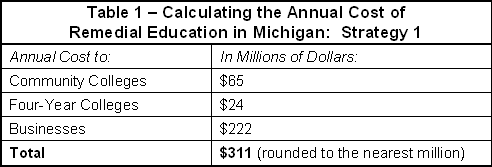
If we add together the direct expenditures by community colleges, public universities, private colleges, and employers in Michigan, the total spent to address the lack of basic skills is $311 million each year.15 For reasons described above, this figure is likely to be a low estimate.16 It is also considerably lower than other estimates of the national cost to the government of remedial education in public institutions. For example, David Breneman and William Haarlow estimate that the cost to the government of remedial education at public universities and community colleges is around $1 billion nationwide. Ronald Phipps estimates the cost to be around $2 billion.17 Our estimate of the total cost at those institutions in Michigan is $89 million, but we have included all expenditures and not just those paid by the government. If, as we have previously estimated, the government is subsidizing only about one-third of these expenditures, then the cost of remedial education to the government in Michigan public institutions is $28 million. Extrapolating to the entire United States, our estimate of the same costs included in the estimates produced by Breneman, Haarlow, and Phipps would be $773 million nationally.
Based on this comparison of government costs, the calculation of costs produced by Strategy 1 is likely to be conservative. The expenditures by Michigan employers are also likely to be a low estimate for reasons discussed at greater length in the following section. Our lowest reasonable estimate of the cost in Michigan of addressing a lack of basic skills after high school is $311 million per year.
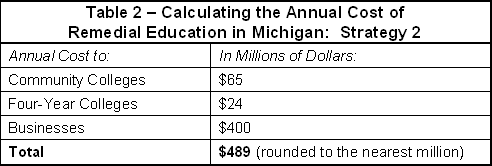
While $222 million spent by Michigan businesses each year to address high school graduates' lack of basic skills may seem like a high estimate, it is probably far lower than the true cost. As mentioned above, businesses purchase technology to make up for the lack of basic skills among workers in ways that even the employers do not fully recognize. Things as trivial as "spell-check" on word-processing programs or inventory control information systems are purchased at least in part to compensate for the inability of workers to perform similar functions without the technology. Employers' reports of expenditures on technology for this purpose are therefore likely to be grossly understated.
In addition, many businesses suffer because they cannot or do not provide employees with remedial education. It is clear from the survey comments that many businesses simply endure what they must with workers lacking basic skills, without teaching those workers and without purchasing technology to substitute. This imposes a significant cost on businesses in the form of lowered productivity. A reasonable estimate of the costs of the lack of basic skills among Michiganians out of high school ought to include the cost of this lost productivity.
In Strategy 2, we attempt to come up with a way to measure how much Michigan employers either spend to address the lack of skills among workers or lose in productivity as a result of those unremediated workers. In doing so, the impossibility of isolating exactly how many workers in how many different jobs lack basic skills, the myriad possible work-related consequences of this lack, and their various impact on productivity, forces us to make some key assumptions. In the absence of an exact measure, the next best option is to discover the most easily comparable and also quantifiable value that could conceivably substitute for the exact, per-year value of lost productivity.
In this case we chose the per-year cost of remedial training in post-secondary institutions as the closest equivalent to what employers lose because of workers without basic skills.18 That is, we assume that it costs businesses either directly or indirectly an equivalent amount of money to handle a worker lacking in basic skills as it would cost the community colleges or universities to remediate that worker. This is a conservative assumption because it assumes that the cost of providing someone with basic skills is neither a loss nor a gain, but is essentially "a wash."
Second, for the sake of convenience, we assume that everyone who graduates from high school lacking basic skills is successfully remediated by post-secondary institutions and that employers are left having to address the lack of skills among dropouts. This assumption, however, is somewhat at odds with the facts. Some dropouts in fact attend community colleges to receive their GEDs and remedial instruction. But this error is more than compensated for by the fact that not all high school graduates who are in need of remedial education obtain it from community colleges and universities. Only 59 percent of Michigan high school graduates attend a post-secondary institution.19 And, as we have already discussed, only a fraction of those students obtain the remedial services they need. Nevertheless, for the purposes of our estimate, we are assuming that everyone who graduates from high school has basic skills or is covered by the costs we have already calculated for post-secondary institutions. We are assuming that employers have the task of coping only with the lack of basic skills among high school dropouts, an assumption that will yield us a conservative estimate of lost productivity.
Third, we assume that dropouts are in need of as much remediation as the years of high school they missed. A student who dropped out at the end of 10th grade would require the equivalent of two years' worth of remediation or would impose on employers the equivalent of the cost of those two years of remediation. This is also likely to be a conservative assumption in that most students who drop out were already several years behind their peers academically when they did so. Assuming that students who drop out at the end of 10th grade had the basic skills required of a 10th grader is making a generous assumption.
We are able to calculate the cost of remediation per full-time student in post-secondary schools—the cost we are assuming is equivalent to the loss of productivity experienced by employers due to employees' lack of basic skills—by taking the total expenditure on remedial education and dividing it by the total number of full-time equivalent (FTE) students participating in those courses. Michigan community colleges, universities, and colleges spend approximately $89 million on remedial education. There are a total of 14,848 FTE students enrolled in remedial courses.20 The average cost of remedial education per FTE student is therefore $6,007 per year of remediation.
Returning to our assumption that Michigan businesses have to address the lack of basic skills only among high school dropouts, we note that there are approximately 29,000 dropouts from Michigan high schools each year.21 On average those dropouts leave high school 2.29 years before they should. If the cost to Michigan business is 2.29 times the cost of one year of remediation ($6,007) and there are 29,000 workers to remediate each year, then the total cost to employers of having workers who lack basic skills is around $400 million each year. In other words, granting our assumptions, employers in Michigan lose $400 million to lost productivity or remedial expenses per year due to employees' lack of basic skills.
Adding the $89 million spent by post-secondary institutions, the total cost of the lack of basic skills in Michigan is around $489 million annually. Simply calculating the costs to Michigan businesses in a different, but still conservative, way increases the total estimated cost of addressing the lack of basic skills in Michigan to nearly a half-billion dollars per year.
In Strategy 3, we independently estimate the cost of providing remedial education for post-secondary institutions as well as for employers. First we calculate how much it costs high schools to provide students with basic skills. We then assume that the cost to post-secondary institutions and businesses to remediate the lack of basic skills is the same as the cost to high schools of producing "successful" graduates. By "successful" graduate we mean a student who receives a diploma and is not lacking in basic skills. We multiply the per-student cost for high schools to produce successful graduates by the number of students who are not successful graduates; that is, by the number of students who drop out or have to enroll in remedial education in college. We further assume that the cost of remediation is proportional to the number of grade levels by which the unsuccessful high school students are behind.
The purpose of calculating the cost in this way is to capture some of the costs that were missed in the previous strategies. As already described, the true cost of remedial education in post-secondary institutions is likely to be larger than we have previously estimated because we do not count capital expenditures, because remedial education occurs outside of courses officially labeled as such, and because many students who need remedial education do not receive it. By using the amount of operating funds that high schools have to spend to produce a successful graduate, we are more likely to capture the costs of remedial education that occur outside of remedial courses. This technique, however, still does not address the omission of capital expenditures nor does it address the undercount of students requiring remedial services. Nevertheless, this less conservative estimate of the costs per FTE student receiving remedial education in community colleges and universities might provide us with a more complete picture of the costs. Using the high school cost should also provide us with a more realistic estimate of the costs imposed on Michigan businesses.
According to the most recent figures available from the Michigan Department of Education, Michigan public schools spend $4,227 per pupil on instructional services, and Michigan public high schools contain 476,485 students.22 On an operating basis (excluding capital expenditures and non-instructional costs, such as lunch and transportation) Michigan public high schools spend a total of $2,014,102,095 per year. But because of dropouts only 91,691 students graduate each year. And of those who graduate, 14,848 are likely to enroll in a year's worth of remedial education in community college or university.23 In other words, Michigan public high schools spend about $2 billion each year to produce 76,843 "successful" graduates, meaning graduates who will not require a year of remedial education to address their lack of basic skills. Dividing the total amount spent by Michigan public high schools by the number of successful graduates (multiplied by four to account for the fact that it takes four years to complete high school), yields a per successful graduate cost of $6,553 per year (excluding capital and non-instructional expenses).
If we calculate the cost of producing "successful" graduates we discover that the instructional cost of Michigan public high schools may be underreported by about 55 percent. When most businesses calculate the cost of making their product, they divide their costs by the number of products that can be sold to customers. Businesses do not normally include those products that were damaged in such a way that they cannot be sold. For example, a cookie company calculating the cost of manufacturing each cookie would not count those cookies that were damaged in production. While students are not cookies, the comparison is illuminating. The true cost per pupil ought to count only those pupils who graduate and possess basic skills.
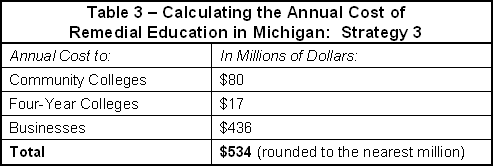
If the true cost of remedial education in post-secondary schools is the same as the high school cost to produce a successful graduate, then we multiply $6,553 by the 14,848 FTE students who receive developmental services each year to yield a total cost of $97 million per year. We can further estimate that it costs Michigan employers $6,553 multiplied by 2.29 to handle the 29,085 dropouts produced each year. (The average dropout is missing 2.29 years of high school.) This produces a total annual cost to employers of about $436 million from lost productivity, the cost of teaching workers basic skills, and the cost of acquiring technology to make up for the lack of basic skills among workers. Changing our calculation of the costs so that we use high school expenditures as the benchmark produces a total cost of $534 million to Michigan businesses and post-secondary institutions to address the lack of basic skills among those who have left high school lacking basic skills.
The previous estimates have assumed that all students lacking in basic skills have either dropped out of high school or enrolled in remedial education courses. That is, we have based our calculations on the estimate that out of the 120,776 students who entered high school in 1994, 29,085 dropped out and another 14,848 graduated but lacked basic skills. These estimates could be mistaken. Perhaps we are over-estimating the number of students lacking basic skills if some of the students who drop out actually possess basic skills. Perhaps we are under-estimating the number if some of the students who graduate but lack basic skills never enroll in remedial education courses. The latter error seems more likely to outweigh the former error; nevertheless it seems desirable to develop a different way of identifying the number of students lacking basic skills.
The National Assessment of Education Progress (NAEP) is administered periodically by the U.S. Department of Education in states that agree to participate. The NAEP is generally considered to be the most reliable long-term measure of student achievement because its low stakes provide little incentive to educators and administrators to manipulate the results. According to the most recent math NAEP results for 8th-graders, 33 percent of students perform "below basic."24 If high school neither improves upon nor worsens this rate (and there is strong reason to believe that the situation should worsen as students get older), we can estimate that a third of Michigan students leave public school lacking basic skills.
Interestingly, this rather rough way of estimating the number of students lacking basic skills generates a figure surprisingly close to the number in our prior estimate. If a third of students who enter high school in Michigan leave lacking basic skills, the figure would be around 39,900. According to our prior estimate that 29,085 students drop out and 14,848 students enroll in remedial education, a total of 43,900 students leave high school each year lacking basic skills. Only 4,000 students separate the two figures.
If we assume that these 39,900 students are roughly two years behind in their skills and if the cost of handling their lack of skills is roughly equal to the cost of teaching those skills in high school, then the lack of basic skills costs Michigan employers and schools of higher education approximately $523 million per year. Using the last three strategies we are arriving at annual figures close to a half-billion dollars.
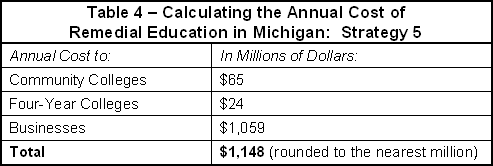
The last three estimates make a conservative assumption: that the "return on the investment" of teaching students basic skills is "a wash." That is, we are assuming that spending roughly $13,000 to remediate a student who is two years behind on learning basic skills (Strategy 3's annual "per successful graduate cost" of $6,553 times two years of remediation) will save only $13,000 later in that student's life. The return is likely to be much greater. If possessing basic skills increases a worker's productivity, that $13,000 could easily yield many times the original investment, especially when one considers that the increase in productivity occurs over the worker's entire working life. Conversely, failing to remediate a student or worker for $13,000 may ultimately cost society many times more money. The costs of incarceration, welfare, and unemployment are quite high compared to the cost of education.
If we change the cost estimate used in Strategy 3 so that the return on remedial education expenditures is a modest 3-percent real return over a 30-year period, the cost balloons to $1.15 billion. The calculation is as follows: $89 million (the direct expenditures by higher education) + [$6,552.66 (the cost per pupil per year of producing a successful graduate) multiplied by 29,085 (the number of dropouts) multiplied by 2.29 (the number of years they are missing on average from high school, which is an indicator of how far behind they are) multiplied by 1.03^30 (which is how much a dollar is worth after thirty years compounded at 3%)] = $1.15 billion.
Even this large number, however, may well be too low an estimate of the cost of the lack of basic skills. A 3-percent real return may be too low. (The real return on 30-year Treasury bonds is closer to 4 percent, while the real return on investments in the stock market over the past 30 years has been much larger.) In addition, there are still many costs that we are not including in our estimate. For example, we make no allowance for the lost wages experienced by students whose full entry into the workforce is delayed or interrupted by having to enroll in remedial education courses in post-secondary institutions. And our prior estimate does not include students who graduate from high school lacking basic skills and never enroll in remedial courses. Even our highest estimate of a little more than $1 billion may well be too low.
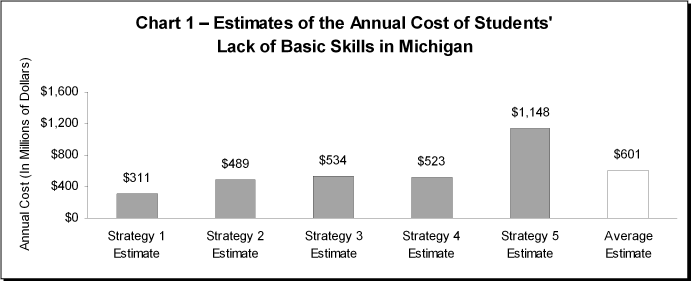
As revealed by these five strategies, the cost imposed on Michigan business and higher education institutions by students who graduate from high school without having learned basic skills could be anywhere from $311 million to $1.15 billion per year. The $311 million estimate is almost certainly too low. It does not include any costs for lost productivity and it probably understates the number of people lacking skills. On the other hand, the $1.15 billion estimate may not be a sufficiently conservative estimate. It assumes a 3-percent real rate of return on investments in remedial education, which may be higher (or lower) than the actual return. The other three estimates are clustered around $500 million. Those estimates are conservative and consider any return on remedial education investments to be "a wash." We believe that the most reasonable estimate of how much the lack of basic skills costs Michigan each year lies somewhere near the average of all five estimates: $601 million (see Chart 1, below).
Some remedial education experts say social problems, beyond the reach of elementary and secondary schools, account for the widespread lack of basic skills. George Swan, Dean of Arts and Humanities at Wayne County Community College, says: "We cater to students who lack the skills to compete for a variety of reasons—age, money, lack of confidence. I can't blame it on the public school system."25 Julianne Sisung of Kellogg Community College attributes the extent of remedial education to the increasing diversity of the population that goes to college: "It's not the public school system's [fault] . . . . The Michigan public school system does a good job and prepares people well to compete at the college level. It's the diversity of students that has changed over the years. Students come from a variety of backgrounds and ages. Many of these students were not college bound before."26
Other experts place the blame squarely at the door of the public schools. They argue that basic reading, writing, and arithmetic skills are necessary for anyone who intends to function in society, not just those who are college bound. Janet Detloff, chair of the Math and Sciences Division at Wayne County Community College, is worth quoting at length:
The Detroit-area public schools are terrible. Most of the students who come to us not only lack math and English skills, but they lack basic academic skills. They have no idea what is expected of them at the college level. They don't know how to take notes. They don't read the assigned material. And many of them don't even come to class. How did they get through high school without these skills? Many of them were promoted for social reasons—they were getting too old; they had repeated the grade three times; they would otherwise fail-out. So they graduate without the skills they need to succeed, not only in academics, but in the workplace. Local employers often find the same problems with their employees that we are addressing here—truancy, lack of attention to detail, inability to complete tasks. I remember one student who called me complaining that she had received an 'F' in a course even though she had attended every day. She didn't understand that she actually had to master the basic course material. That was foreign to her.27
Steve Carlson, chair of the Science and Mathematics Division at Kellogg Community College, had a similar assessment: "Largely it's the public schools' [fault.] Ideally, developmental programs should not exist at the college level. Public schools should prepare people to compete at that level, but they do not."28
A number of remedial level educators identified specific failings of the public schools. Katie Smith, director of Transitional Studies at Lake Michigan College, blames high schools for failing to help students develop proper analytical skills:
For most students, writing consists not of research, but what I call 'I-search.' That is, most students are given writing exercises that ask them to tell how they feel about a particular issue. The exercise doesn't involve analysis or critical thinking, it just asks students to emote. This is a great hindrance to them in the end because they never develop any analytical skills or critical writing skills.29
Sidney Graham, chair of the Department of Mathematics at Central Michigan University, blames the public high schools for assigning "little homework."30 Mitzi Chaffer, also of Central Michigan University's mathematics faculty, points to "lax standards in most high schools."31 Steven Holder, chair of the English Department at Central Michigan, finds fault with grade inflation in public schools.32 Florence Harris, director of the Office of Supportive Services at Michigan State University, describes the futility of trying to identify who is responsible for the situation: "It's a blame game. The colleges blame the high schools. The high schools blame the middle schools. The middle schools blame the elementary schools. Where does it end?"33
While educators could not agree on who or what was ultimately responsible for the widespread lack of basic skills among high school graduates, they did agree that their own efforts significantly improved student skills. While the effectiveness of remedial education is difficult to study, the few studies that have been conducted show that students who participate in remedial education are significantly more successful in college than are students who need such education but fail to enroll in the requisite courses.34 Independent assessments by researchers like David Breneman and William Haarlow repeat that "remediation is surely a good investment."35 This study suggests that the cost of remedial education per full-time equivalent student in post-secondary schools is about 10 percent less than the cost to produce a "successful" student in high school.
If, as these observations suggest, remedial education is effective and relatively cheap, there is no reason to favor curtailing it. The observation that the lack of basic skills costs post-secondary schools and employers a great deal of money does not mean that the money spent on it is wasteful or unnecessary. To the contrary, with more than a third of high school students lacking basic skills, the evidence suggests that we ought to devote even more resources to remedial education.
Rather than cutting back on those who are treating the problem, we should focus our energies on identifying the cause and preventing its occurrence. There is certainly an element of truth in the observations of some remedial education instructors that the social problems of students account for some portion of their failure to acquire basic skills in high school. But educators can do little to change those social conditions. Instead, it is more productive to consider ways in which schools can reduce the number of students who graduate having never learned basic skills.
While this study does not deal at length with solutions to the problem, it is reasonable to conclude with some possible solutions to this burgeoning problem of remedial education:
1. Public school districts and private schools should implement a rigorous test that students must pass before graduating from high school. At the very least, this would re-enforce the idea that there is an academic standard high school students are expected to attain in order to graduate. While it is no panacea, a graduation test would help to shore up the integrity of a high school diploma and give high schools a greater incentive to ensure that their students acquired basic skills.
2. Public school districts and private schools should shoulder at least some of the financial burden of addressing the lack of basic skills among their graduates. A number of organizations have proposed some sort of "money-back guarantee" for high school diplomas. In other words, if high school graduates are unable to demonstrate mastery of basic skills, schools would have to pay for at least some of the cost of remedial education for those students. This financial responsibility would provide a further incentive to schools to ensure that their graduates were minimally competent.
3. Allow families to choose the elementary and secondary schools their children attend. Parents should be able to choose alternative schools for their children when a school or district fails to provide an adequate education. One of the reasons that America's system of higher education attracts the best students from all over the world is the presence of a competitive system that provides students with choices. Post-secondary students can choose among a large number of community colleges, public universities, private colleges, or vocational schools. Meanwhile, elementary and secondary students are assigned to their schools, and are unable to escape poor performing schools unless they possess the financial wherewithal to relocate to a better public school district or pay tuition at a private school. Offering K-12 student the same kind of school choices that we already provide college students will create a more competitive elementary and secondary system that delivers higher quality and greater opportunities.
In my capacity as a teacher of Michigan college students, both on regular faculty at Central Michigan University and on a continuing basis as an instructor of CMU-administered extension courses, I have come to suspect that between a third and a half of entering freshmen have considerable difficulty in comprehending an article from a news magazine such as Time or Newsweek.
The students lack knowledge of grammar, exhibit poor vocabulary, and have done little reading beyond assignments in the unchallenging textbooks that constitute the printed basis of their high-school curriculum. They find it extremely difficult to disengage from the deeply lodged habit of relying on personal narrative and subjective opinion in their confrontation with facts and the world. They react emotionally to problems that can only be solved intellectually.36 They struggle to find the right words to articulate intuitions that remain nebulous and unstated.
When CMU in cooperation with the Mackinac Center for Public Policy staged a debate in Mt. Pleasant in April 1997 on the subject of declining standards at Michigan public universities, one CMU faculty member performed the experiment of sending the 20 students from his upper-division humanities course to report on the occasion. He later let me see these documents, with personal identifications of the writers removed. Although the audience at the event was given much in the way of framework—an outline of topics to be addressed and questions to be posed, skillful moderation, spoken summaries by the participants—the students in question could make little out of what they had witnessed. Asked to reprise the main points of contention and sketch the arguments on both sides, they unanimously failed to do so, falling back instead on random personal observations of the physical setting and tangential expressions of their own confusion.
It therefore should come as no surprise that I endorse the findings of Dr. Jay Greene's report on the cost of remedial education to the Michigan economy. Greene paints a stark picture of the problem in economic terms. Using cautious numbers, he carefully concludes that educational failure—which is what the large and growing need for remedial education signifies—is costing Michigan's economy at least $311 million and perhaps (still conservatively) as much as $1.15 billion yearly.
It is important to underscore Dr. Greene's careful approach. Because the actual extent of educational failure is difficult to determine and because the job of remedially educating students is likely spread throughout the economy in ways not amenable to analysis, Greene reminds us that the full cost of doing again properly what the schools have done badly is almost certainly in excess of his higher figure. To put the numbers in perspective: $300 million is more by a third than the cost of a space-shuttle mission; $1 billion is the cost of a new Seawolf submarine or Aegis cruiser for the U.S. Navy. Those are big-ticket items. Let us underscore, as well, that the costs adduced by Greene are yearly costs. As long as the need exists to make up for a failure in education, those costs will continue to mount. Everyone pays them. They add up, year after year and decade after decade.
However, the failure of our schools is not mainly a dollars-and-cents problem. The failure signified by the need for remedial education in basic verbal and quantitative subjects is also a human tragedy, hard to measure under the dollar sign, but equally worthy of consideration. It is, in fact, a measure of our own distance from an understanding of the nature of this tragedy that to have its maximum impact upon us, it must be expressed terms of dollars and cents.
Since tragedy is best expressed by means of literature, it is entirely appropriate to turn to the world of letters for an illustration. I submit to you Charles Dickens' Bleak House, a novel that first appeared in serial form in 1853. The plot of Bleak House concerns endless litigation over an inheritance. Many parties believe themselves to have an interest in the legacy and petition and cajole in order to take a share of it or get all of it for themselves.
One such character is the furtive Mr. Krook, a rag-and-bone dealer who also runs a shabby boarding house. Krook has bought up a mass of discarded documents from Chancery, the courts where civil cases are heard, and keeps them carefully secured in his rambling storehouse of junk. He fancies that they contain a secret about the pending estate. Unfortunately, his illiteracy prevents him from making any sense of them. Mr. Jarndyce, the guardian of the novel's cousinly main characters, has the following exchange with Krook on visiting his shop. Esther Summerson, one of Jarndyce's two wards, narrates:
We came into the back part of the shop. Here on the head of an empty barrel stood on end, were an ink-bottle, some old stumps of pens, and some dirty playbills; and, against the wall, were pasted several large printed alphabets in several plain hands.
"What are you doing here?" asked my Guardian.
"Trying to learn myself to read and write," said Krook.
"And how do you get on?"
"Slow. Bad," returned the old man, impatiently. "It's hard at my time of life."
"It would be easier to be taught by someone else," said my Guardian.
"Aye, but they might teach me wrong!" returned the old man, with a wonderfully suspicious flash of his eye. "I don't know what I may have lost, by not being learnd afore. I wouldn't want to lose anything by being learnd wrong now."37
Poor Mr. Krook's life is blighted not only by his inability, but by a profound ignorance which, without his knowledge, forever prevents him from improving his lot. He shows traits of meanness and cunning and looks out solely for himself. Not having learned his letters as a boy, he now finds it slow and difficult to learn them in old age. He never succeeds. Not having had any experience of orderly instruction, he indeed suspects those who might teach him. The simple matter of the rules for reading and writing remain a remote mystery to him. The loss that Krook worries about in his lack of education, in not having "learnd afore," appears inevitable.
Dickens devoted great energy to the advocacy of democratic education. The intellectual achievements of Western civilization constituted a legacy, he thought, that belonged by rights to everyone. Sensible education ought to make that legacy available to as many as possible, and in an effective way.
An author by trade, Dickens certainly held a stake in the spread of literacy. Both literacy and facility with numbers are important themes in Bleak House. In contrast to the pathetic Mr. Krook, young Esther Summerson, although an orphan brought up in a foster home, has received a decent education and can read and write with adult fluency. Dickens assigns an entire chapter to the letters that she exchanges, while ill with a contagion, with her friend Ada. Esther's capacity for self-expression aids her in coming to terms with the complexities of adult life that gradually, in the course of the novel, impose themselves on her. Esther's literacy enables her to find order in the great mass of facts and evidences that constitute the world. A minor character, Tom-All-Alone, is a street urchin, whom Dickens pictures as staring in bewilderment at the notices and advertisements of London's shops. His illiteracy shuts him out from participation in the market and all but dooms him to beggardom.
Education is supposed to do something for those who undergo it. It is supposed, by the time the student graduates with a high-school diploma, to have established the intellectual foundations of adult maturity. It is supposed to have prepared the student, not merely to enter the market with basic competency in verbal and numerical skills, but for the lifelong endeavors of continuing his own education, of understanding the many and often bewildering manifestations of culture, both high and low, and of examining himself in objective terms. Education is also supposed to give the student a basic package of knowledge, related to the traditions on which modern civilization rests, that provides him with a minimal context for understanding life, politics, and society. Charles Dickens was certainly not alone in comprehending these things. Our judgment of what it means to be literate in a competent adult fashion—and therefore of what it means not to be literate in that fashion—is as old as the founding of Greek education in the fifth century B.C.38
In our own century, researchers like Walter J. Ong, Jr., Alexander Luria, Millman Parry, and Eric Havelock have carefully explored the ways in which literacy transforms the way people confront one another and the world. Ong in particular, in Orality and Literacy,39 and Havelock in Preface to Plato, have shown how the acquisition of literacy entirely alters the style of thinking of the affected subject. Havelock goes as far as to assert that science, philosophy, and constitutional politics all stem from the literacy revolution of archaic Greece.40
The unlettered, as Ong and Havelock establish, do not think in terms of regular cause and effect; they do not think in abstractions or according to general principles; they do not think in precise quantities (the idea of precise quantity remains baffling to them); they do not think in objective terms at all, but relate everything to the immediate, the personal, and the subjective.41 The lettered, by contrast, acquire the ability to follow complex lines of cause and effect, to link statements with evidence in an objective way, to suppress the merely subjective for the sake of establishing external truths, and to deal with ethical issues in a distanced and principled way. Says Ong in a summary passage: "The distancing which writing effects develops a new kind of precision in verbalization by removing it from the rich but chaotic existential context of much oral utterance . . . . Orally managed language . . . is not noted for analytic precision."
One of the meanings of the word education, then, is the ability to think carefully about things in an objective way and according to abstract, or general, principles. It bears considerable repetition that the students who need remedial education need it in the areas of reading and writing and math: Their capacity for precision, for precise thinking, is insufficiently developed.
That kids have trouble reading and writing means that they must continue to rely, as do very young children, on a sense of the world structured by oral rather than written language. The primary deficiency experienced by the "more than half" of Michigan community college students who, according to Greene's findings, require remedial training is a continuing dependence (by default, because they cannot do otherwise) on oral, which is to say on non-literate, linguistic resources.
No wonder they have a hard time filling out an application or following directions on the job or making change. As banal as an application form appears to a genuinely educated person, it imposes precise demands that daunt the academically cheated. If "today's high school students are unprepared for college-level work," as an administrator quoted by Greene says, then certainly part of the reason is that their previous school experience has left them without those skills that Ong establishes as crucial for life in the modern (literacy-intensive) world.
People call the present age, "The Information Age." Perhaps it is that. But information, whether in books or in "hypertext," is available in a meaningful way only to the literate. When Greene quotes from the Michigan Career and Employability Skills Content Standards, the competencies listed as necessary to employers in those whom they hire correspond almost perfectly with the cognitive implications of literacy as described by Ong.
While Greene (rightly) emphasizes the economic consequences of the failure of up to a third of Michigan students to achieve these rather modest goals out of high school, we should not forget to imagine what life is like for someone who cannot, as the Standards say, "apply basic communication skills," "understand complex systems," or "communicate ideas to support a position and negotiate to resolve divergent interests."42 A student badly served by our education system must live with him or herself, even when the system has bestowed upon him or her a diploma. A vast range of cognitive and expressive activities taken for granted by genuinely educated people remains inaccessible to those whom education has failed.
Would anyone capable, say, of making sense of a social or political debate or of reading with comprehension and pleasure Dickens' Bleak House or simply of balancing accurately his own check-book willingly give up these abilities? No. The capacity for such endeavors is profoundly constitutive of who we are as educated people. Yet students who stand, in the bureaucratic language, "in need of development," lack that very capacity.43 The failure in their education has impoverished them intellectually. The vast range of human achievement, the entire worlds of art and literature and philosophy, remains implacably closed to them.
Greene does not speculate about causes, but something should be said in this regard. Given that the need for remedial education means fundamentally a need for higher levels of literacy in high school graduates, we should probably look to language arts (as it is called) and mathematics instruction at the K-12 level for the origin of so much student incapacity. "No matter what their grade-level," says Professor Sandra Stotsky in her recent book Losing Our Language, "most American students do not read or write very well. Nor do they know much American or world history. Their scores on nationwide assessments of reading, writing, and history knowledge are dismaying."44
The primary cause of this dismally low achievement, Stotsky argues, is a nearly universal rejection of historically proven approaches to literacy instruction in K-12 grade levels and the substitution in their place of affectively oriented, often ideologically driven, types of pedagogy. She cites that tenacious and destructive fad, "whole language," but also points to the domination of a widespread attitude that aggressively denounces grammar competency, large and subtle vocabulary, and adherence to logic, as somehow oppressive to students and that "subordinate[s] literary study to social studies in the elementary school."45 A recent Fordham Foundation report on Why Education Experts Resist Effective Practices46 noted, moreover, that even when empirical evidence refutes ideological claims, teacher-educators stubbornly adhere to ideological assertions. Says Stotsky:
Secondary and college teachers complain, with good reason, that fewer and fewer American students read demanding literature in junior or senior high school or can do demanding academic writing. One editor I spoke with believes that there is little eighteenth- and nineteenth-century literature in the upper elementary grade readers not because of an anticivic perspective, and not because of a bias against dead white males, and not because their works do not relate to students' personal experience, but because many students cannot read the language of eighteenth- or nineteenth-century (or even early twentieth-century) writers anymore. Teacher-educators who cannot abandon their ideologies will continue to downgrade the English language and support the dumbing-down of its literature rather than urge the teaching of the reading skills that will enable students to read demanding literary works at a later age.47
To paraphrase Mr. Krook, "Aye, they have been taught wrong." There can be no doubt of it. Of a collection of 19th-century Michigan classroom-readers in my possession, I would argue that, in simple basic knowledge (of grammar, argumentation, sense of style) they exceed the demands typically made nowadays in college classrooms. Certainly Greene's statistics bear out Stotsky's claim that American public schools, dominated by pseudo-scientific pedagogies, no longer inculcate a high level of basic intellectual competency. Neither can it be pure coincidence that another recent Fordham Foundation report, on state education standards gave Michigan an "F" for its English and another "F" for it math standards.48 Again, I wish to underscore not just the economic cost, but the sorrowful loss in human capacity and potential.
In one of his most powerful poems, "The Keeper of the Books," the late Argentine writer and poet Jorge Luis Borges (1899-1981) offers the monologue of an old man who stands watch over ruined gardens and temples. It helps to understand the poem to know that Borges, a writer and librarian by profession and a lover of books, went gradually blind in his sixties and lived out the last decade of his life in sightlessness. A profoundly literate man, he nevertheless could no longer read, but required others to read to him. It was an agonizing experience. In the crumbling corridors and alcoves of these once-proud buildings lie, Borges' watchman says, "exact music and exact words... secret and eternal laws... the harmony of the world." He means by such figures, the skills of literacy and the arts, the scientific knowledge of nature and the universe, and the accumulated wisdom of philosophy: "These things or their memory," he says, "are here in books."
Yet —
In my eyes there are no days. The shelves
stand very high, beyond the reach of my years,
and leagues of dust and sleep surround the tower.
Why go on deluding myself?
The truth is that I never learned to read...
My name is Hsiang. I am the keeper of the books —
these books which are perhaps the last,
for we know nothing of the Son of Heaven
or of the Empire's fate.
Here on these high shelves they stand,
at the same time near and far,
secret and visible like the stars.
Here they stand, gardens and temples.
Here then is the final summation of what I mean by the human cost of educational failure. To miss out on the basics of education is to suffer being cut off from the nourishment of written traditions; it is to be without history, without cultural context. Educational failure means that untold thousands have been cheated, and not merely out of their billfolds. It is one of the scandals of our time.
Cost data in education have many uses, and equally many misuses. This study by Jay P. Greene explores several ways to estimate the costs to society of the lack of basic skills in Michigan. In this essay, I will discuss the effort he makes and try to place his work and others, including my own, in a basic cost/benefit framework for clear policy thinking.
Prior work, cited by the author in the first footnote of this study, notes that William Haarlow and I have estimated the national cost of remedial education to be about $1 billion annually, while Ronald Phipps estimates the number to be closer to $2 billion. In the Executive Summary, which is all many people will read, Greene puts his estimate at "around $16.6 billion."49 At first glance, one would assume that these different studies have come to wildly different conclusions, but that is not so. Indeed, his figure of $16.6 billion and ours of $1 or $2 billion are comparisons of apples to oranges. Let me explain why.
The $1-billion figure in our work was based on a request that I received several years ago from Diane Ravitch of the Brookings Institution. She was preparing a series of papers for an edited volume that was primarily devoted to articles analyzing the failure of U.S. K-12 public schools to perform satisfactorily on academic measures of student progress.50 My chapter concluded the volume, and I was asked to estimate the cost to the taxpayer of remedial education as a result of K-12 failure. This was a very precise question about costs, far less encompassing than an estimate of the total costs to society, including poverty, welfare, crime, and other forms of social dysfunction associated with poorly educated people.
While the question was precise, the available data were terrible, and I made an extrapolation to the United States based on reasonable cost data collected in two states, Maryland and Texas. There were no readily available data on costs in private colleges and universities, so my estimate was limited to public two-year and four-year colleges and universities. The Maryland data were collected by the state directly from the institutions, based on their own estimates of costs. The Texas data were based on state appropriations. My extrapolations based on these two different methods were remarkably close, at about $1 billion, which gave me some sense of confidence that the number was not too far off the mark.51
It should be emphasized that when Greene makes the same precise extrapolation to the United States based on his data for Michigan, he reaches a figure less than ours, $773 million.52 So, on an apples-to-apples basis, we now have three estimates that are relatively close, and in particular, Greene's number and ours are very close. His work, therefore, further supports the answer I gave to the question that Ravitch posed to me, and I am delighted to have confirmation based on data from a third state.
I went on to conclude that an outlay of $1 billion against a total outlay of state appropriations for public higher education of $113 billion, or less than 1 percent, made remedial education a good investment from the public's perspective. In short, I was invoking an implicit cost/benefit analysis, without doing the detailed work of estimating the benefits, but arguing that any such estimate would vastly exceed, in present value terms, a cost of $1 billion. I believe that Greene's work further makes the same case.
I have belabored this comparison because a hasty read of Greene's paper might lead the reader to the wrong conclusion, namely that remedial education is a horribly expensive waste of the public resources. To the author's credit, that does not appear to be his view, for he argues, as do we, that "remedial education is effective and relatively cheap, there is no reason to favor curtailing it.."53 But this conclusion is easily lost in his effort to generate multiple ways to estimate the costs, each method increasing the previous total, until he reaches the grand estimate of $16.6 billion. He fails, as have all efforts focused solely on costs, to balance the costs with estimates of the benefits. Given that this issue has become highly political (consider, for example, the case of City University of New York), it seems that the likely impact of this study will be to give further ammunition to those who seek to limit options for remedial education for those who clearly need it. And that policy decision, I argue, would be totally misguided.
I will not spend much time commenting on his multiple ways of computing costs for two reasons: First, as long as one is clear about what one is computing, as the author is, I have no quibble with his estimates. Second, and more important, however, exploring the cost side is only part of what analysts should be doing when we seek to give a serious response to the public's concern about this problem. No one, thus far, has tackled the benefit side, and whether the costs are $1 billion or $5 billion, or even $16 billion, we won't know how to evaluate that number without contrasting it with the benefits that society receives from the expenditure. Indeed, in the author's first footnote, mentioned earlier, he includes in his listing as costs items that might more correctly be viewed as benefits. For example, the expenditures related to remedial education may lead to a reduction in expenditures on more costly programs such as welfare, prisons, and state-provided medical care. These socially costly outlays accompany the conditions of poverty that correspond in today's economy to conditions of failed basic education.
The author is right in turning attention in the concluding section to the question of how the need for remedial education might be reduced. Certainly, no right-thinking person can argue against doing what we can to reduce the number of youngsters who graduate from high school (or drop out before graduation) unable to read, write, and compute. Investments at the K-12 level that improve student performance would almost certainly pay off in any cost/benefit calculation, and would be superior to the second-best method, remedial education. The author trots out two approaches favored by some—charging the costs back to the student's high school, and introducing greater school choice at the K-12 level. But now we are into territory where none of the authors who have worked on cost estimates have any particular expertise to bring to the table. I could just as easily argue that evidence suggests that high-quality teachers are the best way to improve student performance and argue that wage levels for teachers are too low to attract the quality into the profession that we need. The point is made, however, that we have every economic and moral reason to continue to work on the improvement of K-12 education, not a particularly surprising or striking conclusion. People will choose their preferred approach as much on ideological grounds as on evidence.
I close with one historical observation. Remedial education has been part of higher education since the founding of Harvard—this is not a new concern. It has grown in importance, however, as the needs of the economy call for a better educated work force, and as we have responded by moving from an elite to a mass form of higher education. The quickest way to solve the remedial education problem would be to return to a smaller, elite system, renouncing the effort, begun with the post-WWII GI Bill, that vastly expanded access to higher education. Few serious people, however, would accept that approach. Given that fact, we are faced with the messy reality that many students enter college less than well prepared. The path of wisdom is to work on the problem at the K-12 level, as we have been doing as a nation for the last 15 years, while simultaneously making remedial opportunities available to those who failed to learn the first time around.
Dr. Jay P. Greene has modestly and cautiously reported exemplary research on the costs of deficient basic skills in Michigan. He makes defensible assumptions and, as he points out, provides conservative estimates. His best estimates of the current annual costs of basic skills deficiencies are $601 million in Michigan and $16.6 billion in the United States.
Greene points out some costs left out of his calculations. But there also are some costs he not only left out, but also didn't mention.54 For example, wasted years in school means potential earnings lost. Is this loss comparable to what might have been earned full-time at unskilled work in factories, on farms, or in service industries? We should, moreover, consider the costs of lost human capital and other forms of capital.55 Such costs are no less important than immediately foregone earnings, even if their size cannot be easily calculated. Efficient schooling, for example, would yield not merely basic skills mastery but even advanced skills. Most parents, citizens, educators, and policy-makers rightly assume that such proficiency and advanced skills not only repay the individuals who acquire them but the society that invests in them.56
Higher cognitive skills result in increased productivity, which contributes to greater economic growth. This advantage applies not merely in the first year on the job or in college but to three-quarters of a lifetime or so beyond high school. Long-range economic growth, in turn, can provide a better quality of life.
As a psychologist specializing in educational productivity, my preference is to emphasize the lack of school standards and the resulting poor academic performance of our students despite unprecedented outlays of money and resources. My recent analysis of reports from the Organization for Economic Cooperation and Development shows that, among students in economically advanced countries, U.S. students made the least gains in reading, mathematics, and science during the school years studied. Yet, our per-student costs were third-highest.57
Why should the most economically productive nation on the planet have the least efficient school system? Many students put little effort into their schoolwork, and colleges have long imbued future teachers with anti-competitive, anti-standards views. More than any other factor in my view, this accounts for Greene's findings of high costs.
The evidence: A 1997 Public Agenda national survey58 of high school students showed that three-fourths believe stiffer examinations and graduation requirements would make students pay more attention to their studies. Three-fourths also said students should not graduate who have not mastered English; a similar percentage said schools should promote only students who master the material. Almost two-thirds reported they could do much better in school if they tried. Nearly 80 percent said students would learn more if schools made sure they were on time and did their homework. More than 70 percent said schools should require after-school classes for those earning Ds and Fs.
On these issues, however, teacher-educators differ sharply from students and the public. A 1997 Public Agenda survey of education professors showed that 64 percent think schools should avoid competition.59 More favored giving grades for team efforts than did those who favored standards of accomplishment.
Teacher-educators also differ from employers and other professionals on measuring standards or employing them at all. Employers, for example, use standardized multiple-choice examinations for hiring. So do selective colleges and graduate and professional schools for admission decisions. Such examinations are required in law, medicine, and other fields for licensing because they are objective, efficient, and reliable. Yet, 78 percent of teacher-educators wanted less reliance on them. Such attitudes, encouraged among school students, obviously ill-educate them for college and the workforce.
Nearly two-thirds of teacher-educators admitted that education programs often fail to prepare candidates for teaching in the real world, and only 4 percent reported that their programs typically dismiss students found unsuitable for teaching. Thus, even starting with their undergraduate education, many educators are laden with anti-competitive ideas against standards and incentives.
Seventy-nine percent of the teacher-educators agreed that "the general public has outmoded and mistaken beliefs about what good teaching means." They apparently forgot that citizens, who pay for schools, constitute their ultimate clients. The public and students are right: Standards can work in schools as they do in much in the rest of society, and Greene's quotes of Michigan observers support this view.
In addition to the human capital generated by maintaining high educational standards, we should not overlook various forms of "social capital," a term referring to the social benefits that accrue as a result of educational success. In his best-selling book Cultural Literacy, for example, E.D. Hirsch showed that schooling deficiencies in civics, history, geography, and other subjects severely limit students' potential civic and cultural engagement and contributions to society.60 If young people lack knowledge and appreciation of American history and laws, for example, how can they vote wisely and serve well on juries? If they lack knowledge of current events and skills in reading and speaking, how can they participate in civic and cultural affairs or appreciate their significance or importance?
Another kind of social capital is family capital.61 Better-educated parents—those with more knowledge and greater skill levels—are far more likely to raise children who are similarly well prepared for their own lives and participation in society. Similarly, family members who understand and communicate effectively with one another can negotiate and reach agreements, trust others and focus effectively on what they have agreed to do.
More broadly, high levels of social capital allow greater trust among individuals within nations. "High-trust" societies like Japan and the United States develop flexible organizations that operate within the global economy with far more alacrity than those of "low-trust" societies such as like China or France.62 This benefit is threatened by long-term, widespread educational failure. American students undoubtedly acquire a measure of trust through participation in sports and other leisure activities requiring teamwork, but are today's kids—so many of whom come from broken homes—learning the kind of trust required in families, work, and civic life? And do they acquire the human capital of knowledge and skills to carry out their parts of group efforts?
Dr. Greene is right to conclude with recommendations for substantial reforms. Already, some of his recommendations are being slowly and timidly enacted throughout the United States. In the future it may become typical to see schools that fail to make learning gains put on probation. If they make little progress, they may be closed or the staff may be replaced. Alternatively, all students in a district or state may be given publicly funded scholarships that allow them to go to public, parochial, or independent schools of their choice. Schools that attract more students may receive more funds, a principle that introduces competition, which appears to improve schools.63 Another twist is to grant only those students from failing schools the ability to use a scholarship voucher to attend public or private schools of their choice.
Such reforms would certainly introduce real incentives into the current system and give more students a better chance to succeed in life.
The author would like to acknowledge the invaluable research assistance of Matthew Ladner and Christopher Hammons. The author also thanks the peer reviewers and commentators, as well as the Mackinac Center's Director of Education Policy Matthew J. Brouillette and staff for their suggestions, editing, and support of this project. The Michigan Chamber of Commerce also provided valuable assistance in conducting the survey of Michigan businesses. The author also would like to express gratitude to all of the educators and state officials who agreed to be interviewed and helped obtain the data for this study. Finally, the author would like to thank the W.K. Kellogg Foundation for providing the financial assistance that allowed this project to be conducted.
Dr. Jay P. Greene is a senior fellow at the Manhattan Institute for Policy Research in New York, NY. He has conducted evaluations of school-choice programs in Milwaukee, Cleveland, and San Antonio. He also has investigated the effects of school choice on civic values and integration. His publications include the chapters, "Civic Values in Public and Private Schools," and "School Choice in Milwaukee: A Randomized Experiment," in the book, Learning from School Choice, published by the Brookings Institution in 1998; "The Effect of Private Education on Political Participation, Social Capital, and Tolerance," in the fall 1999 issue of The Georgetown Public Policy Review; and "The Texas School Miracle Is for Real," in the summer 2000 issue of City Journal.
Dr. Greene is also a research associate at the Harvard Program on Education Policy and Governance and the Tomas Rivera Policy Institute. He has been a professor of government at the University of Texas and the University of Houston. He received his Ph.D. from the government department at Harvard University in 1995.
Thomas F. Bertonneau, Ph.D., is the former executive director of the Association of Literary Scholars and Critics and an adjunct scholar with the Mackinac Center for Public Policy, for which he authored the influential study, Declining Standards at Michigan Public Universities. He also is an instructor at the College of Extended Learning at Central Michigan University and is currently under contract with Encounter Books to write a study of affirmative action.
David W. Breneman, Ph.D., is university professor and dean of the Curry School of Education at the University of Virginia in Charlottesville. He holds a Ph.D. in Economics from the University of California at Berkeley, was a Senior Fellow in Economic Studies at the Brookings Institution, served as President of Kalamazoo College in Michigan, and was on the faculty of the Harvard Graduate School of Education before moving to the University of Virginia.
Herbert Walberg, Ph.D., is research professor of education and psychology at the University of Illinois at Chicago and distinguished visiting fellow (1999-2004) at the Hoover Institution, Stanford University. He holds a Ph.D. from the University of Chicago and formerly served as assistant professor at Harvard University. Walberg has written and edited more than 55 books and written nearly 350 articles on such topics as educational effectiveness and exceptional human accomplishments. Among his most recent books are the International Encyclopedia of Educational Evaluation and Psychology and Educational Practice.
David Breneman and William Haarlow estimate that the cost nationally of addressing the lack of basic skills in public higher education is approximately $1 billion. Ronald Phipps puts the figure at about $2 billion annually. But these figures are only the costs of remedial or developmental education in higher education paid by the government. They do not include several types of costs that are included in our calculations, such as: higher education costs paid by the recipients of remedial education; remedial education costs paid by privately operated higher education; expenditures by employers to teach basic skills to employees; expenditures by employers to purchase technology that substitutes for the lack of basic skills among employees; lost productivity in the workplace caused by the lack of basic skills; and the cost of government programs to address problems caused by the lack of basic skills (including welfare, criminal justice, etc.). See David Breneman and William Haarlow, Remediation in Higher Education (Washington, DC: Thomas B. Fordham Foundation, July 1998); and Ronald Phipps, College Remediation: What it is, What it Costs, What's at Stake (Washington, DC: Institute for Higher Education Policy, December 1998).
The college samples were drawn from a universe of 15 public universities and 54 private colleges, as listed in the "Directory of Michigan Institutions of Higher Education," Michigan State Board of Education, March, 1999. One thousand employers randomly selected from a database provided by the Michigan Chamber of Commerce were sent surveys, 113 of whom responded. The database is a commercially developed product that attempts to list all employers in Michigan, not just chamber members. We weighted the sample so that we were more likely to select employers with more employees. Our sample of Michigan businesses represented 118,840 employees or approximately 4 percent of all workers in Michigan.
Interview with Julianne Sisung, Kellogg Community College, February 29, 2000; Interview with Janet Detloff, Wayne County Community College, March 3, 2000; Interview with Steve Carlson, Kellogg Community College, February 29, 2000.
Michigan Community College Network. Available at
E-mail correspondence with Deborah Lonik, Program Specialist, Community College Services, Michigan Department of Education, September 28, 1999.
Interview, February 28, 2000.
Interview, February 29, 2000.
"A Survey of Student Assessment and Developmental Education in Michigan Community Colleges," Michigan Department of Education, May 7, 1990.
It was usually obvious which courses were remedial. To handle ambiguous cases we defined remedial education courses as those whose credits did not count for graduation or did not count toward a major in the field. Very few courses are offered at colleges whose credits do not satisfy at least some requirements.
This estimate that tuition covers 22 percent of costs was calculated from information obtained from the Michigan Information Center, which provided the Integrated Post-secondary Education Data System Finance Survey results from all 15 public universities. According to those surveys, tuition represented 22 percent of total current revenues.
Interview, March 1, 2000.
Interview, March 2, 2000.
Our response rate of slightly more than 10 percent is typical of surveys administered by mail.
Michigan Curriculum Framework. Available at http://cdp.mde.state.mi.us/MCF/ContentStandards/CareerEmployability/; accessed on August 22, 2000.
Figures are rounded to the nearest million.
Another reason our estimate of the expenditures by post-secondary educational institutions is likely to be low is that we do not include any expenditures by vocational schools, many of which educate students with the lowest level of basic skills. We excluded vocational schools because it was too difficult to isolate expenditures on basic skills from expenditures for job-specific skills.
See Breneman and Haarlow, and Phipps' research referenced in footnote 1.
This measure was chosen over any direct cost to employers who do pay to remediate their own workers because employers as a whole do not have incentives to engage in full remediation of their workers. They understand that if they invest so much in a particular worker, that worker could be hired away by competitors who choose not to pay for full remediation. In other words, direct employer costs are highly unreliable as a measure of the true cost of full remediation.
Education Week's Quality Counts. Available at https://www.edweek.org
The number of full-time equivalent students receiving remedial education at four-year colleges and universities was computed from course enrollment data. The number of full-time equivalent students receiving remedial education at community colleges was estimated by multiplying their total enrollments by 6.3 percent, which is the portion of revenues devoted to remedial services.
According to the Michigan Department of Education there were 120,776 8th-graders in 1994. Five years later when those students should have been graduating there were only 91,691 graduates. The difference of roughly 29,000 are those who dropped out.
Michigan Department of Education. Available at http://www.mde.state.mi.us/reports/msr/index98.shtml; accessed on August 18, 2000. This figure is for instructional costs only and does not include capital expenditures or extra programs, such as school lunch, transportation, etc. (Click on "1998 School Report in PDF format" and see "State Avg Bldg Data.") Since these costs do not apply in post-secondary institutions, this lower per-pupil figure is the most reasonable to use.
Actually more students than this will enroll for less than a year's worth of courses. This figure is the full-time equivalent of students who will enroll in remedial courses.
National Center for Education Statistics. Available at http://nces.ed.gov
Interview, February 28, 2000.
Interview, February 29, 2000.
Interview, March 3, 2000.
Interview, February 29, 2000.
Interview, February 29, 2000.
Interview, March 1, 2000.
Interview, March 1, 2000.
Interview, March 1, 2000.
Interview, March 1, 2000.
See "Developmental Education: A Twenty-First Century Social and Economic Imperative," League for Innovation in the Community College, The College Board, 1998.
Breneman and Haarlow, p. 20. See footnote 1.
Walter J. Ong, Jr., Orality and Literacy; The Technologization of the Word (London: Methuen, 1981). Ong notes that the mental style of people who have not assimilated the demands of literacy tends to be egocentric and combative, hence unsuited to subtle analysis or meditation: "Many, if not all, oral or residually oral cultures strike literates as extraordinarily agonistic in their verbal performance and indeed in their lifestyle. Writing fosters abstractions that disengage knowledge from the arena where human beings struggle with one another. It separates the knower from the known. By keeping knowledge embedded in the human lifeworld, orality situates knowledge within a context of struggle" (pp. 43-44).
Charles Dickens, Bleak House (New York: Penguin, 1996), pp. 236-237.
The requirements of Greek education after the advent of alphabetic literacy can be gleaned from the literary remains of Athenian civilization: The basis of education lay in the alphabet, the minimal set of characters, in an arbitrary order, for allowing the writer to spell or to pronounce any word in his language according to set (minimal) rules. We call this principle phonetics. Once schoolchildren had learned their abecedary, they started to read. Greek education, which produced what is arguably the most intellectually and artistically dazzling cultural outburst known to history, was heavily literary, based on Homer's epic poems and on tragic drama. At later, higher stages, the skills of argument, especially the rules of logic, became important. Geometry entered the pedagogical picture at an early age. A knowledge of civics and, to some extent, of history, was also deemed important.
Ong, pp. 103-104.
Without the ability to organize observations in a permanent and external form, Havelock argues, the systematic examination of nature required for the establishment of any science, as we understand that term, was simply impossible.
"In the absence of elaborate analytic categories that depend on writing to structure knowledge at a distance from lived experience," Ong says, "oral cultures must conceptualize and verbalize all their knowledge with more or less close reference to the human lifeworld, assimilating the alien, objective world to the more immediate, familiar interaction of human beings. A chirographic (writing) culture and even more a typographic (print) culture can distance and in a way denature even the human, itemizing such things as names of leaders and political divisions in an abstract, neutral list entirely devoid of human action context" (Orality and Literacy 42). For a good example of a rational, "distanced," analysis of human behaviors and how they might be optimally organized, see The Federalist Papers.
In his article, "The Swamp of Remedial Education" (Academic Questions 9/3 Summer 1996), Bruno Manno states that "75 per cent of American colleges offer remedial courses in reading, writing, and mathematics. Thirty per cent of entering students (55 at minority colleges) enroll in at least one course" (p. 78). Manno points out that the need for remedial education "lengthens the time it takes to earn an undergraduate degree, adding cost and promoting aimless academic drift. Only 31 percent of students earn a degree in four years, down from 45 percent in 1977, with over 66 percent taking five or more years, up about 55 percent" (p. 79). But, says Manno, "remedial education has a second cost. It devalues the work and significance of the college degree and high school diploma, which are often awarded to the academically unqualified" (p. 79). A Michigan student who has graduated with a high school diploma but who cannot do the tasks listed in the Skills Content Standards perfectly illustrates Manno's argument. Again, I ask my readers to imagine it not from the legitimately frustrated perspective of employers who must remediate poorly educated students, but from the perspective of those students, who cannot exercise command over their own unrealized potential.
As Greene notes, administrators are now reluctant to use the word remediation; they refer to such courses not as remedial but as developmental. As Gertrude Stein put it: "A rose is a rose is a rose."
Sandra Stotsky, Losing Our Language: How Multicultural Classroom Instruction Is Undermining Our Children's Ability to Read, Write, and Reason (New York: Free Press, 1999), pp. 5-6.
Ibid., p. 259.
Douglas Carnine, Why Education Experts Resist Effective Practices (And What It Would Take to Make Education More Like Medicine) (Washington, DC: Thomas B. Fordham Foundation, 2000).
Stotsky, pp. 227-28.
Chester E. Finn, Jr. and Michael J. Petrilli, eds., The State of State Standards 2000 (Washington, DC:
Thomas B. Fordham Foundation, January 2000).
Jay P. Greene, The Cost of Remedial Education: How Much Michigan Pays When Students Fail to Learn Basic Skills (Midland, MI: Mackinac Center for Public Policy, September 2000), p. 1.
Diane Ravitch, ed., Brookings Papers on Education Policy, 1998 (Washington, DC: The Brookings Institution Press, 1998).
David W. Breneman, "Remediation in Higher Education: Its Extent and Cost," in Ravitch, op. cit., pp. 359-381.
Greene, op.cit., p. 9.
Op. cit., p. 18.
There also seem to be one or more minor inconsistencies in his estimates that would lead to unestimated or underestimated costs. Greene counts, for example, the tuition and other costs of community colleges but only the tuition costs of four-year public institutions, even though they are publicly subsidized.
See, for example, Gary A. Becker, A Treatise on the Family (Cambridge, MA: Harvard University Press, 1981) and James S. Coleman, Foundations of Social Theory (Cambridge, MA: Harvard University Press, 1990).
Some economists distinguish these by the terms "private" and "social" returns of education.
Herbert J. Walberg. Spending More While Learning Less (Washington, DC.: Thomas B. Fordham Foundation, 1998).
Jean Johnson and Steve Farkas, Getting By: What American Teenagers Really Think About Their Schools (New York: Public Agenda, 1997).
Steve Farkas and Jean Johnson, Different Drummers: How Teachers of Teachers View Public Education (New York: Public Agenda, 1997).
E.D. Hirsch, Jr., Cultural Literacy: What Every American Needs to Know (Boston, MA.: Vintage, 1987).
See Coleman's work referenced in footnote 55.
Francis Fukuyama, Trust: The Social Virtues and the Creation of Prosperity (New York: Free Press, 1996).
See, for example, Matthew Ladner and Matthew J. Brouillette, The Impact of Limited School Choice on School Districts (Midland, MI: The Mackinac Center for Public Policy, August 2000).



