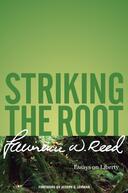
Striking the Root
In this volume, Lawrence W. Reed identifies the root of many of America’s evils today: a failure to recognize that government rests on the use of force. This fundamental feature of government may be a boon when used to protect our individual freedoms, but it is a bane when used to diminish these freedoms in pursuit of a political faction’s idea of a good cause.
Although he has no radio show or nationally syndicated column, Reed, president of the Mackinac Center for Public Policy in Michigan, is one of the most quietly influential people in the American freedom movement today. It is fitting, then, that this volume draws primarily on his past columns for The Freeman, an unpretentious magazine with a resonant voice that has reached some of America’s most prominent people, including a onetime presidential hopeful named Ronald Reagan. In that tradition of plain speaking, Reed demonstrates that the clarion call of liberty will always find an audience, even in a world clamoring for chains. 97 pages. … more
Gridlock in Government: How to Break the Stagnation of America
Government growth has caused the entrenchment of special interests that politicians try to please at public expense. That, in turn, has enhanced the power of incumbency, making it extraordinarily difficult for challengers to mount effective campaigns. The resulting gridlock endangers the democratic process as well as the financial well-being of every taxpayer. Meiners and Miller make a compelling case for state and federal term limitations to correct imbalances, and encourage politicians to think of the long-term welfare of the general public instead of the short-term benefits for a few citizens. Even if the reader opposes term limits, he or she will find a gold mine of facts and figures documenting the explosive growth of the public sector. 147 pages. … more