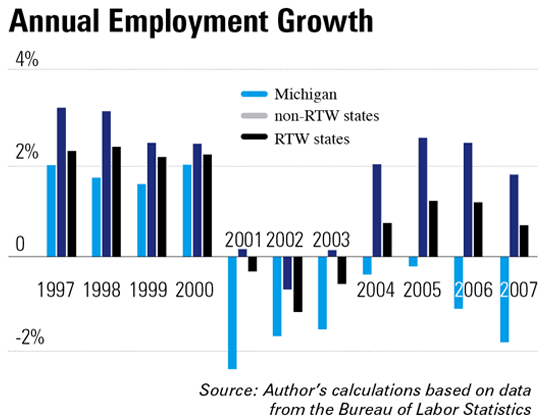
The Michigan Economic Development Corporation is the state’s official "jobs" department. It runs and champions a variety of programs to help facilitate economic development. But the MEDC ignores one economic policy prescription that would likely facilitate robust job creation. The policy, commonly known as "right-to-work," has been adopted by 22 other states. If the MEDC were serious about job creation, it would be cheerleading for right-to-work legislation in Michigan.
"Right-to-work" laws simply say that no one can be compelled to join or financially support a labor union as a condition of employment. Research strongly suggests that it positively influences economic growth in states where it is adopted.
Since the MEDC’s creation, Michigan has lost 323,200 jobs, 283,100 in manufacturing alone. From 2000 to 2007 Michigan’s per-capita personal income rank among the states has fallen from 16th to 26th and now stands at 9 percent below the national average. We also have the highest unemployment rate. Moreover, the Mackinac Center has empirically shown that the MEDC’s chief development program, the Michigan Economic Growth Authority, has effectively had no impact on job creation or per-capita personal income in the state.
During the MEDC’s lifetime its officials have argued in favor of new state laws and programs in the hope of spurring real growth. At times, the MEDC even commissioned studies used later to champion their involvement in a particular industry, such as broadband deployment.
Last year the Mackinac Center sent a Freedom of Information Act request to the MEDC asking for, among other items, any "memos, staff e-mails, and letters regarding right-to-work or compulsory unionism." The Center was curious as to whether or not state development officials had ever discussed the value of a right-to-work law for Michigan. The MEDC’s official response was to deny the request because "they [the documents] do not exist."
In addition, Jim Epolito, chief executive officer of the MEDC, said last year in a Lansing debate with Mackinac Center President Lawrence W. Reed that "… you think all we have to do as a state is be a right-to-work state and all these businesses are going to start pouring into Michigan. Nothing could be further from the truth; nothing is a more ridiculous assumption than that." But is it ridiculous?
The economic performance of right-to-work states can be measured and then compared against non right-to-work states. Let us consider a few measurements and start with the most powerful observation: cross-border employment activity.
Robert Holmes, a University of Minnesota economist writing for the Minneapolis Federal Reserve, examined manufacturing employment in adjoining counties on each side of state borders where one state maintained a right-to-work law and the other did not. He then measured manufacturing employment as a percent of each county’s population and found, on average, that manufacturing employment leaps by about 33 percent simply crossing into the state with right-to-work protections.
The reason that this 1996 study, "The Effect of State Policies on the Location of Manufacturing: Evidence from State Borders," is so important is that it effectively eliminates non-policy related determinants of growth, such as geography, from consideration. For instance, the weather in Kentucky’s Fulton County is the same over the border in Tennessee’s Weakley County, as are likely attitudes toward unions, agricultural conditions and other important variables.
In addition to these cross-border comparisons, there are mountains of comparative data that at least suggest a strong right-to-work influence on growth. Oklahoma adopted right-to-work protections in 2001. In the six years after passage, Oklahoma’s per-capita personal income grew 27 percent faster than the national average. In the six years prior to passage, its per-capita personal income grew at roughly the national average. Maybe that is just a coincidence, but then again maybe it is not. Data such as this and more can be found at the Center’s special right-to-work resource page at www.mackinac.org/8527.
The MEDC has never been necessary for Michigan’s economic well being, but as long as the MEDC exists it should do one thing noticeably well to help facilitate job creation: advance right-to-work legislation.
#####
Michael D. LaFaive is director of the Morey Fiscal Policy Initiative at the Mackinac Center for Public Policy, a research and educational institute headquartered in Midland, Mich. Permission to reprint in whole or in part is hereby granted, provided that the author and the Center are properly cited.

The Mackinac Center for Public Policy is a nonprofit research and educational institute that advances the principles of free markets and limited government. Through our research and education programs, we challenge government overreach and advocate for a free-market approach to public policy that frees people to realize their potential and dreams.
Please consider contributing to our work to advance a freer and more prosperous state.


