

 Font size:
Remarkable advances in analytical chemistry now make it possible to measure minute levels of both natural and synthetic compounds in human tissue and body fluids. This “biomonitoring” allows researchers to determine more precisely than ever the degree to which individuals have been exposed to specific chemicals in the environment, and how exposures change over time. Consequently, federal and state officials increasingly regard biomonitoring as a potential new underpinning of environmental and public health regulations.
Remarkable advances in analytical chemistry now make it possible to measure minute levels of both natural and synthetic compounds in human tissue and body fluids. This “biomonitoring” allows researchers to determine more precisely than ever the degree to which individuals have been exposed to specific chemicals in the environment, and how exposures change over time. Consequently, federal and state officials increasingly regard biomonitoring as a potential new underpinning of environmental and public health regulations.
There is a great deal to be said in favor of basing regulations on actual exposure data, rather than relying on hypothetical modeling or extrapolations of animal studies, as currently is the case. But while biomonitoring certainly offers enormous opportunities for increasing our knowledge and understanding of chemical exposures, caution must be exercised in its application and interpretation. There are limitations to what biomonitoring can reveal, and its misuse will sow confusion, fear and misguided policies.
In this paper, we examine current biomonitoring programs and the benefits of their broader use. We also describe valid interpretations of biomonitoring data and conclude with recommendations for public policy.
Biomonitoring is the analysis of human bodily fluids and tissues for purposes of measuring people’s exposure to chemicals. Chemicals leave “markers” in the body that can be measured. Moreover, if a compound has already been processed by the body, researchers can also measure “metabolites,” which are the byproducts of the body’s absorption and processing of chemicals. The most advanced analytical tools can precisely detect chemicals in amounts as minuscule as one part per trillion, which equates to one particle of a compound for every 999,999,999,999 other particles. Or put another way, one part per trillion is equal to a single drop of liquid in 12 million gallons. Biomonitoring can involve a variety of body fluids and tissues. Blood, urine, saliva and breast milk are most commonly tested for the presence of chemical markers, although hair, nails, semen, fat and bone also may be sampled.[1]
Biomonitoring actually dates to the 1800s, when it was used to monitor the treatment of rheumatism with salicylic acid[2] and to test factory workers for exposure to lead.[3] Until recently, biomonitoring was largely conducted in occupational settings to monitor workers’ exposure to industrial compounds.
Detecting the presence of a chemical in human tissues or body fluids does not presage illness or disease. As noted by Dr. Julie Gerberding, director of the Centers for Disease Control and Prevention: “[W]hen we measure exposure, what we’re measuring is the presence or absence of the amount of various chemicals in the blood. That does not in any way directly correlate with a particular health effect or set of health effects. ...”[4] It is also important to note that the vast majority of chemicals — both naturally occurring and synthetic — that are currently tracked in biomonitoring studies do not produce adverse health effects.[5] The “dose” received is typically far below the level at which health effects occur.
The failure to detect a chemical in body tissues or fluids does not mean that exposure has not occurred. The human body is remarkably efficient at ridding itself of foreign substances; the evidence of exposure may simply have dissipated by the time biomonitoring is conducted. Thus, an accurate interpretation of biomonitoring data requires an understanding of how chemicals are eliminated from the body.*
The health consequences, if any, of chemical exposures are determined by a variety of factors, including the toxicity of a particular compound, the actual “dose,” and the route and timing of contact (i.e., exposure).
The utility of biomonitoring thus rests on understanding for each chemical the precise relationship between various pathways of exposure, the levels of exposure and the actual effects on the body. Simply put, biomonitoring data, in and of itself, cannot reveal the health effects of exposure.
Research is underway to understand more fully the complexities of chemicals in the human body. For example, the nonprofit International Life Sciences Institute† has established a biomonitoring technical committee to standardize both the proper methodology for biomonitoring and the interpretation of biomonitoring results. The committee is composed of representatives from five universities, 11 companies and six government agencies. Additionally, researchers are investigating the interplay in the body between various chemical exposures. Collectively, these efforts can improve our understanding of health effects associated with chemicals in the environment and help determine whether regulatory controls are effective or unduly restrictive.
* The study of how the human body absorbs and eliminates chemicals is known as pharmacokinetics.
† The nonprofit International Life Sciences Institute supports scientific research and educational programs that address health and environmental issues of public concern (see www.hesiglobal.org/).
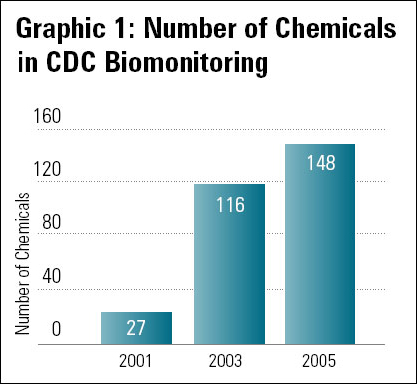
The U.S. Centers for Disease Control and Prevention conducts the most extensive biomonitoring program at present. Most recently, the agency released its Third National Report on Human Exposure to Environmental Chemicals, which includes the results of testing for 148 chemicals* in blood and urine samples from 5,000 people selected randomly nationwide.[6] As Graphic 1 indicates, the number of chemicals included in the CDC’s biennial testing, which began in March 2001, has increased dramatically.[7]
The CDC selects chemicals for analysis from among hundreds nominated by scientists and the general public. The factors considered in the selection include:
The potential for human exposure to the chemical.
The seriousness of health effects from exposure.
An adequate number of people whose blood and urine samples could be tested for the target chemical.
The availability of testing methods with adequate performance and acceptable costs.
The CDC analyses demonstrate how biomonitoring data can inform environmental and public health policy. The data reveal a significant decline in the blood concentrations of many chemicals, indicating the benefits of new technologies that reduce or eliminate emissions and discharges of chemicals, and the success of other pollution prevention efforts. Among the declines noted in the CDC’s latest exposure report:
Only 1.6 percent of children ages 1-5 had “elevated” blood levels of lead, down from 88.2 percent between 1976 and 1980.
From 1988 to 2002, the median levels of cotinine, a marker of “second-hand smoke,” decreased 68 percent for children, 69 percent for adolescents and 75 percent for adults.
There are now undetectable or very low levels of the pesticides Aldrin, Endrin and Dieldrin — all of which have been discontinued in the United States.
All women of childbearing age had mercury levels below the concentration associated with neurological effects in a fetus.
Other federal agencies involved in biomonitoring include the National Institutes of Health, the U.S. Environmental Protection Agency, the Agency for Toxic Substances and Disease Registry, and the National Institute of Environmental Health Sciences.
Biomonitoring capabilities are not widely available in most commercial laboratories, nor does the CDC perform laboratory tests at the request of individuals. A physician may be able to test blood or urine for lead, mercury and a few other chemicals that have known health consequences. If necessary, doctors can refer patients for further evaluation to a toxicologist or a physician who specializes in occupational and environmental medicine.
California established the nation’s first state biomonitoring program when Gov. Arnold Schwarzenegger signed Senate Bill 1379 on Sept. 29, 2006. The California Environmental Contaminant Biomonitoring Program will screen 2,000 volunteers every two years for a variety of compounds and in the future conduct smaller, community-based studies.
In 2001, the CDC began distributing $10 million in grants to 25 states and regional groups for planning biomonitoring programs. The Michigan Department of Community Health was among the recipients. In 2003, Gov. Jennifer Granholm requested the state’s Environmental Science Board to evaluate the scientific validity of the compounds targeted for testing in the state’s draft biomonitoring plan. Among its findings, the board concluded: “As currently written, the Draft Report does not provide a credible source of rationales for including or excluding many of the identified toxic substances for biomonitoring. In addition, most of the discussions presented are lacking in rigor, clarity, and coherence.”[8] In response to the evaluation, the Department of Community Health declined to pursue the establishment of a biomonitoring program.
* The 148 chemicals are grouped into the following categories: metals; cotinine; polycyclic aromatic hydrocarbons; dioxins; furans; polychlorinated biphenyls; phthalates; phytoestrogens; organochlorine pesticides; organophosphate pesticides; herbicides; pyrethroid insecticides; other pesticides; and carbamate insecticides.
Current environmental and public health regulations are largely based on a theoretical calculation of risk associated with human exposure to chemicals in air emissions, water discharges, soil contamination and consumer products. That is, risks of exposures are based on the concentrations of chemicals in the environment, rather than actually in our bodies. Biomonitoring offers the opportunity to analyze the relationship between chemicals in the environment and actual bodily uptake.
Most regulations rely heavily on animal research to estimate potential human health effects. Such studies typically involve exposing rats and mice to chemicals at constant levels every day (often for a lifetime and at concentrations that are substantially above real-world exposures). But the relationship between the level of exposure to a chemical and the amount that ends up in fluids and tissues is complex; to extrapolate from animals to humans is even more so. As noted by Michael Kamrin, a professor emeritus of toxicology at Michigan State University, “[U]nless adequate toxicokinetics* data are available, it is very difficult to compare the dietary levels used in laboratory experiments to fluid and/ or tissue levels measured in biomonitoring studies.”[9] Thus, toxicologists are taking steps to better understand how chemical exposures equate to blood or tissue concentrations, which will help to make biomonitoring data more meaningful.
Biomonitoring involves measuring actual levels of exposure within the body, which can help to make risk assessments far more accurate. In the case of phthalates,† for example, the CDC’s biomonitoring is helping researchers differentiate among the various sources of exposure and determine how environmental exposures translate into actual body concentrations. As noted by Dr. James Pirkle, deputy director for science at the CDC’s National Center for Environmental Health: “[I]t has helped us clarify some understanding about the relative exposure that are, say, in cosmetics and personal care products compared to, say, phthalates that are in soft vinyl plastic products like in toys or in vinyl tubing or things like this. … [T]here is much greater detail … separating out those different kinds of sources and how those sources relate to different levels in people.”[10]
* Toxicokinetics is the study of the relationship between exposure to a chemical compound and the compound’s toxicity. Toxicokinetics data are not available for many chemical compounds.
† Phthalates are a family of chemical substances with a variety of applications, but they are commonly used to make vinyl soft and flexible.
Useful as biomonitoring can be, there remain significant challenges to improving its utility. Largely missing are precise assessments of risk that are necessary to determine the health consequences of exposures. In other words, biomonitoring reveals the amount of a chemical in an individual’s body, but such knowledge is largely meaningless unless we know at what level in body fluids or tissues health consequences do and don’t occur. As noted by Dr. David Galbraith in his 2005 presentation to the International Society of Regulatory Toxicology and Pharmacology: “Our vastly improved abilities to detect have often outstripped our abilities to detect meaning.[11]
Biomonitoring can improve risk assessments by enabling researchers to couple direct observations of physical symptoms or effects with measurements of chemical uptake. But establishing the correct relationship is no easy task.* Biomonitoring data only reflect the amount of a chemical in the body at the time of testing, which may differ from the original exposure. “One sample reading could represent exposure from yesterday, last week, or 30 years ago,” Dr. Galbraith has observed.[12]
Moreover, health consequences, if any, may result either from the original exposure or from the presence of the compound in the body over time. Nor is the source of exposure always apparent, further complicating the interpretation of biomonitoring results.[13]
Uncertainties also arise when exposure measurements approach the minimum levels that can be detected, or when the test for detecting a particular chemical is complex or unproven. Chemical levels may also vary depending on the type of tissue or body fluid tested. In addition, there may be questions about which form of a compound (or combination of forms) is most appropriate to measure.
These challenges were recently documented by a committee of the National Academy of Sciences, which concluded that, “The ability to generate new biomonitoring data often exceeds the ability to evaluate whether and how a chemical measured in an individual or population may cause a health risk or to evaluate its sources and pathways for exposure.”[14] The NAS committee’s findings and recommendations are summarized in Graphic 2.
Graphic 2: Summary of NAS Conclusions
| Finding | Recommendations |
| There has not been a coordinated or consistent strategy for selecting chemicals for testing. | Set priorities for biomonitoring based on health risk and the potential for exposure. |
| The ability to detect chemicals has outpaced the ability to interpret health risks accurately. | Undertake epidemiologic and toxicological exposure assessments for use in biomonitoring. |
| The results of biomonitoring are not communicated appropriately or effectively to the public. | Create strategies for reporting biomonitoring results in an accurate and objective manner. |
| Biomonitoring studies present ethical issues related to informed consent, the interpretation and communication of results, and follow-up with subjects. | Biomonitoring studies must consider ethics and individuals’ rights in the development, implementation and reporting of results. |
* Many regulations are based on risk assessments calculated from workplace exposures. However, workplace studies often suffer methodological flaws.
The importance of accurate interpretation and reporting of biomonitoring data cannot be overstated. Erroneous information too often taints public policy debates, resulting in costly and even deadly consequences. The United States’ ban on DDT, for example, was based on faulty assumptions about the risks of exposure; whether any lives were saved is questionable. But the ban did reduce the availability of the pesticide overseas, thereby increasing deaths from malaria and West Nile Virus by millions.[15] Similarly, safe genetically modified foods are being withheld from starvation-plagued Africa as a “precautionary” measure.
Such tragedies occur, in part, as a result of the public’s inadequate understanding of science: The National Science Foundation found that less than one-fifth of the U.S. population meets a minimal standard of scientific literacy. Compounding the problem is the tendency of mass media to sensationalize stories by legitimizing unproven notions of risk. Reporters often misinterpret research findings and fail to explore significant uncertainties and limitations in the data. Consider the following examples of “studies” that erroneously suggest the mere presence of even low concentrations of chemicals constitutes a public health hazard:
A California-based group called Commonweal garnered headlines and calls for more stringent chemical regulations following release of a biomonitoring “study” documenting “chemicals … turning up inside the human body.”[16] The group had measured the levels of 25 chemicals in only 11 people, but still made much of the fact that the testing found “measurable levels” of several compounds.[17] As noted earlier, the mere existence of a chemical in body fluids or tissues does not correspond to a health risk.
An environmental advocacy group reported its “findings” that common chemicals were detected in the blood of the umbilical cords of a handful of newborns. Chicago Tribune columnist Judy Deardorff fretted in print about her unborn baby “stewing in toxins.”[18] But the purported study did not indicate that the levels of chemicals detected posed any risk to either baby or mother, nor was the sample of test subjects of adequate size to generalize about the findings.
Concern spread among nursing mothers following a report claiming that flame retardants are becoming more common than PCBs in breast milk. But the simple presence of a chemical, even one used in fireproofing, does not necessarily indicate a harmful effect on human health. Moreover, the research, which was conducted by the Sightline Institute (formerly Northwest Environment Watch), involved only 40 women — a number that is not a representative sample of the population.[19]
Each of the “studies” cited above presumed erroneously that the mere presence of chemicals in the human body constitutes a potential health hazard, a presumption based primarily on tests in which animals were subjected to far greater chemical exposures. Such alarmist interpretations can have broad societal impact when they unnecessarily frighten people and provoke calls for unwarranted — and costly — government action. To the extent attention and resources are diverted to phantom risks, the nation’s financial and intellectual resources are less available for genuine threats to public health. Moreover, wasted economic resources reduce our collective wealth, which is precisely what defines the difference between environmental well-being and ruin. Underdeveloped nations tend to be the most polluted and sickly.
There are numerous opportunities for the use of biomonitoring. Well-designed and properly conducted studies can enable scientists and medical professionals to identify and understand exposure trends and any associative or causal effects of disease.
However, biomonitoring data can be detrimental if misinterpreted and sensationalized. It is essential that biomonitoring data be placed in proper context and that specialists in key scientific disciplines like toxicology and pharmacokinetics participate in interpreting the results. Through adoption of a scientific, objective and inclusive approach, the utility of biomonitoring can be maximized for the benefit of public health and the environment. The following recommendations are intended to fulfill that goal:
Government biomonitoring programs should be prioritized by genuine health risks and potential exposures. This would help to ensure that public resources are deployed in the most productive manner.
All government biomonitoring programs should undergo nongovernmental peer review prior to implementation. This would help to ensure the integrity of the research.
Government biomonitoring programs should be conducted in consultation with qualified scientists in the private sector. Such oversight may help protect research from political manipulation.
Greater research is necessary to understand the interplay between exposure and health effects. The proper interpretation of biomonitoring data requires epidemiologic and toxicologic assessments.
Biomonitoring should not be commissioned for the specific purpose of advancing a particular policy. Doing so would undermine the credibility of biomonitoring in general.
Because biomonitoring can be easily misunderstood by the public and policymakers, it is incumbent upon researchers to ensure their methodologies are closely aligned with their specific research questions and any intended use of the biomonitoring data. The costs to human health and well-being can be particularly high when biomonitoring studies are not carefully designed.
Biomonitoring data should be released only within proper scientific context — that is, accompanied by disclosure of the research methodology; discussion of the findings’ relation to the larger body of scientific understanding; and with complete protection of the privacy of the test subjects.
Dr. Daland R. Juberg is a toxicologist and environmental health scientist with Dow AgroSciences. In addition to his current responsibilities, which involve regulatory and industrial toxicology, Dr. Juberg has served as a consultant to the International Center for Toxicology and Medicine and the Environmental Control Technology Corporation. He has participated in environmental health issues at the state and federal levels, and he is involved in numerous science outreach activities that aim to increase the scientific underpinning of public policy in matters involving environmental and children’s health. He received his doctorate in toxicology in 1992 and his master’s degree in environmental health sciences in 1987 from the University of Michigan.
Dr. James Bus is director of external technology at The Dow Chemical Co. and an adjunct professor of pharmacology and toxicology at Michigan State University. Dr. Bus served as president of the Society of Toxicology in 1996-1997 and as president of the American Board of Toxicology in 1986-1987. He is a current member of the U.S. Environmental Protection Agency Chartered Science Advisory Board, the Science Advisory Board of the U.S. Food and Drug Administration National Center for Toxicological Research, and the National Academy of Sciences Board of Environmental Sciences and Toxicology. Dr. Bus received his doctorate in pharmacology from Michigan State University in 1975. He has authored or co-authored more than 100 research papers, reviews and books.
Diane S. Katz is director of science, environment and technology policy for the Mackinac Center for Public Policy. As SET director, Ms. Katz has initiated a variety of major policy research projects, authored more than 100 commentaries and hosted numerous forums. Her reports have been published by policy groups in California, Florida, Indiana, Ohio, Tennessee, Texas and Wisconsin, and her opinion pieces have appeared in The Wall Street Journal, The Washington Times, National Review, Reason and The Weekly Standard. Before joining the Mackinac Center, Ms. Katz was a member of The Detroit News editorial board, where she won numerous awards, including top honors from the Michigan Press Association in 1994, 1996, 1997 and 1998.
1 Michael A. Kamrin, "Biomonitoring Basics," (Environmental Health Research Foundation 2004), http://biomonitoringinfo.org/images/What_is_Biomonitoring.pdf (accessed January 3, 2008).
2 David A. Galbraith, "Human Biomonitoring: An Overview (ISRTP Workshop)," (ChemRisk, 2005), 6, www.isrtp.org/nonmembers/Human%20Biomonitoring%206-05/Galbraith%20Biomon.pdf (accessed January 3, 2008).
3 Dennis Paustenbach and David Galbraith, "Biomonitoring: Measuring Levels of Chemicals in People – and What the Results Mean," (American Council on Science and Health, 2005), 4, www.acsh.org/docLib/20050721_biomonitoring.pdf (accessed January 3, 2008).
4 "Telebriefing Transcript: Third National Report on Human Exposure to Environmental Chemicals, July 21, 2005," Centers for Disease Control and Prevention, www.cdc.gov/od/oc/media/transcripts/t050721.htm (accessed January 3, 2008).
5 Paustenbach and Galbraith, "Biomonitoring: Measuring Levels of Chemicals in People – and What the Results Mean," 2.
6 "Frequently Asked Questions: CDC’s Third National Report on Human Exposure to Environmental Chemicals," Centers for Disease Control and Prevention, www.cdc.gov/exposurereport/pdf/faq.pdf (accessed January 4, 2008).
7 Ibid.
8 Raymond Y. Demers et al., "Critical Review of a Proposed List of Toxic Substances to Biomonitor in Michigan Residents," (Michigan Environmental Science Board, 2003), vii, www.michigan.gov/documents/MESB_Biomonitoring_Report_69163_7.pdf (accessed January 4, 2008).
9 Kamrin, "Biomonitoring Basics," 8.
10 "Telebriefing Transcript: Third National Report on Human Exposure to Environmental Chemicals, July 21, 2005."
11 Galbraith, "Human Biomonitoring: An Overview (ISRTP Workshop)," 27.
12 Ibid. 26.
13 Matt Shipman, "New Model Sought to ‘Translate’ Biomonitoring Data into EPA Risk Levels," Inside EPA, December 12, 2006.
14 National Research Council Committee on Human Biomonitoring for Environmental Toxicants, "Human Biomonitoring for Environmental Chemicals " (The National Academies Press, 2006), 2, http://books.nap.edu/openbook.php?record_id=11700&page=2.
15 See, for instance, Todd Seavey, "The DDT Ban Turns 30 — Millions Dead of Malaria Because of Ban, More Deaths Likely," (American Council on Science and Health, 2002), www.acsh.org/healthissues/newsID.442/healthissue_detail.asp (accessed January 4, 2008).
16 Mark Prado, "Study: Toxins from Bottles Found in Body," Marin Independent Journal, August 30, 2005.
17 "Taking It All in — Documenting Chemical Pollution in Californians Through Biomonitoring" (Commonweal Biomonitoring Resource Center, 2005), www.commonweal.org/programs/download/TIAI_1205.pdf.
18 Julie Deardorff, "Please Don’t Tell Me a Prepolluted Baby Is Just Fine," Chicago Tribune, August 7, 2005.
19 "Flame Retardants in the Bodies of Pacific Northwest Residents" (Northwest Environment Watch, 2004), www.sightline.org/research/pollution/res_pubs/pbde-nw-report/PBDEs_in_NW.pdf, (accessed January 7, 2008).