Michigan is a state rich in natural beauty and resources, skilled laborers and entrepreneurial capability, but our future potential is being frittered away by political leaders who cannot muster the courage to fix the fundamentals.
Poor policy and snake-oil remedies have come to define Lansing these days as our state’s economy languishes. Rising taxes and government spending are about to take a bigger bite out of a shrinking private sector. Regulatory agencies that seem to lack adult supervision are choking growth. A pervasive entitlement mentality deters the transformational thinking that the state desperately needs. Politicians call for more money for universities even though students are staying in Michigan for the education but leaving for the jobs.
Relative to other states, Michigan’s per capita income has been in freefall since 2000 and now stands at an astonishing 7.8 percent below the national average — unprecedented since the Great Depression. If recent income trends continue, Michigan will be poorer than Alabama during our next governor’s first term. Outbound migration is now almost as high as it was during the painful 1982 recession.
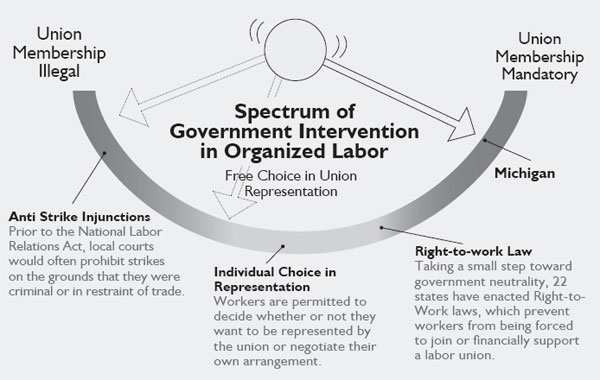
It’s time to fix one of the most important fundamentals of them all, our labor climate. The state’s expensive ads featuring actor Jeff Daniels are no match for the ubiquitous perception around the country that compulsory unionism makes Michigan undesirable for business location. Perhaps nothing we could do would more effectively erase that harmful image and help jumpstart our economy than for Michigan to endorse worker freedom of choice through voluntary unionism.
Twenty-two states never compel union fees or membership as a condition of employment. A 2007 study by Paul Kersey, director of labor policy for the Mackinac Center, reveals some startling numbers about how Michigan compares with them. Between 2001 and 2006, gross state product in those states grew by an average of 18.1 percent, compared to Michigan’s paltry 3.4 percent, the slowest of all 50 states.
During the same five-year period, employment declined in Michigan by 4.8 percent while it grew in the voluntary union states by 6.4 percent. By any meaningful measure of jobs and income, growth in voluntary union states far exceeds all other states and especially Michigan. Adjust for bonuses and the cost of living and even many non-union auto workers in places like Tennessee are earning more and have more job security than unionized auto workers here.
Employee freedom of choice does not mean unions are forbidden. It simply means they must earn the willing approval of workers. The leadership of organized labor protests that this burdens them with representing "free riders" who opt not to pay dues, but that’s a "burden" they lobby in Washington to keep. Besides, unions are not an unqualified benefit that workers should be forced to pay for, particularly if union policies price some workers out of their jobs or contribute to a business climate that drives employers away.
Fixing the labor climate by adopting freedom of choice is not an option in the current Legislature, which will not even seriously consider repealing the state’s costly union subsidy called the Prevailing Wage Act. Gov. Jennifer Granholm has shown utterly no leadership on such issues. The state’s public sector unions flexed their considerable muscle in Lansing by blocking spending cuts and pushing for job-killing tax hikes in the recent budget debate. If unionism is to be made voluntary in Michigan in the foreseeable future, it must happen by voter initiative through a ballot measure.
Ultimately, voluntary unionism is not anti-union. It is decisively pro-worker. It encourages unions to be more accountable and responsible. Not only does it yield a healthier economy, which benefits all of us including schools and governments, it gives workers options and opportunities they don’t have in a compulsory environment.
If anyone thinks that what Lansing did in 2007 will make Michigan a magnet for jobs and enterprise, they are sadly mistaken. It’s time to consider what’s proven effective in states that compete with us. The evidence is overwhelming that freedom of choice in the labor market sends an unmistakable message that a state is open for business.
#####
Lawrence W. Reed is president of the Mackinac Center for Public Policy, a research and educational institute headquartered in Midland, Mich. Permission to reprint in whole or in part is hereby granted, provided that the author and the Center are properly cited.

The Mackinac Center for Public Policy is a nonprofit research and educational institute that advances the principles of free markets and limited government. Through our research and education programs, we challenge government overreach and advocate for a free-market approach to public policy that frees people to realize their potential and dreams.
Please consider contributing to our work to advance a freer and more prosperous state.


