

 Font size:
Many states have given workers complete discretion to decline membership in, and financial support of, a union that they individually oppose. Enacting a right-to-work law abolishes agency fees and allows workers themselves to decide if a union deserves their financial support.
This paper is an update to Dr. William T. Wilson’s 2002 study, "The Effect of Right to Work Laws on Economic Development."
In that report, Wilson compared right-to-work and non-right-to-work states on basic measurements of economic performance, such as gross state product growth, job creation and per-capita disposable income between 1970 and 2000. Wilson found that right-to-work states had significant advantages in economic growth and job creation. While incomes were still somewhat lower in right-to-work states, incomes were also growing faster in those states. Michigan, on nearly every economic measurement, had lagged behind.
This paper picks up where Wilson’s study left off, tracking the same measurements from 2001 to 2006. We find that little has changed — if anything the apparent advantages of right-to-work states have grown larger. The economies of right-to-work states grew by an average of 3.4 percent compared to 2.6 percent for non-right-to-work states and 0.7 percent for Michigan. Jobs grew by 1.2 percent annually in right-to-work states, compared to 0.6 percent for non-right-to-work states, while jobs decreased by an average of 0.8 percent in Michigan.
Meanwhile, the gap in per-capita disposable income continues to shrink, to the point where most right-to-work states are likely to have higher incomes than Michigan does within just a few years.
On several measurements, the trends between 2001 and 2006 were more favorable towards right-to-work states than they had been in the period covered by Wilson’s earlier study. In light of Michigan’s current economic difficulties, this leads to the conclusion that the case for making Michigan a right-to-work state has only become stronger.
In 2002, the Mackinac Center for Public Policy published a study written by former Comerica economist Dr. William T. Wilson titled "The Effect of Right-to-Work Laws on Economic Development." This study compared states that had enacted right-to-work laws and those that had not using common measurements such as gross state product, job creation, per-capita income and poverty rates. It was found that states with right-to-work laws had outperformed the other states in nearly every category, and that Michigan in particular had lagged behind.
Five years have passed, and the state has entered a condition of steady economic stagnation. Michigan-based automobile manufacturers have continued to lose market share, Michigan’s largest bank has moved its headquarters out of state, families have left the state to pursue opportunities elsewhere and political leaders wrestle with the consequences of a shrinking economy and declining tax revenues.
With little grounds for belief that these trends will reverse on their own, Michigan’s residents are increasingly open to fundamental changes in policy that will make the state more attractive to entrepreneurs, who are the real creators of wealth and jobs. One possible way to attract new investment and business into the state would be to enact a right-to-work law.
This report will pick up where the 2002 study left off, updating fundamental measurements of economic health and assessing whether the advantages held by right-to-work states in 2002 remain in place in 2007.
The basic concept of a right-to-work law is simple: workers should not be obligated to join or give support to a union as a condition of employment. Under federal law, workers have both the right to join unions and the right to refrain from union membership, and while a union contract will cover all employees within a given bargaining unit, individual workers are free to join or not join the union at their discretion.
But while a strict "union shop" contract, in which all workers covered by a collective bargaining agreement must formally join the union, is prohibited, federal law does allow something similar: the agency shop, in which covered workers who opt not to join the union must pay an agency fee, which generally is equal to the regular union dues paid by full union members.
The agency fee does not render the right to refrain from joining a union into a total dead letter. A worker who does not join the union is free from legal union sanctions if he chooses not to take part in a strike, and he can also invoke rights affirmed under the Supreme Court’s Beck decision to reduce his agency fee. In theory, his union dues should be limited to a pro rata share of the costs of collective negotiations and contract administration, including the processing of grievances. In practice, Beck rights have proved difficult to enforce — but the remedy is there and offers some relief from supporting union political and social activities that workers often oppose.
Many states have given workers complete discretion to decline membership in, and financial support of, a union that they individually oppose. Enacting a right-to-work law abolishes agency fees and allows workers themselves to decide if a union deserves their financial support.
This policy has much to recommend it from the perspective of workers themselves. While union officials argue that right-to-work laws allow for "free riders" to enjoy the benefits of union representation without shouldering the costs, this argument is based on the presumption that all workers gain equally under collective bargaining agreements. Unions have the potential to be of great value to workers as a representative in contract negotiations, as an advocate in grievances and, if necessary, as a means for united action such as strikes. But it is irresponsible for the law to assume that every union contract creates benefits for every worker it covers: an inept union may agree to terms that are not advantageous for its members and a corrupted union might sell its members short as part of a "sweetheart contract." Union officials may capriciously decide to favor the interests of one group of workers over another for entirely personal reasons. Even a capable and conscientious union negotiator may need to choose between competing interests among the rank-and-file.
Union officials are not infallible. Given the responsibility that they have as worker representatives, the lines of accountability between union and workers should be as firm as possible. Right-to-work laws strengthen accountability by giving dissatisfied members the option of withdrawing all financial support from a union that they believe is not serving their purposes. In the process, it creates incentives for union officials to pay attention to the interests of all members. This, in turn, reduces the temptation for unions to seek to use their position as worker representatives to influence day-to-day operations in ways that benefit only a handful of members. As a consequence, labor is more productive and more attractive to employers. In turn, higher labor productivity drives up the demand for labor in right-to-work states, increasing both wages and the number of jobs available.
In his 2002 study, Wilson found compelling evidence that right-to-work laws also improved state economic conditions across the board. In particular, between 1970 and 2000:
The economies of right-to-work states grew faster. Between 1977 and 1999 the average right-to-work state’s gross state product grew by 3.4 percent annually, compared to 2.9 percent in non-right-to-work states. Michigan’s economy grew by 1.8 percent during that period.
Between 1970 and 2000 overall employment increased by 2.9 percent annually in right-to-work states versus 2.0 percent for non-right-to-work states. Job growth in Michigan was barely half that of right-to-work states at 1.5 percent. Manufacturing employment grew by 1.5 percent annually in right-to-work states but declined by 0.2 percent in non-right-to-work states during that same period.
The unemployment rate between 1978 and 2000 averaged 5.8 percent in right-to-work states versus 6.3 in non-right-to-work states, while Michigan’s unemployment rate averaged 8.1 percent.
Per-capita disposable income was higher in non-right-to-work states than in right-to-work states, but between 1970 and 2000 per-capita disposable income was rising faster in states with right-to-work laws, by 0.2 percent annually.
From 1969 to 2000 the poverty rate in right–to-work states decreased by 6.7 percent, but in non-right-to-work states poverty decreased by only 2.0 percent. In Michigan the percentage of people living in poverty as defined by the Census Bureau increased by 0.6 percent during that same period.
Wilson also observed that unit labor costs — the cost of labor associated with a unit of output — were lower in right-to-work states than in non-right-to-work states, making labor a better overall value in right-to-work states, which, in turn, become more attractive places for businesses to locate. Michigan’s per-unit labor costs were among the highest in the country, second only to New Jersey’s.[1]
Wilson’s study found that right-to-work states outperformed non-right-to-work states in every important economic category. Michigan in particular had performed poorly, placing in the bottom fifth for most of the preceding 30 years in economic growth, job creation, unit labor costs and change in the poverty rate. While the 1990s were a relative bright spot for Michigan, the growth of the state’s overall economy, job creation and income were still little better than average. Wilson expressed particular concern about the state’s high labor costs and their implications for the state’s future: "As the forces of globalization and competition intensify, Michigan’s high unit labor costs will increasingly discourage fresh capital from planting new seeds."[2]
These words appear to have been prophetic, as Michigan has encountered a string of economic setbacks at a time when the rest of the United States is experiencing steady economic growth. The accelerated decline of Detroit’s automobile industry, evidenced by mass layoffs and buyout of employees at the main domestic auto manufacturers and the nettlesome Delphi bankruptcy, has generated constant headlines. At the same time, the state has largely failed to attract employers seeking to expand out of other states or to develop successful, growing firms from within.
The quickening erosion of jobs from the automotive industry, combined with the failure to attract new investment or develop new companies, has left the state with a declining tax base. In combination with structural flaws that make government services more expensive — binding arbitration of labor disputes involving public safety officers, an expensive public employee pension system and a severe prevailing wage law pegged strictly to union construction wages — this has led to a more or less constant budget crunch in Lansing and in many county and municipal governments.
This report will update Wilson’s work, focusing on the economic performance of right-to-work and non-right-to-work states over the five year period from 2001 to 2006. For the purposes of this report, Oklahoma, which passed a right-to-work law by referendum in 2001, will be treated as a right-to-work state unless otherwise noted.
For the most part, this paper will examine the same fundamental economic measurements of economic growth, employment, income and productivity as the Wilson study. It should be noted that this period opens at the beginning of a brief national recession occasioned by the terrorist attacks of September 2001 and also includes the aftermath of Hurricane Katrina in August 2005. As a consequence, growth rates in employment and wages are somewhat lower for all states than for the period measured by Wilson, which generally covers the period from 1970 to 2000. Because Katrina mainly affected the right-to-work states of Louisiana, Mississippi and Alabama, the data may actually understate the value of right-to-work laws. Nonetheless, these measurements will show that the case for a Michigan right-to-work law remains strong and, if anything, has become stronger.
By themselves these statistical measurements do not prove that right-to-work laws alone are responsible for dramatic economic improvement; correlation suggests causation, but the two are not the same. But at a minimum, it seems fair to conclude that right-to-work laws are not incompatible with a strong state economy, high growth in jobs, low unemployment and steady wage gains. And it is certainly logical to ask right-to-work critics what exactly does cause right-to-work states to outperform non-right-to-work states in so many measurements of economic health.
It is not our intention to make the right-to-work concept into a panacea, nor do we claim that right-to-work laws are an absolute necessity before Michigan’s economy can recover. There are a large number of public policies that can affect a state’s economy: high taxation levels, counterproductive government programs, state laws (such as the prevailing wage) that make necessary state activities needlessly expensive, and regulatory burdens that impede economic growth and limit employment. Michigan could probably become a leading state by reducing taxes and streamlining environmental rules, but in the absence of a right-to-work law, the fiscal and regulatory remedies would need to be more stringent. Passing right-to-work legislation is a step Michigan can take to make the state more attractive to employers and create jobs without complicating already difficult budget decisions or taking any environmental risks.
Real gross state product is the market value of all goods and services produced in a state over the course of a year, corrected to account for inflation. Real GSP is the most basic measurement of economic growth. Over the five-year period between 2001 and 2006, the average right-to-work state saw its gross state product grow by 18.1 percent, versus 13.6 percent for non-right-to-work states.[3] During that same period Michigan’s gross state product grew by only 3.4 percent, easily the slowest growth of any state in the union. Next-to-last West Virginia, another non-right-to-work state, managed GSP growth of 7.3 percent. The lowest performing right-to-work states were Louisiana and Mississippi, both of which were struck by Hurricane Katrina in August 2005, yet both outperformed Michigan, with real GSP growth of 9.2 and 9.5 percent respectively.[4]
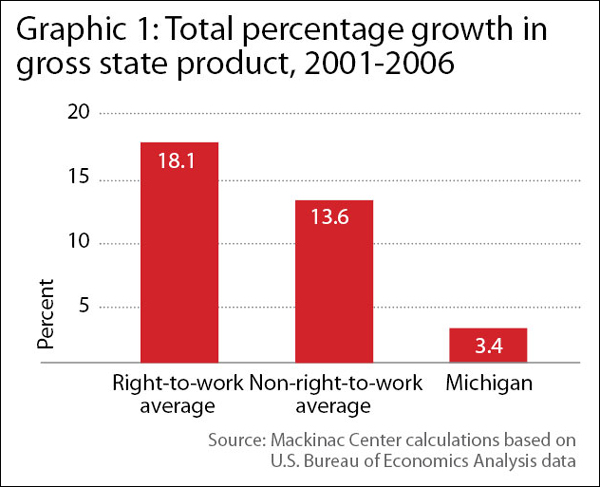
In the 2002 report, Wilson found that between 1977 and 1999 right-to-work states had an average annual (year-to-year, as opposed to cumulative) GSP growth rate of 3.4 percent, versus 2.9 percent for non-right-to-work and 1.8 percent for Michigan. This GSP growth gap of half a percent per year, while modest in appearance, had a significant impact when repeated over 30 years. That growth gap has gotten larger: between 2001 and 2006 annual GSP growth averaged 3.4 percent in right-to-work states, compared with 2.6 percent in non-right-to-work states, a difference of 0.8 percent. Michigan’s annual GSP growth during that same period was only 0.7 percent.
A growing state economy reflects the success of entrepreneurs in developing new businesses or expanding existing ones, creating opportunities for workers in the process. It should not come as a surprise, then, that right-to-work states, with their higher rates of overall growth, show a significant edge in creating jobs.
Between 1970 and 2000 employment grew by an average of 2.9 percent annually in right-to-work states, versus 2.0 percent in non-right-to-work states and 1.5 percent in Michigan. From 2001 to 2006 the rate of employment growth appeared to slow somewhat across the country, but right-to-work states still had a decided advantage, with average annual job growth of 1.2 percent compared to 0.6 percent for non-right-to-work states.[5]
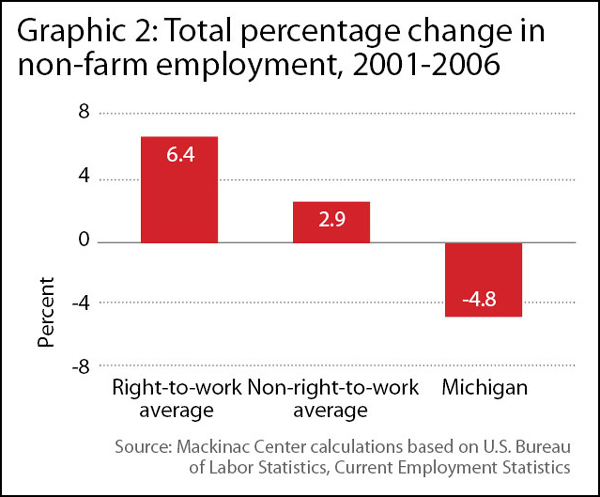
Over the full five-year period from 2001 to 2006, the average right-to-work state increased employment by 6.4 percent, while non-right-to-work states averaged 2.9 percent in job growth. Michigan saw employment decline by 4.8 percent — again, the worst performance in the nation — representing the loss of more than 220,000 jobs.[6] Only three other states lost jobs during this period, non-right-to-work Illinois and Ohio, and right-to-work Louisiana. Aside from Katrina-ravaged Louisiana, the right-to-work state with the worst job-creation record from 2001 to 2006 was Kansas, which managed to increase nonfarm employment by 0.4 percent. If Michigan had merely kept pace with Kansas during that period, the state would have had 238,000 more jobs than it did.[7]
Manufacturing has long been a mainstay of the Michigan economy and an important source of employment across the country. Over the last five years Michigan has lost a large number of manufacturing jobs, especially in the automobile sector. Michigan is far from alone in this; most states saw declines in manufacturing employment between 2001 and 2006. But right-to-work states saw much less severe losses in this area.
The trend away from manufacturing employment was already well underway five years ago; nationally, manufacturing employment reached its peak in 1979. Between 1990 and 2000 right-to-work states experienced an average increase of 1.0 percent annually in manufacturing employment, but non-right-to-work states saw annual declines in manufacturing payroll averaging 0.6 percent. Michigan, in the midst of a stretch of relative prosperity, gained manufacturing jobs by an average of 0.4 percent per year during that time, but had experienced losses in the 1980s.[8]
The tendency for non-right-to-work states to lose manufacturing jobs has become more pronounced over the last several years. Between 2001 and 2006 the typical right-to-work state saw manufacturing employment decline 1.5 percent annually, 7.1 percent overall. Non-right-to-work states, however, faced even sharper declines: averaging 3.0 percent annually and 13.7 percent over the five-year period. Every non-right-to-work state but one, Alaska, lost manufacturing jobs during that period, while five right-to-work states registered at least modest gains in this area.[9]
It will come as no surprise to most readers that Michigan’s record for manufacturing employment over the last five years is particularly disturbing: between 2001 and 2006 Michigan manufacturing employment declined an average of 4.6 percent per-year, or by a total of 20.9 percent over the whole five-year period.[10]

The decline in manufacturing employment is occurring nationwide and has been underway for nearly 30 years; large statewide gains in manufacturing employment are unlikely even with the best economic policies. But given Michigan’s status as one of the most heavily industrialized states in the union, with 14.9 of Michigan’s workforce in manufacturing compared to the national average of 10.2 percent, Michigan has a particular interest in preserving manufacturing employment as much as possible, an area where states with right-to-work laws appear to have a distinct advantage.[11]
Between 1970 and 2000 employment in construction grew nearly half again as fast in right-to-work states. This trend was particularly sharp in the 1990s as the average annual growth in construction jobs reached 4.4 percent in right-to-work states versus 2.5 percent in non-right-to-work states.[12]
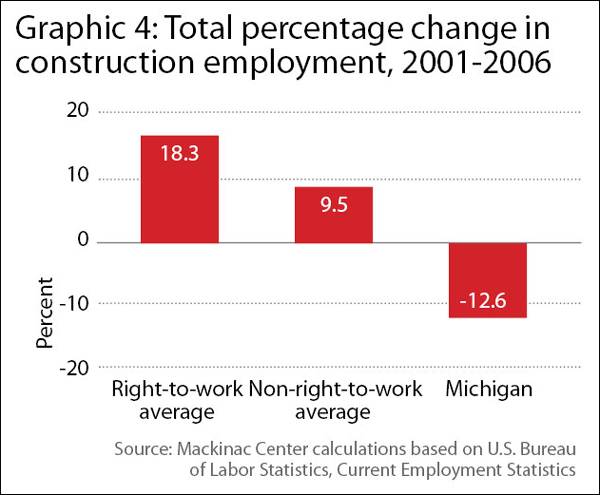
Since then, construction employment has slowed down somewhat, but right-to-work states continue to have a definite edge. Between 2001 and 2006 non-right-to-work states increased construction payrolls by an average of 1.7 percent per year or 9.5 percent for the five-year period. Right-to-work states increased their construction payrolls by 3.3 percent per year, which translates into 18.3 percent for the entire period, nearly double the growth rate of non-right-to-work states.[13]
Four states, all non-right-to-work, experienced declines. Michigan saw the sharpest decline, losing 12.6 percent of its construction payroll over the five-year period, an average of 2.7 percent decline per year.[14]
While Wilson’s 2002 study did not address employment in the services sector, this is a growing area of the economy that is expected to provide the vast majority of new jobs for the foreseeable future. According to Bureau of Labor Statistics projections, 18.7 million out of 18.9 million new jobs created between 2004 and 2014 will be in the service sector.[15] If Michigan is to replace jobs lost from the retrenchment of automakers, the new jobs are far more likely to be found in services than in manufacturing. Sometimes derided as "burger-flipping," the services sector also includes well-compensated careers in health care, education, law, consulting, architecture and technology.[16]
Job creation in the service sector has also favored right-to-work states for some time. Between 1990 and 2000, right-to work states added service-sector jobs at an average rate of 5.8 percent per year, while non-right-to-work states did so at a respectable — but not quite as rapid — rate of 4.1 percent per year.[17]
While job creation has slowed somewhat since then, right-to-work states have retained their advantage. Between 2001 and 2006, right-to work states increased service-sector payrolls by 7.5 percent, or a little more than 1.4 percent per year. That was more than half again the rate of non-right-to-work states, which on average increased service-sector employment by 4.7 percent over the five-year period, or 0.9 percent per year.[18]
Michigan’s performance, again, was among the worst in the nation; from 2001 to 2006 Michigan lost 0.6 percent of its service-sector payroll, an average annual decline of 0.1 percent.[19] Only Louisiana, struck by Hurricane Katrina in 2005, fared worse. Because service-sector jobs in particular tend to focus on interactions with customers, the effects of Hurricane Katrina and the subsequent evacuation of New Orleans are likely to be particularly acute and, consequently, Louisiana’s poor performance in creating service-sector jobs should be considered an anomaly.

With slower job growth — and sharp job losses in manufacturing — one naturally would expect to see higher unemployment rates in non-right-to-work states. This held true between 1978 and 2000: right-to-work states had an average unemployment rate of 5.8 percent versus 6.3 for non-right-to-work states. Michigan, in spite of its relative prosperity during the 1990s, had a poor record for unemployment for the period, with an average unemployment rate of 8.1 percent.[20]
Unemployment rates were lower overall from 2001 to 2006, and the gaps between right-to-work and non-right-to-work states (including Michigan) tightened somewhat, but right-to-work states still tended to have lower rates of unemployment: 4.8 percent for right-to-work states, 5.1 percent for non-right-to-work states and 6.5 percent for Michigan.[21]
The unemployment rate for Michigan may understate the difficulty that Michigan workers have in finding jobs. From 2000 to 2006 the Census estimates that Michigan’s population grew by only 1.6 percent, while the national population grew by 6.4 percent.[22] Data compiled by United Van Lines, one of the nation’s largest movers, indicates that in 2006 Michigan was tied with North Dakota for the highest rate of outbound migration in the country, with nearly two families leaving the state for every family moving in. The families that move out will not show up in the state’s unemployment figures, but it is very likely that many of them are the families of Michigan workers who could not find jobs close to home.
A common argument against right-to-work is that by weakening unions, right-to-work laws drive down compensation. In 2002, Wilson observed that right-to-work opponents "have often acknowledged the faster employment growth in right-to-work states, but counter that it comes at the expense of much lower wages and incomes. Organized labor’s mantra, the ‘right-to-work for less’ or the ‘right-to-starve’ has resonated strongly both inside and outside union circles."[23] This rhetorical flourish had some basis in fact: Wilson found that per-capita disposable income, essentially income after taxes, was approximately $2,850 lower in states without right-to-work laws.[24]
Wilson argued that other factors related to compensation swung the advantage back to right-to-work supporters on the question of compensation. Several studies had found that non-right-to-work states tended to have higher costs of living, and that after accounting for this, compensation was actually higher in right-to-work states. Wilson also found that per-capita disposable income was growing a bit more quickly in right-to-work states; between 1970 and 2001 the average annual per-capita income growth in right-to-work states was 6.8 percent, compared with 6.6 percent in non-right-to-work states. (Michigan also averaged 6.6 percent.)
Further research by University of Oklahoma economist W. Robert Reed has suggested that much of the gap in income favoring non-right-to-work states was due to the fact that many right-to-work states had been relatively poor prior to enacting right-to-work legislation. After accounting for economic conditions prior to enactment, Reed found that a significant, positive impact was associated with right-to-work.[25]
Since Wilson’s paper was released, the difference in wage growth appears to have widened slightly: Per-capita disposable income increased by an average of 4.3 percent per year in right-to-work states, compared to 3.9 percent per year in non-right-to-work states between 2001 and 2006, a difference of 0.4 percentage points. Per-capital disposable income grew more slowly in Michigan, averaging 3.0 percent per year. Only one right-to-work state, Georgia, had slower per-capita disposable income growth than Michigan during this period.
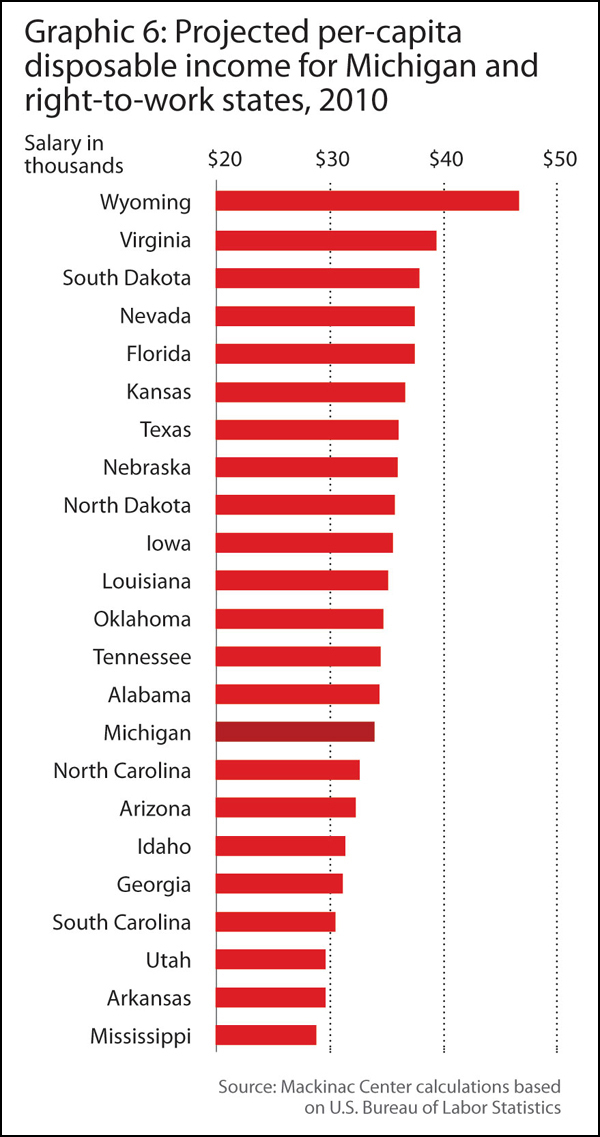
These seemingly small changes have potentially dramatic ramifications: if the trend of the last five years continues, it is simply a matter of time before right-to-work states offer not only more jobs, but better paying jobs, than Michigan. The per-capita disposable income gap between Michigan and the average right-to-work state has already declined considerably, from $2,300 in 2001 to less than $1,000 in 2006.
As far back as 2001, three right-to work states, Nevada, Virginia and Wyoming, already had higher per-capita disposable income than Michigan.[26] Between 2001 and 2006, five more right-to-work states(Florida, Kansas, Nebraska, South Dakota and Texas) overtook Michigan. Assuming current trends hold, six more right-to-work states are poised to feature higher disposable income by 2010: Alabama, Iowa, Louisiana, North Dakota, Oklahoma and Tennessee. At this point, a majority of "right-to-work for less" states will exceed Michigan in per-capita disposable income.[27]
Looking further into the future, every right-to-work state except Georgia will overtake Michigan by 2036 if the trend of the last five years holds. This projection should be taken with a grain of salt; much can and will change between now and 2036. But the exercise does illustrate one final, important point about the gap in wages between right-to-work and non-right-to-work states: the gap is real but it is not so large that it cannot be overcome, in the lifetime of many working Michiganians, by states with the sort of advantage in economic development that right-to-work appears to offer.
Poverty rates are measured by determining the number of people living in households with an income below a defined amount, called the poverty line, which is adjusted for family size. In his earlier study, Bill Wilson found that right-to-work states had historically been burdened by high poverty rates, but also found that they had great success in diminishing poverty. Between 1969 and 2000 poverty rates had dropped by 6.7 percent on average in right-to-work states, compared with a reduction of 2.0 percent in non-right-to-work states.[28]
During the 2001-2005 period, rates of poverty increased somewhat on account of a recession that affected both right-to-work and non-right-to-work states.* Right-to-work states still had higher poverty rates on average than non-right-to-work states, although the gap between the two did close slightly. For right-to-work states, poverty rates increased from an average of 12.9 in 2000 to 14.0 percent in 2006, an increase of 1.1 percentage points. In non-right-to-work states, the average poverty rate moved from 10.9 percent to 12.1 percent, an increase of 1.2 percentage points. While right-to-work states tend to have higher rates of poverty, the gap has been narrowing for 30 years and that narrowing continued over the past five years.†
Michigan, meanwhile, saw its rate of poverty increase sharply, with the number of Michiganians living in poverty jumping from 10.1 percent in 2000 to 13.2 percent in 2005. According to the latest figures, Michigan has a higher poverty rate than nine right-to-work states.
The method for determining poverty has been heavily criticized for being simplistic and arbitrary. Generally there is no adjustment made for local costs of living, which as we showed is generally lower in right-to-work states, a tendency that could inflate poverty rates.[29] Also, the tendency to focus on a single year’s income can result in families with substantial savings from previous years being treated as poor. Even the process of determining an appropriate "poverty line" itself is somewhat subjective.[30] While the relative poverty rates of right-to-work and non-right-to-work states is worth considering, the arbitrariness of this measurement should lead citizens and policymakers to give this one particular statistic less weight than the measurements of economic growth, job creation, unemployment and income.
* 2005 is the last year for which poverty rates are available at the time this is written. Because of the years covered, Oklahoma, which enacted right-to-work in 2001, will be disregarded.
† Mackinac Center calculations based on data from the U.S. Census Bureau, American Community Survey (2006 figures not available at time of publication).
The last measurement of economic performance that this report will consider is arguably the most important for the long-term health of the state: the productivity of labor. For these purposes we use a measurement that reflects the cost of labor to employers, the unit labor cost index calculated by Moody’s Economy.com. This index reflects labor compensation relative to productivity for each state.[31]
This is not merely a measure of compensation per hour; consequently, lower costs do not necessarily translate into lower wages or less generous pension and health-care benefits. A high-wage state can be competitive in this measurement as long as labor produces enough output to justify the compensation.
In 2000, Michigan’s unit labor costs were among the highest in the nation, at 109.2. Only New Jersey had higher labor costs than Michigan. Overall the average labor cost index for right-to-work states was 4.9 points lower than for non-right-to-work states, meaning that labor was roughly 5 percent more productive in right-to-work states.[32]
By 2005, Michigan’s per-unit labor costs had improved somewhat, dropping to 105. But several other high-labor-cost states have also seen improvements in productivity; consequently the only two states with higher per-unit labor costs than Michigan are Massachusetts and Maryland. And the advantage held by right-to-work states has grown to an average of 6.4 points.[33]
While Michigan’s labor cost has been reduced somewhat, the state remains at a significant disadvantage in this area. Unit labor costs are arguably the single largest component in determining competitiveness. In calculating its state business cost index, Moody’s Economy.com will use labor costs as 75 percent of the overall index, more than all other factors combined.[34]
Michigan’s high labor costs have a severe effect on the state’s ability to attract and retain employers. A Mackinac Center review of applications for business tax relief that were submitted to the Michigan Economic Development Commission found that 66 percent of applicants listed the costs of employment in Michigan as a reason they were likely to locate or expand elsewhere. By comparison, only 40 percent mentioned taxes, 34 percent listed building costs and 31 percent described economic incentives given by other states.[35]
As communications and transportation become more advanced, the opportunities for businesses to reach new markets have expanded greatly, but at the same time so has the level of competition. In such an environment, it is essential that labor costs be in line with labor productivity. Michigan’s high per-unit labor costs are likely to remain a serious burden on the state’s economy, dragging down both job creation and wages. Addressing this problem does not mean reducing wages and benefits, but if high wages are to be preserved they must be matched by high output, high quality and workplace flexibility.
Right-to-work laws change the incentive structure for unions. Because a union in a right-to-work state must persuade individual workers to pay union dues, unions are more likely to focus on bread-and-butter issues of pay, benefits and working conditions that provide immediate benefits to workers, and less likely to negotiate complex agreements that enhance their control over the workplace — and unionized workers — at the cost of impeding productivity.[36]
As a consequence, unions in right-to-work states are less of a drain on productivity, but not at the expense of workers. The benefits for employers are obvious; in a right-to-work state employers receive more productivity for each employee compensation dollar.
For employees, the benefit of a right-to-work law may be less obvious, but flows inevitably from fundamental economics: higher labor productivity in right-to-work states results in more demand for labor, and as demand increases, more jobs are offered and the wages attached to those jobs go up. The basic economic record bears this out: both jobs and wages are increasing faster in right-to-work states, a win-win proposition for workers.
If anything the advantage of right-to-work status is growing: comparing the 30-year period from 1970 to 2000 that Wilson covered with the 2001-2006 period covered by this report, we find larger gaps in GSP growth and job creation, both in favor of right-to-work states. Disposable income remains lower in right-to-work states, but right to-work states had been "catching up" in this category prior to 2000. The process accelerated between 2001 and 2006 to the point where the typical right-to-work state will surpass Michigan in a few years.
For Michigan, a state undergoing a difficult economic transition, the enactment of right-to-work legislation would make the state’s workers more attractive to new employers, giving a boost to employment and wages at a time when both are sagging.
Michigan has a right to be proud of its past as a leader in providing workers with plentiful jobs at excellent wages, but its residents and political leaders must recognize that policies that were effective in the past are not viable now. The state’s acceptance of compulsory union membership, and the burdens it placed on employers, could be borne easily when the state was the center of a lucrative industry that faced little competition.
But all industries confront new competition, and the auto industry in particular faces new competitors that do not bear that burden of compulsory unionism, either because they have avoided union representation or because they have located in right-to-work states. Michigan should not let pride in its past blind it to changes that are taking place today. The right-to-work states are poised to overtake Michigan in both job creation and wages. It is doubtful that Michigan can beat them. The state would be better off joining them.
The author would like to express his gratitude to Fiscal Policy Research Assistant James Hohman and Research Intern Aaron Mead, both of whom provided invaluable assistance in assembling the data for this report.
Paul Kersey is senior labor policy analyst at the Mackinac Center for Public Policy, where he researches and analyzes labor and employment issues for the Center’s Labor Policy Initiative.
After practicing law in Livonia, Mich., for several years, Kersey served on the staff of the U.S. House of Representatives Government Reform and Oversight Committee. He then spent three years at the National Right to Work Committee as director of state legislation. In that role, he analyzed and responded to labor legislation in all 50 states. Kersey also spent one year as Bradley Visiting Fellow at the Heritage Foundation, a think tank based in Washington, D.C.
Kersey holds a Bachelor of Arts degree in economics from the University of Michigan-Dearborn. In 1993, he received his juris doctor from the University of Illinois.
1 Wilson, William, The Effect of Right-to-Work Laws on Economic Development, Mackinac Center for Public Policy, June 2002 (hereinafter "Wilson study").
2 Wilson study, 25.
3 Mackinac Center calculations based on Bureau of Economic Affairs data.
4 Ibid.
5 Mackinac Center calculations based on data from the Bureau of Labor Statistics, Current Employment Statistics.
6 Ibid.
7 Ibid.
8 Wilson study, 27.
9 Mackinac Center calculations based on data from the Bureau of Labor Statistics, Current Employment Statistics.
10 Ibid.
11 Ibid.
12 Wilson study, 16-17.
13 Mackinac Center calculations based on data from the Bureau of Labor Statistics, Current Employment Statistics. Statistics not available for Delaware, Hawaii, Maryland and Nebraska.
14 Ibid.
15 Bureau of Labor Statistics, Tomorrow’s Jobs, The Occupational Outlook Handbook 2006-07 Edition, p. 2, available online at https://www.bls.gov/oco/pdf/oco2003.pdf.
16 Ibid., 2-3.
17 Mackinac Center calculations based on data from the Bureau of Labor Statistics, Current Employment Statistics.
18 Ibid.
19 Ibid.
20 Wilson study, 17.
21 Mackinac Center calculations based on data from the Bureau of Labor Statistics, Current Employment Statistics.
22 U.S. Census Bureau.
23 Wilson study, 18 (emphasis in original).
24 Ibid.
25 Reed, Robert, How Right-to-Work Laws Affect Wages, Journal of Labor Research, Vol. 24, No. 4 (2003): 713-730.
26 Bureau of Economic Analysis.
27 Mackinac Center calculations based on data from the Bureau of Economic Analysis.
28 Wilson study, 21.
29 U.S. Census Bureau, How the Census Bureau Measures Poverty, available online at http://www.census.gov/hhes/www/poverty/povdef.html.
30 Rector, Robert, The Myth of Widespread American Poverty, Heritage Foundation Backgrounder #1221, September 18, 1998.
31 Wilson study, 20.
32 Ibid.
33 Mackinac Center calculations based on data found in the North American Business Cost Review, 2006 Edition, available through Moody’s Economy.com.
34 North American Business Cost Review, 2006 Edition, p. 4, available through Moody’s Economy.com.
35 Mackinac Center analysis of applications submitted to the Michigan Economic Growth Agency. Totals add up to more than 100 percent because applicants frequently gave more than one reason for locating outside of Michigan.
36 Reid, Joseph, and Faith, Roger, Right-to-Work and Union Compensation Structure, Journal of Labor Research, Vol. 8, No. 2 (Spring 1987).