

This study empirically tests the notion that consolidating smaller public school districts will save taxpayers money. Multiple regression analyses are employed to analyze the relationship between district size and per-pupil expenditures in the state of Michigan, focusing on the five most recent school years for which data are available.
Based on the model developed for this paper, the most cost-effective size for school districts in Michigan is roughly 2,900 students. Both smaller and larger districts are likely to spend more per pupil, other things being equal. In light of this finding, it is correct to surmise that some Michigan public school districts are probably too small, and others too large, to operate with optimal cost efficiency.
But district size has a more nuanced and less important impact on spending that is often assumed, and the current political emphasis on consolidation of small districts is misplaced. The author estimates that the potential savings from consolidating excessively small districts is about 12 times smaller than the potential savings from breaking up excessively large ones. The maximum total annual savings due to district breakups would be approximately $363 million, while consolidations could save state and local governments at most $31 million annually (note that these are only rough, ballpark figures).
To realize these maxima, it would be necessary to break up every excessively large district into a multiplicity of optimally sized 2,900-student districts and to consolidate all tiny districts into optimally sized districts as well. Some such mergers and breakups would be impractical or impossible. Truly optimal mergers, for instance, could be achieved only in those cases where two 1,450-student districts were adjacent; three 933-student districts were adjacent; and so on. It would actually be counterproductive to merge two 2,000-student districts, because a 4,000-student district would typically spend more per student, other things being equal, than a 2,000-student district.
As a result, the actual savings from pursuing either mergers or breakups is apt to be much smaller than the theoretical maxima given above. It is fair to say, therefore, that neither mergers nor consolidations are likely to bring about dramatic reductions in the roughly $17 billion per year spent on Michigan’s public schools.
If legislators and the governor wish to address the spiraling cost of public schooling, this study points to a far more important factor than district size: the incentive structure of the system itself. The model developed here indicates that public school districts generally endeavor to spend — and succeed in spending — as much as they can.
Specifically, this study compared two alternative theories of school district behavior: that districts spend only as much as they need to in order to fulfill the public trust (the "demand-driven" thesis), or that they spend as much as they can (the "public choice" thesis). Both the ultimately positive relationship between district size and per-pupil spending[*] and the positive relationship between total household income per pupil squared and per-pupil spending compellingly support public choice theory.[†]
In short, public schooling’s incentive structure appears to encourage district officials to maximize their budgets. To improve the efficiency of Michigan’s education system, this problematic incentive structure would have to be replaced with one in which school officials are instead rewarded for simultaneously controlling costs and maintaining or improving quality. This, in turn, suggests the need for incentives similar to those prevailing in the private sector, in which service providers thrive only if they meet their clients’ needs at competitive prices.
The most promising route to higher efficiency in education thus appears to be the injection of market forces such as competition and parental choice. A policy of choice for parents and increased freedom and competition for educators is also consistent with America’s tradition of local and parental control over schooling, something that cannot be said for state-mandated district mergers or breakups.
[*] As discussed later, the checkmark shape of the relationship between spending and district size is consistent with public choice theory because spending rises with district size once a threshold size is reached. The relationship is inconsistent with the “demand-driven” theory, which predicts that spending per pupil should continue to fall as size increases due to economies of scale.
[†] A corollary to this finding is that high district expenditures are not strongly correlated with the high levels of education demand typical in wealthier districts. As explained later in the text, aggregate income per public school pupil squared is not a measure of district wealth and is not strongly correlated with district wealth. Rather, this quantity is a measure of how easy it is to raise per-pupil spending, and it is a very strong predictor of how much money is actually spent. Thus, the ease with which money can be raised is the best predictor of how much money is actually spent, just as expected by public choice theory.
Gov. Jennifer Granholm has advocated school district consolidations as a means of increasing public school efficiency. Moreover, she has asked legislators for the power to force district mergers, at her discretion.[1]
Elaborating on that request, she has suggested that merging "small" districts would be her main priority, since exceptionally large districts, such as Detroit, might already be too big. The governor also identified districts suffering from declining enrollment as candidates for compelled consolidation.[2]
The present study aims to evaluate the merits of district consolidation by determining the relationship between district size and per-pupil expenditures in Michigan. It will attempt to answer several questions:
Is there an optimal size for school districts?
If so, what is it?
Is bigger really better?
How does forcing "small" districts to consolidate compare to other possible reforms as a means of saving taxpayers money?
The push for bigger public schools and school districts began in earnest at the turn of the 20th century. In 1932, after years of consolidation, there were still 127,531 school districts in the United States. That number dropped precipitously through the early 1970s, when it fell below 20,000. Since that time, the consolidation has continued, though at a far more modest rate. The national count of school districts stood at 14,559 in the 2001-2002 school year (see Graphic 1).
The march toward larger and larger districts has been driven chiefly by a desire for improved efficiency. But by 1980, the nation’s public schools were spending nearly 10 times as much per student as they had in 1920, even after adjusting for inflation.[3] Not surprisingly, researchers eventually noticed that spending was rising despite the growth in average district size and began investigating whether larger districts really did spend less per pupil.[*]
Most of the research on the relationship between school district size and spending has found that there are some "economies of scale" in public education — that larger districts do indeed have lower per-pupil operating expenditures than their smaller counterparts. One example is a 1999 study of Utah public school districts by Kalyan Chakraborty, Basudeb Biswas, and W. Cris Lewis.[4] Similarly, a 2004 report by Vicki Murray of the Arizona-based Goldwater Institute found that consolidation of very small districts would result in modest savings for the taxpayers of that state (though she also concluded that much larger sums would be saved by expanding Arizona’s charter school program).[5]
Several recent studies have concluded, however, that the economic benefits of increasing district size diminish as the size of the district grows, and that there is an optimal size of school district beyond which per-pupil expenditures begin to rise. William Duncombe and John Yinger’s 2003 study of 12 actual consolidations in New York state concluded that doubling the enrollment of a 300-student district is likely to produce a net 22.8 percent savings; that doubling the enrollment of a 1,500-student district is likely to yield a 3.2 percent savings; and that little or no savings are to be expected for mergers of districts already enrolling more than 1,500 students.[6] A good recent summary of the scholarly literature on this topic by Matthew Andrews, Duncombe and Yinger reached the same conclusion, finding, "Sizeable potential cost savings may exist by moving from a very small district (500 or less (sic) pupils) to a district with approximately 2,000 to 4,000 pupils," but the authors noted that per-pupil spending actually starts to go up again when district size reaches 6,000 students.[7]
Graphic 1: Number of U.S. Public School Districts
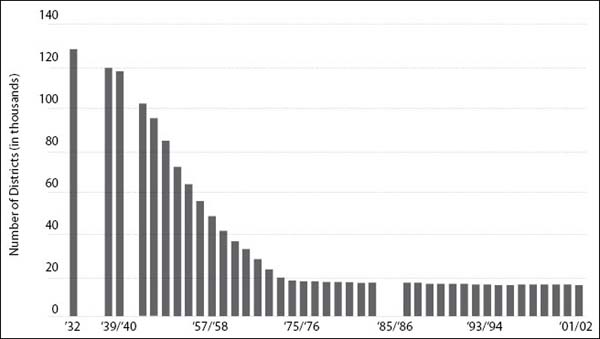
Source: Tyack, David and Larry Cuban (1995). “Tinkering Toward Utopia.” Cambridge, MA: Harvard University Press, p. 19 (for 1932 datum). And: Snyder, T.D., Tan, A.G., and Hoffman, C.M. (2004). “Digest of Education Statistics 2003, (NCES 2005-025).” Washington, DC: U.S. Department of Education, National Center for Education Statistics, p. 103 (for all other data). Data missing in the original NCES publication.
The fact that earlier study results have not been consistent across states points to the need to gather and analyze state-specific data before embarking on a policy of school district consolidation.
[*] This ex post facto investigation into the actual effects of consolidation is perhaps not as useful as an investigation undertaken before the policy had been aggressively pursued for half a century, but "there you have it," as the British say.
District size and district per-pupil spending were the key variables in this investigation. Data for these items were obtained from a pair of related data sets published by the National Center for Education Statistics of the U.S. Department of Education. District size was obtained from the NCES Common Core of Data “Local Education Agency Universe Survey Data,” and spending figures were obtained from the NCES CCD “Local Education Agency Finance Survey” (“local education agency” is the NCES term for a school district).
Two per-pupil spending figures are commonly reported by school districts: “total spending” and “current spending.” The current spending figure is equal to the total spending figure minus capital costs, such as construction and debt service. Current spending is generally the preferred dependent variable in regression studies of school district spending, for two reasons. First, current spending is less “lumpy,” or prone to variation from year to year due to such factors as cyclic construction projects and their associated costs. Second, it is less affected by historical factors outside the control of current school district officials.[*] For these reasons, this study follows the general pattern among education researchers[†] and uses current spending per pupil as its dependent variable.
To broaden the base of evidence from which to draw conclusions, this study considers the five most recent school years for which both district size and spending data are available: 1999-2000 through 2003-2004. As discussed below, the author kept all spending and revenue data in this study in current dollars, dealing with inflationary and other period effects through dummy variables corresponding to the years of observation.
Time series data of this sort are often analyzed with a technique known as panel regression, but that technique is not well-suited to the model of per-pupil spending proposed here or to the research question — that is, How do district mergers affect per pupil spending?[**] The approach taken in this paper is therefore a pooled regression on the data for all districts over all five years, clustering together the observations we have for each district at different times. Clustering the observations by district allows us to control for correlations among those observations, which is necessary to conform to linear regression’s key assumption that the observations are independent of one another. This pooling of observations is accomplished using Stata’s “regress, cluster()” command to produce robust Huber/White/sandwich estimates of variance (and thus robust standard errors).[8]
Given that we want to isolate the effect of school district size on per-pupil spending, we must control for the impact of other factors that might independently affect spending. Those control variables are described in the sections that follow.
[*] See, for instance, Alan L. Gustman; George B. Pidot Jr., “Interactions between Educational Spending and Student Enrollment,” The Journal of Human Resources, vol. 8, no. 1. (Winter, 1973), pp. 3-23. Gustman and Pidot chose current expenditures per pupil, explaining, “We avoid the problems caused by the extreme irregularity of annual capital outlays and omit interest payments which are determined largely by past interest rates and the method of financing construction historically in a particular location.”
[†] See, for instance, Frank Johnson, “Revenues and Expenditures for Public Elementary and Secondary Education: School Year 1998-99,” National Center for Education Statistics, Statistics in Brief, 2001, publication no. NCES 2001-321. http://nces.ed.gov/pubs2001/2001321.pdf. Johnson notes, “Researchers generally use current expenditures instead of total expenditures, when comparing education spending between states or across time.”
[**] There are two main types of panel regression: fixed effects, and random effects. A fixed-effects regression would ignore differences between districts and look only at how districts themselves change over the five years for which we have data. In other words, it would explore the effects of pouring more students into an existing district, holding constant that district’s aggregate income (because we have income data for only a single year). But when two or more districts merge in the real world, the higher number of students in the combined district is always accompanied by higher aggregate income as well. Clearly, then, a fixed-effects panel regression on the data we have would answer a different question than the one we wish to investigate.
In theory, it might have been possible to address this problem by using a random-effects panel regression, because the random effects approach takes into account differences between districts as well as differences within districts over time. But a Hausman test indicates that a random-effects model is inappropriate. Hence we are left with the pooled-regression approach chosen for this study.
There are a number of federal laws and regulations, such as the Individuals with Disabilities Education Act and the Title I funding program for low-income children, that require or encourage districts to provide additional services to certain students. Since this federal funding is attached to categories of children and is, at least in principle, entirely independent of school district size, it is necessary to control for the impact of federal categorical spending on district expenditures. Specifically, this study controlled for the total federal revenues per pupil received by each district. This control also takes into account school spending on free and reduced-price lunches for low-income students, because these lunch programs also receive federal funding.
It might be argued, however, that since some federal funding programs are elective rather than mandated (for example, gifted and talented programs), and since larger districts have more administrative personnel available to apply for federal grants, larger districts may bring in more federal money at least partially due to their size. If that were the case, then including total federal revenues as a control variable in the regression would understate the true significance and magnitude of the district-size term, since some of the size term’s effect would be subsumed by the federal-revenue term.
While this hypothesis is certainly plausible, it does not appear to be a cause for concern in practice. The standard correlation coefficient (“Pearson’s r”) between district size and total federal revenues per pupil is quite low (0.075),[*] as is the Spearman’s Rank correlation coefficient (-0.175), which suggests that a district’s size and a district’s ability to raise per-pupil federal grant funding are not strongly correlated.
[*] A Pearson’s correlation coefficient of 0 indicates the absence of a linear relationship between the two variables and a correlation coefficient of 1 (or -1) indicates perfect positive (or negative) linear correlation (i.e., one variable can be expressed as a linear function of the other).
By the same logic employed above to justify the use of a federal-spending variable, categorical state revenues might also be correlated with district spending independently of district size. To control for that possibility, an all-inclusive categorical state funding variable was included in an early draft of the model, capturing funds earmarked by the state for low-income or disabled students and received regardless of district size. In practice, this state-level categorical revenues variable was found to add virtually nothing to the explanatory power of the model. When state revenues per pupil targeted at school lunch programs were considered in isolation, however, they were associated with district spending and so were included in the model.
Even though the federal-revenues-per-pupil control variable captures some of the variation in spending due to the share of disabled children in a given district, it is possible that the variable will not capture all the additional expenditures necessitated by the presence of these students. This outcome is in fact quite plausible, since the IDEA explicitly forbids districts from considering the cost of special education services in its decisions regarding which sorts of services to offer a student (even though actual federal funding to the states under the IDEA is itself limited). So, if expensive-to-educate disabled students happen to be more heavily concentrated in either small or large districts, their presence could bias the model’s estimate of the effect of district size on spending.
To control for any such unaccounted-for variation in mandated special education spending, the model includes the percentage of special education students in each district as a separate control variable.
Another commonly used control variable in econometric research on public school systems is racial composition of the community or the student body. The rationale for this control is that factors correlated with race, but uncorrelated with the explanatory variable of interest (i.e., district enrollment), may affect district spending. To capture any such effect, the model includes the nonminority percentage of the district’s population.
These data were obtained from “Summary File 3” of the 2000 U.S. Census.[9] It should be noted, however, that these data are available only for 1999, necessitating the use of the 1999 value across all five time periods. This can be expected to decrease the predictive power of this variable (it can only capture variation between districts, not within districts over time), since district demographics may have changed over the period in question. But as we shall see from the regression results, the between-district variations ensure that this variable is a useful and statistically significant predictor even without data on any possible interyear variations in the variable within districts.
Researchers studying school district spending generally like to control for the possibility that demand for education may vary in systematic ways from one district to another. In a district where there is greater demand or higher expectations for education, public officials may choose to spend more per pupil to meet that demand. This response, of course, would lead to variations in spending from one district to another that are unrelated to district size. Hence, it is wise to try to take into account any such variation in educational demand from one district another.
But data on a community’s attitudes towards education spending and its educational aspirations are not generally available, so it is necessary to find and control for some other characteristic that is measured numerically and related to education demand. As it happens, the education literature has shown income to be correlated with demand for education, so economists typically control for average family income as a proxy (or “stand-in”) for educational demand.
In keeping with that traditional practice, aggregate household income per capita (i.e., average income) is included as a control in the model. Average income data are taken from Census 2000 “Summary File 3.”[10]
If a larger share of the population is currently enrolled in public schools, there will be a larger number of prospective beneficiaries of higher public school spending. That, in turn, may change taxpayers’ desire for or acceptance of higher spending independently of how much they might value education in the abstract (which is already controlled for with the average income term discussed above).
To capture this measure of the public’s vested interest in public school spending, census data on public school enrollment as a share of total district population is included as a control variable.[11]
At one time, economists commonly assumed that public officials, such as school administrators, acted purely in the best interests of the public. In the design of government programs and the setting of government spending levels, it was taken for granted that officials would correctly determine the amount and quality of government services the public wanted and act accordingly.
Based on this assumption, economists tried to control for each community’s level of demand for education when studying school district spending, expecting that school district officials would choose higher or lower per-pupil spending levels in response to higher or lower educational demand from one community to the next. That, of course, is the basis for the average income control discussed above.
But the assumption of the demand-driven public servant is viewed today with skepticism. Since at least the 1950s, economists have been concerned that such an idealized view of government service is implausible on its face and is inconsistent with the assumption that consumers act according to what is best for themselves and their families. If public officials and consumers are all human beings, would one group really be motivated purely by selfless devotion to others’ desires while the second group was chiefly self-interested? Public officials, after all, are also consumers themselves.
That shift in thinking lead to the development of “public choice theory.”
Public choice theory applies the economic assumption that human beings are rational and self-interested to everyone, including elected politicians and bureaucrats. The views of economist William Niskanen, a leader in the development of public choice, have been neatly summarized as theorizing that public officials “seek to enhance personal utility [their own interests] by maximising the budgets of their respective departments, since it is expected that their personal incomes and power status (through increased promotional opportunities) would be increased [as a result].”[12]
An analogous set of incentives is theorized to apply to such elected public officials as school board members. The most powerful political players in school board elections are typically school employee unions, who openly acknowledge their desire to raise salaries and overall public school spending. The public choice model suggests that school board members will have an incentive to please the teachers unions, because opposition to union interests would undermine members’ re-election chances. Indeed, candidates opposed to higher spending would have to overcome ardent and organized union opposition. Taxpayers in favor of spending restraint often have no corresponding political action organization.
If public school officials try to spend as much as they can in pursuit of their own interests, school district spending would be correlated with the ease of raising revenues. This expenditure-maximizing tendency would of course interfere with the measurement of the impact of district size on spending, and hence this potential factor must be controlled for in the model.
To do that, we need a way of measuring how easy it is for officials in any particular district to raise a given amount of money per pupil. As economist Larry DeBoer points out, “income is the most common measure of [taxpayers’] ability to pay.”[13] A control variable for the effects of public choice behavior can thus be obtained by dividing a district’s total household income by the number of public school students among whom tax revenues must be distributed.[*] Note that this conclusion should be true in Michigan even after the passage of Proposal A, which shifted most public school revenue generation from the local to the state level. While Proposal A all but eliminated local discretion over current per-pupil spending and raised many low-spending districts to a certain minimum revenue level, it did not impose uniform spending across the state, but rather locked in much of the pre-existing variation. Thus, the per-pupil foundation allowances assigned by the state under Proposal A are based in large measure on the level of per-pupil spending in each district prior to the reform’s passage. The districts that were spending the most before Proposal A generally continue to do so today, and some of this money is in fact still raised locally.
A real world example that is consistent with this theory, though not by itself conclusive, is the state of Utah. Utah’s average family size is well above the national norm, and the state’s per-pupil public school spending is well below it.
It should be noted that the inclusion of this public choice control variable — together with the average income variable that proxies community demand for education — represents an interesting test of competing theories of bureaucratic behavior. The results will help determine whether school district officials in Michigan behave more like the selfless public servants of the traditional view or the self-interested economic agents of the public choice view. As will be discussed later, the answer to that question has at least as much relevance to education policymaking as does this study’s inquiry into the link between district size and spending.
As with the per-capita income variable, the source of the income data for this public choice control was “Summary File 3” of the 2000 Census.[14] Hence, we once again have the data for 1999 alone.[**] Fortunately, any actual inter-year variations in income per pupil were not sufficiently large to undermine the usefulness of this variable.
[*] To elaborate, let’s consider a hypothetical example. Imagine two communities of roughly equal income and number of households (and hence of equal aggregate household income). And let’s assume that community A has one public school student per household while community B has two such students per household. In order to achieve the same level of per pupil spending, the tax burden on householders in community B would have to be twice the burden in community A. But since voters’ ability to pay is constrained by their income, and since the household income in the two communities is the same, public choice theory predicts that public schools in community B would spend less per pupil than those in community A.
Hence, under public choice theory, a district’s aggregate income per pupil is a good measure of how easy it is for officials in that district to spend as much as possible.
[**] The same is true for the previous two variables (public demand for education and school enrollment as a percentage of the population), both of which came from the 2000 Census “Summary File 3.” Such single-year estimates are not uncommon in education research.
The single largest cost for school districts is labor, and labor costs are likely to vary between districts independently of total enrollment. In particular, districts where the cost of living is higher can be expected to pay higher salaries. If they did not, they would probably have considerable difficulty attracting and keeping employees. To control for this variation in input costs, the model includes both the median asking price for homes and the median asking price for apartment rent. Data for this variable come from Census 2000, “Summary File 3.”[15]
When conducting a pooled regression on data for multiple years, it is important to control for the possibility that some unknown factor may have increased district costs at a certain point in time. If, for example, the state had issued new curriculum guidelines in year three of the five-year period under investigation, all districts would likely have experienced higher textbook costs in year four. Gradual changes over time, such as aging of the population and monetary inflation, could also skew the results.
This kind of event is known as a period effect, and it could potentially skew predictions about the relationship between district size and spending. To control for period effects, the model includes a separate dummy variable (a variable whose value is either 0 or 1) for the last four[*] of the five years for which we have data. Doing so allows us to capture the possible impact of any such period effects without having to identify their causes.
[*] It is only necessary to have four dummy variables to control for five time periods because the fifth time period is captured by the four dummies all taking on the value 0. In other words, if an event didn’t occur in years one through four, it must, by process of elimination, have occurred in year five.
A final consideration that is often included in economic models of district spending is student achievement. The assumption behind this control variable is that per-pupil spending and academic achievement are positively correlated. Districts that set and achieve a higher performance standard for their students would thus be spending more to realize that result, and we should therefore control for variation in achievement between districts.
This is a theoretical construct borrowed from market economics, and it is not obviously applicable to public schooling. In competitive markets, it is true that more expensive products and services are generally, though not always, of higher quality, holding constant the amount of the product or service being consumed. But the corresponding assumption that higher spending is significantly correlated with higher student achievement in public schools is not supported by the empirical evidence. Numerous studies have found little or no link between per-pupil spending and achievement.[*]
Because of this empirically demonstrated absence of a significant correlation between public school spending and achievement, it did not seem worthwhile to build an index of overall student achievement from the many available state test results (which would have been necessary in order to include achievement in the model). A future version of this study, however, will include a school achievement control variable for the sake of completeness.
[*] One of the most elegant studies in this field has regrettably received very little attention from scholars or the media: Stephen Childs and Charol Shakeshaft, "A Meta-Analysis of Research on the Relationship Between Educational Expenditures and Student Achievement." Journal of Education Finance, vol. 12 (1986), no. 3, pp. 249-63. Also see the research of Eric Hanushek, including Eric A. Hanushek, "Assessing the Effects of School Resources on Student Performance: An Update," Educational Evaluation and Policy Analysis, vol. 19 (1997), no. 2, pp. 141-164. Most recently, see Andrew T. LeFevre, Report Card on American Education: A State-by-State Analysis, 1981-2003 (Washington, DC: The American Legislative Exchange Council, 2004), chapter 3. http://www.alec.org/meSWFiles/pdf/2004_Report_Card_on_Education.pdf.
A number of other plausible potential control variables were considered, but were found to contribute little or nothing to the predictive power of the model and hence were omitted. These insignificant variables included total state categorical funding per pupil, an index of parental level of education, district urbanicity, percent of poverty in the district and percent of families without two parents in the home.
Putting all of these variables together, the model of Michigan district spending looks like this:
Current Per-Pupil Spending =
b0 + â * {f1(Size), f2(FedRevenuesPP),
f3(StateLunchRevPP), f4(PctSpecialEd), f5(PctWhite),
f6(IncomePerCapita), f7(EnrollmentByPopulation),
f8(IncomePerPupil), f9(MedianHouseAskingPrice),
f10(MedianRentAsked), [Years]} + error
In the equation above, b0 is the y-intercept, â is an array of constants for the explanatory variables, [Years] is an array of dummy variables (see the discussion of period effects, above), and error represents any unexplained variation in district spending caused by factors that we have not thought to, or been able to, measure.
Note that instead of simply including the variables of interest as linear terms in the equation, this study included functions (f1 through f10) of those variables. That is because these terms have been identified as plausible predictors of district spending per pupil, but it has not been established that their relationship to spending is necessarily linear, and Ordinary Least Squares regression assumes a linear relationship between the predictors (independent variables) and the dependent variable. So, using a combination of regression diagnostics, such as the Ramsay RESET test[16] and scatter diagrams of the dependent variable against the predictors, the author has identified the functions of these variables that most effectively and linearly predict district spending, while also conforming to a sound theoretical rationale for their inclusion in the model. Those functions are described in the paragraphs that follow.
Aggregate household income per capita is the only purely linear term, and it is positive as expected.
The percentage of special education students is a positive logarithmic term. Increases in the percentage of disabled children are associated with increased spending, but as a district’s percentage of special education students continues to rise, the marginal effect on spending of such additional increases gradually diminishes.
The percentage of white students in a district is a negative logarithmic term, meaning that districts with a higher share of white students spend less, other things being equal, but that the marginal reduction in spending diminishes as the share of white students becomes large. This may reflect the fact that overwhelmingly white districts may be predominantly located in smaller Michigan towns with lower living costs and hence lower labor costs not fully captured by the house and rental asking price controls.
The federal-revenues-per-pupil term was found to have both a logarithmic and a (small) quadratic component, both of which are positive. This connotes a monotonically increasing function (as expected) that first rises rapidly, plateaus slightly and then begins rising more rapidly once again.
The median house asking price is a quadratic term with a negative linear component and a positive squared component. This U-shaped curve suggests a more nuanced relationship than expected, but one that is theoretically reasonable. It is consistent with the expectation that districts with high housing prices pay their teachers more and hence have higher costs and higher spending, other things being equal. But it also suggests that districts with very low housing prices have above-average costs as well. The latter could be due to the greater difficulty of attracting teachers to work in economically depressed areas, with higher salaries being necessary to entice them to do so.
The state lunch revenue control is a quadratic term with a positive linear component and a negative squared component. Hence, up to a certain threshold, higher state school lunch revenue per pupil is associated with increased district spending but, beyond that threshold, the relationship is reversed. A plausible explanation for this pattern is that the costs associated with feeding and educating students who qualify for the state lunch aid grow at a faster rate than does the state aid itself.
Three of the control variables in the model have only squared terms: public school enrollment as a share of total district population, which has an unexpectedly negative coefficient, and aggregate household income per pupil and median residential rental asking price, which are positive as expected. The fact that public school enrollment as a share of population is negative means that districts whose populations presumably have more to gain from higher public school spending actually spend less, other things being equal. This is perhaps because a higher share of the population in public schools means more students across whom taxpayers’ dollars must be spread, so holding average income constant, it would be harder for officials to raise per-pupil spending in these districts.
Since the main purpose of this study is to explore the relationship between district size and spending, a variety of different functions of size are discussed here and then compared with one another in the following section, “Empirical Results and Analysis.”
The simplest model is of course a linear one, where ƒ(Size) = Size and the enrollment term thus reduces to b * Size. This linear model assumes that increasing district size either always increases spending (if the coefficient b is positive) or always decreases it (if b is negative), and that the rate of change in district spending due to a change in enrollment is constant across the entire range of enrollments (because the slope of a straight line is constant along its length).
For the sake of completeness, the author ran a regression on a version of the model with that simple linear function of Size, but a linear function is not in fact consistent with any of the plausible theories about how enrollment and district spending might be related. Any theory of that relationship must begin with a rapid drop in per-pupil spending from very tiny districts up to those of a few hundred students, simply because of the fixed overhead cost of a principal’s or secretary’s salary, not to mention a superintendent’s. These costs obviously weigh much more heavily on a district with 10 students (and such small districts do exist) than on one with several hundred students.
For districts of more than a few hundred students, differing theories about the relationship between district size and spending diverge both from one another and from a simple linear function of Size. If we assume that district officials seek to be as efficient as possible and are successful in their efforts, then per-pupil spending should continue to fall off as Size grows, but at a decelerating rate, possibly even hitting a plateau beyond which no further efficiency gains are realized. That’s because economies of scale would be greatest when going from extremely tiny districts to medium-size districts. This is a nonlinear relationship — the slope of the line changes as district size changes.
An appropriate function to embody this efficient school spending thesis is ƒ(Size) = ln (Size), the natural logarithm of Size, with a negative coefficient b expected in the regression’s size term, b * ln (Size). This would allow the cost-saving effect of increased district size to be greater when moving from tiny districts to medium sized districts than when moving from large to very large districts.
According to public choice theory, however, school officials would be inclined to grow their budgets rather than economize. Under this theory, initial savings that come from sharing fixed costs among a greater number of pupils would be overwhelmed by district officials’ self-interest once districts reach a certain size. As a district becomes increasingly large, complex and removed from the everyday oversight of community members, administrators might well find it easier to expand district staff and spending. So, under public choice, the correlation between spending and enrollment should eventually become positive once a certain district size is reached.
There is a further reason to expect that very large districts might be less efficient. In “agency shop” states, where all or most teachers are required to pay union dues whether or not they belong to the union, unions in larger districts will invariably have more resources to employ in their efforts to raise salaries, decrease workloads and eliminate competition for their members. To the extent that such union action is effective, it will raise district spending and perhaps also decrease student performance, since artificial barriers to entry into the teaching profession may exclude potentially talented candidates. As it happens, a highly sophisticated 1997 study by Harvard professor Caroline Minter Hoxby[17] found this to be the case, concluding, “[T]eachers’ unions are primarily rent seeking, raising school budgets and school inputs but lowering student achievement by decreasing the productivity of inputs.”
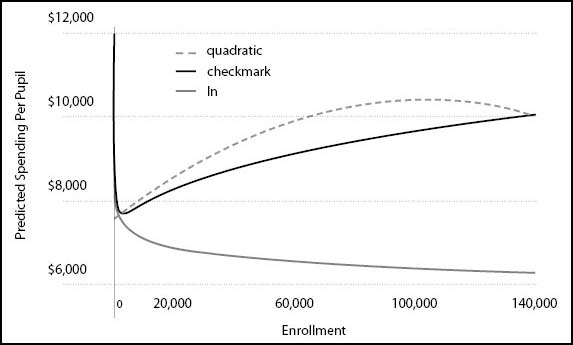
Public choice theory thus suggests that per-pupil spending should fall steeply when moving from tiny to small districts, but then gradually reverse course and begin to rise — steeply at first, but flattening out as district size becomes very large and taxpayers’ resources are stretched thin. This spending curve, shaped essentially like a checkmark, should be noticeable in agency shop states such as Michigan.
Correctly specifying this potential Size equation for the public choice view of bureaucratic behavior is not straightforward. Most researchers trying to determine if increased district size results in lower spending for small districts but in higher spending for already-large districts use a quadratic function of the form:
f(Size) = a * Size + Size2,
where a is an unknown coefficient to be determined by regression.[*] As a basis for comparison to the existing literature, the author performed a regression using this quadratic function of district size, but the simple U-shaped curve it describes is distinctly different from the checkmark shape that would seem to follow from public choice theory.
A better fit for the relationship between enrollment and spending predicted by public choice is given by the following equation:
f(Size) = ln2 (Size) − a * ln (Size)
If a is a moderately sized positive number, this equation produces the checkmark-shaped curve needed to model the public choice view of how size and spending should be related.
A graphic illustration of the three nonlinear functions of enrollment appears in Graphic 2. These curves were obtained by regressing each of the functions against per-pupil spending in the absence of controls. (This figure is meant only to clarify the preceding discussion about the contrasting shapes of the curves. The complete models with the controls incorporated will differ somewhat.)
Graphic 2: Functions of District Size (Without Controls)
[*] Note that in the discussion that follows, the author used the same letters to refer to the unknown quantities in several different equations. Readers should not assume that an ‘a’ constant in one equation represents the same quantity as does an ‘a’ constant in a different equation.
Recalling the original generic model specification, and substituting in the specific control variable functions explained above, we now have:
Current Per-Pupil Spending =
b0 + â * {f(Size), ln(FedRevenuesPP), FedRevenuesPP2,
StateLunchRevPP, StateLunchRevPP2, ln(PctSpecialEd),
ln(PctWhite), EnrollmentByPopulation2, IncomePerCapita,
IncomePerPupil2, MedianHouseAskingPrice,
MedianHouseAskingPrice2, MedianRentAsked2,
[Years]} + error
Combining this formula with the four different specifications for the f(Size) function discussed in the preceding section, we arrive at four different completed specifications, where f(Size) in the generic model is defined in one of the following ways:
(1) ƒ(Size) = Size (Linear)
(2) ƒ(Size) = ln (Size) (Logarithmic)
(3) ƒ(Size) = a * Size + Size2 (Quadratic)
(4) ƒ(Size) = ln2 (Size) − a * ln (Size) (Checkmark)
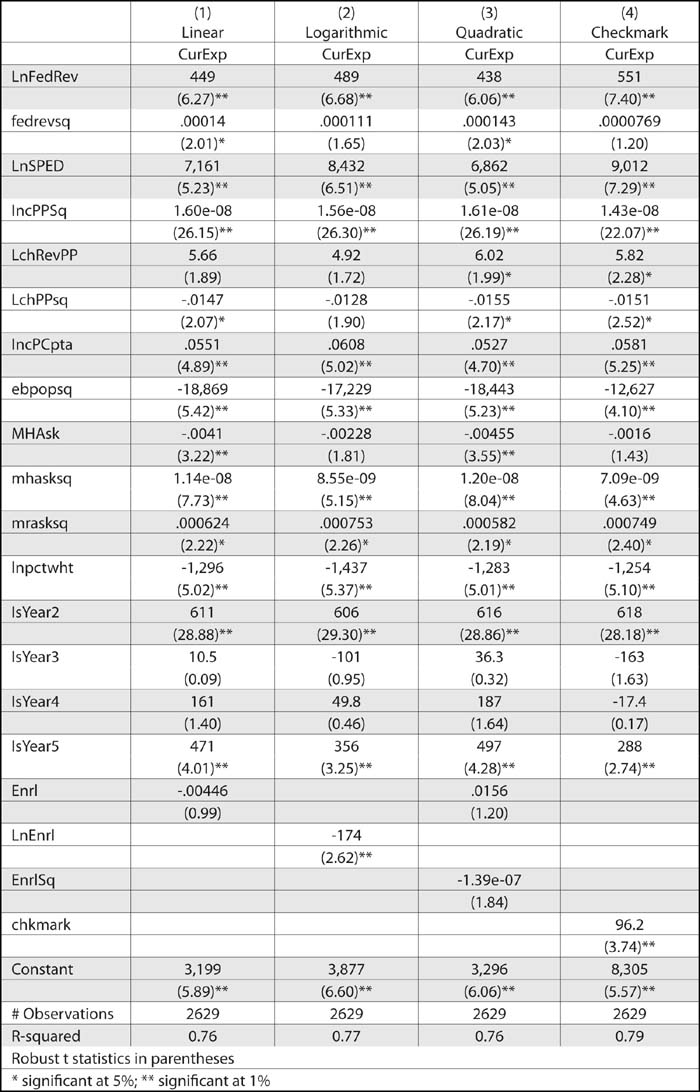
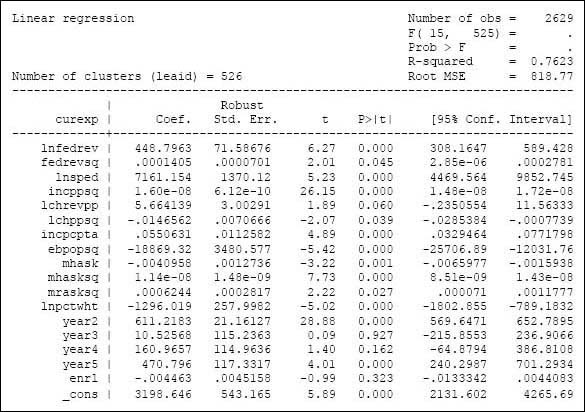
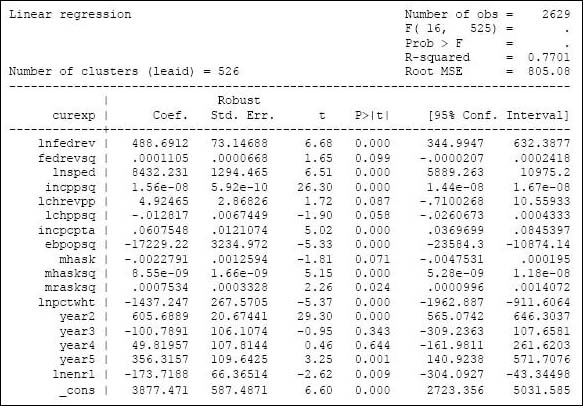
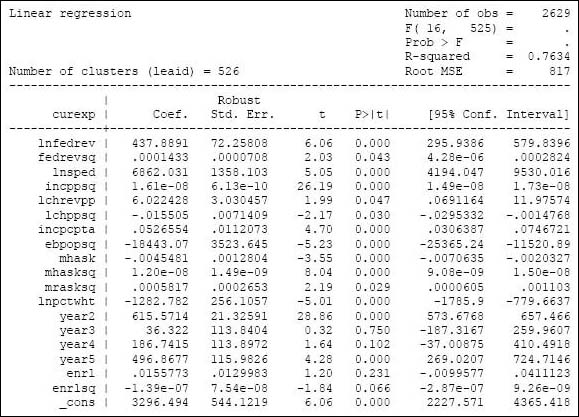
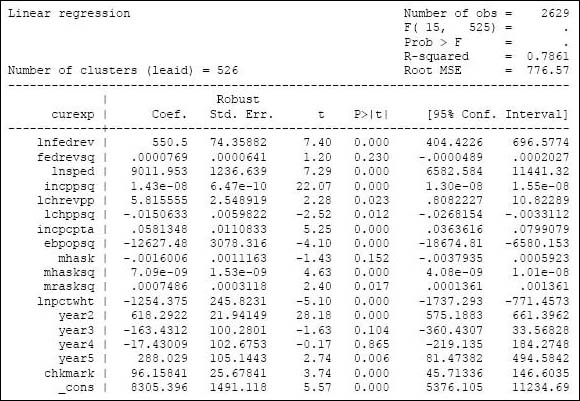
Graphic 3 summarizes the regression results for all four models (see Appendix A for the robust standard error values, confidence intervals, and other details of the regression results).
While the coefficients on the size terms are statistically insignificant in the linear and quadratic models, they are significant at the 1 percent level in the logarithmic and checkmark models. The checkmark model is superior overall, however, explaining an additional two percentage points of the variance in district size (its R-squared value is roughly 79 compared to 77 for the logarithmic model).
Detailed regression diagnostics are presented in Appendix B, but it is sufficient here to observe that the reason why both the logarithmic and the checkmark models are statistically significant is that both accurately fit the decline in per pupil spending that occurs as enrollment rises from a handful of students to a few thousand students. The reason why the logarithmic model is somewhat inferior is that it incorrectly predicts that spending will continue to fall indefinitely as district size increases. The checkmark model, by contrast, correctly predicts that, after a certain size, further increases in district size are associated with higher spending per pupil.
Graphic 3: Summary Regression Results
Given that there is a checkmark-shaped relationship between district size and per pupil spending, we can calculate the theoretically most efficient district size. To do that, we have to know the value of the constant a in the checkmark function f(Size) = ln2(Size) − a * ln(Size). That value can be computed by running the regression with the ln2(Size) and ln(Size) terms being allowed to vary separately, and dividing the ln(Size) coefficient by the ln2(Size) coefficient.[*] Doing so reveals the value of a to be roughly 15.95.
Based on that value of a, the author found that the most efficient school district size in Michigan is 2,911 students. Using the coefficient of 96.2 for the checkmark term (see Graphic 3, Model 4, here Investigating f(Size)), the author calculated that a district of 1,500 students is likely to spend about $40 less per pupil each year than a district of 2,911 students, all other things being equal. Similarly, the spending difference between a district of 500 students and one of 2,911 students is about $300 per pupil.
Those are, of course, only ballpark numbers. A 95 percent confidence interval around the coefficient value for the checkmark term ranges from 46 to 147. As a result, actual differences in spending due to variations in district size could easily be anywhere from less than half the values reported in the previous paragraph, to one and a half times those values. It is also important to realize that a variety of political and geographical[†] considerations might make particular mergers or consolidations difficult or impossible, so this entire confidence interval represents an upper bound on possible savings.
It is also worth considering that districts larger than 2,911 students generally spend more per pupil than optimally sized districts. This is particularly important given that 70 percent of all Michigan’s conventional public school students are currently enrolled in these excessively large districts. The potential savings from consolidating tiny districts are thus modest compared to the potential savings from breaking up overly large districts.
Accentuating the practical advantage of breakups over consolidations is the fact that any excessively large district can be beneficially broken up into smaller districts, but small districts can be beneficially merged together only if they happen to be adjacent to other districts that are also far enough below the optimal size for a consolidation to result in a new district closer to the optimal size.[**]
To put numbers on this discussion, the total cost premium currently being paid due to excessively small districts is on the order of $31 million according to the model presented here, whereas the total cost premium due to excessively large districts is on the order of $363 million.[‡] So, even if every small district in Michigan were located adjacent to other suitably small districts (and hence a viable consolidation candidate), the savings from such consolidations are still predicted to be only about 8.5 percent of those predicted for breaking up excessively large districts. And because many small districts are undoubtedly not located next to other suitably small districts, the difference in potential savings from consolidations versus breakups is almost certainly greater.
Once again, it should be noted that these are only ballpark numbers, since the 95 percent confidence interval on the size term is quite broad.
[*] The reason we don’t simply leave these terms separate in our checkmark model is that they contribute to variance inflation when they’re allowed to vary independently. That variance inflation can be eliminated by grouping the terms together as described in the text.
[†] Optimal consolidations could only happen among adjacent small districts. A small district that is geographically surrounded by large districts could not efficiently be merged with any other.
[**] Noncontiguous school districts are unusual.
[‡]To generate these estimates, the study first calculated the value of the size term for an optimally sized district (i.e., a district of 2,911 pupils). The size term for such a district has the value -6,120. Since that is the minimum possible value for the size term, we can ascertain the cost premium per pupil attached to any other district size by adding 6,120 to the value of its size term. Consequently, we can compute the total possible savings from consolidations and breakups by simply multiplying the per pupil cost premium for each district by that district’s enrollment, and then summing up those net premiums for districts with fewer than 2,911 pupils (to get the maximum theoretical consolidation savings) and for districts of more than 2,911 pupils (to get the maximum theoretical breakup savings).
Finally, let’s return to the competing theories of district spending behavior discussed earlier. As it happens, the control variables for both the “demand-driven” thesis (aggregate income per capita) and the public choice thesis (aggregate income per public school pupil squared) are statistically significant. But their explanatory power differs dramatically.
A common way of assessing the importance of a variable’s contribution to a statistical model is to drop it from the equation and see how much the “R-squared” value drops as a result.[*] The resulting difference in the R-squared value is sometimes called “Darlington’s usefulness statistic.”
When income per capita is dropped from the model, the R-squared value falls by just over 1 point. When income per public school pupil squared is dropped, R-squared falls by over 18 points. In fact, the public choice control for bureaucratic behavior has by far the largest Darlington usefulness statistic of any variable in the model other than the “year2” dummy variable.[†] For comparison, the Darlington value for the checkmark function of district size — the independent variable this paper was written to investigate — is only 2.4. Further evidence of the greater explanatory power of the public choice variable appears in “Appendix B: Postestimation Diagnostics.”
[*] R-squared represents the percentage of the variance in the dependent variable — in this case, a district’s per-pupil operating spending — that is explained by the model.
[†] Note, however, that the year dummy variables are controlling for period effects, including inflation, and the effects on spending due to inflation are essentially imaginary (rising spending from one year to the next in current dollars, due to inflation, does not represent a change in real spending).
An important policy conclusion follows from the study’s key findings (which are distilled in the executive summary): Although school district size plays a statistically significant role in determining per-pupil operating spending in Michigan school districts, this role is relatively small. Manipulating district size by consolidating small districts — or more accurately, by redrawing those districts’ boundaries — could theoretically save as much as $31 million annually, but due to practical considerations, there would seem to be little chance of coming close to that theoretical maximum.
Among other things, such extensive consolidation would require altering the borders of hundreds of Michigan school districts (see “Appendix C: Michigan School District Head Counts”), and optimal size could not easily be maintained, even if it could be initially achieved. In practice, the potential savings from redrawing these boundaries could also be reduced by any initial management and capital construction costs involved, and by potential increases in long-term student transportation costs. It is also unclear what effect consolidating districts might have on academic quality.
The study’s results suggest that costs will continue to rise over time unless market incentives are introduced into the system. Arguably the study’s most significant finding is that public school officials appear to maximize school operating spending regardless of the public demand for educational services. The introduction of market incentives could counteract this tendency by providing inducements for policymakers and school officials to reduce operating costs while maintaining or improving quality.
Graphics A1 through A4 contain the detailed regression results for each of the four models summarized in Graphic 3, (see Investigating f(Size)).
Graphic A1: Linear District Size Model
Graphic A2: Logarithmic District Size Model
Graphic A3: Quadratic District Size Model
Graphic A4: Checkmark District Size Model
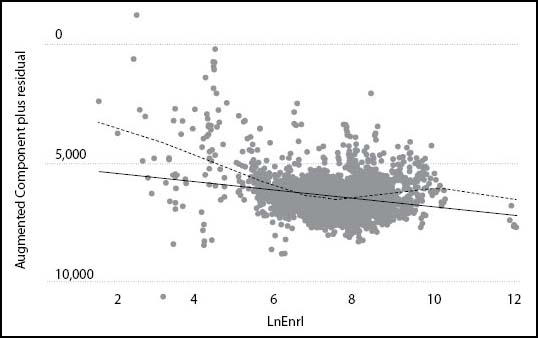
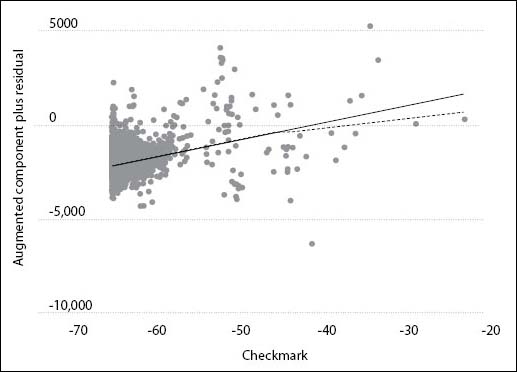
One way to compare how well-specified the logarithmic and checkmark size terms are is to plot their respective augmented component-plus-residual (i.e., augmented partial residual) graphs and check for linearity.[*] I do that in Graphics B1 and B2. In each case, the solid line represents the regression line for the size term of interest and the dashed line is a smoothed Lowess[18] fit. The closer the Lowess line is to the size term’s linear regression line, the better that size term is as a predictor of district spending.
A quick look at Graphic B1 reveals that the logarithmic size model is a poor predictor of district spending. The checkmark model tested in Graphic B2 demonstrates a noticeably better (though not ideal) fit for the data.
Graphic B1: Testing for Linearity of ƒ(Size) = ln(Size) (Logarithmic Model)
Graphic B2: Testing for Linearity of f(Size) = ln2(Size) − a * ln(Size)
Further investigation lends additional support to the view that the logarithmic model is misspecified while the checkmark model is most likely well specified. Applying the Ramsay RESET test for omitted variables to the logarithmic model (see below) produces a statistically significant result. We can therefore not reject the hypothesis that there are omitted variables.
Logarithmic model
Ramsey RESET test using powers of the fitted values of curexp
Ho: model has no omitted variables
F(3, 2608) = 9.57
Prob > F = 0.0000
However, applying the RESET test to the checkmark model (see below) produces an insignificant result, and hence we can reject the hypothesis that there are omitted variables.
Checkmark model
Ramsey RESET test using powers of the fitted values of curexp
Ho: model has no omitted variables
F(3, 2608) = 1.36
Prob > F = 0.2517
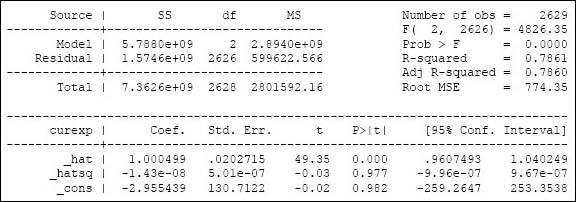
We can conduct a further test of the specification of the checkmark model using Stata’s linktest command, which adds the predicted value (_hat) and the predicted value squared (_hatsq) to the model. The first of these terms should of course be significant, but the second should not be except if we have omitted variables in the model. The linktest output shows an insignificant value for _hatsq, so we can reject the hypothesis that we have omitted variables.
Graphic B3: Linktest on Checkmark Model
To test for multicollinearity, I calculate variance inflation factors for the variables, which are as follows:
Graphic B4: Variance Inflation Factors

Since all the VIFs are below 10, multicollinearity is not a major concern with the checkmark model. Heteroschedasticity is also not a problem because I have used robust standard errors.
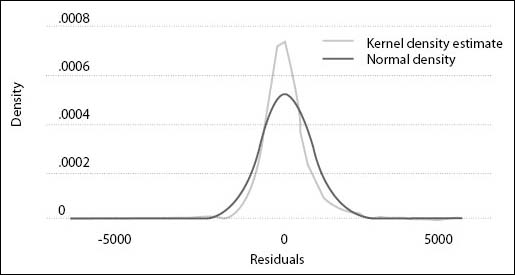
To test for the normality of the residuals, another OLS assumption, I graph the distribution of the residuals against a normal curve in Figure B3. The upshot of that graph is that while the residuals are not perfectly normal, the deviation from normality isn’t enormous. What are the ramifications of this imperfection in the model? It should perhaps raise the level of uncertainty around the estimate of the size effect on district spending, but is not sufficiently egregious to call into question the huge effect of aggregate income per pupil squared on district spending (see the section titled “Evaluating Public Choice Theory” in the body of the text for a discussion of the magnitude of that effect).
Graphic B5: Testing for Normality of Residuals (Checkmark Model)
[*] This was done using Stata’s acprplot command, which is based on C. L. Mallows, “Augmented partial residuals,” Technometrics, vol 28 (1986), p. 313–319.
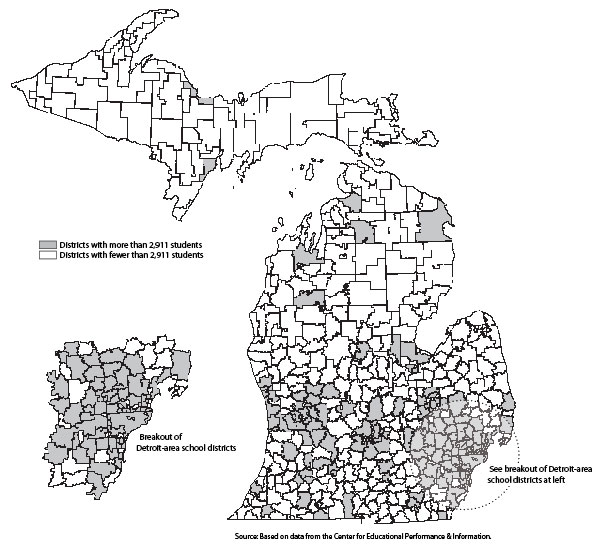
Graphic C1 displays in gray the Michigan school districts whose head counts in the 2005-2006 school year[*] exceeded 2,911 students, the school district size at which per-pupil operating spending appears to be minimized. Of Michigan’s 552 conventional public school districts, 160 had head counts that were greater than 2,911 students, while 391 had head counts that were less. (The state provided no head count for White Pine School District.)
Achieving the theoretical $31 million savings in annual operating spending from school district consolidations in Michigan would require redrawing the borders of the districts colored white in order to produce a series of districts enrolling 2,911 students apiece. The exact head count for each district in the 2005-2006 school year appears in Graphic C2 (see link to table below); rows in gray are districts where the head count exceeded 2,911, while rows in white are districts where the head count was less than 2,911. As a group, districts with fewer than 2,911 students enroll only 30 percent of the total public school population (excluding charter schools), according to the 2005-2006 school year figures shown in Graphic C2.
Graphic C1: Map of Michigan School Districts by Head Count
Graphic C2: Michigan School District Head Counts,
2005-2006 School Year
[*] The 2005-2006 school year is the most recent for which school district head count data are available from the state government’s Center for Educational Performance & Information.
1 Government of Michigan website: https://www.michigan.gov/gov/0,1607,7-168-22079-110164--,00.html (accessed May 16, 2007).
2 Detroit Free Press Editorial Board, "Q&A With Gov. Granholm: Moving forward: Education to jobs," Detroit Free Press, February 10, 2005.
3 Snyder, T.D., Tan, A.G., and Hoffman, C.M. (2004). "Digest of Education Statistics 2003, (NCES 2005–025)." Washington, DC: U.S. Department of Education, National Center for Education Statistics, p. 204.
4 Kalyan Chakraborty, Basudeb Biswas, and W. Cris Lewis, "Economies Of Scale In Public Education: An Econometric Analysis," working paper, Utah State University, Department of Economics, March 1999. http://www.econ.usu.edu/Research/99/ERI99-11.pdf (accessed February 12, 2007).
5 Vicki Murray, "Competition or Consolidation? The School District Consolidation Debate Revisited," Goldwater Institute, Policy Report No. 189, January 12, 2004.
6 William Duncombe and John Yinger, "Does School District Consolidation Cut Costs?" Working Paper, Center for Policy Research, Maxwell School of Citizenship and Public Affairs, Syracuse University, October 2003, p. 27. http://faculty.maxwell.syr.edu/jyinger/Working%20Papers/Does_School%20District_Consolidation_Cut.pdf (accessed February 12, 2007).
7 Matthew Andrews, William Duncombe, and John Yinger, "Revisiting Economies of Size in American Education: Are We Any Closer to a Consensus?" Economics of Education Review, vol. 21, no. 3, pp. 245-62. A pre-publication version of this paper is available on-line at: http://www-cpr.maxwell.syr.edu/efap/publications/revisiting%20economies.pdf (accessed February 12, 2007).
8 For the underlying mathematics of the robust variance calculation, see P. J. Huber, "The behavior of maximum likelihood estimates under nonstandard conditions," in: Proceedings of the Fifth Berkeley Symposium on Mathematical Statistics and Probability (Berkeley, CA: University of California Press, 1967), vol. 1, p. 221–223. Also see H. White, "A heteroskedasticity-consistent covariance matrix estimator and a direct test for heteroskedasticity," Econometrica, vol. 48 (1980), p. 817–830. For the Stata implementation of Huber/White/sandwich robust standard errors with clustered data, see W. H. Rogers, "Regression standard errors in clustered samples," Stata Technical Bulletin, vol. 13 (1993), p. 19–23. Also see R. L. Williams, "A note on robust variance estimation for cluster-correlated data," Biometrics, vol. 56 (2000), p. 645–646.
9 http://www.census.gov/Press-Release/www/2002/sumfile3.html.
10 Ibid.
11 Ibid.
12 Julie Novak, "Public Choice Theory, An Introduction," Policy, Autumn 1998. http://www.cis.org.au/policy/autumn98/aut9810.htm (accessed February 12, 2007).
13 Larry DeBoer, "Criteria for a Good Tax System," presentation to The Citizen’s Commission on Taxation, June 10, 1997. http://www.agecon.purdue.edu/crd/localgov/essays/goodtax.htm.
14 http://www.census.gov/Press-Release/www/2002/sumfile3.html.
15 Ibid.
16 For an explanation of this test, see: https://en.wikipedia.org/wiki/Ramsey_reset_test (accessed February 12, 2007).
17 Caroline Minter Hoxby, "How Teachers’ Unions Affect Education Production," The Quarterly Journal of Economics, August 1996, p. 671-718.
18 For an explanation of Lowess curve fitting, see: https://en.wikipedia.org/wiki/Local_regression (accessed February 12, 2007).