

Writing a primer on school finance is necessarily complicated. Amassing, digesting and explaining such a wide range of technical material is possible only with the assistance of many patient, knowledgeable people. The authors would like to thank those who assisted in the research and preparation of this primer:
Glenda Rader, assistant director, State Aid and School Finance, Michigan Department of Education;
Darcy Marusich, Assessment and Certification Division, Bureau of Local Government, Michigan Department of Treasury;
Alison Taylor, director, Business Services, Bullock Creek School District;
Steve Zakem, assistant superintendent for business, Kentwood Public Schools;
John Schwartz, executive director, Business and Personnel Services, Royal Oak Public Schools;
Thomas Moline, superintendent, Royal Oak Public Schools;
Charles Pisoni, Ph.D., professor emeritus, Central Michigan University;
Gary Start, deputy superintendent, Kalamazoo Public Schools;
Paul Soma, chief financial officer, Traverse City Public Schools;
Tim Yeadon, assistant superintendent for finance, Marquette Area Public Schools;
Mary Ann Cleary, Michigan House Fiscal Agency;
Douglas Newcombe, director of finance and accounting, Bay City School District;
Vicki Duso, director, Finance and Instruction, Midland County Educational Service Agency;
Clark Volz, superintendent, Midland County Educational Service Agency;
Howard Heideman, administrator, Tax Analysis Division, Michigan Department of Treasury;
Paul Brown, Allocations, Student Achievement and School Accountability Programs, Office of Elementary and Secondary Education, U.S. Department of Education;
Phil Boone, financial analyst, Office of State Aid and School Finance, Michigan Department of Education;
Patrick Dillon, assistant superintendent, Finance, Lamphere Public Schools;
Jayne Klein, analyst, Office of School Improvement, Michigan Department of Education; and
Dianne Easterling, consultant, Office of Special Education-Early Intervention Services: Finance Management, Michigan Department of Education.
Several peer reviewers generously gave us the benefit of their expertise and meticulously examined a draft of this publication:
Michael Williamson of School Quality Solutions, LLC, and formerly of the Michigan Department of Education;
Gary Wolfram, George Munson professor of political economy and professor of economics, Hillsdale College;
Paul Soma, chief financial officer, Traverse City Public Schools; and
Michael Shibler, superintendent of schools, and Michael Cuneo, assistant superintendent of finance, Rockford Public Schools.
The final version of this document reflects many of their fine suggestions and is the better for it, but the authors remain solely responsible for any errors that may remain.
Finally, we would also like thank two Mackinac Center staff who collected data from obscure sources and compiled it into an accessible format for our use: Sharon Millerwise; and Sarah Grether, who also helped prepare the electronic module described in Appendix 3.
The system that finances Michigan’s schools from kindergarten through 12th grade is a perennial topic of conversation among policymakers, parents, taxpayers and voters. A constructive discussion of this issue, however, requires a sound knowledge of the financial workings of Michigan’s elementary and secondary school system.
This knowledge is precisely what the authors have attempted to provide. While the Mackinac Center for Public Policy has developed numerous policy recommendations over the years, this primer is exclusively informational. The primer does not make recommendations or adopt positions on questions of school finance, governance, budgeting or management.
Instead, the primer addresses the following:
how revenues are raised for Michigan’s elementary and secondary public school system;
how money is distributed to education programs and school districts once it is collected by various taxing authorities; and
how districts budget monies to be spent on the various activities involved in operating schools and other educational programming.
For instance, we will describe what a sinking fund millage is, the statutory limits on its rate, where the revenues from such millages go when they are collected and how a school district is permitted to spend the funds. We will not discuss, however, whether residents should vote for a sinking fund millage. The simple but important purpose of this primer is to explain to Michigan policymakers, school officials, media and residents how the system works. Understanding the status quo, after all, is the proper starting place for any meaningful attempt at improvement.
Still, a reasonable reader might ask, If this book is a "primer," why is it so long? The authors have often asked themselves this question too, but the answer is straightforward: Michigan school finance is complex and minutely defined. About 376 tightly formatted pages of the Michigan Compiled Laws are needed to reproduce the various Michigan statutes affecting the collection, distribution and expenditure of money in Michigan’s school system. Any primer on this subject is necessarily dense with detail.
This book is arranged in four sections. The first — and the shortest — is "A Brief Overview of the Structure of Michigan’s Public School System," which defines a few basic terms and sketches the main local, state and federal agencies involved in financing Michigan’s public school system. This overview should help readers unfamiliar with Michigan’s public school structure navigate the remainder of the book.
The second, third and fourth sections are considerably longer than the first and cover the three areas outlined above: tax revenues, distribution of revenues and financial management of those revenues by school districts. Three appendices to the book contain a table of federal spending on Michigan’s public schools, a discussion of the landmark "Durant" lawsuits and a brief introduction to a new electronic Web module of Michigan school data.
One final caveat: This primer is current at the time of its publication. We have based our findings on a wide range of legal documents: the Michigan Constitution and Michigan Compiled Laws; reports from Michigan government agencies, such as the Department of Education and the Department of Treasury; interviews with state and school district personnel who administer the details of the system on a daily basis; and various other sources. The reader should be aware, however, that statutes are frequently amended, that figures are revised as they are audited and that new information regularly becomes available as an agency’s reporting schedule is completed.
While we have striven to incorporate the most current data and explanations, minor discrepancies with post-publication data may sometimes crop up. Readers curious about any apparent inconsistencies between recent data and the material in this book may want to visit the Michigan Legislature’s Web site (www.legislature.mi.gov) to see if the amendatory history of a statute indicates a recent change. Recent legislative proposals and changes can also be researched by visiting www.MichiganVotes.org.
The Michigan Constitution states that the Michigan Legislature "shall maintain and support a system of free public elementary and secondary schools" for all pupils "without discrimination as to religion, creed, race, color or national origin."[1] The Legislature passes bills that organize, regulate and help finance these schools, and because these bills typically cannot become law without the approval of the state’s governor,[i] the governor usually influences the organization, regulation and financing of the schools.[ii]
Michigan’s public school policy is also influenced by the State Board of Education, to which the Michigan Constitution assigns "[l]eadership and general supervision" of the state’s public elementary and secondary schools.[2] The board is constitutionally empowered to "serve as the general planning and coordinating body for all public education" and to "advise the [L]egislature as to the financial requirements in connection therewith."[3]
Board members are elected by a statewide vote, and together they appoint a state superintendent of public instruction, who may be terminated by the board at any time.[4] The superintendent’s primary constitutional duty is to implement the board’s policies by serving as the "principal executive officer" of the Michigan Department of Education,[5] which is a state agency that supervises Michigan’s public elementary and secondary schools on the board’s behalf.[6]
The U.S Congress and the president also help finance Michigan’s public school system through federal appropriations of money to help state governments finance local school systems.[7] Congress and the president usually attach conditions to the use of this money, giving both Congress and the president some influence over the organization and regulation of Michigan’s schools. The primary conduit for this federal money and for many of the regulatory decisions about the money’s use is the U.S. Department of Education, a federal agency under the supervision of the president. Other federal departments, such as the U.S. Department of Defense and the U.S. Department of Agriculture, also disburse some federal money ultimately spent by Michigan’s schools, and these departments likewise exert some control over the spending of this money.[8]
Local authority over Michigan’s public schools is usually exercised by local school districts established by the Legislature and authorized to receive state and local tax revenues on behalf of the public schools within the district’s geographic limits, which are set by the Legislature.[9] The districts are run by local boards of education composed of members regularly elected by the voters who reside within the districts. The legal, fiduciary and educational responsibilities of the districts’ schools are supervised by the districts’ superintendents of schools,[10] who are selected by their respective boards and serve at the boards’ pleasure.[11] There are 552 such local school districts in Michigan, and every part of the state of Michigan falls within the borders of one of the districts.
Some Michigan public schools are not under the supervision of a district authorized by the Legislature. Such schools, known as "public school academies" or "charter schools," receive the status of public schools and the power to accept public tax revenues when public universities, community colleges[iii] or "intermediate school districts" (discussed below) formally approve the schools’ organizing "charter" documents and agree to monitor the schools’ conduct and adherence to the charter documents’ provisions. Public school academies can also be "chartered" by local school districts.[12] Charter schools remain public schools at the discretion of the institutions that approved the charters, and the schools receive state money under an arrangement different from that of other public schools.[iv] There are approximately 225 charter schools in Michigan.
The Michigan Legislature has also established "intermediate school districts."[13] An intermediate school district includes a number of local school districts within its borders and acts as a service agency for these districts, often by providing the districts with certain transportation and special education services. Intermediate districts may also provide support services to charter schools.[v] Some intermediate districts have boundaries that correspond with county lines, and all of the state’s local school districts and charter schools fall within the borders of one of the state’s intermediate districts. ISDs have boards selected by school board members from the ISDs’ constituent districts.[vi]
[i] If the governor refuses to approve a legislative bill, the Legislature can still make the bill a law if two-thirds of the members of each house of the Legislature vote to approve the bill within 14 days of the governor’s formal refusal to sign the bill. See Michigan Constitution of 1963, Article IV, Section 33.
[ii] The people of Michigan also retain the right to affect the organization, policies and finance of the state’s public elementary and secondary schools in one of four ways: through laws they propose and enact in an “initiative” process; through laws the Legislature proposes and the people enact in a “referendum” process; through a state constitutional amendment approved by a petition and vote of the people; or through a state constitutional amendment proposed by the Legislature and approved by a vote of the people. See Michigan Constitution of 1963, Article II, Section 9; Article XII, Section 2; and Article XII, Section 1.
[iii] Community colleges are government-financed institutions that are established by the Legislature and award two-year post-secondary school degrees.
[iv] Another difference between charter schools and other public schools is that most or all of the students enrolled in the other schools usually reside within the school district, since all students whose families reside within the district are entitled to attend the schools. The school district may or may not choose to allow students from outside the district to attend the schools (see MCL §§ 388.1705, 388.1705c). Charter school enrollment is not determined by a student’s place of residence. Students generally enroll on a first-come, first-served basis unless the school does not have sufficient space for all applicants, in which case it holds a lottery to determine which students will be admitted (see MCL § 380.504(3)). For exceptions to this practice, such as providing enrollment preference to siblings of current students, see MCL § 380.504(3).
[v] MCL § 380.627(1)(d).
[vi] See MCL § 380.614 for a discussion of the election process.
Michigan schools are governed primarily by the State School Aid Act,[14] a law renewed and revised annually by the state Legislature. The basic purpose of the act is to calculate and appropriate the monies available to the schools for the following school fiscal year. The Revised School Code, in turn, is a state law that sets forth school governance policy, mandates certain educational activities and directs the conduct of local and intermediate school districts and charter schools.
Since 1994, the way in which Michigan’s public schools are financed has been largely guided by Proposal A of 1994, a voter-approved constitutional amendment that reduced the reliance of most school districts on local property taxes and increased their reliance on state sales and property taxes. Proposal A also instituted certain limitations on taxes levied for public elementary and secondary education.[15]
A 1978 state constitutional amendment popularly known as the "Headlee amendment" also plays a significant role in regulating the finance of Michigan’s public school system. The amendment contains a limit on local property tax rates[16] and requires that the state Legislature pay the cost incurred by local governments (including school districts) in meeting any mandate the Legislature imposes on them.[17]
This second provision of the Headlee amendment has led to litigation concerning whether state government has been fully compensating local school districts for the cost of state educational mandates. The most influential legal case in this litigation is Durant v. State of Michigan, a 1980 lawsuit brought by several individuals, 83 local school districts and one intermediate school district concerning state mandates for certain special education services, special education transportation services and a school lunch program.[18] The Michigan Supreme Court ruled in 1997 that the state had not met its constitutional duty under the Headlee amendment to finance the mandates, and the state was ordered to pay the litigating districts approximately $212 million in damages[19] and to ensure that any future cost of the mandates was fully financed by the state.
Under Michigan law, a conventionally constituted local school district and a charter school are both considered "school districts,"[20] even though the "school district" in the second case involves just a single public school. Because the two types of districts are financed and governed in different ways, we will distinguish between the two by calling the first a "conventional local school district" or a "conventional school district" and calling the second a "charter school." (In state law, charter schools are referred to as "public school academies,"[21] but we use "charter schools" in this book, believing that term to be more widely understood).
Throughout the book, we will also discuss education spending in "fiscal 2007" or a variety of other fiscal years. These fiscal years will consistently refer to the Michigan public school system’s fiscal years, which start on July 1 of one calendar year and end on June 30 of the next calendar year,[22] with the fiscal years named after the second of the two calendar years. Hence, "fiscal 2007" will refer to the Michigan school fiscal year that begins on July 1, 2006, and ends on June 30, 2007.[vii]
[vii] Note that the Michigan school system’s fiscal years are not the same as those for Michigan government and the U.S. government, both of which begin on Oct. 1 and end on Sept. 30.
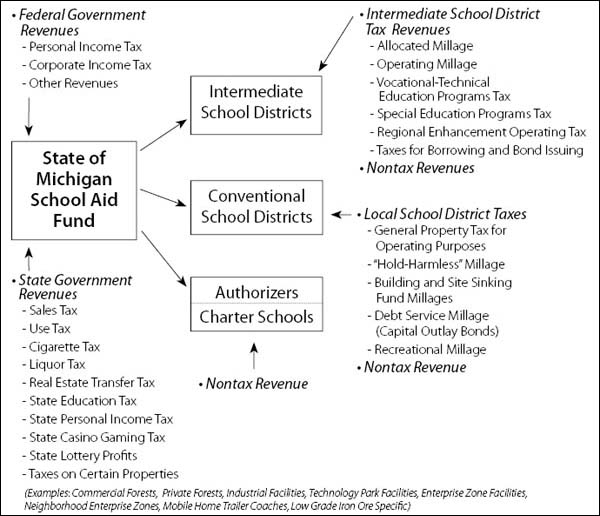
This section of "A Michigan School Money Primer" discusses elementary and secondary education revenues raised through taxes.[viii] These taxes are levied by various government units:
the United States government;
Michigan state government;
conventional local school districts;[ix]
intermediate school districts; and
the 13 counties with county tax allocation boards, with these boards apportioning county taxes to intermediate school districts and other local government units.[x]
These units place taxes on a variety of items and activities, such as property, commercial sales, and corporate and personal income. Federal and state tax revenues are combined in the Michigan school aid fund and then allocated to school districts, including local and intermediate school districts. Local tax revenues are collected locally and then spent by conventional local school districts. In the remainder of this section, the discussion of education taxes is organized by the level of government that levies the tax, beginning with local governments (the last three items listed above) and proceeding to state and federal governments (the first two items listed above).
Note that local school districts, intermediate school districts and charter schools are all able to receive nontax revenues. Conventional local school districts, for instance, sometimes receive substantial interest income on district monies, and conventional school districts and charter schools can realize income from (among other things) the sale of assets, the sale of rights to use land, tuition for summer school and preschool programs, and contributions from charitable foundations. Overall, these nontax revenues are not a large part of Michigan’s public school income, but they are not always negligible, either.
[viii]Revenues can be obtained by units of government in other ways, such as fees, though there is not strict agreement on the differences between fees and taxes. Generally, the Michigan Supreme Court has held, "...A ‘fee’ is ‘exchanged for a service rendered or a benefit conferred, and some reasonable relationship exists between the amount of the fee and the value of the service or benefit.’ A ‘tax,’ on the other hand, is designed to raise revenue.” (See Bolt v City of Lansing, 459 Mich 152, 161; 587 NW2d 264 (1999)).
[ix]Each of Michigan’s charter schools is defined as an independent school district under Michigan law. Unlike conventional public school districts, however, charter schools cannot levy property taxes because they do not have a local jurisdiction. [x]This number is based on information provided to the authors by the Michigan Department of Treasury.Local units of government raise funds for schools by taxing property. For purposes of taxation, property is divided into two broad groups: real and personal. Real property is comprised of land and buildings. Units of real property are placed into six categories for state and local property tax purposes: residential, agricultural, industrial, commercial, timber cutover and developmental property.[23] Personal property, in contrast, involves for-profit business property that is not attached to a structure. Examples of personal property include machinery, office furniture and equipment (there are specific exemptions for certain agricultural crops, and for residents’ personal clothing, furniture and other household goods).[xi] Units of personal property fall into one of five categories for local property tax purposes: residential, agricultural, industrial, commercial and utility property.[xii]
The property types listed above are important for understanding education revenues because of provisions in Proposal A. These provisions differentiate the taxation rate by property classification.[24] Specifically, under Proposal A, primary residential and qualifying agricultural properties[25] are taxed at a different rate than other properties.[26] This distinction will be relevant throughout the explanation of school revenues.
There are three steps involved in taxing property: assessment, determination of the tax rate and calculation of the individual tax bill.
[xi] MCL § 211.9(1). The list of personal property that is exempted from taxation is quite detailed; the main text provides only a broad outline of the property included. For a more complete list, see MCL §§ 211.9-211.9j.
[xii] MCL § 211.34c(3). The tax rates discussed in this section will not include the state education tax, which is a state government property tax, rather than a local government property tax.
To assess a property is to determine its value for tax purposes.[xiii] In Michigan, there are three types of value placed on real and personal property: true cash value, state equalized value and taxable value.[27]
The true cash value of a property is meant to represent the property’s market value.[28] The two are not exactly equal, however: If, for instance, real property has been sold in a particular year, the cash value of the property in that year is not necessarily the sale price, but rather the property’s value relative to other real property of the same type in the assessing jurisdiction.[29] The assessment of personal property, in contrast, is based upon depreciation of the property’s acquisition costs.[xiv]
In years in which a parcel of real property remains in the same hands, however, its cash value is determined by a tax assessor working for the city or township in which the property is located.[30] The assessor’s determination of the property’s cash value effectively establishes the property’s state equalized value, which is defined as 50 percent of the property’s cash value.[xv][31] Thus, a property’s SEV increases and decreases with an assessor’s estimate of the property’s cash value.
Taxes are calculated in one of two ways, depending on whether or not the property was recently purchased. If the property was purchased in the previous calendar year, the property’s taxes are based on the property’s current calendar year SEV.[32] If the property was not purchased in the previous calendar year, the property’s taxes are calculated on the lesser of the property’s SEV and its "taxable value."[33] Taxable value, which is defined in the Michigan Constitution, serves as a limitation on how much assessments on property may increase in a given year.[xvi] Taxable value is related to SEV in the following way: If the cash value — and thus the SEV — of a property increases in a given year by more than 5 percent or the rate of inflation, whichever is less, the taxable value of the property is calculated by increasing the previous year’s taxable value by the lower of the two rates (see example calculations in Graphic 2).[xvii][34] Thus, in areas where property values (i.e., cash values) are increasing quickly, a property’s taxable value will frequently lag behind its SEV, effectively lowering the overall taxes that would have been assessed on the property absent the constitutional limitation.[xviii] In areas where property values are falling, the constitutional provision does not apply, and taxable value and SEV will fall and be equal from year to year.
|
Slowly rising property values. Imagine that a property has been assessed at a cash value of $142,000 in one year and a cash value of $144,000 in the next — an increase of approximately 1.4 percent. The SEV during this period thus increased from $71,000 to $72,000 (likewise an increase of 1.4 percent). Also assume for the moment that the property was transferred in the first year, so the SEV and the taxable value were the same ($71,000).
If the inflation rate during the intervening year was 2.6 percent, the rate of increase in the property’s value (and SEV) is less than both 5 percent and the inflation rate, and the constitutional limitation does not cap the growth of the taxable value. Thus, the taxable value of the property in the second year is simply equal to the second year’s SEV: $72,000. Rapidly rising property values. Imagine that a property has been assessed at a cash value of $142,000 in one year and a cash value of $150,520 in the next — an increase of 6 percent. The SEV during this period thus increased from $71,000 to $75,260 (also an increase of 6 percent). Assume for the moment that the SEV and the taxable value were the same in the first year ($71,000).
If the inflation rate during the intervening year was 3 percent, the 6 percent increase in the property’s cash value (and SEV) exceeds the inflation rate. Since the inflation rate is less than 5 percent, Michigan’s constitutional limitation caps the growth of the taxable value at the 3 percent inflation rate, and the taxable value of the property in the second year is equal to a 3 percent increase in the previous year’s taxable value.[xix] The new taxable value can be calculated by taking the previous year’s taxable value (and SEV) of $71,000 and multiplying it by 1.03. The resulting taxable value in the second year would then be $73,130, while the SEV, based on the cash value in the second year, would be $75,260.
A second year of rapidly rising property values. Now imagine that the cash value of the property in the previous example rises from $150,520 in the second year to $154,000 in the third year — an increase of approximately 2.3 percent. The SEV during this period thus increased from $75,260 to $77,000 (also an increase of about 2.3 percent).
If the inflation rate from the second to the third year was 1.9 percent, the 2.3 percent increase in the property’s cash value (and SEV) exceeds the inflation rate. Since the inflation rate is less than 5 percent, Michigan’s constitutional limitation caps the growth of the taxable value at the 1.9 percent inflation rate, and the taxable value of the property in the third year is equal to a 1.9 percent increase in the previous year’s taxable value. (The taxable value in the second year was not the same as the $75,260 SEV, but was rather $73,130, due to the constitutional constraint on property tax growth.) Thus, the new taxable value can be calculated by taking the previous year’s taxable value of $73,130 and multiplying it by 1.019. The resulting taxable value in the third year would then be approximately $74,519.47.35
Michigan law limits only increases in the taxable value of a property, not decreases.36 The constitutional cap therefore does not apply, and the taxable value simply declines along with the SEV from $71,000 in the first year to $69,000 in the second.[xx] |
Tax Base
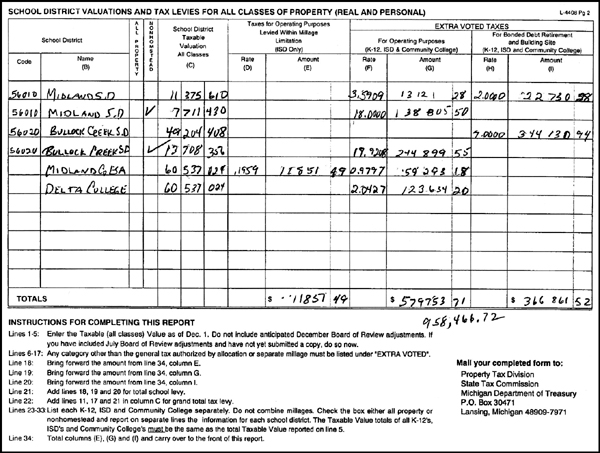
The total taxable value of all property under the jurisdiction of a taxing authority (such as a local school district) is called the "tax base."[xxi] This tax base is described annually in a property tax report prepared by a county official known as an "equalization director." The equalization director must file the report with the State Tax Commission every year by the fourth Monday in June, and the report must include the following:
the total taxable value as of the fourth Monday in May of that year;[xxii]
the taxable value for each class of property;
the total taxable value of all property in the county that is categorized as a "principal residence" or as "qualified agricultural property"[xxiii]; and
the total taxable value for all property that is categorized as something other than a "principal residence" or "qualified agricultural property" (also called "nonhomestead property").[37]
An example of the document is pictured in Graphic 3[xxiv].
[xiii] The assessment of real and personal property involves a complex variety of factors. This primer does not explore these factors, but rather focuses on the tax revenues generated to finance public schools. Interested readers can see the broad statutory language in MCL § 211.27(1) and access the state’s assessor manuals on the Michigan Department of Treasury Web site at www.mi.gov/treasury/0,1607,7-121-1751_2228---,00.html (accessed on April 3, 2007).
[xiv] For an example of the personal property tax reporting form used by an assessor, see www.michigan.gov/documents/taxes/632_2007_181916_7.pdf.
[xv] The process by which local property values are equalized following an assessor’s determinations of true cash value involves adjustments for inflation and other factors. Readers interested in an overview of the equalization process can consult "Bulletin No. 9 of 2006: Equalization Calendar, Equalization of Assessments," (State Tax Commission, Michigan Department of Treasury, 2006), www.michigan.gov/documents/treasury/Bulletin9of2006_177475_7.pdf (accessed April 13, 2007).
[xvi] This is a feature of Proposal A of 1994, appearing in Article IX, Section 3, of the Michigan Constitution of 1963. A number of other taxes on property are not governed by taxable value; see particularly "Certain Properties in Local School Districts," under Property.
[xvii] In instances of general deflation, the rate of increase would still be dependent on the general price level. If the general price level has decreased, taxable value would still be the lesser of SEV or the taxable value in the previous year reduced by the percentage decrease in the general price level.
[xviii] According to a 2006 report, taxable value statewide for real and personal property was $93.9 billion less than SEV: Andrew Lockwood, "The Michigan Property Tax Real and Personal: 2005 Statistical Update," (Tax Analysis Division, Bureau of Tax and Economic Policy, Michigan Department of Treasury, 2006), 1, www.mi.gov/documents/treasury/2005StatUpdatePropTaxReport_178063_7.pdf (accessed April 13, 2007). State taxable value was 84.6 percent of SEV in 2000: Citizens Research Council of Michigan, "The Growing Difference between State Equalized Value and Taxable Value in Michigan," (Citizens Research Council, 2001), www.crcmich.org/PUBLICAT/2000s/2001/memo1058.pdf (accessed January 20, 2006). See Finance and Organization for county comparisons of taxable value and SEV in 1994 and 2000.
[xix] If the inflation rate had exceeded 5 percent, Michigan’s constitutional cap would have allowed the taxable value to increase by no more than 5 percent from the previous year’s cash value. In this case, the new taxable value would then have been calculated by multiplying the old taxable value (and SEV) of $71,000 by 1.05, and the resulting taxable value in the second year would then have been $74,550. The SEV of $75,260 then would have been greater than the taxable value, since the SEV (and cash value) increased by 6 percent, not 5 percent.
[xx] If a property’s value has increased quickly over a number of years, but later decreased, the taxable value would lag the SEV during the years of increase (due to the constitutional amendment), remain constant during the years of decrease until the SEV fell back to the taxable value, and then become equal to (and decline in lockstep with) the SEV. In general, then, the taxable value is the lesser of the capped value and the SEV.
If, on the other hand, a property’s value falls in one year and then increases faster than inflation in the following year, the taxable value is still limited by the rate of inflation in the second year.
[xxi] For a database of taxable value by school district or county, see http://mdoe.state.mi.us/taxvalue/Default.aspx. Users without the appropriate account must click the "Public Access" radio button to enter the database. Districts are searchable only by district code. Users can obtain district codes by searching for a district in the School Code Master database available from the state’s Center for Educational Performance and Information at http://cepi.state.mi.us/scm/directory/step2.asp?intSearchType=2.
[xxii] MCL § 211.27d. The items specified by (2), (3) and (4) also appear to be due on the fourth Monday in May, but the statute specifies the day only for this item (1).
[xxiii] This property is reported separately since it receives a "homestead tax exemption" in many school districts.
[xxiv] This form has been replaced by Form 2849 (www.michigan.gov/documents/2849f_2649_7.pdf), but the new form had not yet been used at the time of this writing. Graphic 3 shows only the second page of the report because the first page contains primarily tax rates and figures that are transferred to Page 2 to make calculations.
Once a property’s taxable value has been calculated, the appropriate tax rate — or millage — must be determined. This rate will depend on the property’s tax category.
Recall that for personal property, this category is one of five classifications: residential, agricultural, commercial, industrial or utility property.[xxv] Similarly, for real property, the category is one of six classifications: residential, agricultural, industrial, commercial, timber cutover and developmental property.
Real property is classified as either "homestead" or "nonhomestead." A "homestead" property is a residential parcel that is a taxpayer’s primary dwelling within the state;[xxvi] the category does not include Michiganians’ secondary in-state residences or "summer cottages." Homestead property also includes some qualified agricultural properties. "Nonhomestead" properties, in contrast, are those that do not qualify as homesteads.
Tax rates for real property and personal property are measured in units called "mills." One mill equals one-tenth of one cent per dollar of taxable value, or equivalently, one dollar per thousand dollars of taxable value. In decimals, 1 mill would be expressed as 0.001.
For example, nonhomestead property is typically subject to a maximum local school operating property tax of 18 mills.[38] Local millage rates, or the number of mills applied to a property, are determined by property type and the purpose of the tax. The various state and local millage rates are discussed beginning with"Local Property Taxes by Type," and in subsequent sections dealing with state taxes for education.
[xxv] See Local Government.
[xxvi] Excepting military personnel, if a Michigan property owner has filed an income tax return as a resident in another state, that person — for example, a civilian Michigan summer home owner who does not permanently reside in Michigan — is not eligible for the homestead exemption; see MCL § 211.7cc(3)(d).
Taxes on real and personal property are levied annually in either the summer or the winter, though the taxes may be billed to a property owner semiannually (in the summer and winter) if the school board passes a resolution to collect them in this way and if the local tax collection authority agrees.[39] The annual tax bill for a specific piece of property is calculated by multiplying the taxable value of the real (or personal) property by the number of mills of tax to which the property is subject. For example, assume that a taxpayer has just purchased a property that has a cash value of $100,000 and is subject to an 18 mill tax. Since taxable value is set equal to SEV when a property is transferred, and since SEV is one-half the cash value of the property, the property's taxable value would be $50,000. Given that a mill is defined as the decimal 0.001, the 18 mill tax rate is equivalent to the decimal 0.018. Thus, the annual property tax bill would be calculated as follows:
Tax Due = Taxable Value x Millage Rate = $50,000 x 0.018 = $900
Hence, the property owner would be required to pay $900 for this 18 mill tax on his or her $100,000 piece of property.
This calculation is reasonably straightforward. Examples of actual tax bills are reproduced in the two graphics below. In each case, a variety of different tax rates have been applied to the taxable values of the two properties in order to pay for different government activities. In Graphic 4, for instance, a 0.64 mill rate is assessed on the property to pay for city debt, while other millage rates are used to calculate taxes owed for the Midland Public Schools sinking fund, Delta Community College operating expenses and so forth.
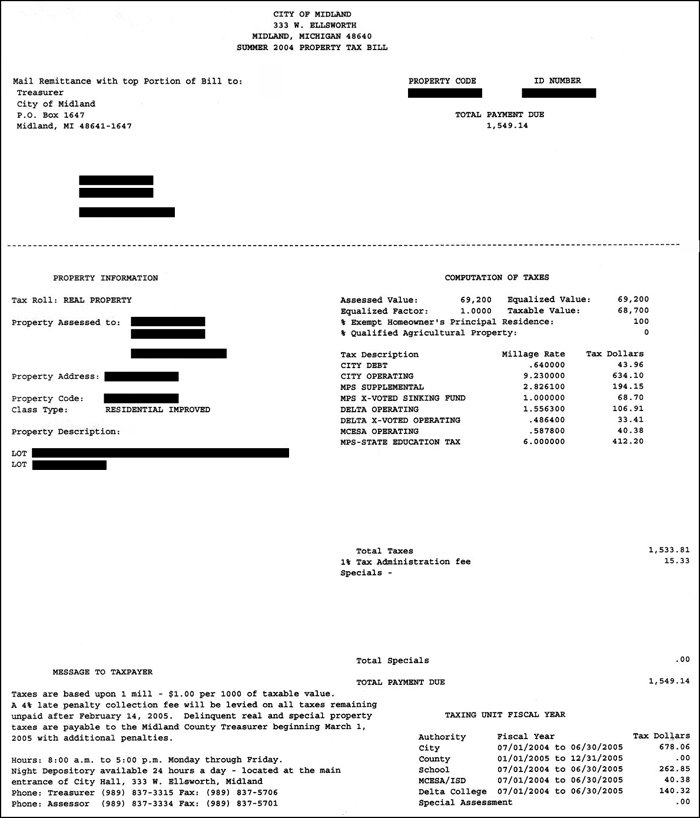
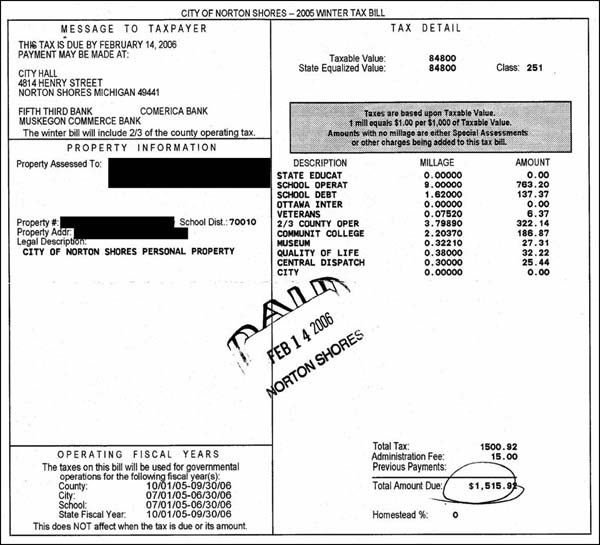
Note that in Graphic 4, the taxable value of the property differs from the property's SEV. As discussed above under "Assessment of Taxable Property", taxable value will diverge from SEV when a property's value increases above the inflation rate or 5 percent, whichever is less (Graphic 2 in that section shows how taxable value is calculated in such instances).[xxvii]
As noted earlier, this property tax cap on taxable value would apply to both real property and personal property. In general, however, the value of personal property tends to decline, rather than increase.
The 'Headlee Rollback[xxviii]
Article 9, Section 31, of the Michigan Constitution stipulates that if the percentage increase in the assessed value of real and personal property in a taxing jurisdiction (excluding new construction) exceeds the inflation rate, the authorized property tax millage must be reduced to a level that would limit the annual increase in property tax revenue to the rate of inflation. This property tax limitation is part of what is popularly known as the "Headlee amendment" to the Michigan Constitution, so this reduction in the millage rate is often referred to as a "Headlee rollback."[xxix] Headlee rollbacks, which are calculated by the county equalization director,[40] are automatic, but a majority of the qualified local electors can override a rollback and hold the tax rate constant in a process known as a "Headlee override."
An alternative form of Headlee "override" can occur as well: In some instances, school districts ask voters to increase the local operating millage beyond the maximum amount that can be levied by law. Although the district cannot collect more than the maximum, all subsequent Headlee rollbacks are calculated on the larger, voter-authorized millage rate. Since the rollbacks calculated on this higher millage are unlikely to fall back to the maximum millage rate for many years, Headlee rollbacks are effectively pre-empted throughout that time.[41]
There are two important points to note about the Headlee rollback. First, the rollback does not apply to the statewide property tax known as the "state education tax".[xxx] Second, the rollback limits the revenue growth districtwide; it does not limit the increase in the property tax bill of an individual property owner. If an owner's assessment jumps well above the inflation rate in a given year, a Headlee rollback might not reduce the millage rate enough to offset the assessment increase and yield a tax increase that is less than the inflation rate for that property owner.
Because of Headlee rollbacks, a local millage rate may vary from year to year. For example, let us say that the taxable value of the properties subject to a particular tax in a school district increases from $150 million in one year to $175 million in the next year with no losses or additions of property.[42] This is a percentage increase of
($175,000,000 − $150,000,000) x 100 percent = $25,000,000 x 100 percent = 16.67 percent,
$150,000,000
$150,000,000
Assume, however, that the rate of inflation during this year is 2 percent – much less than the 16.67 percent increase in taxable value. The millage rate must then be reduced in order to make sure that actual tax revenue from the taxable properties (excluding new construction) does not exceed the inflation rate. The formula for calculating that "rolled-back" millage rate is
MR
2 =TV1 x MR1 x (1 + IR),TV2
where
MR2 is the new, "rolled-back" millage rate;
TV1 is the taxable value in the first year (adjusted to exclude any subsequent property losses);
TV2 is the taxable value in the second year (adjusted to exclude new construction);
MR1 is the millage rate in the first year; and
IR is the inflation rate, expressed as a decimal, from the first year to the second.[xxxi]
Applying this formula to the current example and assuming that last year's rate on the property type in question is 18 mills, the new millage rate would be
MR
2 =TV1 x MR1 x (1 + IR) = $150,000,000 × 18 mills × (1 + 0.02) = 15.7371 mills.TV2 $175,000,000
Note that this new millage does precisely what the Headlee amendment stipulates. When the new millage rate is applied to the new taxable value of $175,000,000, the tax revenue is $175,000,000 ¡Á 0.0157371 = $2,753,992.50. Since the previous tax revenue was $150,000,000 ¡Á 0.018 = $2,700,000, the resulting percentage increase in tax revenue is
($2,753,992.50 − $2,700,000) x 100 percent = $53,992.50 x 100 percent = 2.00 percent,
$2,700,000 $2,700,000
meaning that the increase is, correctly, no more than the 2 percent inflation rate.
[xxvii] For an actual example of a total SEV annual increase as compared to a total taxable value annual increase, see Daryl J. Delabbio and Robert J. White, "2005 Financial Overview, Kent County, Michigan," (Kent County, Michigan, 2005), 6, www.accesskent.com/YourGovernment/Publications/pdfs/ 2005FinancialOverview.pdf (accessed February 2, 2006).
[xxviii] Headlee rollbacks are a form of property tax limitation. Another is a "Truth in Taxation" rollback (see MCL § 211.24e), which is more strict than a Headlee rollback, but according to the Michigan Department of Treasury, less likely to be invoked. This property tax limitation requires that millage rates be reduced so that property tax revenue does not exceed the previous year’s revenue (unlike the Headlee rollback, this limitation does not allow for inflationary increases in a district’s taxable value).
A district may be exempted from the "Truth in Taxation" rollback in one of two ways. First, it may adopt the "Truth in Taxation" provisions (see MCL § 141.436 and MCL § 211.24e(3)), which require school districts (and other local government authorities) to estimate revenues by source (see MCL § 141.436(3)) and taxes the district will levy — within all other applicable statutory limits and constitutional limits (discussed below) — to fund its projected expenditures (see MCL § 141.436(1) and MCL § 141.436(6)). Second, it may hold a "Truth in Taxation" hearing (see MCL § 141.412) to discuss publicly the additional millage required to maintain millage rates at the authorized limit, and then may adopt a resolution to approve the additional mills required to keep the millage rate at the authorized limit ("Michigan Public School Accounting Manual (Bulletin 1022): Section II, Requirement," (Michigan Department of Education, 1998), 16).
[xxix] MCL § 211.34d. This is referred to by the State Tax Commission as the "Headlee Millage Reduction" or an "L-4029 levy," after the name of the form used to report it.
[xxx] See, for instance, Michigan State Tax Commission, "Bulletin No. 4 of 2006: Millage Requests and Rollbacks," (Michigan Department of Treasury, 2006), 4, www.michigan.gov/documents/Bulletin4of2006-MillageRollback_152026_7.pdf (accessed April 3, 2007). The Headlee amendment was passed before the existence of a statewide property tax.
[xxxi] County equalization directors usually calculate this millage reduction using a "Headlee Millage Reduction Fraction." Computations of the Headlee MRF for each taxing jurisdiction are provided annually by the State Tax Commission in a document issued to tax collection officials, such as county clerks, county treasurers, equalization directors, and the boards of local school districts and intermediate school districts.
The MRF formula divides the product of the prior year’s taxable value minus losses and an inflation rate multiplier by the current year’s taxable value minus additions. Generally defined, the inflation rate multiplier is the current year’s general price level divided by the previous year’s general price level. Under Michigan statute, the general price level is the average of the previous year’s monthly consumer price index (CPI) values, which reflect the change in the average urban consumer’s price for certain goods and services.
The general formula is expressed in the following way:
MRF = (Taxable ValuePrevious Year - Losses) x Inflation Rate Multiplier.
(Taxable ValueCurrent Year - Additions)
For 2005, the State Tax Commission’s formula was the following:
2005 MRF = (Taxable Value2004 - Losses) x 1.023.
(Taxable Value2005 - Additions
This product of this fraction and the previous year’s nonhomestead millage rate is then the new millage rate.
Property is typically subject to a number of different local property taxes.
Graphic 4, see "Calculation of an Individual Tax Bill," shows the real property tax bill for a resident of Midland. The bill lists eight different taxes; the three prefaced by "MPS" are levied for the public school system.[xxxii]
We will briefly discuss each type of local property tax levied by local school districts.[xxxiii]
Local School Districts
General Property Tax for Operating Purposes[xxxiv]
Local school districts can levy a general property tax on nonhomestead real and personal property to finance school operations. The amount of this levy must be approved by the voters in the district, and the millage rate is limited to the lesser of 18 mills or the number of mills levied by the district for operating purposes in 1993,[xxxv] prior to the passage of Proposal A.[xxxvi]
In other words, up to 18 mills can be levied on commercial, industrial, developmental, personal, certain timber cutover and unqualified agricultural property, though this millage is subject to Headlee rollbacks. Revenues from these sources are primarily intended for "operating" purposes. According to Michigan law, operating expenditures include personnel, "furniture and equipment, for alterations necessary to maintain school facilities in a safe and sanitary condition, for funding the cost of energy conservation improvements in school facilities, for deficiencies in operating expenses for the preceding year. ..."[xxxvii] They do not include a sinking fund (the purchasing of real property for building construction and renovations), financing a current or projected operating deficit through district-issued bonds,[43] operation of certain libraries or operating a community swimming pool.[44]
‘Hold-Harmless’ Millage
An exception to this 18 mill operating tax limit is commonly referred to as a "hold-harmless" provision. This provision is tied to a district’s "foundation allowance" — that is, the number used to calculate state government’s contribution to operating spending in conventional local school districts and charter schools.[xxxviii]
Of the 552 conventional Michigan public school districts, 51 are considered "hold-harmless districts," because they have been able to levy a "hold-harmless" millage at one time or another since 1994, the year that Michigan voters passed Proposal A. These districts have been permitted to levy this millage above the amount that Michigan statute typically allows because the districts had fiscal 1995 per-pupil revenues that were higher than $6,500. The millage must still be approved by a majority of voters in the district[45] and is subject to the rollback provisions of the Headlee amendment.
A hold-harmless millage can be levied on both homestead and nonhomestead property, but the size of hold-harmless millages is limited by certain provisions of Michigan law. The first is that a school board of a hold-harmless district
"may reduce the number of mills from which a principal residence and qualified agricultural property are exempted … by up to the number of mills … required to be levied on a principal residence and qualified agricultural property for the school district’s combined state and local revenue per membership pupil for the school fiscal year ending in 1995 to be equal to the school district’s foundation allowance for the state fiscal year ending in 1995, and the [hold-harmless district’s] board also may levy in 1994 or a succeeding year that number of mills for school operating purposes on a principal residence, qualified agricultural property, and qualified forest property."[46]
This statute means that after 1994, a qualifying district may levy a large enough homestead property tax millage to produce a total state and local revenue equal to the amount available to the district in 1995. The effect is to allow a hold-harmless district to receive at least as much under Proposal A as it did before Proposal A (an additional provision of the State School Aid Act ensures that increases in per-pupil operating revenues are financed by state government).[47]
Second, the number of hold-harmless mills must be reduced if a growth in the district’s taxable value drives the annual per-pupil revenue increase above either the dollar increase in the state’s basic foundation allowance[xxxix] or the percent increase in the consumer price index, whichever is less.[48] This provision prevents any growth in hold-harmless property taxes from exceeding the inflation rate, but the provision also makes sure that hold-harmless districts, which already spend more than the average district, do not move too much further above the average when the taxable value of property in the district rises rapidly.
Third, hold-harmless millage rates cannot be greater than the number certified for each district by the state Treasury Department in fiscal 1995.[49]
As of fiscal 2006, 28 districts levied hold harmless millages.[xl] These districts are listed in Graphic 6.[xli]
|
District Name |
Homestead |
Homestead Second |
Nonhomestead |
| Ann Arbor Public Schools | 5.509 |
0.000 |
0.000 |
| Avondale School District | 1.320 |
0.000 |
0.000 |
| Birmingham City School District | 8.950 |
0.000 |
0.000 |
| Bloomfield Hills School District | 8.116 |
0.000 |
0.000 |
| Center Line Public Schools | 15.578 |
0.000 |
0.000 |
| Clarenceville School District | 0.727 |
0.000 |
0.000 |
| Dearborn City School District | 5.219 |
0.000 |
0.000 |
| East Lansing School District | 0.857 |
0.000 |
0.000 |
| Farmington Public School District | 9.160 |
0.000 |
0.000 |
| Grosse Ile Township Schools | 2.156 |
0.000 |
0.000 |
| Grosse Pointe Public Schools | 6.265 |
0.000 |
0.000 |
| Lamphere Public Schools | 14.500 |
0.000 |
0.000 |
| Livonia Public Schools | 0.600 |
0.000 |
0.000 |
| Midland Public Schools | 3.591 |
0.000 |
0.000 |
| Novi Community School District | 3.566 |
0.000 |
0.000 |
| Oneida Township S/D #3 | 6.147 |
0.000 |
0.000 |
| River Rouge School District | 18.000 | 1.437 | 1.437 |
| Romulus Community Schools | 8.990 |
0.000 |
0.000 |
| Saugatuck Public Schools | 1.487 |
0.000 |
0.000 |
| School District of the City of Royal Oak | 3.503 |
0.000 |
0.000 |
| South Lake Schools | 4.853 |
0.000 |
0.000 |
| Southfield Public School District | 18.000 | 1.633 | 1.633 |
| Trenton Public Schools | 3.732 |
0.000 |
0.000 |
| Troy School District | 5.739 |
0.000 |
0.000 |
| Walled Lake Consolidated Schools | 2.108 |
0.000 |
0.000 |
| Warren Consolidated Schools | 6.717 |
0.000 |
0.000 |
| Waverly Community Schools | 6.037 |
0.000 |
0.000 |
| West Bloomfield School District | 3.716 |
0.000 |
0.000 |
|
Source: "LEA Millage Rates," Michigan Department of Education. |
|||
Property Taxes for Capital Purposes
Money expended to finance debt and to obtain, build or upgrade physical assets like school buildings and equipment is considered "capital spending," while money spent on day-to-day needs like school supplies and staff for classrooms is considered "operational spending."[xlii] Michigan law requires that local school districts separate their operational and capital expenditures, and different taxes are levied for each purpose. The revenue sources for school districts’ capital expenditures are discussed below.
Building and Site Sinking Fund Millages
According to Michigan law, conventional school districts may levy a tax on the property in a district to create a sinking fund "to be used for the purchase of real estate for sites for, and the construction or repair of, school buildings."[50] A sinking fund is similar to a savings account into which a district makes regular deposits until the district has saved enough to pay for real estate, repairs or construction.[51]
A building-and-site sinking fund millage is limited to 5 mills for no more than 20 years, and these millages are subject to Headlee rollbacks. The millage must be approved by the voters in a school district and must be presented on the ballot in the following terms: "Shall (district name) levy (number not to exceed five) mills to create a sinking fund for the purpose of (projects to be addressed) for a period of (number not to exceed 20) years?"[52]
Compared to the debt millage that will be discussed below, the building-and-site sinking fund millage is little used. In 2002, taxes levied to service debt accounted for more than 92 percent of combined debt and sinking fund levies.[53] Of the 552 conventional school districts, three districts levied 4 mills or more for sinking fund levies in fiscal 2006.[xliii]
Capital Outlay Bonds for Debt Service
In addition to sinking fund levies, local school districts can finance capital projects by issuing bonds. Bonds are bought by investors who are then repaid by the school district over the period stipulated by the terms of the bond. Depending on the bond’s type, the principal (the amount borrowed) and interest (the fee paid to borrow the principal) must then be paid back from the district’s general fund or by revenue raised through a debt service property tax. Such debt service property taxes, unlike general operating millages, are not subject to Headlee rollback provisions.[54]
Local districts can issue three types of bonds,[55] all of which must be approved by the state treasurer, in keeping with Public Act 34 of 2001:[xliv]
"Resolution bonds" are issued by a motion of the local school board and do not require the approval of the district’s voters. Resolution bonds and the district’s other debt cannot total more than 5 percent of the SEV of all property in the district.[xlv] Annual payments on the principal and interest are made from existing school district monies, not from additional property tax levies.
"Nonqualified bonds" can be issued by a school district for a period of one year to 30 years, and the bonds must be approved by a vote of the school district electorate. The board of education must then levy a tax to make principal and interest payments on the bond. Michigan law does not allow nonqualified bonds to exceed 15 percent of the SEV of all property in the district.[56]
State "qualified bonds" are sold by the district but guaranteed by the state of Michigan, meaning that the district may use the state’s — rather than the district’s — credit rating. Since the state’s credit rating is usually better than the district’s, the district is able to obtain a lower interest rate. Still, the district must first seek and gain approval from the state treasurer to sell qualified bonds, and a majority of the district’s voters must approve a property tax levy to finance the bonds. If the property tax revenue is not sufficient to service qualified bond debt — i.e., to make annual payments on the bonds’ principal and interest — the district can borrow from the Michigan School Loan Revolving Fund. Details about the MSLRF and the numerous steps districts must follow to issue qualifed bonds appear in Graphic 7.
|
To receive state approval to issue qualified bonds, the district’s application to the state treasurer must include the following information:[58]
Before qualifying new bonds, the state treasurer must determine that the additional bond issue will not prevent the district from repaying outstanding qualified loans.[xlvi] After determining that a district’s application for qualified bonds has met the requirements of state law, the treasurer can grant "prequalification," which allows the district to present the request for a bond issue to voters in the district. If the voters approve the qualified bond issue, the district has now met all the conditions necessary to issue the qualified bonds, and the district may levy up to 13 mills of property tax to service its bond debt. A district need not always levy a property tax large enough to repay all of its qualified bonds. If a district can get voter approval for at least 7 mills of property tax to repay a portion of the bonds, it can borrow from the state government’s Michigan School Loan Revolving Fund any extra money it needs to supplement the millage and make its bond payments on time.[xlvii] Once the bonds are repaid to the bondholders, the district then continues to levy the millage until the proceeds repay the MSLRF for the loan. The loan may not equal more than the difference between revenue from the millage that a district says in its application will be proposed to voters in the school district[xlviii] and the amount required to pay principal and interest on the qualified bonds. The district is also able to borrow to cover projected lost revenue due to some property owners’ failures to pay taxes.[61] The full MSLRF loan must be repaid by the district within six years of the bond’s maturity date. For example, if a 10 year bond were issued on July 1, 2006, and the district acquired a loan from the MSLRF to repay the bond, the district would have to repay the loan in full by July 1, 2022, since the bond would reach maturity on July 1, 2016.[62] Sources: Various, including the School Bond Qualification, Approval, and Loan Act of 2005 and "State of Michigan Bond Qualification Process Overview" (Michigan Department of Treasury). |
Recreational Millage
Public Act 156 of 1917 authorizes school districts and municipalities to "operate a system of public recreation and playgrounds."[63] The district’s residents may "vote to provide funds for operating"[64] the recreational facilities, and the district may "acquire, equip and maintain land, buildings and other recreational facilities" and "employ a superintendent of recreation and assistants."[xlix] These recreational millages are subject to Headlee rollbacks.
The 12 school districts that levied a recreational millage in fiscal 2006 are shown in the table below.
|
Local School District Name |
Recreational Mills |
|
Bridgman |
0.5000 |
|
East Grand Rapids |
1.3837 |
|
Forest Hills |
1.0000 |
|
Hamtramck |
4.4876 |
|
Jackson |
0.2000 |
|
Northview |
0.7500 |
|
Novi |
0.9800 |
|
Rockford |
0.9949 |
|
Saline |
0.8316 |
|
Saugatuck |
0.2500 |
|
Whitmore Lake |
0.6099 |
|
Zeeland |
0.4000 |
|
Source: Michigan Department of Treasury |
|
Intermediate School Districts
Under Michigan law, an intermediate school district has some of the powers of local school districts[li] and generally provides certain transportation and special education services to the local districts within its borders. There are currently 57 ISDs, and some of them have boundaries that correspond with county lines. All 552 conventional local school districts fall within the borders of an ISD, and each ISD generally acts as service agency for its constituent districts. (The state’s private schools and approximately 225 charter schools may also receive services from their regional ISD.) Most ISDs are referred to by an area name and an acronym, such as ISD, ESA ("educational service agency"), RESA ("regional educational service agency") and ESD ("educational service district"). Despite the different acronyms, all are ISDs and have the same powers.
ISDs receive revenues from local taxes (discussed below) and state and federal government (discussed later).
Allocated Millage
Before each fiscal year, an ISD’s general fund budget is approved by the ISD’s constituent conventional local school districts. If an ISD is located in one of the 70 Michigan counties without a county tax allocation board, the ISD receives an allocated millage approved by the ISD’s voters at the time the county’s tax allocation board was disbanded.[lii][65] If an ISD is located in one of the 13 counties retaining a county tax allocation board, the ISD submits a general fund operating budget for the coming fiscal year to the clerk of the county in which the ISD is located. The county clerk submits the budget to the county’s tax allocation board,[liii] which then sets a tax rate based on the ISD’s general fund operating budget.[liv] The millage rates for an ISD allocated millage are subject to Headlee rollbacks.
The general fund operating budget includes "revenues from the [ISD’s] share of mills as determined by the tax allocation board or by referendum or state school aid." Expenditures from the general fund operating budget of an ISD include those required for "the operation of all [ISD] programs except cooperative education, special education, and vocational education, [but] … may apply to expenditures from the general fund to assist with the costs of cooperative education, special education, and vocational education."[66]
Information from the Michigan Department of Treasury indicates Clare and Muskegon counties had the state’s highest ISD allocated millage rates in fiscal 2006, each distributing 0.5 mills to their respective ISDs. Oscoda County had the lowest allocated millage rate to an ISD, distributing no millage to the four-county ISD that includes parts of Crawford, Ogemaw, Oscoda and Roscommon counties.
Operating Millage
In addition to the levy discussed in the previous section, an intermediate school district may levy a tax for operating expenses on all real and personal property within the ISD’s boundaries if approved by the ISD’s voters. This tax rate may not exceed 1.5 times the ISD’s allocated millage in 1993[67] and is subject to Headlee rollbacks.
While some intermediate school districts’ boundaries follow county lines, several encompass more than one county. Once a county has collected the revenue from the ISD’s operating millage, the treasurers in the counties encompassed by the ISD disburse the appropriate amount of revenue to the treasurer of the ISD board.[lv][68]
The intermediate district with the highest operating millage is the Branch ISD, which levies 8.0345 mills; the lowest is the Crawford-Oscoda-Ogemaw-Roscommon ISD, which levies 0.6329 mills.
Tax for Vocational-Technical Education Programs
ISDs are given the authority by Michigan law to institute and finance vocational-technical education programs.[69] ISDs may fall into one of two tax limitation categories for financing such programs, but in either case, the tax would be subject to Headlee rollbacks. First, if an ISD levied a tax for a vocational-technical education program in 1993, it may levy additional mills for that program at a rate of up to 1.5 times the number of mills it levied for a vocational-technical education program at that time.[70]
Second, if an ISD did not levy a tax for a vocational-technical education program in 1993, the ISD may establish and finance the program once it has received voter approval to create such a program and to levy a tax up to the limit specified in the ballot question. The highest vocational-technical millage these ISDs can present to voters is 1 mill.[71]
Of the 57 ISDs, 31 levied a vocational-technical education millage in 2006. Of the ISDs that levy such a tax, the Branch ISD has the highest rate, 4.2105 mills, while Oakland ISD has the lowest, 0.6231 mills.
Tax for Special Education Programs
An intermediate school district is required by statute to "develop, establish, and continually evaluate and modify" special education programs for its constituent districts.[72] If an ISD wishes to receive funds from local property taxes specifically for special education programs, it must present to voters in the ISD a ballot question that limits the number of mills that the ISD can levy on all property for operating special education programs.[73] The district may not request a millage rate higher than 1.75 times the number of mills the ISD levied in 1993 for special education operating purposes, and the millage rate is subject to rollbacks under the Headlee amendment.
Every ISD levied a local special education property tax in 2006.Jackson ISD levied the highest tax rate at 5.6229 mills, while Crawford-Oscoda-Ogemaw-Roscommon Intermediate School District levied the lowest at 0.6329 mills.
Property Tax for Regional Enhancement Operating Purposes (Tax-Base Sharing Provision)
Intermediate school districts may levy with the approval of voters a "regional enhancement" property tax. Revenues from the tax are meant to "enhance other state and local funding for local school district operations,"[74] so the revenues are not kept and spent by the ISD itself, but rather passed through to the ISD’s constituent districts. The tax can be levied at the rate of up to 3 mills for up to 20 years and is subject to Headlee rollbacks. The tax can, however, be renewed by a majority of voters in the intermediate school district.[75]
The ISD distributes the revenue to its constituent districts by dividing the total raised under the tax by the number of pupils in the ISD. The per-pupil amount is then multiplied by the number of students enrolled in a particular conventional school district on the most recent pupil count day, and the resulting sum is disbursed to the constituent district within 10 days after the ISD receives the revenue.[76]
The two ISDs that levied this tax in 2006 were the Monroe ISD, whose millage rate is 0.9866 mills, and the Kalamazoo Valley ISD, which has a millage rate for this tax of 1.5 mills.[77]
Borrowing and Bond Issuing
Intermediate school districts may borrow money or issue bonds without the approval of voters[lvi] in the ISD if the total amount of bond indebtedness does not exceed one-ninth of 1 percent of the SEV of the taxable property in the district. Total bond indebtedness does not include bonds issued for vocational-technical education facilities or special education facilities.[lvii][78] The bonds are repaid by revenues from a property tax millage approved the ISD’s voters, but this millage is not subject to rollbacks under the Headlee amendment, which specifically excludes from rollbacks "taxes imposed for the payment of principal and interest on bonds. ..."[79]
Bonds issued under these provisions may be used to purchase building sites, purchase information technology systems and software, or "purchase, erect, complete, remodel, improve, furnish, refurnish, equip or re-equip buildings and facilities the (intermediate school) board is authorized to acquire," including administrative, special education and vocational-technical education facilities.[80]
[xxxii] The first two of these school taxes are for local schools, while the third is levied for the state’s public schools by state government.
[xxxiii] Later, under this primer’s discussion of state taxes, it will be possible to report the total revenue raised by each state tax. A similar breakdown is not possible for local property taxes, however. Government documents report aggregate local tax revenue in such broad summaries as "extra voted operating" taxes, a category that combines at least five different property tax levies. Furthermore, in state Treasury Department reports, aggregate revenues are given not by school districts, but by counties, each of which can contain numerous school districts. See, for example, "2005 Ad Valorem Property Tax Levy Report: Taxable Valuations, Average Tax Rate Data and Tax Levies for Counties, Townships, Cities, Villages and Schools," (State Tax Commission, Michigan Department of Treasury, 2006), https://www.michigan.gov/documents/treasury/2005AdValorem_177897_7.pdf (accessed February 27, 2007).
Two other sources could give the interested reader total locally retained revenue, but again not by property tax type. The fiscal data reported in the electronic module described in Appendix 3 presents total revenue from local sources by district. Readers can also arrive at an unaudited but roughly accurate figure by calculating the revenue from the millage rate for a particular tax — most are listed in this primer — and the taxable value for the appropriate class of property.
[xxxiv] Because this primer focuses on school finance, property taxes levied by counties, cities or municipalities for noneducation purposes will not be discussed.
[xxxv] Certain districts can in fact levy more than 18 mills on nonhomestead property, but they must levy these additional mills through a “hold-harmless” millage, which is discussed below. Michigan education fiscal year runs from July 1 through June 30. Note that this fiscal year is different from the fiscal years of Michigan government and the U.S. government, both of which start on Oct. 1 and end on Sept. 30.
[xxxvi] MCL § 380.1211. According to the statute, a local district, with approval from the electorate, “shall levy not more than 18 mills for school operating purposes or the number of mills levied in 1993 for school operating purposes, whichever is less.”
[xxxvii] MCL § 380.1211(8)(g). Personnel are not directly listed, but are implied.
[xxxviii] This state grant spending is discussed in detail under the section entitled “The Foundation Allowance.”
[xxxix] The basic foundation allowance is the minimum amount of per-pupil state and local tax revenue a school district receives for operating purposes if the district levies the maximum possible nonhomestead property tax millage (either 18 mills or the school property tax millage in 1993). For further details, see the section titled “The Foundation Allowance.”
[xl] Since hold-harmless districts are those that have levied such additional property tax millages at some time since 1995, not all 51 hold-harmless districts continue to levy hold-harmless millages.
[xli] This list is compiled from “LEA Millage Rates,” Michigan Department of Education, https://www.michigan.gov/documents/lea_millage_39045_7.pdf.
[xlii] The distinction between capital expenses and operating expenses is not always intuitive or clearly defined. For instance, the capital expenses that local school bonds can (and cannot) defray are listed at length and in some detail in MCL § 380.1351a. In the case of sinking fund millages, the Michigan School Business Officials Web site posts a series of letter exchanges between Michigan school districts and Michigan Department of Treasury concerning whether a sinking fund millage can be used for a variety of specific expenses (for example, acoustical insulation, basketball backboards, replacement of water heaters, kitchen dishwasher rooms); see http://www.msbo.org/library/SinkingFund/Table_Contents_E_L_.pdf.
[xliii] These are Union City Community School District (4.8575 mills), Dearborn Heights School District #7 (4.5909 mills) and Highland Park City Schools (4.9970 mills); see "LEA Millage Rates."
[xliv] Public Act 34 of 2001 is the Revised Municipal Finance Act, MCL §§ 141.2101-2821; for approval provision, see MCL § 141.2303(8).
[xlv] MCL § 380.1351(2). The district’s current debt as a percentage of SEV is often referred to as the "debt-to-assessed-valuation ratio."
[xlvi] Public Act 92 of 2005 added this provision (MCL § 388.1926(a)) to prevent a district from carrying debt longer than the due date on the bonds the state sold to cover the qualified loan it made to finance the district’s own bonds. Previously, a district could postpone repayment of a loan from the state, a practice that could force the state to incur debt service costs. For an explanation, see House Fiscal Agency, “Legislative Analysis: Create School Bond Loan Revolving Fund,” June 27, 2005, 2.
[xlvii] Prior to July 20, 2005, such loans were financed by a similar program known as the “Michigan School Bond Loan Fund,” also run by state government. The MSBLF still exists to finance those loans, but all districts borrowing from the state after July 20, 2005, receive the loans from the School Loan Revolving Fund. See “School Loan Revolving Fund Process,” (School Bond Qualification and Loan Program, Michigan Department of Treasury, 2006), 2, https://www.michigan.gov/documents/3272_2816_7.pdf (accessed March 12, 2007).
[xlviii] This is called the “computed millage;” see MCL § 388.1923(a).
[xlix] The latter two provisions apply specifically to “any city, village, county or township” in MCL § 123.51, but MCL § 123.52 extends the same provisions to school districts: “Any school district ... may exercise all other powers enumerated in section 1.”
[l] Data provided to the authors by the Michigan Department of Treasury.
[li] Specifically, the law empowers ISDs to perform two basic functions: (1) educate students in kindergarten through 12th grade, as well as operate programs for “preschool, lifelong education, adult education, community education, training, enrichment, and recreation programs for other persons” (see MCL § 380.601a(1)(a)); (2) provide for the “safety and welfare of pupils while at school or a school sponsored activity or while en route to or from school or a school sponsored activity” (see MCL § 380.601a(1)(b)). The other functions as described in MCL § 380.601a involve self-referential duties that stipulate an ISD may manage its own budget and facilities; see MCL § 380.601a(1)(c)-(e).
[lii] A county tax allocation board is disbanded by a vote of the county electorate, and the ISD’s maximum millage rate is set by the voters during that election. Such elections have been occurring in counties throughout the state since 1964 (Tuscola County), with the most recent occurring in August 2006 (Manistee County, Presque Isle County and Chippewa County).
[liii] MCL § 380.624(1); for details related to tax allocation boards, see MCL § 211.211; for ISDs that contain more than one county vis-à-vis tax allocation boards, see MCL § 211.211a. According to the Bureau of Local Government of the Michigan Treasury Department, 13 counties had only allocation boards to set tax rates for the county, township and ISD in 2006; those counties were Arenac, Barry, Cheboygan, Ionia, Iosco, Iron, Kalkaska, Livingston, Mackinac, Mason, Newaygo, Ottawa and Washtenaw.
[liv] MCL § 211.211(1). If the budget would require a millage rate that exceeds the funds available (county and township governments also have claims on the county millage distributed by the tax allocation board). State law stipulates certain conditions for setting tax rates; see MCL § 211.211(3)‑(6).
[lv] ISDs have boards selected by school board members from the ISDs’ constituent districts (MCL § 380.614).
[lvi] MCL § 380.629(2). Approval is not required for bonds issued for energy conservation improvements to school facilities under MCL § 380.1274a or bonds to repay loans from the Michigan Municipal Bond Authority issued in the amount of one-half of the state’s payment to certain districts as resolution to the 1997 Durant v. State of Michigan Supreme Court decision (see MCL §§ 388.1611h, 1611i: see also MCL § 380.629(2)). On Durant-related bonds, see the section titled “Durant-Related Payments” under “State Categorical Grants.”
[lvii] The total bond indebtedness also does not include bonds issued under MCL § 388.1611i, which can be up to one-half of the total payment a district was to receive as settlement of the Durant case regarding special education. These bonds can then be repaid as districts receive settlement payments from the state. For a list of districts and payments involved, see MCL § 388.1611h.
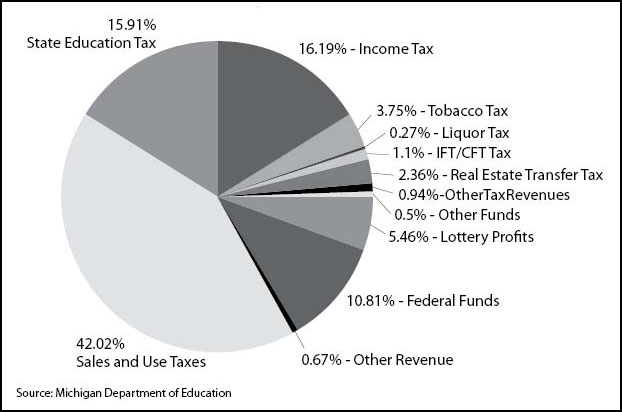
This section will discuss state taxes and other state revenues spent on primary and secondary education. In fiscal 2006, the revenues for the school aid fund, which is where the state government deposits tax revenues for education, were approximately $12,590,363,297.[81] The graph below provides a quick overview of the various state revenue sources for the school aid fund. The discussion that follows categorizes the revenues by their source.
Sales Tax
The state of Michigan currently levies a 6 percent tax on "tangible personal property" sold in the state. More accurately, the state levies this tax on certain buyers purchasing certain goods from certain sellers in certain transactions.[82] The 6 percent is comprised of two parts: a maximum of 4 percent set by the state Legislature and an additional tax of 2 percent authorized on May 1, 1994, by Article 9, Section 8, of the Michigan Constitution.
Article 9, Section 11, of the state constitution specifies that all revenue raised by the additional 2 percent must be credited to the state school aid fund and that 60 percent of the revenue raised from the 4 percent sales tax must also be appropriated to the school aid fund. This means that approximately 73.3 percent of the total sales tax revenue is credited to the school aid fund.[83] In fiscal 2006, approximately $4,883,700,000 was added to the school aid fund from sales tax revenue.[84]
Use Tax
The use tax is a levy for "the privilege of using, storing, or consuming tangible personal property" in the state of Michigan. The tangible personal property specifically mentioned in state statutes includes vehicles, manufactured housing, aircraft, snowmobiles and watercraft, and use taxes are collected when the ownership of such property is transferred.[85] The use tax rate is 6 percent of the price of such items, with several exemptions.[86] As with the sales tax, the 6 percent is made up of a constitutionally allowed 4 percent and an additional 2 percent authorized by voters at the same time they authorized the additional 2 percent addition to the 4 percent sales tax.[87]
All of the revenue from the two percent use tax increase is credited to the state school aid fund,[88] while the four percent portion is allocated to the state’s general fund.[89] In other words, one-third, 33.3 percent, of the revenues raised by the use tax is appropriated for education.[90] In fiscal 2006, approximately $470,500,000 in use taxes was credited to the state school aid fund.[91]
Cigarette Tax
The state of Michigan levies an excise tax on cigarettes, in addition to the sales tax levied on this tobacco product.[92] The cigarette excise tax rate is 100 mills per cigarette,[93] or $2.00 on a pack of 20 cigarettes (20 cigarettes × $0.10). Of this amount, 41.62 percent is credited to the state school aid fund.[94] Thus, approximately 83.24 cents per pack of cigarettes is credited to the school aid fund. In fiscal 2006, $472,199,127 was transferred to the state school aid fund from cigarette taxes.[95]
Liquor Tax
In addition to other taxes on the sale of liquor,[96] a 4 percent excise tax is levied on liquor sales.[97] The revenue from this excise tax is credited to the state school aid fund. In fiscal 2006, $34,496,655 was credited to that fund.[98]
Real Estate Transfer Tax
The Real Estate Transfer Act of 1993 requires that a tax be levied on the seller or grantor of a property for contracts dealing with any act of selling or exchanging the property and on deeds or instruments of conveyance of the property or any interest in the property. If the transaction occurs outside the state for property "wholly located within" Michigan, the statute requires that the tax be levied.[99]
The tax is levied at the rate of $3.75 per $500.00 of the total value of the real property being transferred — in other words, 0.75 percent of the total value of the property. For example, if a $125,000 property is sold, the tax on the transfer of the property for which the seller is liable is $125,000 × ($3.75 / $500) = $125,000 × 0.0075 = $937.50.
In fiscal 2006, the tax augmented the school aid fund by $297,680,118.[100]
State Education Tax
The state education tax is authorized by the State Education Tax Act of 1993 (the tax became effective on March 15, 1994, with the passage of Proposal A). It is a 6 mill levy on all property except exempted[101] property in the state with the exception of certain exempted properties.[102] The education tax is collected by the local taxing authority[103] and deposited by the state treasurer into the state school aid fund.[104] In fiscal 2006, the school aid fund received $2,003,526,578 from the state education tax.[105]
Note that the state education tax is not subject to the Headlee rollbacks described earlier (Calculation of an Individual Tax Bill). Thus, revenues from the state education tax can increase at rates that exceed inflation.
Certain Properties in Local School Districts
Taxes levied on a number of other kinds of property in a local school district are not credited to the districts, and in most cases are credited directly to the state school aid fund. Note that these properties are not subject to the local nonhomestead property tax; rather, they are subject to the tax rates discussed below. Several primary examples are listed, though other taxes and fees exist as well.[lviii]
Commercial Forest
Under Public Act 451 of 1994, a property can qualify as "commercial forest" if an owner shows that the property produces three things: 20 cubic feet or more per acre of forest growth when mature; species that have value commercially or economically; and a stand of timber for commercial purposes "within a reasonable period of time."[106] Under the statute, such land is subject to various state mandates.[107]
Public Act 451 of 1994 stipulates that the state school aid fund receive an amount from commercial forest property taxes[lix] equal to the difference between the number of general property tax mills levied for school operating purposes in 1993 and the number of mills levied for the 6 mill state education tax.[108] For example, consider Emmet County’s Harbor Springs Public School District, which had a school operating tax of 16.68 mills in 1993. Subtracting the 6 mills levied for the state education tax from 16.68 mills yields a 10.68 mill tax rate that is credited to the state school aid fund.[109]
Private Forest[lx]
A "private forest reservation" is timber on property that is smaller than 160 acres and mostly devoted to agriculture.[110] Private forest is assessed the same number of mills as the school operating tax on nonhomestead properties, except that the assessment of the tax on the property is limited to $1 per acre and includes taxes of 5 percent of the value of a timber cut and 5 percent on the value of any property the owner wishes to withdraw from the private forest reservation.[111] The revenue from this tax is deposited in the state school aid fund.[112]
Industrial Facilities
Property designated by law as an "industrial facility"[113] is taxed at the number of general school operating tax mills levied in 1993 minus the 6 mills levied for the state education tax. The millage rate, in other words, is determined in the same way it is for commercial forest. This property tax on industrial facilities is placed in the state school aid fund.
Technology Park Facilities
The tax on technology park facilities is applied to the SEV of the facilities themselves, not to the land on which the facilities are sited and not to the personal property contained in the facilities. According to Michigan law, the tax rate for such facilities is one-half of the total mills levied by all taxing authorities in the area in which the facilities are located — except both the state education tax and those taxes levied by local and intermediate school districts for operating purposes — plus one-half of the number of mills levied for school operating purposes in a facility’s district in 1993.[lxi] The state school aid fund receives revenue from this tax according to the number of mills levied for school operating purposes in 1993 minus the 6 mills levied for the state education tax.[114]
Enterprise Zone Facilities
"Enterprise zones" are created by the state Legislature in troubled areas of the state "to promote economic growth."[115] Businesses in these regions are often exempt from certain state requirements, including some taxes.
The law provides that owners of businesses in enterprise zones created before the passage of Proposal A in March 1994 pay a specific tax directly to the local governmental unit in which they are located, but not to the local school district.[116] Owners of businesses in enterprise zones created after 1993 pay an education tax directly to the state school aid fund[117] if the business does not lie in a "renaissance zone."[lxii] This tax is calculated through a complex formula.[lxiii]
Neighborhood Enterprise Zone
Properties in areas designated as "neighborhood enterprise zones" are taxed for school operating purposes at the millage rate levied in 1993 minus the 6 mills levied for the state education tax.[118] A neighborhood enterprise zone can be defined by the governing body of a local unit of government without specific state approval,[119] and properties that receive tax exemptions with a neighborhood enterprise zone certificate are governed by the Neighborhood Enterprise Zone Act.[120] This tax is paid to the state treasury and credited to the state school aid fund.[121]
Commercial Rehabilitation
A local government authority may award a commercial rehabilitation tax exemption to qualified properties in a locally designated "commercial rehabilitation district."[122] The owner of such an exempted property must instead pay a specific commercial rehabilitation tax that is the sum of three things: taxes paid on the real and personal property of the facility after certain deductions[lxiv] in the year before the property’s tax exemption; the taxes paid for the state education tax; and the tax for school operating purposes after certain deductions[lxv] in the year before the exemption was granted. The amount that would otherwise have been received by a conventional or intermediate school district is paid instead to the school aid fund.[lxvi]
State Housing Development Service Fees
The owner of a tax-exempt "housing project" pays a service fee to the municipality in which the property is located instead of the taxes to which the property would otherwise be subject. If the housing project involves new construction, the service fee to be paid is the greater of the tax rate on the property in the year before the new construction of the housing project began or 10 percent of the rent obtained from the project.[123] If the housing project involves rehabilitation, the service fee is the lesser of the previous year’s property tax or 10 percent of the rents.[124] The revenue from these service fees is distributed to local authorities that levy property taxes. The portion that would have gone to local school districts is instead transferred to the state school aid fund.[125]
Renaissance Zone
The state Legislature has allowed local government authorities to establish certain geographical areas in which properties will be temporarily exempt from property taxation. The purpose of such zones is "to assist certain local governmental units in encouraging economic development, the consequent job creation and retention, and ancillary economic growth in this state."[126] Because properties in these zones are generally exempt from property taxes, the state of Michigan reimburses local and intermediate school districts for revenues lost as a result of the tax exemptions in renaissance zones within the districts’ boundaries.[127]
Mobile Home Trailer Coach
Of the $3.00 monthly tax levied on an eligible coach in a mobile home trailer park, $2.00 is credited to the state school aid fund by the treasurer of the municipality in which the park is located.[128]
Low Grade Iron Ore Specific
The tax on low grade iron ore and low grade iron ore mine property[129] depends upon a mine’s operating status.[130] The portion of the low grade iron ore specific tax levied for school operating purposes is, as with several of the taxes above, equal to the number of mills levied for school operating purposes in 1993 minus the 6 mills currently levied as the state education tax.[131] The total amount levied for school operating purposes is credited to the state school aid fund, rather than to the local school district.[132]
Certain Properties in Intermediate School Districts
Like revenues from some of the local school district property taxes discussed above,[133] revenues from some taxes that would otherwise be received by an ISD are credited to the state school aid fund, rather than sent to the ISD. These taxes include the following:[lxvii]
tax on properties liable under the Enterprise Zone Act;
tax on properties liable under the Neighborhood Enterprise Zone Act;[134]
the specific tax on owners under the Commercial Rehabilitation Act;[135]
the industrial facility tax under the Plant Rehabilitation and Industrial Development Districts Act.[136]
If the total of the ISD property taxes deposited in the school aid fund is more than the amount of state aid to the ISD,[lxviii] the state treasury is obligated to send not just the state aid to the ISD, but also the difference between the two amounts.
[lviii] Some taxes, fees and other income sources not listed include the following: funds that were intended to be part of a “brownfield redevelopment plan,” but were unused and subsequently distributed to both a local school district and the state school aid fund (MCL § 125.2665(20)); property tax monies that were redirected to a technology park through state development programs and that were subsequently reimbursed to local and intermediate school districts and the state school aid fund (MCL § 125.2162a(12)); revenue from the obsolete properties tax (MCL § 125.2790); monies that were transfered from the state’s general fund and that allow the state school aid fund to be “held harmless” from tax credits or deductions granted to motion picture companies (MCL § 205.54cc); penalty fees for failing to change a homestead or qualified agricultural property tax exemption status (MCL §§ 211.7cc, 211.7ee); local school districts’ excess debt levy retirement funds transmitted to the state school aid fund (MCL § 211.905a); and revenue from the specific tax on eligible tax-reverted property (MCL § 211.1025).
[lix] For the tax rate, see MCL § 324.51105.
[lx] Note that the statutes cited here will be repealed on Sept. 1, 2007, and be replaced by Public Act 378 of 2006, which will exempt qualified forest property (MCL § 211.7jj[1](11)(f)) from school taxes (MCL § 211.7jj(1)).
[lxi] See MCL § 207.712(2).
[lxii] MCL § 125.2121b. See MCL § 125.2121c for the exemption from the specific tax on properties — except casinos — located in renaissance zones as governed by the Renaissance Zone Act (MCL §§ 125.2681 – 125.2696).
[lxiii] The tax rate is the sum of the following three products: (1) 50 percent of the average tax rate on industrial, commercial and utility property in the unit of government, minus the state education tax (currently 6 mills), multiplied by the difference between the SEV in the year before the enterprise zone exemption was granted and the current SEV of the property (MCL § 125.2103(g), (h)), excluding exemptions; (2) the state education tax rate (currently 6 mills), multiplied by the difference between the SEV in the year before the enterprise zone exemption was granted and the current SEV of the property, excluding exemptions; and (3) the sum of all millages levied on the property by all local units of government in whose jurisdiction the property lies, multiplied by the SEV in the year before the enterprise zone exemption was granted. See MCL § 125.2121b(2)(a)-(c).
[lxiv] For these deductions, see MCL § 207.850(2)(a).
[lxv] For these deductions, see MCL § 207.850(2)(b).
[lxvi] See MCL § 207.850(4) for the provision concerning ISDs and MCL § 207.850(5) for the provision concerning conventional local school districts.
[lxvii] Taxes and fees not shown above include those described in footnote lviii.
[lxviii] This includes the amounts disbursed under sections 56, 62 and 81 of the School Aid Act, (MCL §§ 388.1656, 388.1662 and 388.1681).
The income tax code is complex, but for our purposes, only an approximation of how the code functions is necessary. Under the Income Tax Act of 1967, the state of Michigan collects tax on “taxable income” or “net income,” which Michigan statute defines as an adjusted version of the taxpayer’s taxable income for federal income tax purposes.[137] In fiscal 2007, the tax rate on personal income is 3.9 percent.[138] The total state personal income tax liability is then subject to statutory tax credits.[139]
The portion of the gross state income tax revenue[lxix] that is dedicated to the state school aid fund is equal to 1.012 percent divided by the 3.9 percent income tax rate, or about 25.9 percent.[140] In fiscal 2006, $2,038,983,344 was earmarked from the personal income tax for the state school aid fund.[141]
[lxix] Gross revenue is the amount of state tax due before taxpayers’ refunds are subtracted from the total. For the refund provision for overpayment of income tax liability, see MCL § 206.325. Our reference here does not include “refundable” tax credit provisions — that is, cases where a taxpayer would receive money back from state government if his or her tax liability were zero.
An 8.1 percent tax is levied by the state of Michigan on the adjusted gross receipts of the state’s licensed casino gaming establishments.[lxx] The entirety of this state tax is credited to the state school aid fund.[142] In fiscal 2006, approximately $102 million was credited to the school aid fund from this tax.[143]
[lxx] The state levies the 8.1 percent tax because the city in which such operations have been established, i.e., Detroit, levies a 9.9 percent tax; see MCL § 432.212(1). If Detroit were unable or did not wish to levy the 9.9 percent tax, the state would levy the full 18 percent on gross receipts of casino gaming operations, with 45 percent of the tax going to the SAF: see MCL § 432.212(3)(b). The city may levy an additional tax, but the revenue raised would not be received by the SAF.
The Michigan Lottery was established on Aug. 1, 1972, with the implementation of Public Act 239. The lottery had been made legal on May 16, 1972, by a constitutional amendment.[lxxi] Except for the lottery money that is set aside for the compulsive gaming prevention fund (the lesser of 10 percent or $1 million),[144] the net earnings of state lottery games are deposited in the state school aid fund.[145] In fiscal 2006, about $688,017,340 was added to the school aid fund from lottery profits.[146]
[lxxi] For a complete history, see "Michigan Lottery Through the Years," Michigan Lottery,
https://www.michigan.gov/lottery/0,1607,7-110-29196-4130--,00.html.
In fiscal 2006, two taxes were the top sources of revenue to the federal government: the federal individual income tax, which raised $1.85 trillion, and the corporate income tax, which raised $350 billion.[147] Total federal government revenue, including borrowing, was approximately $2.9 trillion. This revenue is largely commingled, and a portion of this money is spent on education.
In fiscal 2006, the U.S. Department of Education received approximately $36.5 billion in federal revenues for elementary and secondary education programs.[148] Of this amount, according to the federal government, the department spent $1,107,454,389 (about $1.11 billion) in Michigan in fiscal 2006.[149] According to the state Department of Education, however, the federal government provided $1,360,741,678 to Michigan state government in fiscal 2006.[150] This $1.3 billion constituted about 10.81 percent of the state school aid fund.[151] Much of that amount — $667,588,309 — financed programs that are part of the No Child Left Behind Act of 2001. All federal revenues for Michigan education are placed in the state school aid fund.
Graphic 10 illustrates the percentage distribution of major primary and secondary education funding categories. Graphic 11 breaks out funding for NCLB by grants that made up at least 1 percent of the total federal revenue from the U.S. Department of Education appropriated to the state of Michigan.
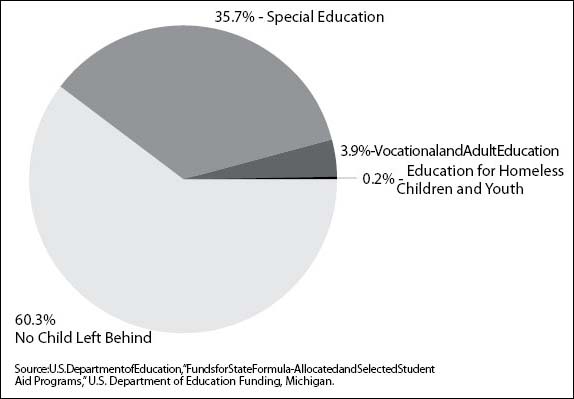
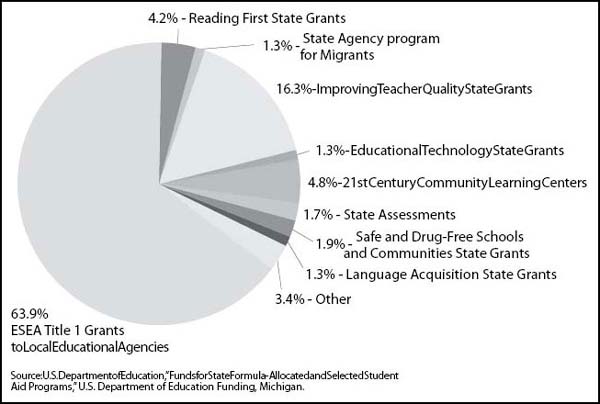
State and local property taxes for education are typically collected by local government, but they must then be distributed to state or local school authorities according to procedures prescribed by state law. Federal taxes are collected by the federal government, and federal revenues for Michigan schools are allocated by the U.S. Department of Education and other federal departments to Michigan’s school aid fund and distributed according to state and federal laws. Local property taxes for education, such as school district capital levies and hold-harmless millages, are collected by local government, usually cities or townships, and then transferred to a school district’s treasurer.[152] The statewide property tax for education (i.e., the state education tax), is collected by local government, usually cities and townships,[lxxii] and then transferred to the county treasurer. The county treasurer then sends the revenues to the state treasurer, who deposits the revenue in the school aid fund.[153]
All other state taxes that state law dedicates to the state’s school aid fund are deposited in that fund as they are collected.
[lxxii] This process is described in MCL § 211.905(2), but MCL § 211.905(4) contains a provision that allows a school district to elect to collect the tax. A city or township may also decline to collect the state education tax (MCL § 211.905b(2)), in which case the county treasurer would collect the tax and impose an administrative fee. The county treasurer may refuse to collect the tax in lieu of the city or township (MCL § 211.905b(4), and in that case, the state treasurer would collect the tax and impose an administrative fee (MCL § 211.905b(5)).
The Michigan Constitution requires the governor to submit to the state Legislature a budget for the expenditure of funds for the following fiscal year.[154] The constitution also requires any proposal that involves the expenditure of state funds to be passed by the state Legislature as an appropriations bill.[155] Both of these constitutional provisions apply to the annual budget for Michigan elementary and secondary schools.
This education budget, known as the state “school aid budget,” is proposed annually as a bill (or bills) in either the state House or the state Senate,[lxxiii] with each chamber performing the bulk of the budget work in alternating years.[lxxiv] In whichever chamber is taking the lead that year, the bill is typically introduced by the chair of the appropriations school aid subcommittee. If the chamber is not controlled by the governor’s political party, the vice chair of the subcommittee (traditionally a member of the chamber’s minority party) will introduce the governor’s proposed school aid budget as a competing bill. In either case, a school aid budget bill will amend or repeal parts of the current State School Aid Act and provide money for the schools’ upcoming fiscal year, which runs from July 1 through June 30. [lxxv]
[lxxiii] Appropriation of school aid fund revenues is specified at MCL § 388.1611.
[lxxiv] For example, the major school aid budget work for fiscal 2008 is being performed by the state House.
[lxxv] The school aid budget is not the budget for the Michigan Department of Education, which is called the education budget.
In addition to submitting a budget proposal, the governor is also constitutionally required to produce an estimate of the tax revenues the state government expects to receive in the following fiscal year.[156] For this purpose, the law specifies that a revenue estimating conference must be held in the second week of January and in the last week of May.[lxxvi] (The state budget director, the state treasurer or the directors of the Senate or House fiscal agencies can call a special revenue estimating conference between these two meetings if they choose.[157]) Those involved in the conference are the state budget director or treasurer and the directors of the House and Senate fiscal agencies.[158] The conference must produce, among other projections, an estimate of revenues to the state school aid fund, as well as the anticipated percentage change in the “basic foundation allowance,” which is an accounting figure that roughly represents the state and local per-pupil operating monies available to local school districts and charter schools (see “The Foundation Allowance: General Education”).[159] The results are published by the House or Senate fiscal agencies.[lxxvii] Such publications are used by school districts as they prepare their own budgets for the next fiscal year.[lxxviii]
[lxxvi] MCL § 18.1367b(1). The January 2007 conference occurred on Jan. 18, 2007: Tim Skubick, “’07 Budget Hole Swells to $800m, Overall Hole $1.5b,” MIRS Capitol Capsule, Jan. 11, 2007.
[lxxvii] For an example of estimates from the January 2006 conference, see "State of Michigan Revenue Source and Distribution: March 2006," Michigan House Fiscal Agency, http://house.mi.gov
[lxxviii] A timeline for district budgets is described under “The Budget Process.”
Once the state Legislature and the governor have approved the school aid appropriations for the next fiscal year, the state Department of Education is legally required to distribute the monies in 11 installments, from October through August, to local and intermediate school districts and charter schools. [lxxix][160] This money falls into two broad classes.
One is “categorical” funding, also known as “restricted revenue.” Categorical funding is money that is not typically distributed on a per-pupil basis and that is typically allocated to schools for specific programs. One example is the $2,965,000 set aside for state school districts in fiscal 2007 for bus driver safety instruction, nonspecial education transportation and state police inspections of buses.[161] The Michigan Public School Accounting Manual requires conventional local school districts, intermediate districts and charter schools to account transparently for the receipt and expenditure of such categorical money in their comprehensive annual financial reports.[162] Categorical funding will be discussed further below.
[lxxix] Two payments from the state school aid fund are not distributed to local and intermediate school districts and charter schools: Up to $48 million in fiscal 2007 payments made on behalf of local and intermediate districts to the state Treasury Department for the school loan bond redemption fund (see MCL § 388.1611j); and up to $22.8 million in fiscal 2007 payments made on behalf of local and intermediate districts and charter schools to the state Treasury Department for fiscal year cash flow borrowing costs (see MCL § 388.1611m).
The second general type of state education money comprises the majority of state education dollars: foundation allowance money, which is allocated to school districts and charter schools on a per-pupil basis.[lxxx] For most school districts, the state distributes this money using a “blended count,” which in fiscal 2007 is the sum of the following: 75 percent of the number of full-time-equivalent students in attendance on the fourth Wednesday after Labor Day in September,[163] and 25 percent of full-time-equivalent students in attendance on the supplemental count day in the previous February.[lxxxi][164] By using a full-time-equivalent student count, rather than a head count, the state can adjust for the percentage of time a student spends in various programs. For example, consider a student who spends 40 percent of his instructional time in a special education program and 60 percent of his time in a general education program. That student would be counted as two-fifths (0.40) of a student for purposes of distributing special education foundation allowances and three-fifths (0.60) of a student for purposes of distributing general education foundation allowances.
Take the Manistee Area Public Schools as an example. On the district’s Jan. 19, 2007, state aid financial status report[lxxxii], the Michigan Department of Education reported that the Manistee district’s “state aid membership” was 1,734.06 full-time-equivalent students,[165] a number made up of general education students and special education students. This number was based on four figures: On the September 2006 count day, the district counted 1,697.60 FTE general education pupils and 39.72 FTE special education pupils; and on its February 2006 count day (the supplemental count day from the immediately previous school year), it recorded 1,692.87 FTE general education pupils and 31.39 FTE special education pupils. Hence, FTE general education membership was
(1,697.60 × 0.75) + (1,692.87 × 0.25) = 1,696.4175,
while FTE special education membership would be
(39.72 × 0.75) + (31.39 × 0.25) = 37.6375.
State aid membership equals the sum of these two FTE figures:
1,696.4175 + 37.6375 = 1,734.055,
or 1,734.06 FTE, since total FTE membership is rounded to the hundredths place.
[lxxx] The foundation allowance is discussed in more detail immediately below. In fiscal 2007, two major foundation allowance payments — the Proposal A obligation payment (section 22a; $6,207,000,000) and the discretionary payment (section 22b; $3,584,950,000) — together accounted for about 75 percent of the total appropriation from the school aid fund ($13,093,745,100). See “School Aid Act Compiled and Appendices,” A1-A2.
[lxxxi] For exceptions, see MCL § 388.1606(4). For example, some districts that have 4.5 students per square mile may receive funding based on a three-year blended count: MCL § 388.1606(4)(y). School districts that are not on a nine-month school calendar also have a different count.
[lxxxii]State aid financial status reports are sent to each school district by the state government in conjunction with the 11 annual state payments to the district. For a detailed discussion of these reports, see “State Aid Financial Status Reports.”
The “foundation allowance” is sometimes referred to as a “foundation grant.” The calculation of the foundation allowance is the same for both general education and special education students, but the discussion below focuses on general education students because the general education calculation helps determine a portion of the money made available for special education students (see “Operating Monies for Special Education”).
Conventional Public School Districts
Since the passage of Proposal A in 1994, the Michigan Legislature has annually calculated a per-pupil funding “allowance” for each local school district and charter school in the state.[lxxxiii] This “foundation allowance” or “foundation grant” is a key figure used in the state’s financing of local school districts and charter schools, and it is intended to represent a district’s per-pupil revenues for general operating purposes. The foundation allowance is not the same for every district,[lxxxiv] and each district’s foundation allowance is comprised of varying levels of money from state government and from local property taxes.[lxxxv]
As will be discussed below (see “Non-Hold-Harmless Districts”), a district’s foundation allowance sometimes differs from the district’s actual per-pupil operating revenues. In some cases, a district’s per-pupil operating revenues differ from its foundation allowance. Nevertheless, a district’s state foundation allowance is a key financial concept in the funding of that district’s schools.
The Legislature sets one floor and two ceilings on the size of districts’ foundation allowances. The floor — that is, the smallest foundation grant any Michigan school district is assigned — is determined afresh each year and is called the “basic foundation allowance.”[lxxxvi] For the beginning of fiscal 2007, the basic foundation allowance was $7,085,[lxxxvii] and 399 conventional school districts and charter schools — about 51 percent of all districts and charter schools — were assigned that amount.[lxxxviii]
The Legislature’s two ceilings are the “state maximum foundation allowance” for conventional districts and the “state maximum foundation allowance” for charter schools.[lxxxix] The state maximum foundation allowance for conventional school districts in fiscal 2007 is $8,385.
This maximum foundation allowance for conventional school districts is not explicitly set by annual amendments to the State School Aid Act. Rather, it is the sum of $6,500 — the maximum foundation allowance for fiscal 1995 (MCL § 388.1620(3)(b)) — plus the annual change in the basic foundation allowance through the current fiscal year. Hence, in fiscal 2007, the maximum foundation allowance for conventional public school districts is the following:
State Maximum Foundation Allowance2007 =
$6,500 + ($153 + $155 + $154 + $0 + $238 + $300 + $300 + $200 + $0 + $0 + $175 + $210) =
$6,500 + $1,885 = $8,385.
The maximum foundation allowance for charter schools, on the other hand, is $300 greater than the basic foundation allowance. In fiscal 2007, the basic foundation allowance is $7,085, making the maximum foundation allowance for charter schools $7,385.
These “state maximums” are not, however, a limit on a district’s per-pupil operating revenues or on a district’s foundation allowance. Rather, these maximum foundation allowances are related to the highest amount that the state agrees to pay per pupil for school operating purposes; the relationship between what the state agrees to pay and the state maximum foundation allowance is explored in more detail below. As a practical matter, “non-hold-harmless districts” (discussed immediately below) never have a foundation allowance above the state maximum foundation allowance.
Of all local districts and charter schools in fiscal 2007, 334, or about 43 percent, are assigned more than the basic allowance and less than the maximum allowance.[xc] Only “hold-harmless districts” have foundation allowances above the “maximum” allowance,[xci] although some hold-harmless districts, such as the Watersmeet Township School District and the East Lansing School District, do not have foundation allowances higher than the maximum in fiscal 2007.
The state government calculates its contribution to a district’s foundation allowance in one of two ways, depending on whether the district is a hold-harmless district. We discuss both types of districts below.
Non-Hold-Harmless Districts
As noted earlier in this primer, a hold-harmless district has — or has had at some time after 1995[xcii] — the ability to levy homestead property taxes for local school operating purposes and to levy more than 18 mills of nonhomestead property taxes for the same. A non-hold-harmless district, in contrast, has neither.
But the distinction between the two types of districts lies in their spending levels in 1995: Hold-harmless districts spent more than $6,500 in state and local revenues on operating expenses that year, while non-hold-harmless districts spent $6,500 or less. The hold-harmless districts’ additional taxing powers were intended under Proposal A to permit those districts to maintain their relatively high spending; without these powers, the higher spending districts would have had to lower their education spending.
If a district is a non-hold-harmless district (as most districts are), a portion of the district’s foundation allowance is received from the school aid fund, while the remainder is raised from a district’s nonhomestead property tax,[xciii] which is retained locally. The state’s portion is the difference between the district’s foundation allowance and the maximum amount the district could legally raise per pupil from a nonhomestead property tax.
We provide an example of this calculation in Graphic 13, but first note several points that follow from this definition of how the state’s contribution to the foundation allowance is calculated:
In the computation of the state’s portion of the foundation allowance for non-hold-harmless school districts, the state assumes that all of the district’s nonhomestead property tax is allocated to general education students, not to special education students. Thus, the state effectively assumes for accounting purposes that funding for special education students comes from other sources (as, in fact, it does, since special education is paid from other state and federal revenues).[166] This distinction, however, is maintained only for the purposes of the state’s calculations; in reality, a school district is free to use its local property tax revenue and its state revenue for general education pupils in the exercise of any of its legal powers, including special education or even capital expenditures.
Under Proposal A, the maximum amount the district can raise on nonhomestead property is the lesser of 18 mills and the district’s 1993 property tax millage for school operating purposes. Because a district might not actually be levying its statutory maximum millage — due to Headlee rollbacks, for instance — the district might not actually receive the total local property tax revenues that the state assumes in calculating the state’s contribution to the foundation allowance. Thus, a district might not receive combined state and local operating funding per general education FTE pupil equal to the foundation allowance that state law describes.
In other cases, a district may actually collect more operating money per general education FTE pupil than the foundation allowance that the state Legislature assigns to the district. This circumstance arises when a district’s local property tax base is valuable enough that the maximum millage — the lesser of 18 mills or the district’s 1993 millage — generates significantly more than the legislatively determined foundation allowance. In such instances (Elm River Township School District is a fiscal 2007 example), the computation of the state’s portion of the district’s foundation allowance yields a negative number, and the state’s actual contribution to that foundation allowance is therefore zero. Such districts’ strong local property tax base would in nearly all cases[xciv] yield operating revenues per general education FTE pupil that exceeded the state foundation allowance. Indeed, the per-general-pupil operating revenues produced by a non-hold-harmless district’s local property taxes could be high enough to exceed the maximum foundation allowance[xcv] — a level of funding comparable to that of most hold-harmless districts.[xcvi]
In short, for many conventional non-hold-harmless school districts, the foundation allowance is an estimate of operating revenues per general education FTE pupil. The same is true of the foundation allowance for conventional hold-harmless school districts, as we will discuss later (see “Hold-Harmless Districts,” below.)
Both a district’s general education membership and a district’s nonhomestead taxable value are used in calculating the state’s contribution to the foundation allowance. These figures are updated monthly, and the best source for them is the district’s state aid financial status report, which state government sends 11 times per year to each school district.[xcvii]
The district’s nonhomestead taxable value in particular should be taken from the state aid financial status report, because the taxable value recorded there has been adjusted to account for any “tax increment finance district”[xcviii] that might lie within the school district’s boundaries. This adjustment for a TIF district is necessary in calculating foundation allowance shares, and the reader should exercise care, since the Michigan Department of Education also posts on the Web unadjusted nonhomestead property tax values. Use of these unadjusted values will lead to inaccurate calculations for some school districts.
The general procedure, then, for calculating the state’s share of a non-hold-harmless district’s foundation allowance would be described mathematically as shown in Graphic 12.
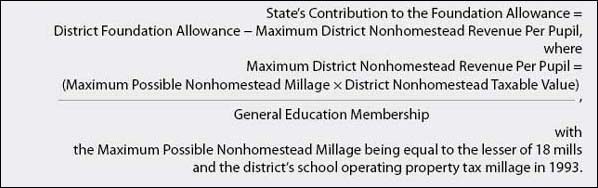
Consider the Sault Ste. Marie Area Schools, which is a non-hold-harmless district.
The Sault Ste. Marie Area Schools’ fiscal 2007 foundation allowance is $7,085. In January 2007, the district’s state aid financial status report showed the district had 2,517.88 FTE general education students[xcix] and a nonhomestead taxable value of $204,378,018.00.[c] The district’s maximum possible nonhomestead millage is 18 mills,[ci] since the district levied a school operating property tax of more than 18 mills in 1993. Thus, the maximum district nonhomestead revenue per pupil would be the following:[cii]
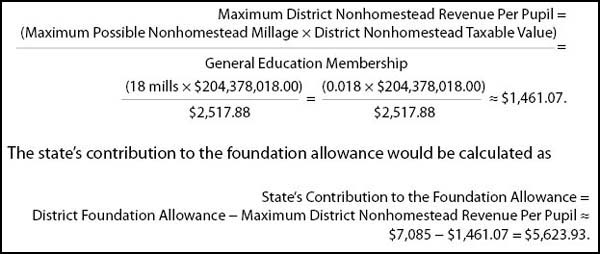
In Graphic 14, we have calculated the state’s contribution to the foundation allowance for three districts, including Sault Ste. Marie, with which the reader is already familiar.[ciii] Note that these districts’ foundation allowances fall between the basic and maximum amounts.
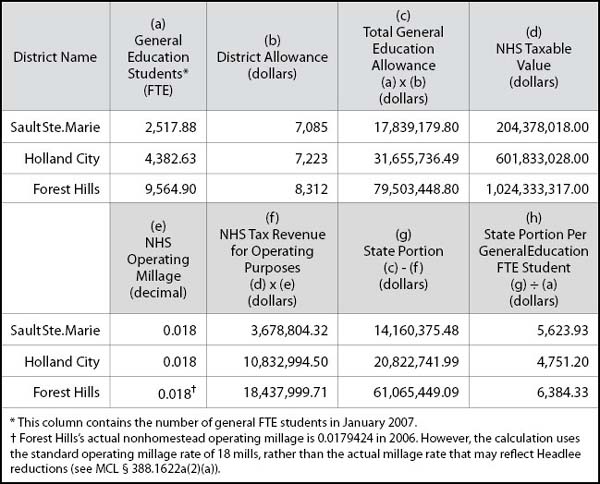
Hold-Harmless Districts
Of all Michigan conventional school districts and charter schools,[cv] 44, or about 6 percent, have district foundation allowances that are higher than the maximum foundation allowance for conventional school districts. For a hold-harmless district, the state’s contribution to the district’s foundation allowance is equal to the state maximum portion minus the district’s maximum possible per-pupil nonhomestead tax revenue. The state maximum portion is calculated by taking the sum of $6,962 (the maximum foundation allowance in 1999) and the dollar increase in the district’s foundation allowance since 1999. The district’s maximum possible revenue per pupil is calculated by multiplying the district’s nonhomestead property tax base[cvi] by the lesser of 18 mills and the district’s school operating property tax millage in 1993, and then by dividing this product by the district’s general education FTEs. Mathematically, the calculation would be expressed as follows:
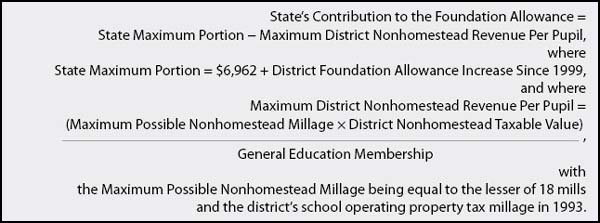
We provide an example of the calculation of the state contribution to a hold-harmless district’s foundation allowance below. First note several points, however:
With hold-harmless districts, the usual relationship between a district’s foundation allowance and the state maximum foundation allowance is often reversed: The districts’ foundation allowance is usually larger than the state maximum foundation allowance. The hold-harmless district Whitefish Schools, for instance, has a foundation allowance of $11,157 in fiscal 2007, a year in which the state maximum foundation allowance is $8,385.[167] The existence of such above-average revenues is a key reason for the existence of the state maximum portion,[cvii] which caps the state’s contribution to any given district’s foundation allowance. The state does not prevent hold-harmless districts from generating relatively high per-pupil operating revenues, but the state does cap the amount the state school aid fund will contribute to those revenues.
The state portion of a hold-harmless district’s foundation allowance does not account for any local property taxes raised by a hold-harmless millage — i.e., a millage on a hold-harmless district’s homestead property or a millage in excess of district’s statutory maximum (the lesser of 18 mills and the property tax millage in 1993).[cviii] Because some hold-harmless districts are permitted to levy these taxes, and because the state effectively assumes in the equation above that these districts levy only the standard nonhomestead property tax, the districts can receive per-general-pupil local property tax revenue larger than their foundation allowances. (Note that the calculation of hold-harmless revenues per general pupil is meaningful only for our accounting purposes here; as a practical matter, the district would likely use hold-harmless millage revenues for special education students as well.) For instance, due to hold-harmless millages, the Southfield Public School District was receiving total per-general-pupil operating revenues of about $11,500 based on January 2007 state figures, while the district’s fiscal 2007 foundation allowance is $11,187. (The state’s contribution to the foundation allowance was $4,070.76 based on January 2007 figures.)
Even if a hold-harmless district can no longer levy hold-harmless millages, it can still achieve per-pupil operating revenues in excess of the district’s foundation allowance, just as a non-hold-harmless district can (see the discussion under “Non-Hold-Harmless Districts,” Page 57). Whenever a district’s local property tax base is valuable enough, the district’s millage on nonhomestead property can provide per-general-pupil operating revenues that exceed the district’s foundation allowance.
Like non-hold-harmless districts, hold-harmless districts that levy only the nonhomestead property tax might collect per-general-pupil operating revenues that are less than the district’s foundation grant. This situation arises whenever the district is not levying its statutory maximum millage on nonhomestead property. In this case, the district is not actually receiving the total local property tax revenues that the state assumes in calculating the state’s contribution to the foundation allowance (note that the equation in Graphic 15 is based on the maximum possible district nonhomestead tax revenue — not the actual revenue). Thus, a district may not receive total operating funding per general pupil from state and local sources equal to the district’s foundation allowance.
As noted in the discussion of non-hold-harmless districts, the district’s general education membership and the district’s nonhomestead taxable value — both of which appear in the equations earlier — are updated monthly, and the best source for them is the district’s state aid financial status report, which state government sends 11 times per year to each school district. The district’s nonhomestead taxable value in particular should be taken from the state aid financial status report.[cix]
In describing the state maximum portion in the equation earlier, we used
State Maximum Portion = $6,962 + District Foundation Allowance Increase Since 1999.
As will be discussed on the next page (see "Annual Adjustments to the Foundation Allowance”), districts’ foundation allowances currently increase by the same amount each year. This was not always so, however, and different districts have received different overall increases in their district foundation allowance. Thus, school districts can have different state maximum portions.
In Graphic 16, we show how to calculate the January 2007 state contribution to the foundation allowance for the Lamphere Public Schools, which is a hold-harmless district.
In January 2007, the Lamphere Public Schools had 2,336.79 general education FTE students and a nonhomestead taxable value of $671,975,280. The district’s maximum possible homestead millage was 18 mills (like the Sault Ste. Marie Area Schools, the district levied a property tax millage greater than 18 mills in 1993). Hence, Lamphere’s maximum district nonhomestead revenue per general-education pupil would be the following:
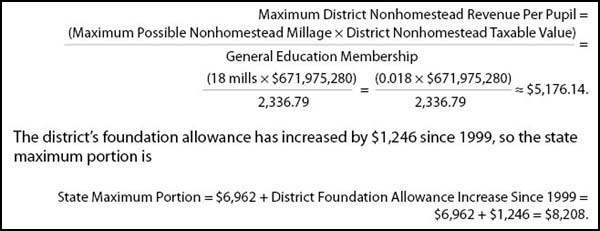
[lxxxiii] State government essentially treats each individual charter school as a local school district when distributing state education money. For a brief history of the per-pupil foundation grant from 1994-2000, see C. Philip Kearney and Michael F. Addonizio, A Primer on Michigan School Finance, 4th ed. (Wayne State University Press, 2002), 19‑31.
[lxxxiv] A district’s foundation grant is related to the district’s spending prior to Proposal A. Since this spending varied from district to district, the foundation grants also tend to differ from district to district. The provisions of Proposal A have required that this variation be reduced somewhat.
[lxxxv] As discussed under “Non-Hold-Harmless Districts,” the state’s contribution to a district’s foundation allowance may be zero in some cases.
[lxxxvi] Proposal A established a minimum foundation allowance and a basic foundation allowance; in fiscal 2000, the minimum and basic foundation allowances were equalized at $5,700: see “School Aid Act Compiled and Appendices,” C-1.
[lxxxvii] MCL § 388.1620(1); the subsection contains two numbers, the previous fiscal year’s foundation allowance and the current fiscal year’s foundation allowance. One of these numbers is revised as section 20 of the State School Aid Act is amended each year with the school aid appropriations bill.
[lxxxviii] Authors’ calculations based on data from the Michigan Department of Education.
[lxxxix] Charter schools’ grant levels will be discussed further below, beginning on Page 78.
[xc] Authors’ calculations based on data from the Michigan Department of Education.
[xci] For a discussion of such districts, see “Hold-Harmless Districts.”
[xcii] For a discussion of the circumstances under which a hold-harmless district may levy homestead and additional nonhomestead property taxes, see the earlier discussion under “‘Hold-Harmless’ Millage.”
[xciii] For more information on the nonhomestead property tax, see the section on the nonhomestead operating millage under “General Property Tax for Operating Purposes.”
[xciv] The words “significantly” and “in nearly all cases” are necessary qualifiers in this paragraph. If a district’s theoretical maximum millage would yield little more than the state foundation grant, the district could end up with per-pupil operating funding that is actually less than the state foundation allowance. This result would occur when the district actually collects less than the maximum millage (remember that this maximum millage is a theoretical number; a district may or may not actually levy it). The district would then have a theoretical maximum nonhomestead property tax revenue sufficient to drive the state’s contribution to the district’s foundation allowance to zero, even as the district’s actual nonhomestead property tax collection wasn’t quite high enough to match the state foundation allowance without a state contribution.
Theoretically, a district could also have actual nonhomestead property tax revenue that yielded per-general-pupil operating revenues exactly equal to the state foundation allowance, rather than greater than the allowance. This outcome, while mathematically possible, is highly unlikely.
[xcv] Recall that the “maximum foundation allowance” is not a ceiling on a district’s per-general-pupil operating revenues; it is a cap on the state government’s contribution to the foundation allowance. Also note that the foundation allowance of the district in this example is still less than the maximum. Only the district’s actual per-general-pupil operating revenues exceed the maximum.
[xcvi] One example of such a non-hold-harmless district in fiscal 2007 was Pentwater Public School District.
[xcvii] For a detailed discussion of these reports, see “State Aid Financial Status Reports” below.
[xcviii] A tax increment finance district is a local authority authorized under state law to capture some increases in local property tax revenues from taxes levied by other local government authorities in the area, including school districts. The additional tax revenues captured by the TIF district are to be used to address declining property values. For more information on TIF districts, see “Survey of Economic Development Programs in Michigan,” (Citizens Research Council of Michigan, 2001), www.crcmich.org/PUBLICAT/2000s/2001/rpt334.pdf (accessed April 18, 2007).
[xcix] This calculation is made using only general education FTE students. The calculation for special education students is different. This will be discussed under “The Special Education Foundation Allowance.”
[c] As noted earlier, a district’s general education FTEs and nonhomestead taxable value are both adjusted monthly. The figures used here come from the Sault Ste. Marie Area Schools’ “State of Michigan 2006-2007 State Aid Financial Status Report: Payment Dated 01/19/2007,” 215. Also as noted in the main text, a district’s state aid financial status report is the correct source of the district’s nonhomestead taxable value in these calculations, since the report’s taxable value is adjusted to account for any tax increment finance district that might lie within the school district’s boundaries. The Sault Ste. Marie Area Schools does include a TIF district.
[ci] The 18 mill figure is the maximum amount the district can levy, but the district did not actually levy 18 mills in January 2007. The district’s actual nonhomestead property tax was 17.9604 mills.
[cii] Because the district’s state aid membership and nonhomestead property taxable value can fluctuate from month to month, the district’s current per-pupil revenue from the state could be different from that calculated here.
[ciii] For a graphic description of this formula, see “School Aid Act Compiled and Appendices,” C-3.
[civ] Numbers in columns (c), (f) and (g) may differ slightly from state numbers due to rounding.
[cv] There are no charter schools above the maximum foundation allowance for conventional school districts, since the maximum foundation allowance for charter schools is less than that for conventional school districts. See “Charter Schools,” next page.
[cvi] As with the non-hold-harmless districts, this base should be taken from the district’s state aid financial status report. See the discussion below.
[cvii] The state maximum portion is, in turn, less than the state maximum foundation allowance. Thus, the state’s contribution to a hold-harmless district’s foundation allowance is less than the state maximum foundation allowance.
[cviii] These property tax levies are referred to as a “hold-harmless millage” because only hold-harmless districts are ever eligible to impose them. See “ ‘Hold-Harmless’ Millage” above.
[cix] The nonhomestead taxable value presented in the state aid financial status reports is adjusted to account for any “tax increment finance district” that might lie within the school district’s boundaries. (See footnote xcvii for a brief discussion of TIF districts.) This adjustment for a TIF district is necessary in calculating foundation allowance shares, and the reader should exercise care, since the Michigan Department of Education also posts on the Web unadjusted nonhomestead property tax values. Use of these unadjusted values will lead to inaccurate calculations of state foundation allowance contributions for some school districts.
[cx] Because the district’s state aid membership and nonhomestead property taxable value can fluctuate from month to month, the state’s current contribution to the district’s foundation allowance is likely different from that calculated here.
The Basis for Hold-Harmless Millages
Note that the calculations for the Lamphere Public Schools in Graphic 16 show the state contributing $3,031.86 to the district's foundation allowance and the district (theoretically) contributing $5,176.14 in nonhomestead property tax revenues.[cxi] Combined, these two figures would generate per-general-pupil operating revenues of $8,208 for Lamphere Public Schools.
Yet the district's foundation allowance for fiscal 2007 is $10,645. This $2,437 per-general-pupil difference results from Proposal A, which allows Lamphere to levy a hold-harmless millage to help make up the difference (the specific statutory language was quoted earlier under "'Hold-Harmless' Millage", under "Local Property Taxes by Type").
The district's fiscal 2007 hold-harmless millage is 14.5000 mills for homestead properties, which had a total taxable value of $283,845,570 in January 2007. The revenue from this millage is $4,115,760.77, or about $1,761.29 per general-education pupil. Added to the state portion ($3,031.86) and the local nonhomestead portion ($5,176.14), the district's total per-general-pupil operating revenue is about $9,969.29. The gap between Lamphere's district foundation allowance and what the district actually received per-general-pupil based on January 2007 figures under the foundation allowance formula is approximately $675.71.
Annual Adjustments to the Foundation Allowance
In fiscal 2007, there were 186 different foundation allowance amounts, ranging from the basic foundation allowance of $7,085 to $15,772. At the start of a fiscal year, each district's foundation allowance is adjusted by the same dollar amount: the Legislature's dollar adjustment (if any) in the basic foundation allowance for the new fiscal year.
For example, the Legislature increased the basic foundation allowance by $175 in fiscal 2006 and by $210 in fiscal 2007. As Graphic 17 shows for the Ypsilanti School District and the Sault Ste. Marie Area Schools, each school district in Michigan received equivalent foundation allowance increases during each of those two years.
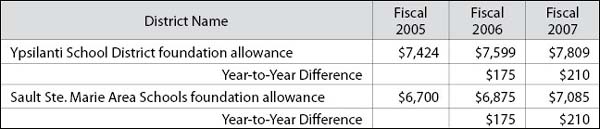
The '20j Supplement' for Hold-Harmless Districts
In addition to hold-harmless millage revenue, hold-harmless districts are able to maintain their level of spending in part through a state payment calculated under section 20j[cxii] of the State School Aid Act. This supplment is often referred to as a "hold-harmless payment."
Section 20j specifies three possible calculations.[cxiii] Which calculation the state uses for a hold-harmless district's payment is based on the relative size of the district's foundation allowance, the district's per-general-pupil local operating revenue, and the increase in the district's foundation allowance compared to the basic foundation allowance since 1999. All three of these possible calculations involve a variable we will call the district's "dollar adjustment difference" — that is, the difference between the basic foundation allowance adjustment since 1999 and the district's foundation allowance adjustment since 1999.
As an example, consider Novi. The Novi district's foundation allowance has increased by approximately $1,143[cxiv] since 1999, while the basic foundation allowance has increased by $1,423 during the same interval. Novi's dollar adjustment difference is
Novi Dollar Adjustment Difference2007 = $1,423 − $1,143 = $280. [cxv]
Case 1. The first calculation is applied to districts whose per-general-pupil local operating revenue is less than or equal to the sum of the dollar adjustment difference and the district's current foundation allowance. If a district fits this criterion and does not fit the criteria for Case 2 below, its 20j supplement is equal to the dollar adjustment difference multiplied by the number of general education FTE students.
Take the Lamphere Public Schools as an example. The per-general-pupil local tax revenue from that district's levy for operating purposes on nonhomestead property (18.000 mills) and homestead property (14.5000 mills) is $6,937.43.[168] Lamphere's dollar adjustment difference is Lamphere Dollar Adjustment
Difference2007 = $1,423 − $1,246 = $177.
When this is added to the district's foundation allowance for 2007 ($10,645), the sum is $10,822 per pupil. This is greater than the district's local property tax revenue per general-education pupil, and Lamphere does not qualify under Case 2 (see below), which requires that the district's local property tax revenue per general-education pupil be greater than the district's foundation allowance. Thus, for fiscal 2007, the state makes a hold-harmless payment to Lamphere based on its dollar adjustment difference multiplied by its general education FTE membership:
Lamphere 20j Supplement2007 = $177 x 2,336.79 = $413,611.83.
Case 2. The second calculation is applied to districts whose foundation allowance is less than their per-general-pupil local property tax revenue and whose per-general-pupil local property tax revenue is less than or equal to the sum of the district's foundation allowance and its dollar adjustment difference. The difference between this sum and the district's per-general-pupil local operating property tax revenue multiplied by the general education FTE membership is the state's 20j supplement payment to the district.
For example, consider "Gitchee Gumee," a hypothetical school district with 1,000 FTE general education students. The district's foundation allowance is $8,700 and its local operating property tax revenue per general pupil is $8,865.77 — i.e, greater than the district's foundation allowance. The district's dollar adjustment difference is $170, which means the district's foundation allowance plus the district's dollar adjustment difference is $8,870 — i.e., greater than the district's $8,865.77 in per-general-pupil local school operating property tax revenue.[cxvi] Thus, "Gitchee Gumee's" 20j payment for 2007 is
"Gitchee Gumee" 20j Supplement2007 = ($8,870 − $8,865.77) x 1,000 = $4,230.
Case 3. The third 20j calculation involves districts whose local operating revenue per general-education pupil is greater than the sum of the district's foundation allowance and the district's dollar adjustment difference. Districts that meet this criterion receive no payment under section 20j.
Consider the Harbor Springs School District. In fiscal 2007, Harbor Springs' per-general-pupil local school operating property tax revenue — $8,865.77 in fiscal 2007 — is greater than its $8,573 foundation allowance plus its $289 dollar adjustment difference (a total of $8,862). Harbor Springs therefore does not receive a 20j payment in fiscal 2007.
Foundation Allowance Adjustments
The adjustments discussed below appear in section 20 of the State School Aid Act (MCL § 388.1620) and are being made to the foundation allowances of conventional local public school districts in fiscal 2007. Also discussed is a section 20 adjustment — the former "section 32e" supplement — that remains relevant because it is used when calculating other education grants to certain school districts.[cxvii]
Former 'Section 32e' Money. Subsection 19 of section 20 of the State School Aid Act requires that a supplement be paid to districts that once received state education money under section 32e.[cxviii] The amount of money that was once disbursed under section 32e is still used in some calculations of certain other state payments made to conventional local school districts.[cxix]
The districts that received funding under section 32e had schools that met the following criteria in 2002:[169]
operated first grade through third grade;
operated by a district offering kindergarten through 12th grade;
received funds under section 31a for at-risk students; and
had 50 percent of their students eligible for free lunch under federal education programs.
The districts may or may not meet these conditions any longer, but the current law stipulates that the only test for receiving an adjustment under subsection 19 of section 20 is whether the district received funding under section 32e in 2002. The per-pupil adjustment amount is fixed at its 2002 level, but is based on the total state aid membership for the current fiscal year.[cxx] The additional money a district receives under this section must be used for one of three possible objectives:
The purpose specified by the former section 32e, which was intended to make the average class size in kindergarten through third grades not more than 17 students, with no more than 19 students in any one class in these grades.[170]
"Early intervention" programs for kindergarten through third-grade students designed to lessen the need for special education services[171] or to implement "schoolwide systems of academic and behavioral supports."[172]
Class-size reduction purposes using alternative methods as approved by the state Department of Education, but only if the district applies for this use of the additional funds and only if the district achieves adequate yearly progress status in language arts and mathematics at all relevant grade levels and in all relevant subgroups under the federal No Child Left Behind Act.[cxxi][173]
Of all Michigan local public school districts, 26 receive the former 32e adjustment.
Nonresident Student Adjustment Under Sections 105 and 105c. Sections 105 and 105c of the State School Aid Act stipulate certain conditions under which a student assigned to one school district may attend a school in another district without the permission of the student’s resident district. The receiving district can enroll students from school districts in the same intermediate school district[174] or from school districts in a bordering intermediate school district.[175] This program is commonly referred to as “schools of choice.”
The state pays a district a foundation allowance for each out-of-district student the district enrolls. The nonresident student brings with him or her a foundation allowance that is the lesser of the assigned district and receiving district’s two foundation allowances.[176] This modification of the foundation allowance amount based the two districts’ allowances is sometimes called a “20‑sub‑5” (20(5)) adjustment after the provision’s location in the State School Aid Act.
In the Wakefield-Marenisco School District, for example, 13.83 general education FTE students in January 2007 came from three other districts under sections 105 and 105c. As Graphic 18 shows, the district’s revenue from these nonresident students was $97,985.55. That amount is based on the resident districts’ foundation allowances, since the resident districts’ allowances are lower than Wakefield-Marenisco’s allowance of $7,645.
On Wakefield-Marenisco’s state aid financial status report, however, the 20(5) adjustment is reported as -$7,744.80. In effect, the state aid financial status report assumes that the district receives its own foundation allowance for all of the students the district enrolls, but then reduces this calculation by $7,744.80 to acknowledge that the “schools-of-choice” students’ foundation allowances are subject to the adjustments required in sections 105 and 105c.[177]
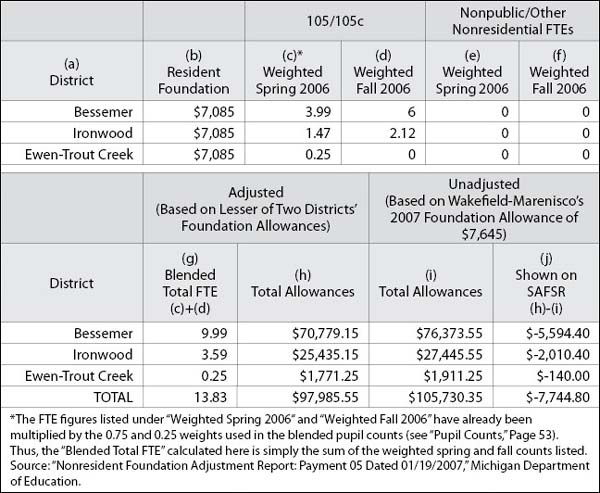
Nonresident Student Adjustment Not Under Sections 105 and 105c. In some intermediate school districts, conventional school districts enter into collaborative agreements regarding interdistrict pupil transfers without using sections 105 and 105c. In such cases, the foundation allowance that the enrolling district receives is that of the district to which the student was assigned. Consider, for instance, the Mona Shores School District. Based on January 2007 data, Mona Shores is receiving money for 378.31 full-time-equivalent students who were originally assigned to various other districts, but who attend Mona Shores under a collaborative agreement like that described above. This movement of students necessitates a financial modification known as a “nonresident student adjustment.”
Graphic 19 shows these students’ originally assigned districts at the far left. Because these students are not entering Mona Shores under the section 105 and 105c school choice options, Mona Shores receives the foundation allowance of the resident district, even though all the districts listed have higher allowances than Mona Shores does. The total foundation allowance assigned by the state to the students who attended Mona Shores under the nonresidential student arrangement in fiscal 2007 would be $2,801,912.29 based on January 2007 figures. This number is the “Adjusted” figure in Graphic 19, meaning that it is based on the resident district’s foundation allowance, not on Mona Shores’ own allowance, which is the basis for the “Unadjusted” figures at the far right. For comparison, the total allowances that Mona Shores would have received had it been paid an unadjusted amount — i.e., based on its own foundation allowance for 2007, $7,085 — would have been $2,680,326.35. That is $121,585.94 less than the adjusted amount, and this $121,585.94 figure appears on Mona Shores’ January 2007 state aid financial status report as the “20(5) Adjust.” (Note that the adjustment for nonresident students who transfer under sections 105 and 105c is also called a “20(5)” adjustment, since nonresident student calculations for both 105/105c and non-105/105c transfers are described in that subsection.)
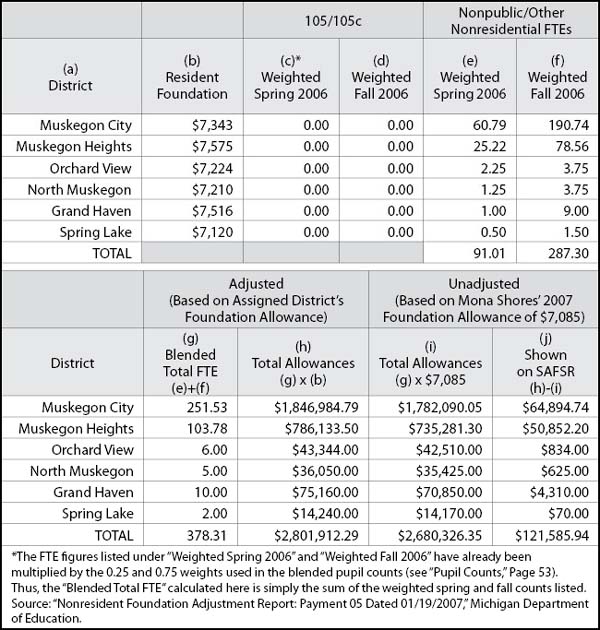
Charter Schools
Charter schools receive a district foundation allowance, just as conventional local school districts do. However, a charter school’s foundation allowance is equal to the lesser of the foundation allowance of the surrounding conventional school district and the basic foundation allowance plus $300.[180] In fiscal 2007, the basic foundation allowance is $7,085, meaning that no charter school is receiving a foundation allowance of more than $7,385 in fiscal 2007.
For example, University Preparatory Academy is located in the Detroit City School District. Detroit’s foundation allowance is $7,469, which is more than $7,385 ($300 above the 2007 basic foundation allowance of $7,085). Thus, University Preparatory Academy has a foundation allowance of $7,385, which is the lesser of the two amounts.
The Hillsdale Preparatory School, another charter school, presents a different situation. This school is located in the Hillsdale Community Public Schools, which is receiving the basic foundation allowance of $7,085 in fiscal 2007. Since the Hillsdale Preparatory School’s foundation allowance is the lesser of the HCPS foundation allowance and $7,385, the Hillsdale Preparatory School’s foundation allowance is $7,085 — the HCPS amount — in fiscal 2007.
Annual adjustments to the foundation allowances for charter schools will generally be the same as the annual adjustments for conventional school districts. A charter school’s foundation allowance would rise less quickly when the surrounding district gets an additional adjustment that raises its foundation allowance above the basic foundation allowance plus $300. In any event, the governing formula for a charter school’s foundation allowance in any one year is the lesser of the surrounding district’s foundation allowance and the basic foundation allowance plus $300.
[cxi] The Lamphere district did, in fact, levy its maximum possible nonhomestead property tax of 18 mills in fiscal 2007.
[cxii] “Section 20j” is shorthand for MCL § 388.1620j. (The first five digits of the MCL citation are understood from the reference to the State School Aid Act, which begins at MCL § 388.1601.)
[cxiii] For each of these three calculations, see MCL § 388.1620j(3).
[cxiv] We say “approximately” here because the state’s calculations of the district’s foundation allowance adjustment since 1999 appear to include fractions of a dollar that used to be part of Novi’s (and many other districts’) district foundation allowance in 1995 (see MCL § 388.1620(3)(c)).
[cxv] Novi’s exact dollar adjustment difference for 2007 is $280.58.
[cxvi] Because the sum of the district’s foundation allowance and dollar adjustment difference is greater than the district’s local operating revenue per general pupil, the district meets the criteria of Case 1. But because the district also meets the second criterion in Case 2 — i.e., the district’s per-general-pupil local operating revenue is greater than the district’s foundation allowance — the district’s payment is calculated under Case 2.
[cxvii] We do not discuss in this primer foundation allowance adjustments that were made in past fiscal years but that are not scheduled to be made again. For instance, in 2003, the state made an “equity payment” on a per-pupil basis to districts whose foundation allowance was less than $6,500. A similar payment was made in 2007, but those “equity payments” are not automatic annual adjustments. A second example of an adjustment that is no longer made is a 2003 increase of $250 per pupil for districts whose district boundaries contained industrial facilities that met specific criteria and received tax reductions (MCL § 388.1620(18)). The provision applied to one district, Gibraltar (“School Aid Act Compiled and Appendices,” C-2), which received a $450 foundation allowance increase in 2003, while the basic foundation allowance increase was $200. These adjustments are permanent in the sense that once they have raised the district’s foundation allowance, the adjusted allowance remains the basis upon which the next fiscal year’s foundation allowance is calculated.
[cxviii] Section 32e was subjected to a gubernatorial veto (and thus removed from the State School Aid Act) on Sept. 28, 2001. The repealed law, MCL § 388.1632e (see Historical and Statutory Notes for 1997 Main Volume, MCLA § 388.1622b), was later replaced by the section under review here, MCL § 388.1620(19).
[cxix] For example, the payment made in 2007 to districts with a foundation allowance of less than $7,360 (MCL § 388.1622c) is based on districts’ foundation allowances including the former 32e per-pupil foundation allowance increase. By contrast, foundation allowances paid to districts accepting nonresident students under MCL § 388.1705 and 1705c are calculated without the former 32e adjustment: See Footnote cxxiii.
[cxx] MCL § 388.1620(19) states that a district’s total adjustment under subsection 19 is the product of the district’s current membership and the district’s per-pupil payment in 2002 given its 2002 resident membership — that is, excluding cross-district transfer students (discussed below).
[cxxi] The No Child Left Behind Act is the federal law governing the distribution of much of the federal education revenue from the U.S. Department of Education to state governments. The act is discussed in more detail in “Distribution of Money from Federal Sources,” Page 90. 8583
[cxxii] A third type of student transfer involves a student’s attendance at classes offered by an eligible postsecondary institution during his or her secondary schooling. Such a transfer may be effected under the Postsecondary Enrollment Options Act (MCL § 388.511 through MCL § 388.524). This transfer technically does not involve a state “adjustment” to the district’s foundation allowance, but rather requires the student’s district to pay the institution the lesser of the cost of the student’s education or a prorated portion of the student’s foundation allowance (MCL §§ 388.1621b(2), 388.1621b(3)).
[cxxiii] Note that the “Adjusted” figures are based on the resident district’s foundation allowance before it is adjusted under section 20(19), which is discussed above as “former section 32e” money. If a foundation allowance included the former section 32e adjustment, the Muskegon Heights school district’s foundation allowance would be $7,741, rather than the $7,575 listed in Graphic 19. Not all districts receive a former section 32e adjustment, but Muskegon City, Muskegon Heights and Orchard View do.
[cxxiv] A brief note is in order about the pupil counts in Graphic 19. The Michigan Department of Education uses FTE student count data from the state government’s Center for Educational Performance and Information, but the CEPI’s FTE counts differ from the numbers listed in the graphic because the blend percentages have not been applied to CEPI’s numbers. For instance, CEPI indicates that the number of FTE general education students who reside in Muskegon Heights but transferred to the Mona Shores district was 104.75 in fall 2007. If we multiply 104.75 by 0.75, we get 78.5625, which is the (unrounded) number listed in column (f) of the “Muskegon Heights” row of Graphic 19. Similarly, CEPI lists the Muskegon Heights FTE count for the same categories in spring 2006 as 100.88. If we multiply this figure by 0.25, we get 25.22, which is the number listed in column (e) of the “Muskegon Heights” row.
Operating Monies for Special Education
Special education funding from the state is distributed on a per-pupil basis for some Michigan districts and on a per-pupil and categorical basis for other districts.[cxxv] Some districts receive more than one type of categorical payment for special education, while others receive an additional amount for students who are in the care of various government institutions or in alternative residential arrangements ("section 53a" students). In the short sections below, we will focus first on conventional school districts, beginning with those districts’ special education foundation allowance, which is the per-pupil calculation for the state’s special education payments.
The Special Education Foundation Allowance
Unlike the foundation allowance for general education students, the foundation allowance for special education students is paid entirely by state government (and federal government, with the state disbursing the federal monies). The state’s per-pupil money for special education — as opposed to categorical money for special education — is computed by multiplying the number of special education FTE students in a particular conventional local school district by the lesser of the state’s maximum foundation allowance and the district’s foundation allowance (including the 20j supplement[cxxvi] in the case of hold-harmless districts). State per-pupil money for special education follows similar lines for charter schools and ISDs, as will be described in more detail below.
This special education expenditure is referred to by the Michigan Department of Education as the "special education foundation." We will refer to this total amount as the "special education foundation allowance," although the per-pupil amount is often the same as the foundation allowance the district is assigned for general education pupils.[cxxvii] In calculating this allowance, the state assumes that all of the money comes from nonlocal sources; revenue from maximum local property tax millages is not considered.
The money that a district receives for the special education foundation allowance is calculated separately for two different types of students: "high incidence" students, who experience more common learning impairments, such as hyperactivity, and "low incidence" students, such as blindness.[181] Note that the calculation is split for bookkeeping purposes only; both types of students receive the same per-pupil foundation allowance.
In education finance calculations, high incidence students are often referred to as "section 52"[cxxviii] students, and "low incidence" students are often referred to as "non-section 52 students" or "section 53 students."[cxxix] These designations refer to the State School Aid Act’s sections 52 and 53, which identify how part of the districts’ per-pupil special education operating monies are allocated to educate these pupils.
Some districts have both types of pupils. For example, Otsego Public Schools had 62.73 FTE students categorized as "section 52" special education students and 0.79 FTE students categorized as "section 53" (or "non section 52") students, according to January 2007 data.
51a(2)(a) Calculation: Foundation Allowance for ‘High Incidence’ Students
For education finance purposes, "high incidence" or "section 52" students are those special education students who do not meet the following criteria:
They participate in special education programs financed under section 53a of the State School Aid Act;[182]
They receive services in a juvenile or child care facility, but are counted as members of an ISD;[cxxx][183]
They are considered "emotionally impaired" and served by a community health program.[cxxxi][184]
The total special education foundation allowance for high-incidence students is determined by multiplying a conventional public school district’s foundation allowance or the state maximum foundation allowance, whichever is less, by the number of FTE "section 52" students. The calculation is slightly different for non-hold-harmless and hold-harmless school districts, as the following examples show.
Example 1: The Non-Hold-Harmless Brandywine School District. The January 2007 state aid financial status report for Brandywine School District shows the district receiving money for 48.25 special education FTE students who met the requirements described above and can be included in the calculation of the special education foundation allowance. Given these January 2007 figures and the district’s foundation allowance of $7,085, in fiscal 2007 the state must send Brandywine
Brandywine Section 52
Special Education Foundation Allowance Monies2007 =
48.25 x $7,085 = $341,851.25.
Example 2: The Hold-Harmless East Lansing School District. With hold-harmless districts, the state pays both the special education foundation allowance and the 20j hold-harmless supplement for special education students, but only up to the state maximum foundation allowance.[cxxxii] For example, the East Lansing School District, a hold-harmless district, has a district foundation allowance in fiscal 2007 of $8,203 and a 20j hold-harmless payment of $314.45. Because the sum of $8,203 and $314.45 is $8,517.45 — greater than the $8,385 state maximum foundation allowance — the district receives $8,385 per section 52 special education FTE student. Assuming the district has no nonresident FTE students,[cxxxiii] the payment would be
East Lansing Section 52 Special Education Foundation Allowance Monies2007 =
$8,385 x 131.43 = $1,102,040.55.
The special education foundation allowance for charter schools follows the same lines as that for conventional public school districts: The state simply pays the charter school the school’s own foundation allowance multiplied by the school’s number of section 52 FTEs.
Intermediate school districts can receive a section 52 special education foundation allowance when a student is not enrolled in a conventional local school district or a charter school and receives educational services from the ISD. In this instance, the special education foundation allowance for this pupil is the allowance the student would receive in his or her resident conventional local school district, including a 20j supplement if the student resides in a hold-harmless district. As with the conventional local school districts, the state’s payment is capped at the state maximum foundation allowance.
51a(12) Calculation: Foundation Allowance for ‘Low Incidence’ Students
The state makes foundation allowance payments to conventional school districts, charter schools and intermediate school districts for "section 53" students, who are students who meet the following criteria:[cxxxiv] [185]
Students assigned by a court or a state agency to a local school district in an intermediate school district in which the student does not reside, or to an intermediate school district in which the student did not reside when the student "came under the jurisdiction of the court or a state agency;"[186]
Students who live in community health nstitutions;[187]
Students who were residents of "community health institutions for the developmentally disabled" who are subsequently "placed in community settings other than the pupil’s home";[188]
Students attending an "on-grounds educational program" approved by the state Department of Education for between 181 and 233 days or at a "residential child care institution" that offered such a program in 1992;[189]
A student whose parent places him in a district "for the purpose of seeking a suitable home, if the parent does not reside in the same intermediate [school] district in which the pupil is placed;"[190]
Students not designated as "special education students" but who receive services from an ISD in a "juvenile detention or child caring facility;"[191]
Students enrolled in an ISD who are "emotionally impaired" and are served by a community health program.[192]
The total special education foundation allowance for these low-incidence students is determined by multiplying a conventional local school district’s foundation allowance or the state maximum foundation allowance, whichever is less, by the number of FTE "section 53" students. Below we show an example of this calculation for both a non-hold-harmless and a hold-harmless school district.
Example 1: The Non-Hold-Harmless Otsego Public Schools. For instance, Otsego Public Schools has 0.79 FTE students categorized as "section 53" students. Otsego’s foundation allowance is $7,085 in fiscal 2007; therefore, based on January 2007 figures, Otsego would receive the following in 2007:[cxxxv]
Otsego Section 53
Special Education Foundation Allowance Monies2007 =
$7,085 x 0.79 = $5,597.15.
Example 2. The Hold-Harmless Farmington Public School District. The Farmington Public School District has a foundation allowance of $10,261 in fiscal 2007 and a 20j payment of $191.22. Since the sum of these payment exceeds the $8,385 state maximum foundation allowance, the district receives $8,385 as the total foundation allowance for the 55.85 section 53 special education FTE students enrolled in January 2007. Based on January 2007 figures, the district in fiscal 2007 would receive the following:
Farmington Section 53
Special Education Foundation Allowance Monies2007 =
$8,385 x 55.85 = $468,302.25.
As with conventional school districts, the state pays charter schools a special education foundation allowance for low-incidence special education students by multiplying the charter school’s foundation allowance by the school’s number of section 53 FTEs. The state also makes special education foundation allowance payments to intermediate school districts that educate low-incidence special education students when those students are educated by the ISD and are not enrolled in a conventional local school district or charter school. The state’s payments to the ISD are calculated by multiplying the number of qualifying students by the special education foundation allowance of the conventional local school district in which the student resides.
Categorical Special Education Payments
51a(2)(b) Calculation: ‘Special Education Payment’
Many districts receive a categorical special education payment
in addition to the per-pupil special education foundation allowance. Districts
qualify for these additional categorical grants whenever the district’s special
education revenue under section 51a(2)(a) (see above) does not equal the sum of
28.6138 percent of the total approved[cxxxvi] "Special ed Costs" and 70.4165 percent of
the total approved "SE Transportation Costs"[193] (these percentages
were calculated during the Durant v. State of Michigan lawsuit).[cxxxvii]
The figures necessary for this calculation are available from each district’s state aid financial status report. For example, Brimley Area Schools has 11.55 special education section 52 FTE students,[cxxxviii] and its foundation allowance is $7,085. The state pays thus pays the district $81,831.75 in special education foundation allowance money for special education expenditures:
Brimley Section 52
Special Education Foundation Allowance Monies2007 =
11.55 x $7,085 = $81,831.75.
However, this amount is not sufficient to cover the sum of the specified percentages of special education program costs and special education transportation costs for the district. According to the district’s state aid financial status report, Brimley’s state-approved special education cost is $291,750, while the district’s approved special education transportation cost is $111,941. The guaranteed minimum in special education funding — that is, the sum of the two percentages applied to these costs — is
Guaranteed Minimum Special Education Monies =
Sum of Percentages of Costs of Special Education and Special Education Transportation =
(28.6138 percent x Special Education Costs) +
(70.4165 percent x Special Education Transportation Costs) =
(0.286138 x $291,750) + (0.704165 x $111,941) = $162,305.70.
Since this sum is greater than the $81,831.75 in per-pupil foundation allowance monies that Brimley receives for its special education FTE students, the state must make up the difference between the two figures:
$162,305.70 − $81,831.75 = $80,473.95. [cxxxix]
This additional state expenditure is referred to by the state Department of Education as a "special education" payment and denoted as being related to section 51a.[cxl]
Intermediate school districts[cxli] and charter schools receive the categorical 51a(2)(b) payment based on the same calculation as conventional local school districts: They receive any positive difference between the guaranteed minimum special education monies for the ISD or charter school and the section 51a(2)(a) payment.
53a: Court- and State Agency-Placed Students
The state pays an additional categorical grant to conventional local school districts, charter schools and intermediate school districts for educating certain low-incidence special education pupils. Such students are described in section 53a of the State School Aid Act and are discussed above.[cxlii] The state makes this payment based on "the total approved costs of operating special education programs and services approved by the department"[194] for section 53a pupils.[195] The monies paid for such students under the special education section 53 (low incidence) foundation allowance are subtracted from the total approved cost, and the difference is disbursed by the state to local districts, charter schools and ISDs as this categorical payment for "53a: Court and Agency Placed Students."
51a(6): Special Education Rule Change Cost Increase Reimbursement
On July 1, 1987, the State Board of Education made changes to certain special education rules. These revised rules "provided more flexibility to school districts in serving students with disabilities, [but] some rules provided more stringent standards," according to a memo from the Michigan Department of Education.[196] The Education Department agrees to authorize the full reimbursement to local and intermediate school districts[cxliii] of the increased costs they incurred in complying with these rules. To receive a reimbursement payment, local and intermediate districts must demonstrate that they meet certain criteria.[197] In 2007, the total amount appropriated for these special education rule change costs was $2.2 million.[198]
51a(3) Calculation: Special Education "Hold Harmless" Payment
If the sum of money from the special education foundation allowances and the categorical "special education payment" is not equal to the amount a conventional local school district, intermediate school district or charter school received in 1997 for special education programs and services[199] and special education transportation,[200] the district or charter school receives from the state an amount equal to the difference between those 1997 costs[cxliv] and the current special education program and transportation costs multiplied by the percentages discussed above, adjusted for "reductions in special education operations and programs" since 1997.[cxlv] This expenditure is referred to by the Department of Education as a special education "hold harmless" payment.[cxlvi] In fiscal 2007, the amount appropriated for these payments is $1.6 million.
Other Special Education Payments to ISDs
Intermediate school districts receive other payments for special education. One payment, calculated under section 51a(8), totaled $15,313,900 in fiscal 2007[201] and appeared to defray personnel costs. This sum is listed on ISDs’ monthly state aid financial status reports as "Center Program FICA/Retirement."[cxlvii]
ISDs also receive payments for students who attend programs of the schools of the deaf and blind. The amount paid to ISDs is to be "proportionate to the total instructional cost at each school" and is not to exceed $1,688,000 in fiscal 2007.[202] (The schools for the deaf and blind are discussed briefly under "Michigan Department of Education.")
Some ISDs may receive a "millage equalization" payment for special education. This payment allows districts with a total taxable value per pupil[cxlviii] below a certain amount — $151,300 in fiscal 2007[203] — to receive a sum of money from the state that complements the ISD’s special education tax so that the combined revenue yields what the district would receive from the special education tax alone if the ISD had the state’s specified per-pupil taxable value. To calculate the per-pupil payment, the ISD’s per-pupil taxable value is subtracted from $151,300, and the difference is multiplied by the ISD’s special education property tax millage.[204]
[cxxv] Note that districts that use special education funding for purposes other than those related to providing special education may be required by the state Department of Education to refund the money, which would then be credited to the state school aid fund (MCL § 388.1651a(11)).
[cxxvi] The 20j supplement is discussed previously on The Foundation Allowance: General Education cont....
[cxxvii] See, for example, “State of Michigan 2006-2007 State Aid Financial Status Report: Payment Dated 01/19/2007,” 4.
[cxxviii] “Section 52” is shorthand for MCL § 388.1652. (The first five digits of the MCL citation are understood from the reference to the State School Aid Act, which begins at MCL § 388.1601.)
[cxxix] Technically, the distinction in the State School Aid Act calculations is not really between section 52 and section 53 students, but between section 51a(2)(a) and section 51a(12) students. We mention sections 52 and 53 in the text because they are the categories referred to in state aid financial status reports. Also note that section 53 has been repealed from the State School Aid Act.
[cxxx] All students fall within the boundaries of an ISD, but some students are not registered in a conventional local school district or a charter school; rather, they are registered only with their ISD.
[cxxxi] This three-point list of students not included in calculating the special education foundation allowance for high-incidence students corresponds to the seven points presented in “51a(12) Calculation: Foundation Allowance for ‘Low Incidence’ Students,” of this section. The first five points describe section 53a students (point No. 1 above), while the remaining two bullet points correspond to the final two groups of students described above.
[cxxxii] The 20j payment for general education students is discussed earlier under “The Foundation Allowance: General Education cont....”
[cxxxiii] The district actually receives a total of $1,070,793.54; this number is obtained by subtracting the nonresident FTE student adjustment from the figure calculated above. In other words, the adjustment is $1,102,040.55 - $31,247.01 (the adjustment for nonresident section 52 special education FTEs) = $1,070,793.54.
[cxxxiv] Strictly speaking, students falling under the first five criteria are the only “Section 53” students; the remainder the students appearing on the list are actually described in section 51a(12). The state, however, describes all of these students as “section 53” students when dealing with conventional local school districts and charter schools. For an example, see “State of Michigan 2006-2007 State Aid Financial Status Report: Payment Dated 01/19/2007,” 14.
[cxxxv] See Ibid., 15-16. This is the amount listed on the state aid financial status report line titled “51a12 Special ED Foundation (Non-Sec 52).”
[cxxxvi] For a list of special education program and transportation cost categories approved for districts in 2007, see Jacquelyn J. Thompson, “Closing out the 2005-06 School Year Special Education Accounts and Funding Information for the 2006-07 School Year,” (Michigan Department of Education, 2006), 20-28, 36-39, www.michigan.gov/documents/OSE-EISMemo06-07_157181_7.pdf (accessed Feb. 14, 2007).
[cxxxvii] Specifically, these percentages were adopted by the Michigan Court of Appeals in its initial ruling in the case (Durant v. Dep’t of Educ., 213 Mich App 500, 505 (1995)).
[cxxxviii] This categorical payment involves only section 52 students (note that the calculation takes place under section 51a(2)(b)). In a hold-harmless conventional local school district, the calculation of the section 52 foundational allowance may include the 20j supplement (up to the state maximum foundation allowance in total).
[cxxxix] The difference between these two numbers in the district’s state aid financial status report is actually $80,473.94. The difference between that figure and the figure calculated above appears to be due to rounding.
[cxl] For an example, see “State of Michigan 2006-2007 State Aid Financial Status Report: Payment Dated 01/19/2007,” 4.
[cxli] Intermediate school districts can receive a categorical 51a(2)(b) payment when a student is not enrolled in a conventional local school district or a charter school and receives educational services from the ISD.
[cxlii] See the types of students described in items 1 through 5 in the section entitled "51a(12) Calculation: Foundation Allowance for ‘Low Incidence’ Students.'"
[cxliii] Charter schools do not receive the payment because they did not exist in 1987.
[cxliv] These are the nominal 1997 costs; they are not adjusted for inflation.
[cxlv] MCL § 388.1651a(3); these adjustments are made “in a manner determined by the [state] department [of education],” according to § 1651a(3). For the state’s payment calculations under this section, see www.michigan.gov/documents/sehh_79613_7.xls.
[cxlvi] See, for example, “State of Michigan 2006-2007 State Aid Financial Status Report: Payment Dated 01/19/2007,” 2.
[cxlvii] See, for example, Ibid., 95.
[cxlviii] This taxable value includes all real and personal property within the borders of the ISD. The pupils counted here include all general and special education FTEs enrolled in the ISD’s constituent school districts.
The general and special education allowances and grants reviewed above are calculated under the sections of the State School Aid Act cited there, but in most instances, the monies are actually allocated from three other sections of the State School Aid Act.
This dual basis in the statute is reflected in a district’s state aid financial status report. The first of the report’s two pages shows the amounts paid under “Proposal A Obligation,” “Spec Ed Headlee Obligation” and “Discretionary Payment,” each of which is enumerated below. The second of the report’s two pages, in contrast, shows the amounts paid under “Foundation Grant,” “Special Ed Foundation” and “Special Ed Hold Harmless,” which are discussed in the sections above. As would be expected, the three amounts on the first page sum to the same total as the three amounts on the second page, even though the individual amounts on the first and second pages are different from each other.
The “Proposal A Obligation,” or section 22a payment, is calculated by multiplying the sum of a district’s FTE students in general education (section 20) and special education (sections 51a(2) and 51a(12)) by the district’s 1995 foundation allowance. The product is then reduced by the amount of revenue generated from the maximum possible millage on nonhomestead property in the district.[cxlix] The state’s total Proposal A guarantee allocation in fiscal 2007 was $6,207,000,000.[205]
The “Spec Ed Headlee Obligation” (section 51c) is calculated by multiplying the district’s cost of special education[cl] by 28.6138 percent and the district’s special education transportation cost by 70.4165 percent. These percentages are the same ones used in the 51a(2)(b) calculation above.[cli] The state’s total allocation for the Headlee obligation payment in 2007 is $708,200,000.[206]
The state’s obligation to provide this special education money is the result of the Michigan Supreme Court’s 1997 decision in Durant v. State of Michigan[clii]. The court ruled that the state government had mandated certain special education services and was required under the Headlee amendment to finance school districts’ compliance with the mandates.
The third allocation made by the state Legislature to schools is the “discretionary payment.” The state’s total allocation for the discretionary payment in fiscal 2007 was $3,584,950,000.[207] This amount represents the “nonmandated payments to districts,”[208] meaning that unlike the Headlee obligation payment and the Proposal A guarantee, this figure is paid at the Legislature’s discretion; it is not required by the courts or the Michigan Constitution. The payment consists of the difference between two figures: the sum of the general education calculations for sections 20 and 20j and the special education calculations under sections 51a(2), 51a(3) and 51a(12); and the sum of the amount paid to guarantee that districts receive the same amount of funding they had when Proposal A took effect (section 22a) and the amount the state was obligated to pay under the Michigan Supreme Court Case Durant v. State of Michigan (section 51c).[209] Essentially, this payment is the source of any annual increases in the districts’ foundation allowances.
[cxlix] MCL § 388.1622a(2)(a). The “maximum possible millage on nonhomestead property” is the same as that discussed earlier: the lesser of 18 mills or the district’s property tax millage for school operating purposes in 1993.
[cl] This cost cannot include the costs reimbursed for providing special education services to students under section 53a.
[cli] See “51a(2)(b) Calculation,” in the previous page, Operating Monies for Special Education.
[clii] For more discussion of the Durant decision, see “Appendix 2: Summary of ‘Durant’ Court Decisions.”
The U.S. Congress appropriates revenues for elementary and secondary education in the federal government’s annual budget. Most federal money for elementary and secondary schools is made available in the form of an appropriation to the U.S. Department of Education.[cliii] The department then sends the budgeted funds to the state departments of education, which distribute the funds to their states’ schools.[210] While these federal monies are appropriated in Michigan as part of in the State School Aid Act (usually as estimates), the monies are actually disbursed through electronic grants and cash management systems.[cliv]
In fiscal 2007, the U.S. Department of Education sent $1.11 billion to the Michigan Department of Education, according to federal education statistics.[clv] About 60 percent, or $667.5 million, of the total federal monies appropriated for Michigan elementary and secondary schools were allocated to finance the federal No Child Left Behind Act.[clvi]
Of that NCLB money, 70 percent, or about $467 million, financed schools that enroll “Title I” students. Title I is part of the federal Elementary and Secondary Education Act, originally passed in 1965 (the act was reauthorized in 2002 as the No Child Left Behind Act of 2001). Title I provides money meant to improve the academic performance of students who face a variety of specific potential educational challenges.[211] The law includes money for schools with children whose families are living below the poverty level,[clvii] children who are learning English as a second language, children who face cultural and linguistic barriers,[212] children who are not meeting state education standards sanctioned by the federal government[213] or children who are neglected or delinquent.[214]
Title I money is to be distributed to districts by the state Department of Education in compliance with federal law.[215] Although federal law concerning education is comprised of several parts, we will review the basics of the federal statutes governing the distribution of monies under Title I, Part A, since it is the largest single area of spending in Michigan under the federal No Child Left Behind Act.[clviii]
The Allocation of Grants Under Title I, Part A
Districts can receive Title I, Part A, money only if 10 or more of their students and more than 2 percent of their school-age population are eligible for the money under federal guidelines.[216] In fiscal 2007 for example, the Novi Community Schools has 98 students meeting the poverty requirements for Title I, Part A, funding, but those 98 students comprise only 1.6 percent of the total student population from ages 5 to 17. Therefore Novi is receiving no Title I, Part A, money in 2007.[217]
Title I, Part A, dollars are transferred in the form of four grants.[clix] The first grant, known as the “basic grant,” is the product of the number of children meeting federal criteria in a local school district multiplied by 40 percent of the average amount of overall operating expenditures per public school student[clx] in the state[clxi]. However, the basic grant cannot be less than 32 percent or more than 48 percent of the average amount of operating money spent per student in the country.[218]
The second kind of Title I, Part A, grant is the “concentration grant.” Concentration grants are given to a local school district that has 6,500 students eligible for Title I, Part A, or has 15 percent of its total population ages 5 through 17 eligible for Title I, Part A.[219] The Walled Lake Consolidated School District qualifies for a basic grant in fiscal 2007 because more than 10 students and more than 2 percent of the district’s total school-age population qualifies under the act as impoverished. However, Walled Lake does not qualify for a concentration grant, since only about 4.9 percent — less than 15 percent — of its students are eligible, and since the district’s 785 eligible students are fewer than the required 6,500.[220] The dollar amount of the concentration grant to school districts is based on the number of students considered to be eligible under Title I, Part A, multiplied by 40 percent of Michigan’s average per-pupil operating expenditure.[221] The amount of the concentration grant might be reduced for each district if congressional appropriations are insufficient to finance the grants for all of the districts that qualify.[222]
A third type of grant is the “targeted grant.” A targeted grant is paid to a district if at least 10 children and at least 5 percent of the 5- to 17-year-olds in the district are eligible under Title I, Part A.[223] In apportioning the grant, two multipliers — one by student number, and the other by student percentage — are determined, and the larger of the two multipliers is used (see Graphic 20). This figure is then multiplied by the number of students qualifying, and the product is in turn multiplied by 40 percent of the state’s average per-pupil operating expenditures to determine the grant’s size.
(Use the method yielding a larger total)[225]
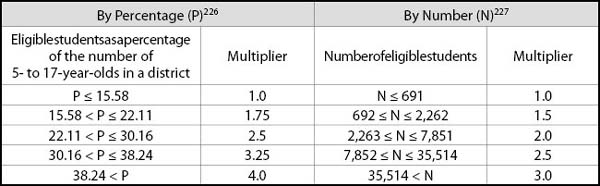
Under this weighted formula, districts with higher percentages of eligible students receive the highest levels of funding. Prior to 2001, targeted grants existed in law, but were unfunded.[228] Currently, Congress does provide money for the grants, but does not ensure that the money appropriated is sufficient to provide all of the targeted grant monies for which districts might qualify under the act.[229] As with the concentration grant, the amount of the targeted grant is reduced if Congress has not appropriated sufficient money.[230] Congress does guarantee, however, that a certain percentage of the total appropriation for targeted grants will be spent in each state.[231]
For each of these three grants, Congress does not permit states to rapidly decrease the amount of money any particular district receives. Instead, for each of the grants, Congress requires that a state provide each local school district with a “hold-harmless” amount, which is a certain percentage of the money the district received for the grant in the previous fiscal year.[232] The hold-harmless amount is based on the percentage of total 5- to 17-year-olds in the district who are currently eligible for Title I, Part A, funding.[clxii]

The Title I, Part A, hold-harmless percentages are important in the distribution of federal monies by state governments. When state education department officials receive the state’s total federal allocation for each of the three grants described above, they distribute the funds so that every district receives at least its hold-harmless amount. In 2007 for instance, Alpena received a total basic grant of $611,505. Since 15.3 percent of the district’s population of 5- to 17-year-olds is eligible in 2007, Alpena must receive in 2008 a hold-harmless amount of at least 90 percent of its 2007 grant amount — meaning at least
$611,505 x 90 percent = $611,505 x 0.90 = $550,354.50.
A fourth grant type distributed under Title I, Part A, is the “education finance incentive grant.” Incentive grants provide money to districts based on the number of students eligible for Title I, Part A, and on three other variables. The first of these variables is 40 percent of the average per-pupil operating expenditure in the state, though that amount cannot be less than 34 percent or greater than 46 percent of the U.S. average per-pupil operating expenditure.[233] The second variable is called an “effort factor.” This effort factor is designed to go up for states that spend more than average or that have less income than average (and to go up particularly for states that do both). This factor is calculated as follows, but there is a floor of 0.95 and a ceiling of 1.05 on the state effort variable when it is used to calculate the incentive grant:[234]
Effort = State 3 Year Average Per Pupil Expenditure x U.S. 3 Year Average Per Capita Income
U.S. 3 Year Average Per Pupil Expenditure x State 3 Year Average Per Capita Income
The third variable includes an “equity factor,” which is subtracted from 1.30 to arrive at the appropriate value.[235] The equity factor consists of measuring the variation between local districts’ per-pupil operating expenditures[clxiii] and the average per-pupil operating expenditure in the state.[236] Each district’s variation is weighted by the number of the district’s students who are eligible for Title I, Part A, basic grant funding multiplied by a factor of 1.4. In effect, the money provided under this equity calculation will tend to go up for districts that spend less than the state average and that have many children eligible for the Title I, Part A, basic grant.[237] For the incentive grant as a whole, then, districts that spend less than the state average and that have many Title I, Part A, eligible students will tend to receive more money, particularly if the districts are located in lower-income states that spend more on education than might be expected.
IDEA Special Education Grants
The second largest category of federal funding is special education programming mandated by the Individuals With Disabilities Education Act.[clxiv] IDEA was re-enacted in December 2004. Among its many provisions, IDEA requires that grants be made to states “to assist them to provide special education and related services to children with disabilities. ...”[238] IDEA stipulates that “a free appropriate public education[clxv] is available to all children with disabilities residing in the State between the ages of 3 and 21, inclusive, including children with disabilities who have been suspended or expelled from school.”[239]
In 2006, the federal government distributed $394.9 million to Michigan for special education programs and services.[clxvi] For 2007, the maximum grant amount for a state is the number of students ages 3 through 21 who received special education and similar services in 2005 multiplied by 40 percent of the U.S. adjusted average per-pupil expenditure in public schools.[240]
The Michigan Legislature mixes some federal special education money with state special education money in state appropriations,[241] but the state Education Department distributes federal special education monies to school districts through federal funding formulas. (As noted above, such monies are disbursed through electronic grant and cash management systems.) Other federal special education money is not appropriated with state revenues, however, and is passed directly to “districts, intermediate districts and other eligible entities.”[clxvii]
Other Federal Education Money
Other federal monies are distributed by the state Department of Education through other parts of the NCLB and through other U.S. Department of Education initiatives.[242] Totals for fiscal 2006 in each of those funding areas can be seen in “Appendix 1: U.S. Department of Education Spending in Michigan.” Much of the money for federal programs that have not been described above is passed through section 39a of the State School Aid Act.[clxviii]
[cliii] Some federal spending on education occurs outside the U.S. Department of Education or as a collaborative effort among federal departments. One example is the National Security Language Initiative; see “National Security Language Initiative,” Office of the Spokesman, U.S. Department of State, www.state.gov/r/pa/prs/ps/2006/58733.htm. For a table of federal outlays for education by department and program, see “Digest of Education Statistics 2005,” (Institute of Education Sciences, National Center for Education Statistics, U.S. Department of Education, 2006), http://nces.ed.gov
[cliv] These electronic grant and cash management systems are accessed via the Web; see, for instance, www.michigan.gov/mde/0,1607,7-140-5236---,00.html.
[clv] See also “Federal Government.”
[clvi] For the formulas used to allocate Title I, Part A, funds to states, see 20 U.S.C. § 6332(a).
[clvii] The number of children living below the poverty level is based on data from the U.S. Department of Commerce (20 U.S.C. § 6333(c)(2), 6333(c)(3)(A)), while the poverty level is defined by the U.S. Bureau of Census (20 U.S.C. § 6333(c)(3)(C).
[clviii] Although federal special education money (like the state special education money described earlier) is appropriated by the Michigan Legislature in the State School Aid Act, federal monies for special education and other purposes are usually disbursed through electronic grant and cash management systems. For more information about such grants, see http://megs.mde.state.mi.us
[clix] For an overview, see “Title I Funding: Poor Children Benefit Though Funding Per Poor Child Differs,” (United States General Accounting Office, 2002), 5-8, 59-60, www.gao.gov/new.items/d02242.pdf (accessed Feb. 17, 2007).
[clx] The figure used by the U.S. Department of Education is obtained from the National Center for Education Statistics’ most recently available Common Core of Data. According to the federal Education Department, the figure used for this calculation is current expenditures, which excludes capital expenditures. The average used in fiscal 2007 for Michigan is $9,577; 40 percent of this figure is $3,830.80.
[clxi] When a school district’s total resident population is less than 20,000 (20 U.S.C. § 6333(a)(2)(B)(vi)(II)), the state may appropriate funds to that district at its own discretion (20 U.S.C. § 6333(a)(2)(B)(iii)), and the district may appeal the department’s grant amount (20 U.S.C. § 6333(a)(2)(B)(v)).
[clxii] Note, however, that if a district no longer meets the requirements for a concentration grant, their hold-harmless percentage is used for four more years (20 U.S.C. § 6322(C)(2)).
[clxiii] Note that only districts that enroll more than 200 students are to be included in the calculation: 20 U.S.C. § 6337(b)(3)(A)(ii)(IV).
[clxiv] IDEA is a complex law, and this primer will not scratch its surface. For an overview, the reader may wish to access the U.S. Department of Education Web site dedicated to IDEA: http://idea.ed.gov
[clxv] This is often referred to as “FAPE” in technical literature on special education.
[clxvi] See “Appendix 1: U.S. Department of Education Spending in Michigan.”
[clxvii] MCL § 388.1651d(1). The federal programs described here are listed in MCL § 388.1651d(2).
[clxviii] MCL § 388.1639a. These include federal programs for drug and violence prevention, for improving the use of technology in instruction and for the Michigan charter school “subgrant” program. The programs are listed in MCL § 388.1639a(1) and MCL § 388.1639a(2).
A number of other grants are made by the state to conventional and intermediate school districts. These are discussed below.
Durant-Related Payments
Durant-related payments refer to state expenditures that resulted from the Michigan Supreme Court’s 1997 decision in Durant v. State of Michigan. The court held that state government had mandated certain special education programs, but failed to finance adequately districts’ compliance with these mandates, thereby violating the Headlee amendment to the Michigan Constitution. As a settlement, the court awarded $212 million in damages to the school districts that had joined in the lawsuit (for more on Durant and related court decisions, see “Appendix 2: Summary of ‘Durant’ Court Decisions”).
A number of school districts, however, did not join the Durant v. State of Michigan lawsuit. These “nonplaintiff” districts receive two forms of payment in return for forgoing any legal claims related to the Durant decision.[clxix] We discuss both payments below.
Durant Nonplaintiff Payment 1: 10 Years of Cash Payments
The first type of payment is a series of cash payments made annually for 10 years to each of the 509 nonparticipant local and intermediate school districts.[243] The cumulative total paid to the districts comprises one-half of their total nonplaintiff settlement.
The state began making these cash payments — $32 million annually — in fiscal 1999,[244] and the state will continue to make the payments through Sept. 30, 2008.[245] The amount received in each year by any one of the 509 districts is equal to one-twentieth of the settlement amount listed for that particular district in a state law passed in 1997.[246] For instance, the amount listed for the Munising Public Schools is $185,461, so the district receives an annual payment of one‑twentieth of $185,461, or $9,273.05, each year through 2008.[247]
Districts may use the revenue from such payments only for the following: “textbooks, electronic instructional material, software, technology, infrastructure or infrastructure improvements, school buses, school security, training for technology, an early intervening program … or to pay debt service on voter-approved bonds issued by the district or intermediate district before the effective date of this section.”[248]
Durant Nonplaintiff Payment 2: Bond Payments or 15 Years of Cash Payments
The second payment to the 509 nonplaintiff local and intermediate school districts can be received by the districts in one of two forms: as 15 years of additional annual cash payments,[249] or as bonds for which the state reimburses the districts’ principal, interest and other bond costs.[250] Each district had chosen one of the two forms of payment by June 30, 1998.[251]
The final 15 year cash payment is due to the districts by Sept. 30, 2013.[252] The annual payments made to districts receiving the cash settlement are one-thirtieth of the total settlement amount listed in state law,[253] so that the total payment over 15 years will be exactly one-half the total nonplaintiff settlement.
Districts receiving only the annual cash payment must use the money in the following order of priority: “to pay debt service on voter-approved bonds” issued before November 1997;[254] to “pay debt service on other limited tax obligations”;[255] and to “deposit into a sinking fund. ...”[256]
The payment made to districts issuing bonds instead is the amount of the bond plus the interest and cost of selling the bond.[257] According to the Michigan Department of Treasury, any bond sold on behalf of the districts under this provision had a term of 15 years and was issued through the state’s Michigan Municipal Bond Authority.[258] The districts are required to use the bond proceeds for capital purposes, such as purchasing, building or remodeling school buildings and other school facilities.[259]
The total state appropriation for the cash payments and bond costs described here was $34,961,000 in fiscal 2007.
Payment for Districts With Foundation Allowances Under $7,360
In fiscal 2007, the state made an “equity payment” to conventional local school districts and charter schools whose foundation allowance was less than $7,360. This payment was equal to the lesser of $23 per pupil and a per-pupil payment of the difference between $7,360 and the district’s fiscal 2007 foundation allowance (including any foundation allowance adjustment under former section 32e).[clxx][260]
Four hundred and seventy-five conventional public school districts and charter schools are receiving money under this provision in fiscal 2007.[261] For example, the Oxford Area Community School District, which has a foundation allowance of $7,343 in fiscal 2007, receives a $17 per-pupil payment under this subsection, since $17 — the difference between $7,360 and $7,343 — is less than $23. Thus, Oxford’s total payment, based on its total state aid membership of 4274.00, is $72,658.[262] In total, the state is spending $20 million on these payments in fiscal 2007.
Payment for Two Years of Declining Membership
In fiscal 2007, the state made an additional payment to conventional local school districts whose state aid membership (the blended count) declined for the previous two fiscal years,[263] although the district qualifies for the payment only if the district is not already receiving a total foundation allowance payment based on a three-year average or on a “geographically isolated” district payment.[clxxi][264] The payment is equal to the district’s foundation allowance multiplied by the difference between the district’s current-year state aid membership and the district’s three-year average[clxxii] membership count over the current year and the previous two years.[265]
The state Legislature appropriated $20 million for this payment in fiscal 2007.[266] If the total payment does not match the declining membership monies the various districts would be entitled to under this statute, the districts are to receive a prorated payment that is proportional to the money they would have received if the total state appropriation for this payment had been larger.[267] Charter schools and intermediate school districts did not receive this payment in fiscal 2007.
‘At-Risk’ Payment
In addition to a foundation allowance, conventional school districts and charter schools receive a payment based on the number of students who qualified for free breakfast, milk or lunch under federal law as of Oct. 31 of the previous fiscal year. This money must be spent on “at-risk” students, defined as those who exhibit at least two of the following characteristics: “... [The child] is a victim of child abuse or neglect; is below grade level in English language and communication skills or mathematics; is a pregnant teenager or teenage parent; is eligible for a federal free or reduced-price lunch subsidy; has atypical behavior or attendance patterns; or has a family history of school failure, incarceration, or substance abuse.”[268] Other, similar criteria are also listed in state law.[clxxiii]
The “at-risk” payment is technically equal to 11.5 percent of the district’s or the charter school’s foundation allowance[clxxiv] multiplied by the number of students qualifying for free breakfast, milk or lunch. The qualifier “technically” is necessary in that definition, however, because the total amount appropriated by the Legislature for the total at-risk payment does not usually cover the sum of every eligible district’s calculated at-risk payment. Consequently, the state Department of Education adjusts the calculation so that the total “at-risk” payments to the districts do not exceed the money appropriated.
The department begins this adjustment by calculating the total amount that would be required to pay 11.5 percent of a district’s foundation allowance for every eligible student.[269] From this sum, the total amount appropriated by the Legislature is subtracted, and the remainder is divided by the number of eligible pupils. The resulting quotient provides the amount per-pupil that the department will need to subtract from each district’s calculated share so that the total payments do not exceed the money appropriated.[270]
In fiscal 2007, $310,457,000 is allocated for at-risk students.[clxxv] According to the Michigan Department of Education, 714 local districts and charter schools receive this at-risk payment in fiscal 2007.[271]
Court-Placed Students
For 2007, the state Legislature allocated $8 million to local and intermediate school districts to educate students placed in that district “by a court or the department of human services to reside in or to attend a juvenile detention facility or child caring institution. ...”[272] This total allocation is divided into two parts. Of the total allocation, 20 percent, or $1.6 million, is used to help pay the districts’ “added cost,” which is defined as the cost of educating such students minus any other payment the districts receive to educate these students. With the remaining 80 percent of the allocation, $6.4 million, the state pays districts the lesser of two per-pupil amounts: the district’s “added cost” per pupil[273] and $6.4 million divided by the total (statewide) number of court-placed students.[274]
As with the payments for at-risk students discussed above, the Legislature typically does not appropriate money to cover all of the claims the school districts can make for educating court-placed students. The state Department of Education therefore makes a correction here, as well, but this correction is more complex than the simple prorating used for at-risk payments.[clxxvi][275]
The percentages discussed above — 80 percent and 20 percent — will change each year. In fiscal 2008, the percentages will shift to 90 percent and 10 percent, while in fiscal 2009, 100 percent of the money allocated for court-placed students is scheduled to finance a per-pupil payment that is the lesser of a district’s added cost per pupil and the amount appropriated divided by the total number of court-placed students.[276]
School Meals
The state distributes money to charter schools and conventional local school districts to pay for breakfast programs and for lunch programs for students who meet certain family income criteria.[clxxvii]
Lunch Programs
The school lunch program appropriation is made up of both state and federal components, but the state distributes both payments.[277] The two amounts are based on different formulas.
The state payment is equal to 6.0127 percent of a district’s costs for school lunch programs, and it is calculated based on a formula found in a Durant decision.[278] The federal payment, which is calculated under the Richard B. Russell National School Lunch Act, is computed for most districts by multiplying the number of lunches served by the “national average lunch payment.” This national average lunch payment is a per-lunch figure that is determined by the federal government and that varies based on two criteria: whether the lunch is free, of reduced price, or of regular price to students; and the percentage of the state’s students who qualify for free and reduced-price lunches. Free and reduced-price lunches receive higher federal funding than regularly priced lunches, and in geographical areas where the percentage of the students eligible for lunch price reductions is higher, the national average lunch payment made to the states is higher.[279]
In fiscal 2007, the total state lunch program payment is $22,495,100,[280] while the total federal lunch program payment is $322,506,000.[clxxviii][281]
Breakfast Programs
State and federal monies are also disbursed to schools for the school breakfast program. The federal government distributes monies to states based on the number of school breakfasts served in a state multiplied by the “national average breakfast payment.” This payment, like the national average payment for lunches described directly above, is a per-breakfast figure determined by the federal government, and the amount, while different from the figure for lunches, varies in the same way as the national average lunch payment. The per-breakfast figure, however, is calculated somewhat differently in “severe need” schools.[clxxix][282]
The state also distributes state revenues to school districts for the school breakfast program; in fiscal 2007, the total amount is $9,625,000.[283] The amount is disbursed only to school districts that participate in the federal breakfast program,[284] and distribution of the money is prorated by the cost of breakfasts[clxxx] minus federal breakfast money, student payments and any other relevant state reimbursement.[285] According to preliminary figures from the U.S. Department of Agriculture, Michigan received $46,846,021 for breakfast programs in 2006.[286]
Early Education
Michigan government makes a number of payments related to early education, typically for preprimary programs. Since preprimary programs fall outside the immediate scope of this primer, we will summarize these payments only briefly.[clxxxi]
Early education payments include $1 million in fiscal 2007 for grants made to intermediate school districts for programs accepted by the “early childhood investment corporation;”[clxxxii][287] $1.75 million for programs to teach parenting skills;[clxxxiii] $5 million for programs teaching early math and reading to preschool-age children;[clxxxiv] $500,000 for the monthly distribution of books to children from birth to 5 years old;[288] and $400,000 for an “early intervening” pilot program that instructs teachers on how to “monitor individual pupil learning and how to ... reduce the need for special education placement.”[289]
The state is also financing “comprehensive compensatory programs” commonly referred to as the “school readiness program.” In fiscal 2007, the state provided school readiness monies of with $78.8 million[clxxxv] to conventional local school districts, intermediate school districts and charter schools, and of $12.25 million[290] to nonprofit organizations. The amount of money sent to districts is based on half of the percentage of students eligible to receive free lunch in first through fifth grade in the school year two years before the current year multiplied by the average kindergarten enrollment on count day in the two immediately previous years.[clxxxvi] This eligibility estimation is multiplied by $3,300, and the money is distributed in a prioritized list beginning with districts that have the highest number of eligible children.[291] This distribution continues until the appropriation is exhausted.
The grants for school readiness programs are intended to be spent for preschool, “parenting education programs,” and/or 4-year-old students who have at least two risk factors as defined by the State Board of Education in 1988.[clxxxvii][292] For private or public nonprofit organizations, the monies are given as competitive grants to applicants who meet certain criteria[clxxxviii][293] for providing programs that prepare “children for success in school, including language, early literacy, and early mathematics.”[294]
Vocational-Technical Education
In 2007, $30 million of state money was allocated to reimburse conventional school districts, ISDs and “secondary area vocational-technical centers” (usually associated with a particular region) for “added costs” for vocational-technical education programs.[295] Districts and vocational-technical centers must apply for the grants.[296] The added cost reimbursement determined by the Michigan Department of Education is based on the number of students served by such programs and the programs’ length. The amount paid to districts cannot be more than 75 percent of the amount that the department has determined as a program’s added cost.[clxxxix][297]
Bilingual Instruction Programs
School districts offering language instruction for students with limited English abilities can qualify for both state and federal grants[cxc] based on the number of district students who are in need of such programs. Districts can receive state bilingual education grants for a particular student for no more than three years.[298]
Instruction-Related Grants
The state makes a number of other payments to districts for instructional programs with specific purposes. These include payments in fiscal 2007 as follows:
A total of $20 million — approximately $54[299] for each sixth-, seventh- and eighth-grader — “to achieve the middle school mathematics standards and benchmarks adopted by the state board”;[cxci][300]
$285,000 for intermediate school districts’ summer programs for “advanced and accelerated students”;[301]
$250,000 to provide five schools with $50,000 grants for starting international baccalaureate programs (the grant is competitive);[cxcii]
a $250,000 grant to Michigan State University to test the effectiveness of “conductive learning” for students with cerebral palsy;[302]
payments totaling $780,100 for engineering and science programs financed from the state school aid fund ($100,000)[303] and the Department of Labor and Economic Growth ($680,100);[304]
grants to intermediate school districts and the Detroit Public Schools totaling $2 million to establish programs that allow students to graduate from high school with both a high school diploma and a certificate or degree from a community college or public university in a “health sciences” field;[305]
$3,416,000 to 33 “mathematics and science centers” (cooperative programs among higher education institutions, school districts, science museums and professional organizations) meant to aid math and science education,[cxciii] including $1 million to facilities that could provide curricular and professional development assistance to school districts;[306]
$1 million for up to 240,000 sixth-, seventh- and eighth-grade students to participate in a remediation program that includes Web-based testing in reading, mathematics, science and social studies;[307]
$6 million for the “Michigan Virtual High School,” which is intended to provide various Web-based educational and test-preparation programs;[cxciv]
$1.5 million in federal money for grants that facilitate the integration of wireless technology in the classroom under a program called “Freedom to Learn”;[cxcv]
$150,000 for districts that match 50 percent of the state’s grant for students who participate in a particular robotics competition.[308]
The state also allocated $27,925,200 in fiscal 2007 to districts for the cost of administering the Michigan Educational Assessment Program tests and the Michigan Merit Examination in compliance with state and federal laws that require standardized student testing.[cxcvi]
‘Youth Challenge Program’
In fiscal 2007, the state appropriated $1,253,100.00 to pay the Battle Creek Public Schools[309] for students enrolled in a “nationally administered community-based education and youth mentoring program” overseen by the Michigan Department of Military and Veterans Affairs.[310]
Children of Incarcerated Parents
The state provides selective grants to conventional public school districts to finance programs for students whose parents are currently incarcerated.[cxcvii] A district must apply to the Michigan Department of Education to receive the grant, and a district is eligible in fiscal 2007 only if 60 percent or more of the district’s 2005 student population qualified for free breakfast, milk, or lunch under the federal school lunch program. In fiscal 2007, the state appropriated $1,875,000.00,[311] which was to be disbursed in $75,000 amounts, unless the district was a “district of the first class,”[cxcviii] in which case, the district was to receive a grant of $150,000.[312]
Local Property Tax Revenue Adjustments
The state makes payments to certain conventional and intermediate school districts to make up for certain decreases in local property tax revenues.
The state is allocating $50.2 million to conventional and intermediate school districts in fiscal 2007[cxcix] to compensate the districts for properties within the districts’ borders that would have produced local property tax revenue, but were tax-exempt as part of a “renaissance zone” established in the area to spur local economic development (see “Renaissance Zone” under “Property.”)
The state allocated $2.4 million to community colleges and conventional and intermediate school districts[313] for land that is the property of the Department of Natural Resources and therefore does not generate local property tax revenue.[cc] These grants are commonly referred to as “Payments in Lieu of Taxes.”[cci]
Intermediate school districts that operate vocational-technical education programs and that have an ISD taxable value of less than $160,500 per student are eligible for state payments so that the ISD receives revenues as if the district’s taxable value were $160,500 per student.[314] As much as $9 million was available for this purpose in fiscal 2007,[315] though the payments had to be used for the same purpose as ISD vocational-technical education property taxes would be.
“Geographically Isolated” Districts
To qualify for this grant, districts must offer kindergarten through twelfth grade, have fewer than 250 students and have school buildings that are at least 30 miles from another public school in the Upper Peninsula or that are located on an island not connected to the mainland by a bridge.[316] The amount that districts receive under this provision is developed by ISD superintendents and ultimately approved by the state superintendent of public instruction.[317] Five districts qualify, and the highest per-student payment is $3,285 (Whitefish), while the lowest is $869 (Detour Area). The other three districts receiving the grant are Burt Township ($1,781 per student), Beaver Island ($1,575 per student) and Mackinac Island ($1,105 per student).
Certain Transportation Programs
Up to 75 percent of the cost of bus driver safety instruction courses, driver tests and driver compensation for required training time is to be paid by the state to public colleges and universities and intermediate school districts providing such courses and assessments.[318] In addition, the state pays the cost of transportation of private school general education students for auxiliary programs[319] provided by conventional school districts.[320] As much as $1.34 million of the total amount distributed under this section reimburses districts for the cost of state police inspections of school bus and transport vehicles.[321] The total appropriation under this section in fiscal 2007 is $2,965,000.[322]
Compensation for Reduced Foundation Allowance
This grant was provided to a district that had its foundation allowance prorated because it had an emergency financial manager, that experienced FTE student growth of at least 20 percent between 2005 and 2006, had at least 60 percent of its students eligible for free and reduced-price lunch and that had a 10 mill debt-service property tax.[323] The state provided one such grant in fiscal 2007: a payment of $125,000[324] to the Inkster City School District.[325]
School Building Mapping Pilot Project
In fiscal 2007, certain conventional and intermediate school districts were provided state grants to generate maps to be used in emergency situations, including “the release of hazardous material, the presence of an armed individual on or near the premises, an act of terrorism, or a related emergency.”[326] Districts compete for the grants and must meet several criteria,[327] including having experienced an emergency in or around school buildings in the last five years or being judged to be a likely future emergency site by the state Education Department and state police. Districts could receive up to three such grants,[328] and in total, $350,000 worth of the grants are being distributed in fiscal 2007.
School-Based Crisis Intervention Project
In fiscal 2007, a district is eligible for a payment under the “school-based crisis intervention project” if it has more than 9,000 FTE students, a student population at least 60 percent of which are eligible for free or reduced-price lunch, and a foundation allowance of less than $7,310.[329] The grant was awarded competitively to the Pontiac City School District, which received $300,000.[ccii]
Library for Special Education Assessments
This $250,000 grant is to support Central Michigan University’s lending library, which loans special education assessment materials to intermediate and conventional school districts.[330]
Automated External Defibrillator Purchases
The Legislature appropriated $100,000 in fiscal 2007 for schools to purchase defibrillators,[331] devices used to establish a normal heart rhythm in instances of cardiac arrest. Districts must provide local matching money that is at least half the amount granted to them by the state under this section.[332]
[clxix] By March 2, 1998, a district that wished to receive a “nonparticipant payment” had to submit to the state treasurer a resolution stating that the district’s board “desires to settle and compromise, in their entirety, any claim or claims that the district (or intermediate district) has or had for violations of section 29 of article IX of the state constitution of 1963” (MCL § 388.1611f(7)).
[clxx] For a discussion of the former section 32e payment, see “The Foundation Allowance: General Education cont....”
[clxxi] “Geographically isolated” districts are discussed later in this section.
[clxxii] The average referred to in the statute is the mean.
[clxxiii] MCL § 388.1631a(18). The law states, “For pupils for whom the results of at least the applicable Michigan education assessment program (MEAP) test have been received, at-risk pupil also includes a pupil who does not meet the other criteria under this subsection but who did not achieve at least a score of level 2 on the most recent MEAP English language arts, mathematics, or science test for which results for the pupil have been received. For pupils for whom the results of the Michigan merit examination have been received, at-risk pupil also includes a pupil who does not meet the other criteria under this subsection but who did not achieve proficiency on the reading component of the most recent Michigan merit examination for which results for the pupil have been received, did not achieve proficiency on the mathematics component of the most recent Michigan merit examination for which results for the pupil have been received, or did not achieve basic competency on the science component of the most recent Michigan merit examination for which results for the pupil have been received. For pupils in grades K-3, at-risk pupil also includes a pupil who is at risk of not meeting the district’s core academic curricular objectives in English language arts or mathematics.”
[clxxiv] The foundation allowance includes any section 20j adjustment for hold-harmless school districts (see “The ‘20j Supplement’ for Hold-Harmless Districts,” under "The Foundation Allowance: General Education cont...").
[clxxv] Note that section 388.1631a(1) appropriates $319,450,000, but certain amounts of funding under this section (388.1631a(5)-(8)) are to be used for other purposes, such as health facilities for children and adolescents. Once money for these programs is removed from the total, $310,457,000 remains for at-risk students. At-risk monies can be used for such programs as adult education, including preparation for the general education development (“GED”) test and for English language classes (see MCL § 388.1631a(12)).
[clxxvi] A detailed description of this correction is posted at www.mackinac.org/archives/2007/sec24memo.pdf.
[clxxvii] These meal programs include nonpublic schools, so in states like Michigan, where the state is constitutionally prohibited from distributing money to private schools, the federal government distributes it. (42 U.S.C.A. § 1774(b)).
[clxxviii] This $322,506,000 figure is actually the sum of two figures: $320 million for the national school lunch program, and $2,506,000 for the emergency food assistance program.
[clxxix] Schools “in severe need” are defined as those in which 40 percent of the lunches served in the “most recent second preceding school year” were free and reduced-price, or in which the department estimates that a school would have qualified if the school had served lunches in that year. (42 U.S.C.A. § 1773(d)(1)(A)).
[clxxx] According to MCL § 388.1631f(3), the cost of breakfasts is “equal to the lesser of the district’s actual cost or 100% of the cost of a breakfast served by an efficiently operated breakfast program as determined by the [Michigan] [D]epartment [of Education]. ...”
[clxxxi] Also outside the scope of this primer are adult education programs, which receive a total of $24,000,000 in fiscal 2007 (MCL § 388.1707). For a summary, see “School Aid Act Compiled and Appendices,” B-18.
[clxxxii] According to the governor’s office, the “Early Childhood Investment Corporation … will establish standards and guidelines for early childhood development activities that will be implemented throughout the state by the ECIC in partnership with local [and] intermediate school districts (ISDs).” See Office of the Governor, “Granholm Administration Launches Statewide Early Childhood Development Program,” Feb. 22, 2005, www.michigan.gov/gov/0,1607,7-168-23442_21974-111022--,00.html (accessed April 30, 2007).
[clxxxiii] MCL § 388.1632c: $1,750,000 for “community-based collaborative prevention services designed to promote marriage and foster positive parenting skills; improve parent/child interaction, especially for children 0-3 years of age; promote access to needed community services; increase local capacity to serve families at risk; improve school readiness; and support healthy family environments that discourage alcohol, tobacco, and other drug use” (MCL § 388.1632c(1)).
[clxxxiv] MCL § 388.1632j: These monies are distributed to intermediate school districts that offer programs meeting certain criteria (MCL § 1632j(2), (3), which include a local public or private funding match of at least 20 percent of the projected budget) and are based on a 150.33 percent increase of 2006 funding (MCL § 1632j(5)(a)).
[clxxxv] MCL § 388.1632d(1): This is comprised of $78,600,000 from the school aid fund and $200,000 from the general fund. The general fund amount is to be used to study the program’s effectiveness (388.1632d(3)).
[clxxxvi] MCL § 388.1638. Districts with more than 315 students eligible receive an amount based on 65 percent of the total number of eligible students (388.1639(4)). For some districts, the number used to calculate funding may be based on the number of students that district officials report they are able to serve if that number is less than the total number of eligible students (388.1639(1)). Districts that use this lower “able-to-serve” number may increase their grants by offering a full-day program, rather than the traditional part-day program. Offering this full-day program allows the district to double the number of students counted under this section (388.1639(1), (9)).
[clxxxvii] These risk factors are “low birth weight,” “developmentally immature,” “physical and/or sexual abuse and neglect,” “nutritionally deficient,” “long-term or chronic illness,” “diagnosed handicapping condition (main streamed),” “lack of stable support system of residence,” “destructive or violent temperament,” “substance abuse or addiction,” “language deficiency or immaturity,” “non-English or limited English speaking household,” “family history of low school achievement or dropout,” “family history of delinquency,” “family history of diagnosed family problems,” “low parent/sibling educational attainment or illiteracy,” “single parent,” “unemployed parent/parents,” “low family income,” “family density,” “parental/sibling loss by death or parental loss by divorce,” “teenage parent,” “chronically ill parent/sibling (physical, mental or emotional),” “incarcerated parent,” “housing in rural or segregated area,” and “other.” See www.michigan.gov/documents/MSRP_Risk_Factors_11372_7.PDF.
[clxxxviii] According to the Michigan Department of Education’s Web site, children in candidate programs must have two risk factors among 25 identified, and more than 50 percent of the students must be defined as low-income. (See Michigan Department of Education Web site under “Resources and Related Information,” available on the Web at www.michigan.gov/mde/0,1607,7-140-5234_6809-20509--,00.html (accessed Jan. 2, 2007).)
[clxxxix] For exceptions, see MCL §§ 388.1661a(2), 388.1661a(3).
[cxc] In fiscal 2007, these state grants are composed of $2,800,000 of state money (MCL § 388.1641) and $1,232,100 of federal money (MCL § 388.1641a).
[cxci] According to MCL § 388.1699c(4): “It is the intent of the [L]egislature to continue to allocate funds under this section for subsequent fiscal years based on improved pupil performance. It is also the intent of the [L]egislature to develop standards for determining improvement in pupil performance by March 1, 2007.”
[cxcii] MCL § 388.1657a(1), (2)(b): These are limited to international baccalaureate programs that would enroll 75 or more students in each program grade or 200 students total (1657a(2)(e)).
[cxciii] MCL § 388.1699; for a listing of the facilities, see “2002 Master Plan for Michigan’s Mathematics and Science Centers,” (Michigan Department of Education, 2002), 11-14, www.mscenters.org/documents/MASTER121004.pdf (accessed Feb. 22, 2007). The centers are not schools.
[cxciv] For a breakdown of the allocation and a description of the component programs, see MCL § 388.1698. In 2007, the school aid fund appropriation for this program is $500,000; the federal appropriation is $3,250,000; and the state general fund amount is $2,250,000.
[cxcv] MCL § 388.1698b(1), (2). The federal funds are those appropriated in MCL § 388.1611(1) and are programmed to be spent as Title II “education technology grants funds” (388.1698b(1)).
[cxcvi] MCL § 388.1704. For the relevant state laws, see MCL §§ 388.1704a, 388.1704b, 380.1279, 380.1279g and 380.1280b. For federal laws, see 20 U.S.C. § 7301. The state portion is $19,500,000, while the federal portion is $8,425,200.
[cxcvii] MCL § 388.1631c. The program provides, among other things, “video conferencing or audio conferencing opportunities, or both, between a district pupil and his or her incarcerated parent or parents on a regular basis” (MCL § 388.1631c(2)(a)).
[cxcviii] The only “district of the first class” in Michigan is the Detroit City School District.
[cxcix] MCL § 388.1626a. In fiscal 2007, $37,650,000 is being appropriated from the state school aid fund and $12,550,000 is being appropriated from the state’s general fund.
[cc] For information on the assessment of these properties, see MCL § 324.2154.
[cci] For a report on the DNR’s property and payments under this section, see “Payment in Lieu of Taxes Report, Taxation Year 2005,” (Michigan Department of Natural Resources, 2006), www.michigan.gov/documents/2005PILTReportCover_163934_7.pdf (accessed Feb. 22, 2007).
[ccii] Pontiac’s approved grant application can be viewed at www.michigan.gov/documents/mde/Item_O_179650_7.pdf (accessed April 30, 2007).
In addition to the local property tax revenue discussed earlier,[cciii] intermediate school districts receive other payments from the state. State government is distributing a total of $80,110,900 to ISDs for operating purposes in fiscal 2007.[333] ISD operating money is to be used to fulfill ISDs’ legal roles and “to provide technical assistance to districts as authorized by the intermediate school board.”[334]
The state also pays ISDs for education services provided to students in local juvenile justice service facilities operated by the state Department of Human Services (this payment is different from the “court-placed students” money discussed above on Page 101). The Legislature is appropriating a total of $3 million to ISDs for these programs in fiscal 2007.[335]
[cciii] See “Intermediate School Districts,” under “Local Property Taxes by Type.”
The Center for Educational Performance and Information is a state agency that collects public school data required by state and federal laws and provides that information to policymakers, educational officials and the public.[336] In fiscal 2007, a total of $5,893,200 is allocated to the CEPI. This sum includes $2,350,000 for general operations from the state’s general fund[337] and an estimated $3,543,200[338] from federal funds to meet federal reporting requirements.
As noted in “A Brief Overview of the Structure of Michigan’s Public School System,” The Michigan Department of Education is responsible for carrying out all the leadership powers, duties and responsibilities involved in supervision of Michigan public education,[339] including community colleges, but excluding institutions of higher education that grant baccalaureate degrees.[340] The department, however, is under the control of the Michigan Board of Education, which advises the state Legislature regarding the financial needs of Michigan public schools[341] and provides “leadership and general supervision” over Michigan’s public schools.[342] The board exercises its authority over the department through the state superintendent of public instruction, who is selected by, and serves at the pleasure of, the board.[343]
The Michigan Department of Education also oversees the Michigan Schools for the Deaf and Blind. The Michigan School for the Deaf is located in Flint and is described by a state Web site as a “public residential school for children who are Deaf or Hard of Hearing established by an Act of the Michigan Legislature in 1848. Students are referred by their local school districts. ...”[344] The Michigan School for the Blind, in contrast, works with the Department of Education’s outreach programs for children with uncommon learning challenges (“low incidence outreach”), according to a Michigan Department of Education Web site.[345]
Total revenues for operating the Michigan Department of Education in fiscal 2007 are $90,665,100. Three-quarters of that revenue is federal money, of which about 22 percent is for school improvement services, 18 percent is for educational assessment and accountability, and 16 percent is for special education support services.[346]
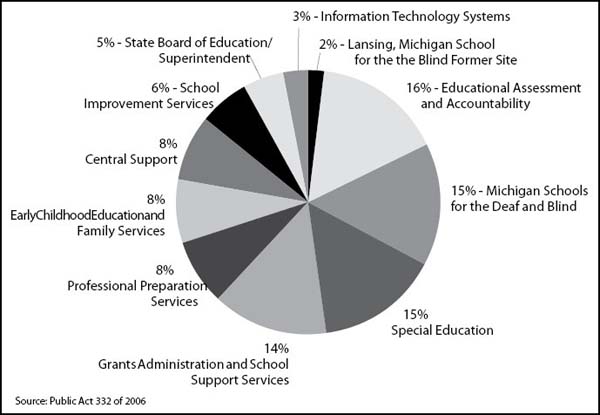
Eleven times a year, the state of Michigan sends financial payments to conventional local school districts, intermediate school districts and charter schools in several different “allowance” categories, as described in previous sections. These financial payments are accompanied by a “state aid financial status report,” which informs each district how much state financial assistance the district is receiving through each specific state allowance and grant.
State aid financial status reports have been briefly described several times in earlier sections. The discussion below will look more closely at the reports themselves, which can be downloaded from the World Wide Web for any district in the state.[cciv]
[cciv] Current fiscal year and archived state aid financial status reports are available on the Web at http://mdoe.state.mi.us
The first page of the Dec. 20, 2006, state aid financial status report for the Grand Rapids City School District is shown nearby (see Graphic 23). The report is actually two pages long, but the second page contains mostly summary and prior-year adjustment data and alternative breakdowns of some of the monies listed on Page One of the SAFSR.
The top right-hand side of Page One details the number of general and special education pupils (in FTEs) in the Grand Rapids district,[ccv] as well as the district’s special education costs, including transportation-related expenses. On the left is a text box showing the amount of the district’s fiscal 2007 foundation allowance. Below that figure is the line “20(19) Foundation Adjustment,” followed by the numbers 159.00 and 3,348.131 (for more on this foundation adjustment, see “Former ‘Section 32e’ Money,” under "The Foundation Allowance: General Education cont..."). Multiplying $159 (the financial adjustment) times the state aid membership of 21,057.43 (upper right) and rounding to the nearest dollar yields the $3,348,131 in additional revenue shown in the box.
The lines below the box that read “NHS T.V. Per GE” and “NHS T.V. Per Membership,” are shorthand for “nonhomestead taxable value per general education” and “nonhomestead taxable value per membership” (a district’s nonhomestead taxable value is explained in “General Property Tax for Operating Purposes,” under "Local Property Taxes by Type." ). The two figures across from these abbreviations are obtained by dividing the “General Ed K-12” figure of 18,367.63 (upper right) and the “State Aid Membership” (upper right) into the “Non-Homestead Tax Value” of $1,808,126,640.00 (below the box), respectively.
The rest of the report details the district’s income by category and is discussed below. For each category, the amount sent on Dec. 20 is shown under “Current Amt” (“current amount”) in the right-hand column, while the total amount the district expects throughout the fiscal year appears under “Amount,” the left-most column following the “Current Year Allowances” category. [ccvi]
While the categories shown in the state aid financial status report do differ from district to district, many of the categories listed in the Grand Rapids report would be found in other districts’ SAFSRs. The following is a brief explanation of each of these categories, recognizing that most of them are described in greater detail under the “Appropriations” section of the primer.

[ccv] Note that the counts are given for both February and September, reflecting the September pupil membership count day and February supplemental count day (see “Pupil Counts”).
[ccvi] The “Previous Amts” indicates the money the district has received during the fiscal year so far. The sum of the previous amount and the current amount divided by the total amount expected (“Amount”) yields in percentage terms the “Pct To Date” (“percent to date”).
Following is a discussion of each of the “current year allowances” provided to the Grand Rapids City School District in the 2006-2007 school year. These allowances represent the sums of money that the state has allotted the district for the current state fiscal year in various spending categories.
In response to the Michigan Supreme Court’s ruling in Durant v. State of Michigan,[ccvii] the State School Aid Act now provides for three major state payments to intermediate and local school districts: the “22a Prop A Obligation” described here, the “51c Spec Ed Headlee Obligation” outlined in the next section, and the “22b Discretionary Payment” described here.
The Prop A obligation payment listed here is discussed under “Payment Sections.” In the Grand Rapids report shown above, the district received $6,674,204.47 from the state in December 2006. The district is estimated to receive a total of $78,672,243.07 under this section 22a payment in fiscal 2007.
The parenthetical “STATEPP: $3,873.11” refers to the precise amount of the state contribution to the district’s fiscal 1995 foundation allowance after the maximum possible nonhomestead millage (usually 18 mills) is taken into account. The number “22a” refers to the State School Aid Act’s section 22a, where the total value of the fiscal 1995 foundation allowance is detailed in state law.[ccviii]
[ccvii] For a more detailed discussion of Durant v. State of Michigan and related cases, see “Appendix 2: Summary of ‘Durant’ Court Decisions.”
[ccviii] The numbers to the left of each category in the state aid financial status report — “22a,” “51c” and so on —refer to the sections of the School Aid Act that provide for each allowance (388.1622a, 388.1651c, and so forth). The numbers are reproduced in the headings of each of the succeeding sections.
The section 51c special education payment referred to by this line of the SAFSR is discussed above under “Payment Sections” (see point No. 2). The report shows the Grand Rapids district receiving $1,756,123.67 in December 2006, with an estimated total of $19,319,292.34 for fiscal 2007.
The payment in this section is a reimbursement to the district for forgone property tax revenues produced by the existence of a “renaissance zone” within the Grand Rapids City School District (see the discussion under “Renaissance Zone,” under "Property," and under “Local Property Tax Revenue Adjustments,” under "State Categorical Grants"). The Grand Rapids state aid financial status report shows the district receiving $251,794.10 in December 2006, with an estimated fiscal 2007 payout of $2,770,012.06.
This line refers to the section 22b money described earlier under “Payment Sections," (see point No. 3). According to the Grand Rapids SAFSR, the district received $2,311,238.47 for this section 22b payment, with an estimated total payment of $27,434,412.45 in fiscal 2007.
This line refers to the section 22c “equity payment” described above under “Payment for Districts With Foundation Allowances Under $7,360,” under "State Categorical Grants." In December 2006, according to the state aid financial status report, the Grand Rapids City School District received $41,947.16, with an expected total disbursement to the district of $484,320.89 in fiscal 2007.
This line refers to the section 29 payment discussed above under “Payment for Two Years of Declining Membership,” under "State Categorical Grants." The Grand Rapids SAFSR indicates that the district received a $31,335.97 declining membership payment in December 2006, with an estimated total payment of $551,363.88 in fiscal 2007.
This line refers to the section 11f payment made to conventional local school districts and ISDs that did not participate in the original Durant v. State of Michigan lawsuit (see “Durant Nonparticipant Payment 1: 10 Years of Cash Payments,” under "State Categorical Grants."[ccix] According to the SAFSR, the Grand Rapids district received nothing in December 2006 for this payment, since by December, the district had already received its total payment of $1,502,619.95 for fiscal 2007 (note the “100%” listed under “Pct To Date”).
[ccix] This SAFSR does not show the section 11g payment that Grand Rapids also receives as part of the state’s nonplaintiff Durant settlement (see the discussion under “Durant Nonparticipant Payment 2: Bond Payments or 15 Years of Cash Payments,” under "State Categorical Grants.")
The section 24 payment listed on this line of the Grand Rapids SAFSR is discussed earlier under “Court-Placed Students,” under "State Categorical Grants." As shown on the report, the district expects to receive $317,623.02 in fiscal 2007, with a December 2006 payment from the state of $28,871.93.
This payment shown on this line of the state aid financial status report refers to the at-risk money described under “‘At-Risk’ Payment,” under "State Categorical Grants." The state aid financial status report shows that the Grand Rapids school district received $880,023.28 in at-risk monies in December 2006, with an expected total state disbursement of $9,681,070.17 to the district in fiscal 2007.
The number of at-risk students can vary greatly between districts. According to the state of Michigan’s Center for Educational Performance and Information, 77 percent, or 17,392, of the students in the Grand Rapids City School District receive free and reduced meals; in East Grand Rapids, that figure is just 6 percent (150 students).[347]
This allowance is designed to pay for that portion of “necessary costs of the state mandated portion of the school lunch programs provided by those districts.”[348] This state mandate for school lunches is described above under “Lunch Programs,” under "State Categorical Grants." The state aid financial status report shows that the Grand Rapids district received $33,913.84 for the state’s mandated school lunch costs in December 2006, with the district receiving an estimated $373,089.51 for this cost in fiscal 2007.
The money paid to the Grand Rapids district on this line of the state aid financial status report is described in the discussion of “school readiness programs” under “Early Education” under "State Categorical Grants." According to the report, the district is estimated to receive a total payment of $2,603,700 in fiscal 2007, with a payment of $236,676.33 in December 2006.
The state payment for the students listed in this line of the report is discussed above under “53a: Court- and State Agency-Placed Students,” under "Operating Monies for Special Education." The SAFSR shows that an estimated $141,920.20 will be paid to the Grand Rapids district in fiscal 2007, with a state payment to the district of $12,900.55 in December 2006.
The state payment for the subsection 61a(1) vocational education listed here is described under “Vocational-Technical Education,” under "State Categorical Grants." The SAFSR shows the Grand Rapids district receiving an estimated total of $76,583.87 in fiscal 2007 and a December 2006 payment of $6,961.47.
The money in this line of the SAFSR refers to the middle school mathematics payment described earlier under “Instruction-Related Grants,” under "State Categorical Grants." The Grand Rapids SAFSR shows the district receiving $22,672.67 in December 2006 and an estimated total of $227,693.23 in fiscal 2007.
This subsection 107(1)[ccx] categorical provides second-chance education funding for adults who did not graduate high school or who otherwise lack important basic skills. Payments for adult education are not discussed, since the primer focuses on kindergarten through 12th grade.[ccxi]
In fiscal 2007, the state allocated $24 million for adult education programs throughout the state.[349] The Grand Rapids SAFSR shows that the district received $105,139.63 for this adult education payment in December 2006 and that the district is estimated to receive $1,156,651.63 under this section in fiscal 2007.
[ccx] Subsection 107(1) corresponds to MCL § 388.1707(1).
[ccxi] In order to be eligible for adult education programs, participants must meet a number of requirements. These requirements include being older than 20 years of age; or if under 20, receiving a recommendation from an employer; or being part of “English as a second language [or] General Education Development test preparation. …” See MCL § 388.1707(2).
When conventional and intermediate school districts and charter schools receive revenues from the state and from local taxes, the Michigan Public School Accounting Manual (promulgated by the Michigan Board of Education)[350] requires that this money be deposited into and spent from seven specific “funds” or accounts.[351] This stipulation is important, because monies may be spent only for the purposes for which they were allocated. For instance, a school district may not spend capital funds for general expenditures (see Graphic 24).
The budget component of a district’s fiscal responsibilities will be discussed further below. First, however, we will examine briefly the means by which districts receive their revenue.
The seven funds mentioned above — generally known as “revenue funds” — are designed to allow districts to separate their revenues and expenditures correctly.[ccxii] Graphic 24 shows each fund’s name, the source of the fund’s revenue and the types of expenditures that can be made from the fund.
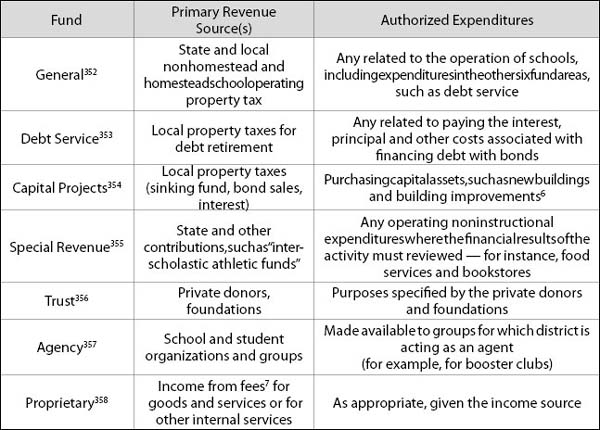
[ccxii] Not all costs can be easily tracked to a particular program. Therefore, the state Education Department has established an accounting method that includes “indirect costs,” because always identifying “the specific program or project served would take an effort disproportionate to the results achieved.” (“Michigan Public School Accounting Manual (Bulletin 1022): Section II Requirements,” 29.)
The Uniform Budgeting and Accounting Act[ccxiii] mandates a budgeting system for public entities in Michigan. These public institutions include all 552 conventional school districts, 57 intermediate school districts and approximately 225 charter schools.[359]
Section 14 and 15 of the act provide details about responsibility for preparing budgets and a list of data that should be contained within. The basic budget requirements are straightforward. Subsection 14(3) states:
“The chief administrative officer shall transmit the recommended budget to the legislative body according to an appropriate time schedule developed by the local unit. The schedule shall allow adequate time for review and adoption by the legislative body before commencement of the budget year. The recommended budget, when transmitted by the chief administrative officer, shall be accompanied by a suggested general appropriations act to implement the budget.”[360]
Subsection 15(1) stipulates, “The recommended budget shall include at least the following:
Expenditure data for the most recently completed fiscal year and estimated expenditures for the current fiscal year.
An estimate of the expenditure amounts required to conduct, in the ensuing fiscal year, the government of the local unit, including its budgetary centers.
Revenue data for the most recently completed fiscal year and estimated revenues for the current fiscal year.
An estimate of the revenues, by source of revenue, to be raised or received by the local unit in the ensuing fiscal year.
The amount of surplus or deficit that has accumulated from prior fiscal years, together with an estimate of the amount of surplus or deficit expected in the current fiscal year. The inclusion of the amount of an authorized debt obligation to fund a deficit shall be sufficient to satisfy the requirement of funding the amount of a deficit estimated under this subdivision.
An estimate of the amounts needed for deficiency, contingent, or emergency purposes.
Other data relating to fiscal conditions that the chief administrative officer considers to be useful in considering the financial needs of the local unit.”
These sections of the Uniform Budgeting and Accounting Act, combined with the school fiscal year mandate in the State School Aid Act of 1979 (Public Act 94), regulate timely production of district budgets.[361]
[ccxiii] The Uniform Budgeting and Accounting Act, passed in 1968 and amended in 1978, 1980 and 1996, can be found at MCL § 141.421.
The Michigan Public School Accounting Manual’s Section IV, entitled “Budget Preparation and Management,” contains basic instructions on how to construct a budget (the manual can be downloaded from a Michigan Department of Education Web site).[ccxiv] These guidelines include a basic description of accounting mandates imposed by the state’s Uniform Budgeting and Accounting Act. The minimum accounting data outlined in Section IV is comprised of a list of categories that a school district must include in its budget to comply with “best budgeting practices.”[362]
Graphic 25 is based on Section IV of the manual and details information that must be listed individually in the district’s budget. Revenues are listed below by a major class code that provides the general source of the revenue. Nevertheless, a complete district accounting will also track revenues using codes for the “fund,” “transaction” and “suffix.”[363] Similarly, expenditures in Graphic 25 are listed by a function code that details the purpose of the expenditure, but a complete accounting will also track expenditures by “fund,” “transaction code,” “object code,” “program code,” “state code,” “facility/school code” and even additional codes chosen by the school district or charter school.[364]
Actual revenues and expenditures reported using the major class and function codes listed in Graphic 25 are available for all Michigan conventional local school districts, charter schools and ISDs at the Center for Educational Performance and Information Web site.[ccxv] District and charter school revenue and expenditure information classed by the other codes described above are also available at the site.
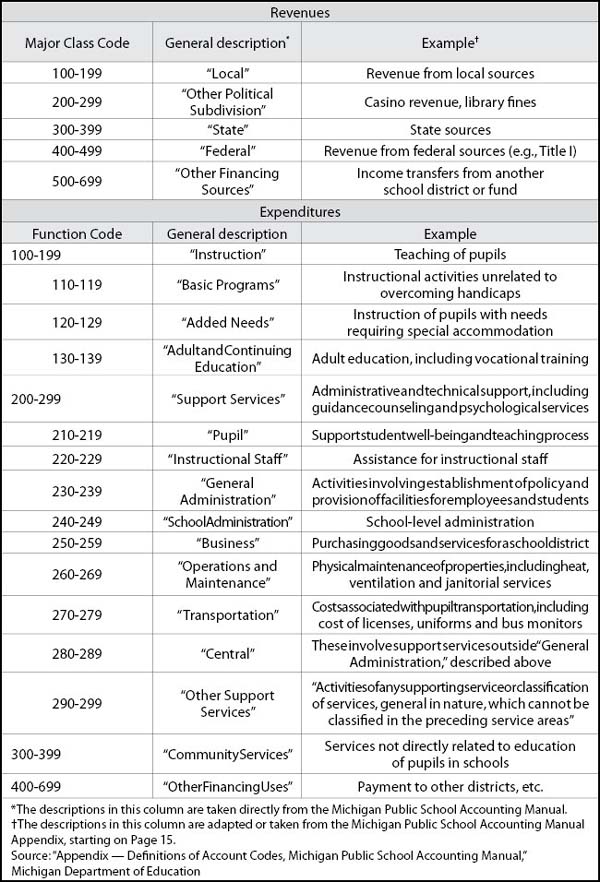
[ccxiv] See www.michigan.gov/mde/0,1607,7-140-67530_6605-21321--,00.html (accessed April 19, 2007). Section IV appears as a PDF at www.michigan.gov/documents/sc-iv_13270_7.pdf (accessed April 19, 2007).
[ccxv] The Web address is www.michigan.gov/cepi. See also “Financial Information Database,” under "Other Reporting Requirements."
As the previous paragraphs suggest, conventional and intermediate school districts and charter schools must adhere to a detailed set of accounting rules. State government and federal government frequently change these rules as the Michigan Legislature and U.S. Congress impose new reporting requirements, programs and laws on the districts. The districts’ accounting rules are also governed by the Government Accounting Standards Board, which determines generally accepted accounting principles for government entities. These principles are used by auditors when expressing opinions about the financial statements of a school district or other government unit.
GASB issued new standards for reporting financial statements in 1999, but local units of government were not required to adhere to them until after June 15, 2003. The reporting changes, outlined in GASB Statement No. 34,[365] produce government accounting practices that now more closely resemble those used in the private sector. One key format change involves financial statement audits that show original budget numbers, not just amended and final budget numbers. According to the American Institute of Certified Public Accountants, this shift is intended to make it easier for school districts and other units of government to determine how well they are forecasting budget needs. The new GASB standards are also intended to promote greater transparency concerning a government unit’s financial position, as opposed to its compliance with legal constraints.[366]
We provide a step-by-step description of the process of developing a budget in Michigan’s conventional public school districts. For various reasons, charter schools and intermediate school districts are not part of this discussion.
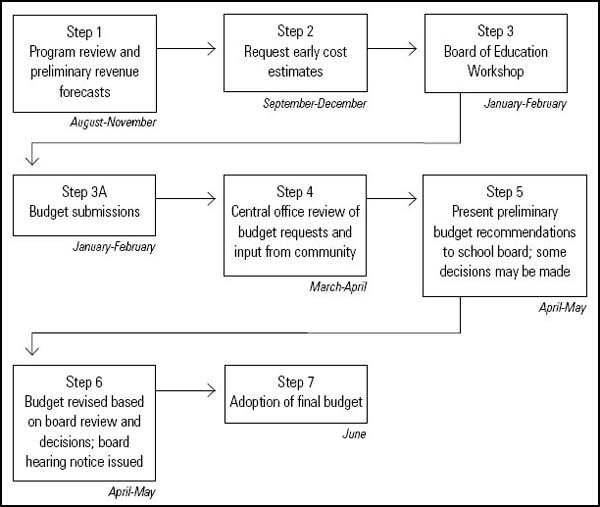
Both charter schools and intermediate school districts are subject to the requirements of the Uniform Budgeting and Accounting Act, the Michigan Public School Accounting Manual, GASB standards and other state budget and accounting laws. Nevertheless, charter schools are generally much smaller than conventional local school districts and may need less time to gather data and reach consensus. At the same time, charter schools must satisfy any additional budget and accounting requirements promulgated by the schools’ authorizers. These requirements may vary depending on the authorizer and may lead to different budget timelines.[ccxvi]
Intermediate school districts, on the other hand, must track not only their internal expenditures, but numerous, complex financial and budgeting interactions with their constituent local school districts. ISD accounting and budgeting requirements outside the description provided below go beyond the scope of this primer.[ccxvii]
The budget process described here for conventional public school districts is not an exact timeline for any single district. While the state does place certain mandates on school districts to ensure responsible budgeting, the state does not always stipulate the process through which these mandates should be met.
For instance, the state requires that a school board hold a final budget meeting to approve the budget and that the board notify the public of this meeting in advance. Some districts may do only this much, while others, such as the Traverse City Area Public Schools, actually visit local civic groups to explain the district’s budget projections for the forthcoming year and solicit feedback before the final budget meeting. In addition, districts employ different numbers of central office administrators. Some districts have a superintendent, business officers and academic officers; other districts have only a superintendent. Hence, the budget process can be as varied as the 552 conventional public school districts themselves.
In addition, not all districts possess a written description of their budget process. District business officials and superintendents may be able to rely on their own institutional knowledge of the process and have little need to outline the steps formally. Still, many districts have formalized the process in written documents, and their schedules, along with our interviews with dozens of district officials, allow us to provide a general description of the budget process that occurs in Michigan school districts.
District budgeting for the next fiscal year is usually based on several factors:
an evaluation of existing and proposed educational programs, as well as any programs newly mandated by the Michigan Legislature or by the local school board;
a review of the district’s financial reports and audits from the immediately preceding fiscal year and a review of current fiscal year accounts to determine the district’s financial strength;
a review of current and upcoming employee union negotiations and contracts; and
projected revenues for the next fiscal year.
Different districts will place varying degrees of emphasis on the four factors listed above. Some might emphasize the educational program reviews described in point No. 1 above. Such districts might use “program budgeting,” which is described by the Michigan School Business Officials organization as budgeting in which “[d]istrict funds are organized according to their specific objective or purpose.”[367] These districts might also use “zero-based budgeting,” in which “[a]ll budget categories must be completely rejustified each fiscal year to ... improve organizational and fiscal efficiency.”[368]
Other districts might emphasize the projected revenues described in point No. 4 above. Such districts might employ “incremental budgeting,” in which each line item receives similar percentage increases or decreases.[369] Yet other districts might combine revenue and program concerns, perhaps using “line item budgeting,” in which “[e]ach line item receives separate consideration and may be increased or decreased by different amounts.” [ccxviii][370]
Regardless, one milestone in the local school district budget process is the governor’s budget recommendations for the coming fiscal year, since these help the districts project district revenues for the coming year. These recommendations are typically made in early February. Another milestone is the state’s January “Consensus Revenue Estimating Conference” (see "Revenue Estimating Conference.") The conference produces estimates of expected revenue to the state and all of its funds, such as the state’s general fund and school aid fund. The general fund is the state money over which Michigan legislators have the most discretion, and they may allocate some of it to public schools. As discussed earlier, however, the vast majority of public school money comes from the state school aid fund. For district budget officers, the school aid fund estimate is the more important of the two. In fiscal 2007, the school aid fund totaled approximately $13.1 billion,[371] according to the Michigan House Fiscal Agency.
Once such numbers are announced by the revenue estimating conference, school officials typically begin to forecast the district’s revenues for the coming fiscal year or update their own existing projections, since many districts will have begun to make such revenue projections in the autumn of the previous calendar year. For instance, the January 2006 edition of the Michigan School Business Officials monthly newsletter published predictions for a $7,075 state foundation allowance in fiscal 2007; this projection was originally made by a group of 59 Grand Valley School Business Officials (from western Michigan) in November 2005.[372]
Such estimates, which can include projected school cost increases,[ccxix] may be used by other school district business officials when preparing a budget. One business officer remarked in an interview with the authors that district business officials frequently contact each other to discuss possible future school revenues long before the state estimates are released (there are about 1,900 members of the MSBO in the state).[ccxx][373]
Hence, the budget process often begins as early as the autumn of the year before the new school fiscal year begins,[ccxxi] frequently when the audit of the previous year’s budget is complete. For instance, in August 2007 (which falls in fiscal 2008), districts will receive from outside private accountants a complete audit of the fiscal 2007 budget year, which will have finished in June 2007 (audits must be filed with the state treasurer by Nov. 15 each year[374]). At that point, many district officials will immediately commence building their budgets for fiscal 2009. That process will continue until the local board of education approves the budget.
Graphic 26 provides a flow chart based on the authors’ research of numerous Michigan districts. Many districts employ timelines or calendars, complete with critical dates, to guide their planning; the Detroit City School District posts its calendar online in its adopted budget.[375]
[ccxvi] Readers interested in the budget process for charter schools may wish to review the Michigan Council of Charter School Authorizers’ “Public School Academy Oversight and Accountability Standards,” (Michigan Council of Charter School Authorizers, 2005), www.mccsa.us/pdf/MCCSA_04_AccStds_11.pdf (accessed April 20, 2007).
[ccxvii] For more on ISD budgeting, see, for example, “Accounting and Fiscal Reporting Requirements for Intermediate School District Use of Special Education Funds,” State Board of Education, 1993.
[ccxviii] This discussion is not meant to imply that the district’s method of budgeting — program budgeting, incremental budgeting and so on — is determined by the emphasis the district may place on any one of the four factors listed above. For a complete list of budget methods a district might use, see “MSBO School Finance Reference Manual,” (Michigan School Business Officials, 2007), 7-3.
[ccxix] For instance, the officials also predicted an 18 percent increase in the cost of employee health insurance and a 10 percent to 15 percent increase in the cost of energy in fiscal 2007. See “A message from your president: Budgeting for 2006-2007,” (Michigan School Business Officials, 2006), 2, www.msbo.org/publications/newsletter/2006/Jan06.pdf (accessed Jan. 2, 2007).
[ccxx] In the autumn, school business officials may be analyzing numbers from three different budgets simultaneously: the past year’s budget, which has been recently audited; the current year’s budget, which is usually under revision; and the coming year’s budget, which is already being estimated. Midyear revenue corrections from the state may complicate current-year budgets. On April 30, 2007, just as this primer was going to press, the governor issued an executive order that reduced the basic foundation grant by $122 for fiscal 2007; see “Cut May Force Schools To Close Early,” MIRS Capitol Capsule, April 30, 2007. (Membership required.)
[ccxxi] Recall that the school’s fiscal year begins on July 1 and ends on June 30. Fiscal 2007 thus began on July 1, 2006.
As the school year begins, district administrators often begin the first steps in the budget process for the next fiscal year. Superintendents and other educational program officials may begin reviewing and projecting educational program needs, while district business officials will attempt to draft a preliminary forecast of state and local revenues for the coming year based on available data and projections. As noted earlier, this process can occur as many as nine months before the school board approves the new fiscal year budget. At this stage, budget projections are tenuous, since the amount of the district’s foundation grant and the district’s state aid membership for the coming year will not be known for more than six months.
The Bullock Creek School District in Midland County begins its budget process as early as September by creating a preliminary budget forecast for key personnel to review. This forecast includes both best-case and worst-case scenarios, and as Graphic 27 on the next page shows, the district’s best-case scenario in November 2006 for fiscal 2008 included an adjusted deficit of $67,881.[376]
At this early stage, some districts send out budget documents to key administrators, such as principals and department heads, to query them on expected program, staffing, equipment and other needs. Some districts complete this task before holding budget workshops with their respective boards of education (usually in January). Others will wait until January to get these data, while some may wait even longer.

At some point, often between October and February, the district superintendent, a district business official or another district official will present to the school board a budget forecast for the coming year. This presentation may also include data about the current year’s budget situation.
For instance, on Jan. 28, 2006, the Royal Oak Public Schools held a “Board of Education Workshop” to discuss the state of the district’s current and future fiscal affairs. This workshop was attended by one of the authors.
Royal Oak Public Schools is one of the state’s 51 hold-harmless districts[ccxxii] and thus spends more per pupil than many other districts.[377] The Royal Oak Public Schools has experienced declining student enrollment and revenue and has subsequently made spending cuts, including staff reductions, school closures and property sales.[378]
The major portion of Royal Oak’s budget workshop involved a detailed discussion of the coming budget, including a decision-making schedule for the board and other personnel involved in the budget process.[ccxxiii] The district’s executive director of business and personnel services projected a $150 increase in the district’s basic foundation allowance, making the allowance $9,176. He also reported that the district was forecasting an enrollment decline of 251 students, resulting in a revenue loss of nearly $2.3 million.[379] Presentations like Royal Oak’s occur in school districts across Michigan every winter.
This “step three” in the budget process is almost purely informative, bringing board members, union representatives and the public up to speed on the district’s current and future budget. Once the workshop is concluded, the district’s administrators will begin gathering input on spending priorities from other district officials.
In larger districts, this goal is often accomplished by issuing and collecting budget request forms. (As mentioned under “Step 2,” this process of soliciting spending requests often occurs before the budget workshop.) After these budget forms are returned to the central office, the information is usually entered into the district’s data processing system.
Smaller districts, in contrast, may have face-to-face meetings with key personnel for input on budget needs. This collection of feedback does not necessarily end in February. For instance, the Rockford Public School system has in the past dedicated January, February and March to what it describes as its “listening” phase.
In Traverse City in 2006, the district scheduled more than 30 presentations between Jan. 4 and March 30 to such groups as the district’s local principals, League of Women Voters, Rotary club, parent-teacher organization and collective bargaining units.[380] Most of these meetings are designed to elicit feedback for use in the budget-building process.
The members of the budget team may also brainstorm ideas for saving money or generating new revenues. Some ideas implemented in recent years to address school deficits include closing buildings and selling property or the “naming rights” to a high school football stadium. In November 2005, The Ann Arbor News reported that advertisements would be placed inside 45 Ypsilanti school buses to generate revenue.[381]
[ccxxii] For more on hold-harmless districts, see “ ‘Hold-Harmless’ Millage,” under "Local Property Taxes by Type."
[ccxxiii] The Royal Oak Public Schools budget timeline includes the following dates: Dec. 16, 2005, distribution of budget instructions and projected budget allocations; Feb. 17, 2006, budget submissions from key decision-makers due; March 10, 2006, preliminary budget revenue and cost forecast reports generated; April 14, 2006, recommended budget completed; May 11, 2006, recommended budget presented to school board and the community; June 8, 2006, millage rate adoption and public hearing; and June 22, 2006, budget adoption.
At this point in the budgeting process, district officials must rank their spending priorities and determine funding levels for the district’s programs, policies and personnel. The number of people making these decisions will depend on the district’s size and business culture. Many smaller districts delegate such duties to one or two people, while larger districts may set up large formal committees.
Once funding requests have been prioritized, a business officer (or in many cases a superintendent) will update the initial budget costs and revenues based on input from district officials and new information about such matters as the anticipated state foundation allowance and potential changes in enrollment. If necessary, officials will then schedule meetings with key budget officers and community leaders to review priorities developed through the central office decision process.
For instance, a superintendent may need to communicate his or her intention to shutter buildings, merge departments or make new staff assignments. Personnel decisions in particular are often made early in the year to ensure staff the opportunity to plan accordingly.[ccxxiv] District officials may then inform union officials of proposed employment changes in order to allow union representatives to review the changes in light of collective bargaining agreements and the tenets of the Michigan Teachers’ Tenure Act.[ccxxv] The initial budget presentation is updated to accommodate input and spending prioritization made by the central office.
[ccxxiv] Some districts’ collective bargaining contracts may specify a deadline for informing employees of future layoffs. These deadlines may drive a district to make its personnel decisions earlier than other districts do.
[ccxxv] The Teachers’ Tenure Act can be found at MCL § 38.71 through MCL § 38.191.
At this point in the budgeting cycle, the forthcoming fiscal year’s budget begins to solidify, and the budget forecast becomes a preliminary budget. Budget updates may be made at each board meeting, but in late spring, the board is often making the important decisions necessary in approving a final budget. For instance, in late March or early April, a board of education may take action on the next year’s staffing levels. The board’s feedback on the budget during this period tells district budget officials what adjustments should be made to arrive at a final budget the board can approve.
After receiving the board’s feedback on budget issues, district officials make appropriate adjustments to the district’s budget. Final meetings are held with key budget figures, and union officials are informed of projected staffing changes.
This sets the stage for a final budget presentation to the board and for the board’s final vote. The district issues a formal notice announcing the venue for the upcoming board hearing, during which the board will adopt the budget for the coming fiscal year.
The new budget is presented to the board and adopted just prior to the end of current fiscal year. Note that a district will pass a budget by June 30 even if the state Legislature’s appropriation for public schools in that fiscal year has not been finalized.
The seven steps described above provide an outline of what most Michigan school districts achieve during the 10 month budget process. Readers interested in a detailed treatment of how to prepare school budgets may want to consult others texts written specifically on this subject.[382]
Reports
Although a a full explanation of district accounting and reporting is beyond the scope of this primer, we will give the reader a general idea of how to read reports of Michigan school districts’ spending, as well as a general breakdown of major spending categories. “Bulletin 1011: Analysis of Michigan Public School Districts’ Revenues and Expenditures” is published annually and assesses school fiscal data from two years before the current fiscal year. This publication groups conventional school districts and charter schools by enrollment size and reports on subcategories of income and spending. The report is available online as a PDF or as a database file.
The state Department of Education produces another annual report in the same year as the Bulletin 1011: “Bulletin 1014: Michigan Public School Districts Ranked by Selected Financial Data.” Bulletin 1014 provides general fund per-pupil revenue from local, state and federal sources and general fund per-pupil expenditures for instructional programs, including basic programs and instructional salaries. Bulletin 1014 also includes data on current operating expenditures, average teacher salaries, district taxable value and per-student spending for support services like operations and maintenance. The publication is available as hard copy, as a PDF or in a database version.
The Michigan Department of Education annually files the data used to generate these reports with the U.S. Department of Education in the “National Public Education Finance Survey.” The state’s detailed dataset is available in a PDF on the state Department of Education’s Web site.[383] We have also made the dataset available on the Web in a more easily accessible format. Please see “Appendix 3: Guide to a New School Finance Electronic Module” for more information.
Michigan law requires that local and intermediate districts and charter schools not spend all the money in their funds; in official terminology, the districts and charter schools cannot carry an “operating deficit in a fund.”[384] A district is considered to have incurred a deficit fund balance if the district’s “General Fund balance before reserves is negative” or the district’s “[o]ther funds have negative balances that are greater than the General Fund balance before reserves.”[385] (Note that “reserves” has a specific meaning here, as described below; “reserves” does not refer to money saved for weathering a revenue shortage.)
To ensure that no operating deficit occurs, conventional school districts, intermediate school districts and charter schools may carry a “general fund balance” or “general fund equity.” This is an amount of money in a district’s general fund that it does not spend, but saves.
Fund balances fall into three categories. The Michigan Public School Accounting Manual’s description of these appears in Graphic 28.
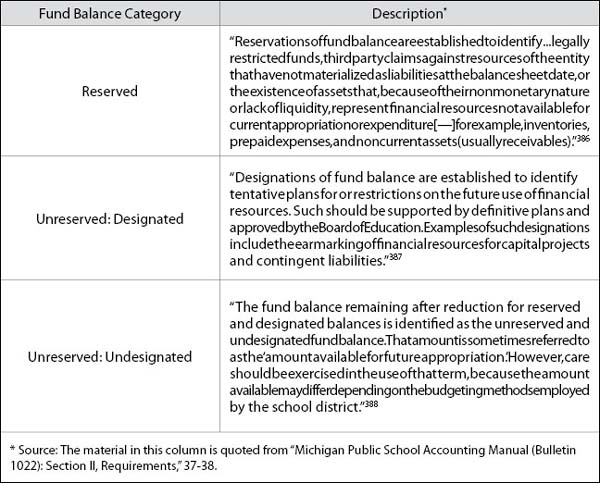
The Michigan School Business Officials organization recommends that districts maintain a fund balance of at least 15 percent of a district’s general fund expenditures.[389] Based on data from Bulletin 1011 for fiscal 2006, the general fund balance after reserves and designations of conventional school districts and charter schools statewide was about 10.8 percent of total current operating expenditures.
School districts are prohibited by Michigan law from adopting a budget deficit.[390] This restriction means that in any given budget year a district may never plan to spend — or actually spend — more than the annual revenue the district will receive from all sources. A district that spends itself into deficit cannot receive further payments from the state until the district submits a deficit elimination plan.[391] The plan must include measures to eliminate the deficit in no more than two fiscal years after the deficit was incurred,[392] and a district must file a monthly revenues-and-expenditures report with the state Department of Education.[393] The only permissible deficit is one incurred as a result of a reduction of money available to the schools due to an executive order issued during the fiscal year.[394]
In fiscal 2007, 23 conventional local school districts and charter schools are operating with deficit elimination plans.[395]
Conventional and intermediate school districts and charter schools must submit an independent auditor’s report to the state each year detailing their financial positions.[ccxxviii] According to the Michigan Department of Education’s “Michigan Public School Auditing Manual, 2005/2006,” this audit should not only give an independent appraisal of the district’s financial resources, but also indicate whether the district or charter school follows appropriate internal procedures for handling school district finances (“internal control compliance”). Further, the manual states that these audits must be “performed in accordance with generally accepted government auditing standards (GAGAS).”[396]
The audits typically include the following:
a letter of introduction;
a “management discussion” that may explain accounting methods employed to audit the district’s records;
a series of financial statements that highlight a district’s fiscal position;
important notes of explanation; and
supplemental fund data comparing previously budgeted amounts for, say, capital outlay with what was actually spent from that fund in a particular fiscal year.[ccxxix]
[ccxxviii] These audits should not be confused with the widely known Comprehensive Annual Financial Reports produced by municipalities and other government organizations. School audits may contain the same information as CAFRs, but CAFRs require far more historical data than those submitted by school districts to the state.
[ccxxix] For further reading on these subjects, see the Michigan Public School Auditing Manual, www.mi.gov/mde/0,1607,7-140-6530_9091-67431--,00.html. Recent audits of school districts can also be obtained from the districts directly.
If a school district accepts more than $500,000 in federal revenues, it must submit what is known as a “Single Audit” report to the federal government and to the monies’ “pass-through entity” (the unit of government — often the state — that first received the federal dollars and sent them to the district).[397] The federal government’s Office of Management and Budget has provided audit guidelines to both state and local units of government.[398]
Financial Information Database
School districts and charter schools must also file information with the Michigan Department of Education’s Center for Educational Performance and Information. CEPI maintains a “Financial Information Database” based on reports prepared by conventional school districts, ISDs and charter schools. This database, known as FID, is publicly accessible on the Web at www.michigan.gov/cepi.
Michigan Electronic Grant System
The Michigan Electronic Grant System was established by the Michigan Department of Education in 2001 to streamline the grant application, award, research and management process.[ccxxx] Conventional and intermediate school districts and charter schools that wish to receive education-related grants are required to submit forms related to the grants, and the Michigan Department of Education makes these forms available online at http://megs.mde.state.mi.us
Special Education Actual Cost Report (Form SE 4096)
In the Special Education Actual Cost Report, submitted annually to the Michigan Department of Education, a conventional school district, ISD or charter school must report the expenditures associated with more than 30 categories of special needs students, such as those who have an emotional impairment or autism. Expenditure categories include personnel salary and benefits, school supplies and purchased services. [399]
Transportation Expenditure Report (Form SE 4094)
This report details transportation expenditures by school district and is submitted to the state on an annual basis. It records how many “full time equivalent employees”[ccxxxi] work in transportation by each category (“bus driver,” “supervision,” “clerical” and “other”). The report also tallies the cost of “purchased services” related to the actual use of the vehicle; “purchased services” unrelated to the vehicle; and supply costs, such as the money spent on gasoline.[400]
[ccxxx] See “About MEGS,” (Michigan Department of Education), http://megs.mde.state.mi.us
[ccxxxi] “Full time equivalent” is similar in meaning here to the “full time equivalent” students mentioned in “Pupil Counts.” Because some people work only part time, their hours are added to determine how many how many full-time employees their hours would represent. Two employees each working 20 hours per week would typically equal one “full time equivalent,” or “FTE.”
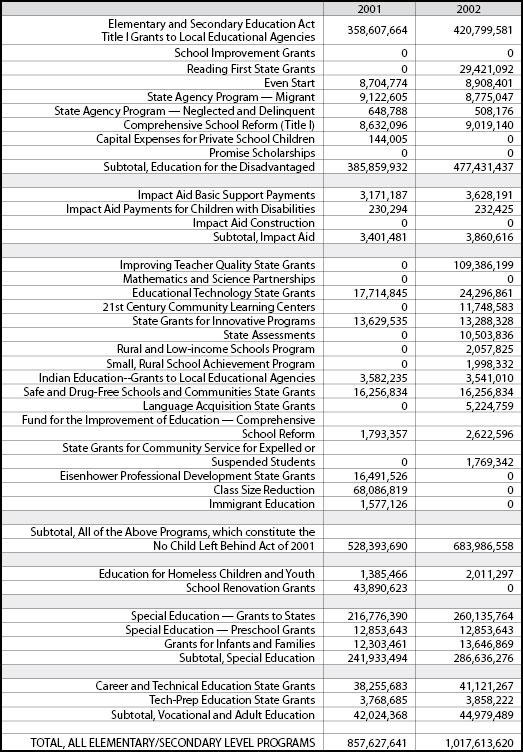
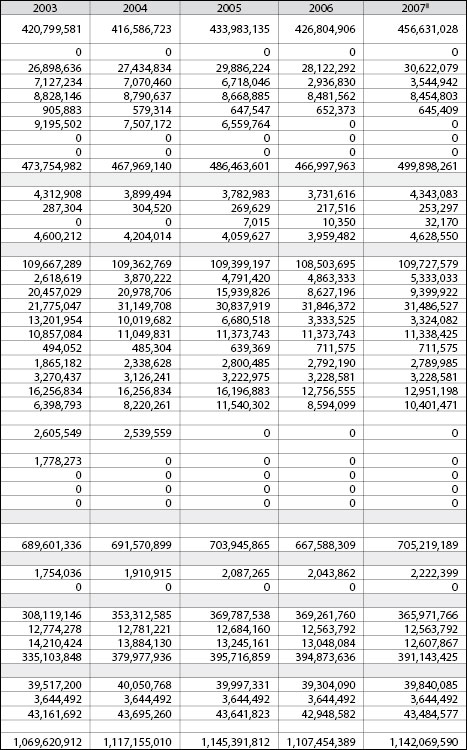
*Fiscal 2007 figures are the U.S. Department of Education’s estimates, rather than actual dollars spent.
Source: U.S. Department of Education, Fiscal Year 2001-2008 State Tables for U.S. Department of Education, State Tables by State, www.ed.gov/about/overview/budget/statetables/08stbystate.pdf.
by Patrick J. Wright[ccxxxii]
Public school finance has been significantly affected by the Michigan Constitution’s Article 9, Section 29, which is one of the sections added to the state constitution by the “Headlee amendment.”[ccxxxiii] The section states:
“The state is hereby prohibited from reducing the state financed proportion of the necessary costs of any existing activity or service required of units of Local Government by state law. A new activity or service or an increase in the level of any activity or service beyond that required by existing law shall not be required by the legislature or any state agency of units of Local Government, unless a state appropriation is made and disbursed to pay the unit of Local Government for any necessary increased costs. The provision of this section shall not apply to costs incurred pursuant to Article VI, Section 18.”
The Michigan Supreme Court has explained the basic meaning of the first two sentences contained within Section 29:
“The first sentence of this provision prohibits reduction of the state proportion of necessary costs with respect to the continuation of state-mandated activities or services. The second sentence requires the state to fund any additional necessary costs of newly mandated activities or services and increases in the level of such activities or services from the 1978 base year.”[401]
The Michigan Supreme Court described the first sentence as “‘a maintenance of support’ (MOS) provision” and the second sentence as a “ ‘prohibition on unfunded mandates’ (POUM) provision.”[402]
There have been four significant lawsuits regarding school finance and Section 29. The first lawsuit, Durant v. State of Michigan (commonly referred to as “Durant I”), was filed in 1980, and it was not decided until 1997.[403] The plaintiffs were several individuals (including the eponymous Donald Durant), 83 local school districts and one intermediate school district. Durant I was an MOS case, and the major issue was state funding for special education mandates.
In its ruling on Durant I, the Michigan Supreme Court unanimously held that state government had not properly financed three state-imposed mandates: special education, special education transportation and a school lunch program. The court split 4-3 on the proper remedy. The majority held that the unique facts presented in this case — most important, the state’s recalcitrance, exemplified by the state’s inconsistent arguments throughout the long course of the litigation — justified an award of monetary damages. While the Michigan Supreme Court held that the injured parties were Michigan’s local taxpayers, the court nevertheless awarded damages to the local school districts, writing, “[T]he democratic process will inform and shape distribution of the award.”[404] The minority would have limited the plaintiffs to a declaration that the state had not funded the school districts sufficiently.
The monetary damages award, which was approximately $212 million,[405] was compensation for the 1991-1992, 1992-1993, and 1993-1994 school years. The court traced the damages to 1991 because it was then that the Michigan Court of Appeals held in its own Durant I ruling that districts were underfunded. The Michigan Supreme Court terminated the damages in 1994, when voters approved Proposal A, which largely prevented harm to local taxpayers.
The state paid Durant I’s money damages to the plaintiff school districts in 1998. At about the same time, the Legislature passed Public Act 142 of 1997, a reauthorization of the State School Aid Act that appropriated around $632 million for the 457 conventional school districts and 52 intermediate school districts that did not participate in the Durant I lawsuit.[ccxxxiv] In order to receive this money, the districts had to agree to waive any claims that were based on issues similar to those in Durant I and that involved the state’s conduct prior to Sept. 30, 1997. A total of 382 conventional and intermediate school districts agreed to the waiver and received money.[ccxxxv]
The lawsuit known as “Durant II” — technically Durant v. State (on Remand)[ccxxxvi] [406] — was brought by 225 local school districts and 11 intermediate school districts. The districts claimed that in Public Act 142 of 1997 and Public Act 339 of 1998 (two versions of the State School Aid Act), the state of Michigan continued to underfund special education and special education transportation, hence violating the MOS provision of Article 9, Section 29. The plaintiffs alleged that the state improperly paid for special education by requiring the districts to spend a portion of their state foundation allowance to cover special education costs — i.e., that the state Legislature had attached strings to a portion of the foundation allowance.
The Michigan Court of Appeals agreed and based its decision on Article 9, Section 11, more commonly known as Proposal A, instead of Article 9, Section 29. The Michigan Court of Appeals held, “Our constitution prohibits the Legislature from using the per pupil funding guaranteed by Proposal A to satisfy the state’s obligations under the Headlee Amendment (Article 9, Section 29).”[407] Thus, the court essentially ruled that no strings could be attached to the foundation allowance.
Significantly, however, the Michigan Court of Appeals granted only declaratory relief and denied the plaintiffs’ request for monetary damages. The Michigan Supreme Court denied leave to appeal.
To address the constitutional deficiencies identified by the court in Durant II, the Legislature passed Public Act 297 of 2000. This act effectively set aside the single foundation grant used after Proposal A and replaced it with three separate payments to school districts: (1) the minimum required to satisfy the Headlee amendment’s MOS requirement for special education; (2) the minimum required by Proposal A — an amount equal to the fiscal 1995 foundation allowance, according the language of the proposal; and (3) a discretionary amount for any additional funding.[ccxxxvii]
In response, 423 school districts and 33 intermediate school districts filed a constitutional challenge commonly known as “Durant III.”[408] The lawsuit alleged that the new arrangement was merely a “shell game,” with each school district receiving the exact amount the district would have received under Public Act 142 of 1997 and Public Act 339 of 1998. Specifically, the plaintiffs claimed that the Legislature was violating the court ruling in Durant II by once again using money from the state’s foundation grants to meet the MOS requirement for special education under the Headlee amendment. The Michigan Court of Appeals, however, disagreed with the plaintiffs and held the following:
“The essence of plaintiffs’ argument is that once the Legislature has allocated money to the ‘foundation allowance,’ that money is unavailable to satisfy the state’s obligations under the Headlee Amendment even if that foundation allowance is greater that the minimum required under art 9, § 11 [Proposal A]. The essence of defendants’ argument is that funds allocated to the ‘foundation allowance’ may be used to meet the state’s obligations under both Proposal A and the Headlee Amendment as long as that foundation allowance is equal to, or greater than, the sum of the state’s obligations under Proposal A and the Headlee Amendment. We agree with defendants.”
The Michigan Supreme Court denied leave to appeal.
The last significant school funding case is Adair v. State, sometimes referred to as “Durant IV.” Here, 429 conventional and 34 intermediate school districts (as well as numerous individuals, including Daniel Adair) cited Headlee’s prohibition on unfunded mandates to bring a claim against administrative rules and statutes governing special education. The Michigan Supreme Court found that most of the claims were either precluded by the Durant I litigation or were not properly categorized as mandates. The Supreme Court allowed a single claim regarding record-keeping to proceed. This claim related to student, programming and facilities data that the school districts were required to collect, maintain and transit to the state’s Center for Educational Performance and Information.
On remand, the Michigan Court of Appeals dismissed the claim because the districts had not shown documentary support.[409] The court also noted that much of the data was already being collected and used by the districts for their own purposes.
In 2006, however, the Michigan Supreme Court held that the fact that districts had already been collecting much of the data was not enough to lead to dismissal of the claim.[410] The case was again remanded to the Michigan Court of Appeals for a determination of the extent to which the school districts’ data reporting requirements were not funded by previous expenditures. As of this writing, the lawsuit is still proceeding.
[ccxxxii] Patrick J. Wright is a senior legal analyst with the Mackinac Center for Public Policy and a former Michigan Supreme Court commissioner and Michigan assistant attorney general.
[ccxxxiii] Michigan voters approved the “Headlee amendment” to the state constitution in 1978. The amendment reached the state ballot as a citizens initiative spearheaded by Michigan insurance executive Richard H. Headlee.
[ccxxxiv] Durant v. Michigan, 238 Mich App 185, 200 (1999) (Durant II), lv denied 462 Mich 882 (2000); see also subsection 11h(1) of Public Act 142 of 1997.
[ccxxxv] Adair v. Michigan, 470 Mich 105, 114 (2004).
[ccxxxvi] The similarity between the case names Durant v. State (“Durant I”) and Durant v. State (on Remand) (“Durant II”) should not be taken to suggest that the two cases are simply different stages of the same lawsuit. The parties and the issues in the two lawsuits are different, and the court actions are therefore entirely separate.
[ccxxxvii] For further discussion, see “Payment Sections.”
Each year, the Michigan Department of Education collects and audits data from Michigan’s public schools and transmits the resulting database to the U.S. Department of Education. This database is called the National Public Education Finance Survey, and the state version is available to the public as a single, lengthy PDF.
Michigan’s data have been compiled into an interactive Web database by the authors and the Mackinac Center for Public Policy. The Web database may be accessed to create reports, perform comparisons between local school districts, sort districts in terms of certain revenue and spending categories and so on. It is available at www.mackinac.org/michiganschoolmoney. As of this writing, fiscal 2006 was the most recent year for which these revenue and expenditure data were available.
Ryan S. Olson joined the Mackinac Center for Public Policy in June 2005 and is director of the Center’s education policy initiative, which aims to improve the quality of elementary and secondary schools in Michigan.
Olson’s education policy analyses have been featured in the Detroit Free Press, The Detroit News and numerous other Michigan newspapers, as well as Detroit’s WJR 760 AM, Michigan Radio and National Public Radio. He also oversees the publication of Michigan Education Report, a quarterly education journal available to Michigan school teachers, administrators and policymakers, and Michigan Education Digest, a weekly electronic periodical that summarizes key education news stories.
Olson is receiving his doctorate in classical languages and literature from Oxford University in May 2007. He has earned a master’s degree from Oxford in Oriental studies and graduate degrees from Regent College in Vancouver and Durham University in the United Kingdom. He received his B.A. from North Park University and his elementary and secondary education from Michigan public schools.
Olson has a varied teaching background, having taught English composition at a private college in Michigan, tutored students in the humanities and classical Greek, and taught Roman history classes in his community.
He lives with his wife and daughter in Midland, Mich.
Michael D. LaFaive is director of the Morey Fiscal Policy Initiative for the Mackinac Center. He is the author or coauthor of scores of articles, Op-Eds and studies on fiscal policy issues. These include a 155-page analysis in 2003 of the state budget entitled "Recommendations to Strengthen Civil Society and Balance Michigan’s State Budget" and a 121-page study of the Michigan Economic Growth Authority entitled "MEGA: A Retrospective Assessment." Since 1995, LaFaive has been senior managing editor of Michigan Privatization Report, a Mackinac Center periodical concerning state privatization issues.
As a consequence of his widely published research and writing, he appears frequently in major newspapers and on talk radio programs across Michigan.
LaFaive has undergraduate and graduate degrees in economics from Central Michigan University and has served as an adjunct faculty member at the Midland, Mich., campus of Northwood University, where he has taught American economic history and economics of public policy.
1 Michigan Constitution of 1963, Article VIII, Section 2.
2 Michigan Constitution of 1963, Article VIII, Section 3.
3 Michigan Constitution of 1963, Article VIII, Section 3.
4 Michigan Constitution of 1963, Article VIII, Section 3.
5 Michigan Constitution of 1963, Article VIII, Section 3.
6 MCL § 16.402.
7 The No Child Left Behind Act of 2001, Public Law 107-110, 20 U.S.C. § 6301 et seq.
8 For a table of federal outlays for education by department or program, see Table 359 in "Digest of Education Statistics 2005," (Institute of Education Sciences, National Center for Education Statistics, U.S. Department of Education, 2006), http://nces.ed.gov/programs/digest/d05/.
9 MCL §§ 380.1280, 380.11a.
10 MCL § 380.1246(1).
11 MCL § 380.1129.
12 MCL § 380.502(2).
13 MCL § 380.601 et seq.
14 MCL § 388.1601 et seq.
15 Michigan Constitution of 1963, Article IX, Section 3.
16 Michigan Constitution of 1963, Article IX, Section 31.
17 Michigan Constitution of 1963, Article IX, Section 29.
18 Durant v. State, 456 Mich 175 (1997) (Durant I).
19 Mary Ann Cleary and Kathryn Summers-Coty, "Durant: What happened and implications for the future," (Michigan House Fiscal Agency, 1999), 3.
20 MCL § 380.501.
21 MCL § 380.501.
22 MCL § 388.1606(11).
23 MCL § 211.34c(2).
24 For the classification of real property, see MCL § 211.34c.
25 MCL § 211.7ee.
26 See, e.g., MCL § 380.1211(1); Andrew Lockwood, "The Michigan Property Tax Real and Personal, 2003," (Office of Revenue and Tax Analysis, Michigan Department of Treasury, 2005), 36, http://www.mi.gov/documents/2003PropertyTaxReport_128524_7.pdf (accessed December 31, 2005).
27 Michigan Constitution of 1963, Article IX, Section 3.
28 MCL § 211.27(1).
29 MCL § 211.27(5).
30 MCL § 211.27(2); for information on local tax assessors, see MCL § 211.10d.
31 See MCL § 211.34d.
32 MCL § 211.27a(3).
33 MCL § 211.27a(2).
34 MCL § 211.34d(1)(b)(iv)(A), (C)(v), (C)(vii).
35 Tax amounts are to be rounded down to the nearest cent (MCL § 211.39(3)).
36 MCL § 211.27a(2).
37 MCL § 211.27d; for definitions of homestead exemptions, §§ 211.7cc, 211.7ee.
38 MCL § 380.1211.
39 MCL § 380.1613.
40 MCL § 211.34d(2).
41 "Grand Ledge Public Schools: Headlee Override Vote," Michigan School Business Officials Web site, http://www.msbo.org/services/biz/2005/Headlee_Override.ppt.
42 For simplicity, we have not included losses that would be subtracted from Year A’s TV or additions that would be subtracted from Year B’s TV. This concept is explained briefly below in the text.
43 Bonding to make up for a current or projected operating deficit is allowed if the deficit is at least $100 per pupil and if other requirements specified at MCL § 380.1356 are met.
44 MCL § 380.1211(8)(f).
45 MCL § 380.1211(4).
46 MCL § 380.1211(1).
47 MCL § 388.1620j.
48 MCL § 380.1211(3).
49 MCL § 380.1211(1), MCL § 380.1211a: "the department of treasury shall certify … the number of mills by which a school district may reduce the exemption for a homestead and qualified agricultural property for 1994. …"
50 MCL § 380.1212(1).
51 See C. Philip Kearney and Michael F. Addonizio, A Primer on Michigan School Finance, 4th ed. (Wayne State University Press, 2002), 61.
52 MCL § 380.1212(3).
53 Lockwood, "The Michigan Property Tax Real and Personal, 2003.", 16 n. 14.
54 Michigan Constitution of 1963, Article IX, Section 31.
55 For types of bond issues, "State of Michigan Bond Qualification Process Overview," (Michigan Department of Treasury, 2006), 1, 5, https://www.michigan.gov/documents/3160_2815_7.pdf.
56 MCL § 380.1351(3).
57 "Bill Analysis: School Bond Loan Fund Reform," Michigan Senate Fiscal Agency, https://www.legislature.mi.gov/documents/2005-2006/billanalysis/Senate/ pdf/2005-SFA-0406-S.pdf.
58 MCL § 388.1925(2), which is part of the School Bond Qualification, Approval, and Loan Act, 93rd Legislature, Public Act 92 of 2005. For the complete act, see MCL § 388.1921-388.1925. For a rough summary of new and revised provisions in this statute, see "Bill Analysis: School Bond Loan Fund Reform." The Michigan Senate Fiscal Agency’s analysis summarizes the state Senate bills, not the public act, so it must be read with care.
59 This is the statute’s method of determining need for the project. The following are factored into utilization calculation: (1) Current enrollment data as filed with the Michigan Department of Education; (2) projected enrollment for next five years as estimated by an independent party; (3) number of current and proposed rooms or areas to which a teacher is assigned; and (4) Pupils per room or area (as per item (3)) utilization standards: (a) elementary: 25 students per room/area x 100 percent, (b) junior high: 25 students per room/area x 90 percent, (c) senior high: 25 students per room/area x 85 percent. The district-wide utilization percentage must equal 85 percent or greater for facilities to be built and 60 percent or greater for facilities to be renovated. For this description, see "State of Michigan Bond Qualification Process Overview," 2.
60 For an explanation of these loans, see below. Qualified bonds that were outstanding before July 20, 2005 — the date on which Public Act 92 of 2005 became effective — are subject to slightly different provisions: see MCL § 388.1929(2), (6). The stipulation that an application include evidence that the new debt issue would not prevent a district repaying existing loans on time is an addition in the 2005 law to the Public Act 108 of 1961; see "Bill Analysis: School Bond Loan Fund Reform."
61 MCL § 388.1928(1).
62 For full details on MSBLF, see "State of Michigan Bond Qualification Process Overview."
63 MCL § 123.52.
64 MCL § 123.52.
65 MCL § 211.205j.
66 MCL § 380.624.
67 MCL § 380.625a.
68 MCL § 380.625(2).
69 MCL § 380.681(1).
70 MCL § 380.681(4)(b).
71 MCL § 380.681(4)(a).
72 MCL § 380.1711(1).
73 MCL § 380.1723.
74 MCL § 380.705(1).
75 MCL § 380.705(4).
76 MCL § 380.705(3).
77 See Joe Carrasco Jr., "Declining Enrollment and Its
Effect on School District Revenue," (Senate Fiscal Agency, 2004), 3,
https://www.senate.michigan.gov/sfa/Publications/Notes/2004Notes/
NotesNovDec04jc.PDF
(accessed February 2, 2006). "Holland Union, District Still Split,"
Michigan Education Digest 7, no. 41 (2005), https://www.educationreport.org
78 MCL § 380.629(2).
79 Michigan Constitution of 1963, Article IX, Section 31.
80 See MCL § 380.629(1)(b); for other details, see the whole of MCL § 380.629.
81 "State School Aid Fund by Source of Revenue 1992-93 to 2005-06," (Michigan Department of Education, 2007), https://www.michigan.gov/documents/SAFREV04_117962_7.pdf (accessed April 12, 2007).
82 For a concise summary of sales tax exemptions in terms of purchasers, items, transaction types, status of sellers and the use of the personal property or service, see "Outline of the Michigan Tax System," (Citizens Research Council of Michigan, 2007), 25-26, http://www.crcmich.org/PUBLICAT/1990s/1999/rpt327d.pdf (accessed February 27, 2007). For a legislative history of the sales tax that led to the various exemptions currently in place, see "Michigan’s Sales and Use Taxes 2005," (Tax Analysis Division, Bureau of Tax and Economic Policy, Michigan Department of Treasury, 2006), 5-7, http://www.mi.gov/documents/ SalesAndUseTaxReport2005_May2006_160159_7.pdf (accessed February 28, 2007).
83 See "Michigan’s Sales and Use Taxes 2005," 1.
84 "State of Michigan Revenue Source and Distribution: June 2006."
85 MCL § 205.93(2).
86 For a convenient list of exemptions, "Outline of the Michigan Tax System," 29-30.
87 Michigan Constitution of 1963, Article IX, Section 8.
88 Ibid.
89 MCL § 205.111(1).
90 See "Michigan’s Sales and Use Taxes 2005," 1.
91 "State of Michigan Revenue Source and Distribution: June 2006."
92 The cigarette excise tax is not to be confused with the state’s excise tax on cigars, noncigarette smoking tobacco and smokeless tobacco: MCL § 205.427(1)(g).
93 MCL § 205.427(1)(b)-(e).
94 The aggregate percentage of the cigarette tax appropriated to the state School Aid Fund is from the following calculations based on the percentages of various cigarette tax raises in the Tobacco Products Tax Act of 1993, as amended by Public Act 164 of 2004. The relevant figures are: 63.4 percent of the original 37.5 mills per cigarette tax (23.775 mills) [see MCL § 205.432(3)(e)], 56.3 percent of the 15 mill increase on cigarettes (8.445 mills) [see MCL § 205.432(4)(b)] and 94 percent of a 10 mill raise on the cigarette tax (9.4 mills) [see MCL § 250.432(6)(a)]. The sum is 41.62 mills, which is 41.62 percent of 100 mills.
95 "State School Aid Fund by Source of Revenue 1993-94 to 2005-2006," (Michigan Department of Education, 2007), https://www.michigan.gov/documents/SAFREV04_117962_7.pdf (accessed April 13, 2007).
96 MCL §§ 436.2201, 2205, 2207.
97 MCL § 436.2203. This tax should not be confused with the tax on beer and wine, which is not credited to the state school aid fund.
98 "State School Aid Fund by Source of Revenue 1993-94 to 2005-2006."
99 MCL §§ 207.523-524.
100 "State School Aid Fund by Source of Revenue 1993-94 to 2005-2006."
101 For exemptions, see MCL § 207.1-21.
102 MCL § 211.903(1).
103 MCL § 211.905(1).
104 MCL § 211.905(6).
105 "State School Aid Fund by Source of Revenue 1993-94 to 2005-2006."
106 MCL § 324.51103(2)(a)-(c).
107 MCL § 324.51103 et seq.
108 MCL § 324.51109(1).
109 It could levy these on commercial forests listed in its district, which would include some of those in Emmet County, as reported by "Lands Listed as of 08/22/2005 14:09:39, County: Emmet (24)," (Michigan Department of Natural Resources, 2005), http://www.midnr.com/Publications/pdfs/ForestsLandWater/forestry/ CFListings/Emmet/Emmet.pdf (accessed February 3, 2006).
110 MCL § 324.51301.
111 MCL § 324.51311.
112 MCL § 324.51312.
113 MCL § 207.561(2), § 207.561(5); for cases when the revenue is allocated to the local district, see MCL § 207.561(3).
114 MCL § 207.712(6), (4).
115 MCL § 125.2102.
116 MCL § 125.2121(5)(a).
117 MCL § 125.2121b(9); for the calculation of the specific tax rate, see MCL § 125.2121b(2).
118 MCL § 207.779(9).
119 MCL § 207.773(1).
120 See MCL §§ 207.771 – 207.787.
121 MCL § 207.779(10), (11).
122 MCL §§ 207.843(1), 207.843(5).
123 MCL § 125.1415a(2).
124 MCL § 125.1415a(2).
125 MCL § 125.1415a(4).
126 MCL § 125.2682.
127 MCL §§ 125.2692(2), 125.2692(1).
128 MCL §§ 125.1041-1042.
129 MCL §§ 211.621-626.
130 MCL § 211.623(1); the statute does not specify the applicable rate after 2006.
131 MCL § 211.624(4).
132 MCL § 211.624(5).
133 See "Certain Properties in Local School Districts," Page 40.
134 MCL § 207.771 et seq.; the subsection relevant to ISDs is section 9(10).
135 MCL § 207.850(4).
136 MCL § 207.551 et seq.; the relevant subsection is 11(3). See exceptions in subsections 11(3)(a), (b).
137 MCL § 206.30(1); for additions and deductions, see MCL § 206.28, 206.30(1)(a)-(bb).
138 MCL § 206.51e(b).
139 MCL § 206.51a(2), MCL § 206.251-274.
140 MCL § 206.51(2)(c); note this is also the percentage reported by "Outline of the Michigan Tax System," 5. Compare "State of Michigan Revenue Source and Distribution: June 2006," 12.
141 "State School Aid Fund by Source of Revenue 1993-94 to 2005-2006."
142 MCL § 432.212(1).
143 "State of Michigan Revenue Source and Distribution: June 2006," 12.
144 MCL § 432.41(4).
145 MCL § 432.41(3).
146 "State School Aid Fund by Source of Revenue 1993-94 to 2005-2006."
147 "2006 Financial Report of the U.S. Government," (Treasury Department, U.S. Government, 2006), 42, http://www.fms.treas.gov/fr/06frusg/06frusg.pdf (accessed February 28, 2007).
148 "Funds for State Formula-Allocated and Selected Student Aid Programs, U.S. Department of Education Funding," U.S. Department of Education, http://www.ed.gov/about/overview/budget/statetables/08stbystate.pdf.
149 Ibid.
150 "State School Aid Fund by Source of Revenue 1993-94 to 2005-2006."
151 Ibid.
152 MCL § 211.43(2), (3)(a)-(c), (5), (6).
153 MCL § 211.905(6).
154 Michigan Constitution, Article 5, Section 18; MCL § 18.1323; For an example, see "Governor’s Letter and Department Budget Detail: School Aid," State of Michigan, https://www.michigan.gov/documents/School_Aid_58850_7.pdf. For an explanation of the entire budget process, see "Budget Process Information," State of Michigan, https://www.michigan.gov/budget/0,1607,7-157-11462-34950--,00.html.
155 Michigan Constitution, Article 4, Section 31.
156 Michigan Constitution, Article 4, Section 31; MCL § 18.1367.
157 MCL § 18.1367f.
158 MCL § 18.1367b(2).
159 MCL § 18.1367b(3).
160 MCL § 388.1617b.
161 "School Aid Act Compiled and Appendices," (House Fiscal Agency, 2006), A2, https://www.house.mi.gov/hfa/PDFs/school%20aid%20act%202006.pdf (accessed January 15, 2007).
162 "Michigan Public School Accounting Manual (Bulletin 1022): Section VI, Internal Controls," Michigan Department of Education, https://www.michigan.gov/documents/sc-vi_13272_7.pdf.
163 MCL § 388.1606(7)(a).
164 MCL § 388.1606(4). See also "Pupil Accounting Manual: Section 3, Pupil Membership Count Requirements," (Michigan Department of Education, 2005), https://www.michigan.gov/documents/Section-3_41425_7.pdf (accessed January 25, 2007).
165 See "State of Michigan 2006-2007 State Aid Financial Status Report: Payment Dated 01/19/2007," (Michigan Department of Education, 2007), 869, http://mdoe.state.mi.us/statusreports/statusreports/ALL0705.pdf (accessed January 25, 2007).
166 MCL § 388.1620(4).
167 "State of Michigan 2006-2007 State Aid Financial Status Report: Payment Dated 01/19/2007," 225.
168 See MCL § 388.1620j, MCL § 388.1620(25)(e) and MCL § 380.1211(1).
169 MCLA 388.1622b.
170 MCLA 388.1632e(4).
171 MCL § 388.1620(20)(a).
172 MCL § 388.1620(20)(b).
173 MCL § 388.1620(19).
174 MCL § 388.1705.
175 MCL § 388.1705c.
176 MCL § 388.1620(5).
177 "State of Michigan 2006-2007 State Aid Financial Status Report: Payment Dated 01/19/2007," 386.
178 "Nonresident Foundation Adjustment Report: Payment 05 Dated 01/19/2007," (State Aid and School Finance, Michigan Department of Education), 154, http://mdoe.state.mi.us/nonresident/nonresreports/nrall_05.pdf (accessed April 6, 2007).
179 Ibid., 435.
180 MCL § 388.1620(6).
181 MCL § 388.1651a(2)(a).
182 MCL § 388.1651a(12)(a).
183 MCL § 388.1651a(12)(b).
184 MCL § 388.1651a(12)(c).
185 MCL § 388.1651a(12)(a)-(c).
186 MCL § 388.1653a(2)(a).
187 MCL § 388.1653a(2)(b).
188 MCL § 388.1653a(2)(c).
189 MCL § 388.1653a(2)(d).
190 MCL § 388.1653a(2)(e).
191 MCL § 388.1651a(12)(b).
192 MCL § 388.1651a(12)(c).
193 MCL § 388.1651a(2)(b).
194 MCL § 388.1653a(1).
195 MCL § 388.1653a(3).
196 Jacquelyn J. Thompson, "Application for Funds under Section 51a(6) of the State School Aid Act for the 2006-07 School Year," (Office of Special Education and Early Intervention Services, Michigan Department of Education, 2006), 1, https://www.michigan.gov/documents/OSE-EISMemo06-16_166821_7.pdf (accessed April 11, 2007).
197 For a list of the criteria and the process by districts to be reimbursed for the related increased costs, see Ibid., 1-5.
198 MCL § 388.1651a(6).
199 MCL § 388.1651a(3); cf. § 388.1652
200 MCL § 388.1651a(3); cf. § 388.1658
201 MCL § 388.1651a(8).
202 MCL § 388.1654.
203 MCL § 388.1656(3).
204 MCL § 388.1656(1)(b), § 388.1656(3).
205 MCL § 388.1622a(1).
206 MCL § 388.1651c.
207 MCL § 388.1622b(1).
208 MCL § 388.1622b(1).
209 MCL § 388.1622b(2).
210 MCL §§ 388.1008a, 1031.
211 20 U.S.C. § 6301.
212 20 U.S.C. § 6301(2).
213 20 U.S.C. § 6301(3).
214 20 U.S.C. § 6301(2).
215 MCL § 388.1639a(4).
216 20 U.S.C. § 6333(b).
217 "Title I — Part A Allocations, School Year 2006-07," (Michigan Department of Education, 2006), 20, https://www.michigan.gov/documents/MDE-P2_FS_07_T1aAllocListRev 1_168603_7.pdf (accessed February 17, 2007).
218 20 U.S.C. § 6333(a)(1).
219 20 U.S.C. § 6334(a)(1).
220 "Title I — Part A Allocations, School Year 2006-07," 20.
221 20 U.S.C. § 6334(a)(2).
222 20 U.S.C. § 6334(a)(3).
223 20 U.S.C. § 6335(a)(1).
224 20 U.S.C. § 6335(c).
225 20 U.S.C. § 6335(c)(2)(A).
226 20 U.S.C. § 6335(c)(2)(B).
227 20 U.S.C. § 6335(c)(2)(C).
228 "Title I Funding: Poor Children Benefit Though Funding Per Poor Child Differs," 59.
229 20 U.S.C. § 6335(e).
230 20 U.S.C. § 6335(a)(2).
231 20 U.S.C. § 6335(e).
232 20 U.S.C. § 6332(c)(1).
233 20 U.S.C. § 6337(b)(1)(A)(i).
234 20 U.S.C. § 6337(b)(2)(A).
235 20 U.S.C. § 6337(b)(3)(A)(ii).
236 20 U.S.C. § 6337(b)(3)(A)(ii)(II).
237 20 U.S.C. § 6337(b)(3)(A)(ii)(III).
238 20 U.S.C. § 1411(a)(1).
239 20 U.S.C. § 1412(a)(1)(A).
240 20 U.S.C. § 1411(a)(2)(B); for adjustments, see 20 U.S.C. § 1411(a)(2)(B)(iii).
241 MCL § 388.1651a.
242 For other initiatives, see "Initiatives: Ed Priorities and Initiatives," U.S. Department of Education, http://www.ed.gov/about/inits/ed/index.html?src=ln.
243 MCL §§ 388.1611f, 388.1611h.
244 MCL § 388.1611f(2).
245 MCL § 388.1611f(1).
246 MCL § 388.1611h.
247 "State of Michigan 2006-2007 State Aid Financial Status Report: Payment Dated 01/19/2007," 7.
248 MCL § 388.1611f(6).
249 MCL § 388.1611g(3)(a).
250 MCL § 388.1611g(3)(b).
251 Michigan Department of Treasury, "Questions and Answers Regarding the Bonding Option in the Non-Plaintiff Offer of Settlement Amounts in the Durant Resolution Package: March 20, 1998 Addendum," https://www.michigan.gov/documents/q&adurant_13858_7.htm (accessed April 9, 2007).
252 MCL § 388.1611g(1).
253 MCL § 388.1611g(3)(a).
254 MCL § 388.1611g(4)(a).
255 MCL § 388.1611g(4)(b).
256 MCL § 388.1611g(4)(c).
257 MCL § 388.1611g(3)(b).
258 MCL § 388.1611g. Also see https://www.michigan.gov/treasury/ 0,1607,7-121-1753_37602_37604-5848--,00.html.
259 MCL § 380.1351a.
260 MCL § 388.1622c.
261 Authors’ count using Michigan Department of Education data.
262 See "State of Michigan 2006-2007 State Aid Financial Status Report: Payment Dated 01/19/2007," 1061.
263 MCL § 388.1629(2)(a).
264 MCL § 388.1629(2)(c).
265 MCL § 388.1629(4).
266 MCL § 388.1629(1).
267 MCL § 388.1629(3).
268 MCL § 388.1631a(18).
269 MCL § 388.1631a(3).
270 MCL § 388.1631a(15).
271 See the at-risk allocation report last updated January 13, 2007 at https://www.michigan.gov/documents/mde/ MDE-P2_FS_07_S31aAllocListOrig-Web_171981_7.pdf.
272 MCL § 388.1624(1).
273 MCL §§ 388.1624(2), (2)(a).
274 MCL §§ 388.1624(2), (2)(b).
275 "Memorandum: Preliminary Distribution of Section 24 Funding for 2006-07," (Michigan Department of Education, 2007). To view a copy of this document, see https://www.mackinac.org/archives/2007/sec24memo.pdf.
276 MCL § 388.1624(2).
277 42 U.S.C. § 1756(b).
278 MCL § 388.1631d.
279 42 U.S.C. § 1753(b)(1), (2).
280 MCL § 388.1631d(1).
281 MCL § 388.1631d(5).
282 42 U.S.C.A. § 1773(a)(2)(A).
283 MCL § 388.1631f(1).
284 MCL § 388.1631f(2)(a).
285 MCL § 388.1631f(3).
286 "School Breakfast Program: Cash Payments, Data as of March 27, 2007," (U.S. Department of Agriculture, 2007), http://www.fns.usda.gov/pd/10sbcash.htm (accessed April 11, 2007).
287 MCL § 388.1632b; the criteria for grant applications are specified at 388.1632b(3).
288 MCL § 388.1632m.
289 MCL § 388.1634.
290 MCL § 388.1632l(1).
291 MCL § 388.1639(1).
292 MCL § 388.1632d(1)(a), (b).
293 MCL § 388.1632l(1).
294 MCL § 388.1632l(1); the grant amount cannot be more than $3,300 per participating student 388.1631l(4).
295 MCL § 388.1661a(1).
296 MCL § 388.1661a(1).
297 MCL § 388.1661a(1).
298 MCL § 388.1641.
299 "School Aid Act Compiled and Appendices," B-16.
300 MCL § 388.1699c(1); for the mathematics standards, "Mathematics Grade Level Content Expectations V.12.05," (Michigan Department of Education, 2006), 33-48, https://www.michigan.gov/documents/MathGLCE_140486_7.pdf (accessed February 22, 2007).
301 MCL § 388.1657.
302 MCL § 388.1654b(1).
303 MCL § 388.1654b(3).
304 MCL § 388.1665(2).
305 MCL § 388.1664(1), (3).
306 MCL § 388.1699(6).
307 MCL § 388.1698c.
308 MCL § 388.1699h(1), (3).
309 "State of Michigan 2006-2007 State Aid Financial Status Report: Payment Dated 01/19/2007," 149.
310 MCL § 388.1624c.
311 MCL § 388.1631c(1).
312 MCL § 388.1631c(2).
313 MCL § 388.1626b.
314 MCL § 388.1662(3).
315 MCL § 388.1662(2).
316 MCL § 388.1622d(2).
317 MCL § 388.1622d(3).
318 MCL § 388.1674(2).
319 MCL § 380.1296, § 380.1323.
320 MCL § 388.1674(3).
321 MCL § 388.1674(4).
322 MCL § 388.1674(1).
323 MCL § 388.1699e(1).
324 MCL § 388.1699e.
325 "State of Michigan 2006-2007 State Aid Financial Status Report: Payment Dated 01/19/2007," 1459.
326 MCL § 388.1699f.
327 See criteria at MCL § 388.1699f(2)-(5).
328 MCL § 388.1699f(6).
329 MCL § 388.1699g(1).
330 MCL § 388.1654a.
331 MCL § 388.1699d.
332 MCL § 388.1699d(1)(b).
333 MCL § 388.1681(1).
334 MCL § 388.1681(1).
335 MCL § 388.1624a.
336 MCL § 388.1694a(1).
337 MCL § 388.1694a(6).
338 MCL § 388.1694a(6).
339 MCL § 16.402.
340 MCL § 388.1009.
341 MCL § 388.1011.
342 Michigan Constitution of 1963, Art VIII, Section 3; see also MCL § 388.1009.
343 Ibid.
344 "Michigan School for the Deaf," Michigan Schools for the Deaf and Blind, http://www.msdb.k12.mi.us/msd/index.html (accessed April 11, 2007).
345 "Michigan School for the Blind/Low Incidence Outreach (MSB/LIO) Programs and Services," Michigan Department of Education, https://www.michigan.gov/mde/0,1607,7-140-6530_6598-98355--,00.html (accessed April 11, 2007).
346 Authors’ calculations based on data in Michigan Public Act 332 of 2006.
347 The State of Michigan Center for Educational Performance and Information Web site, https://www.michigan.gov/cepi/ 0,1607,7-113-21423_30451_36965-119716--,00.html. Accessed on Jan. 2, 2007.
348 MCL § 388.1631d(2).
349 MCL § 388.1707(1).
350 MCL § 380.1281(1)(c).
351 "Michigan Public School Accounting Manual (Bulletin 1022): Section II, Requirements," 10. See also 5-7.
352 "Michigan Public School Accounting Manual (Bulletin 1022): Section II, Requirements," 6.
353 Ibid.
354 Ibid.
355 "Michigan Public School Accounting Manual (Bulletin 1022): Section II, Requirements," 6.
356 Ibid., 7.
357 Ibid.
358 Ibid., 8.
359 Michigan School Code Master, Center for Educational Performance & Information, https://cepi.state.mi.us/scm/power_search/index.asp?intPowerSearchType=1 (accessed December 18, 2006).
360 MCL § 141.436.
361 MCL § 388.1606(11).
362 Ibid., 14.
363 "Michigan Public School Accounting Manual, Appendix – Definitions for Accounting Codes," (Michigan Department of Education, 2003), 2-3, https://www.michigan.gov/documents/appendix_33974_7.pdf (accessed April 20, 2007).
364 Ibid.
365 "Preface and Summary of Statement No. 34: Basic Financial Statements — and Management’s Discussion and Analysis — for State and Local Governments," (Government Accounting Standards Board, 1999), http://www.gasb.org/st/summary/gstsm34.html (accessed May 1, 2007).
366 "Clarifying GASB Statement No. 34," (American Institute of Certified Public Accountants, 2002), http://www.aicpa.org/pubs/tpcpa/oct2002/clarifying.htm (accessed May 1, 2007).
367 "MSBO School Finance Reference Manual," (Michigan School Business Officials, 2007), 7-3.
368 Ibid.
369 Ibid.
370 Ibid.
371 "Executive Budget: Fiscal Year 2007," (Office of the Governor, State of Michigan, 2006), D-63, https://www.michigan.gov/documents/FY07ExecutiveBudget_151966_7.pdf (accessed May 1, 2007).
372 Jeffrey C. Mills, "A message from your president: Budgeting for 2006-2007," MSBO Newsletter 43, No. 5 (2006): 2, http://www.msbo.org/publications/newsletter/2006/Jan06.pdf (accessed January 2, 2007).
373 Patty Lenneman, membership coordinator, Michigan School Business Officials, telephone conversation with Michael D. LaFaive, February 6, 2006.
374 Ibid. Act No. 342: 12.
375 "Fiscal Year 2006-2007 Adopted Budget," (Division of Finance, Office of Budget, Detroit Public Schools, 2006), 39, http://www.detroit.k12.mi.us/data/finance/ FiscalYear2006-2007AdoptedBudgetPages1-607.pdf (accessed January 2, 2007).
376 Alison Taylor, "Budget Projections for 2007/2008, Best Case Scenario," (Bullock Creek School District, received by e-mail, January 4, 2007).
377 Daniel Hanrahan, telephone conversation with Michael D. LaFaive, January 3, 2007.
378 John Schwartz, "Board of Education Budget Workshop" (presentation made to the Royal Oak Board of Education, Royal Oak, Mich., January 28, 2006).
379 Ibid.
380 Paul Soma, "Budget Process Timeline," (Traverse City Area Public Schools, received by e-mail, February 7, 2006).
381 Joe Collins Mathis, "Ypsilanti schools allow ads in buses," The Ann Arbor (MI) News, November. 18, 2005, https://www.mlive.com/news/aanews/index.ssf?/base/news-15/ 1132328544327520.xml&coll=2 (accessed February 9, 2006).
382 See, for instance, Robert N. Kratz, Charles A. Scott, and Harry T. Zechman, A Primer On School Budgeting (Lancaster, PA: Technomic Publishing Company, Inc., 1998).
383 See https://www.michigan.gov/documents/npefs2005_163631_7.pdf.
384 MCL § 388.1702(1); see "Michigan Public School Accounting Manual (Bulletin 1022): Section II, Requirements," 31.
385 Ibid.
386 "Michigan Public School Accounting Manual (Bulletin 1022): Section II, Requirements," 37.
387 Ibid., 38.
388 Ibid.
389 "Budget Fund Balance," (Michigan School Business Officials, 2007).
390 MCL § 388.1702(1).
391 MCL § 388.1702(1).
392 MCL § 388.1702(1).
393 MCL § 388.1702(4).
394 MCL § 388.1702(3).
395 "Michigan Public Schools with Deficits for Fiscal Year Ending June 30, 2006 and Projections for Fiscal Year 2007."
396 "Michigan Public School Auditing Manual," (Michigan Department of Education, 2005), 4, https://www.michigan.gov/mde/0,1607,7-140-5235_6539-67431--,00.html (accessed January 4, 2007).
397 "OMB Circular No. A-133," (Office of Management and Budget, Executive Office of the President of the United States, 2003), http://www.whitehouse.gov/omb/circulars/a133/a133.pdf (accessed January 5, 2007).
398 Ibid.
399 Jacquelyn J. Thompson, "Special Education Actual Cost Report Form SE-4096 for the 2005-06 School Year," (Michigan Department of Education, 2006), https://www.michigan.gov/documents/OSE-EISMemo06-17and19_168686_7.pdf (accessed May 1, 2007).
400 Ibid.
401 Adair v. State, 470 Mich. 105, 110 (2004).
402 Ibid., 111.
403 Durant v. State, 456 Mich 175 (1997) (Durant I).
404 Ibid., 215.
405 Mary Ann Cleary and Kathryn Summers-Coty, "Durant: What happened and implications for the future," (Michigan House Fiscal Agency, 1999), 3.
406 Durant v. State (on Remand), 238 Mich. App. 185 (Durant II), lv denied 462 Mich. 882 (2000).
407 Ibid., 212.
408 Durant v. State, 251 Mich. App. 297 (Durant III), lv denied 467 Mich. 900 (2002).
409 Adair v. State, 267 Mich App 583 (2005).
410 Adair v. State, 474 Mich 1073 (2006).