Font size:
America’s Founders created a system of government designed to protect property rights. The Founders were influenced by the 17th century philosopher John Locke, who held that everyone who labored had a natural right to property. Property rights, he wrote, reward effort and reduce conflict. Preserving “lives, liberties, and estates” is “the great and chief end” of government.

Library of Congress, LC-USW361-803 DLC
Property Promotes Freedom
U.S. Supreme Court Justice Potter Stewart once wrote: “(T)he dichotomy between personal liberties and property rights is a false one. Property does not have rights. People have rights. … In fact, a fundamental interdependence exists between the personal right to liberty and the personal right in property. Neither could have meaning without the other.”
____________________
America’s Founders created a system of government designed to protect property rights. The Founders were influenced by the 17th century philosopher John Locke, who held that everyone who labored had a natural right to property. Property rights, he wrote, reward effort and reduce conflict. Preserving “lives, liberties, and estates” is “the great and chief end” of government.
Hence, the Fifth Amendment of the Bill of Rights states, “No person shall be … deprived of life, liberty, or property, without due process of law; nor shall private property be taken for public use, without just compensation.”
Article 1, Section 17 of the Michigan Constitution asserts, “No person shall be ... deprived of life, liberty or property, without due process of law,” while Article 10, Section 2 holds, “Private property shall not be taken for public use without just compensation. ...”
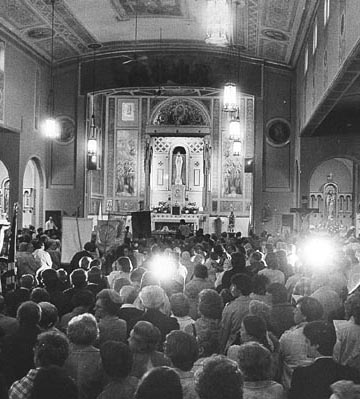
Worshipers attend services at Immaculate Conception Church in the Poletown community of Detroit, Mich., not long before the church is razed (photo from The Detroit News archives).
Up From Poletown: Hathcock
The Poletown ruling spawned a wave of copycat takings across the country. But in 2004, the Michigan Supreme Court unanimously reversed the Poletown decision in Wayne County v. Hathcock. Justice Robert P. Young Jr. wrote, "(W)e must overrule Poletown in order to vindicate our Constitution (and) protect the people’s property rights. ..."
____________________
Judges and officeholders often speak eloquently about property rights, but in recent decades, they have eroded these rights all the same.
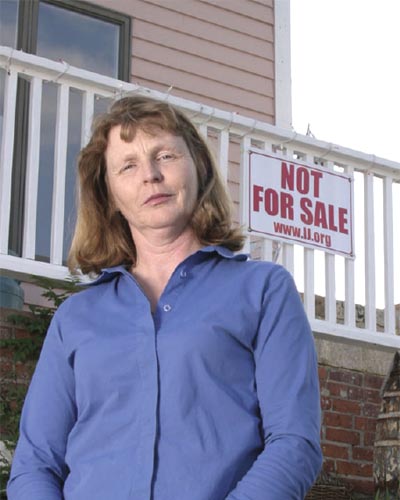
Susette Kelo stands near her home in New London, Conn. (photo by Isaac Reese, 2004 © Institute for Justice).
The most direct assault has come from "eminent domain," in which governments seize private property, pay compensation to the owners and use the land for various projects. This power was meant for public purposes like roads, yet it is now used for "economic development" that generates higher tax revenue, but serves primarily private interests.
In 2005, the U.S. Supreme Court in Kelo v. New London upheld a city’s power to transfer the homes of numerous residents to a private developer planning upscale office space. In a memorable dissent from this ruling, Justice Sandra Day O’Connor charged: "(T)he government now has license to transfer property from those with fewer resources to those with more. The Founders cannot have intended this perverse result."
Sadly, the Kelo decision had decades of precedent. In 1981, the Michigan Supreme Court allowed the city of Detroit to level Detroit’s "Poletown" enclave and transfer the land to General Motors Corp. By The Detroit News’ count, the project uprooted some 4,200 residents and razed 1,300 homes, 140 businesses and six churches.
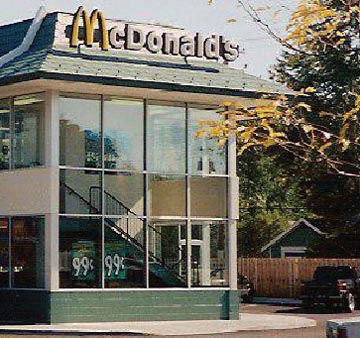
This McDonald’s restaurant is in East Lansing, Mich., and is owned by a member of the board of directors of the Mackinac Center for Public Policy.
Blight Blowback?
In 2005, citizens in East Lansing, Mich., protested the city’s absurd abuse of blight designations in a proposed taking. The Michigan House and Michigan Senate have since taken testimony on the blight loophole in laws on eminent domain.
____________________
When eminent domain is used to tear down communities for private development, compensation is cold comfort. And when government officials cite higher tax revenue as a public purpose, they imply that property owners exist to serve the government. In truth, the government exists to serve property owners.

Home in East Lansing, Mich.
The Hathcock ruling now prevents Michigan governments from using eminent domain for "economic development." But the state’s communities remain vulnerable, since entire neighborhoods can still be razed and given to other owners if public officials label an area "blighted."
Blight designations are not reserved for decayed properties. Government officials across the country apply the label freely to entire areas when they want land for new building projects.
In fact, these are just some of the properties that have been threatened with condemnation for blight.
For more pictures of buildings threatened with blight condemnations, see the Web site http://www.castlecoalition.org/castlewatch/ bogusblight/index.html.
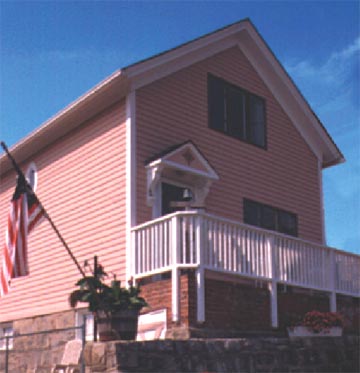
Susette Kelo’s home in New London, Conn. (photo by Isaac Reese, 2004 © Institute for Justice).
A Kelo of Prevention
So far, the American people — not the justices of the Supreme Court majority — have had the final word on Kelo v. New London. Outrage over the court’s decision is so widespread that the city of New London has postponed its plans. Susette Kelo and her neighbors continue to live in their homes and to fight for their right to remain there.
____________________
The property rights that inspired America’s Founders remain relevant today. More than at any time in our past, Americans value equal respect for all, regardless of race, creed, sex or income.

A woman embraces two children in the Poletown enclave of Detroit, Mich.
Yet as Justice O’Connor noted in her Kelo dissent, abuse of eminent domain usually benefits "those citizens with disproportionate influence and power in the political process. ..." The result, whether in Poletown or New London, is an almost aristocratic advantage for those who are exceptionally successful and likely to pay more taxes than the current property owners.
That advantage can be used against most other Americans, including middle-income citizens whose homes are suddenly declared "blighted" or lower-income homeowners who live respectably in struggling neighborhoods. Eminent domain abuse means those who are lower on society’s ladder will not receive equal treatment under the law.
That is not what this country has fought so hard to achieve.

A Taking ‘Too Far’
Property owners seldom receive compensation when a taking leaves even a small portion of their property’s value intact. But in Lucas v. South Carolina Coastal Council in 1992, the U.S. Supreme Court ruled that when a regulation suddenly deprives a property of all value, the owner is entitled to compensation.
____________________
Government takings involve more than just physical seizures of private property. A taking also occurs when government regulations substantially reduce a property’s usefulness or value.
In such cases, property owners rarely receive compensation. Yet they should. Their private losses ostensibly benefit the public, and compensation is meant to redress the imbalance.
The U.S. Supreme Court first recognized regulatory takings in the 1922 case Pennsylvania Coal Company v. Mahon. Justice Oliver Wendell Holmes Jr. wrote, "While property may be regulated to a certain extent, if regulation goes too far it will be recognized as a taking."
Ever since this ruling, the courts have struggled to define how "far" a regulatory taking must go before property owners are entitled to reimbursement.
High Water Mark?
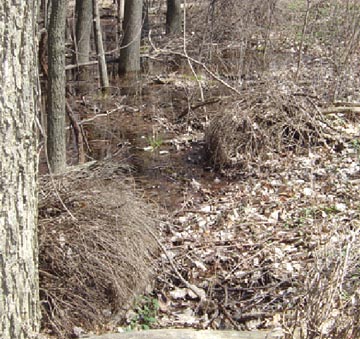
The U.S. Supreme Court has heard oral arguments in the Rapanos and Carabell cases. The central issue is whether regulators interpreted federal water laws too broadly — or indeed, whether Congress exceeded its constitutional powers in those laws. The court’s ruling could curb federal overreach in many areas of regulation.
____________________
Compensation for regulatory takings is an important goal of property rights reform. But property rights can also be buttressed by ensuring that regulators and elected officials don’t overstep their regulatory powers.
The potential for regulatory excess is considerable. Legislators frequently delegate their regulatory powers in vague terms to unelected rule-makers. These regulators are then tempted to read their power broadly, and they have fewer reasons to consider voters’ objections.
Consider two legal disputes: Rapanos v. United States and Carabell v. United States Army Corps of Engineers. In these cases, Michigan families and their business associates have objected to federal wetlands regulation of their properties. Federal regulators have claimed jurisdiction on grounds that the properties’ runoff could affect "waters of the United States," even though navigable waters are distant from the properties. If these lands are subject to tight federal scrutiny, properties all across Michigan, a peninsula, are as well.
Promoting Security for Property Owners
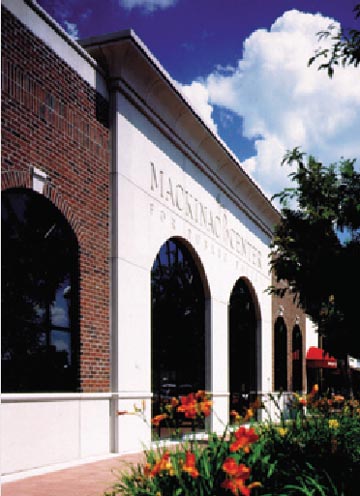
Even the most fundamental rights will be violated if people don’t insist on them. Two organizations that are defending property rights in public policy debates and the courtroom are the Mackinac Center for Public Policy in Midland, Mich., and the Institute for Justice in Arlington, Va. For more information on the Institute for Justice, consult their Web site at www.ij.org.
____________________
James Madison, often called the father of the U.S. Constitution, once wrote, "Government is instituted to protect property of every sort. ... This being the end of government, that alone is a just government, which impartially secures to every man, whatever is his own." The emphasis in that quote was Madison’s.
Restoring our property rights will require a variety of reforms, but two stand out:
Prohibiting the use of eminent domain for so-called "economic development" and for loosely defined "blight."
Requiring compensation for regulatory takings, as the citizens of Oregon recently did in a state constitutional amendment.
These protections will help us secure what the Founders sought to establish: a land in which Americans are truly free.
The poorest man may in his cottage bid defiance to all the force of the Crown. It may be frail; its roof may shake; the wind may blow through it; the storms may enter, the rain may enter, — but the King of England cannot enter; all his forces dare not cross the threshold of the ruined tenement!
William Pitt, 1st Earl of Chatham,
in a speech delivered in 1763
in opposition to an
excise tax on perry and cider
Property is surely a right of mankind as real as liberty.
John Adams, "A Defence of the Constitutions of
Government of the United States of America," 1787