

 Font size:
In this transcription of his May 1994 Commencement address at Central Michigan University, Mackinac Center for Public Policy President Lawrence Reed argues that it is counterproductive to try to reform the world by force or political decree while allowing our own personal lives to fall into disrepair.The best way to win others to a worthy cause is to serve as an attractive beacon instead of a hypocritical pontificator. Makes a great gift for graduates.10 pages.
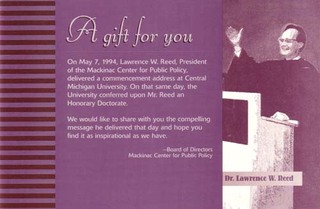
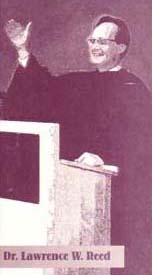
On May 7, 1994, Lawrence W. Reed, president of the Mackinac Center for Public Policy, delivered a commencement address at Central Michigan University. On that same day, the University conferred upon Mr. Reed an Honorary Doctorate.
We would like to share with you the compelling message he delivered that day and hope you find it as inspirational as we have.
–Board of Directors
Mackinac Center for Public Policy
I regard these few minutes I have to speak to you today as a great privilege and a high honor. It would not be accurate for me to say that I am "speechless"—because I do indeed have something I am prepared to say—but I could not find words that I felt were sufficiently adequate to express my deep appreciation for this invitation. To impart a message that might make some difference—any difference, fleeting or lasting—in the hearts, minds or lives of several hundred future leaders of America, and to do so on this occasion at this prestigious institution, is an awesome responsibility.
This occasion is special to me for another, more personal reason. As an academician and former professor who taught at the college level for seven years, I feel that being with students again is much like coming home. There is much about the academic environment that shines as a beacon for the rest of society—not the least of which is the principle of genuine intellectual inquiry—a tolerance, an openness, and indeed, an encouragement of new ideas and a wide range of perspectives.
Central Michigan University is to be commended for practicing and steadfastly defending this essential pillar of academia. An institution of higher learning is a marketplace of ideas, where ideas are shared, discussed, debated, sometimes debunked, but always treated with the respect they are due, never dismissed without thought or reason, and never feared. In the spirit of the true academician, truth is not advanced by stereotyping, by shallow epithets, by innuendo or insinuation, by blind obedience to an ideology at the expense of evidence and reality, or by suggestion that those with different views should not be heard. That’s the stuff of small or idle minds. Those who labor and study in our centers of learning must be made of stronger stuff than that, for if they are not, the prospects for a free, virtuous, and compassionate larger society are slim. These are modern times, not the dark ages. We should judge ideas as we should judge the people who bring them to the marketplace—on their merits. The thing I have always found refreshing about the traditional academic environment is that we place a premium on thinking. We can disagree without being disagreeable. We reject the thought police.
Graduates, you are about to step from this institution into a world you will shape for years to come. I know it’s customary for Commencement speakers to say at least a dozen times in their addresses, "You are the future." We all know that. What I would like to prompt you to think about is HOW you want to shape that future. HOW do you want your influence to be expressed? I have chosen as my title this afternoon, "The Power of Positive Example."
Will you please, each one of you, for just a few seconds, close your eyes and try to think of one or two people in your life who have, in some fashion, motivated you, encouraged you, spurred you on … Ask yourself, was it because of what they said, or what they did? How they talked, or how they behaved?
My guess is that, for most of you, what those people did and how they behaved—in other words, the example they were (or are) for you, has had the more lasting and meaningful impact. Certainly, no one is inspired in a positive way by the hypocrite or by the unprincipled. No one proudly admits, "I want to be like them." Paraphrasing Emerson, What you are speaks so loudly I cannot hear what you’re saying.
If you think harder about it, I believe you will agree with me that as human beings we are inspired far more by the power of positive example than by commands or threats. This is not to say that those who have wielded great power at the point of a gun have not had profound impact. But doesn’t it mean so much more to us to earn the respect of others as opposed to commanding it? How much have we really won, if others pay attention not because they want to but because they have to?
I can think of so many things I wish more people would do. I wish they would value education more highly and read to their children. I wish they would show more concern for those around them in need and do something about it. I wish they would work harder at being the very best at whatever they’ve chosen as their life’s work. I wish they would take more seriously the responsibilities of being free citizens in a democratic society. I wish they would show more respect for the lives and property of others. I wish they would be better neighbors, more caring friends, more honest politicians, more responsible business associates.
I suppose we could devise all sorts of laws that would coerce more people in these directions and that would penalize them if they failed to comply. But that approach, frankly, leaves me with a feeling of hollowness. The bottom line is that there are limits to how much you can do to people to make them good. I really don’t want a society in which people do the right thing just because they have to, when they really don’t want to. And I believe strongly that the most effective teaching method—and at the same time, sadly, the most underappreciated teaching method—is the power of positive example. It isn’t a quick fix, it doesn’t promise instant gratification, but in the long run, it makes all the difference in the world.
Forcing a person to go to church doesn’t make him religious any more than forcing him to stand in a garage makes him a car. You don’t make a person truly loyal by forbidding disagreement. You don’t make a person charitable by robbing him at gunpoint and spending his money on good things.
The test of a true leader, it’s often been noted, is not how many people you can coerce into submission or intimidate into silence, but how far others will go to follow you because they are attracted to your mission of their own free will. And the attraction is the power of your example.
The late Leonard Read, founder of the Foundation for Economic Education, was fond of relating a story which I would like to paraphrase here and apply to myself: I’m terrible at golf, but I golf anyway. When I show up at the course, not surprisingly, no throngs appear. No one watches me to see how it’s done. But let a Palmer or a Nicklaus or a Watson or a Trevino show up, and instantly the crowds gather, seeking their tutelage. The British statesman Edmund Burke once said, "Example is the school of mankind, and they will learn at no other." I especially like the way Mark Twain said it, "Few things are harder to put up with than the annoyance of a good example."
I am sure that no one here is entirely happy with the world the way it is. To some extent, all of us are would-be reformers of the world, whatever our personal philosophical inclinations may be. What we sometimes forget in our haste to reform the world is that we must first reform ourselves, one at a time, and none of us has yet done all we can in that regard. We are probably chronically underestimating how much influence for good we can be by being better ourselves—not pontificating about doing good, but actually doing good—and doing it with your own resources, not someone else’s—living it, serving as an inspiration for others. We underestimate our ability to shape the future of society by shaping ourselves first. In the process, we sometimes meddle in the lives of others while allowing our own to fall into disrepair.
In recent years, we have been treated to a great deal of public moralizing from some who have postured as our self-appointed moral authorities. But as certain televangelists have proven, moralizing and morals are two different things and sometimes are not found in the same person. Individuals who pontificate about the morals of the rest of us while living their own lives to the very standards they prescribe do certainly exist, but I suspect that the greatest influence for good comes from those quiet folks who make morals, not moralizing, their vocation.
An item from a newspaper seven years ago caught my eye because it made this very point. The story came from the little town of Conyers, Georgia. When school officials there discovered that one of their basketball players who had played 45 seconds in the first of the school’s five post-season games had actually been scholastically ineligible, they returned the state championship trophy the school team had won a few weeks before. If they had simply kept quiet, probably no one else ever would have known about it and they could have retained the trophy.
The really amazing thing was that the team and the town, dejected though they were, rallied behind the school’s decision. The coach was quoted as saying, "We didn’t know he was ineligible at the time … but you’ve got to do what’s honest and right and what the rules say. I told my team that people forget the scores of the games; they don’t ever forget what you’re made of."
In the minds of most, it didn’t matter that the championship title was forfeited. That coach, and the team were still champions, and in more ways than one. We should ask ourselves, "Could I have mustered the courage to do the same?"
I could spend all day telling you real-life stories of real people whose personal examples made all the difference in the world. I have traveled to some 42 countries, meeting and interviewing presidents and cabinet ministers. But let me just share with you one story from a country with which I feel a strong, emotional bond—Poland. I have been fortunate to visit it twice, once in 1986 to spend time underground with activists in the banned Solidarity movement, and later in 1989 after the changes that brought Solidarity out of hiding and democracy to the nation.
The story I want to share with you is that of Zbigniew and Sophia Romasczewski, the couple who ran Solidarity’s underground radio in Warsaw during the first six months after the socialist regime imposed martial law in December 1981. That was a time of terror and oppression, when many Solidarity leaders and sympathizers were rounded up, arrested, beaten, and worse.
The Romasczewskis were discovered and arrested by the authorities in 1982. They were each given sentences of four years behind bars, and kept apart from one another in solitary confinement for much of that time. His eyesight suffers today from the beatings he endured in prison. I had the privilege of meeting with them in the privacy of their apartment in November 1986, not long after they had been released. They were active again in the underground, defying the regime, and fully expecting to be arrested again, but that didn’t deter them for a moment. They were totally committed to the cause of a free Poland and were not about to give up.
In my time with them, I asked many questions about what it was like to run an illegal radio operation. At one point I asked, "How did you know if anyone was listening?" I’ll never forget Sophia’s response. She said, "We could only broadcast for about 8 to 10 minutes at a time and then had to go off the air to avoid detection. One evening, we asked listeners who were supportive of the radio to blink their lights, and to call others who were also supporters but might not be listening at that moment, to ask them to do the same."
With a tear in her eye, she then said, "We went to our window, and for hours, all of Warsaw was blinking."
The Romasczewskis and so many other brave souls like them were the examples that galvanized not only a nation, but half a continent, and in the course of events, brought an evil empire to its knees. They are heroes to millions.
And by the way, Zbigniew later became a duly elected member of the lower house of Parliament of a free Poland whose President is Lech Walesa.
I would be remiss if I didn’t say something about how my theme today applies to the field in which I now work—public policy. This is an area that touches each of your lives in important ways.
I interact on a regular basis with policy makers, including politicians. I am not one who disparages all politicians. I recognize that there are good ones and bad ones, just as in all other professions. And when I think of what makes a good one and what makes a bad one, I don’t think first about how they vote—which may surprise you. I think of why they vote the way they do. And I have friends in the political arena from across the philosophical spectrum.A California state senator once wrote a fascinating little book whose title spoke volumes: What Makes You Think We Read the Bills? So, I do think that one characteristic of a good politician is that he or she read the bills! But there’s more to possessing the power of positive example and being a politician at the same time. I’m referring to having convictions, believing in something, putting truth and fairness and right ahead of re-election.
I know a state senator (I won’t divulge the person’s name or even whether he resides in Michigan) who has told me on more than one occasion, "Larry, you’re right, I agree that’s the right way to go, but I can’t vote that way because I’d lose the next election." I never found him to be an inspiration.
Then there are politicians like my friend Dave Hollister, usually labeled in the press as being "very liberal." Dave was a long-time state representative from Lansing who recently left the state House when he was elected Mayor of Lansing. I have rarely agreed with Dave on issues, but I admire and respect his courage on conviction. He believes in something. He preaches it and he practices it. He tells people what he believes, not necessarily what he thinks they want to hear. He has never been afraid of ideas different form his own, and he vigorously defends his own ideas. I respect him.
If you think about it, of all the tens of thousands of politicians who have come and gone in American history, the memorable ones whom we look up to are not, for the most part, the wet-finger-in-the-wind, believe-in-nothing types, but the ones who stood for something.
If you want to enter political life, my advice to you is, stand for something and have the courage of your convictions to say so. The advice of George Washington seems appropriate here: "If to please the people, we offer what we ourselves disapprove, how can we later defend our work? Let us raise a standard to which the wise and honest can repair. The rest is in the hands of God."
I suppose some of you might be saying, "OK, so he’s telling us to be good. So did mother. What else is new?"
What I’m saying is, keep your youthful zeal for doing good and for changing the world. Some may call you idealistic, but progress is never made without ideals, and those who champion them are the examples we most admire and remember. Resolve that you will indeed make your mark and shape society for the better. But understand that it is not enough to preach to others, no matter how good it might make you feel inside. It is not enough, indeed it’s probably counterproductive, to try and shape the work by the use of force or political decree. You have it within your power to wield great influence. Just recognize that how great that influence will be, is in direct proportion to your ability as a shining example to attract others to your cause.
Graduates—With the degrees you’ve worked long and hard to achieve and will take with you today from this fine institution, you have a head start on success in life. Now, it’s up to you to rise to the duty of serving others as the very best examples you can possibly be in every aspect of all that you do.
~~~~~~~~~~~~~~~
Congratulations, Good Luck, Best Wishes, Godspeed, and Thank you for this opportunity.



