Font size:
Written by one of America's foremost authorities on auto insurance, this study is a thorough review of Michigan's Essential Insurance Act and No-Fault Law. Harrington examines in-depth the structure of rates in the state and explains that they are not the result of price-gouging or insufficient competition. He analyzes the effects of the state's insurance regulations, and makes suggestions that would increase competition, lower costs, and limit the interference of government in a free insurance market. 33 pages.
Increases in the cost of automobile insurance have led to demands for increased regulation of auto insurance rates in many states. One view o£ auto insurance affordability problems is that high and rapidly growing premiums are caused by high and rapidly growing claim costs and that the principal objective of public policy should be the evaluation and possible adoption of changes that will help to control claim costs. A second view is that inadequate competition, inefficiency, and excessive profits in the auto insurance industry make insurance unaffordable for many buyers and that competition that does exist leaves large numbers of buyers without access to coverage at reasonable rates. According to this view, regulation of premium rates, underwriting decisions, and insurance company operating expenses is essential to benefit consumers.
This report evaluates the private passenger auto insurance market in Michigan. It suggests appropriate government policies for dealing with auto insurance affordability problems and for improving the auto insurance system to benefit Michigan motorists. The report considers (1) the nature and causes of affordability problems, (2) the benefits and costs of the current system of auto insurance regulation as set forth under the Essential Insurance Act, (3) the performance of the state's no-fault law, and (4) the competitiveness of the auto insurance market. The major findings are:
Evidence on market structure, ease of entry, and profitability supports the conclusions that the private passenger auto insurance market is competitive and that the principal cause of auto insurance affordability problems is high claims costs. As would be expected in a competitive market, premium rates are higher in Detroit than in other parts of the state because claim costs are higher. The focus of government policy should be on actions that will help to control claim costs. In order to represent the interests of policyholders in the political process, insurers must be willing to accept temporary mandated rate cuts that are closely tied to desirable legislative changes that reduce expected claim costs.
The Essential Insurance Act has reduced certain negative consequences of insurer underwriting practices, but it has created other problems. The law promotes cross-subsidies among consumers and reduces the incentives for many drivers to take precautions that would lower expected accident costs. Consideration should be given to modifying the statutory constraints to allow more discretion in underwriting and rate classification. The primary effect of any additional restrictions on cost-based pricing, such as those that involve territorial rating, would be increased subsidization of some groups at the expense of others. The likely result over time would be even higher claim costs and premiums.
While the state's no-fault law has several characteristics that could serve as models for other states, a number of modifications in the law are desirable to maintain its principal advantages and improve the affordability of coverage. The legislature should take action to provide consumers with significant choice in the selection of personal injury protection benefit levels and to ensure that tort liability for noneconomic losses is restricted to serious injuries. These changes would benefit most motorists; low income groups that face high premiums in Detroit and other areas would especially benefit. Serious consideration also should be given to the possibility of adopting an optional no-fault law that would allow consumers the choice of eliminating the right to sue other drivers for damages in exchange for a corresponding exemption from tort claims. Under this system, motorists who rejected no-fault would be able to recover damages from their own insurer if they were to be injured by an at-fault driver who had chosen no-fault.
Given competition in the auto insurance market, overall rate levels should continue to be governed by file-and-use regulation rather than prior approval.
Under the Michigan no-fault law, which was effective October 1, 1973, all auto owners are required to purchase personal injury protection coverage, property protection insurance, and residual liability coverage. Personal injury protection insurance provides the most comprehensive first-party benefits of any no-fault law. It covers medical and rehabilitation expenses without limitation and provides a maximum of three years of coverage for wage loss and survivor benefits. The law limits tort liability to economic losses in excess of personal injury protection benefit limits and provides for tort liability for noneconomic losses only if a verbal threshold is satisfied. The restriction on tort claims for noneconomic loss historically has been the most effective in the nation.
Property protection insurance provides up to $1 million in coverage for property damage by the insured on a no-fault basis. It does not cover the insured's property or damage to autos unless legally parked at the time of the accident. In contrast to almost all other states with no-fault, Michigan's no-fault law limits tort liability for property damage to other autos. Until July 1, 1980, tort liability was completely eliminated. In 1980, drivers became subject to tort liability for up to $400 in damage to other vehicles if the loss was not covered by insurance. A driver who is more than 50 percent at-fault cannot recover under this "mini-tort" provision. Residual liability coverage is required to be purchased with minimum limits of $20,000 per person and $40,000 per occurrence for bodily injury and $10,000 per occurrence for property damage. [1]
Auto owners have the option of purchasing comprehensive coverage for theft and damage other than collision and either standard, broad, or limited collision coverage. [2] The purchase of uninsured and underinsured motorists coverage also is optional.
Michigan's system of auto insurance regulation has several unique features. The Essential Insurance Act, which was enacted in 1979 and took effect on January 1, 1981, places significant limitations on underwriting and rate classificationby insurers. [3] All auto insurers must offer coverage (including personal injury protection, property protection, residual liability, comprehensive, and collision) to any "eligible person" who also meets their underwriting rules (which must be filed with the Insurance Bureau). Each person is eligible unless he or she has recently been convicted of insurance fraud or some serious motor vehicle violation, has been cancelled recently for non-payment of premium, or has accumulated more than six points for accidents and motor vehicle violations in the past three years. [4] Insurers do not have to offer coverage to ineligible persons or to eligible persons who do not meet their underwriting criteria. Allowable underwriting criteria (which must be uniformly applied) only include the factors that define an eligible person and several other factors that are specifically set forth in the law, such as use of the auto for commercial purposes, modifications to increase speed, or the points accumulated by another driver in the insured's household who accounts for 10 percent or more of the use of the insured vehicle.
Voluntary market rates are subject to a file-and-use rating law. Insurers need not obtain approval of rates prior to their use. [5] However, insurers may only employ rating criteria that are specified by law. The principal criteria allowed include age or driving experience, driver "primacy", average mileage, commuting mileage, type of use, vehicle characteristics, number of cars or licensed operators, and amount of insurance. Insurers also are required to establish merit rating plans that provide surcharges for substantially at-fault accidents and for motor vehicle violations. Rates cannot be based on the owner or driver's gender or marital status. The Essential Insurance Act also contained significant restrictions on the use of territorial rating. As is discussed in detail later in the paper, these restrictions proved to be unworkable and were substantially modified in 1986.
The Essential Insurance Act changed Michigan's involuntary market for auto insurance from an assigned risk plan to a joint underwriting association (the Michigan Automobile Insurance Placement Facility or MAIPF). [6] The law requires that the five largest auto insurers and up to five additional insurers operate as servicing carriers. Rates for the MAIPF are subject to prior approval by the insurance commissioner. As will be discussed later, the law places specific restrictions on MAIPF rates in higher-rated territories. MAIPF operating losses are assessed against all insurers in proportion to their voluntary market volume.
Only a small number of states impose significant restrictions on auto insurance underwriting and rate classification. Among these states, Michigan's system of regulation is distinctive in that it employs file-and-use regulation rather than prior approval for overall voluntary market rate levels. Other states with substantive limitations on underwriting and rate classification also employ a reinsurance facility or similar mechanism that permits insurers to pool the financial results of any insured with other insurers in the state. [7]
The magnitude and growth in auto insurance premiums and claim costs in Michigan and other states are examined in this section to provide useful background on the nature and causes of affordability problems, including the average cost of coverage in Michigan compared to other states, the performance of Michigan's no-fault law, and the magnitude of claim costs in Detroit relative to statewide claim costs. Given competition in the Michigan auto insurance market (see Section V), the magnitude and growth in premiums will primarily reflect the magnitude and growth in the frequency and severity of claim costs, which are influenced by factors such as the rate of growth in the cost of medical treatment and auto repair parts, changes in the accident rate, and changes in legal rules governing liability for auto accidents.
Table 1
Average Premium and Growth in Average Premium for Private Passenger Automobile Insurance: 1982 vs. 1987
|
|
Average Premium 1987 |
|
|
|
Average Premium 1982 |
|
|
|
Percent Growth 1982-87 |
|
|
1. |
New Jersey |
$774 |
|
1. |
New Jersey |
$529 |
|
1. |
Georgia |
96% |
|
2. |
California |
$717 |
|
2. |
Massachusetts |
$453 |
|
2. |
Maryland |
79% |
|
3. |
D.C. |
$709 |
|
3. |
D.C. |
$434 |
|
3. |
Delaware |
75% |
|
4. |
Massachusetts |
$655 |
|
4. |
Louisiana |
$423 |
|
4. |
Alabama |
74% |
|
5. |
Connecticut |
$634 |
|
5. |
California |
$421 |
|
5. |
Connecticut |
72% |
|
|
|
|
|
|
|
|
|
|
|
|
|
22. |
Michigan |
$486 |
|
19. |
Michigan |
$327 |
|
32. |
Michigan |
49% |
|
|
|
|
|
|
|
|
|
|
|
|
|
47. |
Idaho |
$322 |
|
47. |
Idaho |
$217 |
|
47. |
Wyoming |
34% |
|
48. |
Iowa |
$285 |
|
48. |
Montana |
$213 |
|
48. |
North Dakota |
28% |
|
49. |
South Dakota |
$273 |
|
49. |
North Carolina |
$212 |
|
49. |
Nebraska |
25% |
|
50. |
Nebraska |
$272 |
|
50. |
North Dakota |
$209 |
|
50. |
Iowa |
24% |
|
51. |
North Dakota |
$268 |
|
51. |
South Dakota |
$192 |
|
51. |
Alaska |
22% |
|
|
|
|
|
|
|
|
|
|
|
|
|
Countrywide |
$514 |
|
Countrywide |
$331 |
|
Countrywide |
56% |
|||
|
Median State |
$439 |
|
Median State |
$286 |
|
Median State |
51% |
|||
Sources: Insured car-years obtained from AIPSO FACTS 1987/88 and AIPSO, Circular RMC 89-14, April 14, 1989. Written premiums obtained from Insurance Factsand A.M. Best Co. Calculations by the author.
Table 1 shows the average private passenger auto premium (for all coverages combined) per insured vehicle for Michigan and selected additional states in 1982 and 1987 along with the percentage change between 1982 and 1987. [8] The average premium in Michigan was $486 in 1987 compared to a countrywide average of $514. Michigan's average premium ranked 22nd in 1987, down from 19th in 1982. The average premium in Michigan grew by 49 percent between 1982 and 1987 compared to a countrywide rate of 56 percent. Its growth rate was the 32nd highest in the nation.
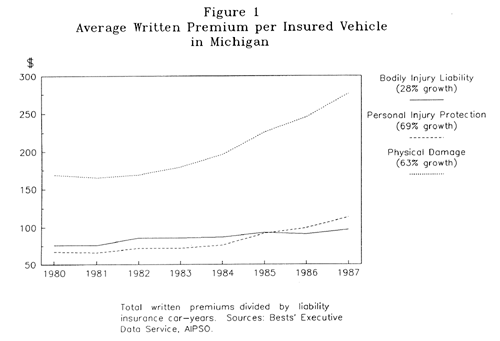
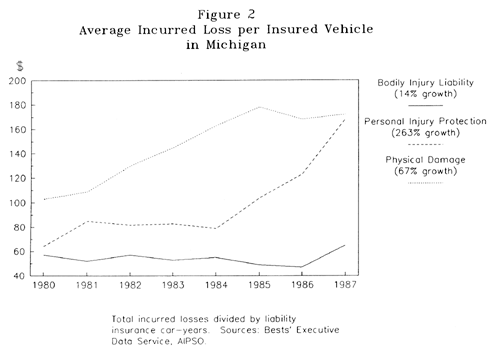
Figure 1 shows the average premium per insured vehicle in Michigan for personal injury protection coverage, for residual liability coverage (which is denoted bodily injury liability in the figure), and for physical damage (comprehensive and collision) coverage during 1980-87. Figure 2 shows the average incurred loss per insured vehicle during the same period.[9] Values are shown only through 1987 because data on the number of insured vehicles are no, yet available for 1988.
In 1988, physical damage coverage accounted for 56 percent of total private passenger auto insurance premiums in Michigan. The average physical damage premium per vehicle grew by 63 percent from 1980 to 1987. The average loss grew by 67 percent. [10] Personal injury protection premiums represented 25 percent of total premiums in 1988. The average personal injury protection premium grew by 69 percent during 1980-87. The average loss grew by 263 percent. As is discussed later, much of this growth is attributable to increases in losses for the Michigan Catastrophic Claims Association, which provides coverage for all personal injury protection claims for medical and rehabilitation expenses in excess of $250,000 per injured person. [11] Residual liability premiums represented 20 percent of total premiums in 1988. Residual liability premiums and incurred losses (the vast majority of which are for bodily injury liability coverage) increased by 28 and 14 percent, respectively, during 1980-87. [12] After declining in 1985 and 1986, the average residual liability premium increased sharply in 1987. The issue of whether this growth was influenced by changes in the limitation on tort liability under the state's verbal threshold is discussed in Section IV.
Table 2
Frequency, Severity, and Average Cost of Paid Claims for Four Quarters Ending in June 1989: Michigan vs. Countrywide
|
|
Michigan |
Countrywide |
||||
|
Coverage |
Claim Frequency |
Claim Severity |
Average Cost Per Vehicle |
Claim Frequency |
Claim Severity |
Average Cost Per Vehicle |
|
l. Bodily Injury Liability |
.28 |
$17,390 |
$47.97 |
1.28 |
$7,406 |
$94.60 |
|
2. Personal Injury Protection |
1.26 |
$7,144 |
$89.90 |
1.87 |
$2,637 |
$49.35 |
|
3. Property Damage Liability |
.62 |
$742 |
$4.61 |
4.10 |
$1,338 |
$54.91 |
|
4. Collision |
12.78 |
$1,445 |
$184.97 |
8.03 |
$1,414 |
$113.66 |
|
5. Comprehensive |
11.56 |
$571 |
$66.01 |
9.42 |
$584 |
$55.02 |
|
6. Property Protection |
.76 |
$791 |
$5.98 |
-- |
-- |
- |
Note: Claim frequency is number of paid claims per 100 insured vehicles. Claim severity is total paid claims divided by number of paid claims. Average cost per vehicle is total paid claims divided by number of insured vehicles. All values are averages of quarterly results for last two quarters of 1988 and first two quarters of 1989.
Source: Fast Track Monitoring System. Calculations by the author.
Table 2 presents information on the level of frequency, severity, and average cost per vehicle of paid claims in Michigan and countrywide for the year ending June 1989. [13] Table 3 presents analogous information on the growth in paid claim costs since 1985. As can be seen in Table 2, the frequency of paid claims for bodily injury liability is much lower in Michigan than countrywide, and the severity of paid claims is much higher. Both differences reflect the operation of Michigan's restrictions on tort liability. Claims for minor injuries are removed from the tort system. As a result, the average paid claim cost per vehicle also is much lower in Michigan. [14]
The severity and average cost per vehicle of personal injury protection paid claims are much higher in Michigan than countrywide. [15] The major reason for these differences is that Michigan's personal injury protection benefits are much more comprehensive than those in most other states with no-fault. The relationship between personal injury protection benefit levels in Michigan and the affordability of coverage is discussed in Section IV. The Michigan system of no-fault property damage leads to much smaller claims for property damage and correspondingly higher claims for collision coverage than countrywide. [16] For comprehensive coverage, Michigan's claim frequency and average cost per vehicle are higher than the countrywide results.
Table 3
Percentage Growth in February, Severity, and Average Cost of Paid Claims During 1985-89: Michigan vs. Countrywide
|
|
Michigan |
Countrywide |
||||
|
Coverage |
Claim Frequency |
Claim Severity |
Average Cost Per Vehicle |
Claim Frequency |
Claim Severity |
Average Cost Per Vehicle |
|
l. Bodily Injury Liability |
4.2% |
24.5% |
29.9% |
17.8% |
35.8% |
59.8% |
|
2. Personal Injury Protection |
-5.3% |
57.0% |
48.5% |
10.2% |
33.5% |
47.1% |
|
3. Property Damage Liability |
14.8% |
9.9% |
26.6% |
-5.3% |
37.5% |
30.8% |
|
4. Collision |
-4.3% |
38.0% |
32.1% |
-6.8% |
35.3% |
26.2% |
|
5. Comprehensive |
2.8% |
-15.5% |
-13.0% |
8.2% |
19.9% |
29.9% |
|
6. Property Protection |
-23.2% |
35.0% |
3.1% |
-- |
-- |
- |
Note: Values are percentage changes between 4-quarter averages ending June 1989 and June 1985.
Source: Fast Track Monitoring System.
Table 3 indicates that auto liability paid claim cost frequency, severity, and average cost per vehicle in Michigan grew at a slower rate between 1985 and 1989 than in the rest of the country. As is discussed in Section IV, however, bodily injury claim frequency has begun to increase since 1986 following a period of declining frequency in 1985 and 1986. The growth of personal injury protection claim severity in Michigan is much greater than the growth in countrywide personal injury protection severity. As a result, the growth in the average cost of personal injury protection claims was about the same as the countrywide growth rate despite the fact that personal injury protection claim frequency declined in Michigan and grew by 10 percent countrywide since 1985. Again, the larger value for severity in Michigan reflects its greater level of personal injury protection benefits.
The average cost of comprehensive claims in Michigan has decreased since 1985 despite a small increase in frequency. The major cause of this decline is likely to have been a reduction in auto thefts during the past several years (see below). Since auto thefts have higher severity than other comprehensive claims, the reduction in severity since 1985 is consistent with a reduction in the proportion of comprehensive claims represented by theft claims.
Table 4
Five-Year Relative Frequency, Severity, and
Average Cost of Paid Claims: Detroit vs. Statewide
(mid-1983 through
mid-1988)
|
Coverage |
Frequency |
Severity |
Average Cost per Vehicle |
|
|
Bodily Injury Liability |
138% |
103% |
142% |
|
|
Personal Injury Protection |
144% |
113% |
163% |
|
|
Broadened Collision |
128% |
107% |
138% |
|
|
Comprehensive |
150% |
165% |
248% |
|
Note: 5-year values for Detroit divided by 5-year values statewide, in percent.
Source: ISO and NAII, Factors Affecting Urban Auto Insurance Costs
In general, auto insurance claim costs and thus premiums are significantly higher in large urban areas than in smaller cities and rural areas. Table 4 shows ratios (in percent) of paid claim frequency, severity, and average cost per vehicle in Detroit to statewide results for the period 1983-88. As can be seen, claim frequency, severity, and average cost per vehicle are uniformly higher in Detroit than for the entire state. [17] The ratios of Detroit severity to statewide severity are much smaller than those for frequency, except for comprehensive coverage, in which case the much higher severity in Detroit is most likely attributable to the higher vehicle theft rate. As a result of much greater frequency and severity, the average cost per vehicle of comprehensive claims in Detroit is two and a half times the statewide average.
The results shown in Table 4 were obtained from a study of claim costs in 18 large cities that was conducted by the Insurance Services Office (ISO) and the National Association of Independent Insurers (NAII). Of these 18 cities, Detroit's ratio for the average cost per vehicle of comprehensive claims was the fifth largest during 1983-88 (behind New York, Newark, Boston, and Philadelphia). [18] The ratio of thefts per 100,000 population in Detroit to that for the entire state was the third largest of the 18 cities studied by the ISO and NAII (behind Newark and Boston). In 1987, the motor vehicle theft rate in Detroit was 2,732 per 100,000 population compared to a statewide rate of 752 per 100,000. The 1987 theft rate in Detroit was much lower than the 1985 rate of 3,452 per 100,000 population, and the ratio of the theft rate in Detroit to the statewide theft rate declined from 417 percent in 1985 to 363 percent in 1987. [19] Since the ISO/NAII analysis was based on aggregate data for i983-88, the ratios for comprehensive coverage shown in Table 4 are likely to overstate the difference that existed at the end of this period.
In addition to the higher premiums in Detroit for comprehensive and other forms of coverage due to higher claim frequency and severity, affordability problems in Detroit are aggravated by the low per capita income of many residents. [20] As a result, the affordability problem in Detroit is acute for many motorists, regardless of the fact that the statewide average premium in Michigan and average premium growth are lower than countrywide.
The basic arguments for restrictions on insurer underwriting and rate classification that ultimately were enacted in the Essential Insurance Act of 1981 are set forth in a 1977 report to the Governor by the Michigan Insurance Bureau. [21] This report argued that auto insurance is essential in modern life and that government must ensure that coverage is available to all citizens. It argued that the auto insurance market was characterized by pronounced availability problems and suggested that an availability crisis was imminent without substantial government action. In support, it referred to a rapid increase in the number of applications to the Michigan assigned risk plan in 1976. It also suggested that availability problems were widespread, although somewhat less dramatic, in other states including the nearby states of Illinois and Ohio. [22]
Specific criticisms of the auto insurance market that are contained in the 1977 report include:
The principal form of competition in insurance involved attempts by insurers to underwrite the best risks and avoid risks that were perceived as undesirable.
Insurer underwriting decisions and rate classification were subjective, arbitrary, and unfairly discriminatory. Insurers did not have the technical ability to identify differences in risk across individuals with sufficient accuracy. Existing regulation was inadequate to deal with these problems. [23]
As a result of subjective, arbitrary, and unfairly discriminatory underwriting and rate classification, large numbers of drivers were forced into the involuntary market, which was characterized by higher premiums and lower service quality. This situation was inequitable, since many of these drivers were "objectively" similar to drivers insured in the voluntary market. [24]
The insurance market provided only limited choice to consumers, since they could be denied coverage by the insurer of their choice.
The report argued that the objectives of regulation should be to guarantee the right to essential coverage, to guarantee "competitive and fair" rates, to provide freedom of choice to consumers, and to be cost effective. The report defined competitive rates as those that in the aggregate would not produce excessive profits. Fair rates were defined as those based only on objective factors that were both largely within the ability of the insured to control and causally related to losses.
To meet these objectives, the Essential Insurance Act of 1977 was proposed by the Insurance Bureau. [25] This proposal had four main features. First, insurers would be required to accept all applicants for coverage. Second, rate classification would be subject to greater government control to ensure fairness. Third, overall rate levels would be determined by competition under a file-and-use system of rate regulation. Fourth, a reinsurance facility would be created, and insurers would have the discretion of reinsuring any insured in the facility. The key details, analysis, and suggested program of regulation set forth in the Insurance Bureau's 1977 report were identical to those contained in a report prepared by the Federal Insurance Administration in the early 1970s. [26] Major facets of this program had been adopted in Massachusetts, North Carolina, and South Carolina in the mid-1970s, with the principal exception that none of these states allowed insurers to change rates without prior approval by regulators.
The Insurance Bureau's 1977 reform program was not enacted by the legislature. In June of 1978 the Supreme Court of Michigan issued its decision on the constitutionality of the state's no-fault law. The Court's four-to-three decision in Shavers v Attorney General (402 Mich 554) provided substantial impetus for the Michigan legislature to restrict underwriting and rate classification. [27] The Court upheld the right to limit tort liability for bodily injury liability, but it held that no-fault property damage was constitutional. More importantly, it held chat compulsory no-fault coverage violated due process and was thus unconstitutional because insurance regulation failed to ensure that coverage would be available at "fair and reasonable" rates.
In order to satisfy due process, the Court held that it would be necessary to give substantial meaning to the statutory requirement concerning rate levels that rates be adequate but not excessive or unfairly discriminatory, to clearly identify rating factors and rate differentials and disclose such factors to consumers, and to provide prompt administrative review to consumers who desired to challenge underwriting or rating decisions. The Court provided 18 months for the legislature and Insurance Commissioner to act before the no-fault law would become unconstitutional. [28] The Essential Insurance Act, with its restrictions on insurer underwriting and rating and detailed provisions allowing policyholders to review rates and rate factors, was enacted by the legislature in 1979 prior to the end of the 18 month period specified in Shavers.
The 1977 report by the Insurance Bureau and the earlier work by the Federal Insurance Administration exaggerated problems in the insurance market and did not devote sufficient attention to the benefits of competitive underwriting, risk classification, and claim settlement. Substantial restrictions on underwriting and rating adopted in the Essential Insurance Act and in other states have significant drawbacks. [29]
Competitive Underwriting and Risk Classification. Many factors affect the expected costs of accidents for a given driver. The probability and likely cost of damages from an accident will depend on factors such as traffic density, road conditions, the cost of hospitalization, and the cost of vehicle repair parts. They also will be affected by the precautions taken by persons to avoid accidents and to reduce the cost of accidents that do occur. Possible precautions include deciding not to drive, deciding to drive less, purchasing a more crash worthy vehicle, maintenance of vehicle safety, driving more slowly, not driving after consumption of alcohol, paying close attention to traffic conditions and traffic controls, etc. A driver's expected accident costs also depend on his or her honesty and integrity. Drivers are likely to vary significantly in their tendency to create fraudulent losses, inflate claim costs following an accident, or both.
The major economic justification for allowing insurers substantial discretion in underwriting and risk classification is that it provides incentives for drivers and insurers to control claim costs in an efficient manner. [30] Insurance is a loss-sharing mechanism. Policyholders in a given group with greater than average claim costs during the coverage period essentially have their claims paid by their own premiums and by a portion of the premiums of policyholders with lower than average claim costs. While it is customary for the insurer to bear the risk of unanticipated changes in the average cost of losses for a given group during the coverage period, anticipated changes in the cost of coverage over time will be reflected in premiums and thus borne by policyholders. Underwriting and risk classification determine the scope of loss sharing among policyholders.
Competitive pressure and policyholder preferences provide insurers with the incentive to sort policyholders into the most homogeneous groups possible subject to constraints on the availability and cost of information. The desire by policyholders for the lowest possible premium creates the incentive for insurers to reduce rates for drivers with lower than average expected accident costs. As a by-product, premiums for drivers who on average will have higher accident costs will increase. Any insurer that did not engage in risk classification to sort policyholders into the most homogeneous groups possible would lose customers with lower than average expected costs to competitors, attract customers with higher than average expected costs, or both. The insurer would need to raise rates, engage in classification, or both to survive.
Competitive risk assessment does not produce perfect accuracy in the sense that each policyholder pays a premium commensurate with his or her expected loss. Due to inherent constraints on knowledge and the cost of information, some heterogeneity will exist in any rating class (i.e., expected accident costs will not be identical for all policyholders in the class). However, competitive underwriting and rate classification will produce the greatest possible accuracy given such constraints. The resultant system of "cost-based pricing" has a persistent tendency to achieve two related results over time: First, in any rating class it will not be possible ex ante to distinguish drivers with higher than average expected accident costs from drivers with lower than average expected accident costs at a cost that would justify obtaining the information necessary to do so (assuming that such information existed). Second, actual losses will differ significantly between rating classes, but on average it will not be possible ex post to identify subgroups within a class that have experienced significantly different losses using information that could have been obtained at low cost prior to the period of coverage. As such, competitive risk classification operates over time to eliminate "cross-subsidies" among policyholders to the extent that it is cost efficient to do so.
Given discretion, some insurers will engage in "subjective" underwriting. Some of the characteristics that are related to expected accident costs or underwriting expenses are difficult to measure or quantify with objective tests. Examples include an applicant's proclivity to engage in fraud or the likelihood that an applicant will pay subsequent premium installments. In a perfect world, subjective underwriting would not exist, but then neither would claims fraud or nonpayment of premiums. While many observers regard any form of subjectivity as objectionable, it is important to stress that competition will only reward subjective judgment to the extent that it helps to identify policyholders who on average will have either higher or lower claim costs. Erroneous judgments either will be penalized by adverse loss experience (e.g., if the subjective assessment understates expected claim costs), or they will result in an unnecessary loss of sales for the insurer and agent (e.g., if the assessment overstates expected claim costs). As a result, competition will prevent the widespread use of arbitrary underwriting and rating criteria over time. Moreover, subjective underwriting that does occur in states that allow insurers a large degree of discretion in underwriting and rate classification does not result in a large involuntary market (see below).
Significant restrictions on risk assessment are likely to be costly because they distort incentives for claim cost control by drivers, insurers, and policymakers. First, cost-based pricing provides desirable incentives for policyholders to take precautions to reduce expected accident costs. Second, if an insurer bears sole responsibility for the claim costs of its policyholders, it has a strong incentive to minimize the sum of claim costs and the cost of claim settlement. [31] As is discussed further below, reinsurance facilities and joint underwriting associations, which involve pooling of claim costs among insurers, are likely to reduce the incentive for efficient claims settlement. These mechanisms are more likely to be used if restrictions on underwriting and rate classification are adopted. Third, when confronted with rising claim costs and affordability problems, policyholders and insurers have incentives to influence legislation to control claim costs and thus premium growth in efficient ways. [32] Substantial restrictions on underwriting arid rate classification also distort these incentives.
Causes of Large Involuntary Markets. Given substantial discretion in underwriting and rate classification, almost all policyholders are able to obtain coverage in the voluntary auto insurance market, and cyclical fluctuations in prices and the supply of coverage are likely to have only a minor impact on the proportion of drivers insured in the involuntary market. [33] Instead, there are two principal causes of large involuntary markets: (1) inadequate involuntary market rates that compete with and crowd out the voluntary market, and (2) voluntary market rate regulation that produces inadequate rates and thus makes insurers unwilling to write coverage voluntarily. [34]
Table 5
Involuntary Market as a Percent of Total
Market in 1987
(Private Passenger Auto Liability)
|
Selected States |
Frequency Distribution |
||
|
State |
Percent |
Range |
Number of States |
|
Massachusetts |
58.47% |
50 to 60% |
1 |
|
New Jersey |
44.03% |
|
|
|
South Carolina |
32.85% |
40 to 50% |
1 |
|
New Hampshire |
30.52% |
|
|
|
North Carolina |
22.52% |
30 to 40% |
2 |
|
New York |
15.64% |
|
|
|
District of Columbia |
15.53% |
20 to 30% |
1 |
|
Rhode Island |
12.48% |
|
|
|
Connecticut |
9.45% |
10 to 20% |
3 |
|
Delaware |
7.25% |
|
|
|
|
|
5 to 10% |
2 |
|
Michigan |
3.04% |
|
|
|
Illinois |
0.08% |
3 to 5% |
7 |
|
Indiana |
0.06% |
|
|
|
Ohio |
0.01% |
1 to 3% |
6 |
|
Pennsylvania |
2.17% |
|
|
|
Wisconsin |
0.06% |
.l to l% |
13 |
|
|
|
|
|
|
Countrywide |
6.75% |
0 to .1% |
15 |
Note: Percent of liability insurance car-years insured in the involuntary market.
Source: AIPSO Circular RMC 89-14, April 14, 1989
Table 5 presents information on the size of the involuntary market in Michigan and other states in 1987. Seventeen states had involuntary market shares (of total insured car-years for liability coverage) greater than or equal to three percent. Michigan ranked 17th with an involuntary market share of 3 percent. Twenty-eight states had less than one percent of insured vehicles in the involuntary market. Fifteen of these states (including the neighboring states of Illinois, Indiana, Ohio, and Wisconsin) had less than one tenth of one percent of insured vehicles in the involuntary market. The five states with the largest involuntary market shares each have substantial restrictions on underwriting and rate classification, restrictive voluntary and involuntary market rate regulation, or both. Most of the other states with greater than one percent of insured vehicles in the involuntary market regulate voluntary market rates or are likely to hold involuntary market rates below the expected cost of providing coverage for some groups.
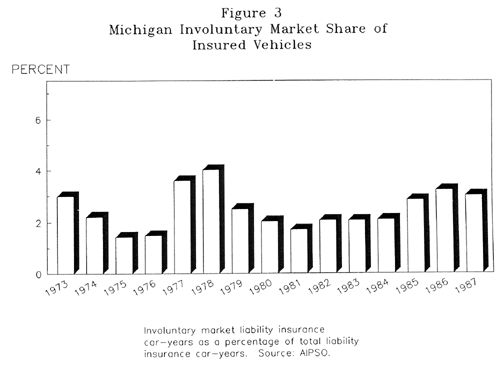
The 1977 report by the Insurance Bureau emphasized an increase in the number of applications in the Michigan assigned risk plan, but it did not mention the share of vehicles insured in this plan.[35] Figure 3 shows the percentage of vehicles insured in Michigan's involuntary market each year from 1973 to 1987. As can be seen, the percentage increased sharply in 1977. However, at its peak in 1978, the involuntary market accounted for just over four percent of total insured vehicles. The involuntary market share declined to just over two percent by 1980, the year prior to the effective date of the Essential Insurance Act. [36]
Between 1975 and 1977, the involuntary market share in Illinois increased from 0.44 percent to 1.04 percent. It declined in 1978. Ohio's involuntary market share increased from 0.18 percent in 1975 to 0.20 percent in 1977; it declined in 1978.[37] Why was Michigan's involuntary market share and the increase in its share larger than for its industrial neighbors during this period? The most likely causes are either lags in voluntary market rate approval during a period of rapid growth in claim costs, inadequate involuntary market rates, or both. [38]
Cross-Subsidies from Low to High Risks. The limitations on cost-based pricing in the Essential Insurance Act have created subsidies (lower premiums) for some groups and implicit taxes (higher premiums) for other groups. For many rating classes, insurers are able to identify subgroups ex ante that on average will be likely to have different levels of losses, and historical losses for these subgroups will be significantly different. In general, the direction of the resultant subsidies is from drivers who on average have lower expected claim costs to drivers who on average have higher expected claim costs.
The most obvious examples of subsidies in Michigan include: (1) young females subsidizing young males, (2) young married persons subsidizing young single persons, and (3) the tendency for persons who reside in areas with low accident costs to subsidize persons in areas with high accident costs. [39] If cost-based pricing is allowed, the use of sex, marital status, and territory as rating variables significantly improves the accuracy of rate classification. Within reason, these traits can be observed with a high degree of accuracy and for a relatively low cost. [40] While these characteristics may not be readily controlled by the person, their use in rate classification is neither subjective nor arbitrary.
Rates for the MAIPF also are likely to produce a subsidy because they are designed to be competitive with voluntary market rates in certain cases. By law, base rates for the MAIPF in the highest rated territory are set equal to the average of voluntary market base rates for the top five insurers. Base rates for other territories are set from 105 percent to 120 percent of the average voluntary market base rates for the top five companies, with the higher rated territories receiving the lower percentage increases. Since many drivers in the MAIPF will not meet the law's requirements for a mandatory offer of voluntary market coverage, the average driver in the MAIPF will tend to have significantly higher expected accident costs than drivers who are insured voluntarily. Prior approval regulation of MAIPF rates also may constrain rates below expected costs for some groups of drivers. The overall system tends to produce a subsidy to drivers who on average have higher expected accident costs, and the subsidy will tend to be greatest for drivers in the Detroit area due to the restrictions on MAIPF base rates in territories with the highest voluntary market rates. While the magnitude of the assessments paid by insurers to cover operating losses of the MAIPF has been small relative to premiums in recent years, the expected cost of assessments increases rates in the voluntary market. [41] Moreover, a relatively large market share for the MAIPF in Detroit (see below) or any other area is likely to reflect regulatory constraints on cost-based pricing rather than inadequate competition.
Drawbacks of Subsidies. Subsidies make coverage more affordable to some drivers. They also make it more likely that some drivers buy mandatory coverage as opposed to driving uninsured. However, restrictions on cost-based pricing essentially require persons who on average have lower expected accident costs to share losses with persons who on average have higher expected costs. While some persons regard such subsidies as fair, others will not. Moreover, the higher premiums made necessary to finance subsidies make insurance less affordable for drivers who bear the cost of subsidies. The general public also may not be aware of the nature and magnitude of cross-subsidies in Michigan and other states. In some instances, the consequences of restrictions on underwriting and rate classification, such as a larger involuntary market, may be incorrectly attributed to inadequate competition and used to support proposals for additional regulation.
If large numbers of drivers pay a modest increase in premiums to finance significant premium reductions for a relatively small group, overall affordability may in some sense be improved. However, even in this case, a significant drawback of restrictions on cost-based pricing is that they alter the incentives for many drivers to take precautions to control accident costs with the result that the total cost of accidents and accident prevention will increase. [42] Restrictions on cost-based pricing also are likely to increase accident frequency and severity. Persons whose rates are made lower will tend to buy more extensive coverage (e.g., choose lower deductibles) and undertake fewer precautions to reduce expected accident costs. While persons whose rates are increased will tend to buy less coverage and take greater precautions, it is likely that the overall effect will be fewer precautions and greater accident frequency and severity. [43] As a result, any overall improvement in auto insurance affordability from subsidies is likely to diminish over time. [44]
As suggested earlier, regulation associated with restrictions on cost-based pricing also can contribute to higher claims costs after losses occur. Losses incurred by drivers insured in the MAIPF are divided among all insurers in the state. Servicing insurers for the MAIPF are required by statute to employ the same claim settlement methods as used in the voluntary market. Nonetheless, the fact that expenditures on claim settlement are borne by the servicing carrier (in exchange for receiving stipulated fees expressed as a percentage of premiums) while the losses paid are spread among all insurers may dilute the incentive of the carrier to minimize the sum of claim costs and loss adjustment costs. [45] While the effect could be minor in the MAIPF given its modest size, it would become more pronounced if any policy were adopted thatsignificantlyincreased the size of the MAIPF or changed the involuntary market mechanism to a reinsurance facility.
Subsidies for drivers who on average have higher expected accident costs also are likely to reduce temporarily the pressure on policymakers to deal with the underlying causes of high premiums. High premiums indicate that claim costs are high. If the government attempts to spread claim costs more broadly in the population through cross-subsidies, public pressure for actions that efficiently reduce claim costs and thus premiums initially is likely to decline. However, if cross-subsidies increase growth in claim costs and thus aggravate affordability problems over time, subsidies will only delay public pressure for substantial action to reduce premiums.
The Essential Insurance Act limited insurers to a maximum of twenty different territorial rates. It also required that the base rate in any territory be no less than 90 percent of the base rate in an immediately adjacent territory and that the smallest territorial base rate be no less than 45 percent of the highest territorial base rate. [46] The objective of these restrictions was to reduce differences in rates across territories. The restrictions were based on the assumption that an insurer would write roughly the same proportion of drivers in different territories so that any subsidy to high cost territories would be spread broadly by insurers among low cost areas. However, as claim costs increased in Detroit, serious market dislocations occurred. [47] Market concentration increased in Detroit, and insurers with large -volume in Detroit found it difficult to compete outstate with insurers that had a minimal presence in Detroit without experiencing large operating losses in Detroit. Absent change in the law, it is likely that the market would have become increasingly bifurcated over time between Detroit writers and outstate writers. [48]
The 1986 Reform Act. The legislature adopted a bill in 1985 that would have substantially reduced restrictions on territorial rating. Then Governor Blanchard vetoed this bill, which had been opposed by the Insurance Bureau for possibly allowing large rate increases in Detroit. A modified bill was enacted that took effect in early 1986. This law suspended the 45 and 90 percent constraints on territorial rating, allowed insurers to raise rates in Detroit to the average level of the top five insurers, and restricted annual rate increases in Detroit to four percent plus the percentage change in the Consumer Price Index. The law also allowed insurers to redefine territories in Detroit. A maximum of six territories in Detroit could be used, and the weighted-average rate of any new territories could not exceed the weighted-average of previous territories. The law also allowed insurers beginning in February 1988 to exercise a one-time election to limit annual rate increases in Detroit to the percentage increase outside of Detroit, as opposed to remaining subject to the percent change in the CPI plus 4 percent limit. According to a sunset provision, the Essential Insurance Act's restrictions on territorial rating will again apply in July, 1991 absent legislative action.
The 1986 Reform Act also contained a number of provisions designed to reduce auto thefts. An Automobile Theft Prevention Authority was established. Insurers were required to establish premium discount plans for the installation of auto theft prevention devices. Provisions were also included that required insurers to verify the existence of an auto under certain conditions, to require that thefts be reported to police in order for claims to be paid, and to allow insurers to impose a $500 deductible or a 10 percent co-payment if the auto was stolen while unattended with the keys in the vehicle. [49] These changes are likely to have reduced auto thefts. [50]
Territorial rating remains subject to considerable controversy in Michigan. The focus of the debate continues to be high rates in Detroit. The NAACP has threatened to sue insurers for unfair discrimination. Territorial boundaries are again being criticized as arbitrary and unfair. In addition, it is argued that high rates in Detroit primarily are caused by inadequate competition. A bill has been introduced in the legislature that would eliminate territorial rating and, if necessary, force insurers to write coverage in Detroit. [51]
The Insurance Bureau's 1989 Report. The Michigan Insurance Bureau recently released a report on the effects of the 1986 Reform Act. [52] The report argues that insurers with large market shares in Detroit did not become more competitive outside of Detroit after the law took effect. While it presents evidence that rates for a number of insurers increased more rapidly in the Detroit area than the remainder of the state since 1986, it does not consider the possibility that this result would be expected if the previous territorial restrictions had produced inadequate rates in Detroit (or that it possibly could be due to more rapid growth in expected claim costs for certain coverages in Detroit). It presents evidence that insurers increased their number of territorial base rates and that rate differences between territories often exceeded those that would have been permitted by the previous 45 and 90 percent rules. The report illustrates substantial diversity in territorial boundaries and rate factors across insurers, but it does not recognize that such diversity is consistent with competition and that it will tend to smooth premium differences between adjacent regions. Instead, the report argues that territorial rating is largely arbitrary and subjective.
The report argues that the Detroit market is not competitive because it is highly concentrated, because a number of geographical areas (as defined by U.S. postal zip codes) have very few insurance agents, and because 16 percent of Detroit exposures (most of which were eligible for coverage in the voluntary market) were insured in the MAIPF (also see note 54 infra). The discussion of market concentration does not consider that the large number of auto insurers in Michigan could readily expand their writings in Detroit if rates were excessive, [53] The report notes that Insurance Bureau data providing addresses of agents did not indicate whether they were for the agent's business or residence. It nonetheless interprets the addresses as though they all indicate place of business. The analysis will be distorted to the extent that any agents who gave residential addresses do not live in the same area that their businesses are located.
The report argues that the large market share of the MAIPF in Detroit does not reflect MAIPF rates that are competitive with the voluntary market. However, the data shown for a young male driver in the Detroit area indicate that MAIPF rates were competitive. [54] The fact that MAIPF rates may not be among the lowest for certain drivers in or outside of Detroit is not relevant to inferences about. whether drivers insured in the MAIPF received rates that were competitive in the voluntary market. The appropriate question to ask is how MAIPF rates compare to those in the voluntary market for Detroit drivers Actually insured in the MAIPF. The report did not pose or answer this question.
The 1989 report by the Insurance Bureau almost completely ignores that loss costs are higher in the Detroit area than in the remainder of the state. Exhibit 18 (p. 102) illustrates higher losses in Detroit, but the report argues that drivers in the Detroit area pay more than their fair share for coverage because the loss ratio (ratio of incurred losses to earned premiums) for all coverages in the Detroit area in 1987 was less than the statewide loss ratio (58.6 percent versus 64.1 percent). This comparison does not consider that the loss ratio that would allow insurers to break even from writing coverage will depend on numerous factors that could vary between Detroit and the rest of the state, such as differences in underwriting expenses associated with different marketing systems and differences in the mix of business between liability, personal injury protection, collision, and comprehensive coverage. [55] Even if this comparison were appropriate, it would not support rate reductions for the two regions in Detroit (inner and middle metro) with much higher premiums per vehicle in 1987 than the remaining regions shown for the Detroit area. These two regions had loss ratios that were approximately equal to the statewide loss ratio (see Exhibit 18, p. 102).
In order to address the perceived deficiencies in territorial rating, the report proposes that rating territories be (p. 112) "no smaller than a county or a Metropolitan Statistical Area, whichever is larger". In an attempt to prevent market dislocations that occurred under the prior restrictions on territorial rating, it also proposes an assigned risk procedure in which persons in the MAIPF that satisfied the Essential Insurance Act's eligibility rules would be assigned to (p. 113) "voluntary market insurers in inverse proportion to their presence in urban markets". Each insurer also would be required to have a statewide marketing plan and to have a toll free number to provide persons with rating information, to take applications, and to refer persons to agents. [56]
The Insurance Bureau's proposals would create significant cross-subsidies and is thus subject to the drawbacks that were discussed earlier. [57] As was the case in 1977, the Insurance Bureau largely attributes affordability problems to insurer underwriting and rate classification. The analysis and conclusions are inconsistent with the fact that rates are high in Detroit because claim costs are high. If subsidies to certain areas of Detroit are in the public interest, they should be able to withstand public scrutiny. The legislature should only undertake such action as a last resort after a full debate of the issues. If the motivation for subsidies is to reduce affordability problems, they should be targeted to intended recipients as accurately as possible, and they should be designed to minimize their impact on productive behavior, such as labor force participation. Premium increases, taxes, or fees necessary to finance subsidies should be clearly identified to the public. [58]
Michigan's no-fault law combines comprehensive personal injury protection benefits with the most effective limitation on tort liability of any no-fault law in the nation. A recent study of 46,000 countrywide claims closed in 1987 indicated that only 12 percent of bodily injury related claims in Michigan would be likely to satisfy the threshold for tort liability. [59] While double the 6 percent figure obtained in a comparable study of claims closed in 1977, the percentage for Michigan was still well below the average of 39 percent for all states with no-fault and the percentages for New York (29 percent) and Florida (33 percent), the other two states with verbal thresholds. Studies also suggest that overall premiums for bodily injury related coverages in Michigan are significantly lower than would have been the case if no-fault had not been adopted. [60]
Despite the overall success of the law, there exist a number of ways in which the no-fault system could be improved to benefit Policyholders and to mitigate auto insurance affordability problems. Personal injury protection costs have increased rapidly in recent years, and the effectiveness of law's threshold for tort liability for noneconomic loss has been eroded by judicial interpretation. [61]
The Michigan no-fault law provides prompt and assured payment of economic losses to injured persons without regard to fault. The tort Limitation substantially reduces attorneys' fees and other litigation costs and the amount of premiums that otherwise would be used to finance payments for noneconomic losses for minor injuries. These features of the law illustrate the fundamental tradeoff between first-party benefits for economic loss and tort liability that has been emphasized in studies of the advantages of no-fault. Significant restrictions on tort liability are essential. Without such limitations, large personal injury protection benefits can greatly increase the overall cost of coverage and seriously aggravate affordability problems. [62]
Opponents of no-fault emphasize the need to deter negligent behavior and to hold drunk and reckless drivers accountable for their actions. They argue that restrictions on tort liability reduce the rights of innocent victims. Despite these arguments, a strong economic case can be made for limiting tort liability for auto accidents. Clear thinking about tort restrictions does not begin with the question of whether they are fair to injured persons. Instead, it focuses on whether (1) consumers are willing – prior to being involved in an accident – to pay the cost of unrestricted tort liability and (2) whether restrictions on tort liability will increase the total cost of accidents significantly by reducing the incentives for persons to drive safely.
Economic theory and common sense suggest that most people would be unwilling to demand substantial insurance coverage for noneconomic loss or duplicate coverage for economic loss if they had to pay the full cost of such coverage. [63] Unrestricted tort liability essentially requires consumers to buy coverage for both, The right to pursue tort claims against another driver goes hand in hand with the right to be sued. Every auto owner that buys liability coverage is paying for a system that provides benefits for noneconomic loss and some duplicate payments for economic loss. When judged as a compensation (i.e. insurance) system, the tort system provides benefits that most people would not be willing to pay for prior to being injured if given the choice. It also fails to provide assured or prompt recovery, and it involves large payments for litigation and attorney fees.
Unrestricted tort liability can only be economically justified if it reduces the overall cost of accidents and accident prevention by deterring enough accidents to overcome its shortcomings as a compensation system. However, liability insurance is likely to diminish the impact of unrestricted tort rights on accident rates, and there is little evidence that restrictions on tort liability for auto accidents have increased accident frequency. [64] Moreover, there are alternatives to unrestricted tort liability for deterring risky behavior, such as fines or other sanctions for motor vehicle violations and inappropriate behavior. [65]
A widespread sentiment probably exists among the public that people who cause accidents should be held accountable. However, liability insurance protects persons who cause accidents from full accountability. The only financial impact on most negligent drivers is that their premiums may increase for several years, and premium surcharges for accidents and violations are an unavoidably imperfect means of promoting either efficient deterrence or corrective justice. The tort system for auto accidents is an expensive, inefficient, and ineffective method of punishing wrongdoers. The goal of corrective justice could be achieved through fines and other sanctions against undesirable behavior.
Rapid growth in personal injury protection claim severity in Michigan in recent years reflects increases in the overall cost of medical care. It also has been influenced by the comprehensive level of personal injury protection benefits and a lack of provisions that could help reduce benefit utilization in efficient ways. Suitable modifications in personal injury protection coverage could reduce the level and growth in personal injury protection premiums in ways that would benefit a large majority of drivers. They also would provide significant relief to low income persons for whom affordability problems are most pronounced.
Michigan Catastrophic Claims Association. The Michigan Catastrophic Claims Association (MCCA) was established by the legislature in 1978. The MCCA serves as a reinsurer for all personal injury protection claims for medical and rehabilitation costs that exceed $250,000. While only a small fraction of claims exceed this limit, the cost of unlimited benefits with virtually no controls on utilization is very large. [66]
The expected cost of MCCA coverage increases premiums. The MCCA assesses each auto insurer a fixed amount per insured vehicle. The annual assessment for 1989 was $43.65, and the assessment for 1990 will be $66.64. Assessments are based on the expected discounted cost of paying claims, and they generally include an amount designed to reduce the MCCA deficit (see below). Estimation of future costs for such injuries is problematic and subject to potentially large errors. Total assessments have grown rapidly in recent years, from $57.5 million in 1985 to $200 million in 1988. Nonetheless, the deficit of the MCCA (assets less discounted liabilities) was estimated at $300 million as of year end 1988. [67] Political pressure has begun to mount for developing methods to reduce the size of the estimated deficit and future assessments.
The no-fault law's requirement to cover necessary and reasonable expenses has been generous to injured persons. Common expenses include substantial costs to renovate (or buy new) homes, to provide home health care (even if it is more costly than institutional care), to provide specially equipped vans, and to provide vocational training. It is not clear that significant incentives exist for injured persons (or their families or guardians) to request anything but the most expensive form of care. Unlimited benefits and the lack of provisions for cost control in the no-fault act are very costly, and they are likely to become much more costly over time unless the law is modified. Once a person is seriously injured, it clearly is in his or her interest to seek the best and therefore most expensive care. The key question that should be addressed is whether, prior to injury, most auto owners are willing to pay the high premiums that will be necessary to provide for such benefits in the event that they become seriously injured. The answer in many cases is likely to be no.
Some form of cost control provisions that provide for reasonable quality are needed for catastrophic expenses paid by the MCCA. The goal should be to include the type of controls that would be included in a voluntary insurance arrangement, such as employment related group health insurance. Of equal importance, serious consideration should be given to allowing drivers either (1) to maintain unlimited benefits and pay for such benefits through MCCA assessments or (2) to choose a $250,000 limit on benefits and forego paying a premium for MCCA coverage. [68] The $250,000 limit would be sufficient to cover the vast majority of claims (see note 66 supra). In the small number of cases that would exceed this limit there exist alternatives to MCCA coverage. Many persons will have large limits on their group health coverage. Others would become eligible for government financed medical care, and some persons would receive "free" care from hospitals and physicians with the costs shifted to other parties,
Other Cost Control Measures. It is commonly believed that unlimited medical care coverage in health insurance plans can lead to excessive utilization of health care services. The no-fault law allows insurers to offer a $300 deductible in personal injury protection coverage. Serious consideration should be given to allowing insurers to offer other forms of co-payments to policyholders in exchange for lower premiums. For example, a choice of deductible amounts and a 20 percent co-payment on all claims above the deductible could be offered (subject to some reasonable limitation on total uninsured costs per injury), with the proviso that tort liability would still be limited for all medical expenses. Many consumers might prefer to bear the risk of small losses in exchange for reduced premiums (which would include savings on administrative expenses necessary to pay for small losses). Increased co-payments also could encourage consumers and health care providers to reduce the utilization of health care services in efficient ways. If co-payments of this type would be unlikely to reduce utilization, it might be necessary to adopt restrictions on medical care fees to control personal injury protection costs.
Duplicate Coverage. Many Michigan motorists are able to recover from both personal injury protection coverage and alternative sources of health insurance benefits. The availability of duplicate coverage increases the incentive for persons to inflate their medical expenses. As noted, economic theory and common sense suggest that most persons would not be willing to pay for duplicate coverage. The no-fault law requires insurers to offer premium reductions for auto owners who make personal injury protection coverage excess over other forms of coverage. However, administrative expenses associated with coordinating coverage, differences in the scope of alternative sources of benefits, and the possibility that alternative coverage will no longer be in effect at the time of an accident significantly reduce the premium savings that are available to policyholders from making personal injury protection coverage excess. As a result, this choice often will not be attractive.
One proposal that has been discussed in Michigan is to require mandatory offset for alternative forms of private coverage. [69] A potentially attractive alternative to mandatory offset, which could be instituted in conjunction with a reduction in required personal injury protection limits (see above), would be to allow policyholders with alternative coverage meeting specified requirements to forego buying personal injury protection coverage (medical, wage loss and survivor coverage, or both) up to some specified limit of benefits without allowing policyholders to sue in tort for expenses that otherwise would be covered by full personal injury protection coverage. A possible advantage of this system is that it would save on the expenses of coordinating personal injury protection and alternative health coverage for losses up to the specified maximum. It also would tend to produce a more accurate premium reduction than under the current system. Moreover, alternative coverage already is likely to contain a number of features to help control costs, such as prepayment of providers or deductibles and other co-payments.
In summary, a redesigned personal injury protection benefit system that would preserve most- of. the advantages of the present plan, emphasize cost control, and make coverage significantly more affordable is illustrated be low:
Auto owners could choose to maintain unlimited coverage for medical care costs or choose a lower limit (e.g., $250,000 or less) in exchange for lower premiums.
Auto owners with alternative private medical expense coverage could choose not to buy the minimum personal injury protection benefit: limit described in 1. above. They would maintain the choice of buying coverage in excess of the minimum limit.
Deductible and co-payment options would be provided far "basic" personal injury protection benefits in exchange for lower premiums. Buyers could choose among the available options.
Policyholders that opted for reduced personal injury protection coverage would not be able to recover for losses in a tort action that would have been paid by full personal injury protection coverage.
Possible objections to this system would be that it would hurt low income persons who might have to choose lower coverage limits to reduce premiums, that much of the likely increase in uninsured medical expenses would have to be borne by other parties, and that some persons might choose low limits without fully considering the ramifications of their decision. However, it is not at all clear that forcing low-income persons to buy costly, comprehensive personal injury protection benefits is appropriate, especially when it may lead to pressure for subsidies to make coverage more affordable. A fundamental drawback of compulsory coverage, whether liability or personal injury protection, is that it exacerbates auto insurance affordability problems for those least able to afford coverage. [70] Moreover, improved education and information disclosure could be developed if necessary to ensure that most motorists make informed decisions.
Adoption of these changes also would require re-examination of the notion (which frequently has been reflected in analyses of its constitutionality) that no-fault necessarily involves a tradeoff in which motorists obtain the right to receive first-party benefits for economic loss in exchange for restrictions on tort liability. The right to purchase and receive first-party benefits can exist even if it is not exercised. Moreover, even if the purchase of personal injury protection coverage were completely optional, tort limitations would still entail a meaningful cost-benefit tradeoff for motorists. While no-fault restricts the ability of motorists to pursue tort claims, they receive a corresponding exemption from tort liability and pay lower liability premiums as a result.
Michigan's verbal threshold for tort liability for noneconomic loss states that: "A person remains subject to tort liability for noneconomic loss . . . only if the injured person has suffered death, serious impairment of body function or permanent serious disfigurement". Numerous court decisions have dealt with the meaning of "serious impairment of body function", and whether satisfaction of the threshold is a matter of law for the court to decide or a question of fact for the jury.
In Cassidy v McGovern (416 Mich 104), decided in December 1982, the Supreme Court of Michigan held in a five-to-one decision that whether a serious impairment of body function had occurred was a question of statutory construction for the trial court as long as there was no material., factual dispute about the extent of injury. The Court reasoned that the expression "serious impairment of body function" was not one in which the jury would have a clear sense of the intended meaning, that to allow the jury to make the determination would increase litigation contrary to the objective of no-fault, and that having the court decide the issue would increase uniformity. The Court also specified several criteria to be employed in determining whether a serious impairment of body function had occurred. It argued that the meaning should be considered in conjunction with the other criteria in the statute (death and permanent serious disfigurement), that it cannot mean any body function (e.g., "harm to a person's little finger"), that the injury should be "objectively manifested", and that it should interfere with a person's "general ability to lead a normal life". The Court ruled, however, that the impairment need not be permanent.
In the next several years numerous appellate court decisions dealt with whether injuries satisfied the criteria set forth in Cassidy. By 1986, the members of the Supreme Court had changed substantially. In DiFranco v Pickard (427 Mich 32), the Court overturned Cassidy in a four-to-three decision. It ruled that whether an injury constituted a serious impairment of body function was a question for the jury unless reasonable minds could not disagree about the issue. It rejected the "objectively manifested" and "general ability to lead a normal life" criteria and essentially stated that all relevant factors could be considered to determine whether an injury satisfied the threshold. The clear implication was that soft tissue injuries for which there existed no evidence of physical damage might nonetheless satisfy the tort threshold. The court based this decision largely on the argument that the legislature had not intended to impose a substantial barrier to recovery for noneconomic loss when it enacted no-fault. The insurance industry has argued that the DiFranco decision has increased bodily injury liability claim costs. It has been proposed that the no-fault law be amended to codify the key elements of the Cassidy decision. [72]
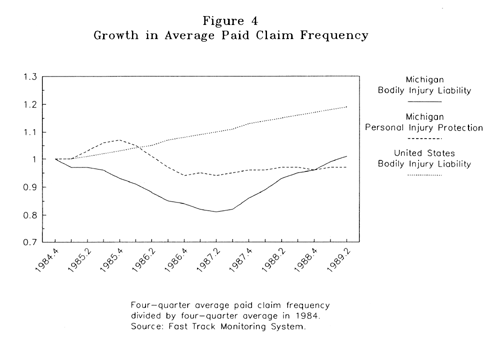
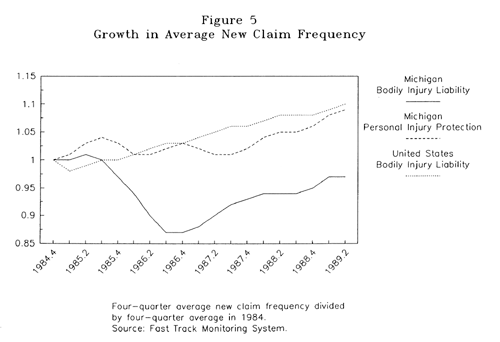
Figure 4 illustrates changes in paid claim frequency (per 100 vehicles) for bodily injury liability and personal injury protection coverage in Michigan. The figure also shows countrywide paid claim frequency for bodily injury liability. The values shown are the average frequency for the previous four-quarters divided by the average frequency for the four-quarters ending in December 1984. [73] Analogous results are shown for the frequency of new claims in Figure 5. Both figures suggest an increase in bodily injury claim frequency in 1987 that cannot be explained by changes in the number of injuries in Michigan (i.e., personal injury protection claim frequency does not show the same pattern) or by countrywide trends in frequency. Since the DiFranco decision was decided in December 1986, the results are consistent with a positive impact of the decision on the frequency of liability claims. The results also indicate a general decline in bodily injury claim frequency until 1987. This decline could reflect greater difficulty in satisfying the threshold after the Cassidy decision.
The Michigan legislature should make the statutory threshold as precise as is possible. Given the objectives and economic advantages of no-fault, it makes little sense to have large numbers of injuries potentially subject to litigation to determine whether the threshold has been satisfied. Under such conditions, insurance companies would be likely to pay many questionable claims for noneconomic loss rather than incur the expense and risk of letting the case go before a jury. The legislature should ensure that a strict threshold is maintained that limits tort liability for noneconomic loss to serious injuries. Erosion of the threshold in conjunction with large personal injury protection benefits could greatly aggravate the affordability problem and threaten the entire no-fault system.
The possible advantages of adopting a system that would allow each motorist the choice between no-fault and the tort system has begun to receive attention in a number of states. [74] Under an optional no-fault system, motorists who chose no-fault would be largely or completely exempt from tort liability for bodily injury and thus the need to purchase bodily injury liability coverage. In exchange for this exemption, they would not be allowed to pursue a tort claim. Persons who chose to remain subject to the tort system would maintain the ability to sue other drivers who have opted for the tort system, and they could be sued by such drivers. They also would be able to purchase first-party coverage, similar to uninsured motorists coverage, that would provide payment if they were injured by a driver who had chosen no-fault. Variations in the amount of no-fault personal injury protection coverage that is required and in the magnitude of the tort exemption for persons who choose no-fault are possible under this approach. [75]
There exist two possible advantages of optional no-fault compared to mandatory no-fault. First, optional no-fault is less coercive than mandatory no-fault, and it is consistent with the principle of consumer sovereignty. Second, in the event that strict, mandatory limitations on tort liability are politically infeasible, the possibility exists that optional no-fault may be able to attract enough support from the public to be enacted despite opposition from trial attorneys and other parties who oppose tort limitations.
Advocates for increased regulation of the auto insurance market in Michigan and other states argue that the insurance market is not competitive. It is alleged that insurers fix prices, that they make excessive profits, and that the market is characterized by waste and inefficiency. [76]
In November 1988 just over half of California voters voted for Proposition 103. Among other provisions, Proposition 103 requires prior approval of auto insurance rates under certain conditions and requires that rates primarily be based on the insured's driving record, annual mileage, and years of driving experience. The latter requirement is likely to result in restrictions on the use of gender and territory as rating factors. A provision that played a major role in generating support for the proposition was the requirement that rates be rolled back 20 percent below levels that existed in November 1987 unless to do so would threaten an insurer with insolvency. In June 1989 the California Supreme Court held the insolvency exemption unconstitutional and stipulated that rates could not be reduced below levels needed to provide insurers with a fair rate of return on capital. The Court let stand most of Proposition 103's other provisions. [77]
An auto insurance bill has been introduced in the Michigan legislature that contains many of the provisions included in Proposition 103. [78] The bill would require close supervision of auto insurance rate levels, profits, and insurer operating expenses, eliminate territorial rating, and mandate a 20 percent rate rollback from rate levels in effect on May l, 1988. The bill also would eliminate the ability of insurers to pool data for the purpose of developing estimates of future loss costs. [79]
This final section of the study deals with the question of whether conditions in the auto insurance market justify increased regulation of rates, rate classes, and operating expenses. The principal conclusion is that in the absence of government regulation that impedes price competition, evidence indicates that the market for auto insurance and most other lines of property-liability insurance is competitive in Michigan and other states. Adoption of Proposition 103 type regulation is not necessary to protect consumers, and it would have several. harmful effects.
When assessing whether the benefits of competition are likely to be achieved in a given industry it is customary to examine market structure and ease of entry into the market. The essence of competitive behavior is independent action by firms. The presence of only a small number of firms with large market shares in an industry increases the possibility of either tacit or active cooperation among firms to raise prices above costs, provided that the firms are protected from entry by other firms. Economists generally agree that market structure and ease of entry are highly conducive to competition in auto insurance and other property-liability insurance lines. [80]
Table 6 shows data on the share of private passenger auto premiums written by the top four, top eight, and top twenty insurer groups and on the number of insurer groups writing coverage. The table also shows another commonly used measure of market concentration, the Herfindahl-Hirschman Index. [81] Values are shown for the nationwide market and Michigan. Average values for the 50 states and the District of Columbia also are shown. While there is no firm criterion for assessing the point at which market concentration becomes high enough to produce significant deviations from competitive behavior, the levels of concentration shown in the table would be considered to be low or moderate by most economists. [82] Not surprisingly, the state averages for the concentration measures exceed the national level, but they are still relatively low. It also can be argued that the national values are more relevant given the ease in which insurers can expand writings into additional states. The values for Michigan are higher than the state average. The difference reflects the large market share of the Auto Club of Michigan (AAA), which wrote 27 percent of private passenger auto premiums in Michigan during 1988.
While most economists would agree that the levels of concentration shown in Table b would make non-competitive pricing unlikely, some critics of the industry would argue that these or similar data indicate that the industry is not competitive. [83] However, collusion is unlikely to raise prices even in highly concentrated markets if there are no entry barriers, since in this case potential entry can deter non-competitive behavior. Most economists have argued that entry barriers are low for new insurers. Moreover, existing insurers generally could readily expand their writings in new states or lines of business. [84]
Critics of the industry also argue that the industry's limited antitrust exemption facilitates price-fixing by insurers. [85] However, there exists substantial evidence of price variation across insurers for a given driver class and territory in Michigan and in other states. This evidence is prima facie inconsistent with price-fixing and cartel behavior. Most of the large auto insurers in Michigan and other states use independent rate filings (i.e., they do not rely on ISO prospective loss costs or advisory rates if available). For example, none of the top five insurers in Michigan utilizes ISO prospective loss costs. According to a study sponsored by the U.S. Federal Trade Commission, only 35 percent of insurers writing auto insurance in Michigan received rate information from the ISO in 1980. These insurers accounted for only 14 percent of premiums written in the state. [86] Instead of being anti-competitive, the ability of insurers to use rate services provided by advisory organizations is likely to enhance competition by reducing the cost of ratemaking and facilitating entry by small insurers. [87]
As a result of the liability insurance crisis and auto insurance affordability problems, the profitability of the property-liability insurance industry has been intensely debated during the past several years. Measurement of insurer profitability is problematic for several reasons including the failure of insurance company financial statements to report estimated unrealized capital gains on bond portfolios and to discount loss reserves. Moreover, results for any given year may be greatly affected by errors in reported loss reserves. By line and by state calculations are even more problematic. It is difficult to allocate accurately many expenses and investment income either by line, by state, or both. Similarly, there is no solid theoretical basis for allocating insurer surplus (equity) in order to calculate rates of return on surplus for different lines and states.
Table 6
Market Concentration for Private Passenger Auto Insurance in 1988
|
|
Concentration Ratios |
|
|
||
|
Category |
4-firm |
8-firm |
20-firm |
Herfindahl - Hirschman Index |
Number of Insurer Groups |
|
National |
40.3% |
49.6$ |
64.4% |
613 |
585 |
|
State Average |
53.3% |
67.7% |
85.3% |
1,026 |
104 |
|
Michigan |
63.5% |
77.9% |
91.3% |
1,312 |
94 |
Source: Robert Klein, "Competition in Private Passenger Automobile Insurance: A Report to NAIC Personal Lines (C) Committee", September 1989
Based on generally accepted accounting principles, the average annual rate of return on surplus for the property-liability industry during 1972-87 was 10.4 percent. [88] The rate of return on surplus for auto insurance in 1988 has been estimated at about 8 to 9 percent. [89] In recent years the loss ratio (ratio of incurred losses to earned premiums) for auto insurance in Michigan has been significantly higher in Michigan than the average for other states. [90] Whether this result suggests that auto insurance profitability has been below average in Michigan is not clear given that other factors that affect profitability (such as investment income earned between the receipt of premiums and the payment of claims) could differ between Michigan and other states. [91]
Critics of the industry have argued that reported operating results understate insurer profitability for a variety of reasons including the failure to discount loss reserves and the possibility that insurers deliberately inflate estimates of losses to hide profits. However, there is no evidence that insurers consistently overstate their loss reserves, or that discounting losses on financial statements would substantially increase the return on surplus (since discounting loss reserves would increase both reported income and surplus). [92] Consumer advocates also have sometimes compared written premiums and paid losses to imply excessive profits. [93] This comparison is patently misleading because (among other problems) it does not consider an insurer's obligation to pay claims in the future. Written premiums in a competitive market will grow much faster than paid claims when expected claim costs are growing rapidly.
Arguments that the insurance industry is inefficient commonly point to variation in the ratio of operating expenses to premiums across companies and allege that the nationwide expense ratio is excessive. It is claimed that inefficient insurers are not removed from the market because of price-fixing and because consumers have difficulty in comparing prices.
Table 7 presents evidence of operating expenses and loss costs relative to earned premiums for private passenger auto insurance. While results are shown for Michigan and for the nation, it should be emphasized that expenses and investment income are allocated to Michigan in proportion to premium volume (or incurred losses). They need not equal the actual values (which are unavailable). Results are shown for liability-related coverages (bodily injury and property damage liability, personal injury protection, and uninsured motorists coverage) and for physical damage coverages (collision and comprehensive). As can be seen, insurance company expenses are small relative to loss costs, and the breakdown suggests that the potential reduction in premiums from reducing claim costs greatly exceeds the reduction that would result from reducing operating expenses. [94]
The argument that variation in expense ratios among insurers necessarily indicates inefficiency fails to recognize that different expense ratios commonly are associated with different levels of service. [95] Critics of the industry often point to the low expense ratio for United Services Auto Association (USAA), a mail order insurer that only writes auto coverage for current or retired military personnel. The implication of the argument is that all insurance could be purchased through the mail at lower cost. There is no recognition of the role played by agents in a competitive insurance market, or of why an insurer like USAA that is purported to be more efficient does not expand its writings to other consumer groups.
In a competitive market, firms that choose inefficient operating methods are not rewarded and eventually disappear. Since firms that introduce cost-saving innovations can earn large profits, a substantial incentive exists for firms to minimize costs. In the final analysis, the argument that the industry is grossly inefficient presumes an absence of competition. If a large part of the market could be served at lower cost, why does some company not do so given the immense profit potential? Why do all consumers not flock to the lower cost insurers?
One possible reason that inefficient insurers could survive in the market is that consumers could find it difficult to identify low cost insurers. Some authors have argued that it is difficult for consumers to compare prices. [96] A number of states, including Michigan, make price information available to consumers to assist in comparison shopping. [97] However, it is highly unlikely that inefficiency of the magnitude alleged by consumer advocates could persist in the auto insurance market due to costly consumer search. Moreover, to the extent that comparison shopping is difficult enough for consumers to justify action by the government, the preferred mode of regulation would be increased information disclosure rather than restrictions on insurer expense levels. [98]
Given the evidence on competition and profitability, auto insurance rates cannot be rolled back if insurers are to be allowed a fair rate of return. Political pressure may cause some rollback in California, but it is likely to be much less than 20 percent of premiums. It also is likely that the principal function of proposals for mandatory premium rollbacks without any reduction in claim costs is to generate public support for increased regulation. The major consequences of adopting Proposition 103-type regulation in Michigan would include (1) an increase in subsidies that would be likely to increase accident costs, (2) a large increase in the size of the MAIPF and pressure for the creation of a reinsurance facility or some other form of mandated marketing, (3) costly rate hearings involving numerous expert witnesses and attorneys for consumer advocates, regulators, insurers, and agents, (4) strict regulation and control of insurer operating expenses, and (5) less consumer choice due to reduced variation in insurer marketing methods and services.
The causes of high premiums and auto insurance affordability problems are high claim costs and requirements to buy extensive coverage. Increased regulation of insurance rates, rate classification, and operating costs are not justified by imperfections in the insurance market. [99] Advocates of substantially greater regulation either misunderstand the causes of affordability problems or are so dissatisfied with the outcomes of competitive, cost-based pricing that they favor strong government control of the market or even direct public provision of coverage to reduce differences in premium rates across consumers.
Table 7
1988 Operating Results for Private Passenger Auto Insurance as a Percent of Earned Premiums: Michigan and Countrywide
|
|
Liability |
Physical Damage |
||
|
Item |
Michigan |
U.S. |
Michigan |
U.S. |
|
l. Incurred Losses |
83.7% |
79.4$ |
65.3% |
61.0$ |
|
2. Loss Adjustment Expenses |
13.7% |
13.1% |
8.4% |
7.9% |
|
3. Total Loss and Adjustment [(1) + (2)] |
97.4% |
92.5% |
73.7% |
68.9% |
|
4. Selling Expenses |
15.6% |
15.5% |
16.0% |
16.1% |
|
5. General Expenses |
4.0% |
4.2% |
3.8% |
4.0% |
|
6. Taxes, Licenses and Fees |
3.0% |
2.9% |
2.8% |
2.8% |
|
7. Total Underwriting Expenses [(4)+(5)+(6)] |
22.6% |
22.6% |
22.6% |
22.9% |
|
8. Investment Gain |
9.6% |
9.6% |
2.2% |
2.3% |
|
9. Dividends to Policyholders |
1.0% |
0.9% |
1.0% |
0.9% |
|
10. Federal Taxes |
-4.4% |
-2.9% |
1.3% |
3.0% |
|
11. After-tax Operating Profit [(100-(3)-(7)+(8)-(9)-(10)] |
-7.1% |
-3.5% |
3.5% |
6.6% |
Note: Liability includes bodily injury and property damage liability, personal injury protection, and uninsured motorists coverage. Physical damage includes collision and comprehensive coverage. Underwriting expenses calculated according to generally accepted accounting principles.
Source: NAIC Report on Profitability By Line and By State 1988
The preferred alternative to more regulation as a means of mitigating affordability problems is to allow competition to operate, to reduce the amount of mandatory coverage, and to institute appropriate policies to control claim costs for liability, personal injury protection, and physical damage coverage. In addition to its economic benefits, this approach is consistent with the traditions of limited government and free enterprise. Insurers must explain the advantages of this approach to the public compared to greater regulation. They also must be willing to bargain for changes that will benefit policyholders by accepting temporary mandatory rate cuts that are tied to changes that reduce claim costs. Unless insurers elicit increased support from the public and strongly oppose increased regulation of underwriting and rate classification, the private sector is likely to play a much smaller role in the provision of auto insurance and other types of coverage in the years ahead.
Property damage liability covers Michigan drivers involved in accidents out, of state.
Standard collision pays for damages above a deductible, regardless of whether the insured or other drive: is at fault. Broad collision only includes a deductible if the insured is more than 50 percent at fault. Limited collision only provides coverage if the insured is not more than 50 percent at fault. For additional background on auto insurance coverages and the auto insurance market and regulation in Michigan, see Michigan Insurance Issues Handbook, Public Sector Consultants, for the Michigan Association of Insurance Companies, 1989.
The Essential Insurance Act deals with both auto and homeowners insurance, The present study focuses exclusively on auto insurance, and the discussion concentrates on private passenger auto insurance.
For example, conviction for speeding 16 or more miles per hour over the limit produces four points. The first substantially at-fault accident produces three points, and subsequent at-fault accidents produce four points each.
Prior to 1981, insurers could choose between prior approval regulation of rates and a file-and-use system that allowed the commissioner to order refunds if rates filed under the file-and-use provision were Later found to be excessive. Most insurers submitted rates for prior approval.
Four broad types of involuntary market mechanisms are used in the United States. Most states have assigned risk plans in which drivers are assigned to insurers in proportion to their voluntary market share. A few states have reinsurance facilities. In these states, insurers generally are required to accept almost all applicants, but they are allowed to cede business to the reinsurance facility, Financial results of the facility are pooled among all insurers in proportion to their voluntary market volume. Several states in addition to Michigan have joint underwriting associations, in which a limited number of insurers are paid fees to issue policies and settle claims for involuntary market insureds. The financial results for involuntary market business are shared among all insurers. Maryland has a state insurer for the involuntary market Insurers pay assessments to finance the state insurer's operating losses.
This distinction is important in understanding the problems that arose from the Essential Insurance Act's restrictions on territorial rating. As will be discussed later, a significant disadvantage of reinsurance facilities and joint underwriting associations is that they dilute incentives for efficient claims settlement by insurers.
Insured vehicles are the number of liability insurance written car-years during the year. These data, along with data on passenger car registrations, are available from the Automobile Insurance Plans Service Office (AIPSO, Circular RMC 89-14, April 14, 1989 and AIPSO Facts). Premium comparisons published by the A.M. Best Company are based on vehicle registrations rather than insured vehicles. Michigan's average premium in 1987 was 5509 and ranked 17th among the states using the A.M. Best procedure. The reason that its average premium is lower using insured car-years is that the number of passenger car registrations in 19$7 was 5,440,087 compared to 5,700,936 insured car-years (see AIPSO Circular RMC 89-14). A problem with Best's approach is that states vary widely in their definitions of private passenger vehicle registrations. For example, since many states exclude vans and pickup trucks from the registered vehicle data, the number of insured vehicles often exceeds the number of registrations. Similarly, the use of registered vehicles will not reflect differences across states in the number of uninsured cars. For these reasons, it is probably better to compare premiums per insured vehicle across states. Also see note 9 infra.
The written premium and incurred loss data were obtained from Best's Executive Data Service. Incurred losses are calendar-year values. They equal paid losses plus the change in the loss reserve. Insured vehicles are again defined as liability insurance written car-years. Data on physical damage exposures are not available. As a result, the physical damage results will be affected by any change over time in the proportion of cars that are insured for liability but not physical damage.
Total physical damage premiums declined slightly during 1988, while total physical damage losses increased slightly, Liability premiums increased slightly in 1988; persona, injury protection premiums grew by six percent.
Due largely to discounting of personal injury protection loss reserves by a number of insurers, total reported personal injury protection incurred losses declined by 33 percent :n 1988.
The greater growth rate for premiums is likely to have been influenced by the reduction in interest rates that occurred between 1980 and 1986. Other things being equal, a reduction in interest rates tends to increase premiums because insurers will earn less investment income before claims are paid. The greater the average length of time between the receipt of premiums and the payment of claims, the greater will be the premium increase. Hence, interest rates are likely to have a greater impact on liability premiums than on physical damage premiums.
As shown in the note to Table 2, claim frequency is defined as the annual number of claims per 100 insured vehicles. Claim severity is the average payment per claim. The average claim cost per vehicle is total annual claim costs divided by the number of vehicles.
The bodily injury paid claim frequency and average paid claim cost per vehicle also are lower, and the severity of paid claims is higher in Michigan than the average for other states with no-fault laws due to the greater effectiveness of Michigan's tort threshold in eliminating tort liability for minor injuries.
The countrywide numbers only reflect states with personal injury protection coverage.
If the sum of the results for property damage liability and collision in Michigan is compared to the countrywide sum for property damage liability and collision, the frequency of claims is about the same. and the average cost per vehicle is higher in Michigan.
Of course, the ratios of Detroit results to those for areas outside of Detroit would be higher than the values shown in Table 4.
See ISO and NAII, Factors Affecting Urban Auto Insurance Costs, 1988. Detroit's ratio for the average cost per vehicle for bodily injury liability claims ranked 11th out of the 18 cities.
These data were obtained from Auto Theft in Michigan: A Report to the Legislature, Michigan Insurance Bureau, August 1989. This report provides detailed information about the auto theft problem. In 1984, Michigan had the highest auto theft rate of any state. In 1987, Michigan's theft rate was the fifth highest in the nation.
For evidence of low per capita income in many areas of Detroit, see Auto Insurance Rating In Michigan: The Effects of Public Act 10 of 1986, Michigan insurance Bureau, November 1989, pp. 95-96. This report provided some evidence of greater premium growth in Detroit than statewide since 1986, The analysis and conclusions concerning territorial rating that are contained in this report are examined in Section III below.
See Essential Insurance in Michigan: An Avoidable Crisis, Michigan Insurance Bureau, March 1977. These arguments are reviewed by the Michigan Insurance Bureau along with the Act's performance during 1981 in A Year of Change: The Essential Insurance Act in 1981, June 1982. John Hogan's critique of the 1977 report and legislation proposed in the report (see "Essential Insurance Reform Act: Analysis and Comment", no date) discusses several of the issues that are addressed in the present study, Also see Thomas Wenck, "Michigan's Essential Insurance and No-Fault Laws: Economic and Philosophic Issues", The Michigan Economy, 1 (July-August 1982).
The discussion in the report was not clear as to whether widespread problems existed for auto insurance, for urban property insurance, or both. The implication was that problems were widespread in both areas. See p. 5, Essential Insurance in Michigan, ibid.
The report criticized a section in the insurance code that allowed insurers to utilize any classification scheme that "may measure differences among risks and that may have a probable effect on losses or expenses."
The report also noted that availability problems were aggravated by cyclical fluctuations in insurance prices and in the supply of coverage and that cancellations of policies and denials of coverage renewal created difficulties for some drivers. Many states adopted legislation in the 1970s that specified allowable reasons for insurer cancellation of auto and homeowners coverage. A few states also limited the ability of insurers to deny renewal of coverage.
See Part 5, Essential Insurance in Michigan, note 21 supra.
See Report of the Federal Insurance Administration to the Secretary, Department of Housing and Development, on Full Insurance Availability, 1974. Also see the discussion by James Daoust and George Cabot. The Michigan Essential Insurance Act – Beware!", Federation of Insurance Counsel Quarterly, 34 (1983), pp. 53-72.
The initial Shavers case was filed in 1973 prior to the effective date of no-fault. Both the trial court and the Court of Appeals held that compulsory personal injury protection coverage and the restrictions On tort liability for bodily injury were constitutional, but that no-fault property damage was unconstitutional..
In its discussion of the constitutionality of no-fault, the Court noted that .t would be acceptable for the state to fix rating plans and rate differentials, to prohibit cancellations and nonrenewals and to restrict other insurance company underwriting practices to ensure availability. The discussion was broad enough to make it clear that the type of remedies suggested in the Insurance Bureau's 1977 report would be acceptable. The 1977 report was referenced in the majority opinion. Three justices dissented from the majority in sharply worded opinions. The major objections were that the issue of compulsory coverage and insurance rate regulation had not been brought before the court, and that no factual record existed concerning these matters.
See Daoust and Cabot, note 26 supra, and Wenck, note 21 supra, for discussion of Michigan. For general discussion and discussion of particular states, see Richard Schmalz, "Problems of Insurance Availability – ‘Redlining' , CPCU Journal, 33 (December 1980), pp. 149-157 and "Problems of Insurance Availability – ‘Redlining', Part II", CPCU Journal. 34 (March 1981), pp. 25-36; Auto Insurance: State Regulation Affects Cost and Availability, U.S. General Accounting Office, 1986; Judith Mintel, "New Jersey's Regulatory Policy for Auto Insurance", Journal of Insurance Regulation, 4 (September 1986); Scott Harrington, "Rate Regulation, No-Fault, and the Automobile Insurance Affordability Problem", College of Business Administration, University Of South Carolina, January 1989; Scott Harrington and S. Travis Pritchett, "Auto Insurance Reform in South Carolina", March 1989, South Carolina Policy Council Educational Foundation and Journal of Insurance Regulation (in press) ; and Simon Rottenberg, The Cost of Regulated Pricing A Critical Analysis of Auto insurance Premium Rate-Setting in Massachusetts, Pioneer Institute for Public Policy Research, 1989.
As noted by Schmalz, ibid. 1981, risk assessment constitutes the very heart of the private insurance market.
The incentive to maximize profits leads to cost minimization. Competition produces premiums that provide insurers with only a fair rate of return on capital over time. In most instances, claim settlement is likely to be done in a manner that is consistent with policyholder preferences for quality of service at the time coverage is purchased.
Incentives of insurers and agents to influence legislation to control costs sometimes can be tempered by the desire for greater premium volume and commission volume, respectively. For further discussion, see Scott Harrington, The insurance Industry and Tort Reform," Legal Backgrounder, Washington Legal Foundation, September 16, 1988.
Even without cyclical fluctuations, a small proportion of drivers might be unable to obtain coverage in the voluntary market as a result of adverse selection. A significant number of drivers also may only be able to obtain coverage in the ''nonstandard" voluntary market, as opposed to the standard or "preferred" market. The existence of these segments in the voluntary market reflects the risk assessment process discussed above.
See U.S. General Accounting Office, note 29 supra; Henry Grabowski, W. Kip Viscusi, and William Evans, "Price and Availability Tradeoffs of Automobile insurance Regulation", Journal of Risk and Insurance, 55 (1989), 275-299; and Scott Harrington, "The Relationship Between Voluntary and involuntary Market Rates and Rate Regulation in Automobile Insurance," Journal of Risk and Insurance, 57 (in press).
A similar point is made by John Hogan, note 21 supra, and by Daoust and Cabot, note 26 supra. As suggested in the latter article, the proportion of vehicles insured in the involuntary market will tend to understate proportion of policies insured in the involuntary market if involuntary market insureds are less likely to own and insure more than one car than are voluntary market insureds.
If Michigan had a reinsurance facility rather than the MAIPF, its involuntary market share in 1981 and subsequent years probably would have been much higher, since insurers would have the incentive to cede all business to the facility for which restrictions on rate classification (e.g., unisex rating) produced rates lower than would exist under cost-based pricing. Also see ch. 4, U.S. General Accounting Office, note 29 supra.
Data obtained from AIPSO Facts, 1979 and 1983 editions. Compare these results to the 1977 report's discussion of national availability problems in auto and homeowners insurance (see p. 5, Essential Insurance in Michigan, note 21 supra; also see note 22 supra).
The problem of "clean" risks (drivers without prior accidents or violations) in involuntary markets (see the 1977 report) also is likely to be largely caused by rate regulation.
As is discussed further below, the extent of the third form of subsidy probably has declined since the Essential Insurance Reform Act took effect in 1986. Evidence on the short term impact of the Essential Insurance Act on rate and territorial classification is provided in A Year of Change, note 21 supra. A later study by the Michigan Insurance Bureau (see Frances Wallace, "Unisex Automobile Rating: The Michigan Experience", Journal of Insurance Regulation, 3 (December 1984), pp. 127-139) presented evidence that when the Essential Insurance Act took effect in 1981 total premiums for mandatory coverages increased by no more than 20.9 percent for young females and decreased by no more than 15.1 percent for young males. The U.S. General Accounting Office, note 29 supra, ch. 4, noted that for all coverages combined, the corresponding figures were a 28.9 percent maximum increase and a 20.4 percent maximum decrease. It is often argued by the proponents of unisex rating that greater use of mileage as a rating variable would reduce the adverse consequences of unisex rating to young females. (See, for example, Patrick Butler, Twiss Butler, and Laurie Williams, "Sex-Divided Mileage, Accident, and Insurance Cost Data Show that Auto Insurers Overcharge Most Women", Journal of Insurance Regulation, 6 (March and June 1988).) This discussion generally ignores the cost of verifying mileage accurately and the reduction in the predictive value of mileage that will occur when young persons have a substantial incentive to understate mileage to produce a lower premium. While the thrust of the discussion by Wallace (see above) was that subsidies produced by the Essential Insurance Act were of no real consequence, it also presented evidence that the elimination of marital status as a rating factor led to large premium increases for young married males.
For this reason, theory suggests that the use of these variables is likely to be efficient (even when the impact of subsidies on precautions is ignored) in the sense that the gains to persons whose rates are made lower by their use are less than the costs to persons whose rates are made higher. See Keith Crocker and Arthur Snow, "The Efficiency Effects of Categorical Discrimination in the Insurance Industry", Journal of Political Economy, 94 (1986). Also see the discussion below on the impact of subsidies on accident costs.
For example, the MAIPF assessment for private passenger auto insurance in 1985 was $31.1 million, which represented 1.5 percent of earned premiums. The assessment for 1987 was $7.8 million (0,3 percent, of earned premiums). The assessment data were obtained from the MAIPF (Memorandum Lo Board Members, January 21, 1998, Exhibit. I). Earned premiums were obtained from Best's Executive Data Service.
An increase in the total cost of accidents and accident prevention is suggested by basic economic theory.
For further discussion in the context of insurance, see Rottenberg, Schmalz, and Harrington and Pritchett, note 29 supra. While empirical analysis o£ the possible impact of subsidies on claim costs has not been undertaken, this conclusion is suggested by the fact that taking a given precaution is likely to have a greater impact on expected accident costs for high risk drivers than for low risk drivers, other things being equal. Moreover, a small change in premiums for each person that is "taxed" to finance subsidies is likely to have a less than proportional impact on precautions compared to a large change in premiums for each person that is subsidized.
As an example of the adverse effects of restrictions on risk assessment, it 1s likely that the Essential Insurance Act contributed to the auto theft problem in Michigan. The specified underwriting and rating criteria contained in the Act provided little incentive for a policyholder to take efficient precautions to reduce the likelihood of theft, and the Act is likely to have restricted the ability of insurers to deny coverage or charge higher rates to persons who on average would be more likely to engage in theft-related fraud. As previously noted, the three cities studied by the ISO and NAII (note 18 supra) with the highest theft rates in 1987 were Newark, Boston, and Detroit. The fact that Massachusetts and New Jersey are both well-known for regulatory policies that promote cross-subsidies among motorists (see, for example, Rottenberg and Mintel, note 29 supra) is probably suggestive in this regard.
This problem has plagued states with reinsurance facilities, as well as the New Jersey Joint Underwriting Association. For further discussion, see the U.S. General Accounting Office, Harrington and Pritchett,and Harrington, note 29 supra.
Following the effective date of the Essential Insurance Act, insurers redrew their territories. See A Year of Change, note 21 supra, for details. This study also presents evidence that the ratio of the base rate for the lowest rated territory to that for the highest rated territory was greater than 45 percent in 1981 for each of the insurers studied. Evidence presented for several large insurers in Auto Insurance Rating in Michigan, note 20 supra, indicates that their ratios had declined to 45 percent by 1985 and that they fell below 45 percent following the relaxation of restrictions on territorial rating in 1986 (see below).
For further discussion, see, for example, U.S. General Accounting Office, note 29 supra, ch. 4. Two provisions in the Essential insurance Act suggested that its drafters were aware of the problems that might arise. One provision contained strict limitations on the ability of insurers to cancel contracts with independent agents, Another provision gave the insurance Commissioner authority to order insurers to establish sales offices in areas with inadequate competition. The Latter prevision was repealed in the 1936 Reform Act.
This result assumes that the Insurance. Commissioner would not have exercised authority given in the act (see note 47 supra) to order companies to establish sales offices in Detroit.
The 1986 Reform Act also changed the basis for MAIPF rates from the average of the top ten insurers to the average of the top five. Premium discounts for seatbelt use also were required.
See Auto Theft in Michigan, note 19 supra. The insurer-funded HEAT (Help Eliminate Auto Theft) program, which provides rewards for Lips leading to the arrest o: persons involved with auto theft, also appears to have had some success. See -Here Today Gone Tomorrow", Journal of American Insurance, 65 (i989), pp. 1-5. Recent history in Michigan probably illustrates one likely consequence of significant restrictions on underwriting and rate classification. if restrictions reduce incentives for policyholders to control costs, additional regulations may be necessary to control, the resultant increase in costs.
H.B. 4912, introduced by Representative Nelson Saunders, June 8, 1989.
Auto Insurance Rating in Michigan, note 20 supra. This report was required by the 1986 Act.
The importance of considering ease of entry and expansion in assessing whether a market is competitive is discussed in Section V. On page 30, the 1989 report notes that the market share of the largest four insurers in Detroit (based on insured exposures) was 71 percent in 1987 and states that markets with a ratio of 60 percent or more would be considered highly concentrated. The market shares shown in the report on page 51 for the top-four firms when MAIPF business is excluded sum to 59 percent.
See Exhibits 6, 7, and 8, Auto insurance Rating in Michigan, note 20 supra. The report notes that (p. 54) "while the base rate (in Detroit) may be 'competitive' with the base rates in the voluntary market, the resulting premiums often are not", The Executive Summary states (p, iii): "Premiums charged eligible drivers by the Facility are not competitive with those charged by the top ten insurers, either in Detroit or outstate." Based on the information provided in the report, this latter statement is misleading. The report also notes (p. 106) that the market share of the MAIPF in Detroit increased from 8.1 percent in 1985 to 17.1 percent in 1987, Elsewhere (p. 51), it reports the 1987 market share of the MAIPF as 16 percent. A reason for this discrepancy was not provided.
Comparisons of loss ratios for one year also may be greatly affected by differences inunanticipatedchanges in loss costs across regions. As an example, if theft rates declined more than expected by insurers in Detroit in 1987 compared to the remainder of the state, other things being equal, the loss ratio in Detroit would be lower than in the remainder of the state, (Similarly, if in any given period losses were higher than expected in a given region, the loss ratio would be higher in that region.) It also was not clear whether MAIPF experience, which would be likely to have a significantly greater loss ratio in Detroit, was included in the data.
While the report endorses file-and-use regulation of overall rata levels, it also proposes a significant expansion in the powers of the insurance commissioner if he or she finds that a rata is inconsistent with the standards set forth in the Essential Insurance Act. For example, upon a finding that any rates were excessive, an insurer would have to make refunds to policyholders. The adoption of this proposal could change the file-and-use system to a de facto system of prior approval if it discouraged insurers from changing rates without explicit or tacit regulatory approval.
The proposed restrictions on territorial rating also might not be very successful at targeting subsidies to low income drivers. See Schmalz, note 29 supra, and the references cited therein for general discussion of this point.
One proposal in Michigan that generally meets these criteria would provide auto insurance premium cuts La welfare recipients through an increase in motor vehicle registrations fees.
See Compensation for Automobile Injuries in the United States, All-Industry Research Advisory Council, 1989, as discussed in "Brother Can You Spare a Tort?", Journal of American Insurance, 65 (1989), pp. 16-19.
See Compensating Auto Accident Victims: A Follow-Up Report on No-Fault Insurance Experiences, U.S. Department of Transportation, May 1985, and Brian Smith, "Reexamining the Cost Benefits of No-Fault," CPCU Journal, 42 (March 1989), pp. 28-36.
A package of bills has been proposed that would attempt to improve the performance of the law by strengthening the tort threshold and helping to control. personal injury protection claim costs. The proposals. which were developed by Senator Richard Posthumous, also provide for reductions in personal injury protection and residual liability premiums by an amount sufficient to reduce overall premiums for bodily injury and physical damage coverage by 10 percent.
Attempts to mandate large personal injury protection benefits without imposing significant restrictions have created serious problems in a number of states. See U.S. Department o` Transportation and Smith, note 60 supra. These problems eventually influenced the repeal of no-fault in Pennsylvania and Nevada.
Economic theory suggests this result unless at a given level of wealth a person's marginal valuation in income is significantly greater after an injury than before. See, for example, Philip Cook and Donald Graham, "The Demand for Insurance Protection: The Case of Irreplaceable Commodities", Quarterly Journal of Economics. 91 (1977), pp. 143-156; Michael Spence, "Consumer Misperceptions, Product Failure, and Product Liability," , Review of Economic Studies, 64 (1977), pp, 561-572; and Steven Shave!!, Economic Analysis of Accident Law, Harvard University Press, 1987, ch. 10-11. Also see J. David Cummins and Mary Weiss, °An Economic Analysis of No-Fault Auto Insurance", Wharton School, University of Pennsylvania, 1938; Patricia Danzon, "Liability and Liability Insurance for Medical Malpractice", Journal of Health Economics, 4 (1985), pp. 309-331; and Patricia Danzon and Scott Harrington, The Demand for and Supply of Liability Insurance", Wharton School, University of Pennsylvania, July 1999.
See U.S. Department of Transportation, note 60 supra, and J. David Cummins and Mary Weiss, ibid.
For example, an uninsurable fine of several hundred dollars for substantially at-fault accidents might provide a significant deterrent, For theoretical discussion of the possible advantages of fines in this case, see Spence and Shavell, note 63 supra. It should be noted that the term "unrestricted liability" refers to the potential liability of a person for the full economic and noneconomic loss of an injured party. As a practical matter, liability is restricted by the amount of a motorist's auto liability insurance coverage and, in same instances, personal wealth.
The frequency of personal injury protection claims that will exceed the $250,000 limit is estimated at less than 0.1 percent. See Memorandum on PIP Claims Study, from Herman J. Arends, Auto-Owners Insurance, Lo Insurance Industry Task Force, November, 2, 1989. The most common injuries that produce large claims involve brain damage or paralysis. These injuries typically require lifetime care.
MCCA Annual Statement, 1988. The predicted MCCA deficit as of year-end 1989 is $546 million. See Milliman and Robertson, "An Estimate of the Pure Losses and Loss Expenses for Assessments to be Set by the MCCA for Calendar Year 1990", preliminary draft, Exhibit I (no date).
If this were to be done, all policyholders would need to pay premiums to finance assessments until the MCCA deficit on prior claims was eliminated.
See note 61 supra.
For detailed discussion of this issue and other drawbacks to compulsory coverage, see Scott Harrington, The Efficiency and Equity of Compulsory Automobile Insurance Laws", College of Business Administration. University of South Carolina, January 1989.
While the discussion in this section focuses on Michigan's tort threshold, two other issues concerning tort liability for auto accidents in Michigan merit brief comment. First, since property damage liability claims under the tort system involve lower litigation costs and payments to attorneys and do not entail payment for noneconomic loss, the case for no-fault property damage is less compelling than that for bodily injury. Dissatisfaction with no-fault property damage in Michigan is likely to have influenced the adoption of the law's "mini-tort" provisions, (See the Michigan Insurance Bureau's April 1978 report to the Governor on consumer attitudes on no-fault. ) The possible advantages of returning to the fault system for all property damage claims are worthy of study. Second, Michigan has adopted a "pure" form of comparative negligence that in some instances allows e person who is primarily responsible for an accident to recover damages from a person who is only slightly responsible. Most states with comparative negligence employ a "modified" form in which a driver who is 50 percent or more (or, in some states, more than 50 percent) at fault cannot recover damages. Adoption of the modified form of comparative negligence would reduce the cost of liability coverage. The merits of this change (as well as other issues related to no-fault) are debated in "No-Fault: The Real Story", Michigan Trial Lawyers Association No-Fault Task Force, July 1983, and "Taking the Task Force to Task", Michigan Insurance Federation (no date).
See note 61 supra. The majority opinion in DiFranco emphasized that Cassidy had made it very difficult to recover for noneconomic loss (see p. 21). The implication was that its ruling in DiFranco would increase the number of compensable claims.
Four-quarter averages are used to reduce the impact of any seasonal variation in claim frequency.
The basic concept of optional no-fault was introduced by Jeffrey 0'Connell and Robert Joost, Giving Motorists a Choice Between Fault and No-Fault Insurance", Virginia Law Review, 72 (February 1985).
New Jersey recently modified its no-fault law to allow motorists the choice between a verbal threshold for tort liability and no limitation on liability. (Motorists must sign a form to reject the verbal threshold.) Motorists who select the verbal threshold cannot sue or be sued for noneconomic loss unless the verbal threshold is satisfied. Initial evidence indicates that 83 percent of motorists have accepted the verbal threshold in exchange for lower liability premiums. See "State Watch", Insurance Review, October 1989, p. 18.
See, for example, "Reducing Auto Insurance Rates: A Comprehensive Program," Consumer Federation of America, et a1., May 1989, and Michael Johnson, "The Bottom Line: Hew Insurers Understate Their True Profitability", Voter Revolt, August 1989. Voter Revolt is a California interest group that supported the passage of Proposition 103.
Hearings have begun that will determine the magnitude of the rollback, if any, the procedures to be used in prior approval regulation, and allowable rating factors in auto insurance. As a result of the passage of Proposition 103 and the Court's decision, the California market could become one of the most heavily regulated in the nation. The proposition specifically prohibits the insurance commissioner from considering the degree of competition in the market when making decisions over rates, For over 40 years prior to the enactment of Proposition 103, California regulation had reflected the philosophy that rates should be determined by competitive market forces.
See note 51 supra.
Similarly, a bill passed by the House of Representatives in May 1989 would eliminate the insurance industry's limited antitrust exemption under Michigan law.
See, for example, Robert Klein, "Competition in Private Passenger Automobile Insurance: A Report to the Personal Lines (C) Committee-, National Association of Insurance Commissioners, September 1989; Clarke, et al., "Sources of the Crisis in Liability Insurance: An Empirical Analysis" Yale Journal on Regulation, 5 (1988), pp. 367-395; Danzon and Harrington, note 63 supra; and the references cited therein. Also see Eisenach, note 86 infra, and Danzon and Winter, note 87 infra.
The Herfindahl-Hirschman Index equals the sum of the squared market shares (in percent) for all groups in a specified market. Larger values indicate greater dominance by large firms. For example, a value of 10,000 would indicate a monopoly; a value of 100 would be obtained for a market with 100 firms that each had a one percent market share.
For example, for national markets and broadly defined industries, the Department of Justice classifies all industry as having low concentration if the Herfindahl-Hirschman Index is less than 1000 and moderately concentrated if the index falls between 1000 and 1800. The value of the index for the nationwide auto insurance market is 613. For further discussion of concentration in the auto insurance market, see Klein, note 80 supra.
See, for example, Consumer Federation of America, et al., note 75 supra.
For further details, see Danzon and Harrington, note 63 supra, and the other references listed in note 80 supra. Several authors have argued that state licensing rules and minimum capital and surplus requirements are unlikely to constitute a significant entry barrier (e.g., Klein, note 80 supra). Regulatory restrictions on the sale and underwriting of insurance by banks, which appear to be eroding, may prevent entry by entities that would employ alternative modes of distribution for some lines of business and consumer groups. However, several issues, such as the appropriate form of regulation and the possible existence of market power by some banks, may make the efficiency case for relaxing such restrictions ambiguous.
For states such as Michigan with competitive rating Laws, the Insurance Services Office (ISO, the principal insurance advisory organization) makes available prospective less costs for auto insurance. For states with prior approval regulation, the ISO makes available advisory rates for auto insurance that include an expense and profit loading. Beginning in 1990, the ISO will provide prospective loss costs only for both commercial and personal lines, regardless of the type of rate regulation.
See Jeffrey Eisenach, The Role of Collective Pricing in Auto Insurance, Staff Report, Bureau of Economics, U.S. Federal Trade Commission, 1985, p. 264. Recent evidence of diversity in auto insurance rates across insurers in Michigan is provided in Auto Insurance Rating in Michigan, note 20 supra, and in information on premium rates made available to assist Michigan motorists in shopping for coverage (see note 97 infra).
These activities are especially important in commercial lines. For further discussion of the pro-competitive aspects of the limited antitrust exemption and the activities of insurance advisory organizations, see Patricia Danzon, "Rating Bureaus in U.S. Property-Liability Insurance Markets: Anti- or Pro-Competitive", Geneva Papers on Risk and Insurance, 8 (1983), pp. 371-402; Ralph Winter, The Liability Crisis and the Dynamics of Competitive Insurance Markets", Yale Journal on Regulation, 5 (1988), pp. 455-499; and Scott Harrington, "Fact vs. Fiction on Advisory Rates", Best's Review Property-Casualty Edition, 90 (October 1989).
See, 1988 Insurer Financial Results, ISO, June 1989. The rate of return on surplus in 1988 was 11.5%.
See Klein, note 80 supra, and "S&P Analyzes Auto Insurer Profitability", National Underwriter, Property & Casualty/Risk & Benefits Management Edition, March 27, 1989, p. 6. A recently released report by the U.S. General Accounting Office (GAO/GGD-90-4FS) provided a rough estimate of the average return on surplus for auto insurance of 9.2 percent during 1978-87 (as summarized in "GAO Reports on Insurer Profits", The Executive Letter, Insurance Information Institute, October 16, 1989).
Klein, note 80 supra, reports an average private passenger auto insurance loss ratio of 82 percent for Michigan during 1983-88 and an average for all other states of 74 percent.
In particular, unlimited personal injury protection coverage for medical and rehabilitation expenses in Michigan produces large loss reserves for catastrophic health expenses that will not be paid until many years in the future.
For accidents in 1983 insurers reported $24.2 billion of incurred losses for auto liability insurance in their 1983 statements. As of year-end 1988, they had paid $23.4 billion and showed a remaining reserve for unpaid claims of $1.1 billion. See Best's Aggregates & Averages, 1989 edition. Johnson, note 76 supra, argued that more rapid growth in loss reserves than in paid claims is prima facie evidence of overreserving to hide profits. However, when expected claim costs are growing rapidly over time, loss reserves will naturally grow more quickly than paid claims. The Consumer Federation of America, et al., note 75 supra, estimated the nationwide return on surplus for auto insurance as 17 percent in 1988. The calculation of income used discounted losses, but the allocation of surplus was based on a conventional norm for surplus calculated with undiscounted loss reserves. The effect of this inconsistency is to significantly overstate the rate of return.
See, for example, Johnson, note 76 supra.
While critics of the industry combine loss adjustment costs with underwriting expenses when discussing the industry expense ratio, it would be more appropriate to treat some loss adjustment costs as direct benefits to policyholders. For example, much of the expense in settling liability claims involves defense costs that would be incurred by the policyholder in the absence of insurance coverage. This point is also made in "How Efficient is Your Auto Insurer?", Journal of American Insurance, 65 (1989), pp. 6-9.
See "How Efficient is Your Auto Insurer", ibid, and Klein, note 80 supra.
See, for example, Lawrence Berger, Paul Kleindorfer, and Howard Kunreuther, "A Dynamic Model of Price Information in Auto Insurance Markets", Journal of Risk and Insurance, 56 (March 1989), pp. 17-33. For an opposing view, see M. Plummer, The Availability and Utility of Consumer Information on Auto Insurance, U.S. Federal Trade Commission, 1985.
For Michigan, see "Do Not Buy Car Insurance Until You Read This!", October 1989. Michigan Law also requires agents to provide prospective buyers with the lowest quote for available coverage.
For general discussion of this issue, see Stephen Breyer, Regulation and Its Reform, Harvard University Press, 1982, pp. 161-164.
Breyer, ibid, ch. 9, makes a persuasive argument that price regulation should only be adopted if there is clear evidence that competition is unworkable in a given industry. Chapter three of his book contains detailed discussion of the limitations of price regulation.
Scott E. Harrington is Professor of Insurance and Finance, College of Business Administration, University of South Carolina. A faculty member of the Insurance Department of the Wharton School, University of Pennsylvania, from 1978-88, he has published numerous articles on insurance markets and insurance regulation.

The Mackinac Center for Public Policy is a nonprofit research and educational institute that advances the principles of free markets and limited government. Through our research and education programs, we challenge government overreach and advocate for a free-market approach to public policy that frees people to realize their potential and dreams.
Please consider contributing to our work to advance a freer and more prosperous state.