


 Font size:
A Low-Cost, Highly Effective Way to Help Your Employees 
America needs citizens who make good political decisions,
and the Right to Know Payroll Form is one way business leaders can help make good
citizenship a reality.
The quality of any decision is directly linked to the quality of the information on which
the decision is based. One reason that people often make poor political decisions is that
they lack information about the costs of various government activities. Hidden costs in
any enterprise result in misallocation of resources, and the enterprise of democracy is no
exception.
One reason why our country suffers from massive budget deficits, high taxes, and excessive
bureaucracy is because people often don't realize the actual costs government imposes
through its spending and regulation. And without this knowledge, there is little hope that
we can protect our jobs, families, and standard of living from detrimental government
policies.
The purpose of the Right to Know Payroll Form is to equip employees to more effectively
exercise their responsibilities in the political process. This is accomplished when
employers communicate clearly and accurately to all employees the total costs of
employment taxes, mandated programs, and administering those taxes and programs. Using
this information, citizens will be better able to understand and judge the value of
various public policies.
The Right to Know Payroll Form summarizes the costs of government in a clear,
comprehensive format, and is included with each employee's paycheck. Like most pay stubs
today, the costs shown include the employee's state and federal income tax and social
security payments. But the Right to Know Payroll Form also shows costs that often go
unseen.
These include the employer's share of social security and medicare taxes, the
employer's costs of unemployment insurance and workers' compensation costs, the employer's
costs of administering these taxes, and the employer's costs of complying with state and
federal personnel-related mandates, such as the Americans with Disabilities Act and the
Family and Medical Leave Act.
Significant Benefits for Employers and Employees
For employers, the Right to Know Payroll Form:
Helps workers understand the constraints employers face when seeking to create jobs, increase pay, and compete effectively in a global economy.
Shatters the myth that taxes and mandates can be placed on employers without affecting the workers themselves.
Promotes reasonable business tax and regulatory policy, including simplifying the Internal Revenue Code or replacing it with a flat tax or national sales tax.
For workers, the Right to Know Payroll Form:
Allows workers to compare the benefits and costs of various government programs.
Encourages participation in the democratic process.
Helps raise awareness of employment-related public policy, and how it affects their jobs.
Developing the Cost Data is Simple
To implement the Right to Know Payroll Form, an
organization must first identify the various taxes and other costs imposed by government
on the employment relationship. The sum of these is the Estimated Payroll Allocation. Most
of these are already defined, and those that are deducted from gross pay are usually
already shown on the pay stub.
The Right to Know Payroll Form, however, extends payroll accounting beyond the standard
withholding deductions to demonstrate to employees all the employer's costs,
including the employer's share of payroll taxes and the costs of administering those taxes
and other employment-related mandated benefits. Accountants and tax and benefits managers
can calculate the total cost of these programs, and estimate an average cost per employee.
Once these costs are estimated, they are added to the gross pay to provide an Estimated
Payroll Allocation, which is the employer's total cost of employing that specific worker.
On the Form, the employer's costs are shown as deducted from the Estimated Payroll
Allocation to produce gross pay. The employee's tax withholding is subtracted from gross
pay to produce net pay, just as most payroll forms do now.
Presenting the Costs of Government
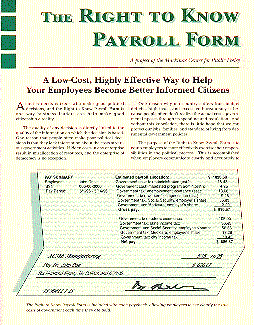
Having acquired the data, a standard payroll form is then developed that clearly communicates the costs associated with employing the worker. The standard form is shown below.
|
Definitions
Estimated payroll allocation is the total estimated cost of employing the employee, calculated by adding the employer's costs and taxes to gross pay.
Government cost: tax administration is the employer's average cost per employee to administer federal, state, and local employment taxes noted below.
Government cost: mandated program admin. is the employer's average cost per employee to administer mandated benefit programs such as the Americans with Disabilities Act and the Family and Medical Leave Act, and EEO.
Government tax: unemployment insurance is the employer's estimated average cost per employee for unemployment insurance.
Government tax: workers' compensation is the employer's estimated average cost per employee for workers' compensation.
Government tax: social security, employer's share is the actual cost of the employer's share of social security.
Government tax: Medicare, employer's share is the actual cost of the employer's share of Medicare.
Government tax: federal income tax is the employee's actual federal income tax withholding.
Government tax: state income tax is the employee's actual state income tax withholding.
Government tax: employee's social security is the employees actual social security withholding.
Government tax: Medicare is the employee's actual Medicare withholding.
Government tax: city income tax is the employee's actual city income tax withholding.
Implementing the Form is Easy
Implementing the Right to Know Payroll Form is as simple as changing the format of your current pay stub.
Once the cost data is calculated and the form defined, the organization should select an implementation date and give the employees advance notice and explanation of the upcoming changes in their payroll form.
Act Today to Implement the Right to Know Payroll Form!
If you are a CEO or other key decision maker, please take steps today to have your organization advance good citizenship by using the Right to Know Payroll Form. If you are not the final decision maker, please pass along copies of this brochure to the appropriate people in your organization. Copies are available from the Mackinac Center for Public Policy by calling (989) 631-0900.
Let Us Know When You Start to Use the Right to Know
Payroll Form
Businesses and other organizations across the country are using the Right to Know Payroll Form to help their employees become better informed citizens. When you implement the form where you work, please contact the Mackinac Center for Public Policy so we can add you to our growing list of participating companies.
For more information on the Right to Know Payroll Form or
a list of employers who use it, please contact the Mackinac Center for Public Policy at
the address below.
Mackinac Center for Public Policy
P.O. Box 568
Midland, Michigan 48640
(989) 631-0900
mcpp@mackinac.org
Who is Using the Right to Know Payroll Form
The following is a partial list of organizations that are advancing good citizenship through use of the Right to Know Payroll Form:
Cascade Policy Institute
Dateppli Corporation
Foremost Insurance Company
Independence Institute
Mackinac Center for Public Policy
Romanow Building Services
Spartan Oil Company
State of Michigan
The Buckeye Institute
The Lockwood Companies
Vern Dale Products
Wolverine Development Corporation
Institute For Justice
Macomb Tobacco & Candy Co.
Pantograms

The Mackinac Center for Public Policy is a nonprofit research and educational institute that advances the principles of free markets and limited government. Through our research and education programs, we challenge government overreach and advocate for a free-market approach to public policy that frees people to realize their potential and dreams.
Please consider contributing to our work to advance a freer and more prosperous state.
 A Low-Cost, Highly Effective way to Help
Your Employees Become Better Informed Citizens
A Low-Cost, Highly Effective way to Help
Your Employees Become Better Informed Citizens


