(Editor's note: This publication was updated in April 2010.)
Students today are often given a skewed account of the Great Depression of 1929-1941 that condemns free-market capitalism as the cause of, and promotes government intervention as the solution to, the economic hardships of the era. In this essay based on a popular lecture, Mackinac Center for Public Policy President Lawrence W. Reed debunks the conventional view and traces the central role that poor government policy played in fostering this legendary catastrophe.Many volumes have been written about the Great Depression of 1929-1941 and its impact on the lives of millions of Americans. Historians, economists and politicians have all combed the wreckage searching for the "black box" that will reveal the cause of the calamity. Sadly, all too many of them decide to abandon their search, finding it easier perhaps to circulate a host of false and harmful conclusions about the events of seven decades ago. Consequently, many people today continue to accept critiques of free-market capitalism that are unjustified and support government policies that are economically destructive.
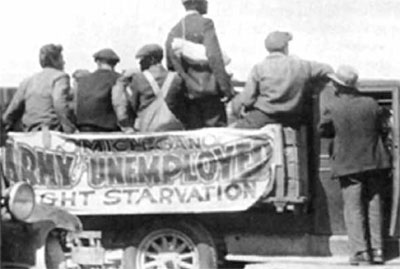
How bad was the Great Depression? Over the four years from 1929 to 1933, production at the nation's factories, mines and utilities fell by more than half. People's real disposable incomes dropped 28 percent. Stock prices collapsed to one-tenth of their pre-crash height. The number of unemployed Americans rose from 1.6 million in 1929 to 12.8 million in 1933. One of every four workers was out of a job at the Depression's nadir, and ugly rumors of revolt simmered for the first time since the Civil War.
"The terror of the Great Crash has been the failure to explain it," writes economist Alan Reynolds. "People were left with the feeling that massive economic contractions could occur at any moment, without warning, without cause. That fear has been exploited ever since as the major justification for virtually unlimited federal intervention in economic affairs."[1]
Old myths never die; they just keep showing up in economics and political science textbooks. With only an occasional exception, it is there you will find what may be the 20th century's greatest myth: Capitalism and the free-market economy were responsible for the Great Depression, and only government intervention brought about America's economic recovery.
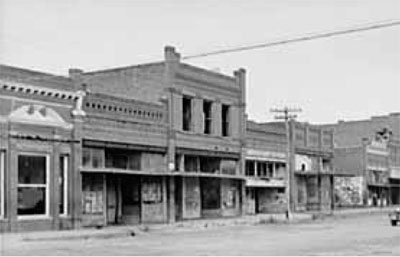
According to this simplistic perspective, an important pillar of capitalism, the stock market, crashed and dragged America into depression. President Herbert Hoover, an advocate of "hands-off," or laissez-faire, economic policy, refused to use the power of government and conditions worsened as a result. It was up to Hoover's successor, Franklin Delano Roosevelt, to ride in on the white horse of government intervention and steer the nation toward recovery. The apparent lesson to be drawn is that capitalism cannot be trusted; government needs to take an active role in the economy to save us from inevitable decline.
But those who propagate this version of history might just as well top off their remarks by saying, "And Goldilocks found her way out of the forest, Dorothy made it from Oz back to Kansas, and Little Red Riding Hood won the New York State Lottery." The popular account of the Depression as outlined above belongs in a book of fairy tales and not in a serious discussion of economic history.
To properly understand the events of the time, it is factually appropriate to view the Great Depression as not one, but four consecutive downturns rolled into one. These four "phases" are:[2]
I. Monetary Policy and the Business Cycle
II. The Disintegration of the World Economy
III. The New Deal
IV. The Wagner Act
The first phase covers why the crash of 1929 happened in the first place; the other three show how government intervention worsened it and kept the economy in a stupor for over a decade. Let’s consider each one in turn.
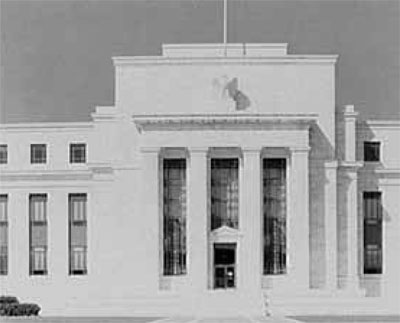
The Great Depression was not the country’s first depression, though it proved to be the longest. Several others preceded it.
A common thread woven through all of those earlier debacles was disastrous intervention by government, often in the form of political mismanagement of the money and credit supply. None of these depressions, however, lasted more than four years and most of them were over in two. The calamity that began in 1929 lasted at least three times longer than any of the country’s previous depressions because the government compounded its initial errors with a series of additional and harmful interventions.
A popular explanation for the stock market collapse of 1929 concerns the practice of borrowing money to buy stock. Many history texts blithely assert that a frenzied speculation in shares was fed by excessive "margin lending." But Marquette University economist Gene Smiley, in his 2002 book "Rethinking the Great Depression", explains why this is not a fruitful observation:
There was already a long history of margin lending on stock exchanges, and margin requirements — the share of the purchase price paid in cash — were no lower in the late twenties than in the early twenties or in previous decades. In fact, in the fall of 1928 margin requirements began to rise, and borrowers were required to pay a larger share of the purchase price of the stocks.
The margin lending argument doesn't hold much water. Mischief with the money and credit supply, however, is another story.
Most monetary economists, particularly those of the "Austrian School," have observed the close relationship between money supply and economic activity. When government inflates the money and credit supply, interest rates at first fall. Businesses invest this "easy money" in new production projects and a boom takes place in capital goods. As the boom matures, business costs rise, interest rates readjust upward, and profits are squeezed. The easy-money effects thus wear off and the monetary authorities, fearing price inflation, slow the growth of, or even contract, the money supply. In either case, the manipulation is enough to knock out the shaky supports from underneath the economic house of cards.
One prominent interpretation of the Federal Reserve System's actions prior to 1929 can be found in "America's Great Depression" by economist Murray Rothbard. Using a broad measure that includes currency, demand and time deposits, and other ingredients, he estimated that the Fed bloated the money supply by more than 60 percent from mid-1921 to mid-1929.[3]; Rothbard argued that this expansion of money and credit drove interest rates down, pushed the stock market to dizzy heights, and gave birth to the "Roaring Twenties."
Reckless money and credit growth constituted what economist Benjamin M. Anderson called "the beginning of the New Deal"[4] — the name for the better-known but highly interventionist policies that would come later under President Franklin Roosevelt. However, other scholars raise doubts that Fed action was as inflationary as Rothbard believed, pointing to relatively flat commodity and consumer prices in the 1920s as evidence that monetary policy was not so wildly irresponsible.
Substantial cuts in high marginal income tax rates in the Coolidge years certainly helped the economy and may have ameliorated the price effect of Fed policy. Tax reductions spurred investment and real economic growth, which in turn yielded a burst of technological advancement and entrepreneurial discoveries of cheaper ways to produce goods. This explosion in productivity undoubtedly helped to keep prices lower than they would have otherwise been.
Regarding Fed policy, free-market economists who differ on the extent of the Fed's monetary expansion of the early and mid-1920s are of one view about what happened next: The central bank presided over a dramatic contraction of the money supply that began late in the decade. The federal government's responses to the resulting recession took a bad situation and made it far, far worse.
By 1928, the Federal Reserve was raising interest rates and choking off the money supply. For example, its discount rate (the rate the Fed charges member banks for loans) was increased four times, from 3.5 percent to 6 percent, between January 1928 and August 1929. The central bank took further deflationary action by aggressively selling government securities for months after the stock market crashed. For the next three years, the money supply shrank by 30 percent. As prices then tumbled throughout the economy, the Fed's higher interest rate policy boosted real (inflation-adjusted) rates dramatically.
The most comprehensive chronicle of the monetary policies of the period can be found in the classic work of Nobel Laureate Milton Friedman and his colleague Anna Schwartz, "A Monetary History of the United States", 1867-1960. Friedman and Schwartz argue conclusively that the contraction of the nation's money supply by one-third between August 1929 and March 1933 was an enormous drag on the economy and largely the result of seismic incompetence by the Fed. The death in October 1928 of Benjamin Strong, a powerful figure who had exerted great influence as head of the Fed's New York district bank, left the Fed floundering without capable leadership — making bad policy even worse.[5]
At first, only the "smart" money — the Bernard Baruchs and the Joseph Kennedys who watched things like money supply and other government policies — saw that the party was coming to an end. Baruch actually began selling stocks and buying bonds and gold as early as 1928; Kennedy did likewise, commenting, "only a fool holds out for the top dollar."[6]
The masses of investors eventually sensed the change at the Fed and then the stampede began. In a special issue commemorating the 50th anniversary of the stock market collapse, U.S. News & World Report described it this way:
Actually the Great Crash was by no means a one-day affair, despite frequent references to Black Thursday, October 24, and the following week's Black Tuesday. As early as September 5, stocks were weak in heavy trading, after having moved into new high ground two days earlier. Declines in early October were called a "desirable correction." The Wall Street Journal, predicting an autumn rally, noted that "some stocks rise, some fall."
Then, on October 3, stocks suffered their worst pummeling of the year. Margin calls went out; some traders grew apprehensive. But the next day, prices rose again and thereafter seesawed for a fortnight.
The real crunch began on Wednesday, October 23, with what one observer called "a Niagara of liquidation." Six million shares changed hands. The industrial average fell 21 points. "Tomorrow, the turn will come," brokers told one another. Prices, they said, had been carried to "unreasonably low" levels.
But the next day, Black Thursday, stocks were dumped in even heavier selling ... the ticker fell behind more than 5 hours, and finally stopped grinding out quotations at 7:08 p.m.[7]
At their peak, stocks in the Dow Jones Industrial Average were selling for 19 times earnings — somewhat high, but hardly what stock market analysts regard as a sign of inordinate speculation. The distortions in the economy promoted by the Fed's monetary policy had set the country up for a recession, but other impositions to come would soon turn the recession into a full-scale disaster. As stocks took a beating, Congress was playing with fire: On the very morning of Black Thursday, the nation's newspapers reported that the political forces for higher trade-damaging tariffs were making gains on Capitol Hill.
The stock market crash was only a reflection — not the direct cause — of the destructive government policies that would ultimately produce the Great Depression: The market rose and fell in almost direct synchronization with what the Fed and Congress were doing. And what they did in the 1930s ranks way up there in the annals of history's greatest follies.
Black Thursday shook Michigan harder than almost any other state. Stocks of auto and mining companies were hammered. Auto production in 1929 reached an all-time high of slightly more than 5 million vehicles, then quickly slumped by 2 million in 1930. By 1932, near the deepest point of the Depression, they had fallen by another 2 million to just 1,331,860 — down an astonishing 75 percent from the 1929 peak.
Thousands of investors everywhere, including many well-known people, were hit hard in the 1929 crash. Among them was Winston Churchill. He had invested heavily in American stocks before the crash. Afterward, only his writing skills and positions in government restored his finances.
Clarence Birdseye, an early developer of packaged frozen foods, had sold his business for $30 million and put all his money into stocks. He was wiped out.
William C. Durant, founder of General Motors, lost more than $40 million in the stock market and wound up a virtual pauper. (GM itself stayed in the black throughout the Depression under the cost-cutting leadership of Alfred P. Sloan.)
Though modern myth claims that the free market "self-destructed" in 1929, government policy was the debacle's principal culprit. If this crash had been like previous ones, the hard times would have ended in two or three years at the most, and likely sooner than that. But unprecedented political bungling instead prolonged the misery for over 10 years.
Unemployment in 1930 averaged a mildly recessionary 8.9 percent, up from 3.2 percent in 1929. It shot up rapidly until peaking out at more than 25 percent in 1933. Until March of 1933, these were the years of President Herbert Hoover — a man often depicted as a champion of noninterventionist, laissez-faire economics.
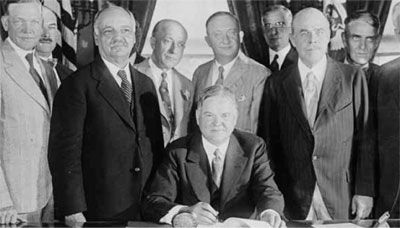
Did Hoover really subscribe to a "hands-off-the-economy," free-market philosophy? His opponent in the 1932 election, Franklin Roosevelt, didn't think so. During the campaign, Roosevelt blasted Hoover for spending and taxing too much, boosting the national debt, choking off trade, and putting millions on the dole. He accused the president of "reckless and extravagant" spending, of thinking "that we ought to center control of everything in Washington as rapidly as possible," and of presiding over "the greatest spending administration in peacetime in all of history." Roosevelt's running mate, John Nance Garner, charged that Hoover was "leading the country down the path of socialism."[8] Contrary to the conventional view about Hoover, Roosevelt and Garner were absolutely right.
The crowning folly of the Hoover administration was the Smoot-Hawley Tariff, passed in June 1930. It came on top of the Fordney-McCumber Tariff of 1922, which had already put American agriculture in a tailspin during the preceding decade. The most protectionist legislation in U.S. history, Smoot-Hawley virtually closed the borders to foreign goods and ignited a vicious international trade war. Professor Barry Poulson describes the scope of the act:
The act raised the rates on the entire range of dutiable commodities; for example, the average rate increased from 20 percent to 34 percent on agricultural products; from 36 percent to 47 percent on wines, spirits, and beverages; from 50 to 60 percent on wool and woolen manufactures. In all, 887 tariffs were sharply increased and the act broadened the list of dutiable commodities to 3,218 items. A crucial part of the Smoot-Hawley Tariff was that many tariffs were for a specific amount of money rather than a percentage of the price. As prices fell by half or more during the Great Depression, the effective rate of these specific tariffs doubled, increasing the protection afforded under the act.[9]
Smoot-Hawley was as broad as it was deep, affecting a multitude of products. Before its passage, clocks had faced a tariff of 45 percent; the act raised that to 55 percent, plus as much as another $4.50 per clock. Tariffs on corn and butter were roughly doubled. Even sauerkraut was tariffed for the first time. Among the few remaining tariff-free goods, strangely enough, were leeches and skeletons (perhaps as a political sop to the American Medical Association, as one wag wryly remarked).
Tariffs on linseed oil, tungsten, and casein hammered the U.S. paint, steel and paper industries, respectively. More than 800 items used in automobile production were taxed by Smoot-Hawley. Most of the 60,000 people employed in U.S. plants making cheap clothing out of imported wool rags went home jobless after the tariff on wool rags rose by 140 percent.[10]
Officials in the administration and in Congress believed that raising trade barriers would force Americans to buy more goods made at home, which would solve the nagging unemployment problem. But they ignored an important principle of international commerce: Trade is ultimately a two-way street; if foreigners cannot sell their goods here, then they cannot earn the dollars they need to buy here. Or, to put it another way, government cannot shut off imports without simultaneously shutting off exports.
Foreign companies and their workers were flattened by Smoot-Hawley's steep tariff rates and foreign governments soon retaliated with trade barriers of their own. With their ability to sell in the American market severely hampered, they curtailed their purchases of American goods. American agriculture was particularly hard hit. With a stroke of the presidential pen, farmers in this country lost nearly a third of their markets. Farm prices plummeted and tens of thousands of farmers went bankrupt. A bushel of wheat that sold for $1 in 1929 was selling for a mere 30 cents by 1932.
With the collapse of agriculture, rural banks failed in record numbers, dragging down hundreds of thousands of their customers. Nine thousand banks closed their doors in the United States between 1930 and 1933. The stock market, which had regained much of the ground it had lost since the previous October, tumbled 20 points on the day Hoover signed Smoot-Hawley into law, and fell almost without respite for the next two years. (The market's high, as measured by the Dow Jones Industrial Average, was set on Sept. 3, 1929, at 381. It hit its 1929 low of 198 on Nov. 13, then rebounded to 294 by April 1930. It declined again as the tariff bill made its way toward Hoover's desk in June and did not bottom out until it reached a mere 41 two years later. It would be a quarter-century before the Dow would climb to 381 again.)
The shrinkage in world trade brought on by the tariff wars helped set the stage for World War II a few years later. In 1929, the rest of the world owed American citizens $30 billion. Germany's Weimar Republic was struggling to pay the enormous reparations bill imposed by the disastrous Treaty of Versailles. When tariffs made it nearly impossible for foreign businessmen to sell their goods in American markets, the burden of their debts became massively heavier and emboldened demagogues like Adolf Hitler. "When goods don't cross frontiers, armies will," warns an old but painfully true maxim.
Smoot-Hawley by itself should lay to rest the myth that Hoover was a free market practitioner, but there is even more to the story of his administration's interventionist mistakes. Within a month of the stock market crash, he convened conferences of business leaders for the purpose of jawboning them into keeping wages artificially high even though both profits and prices were falling. Consumer prices plunged almost 25 percent between 1929 and 1933 while nominal wages on average decreased only 15 percent - translating into a substantial increase in wages in real terms, a major component of the cost of doing business. As economist Richard Ebeling notes, "The 'high-wage' policy of the Hoover administration and the trade unions ... succeeded only in pricing workers out of the labor market, generating an increasing circle of unemployment."[11]
Hoover dramatically increased government spending for subsidy and relief schemes. In the space of one year alone, from 1930 to 1931, the federal government's share of GNP soared from 16.4 percent to 21.5 percent.[12] Hoover's agricultural bureaucracy doled out hundreds of millions of dollars to wheat and cotton farmers even as the new tariffs wiped out their markets. His Reconstruction Finance Corporation ladled out billions more in business subsidies. Commenting decades later on Hoover's administration, Rexford Guy Tugwell, one of the architects of Franklin Roosevelt's policies of the 1930s, explained, "We didn't admit it at the time, but practically the whole New Deal was extrapolated from programs that Hoover started."[13]
Though Hoover at first did lower taxes for the poorest of Americans, Larry Schweikart and Michael Allen in their sweeping "A Patriot's History of the United States: From Columbus's Great Discovery to the War on Terror" stress that he "offered no incentives to the wealthy to invest in new plants to stimulate hiring." He even taxed bank checks, "which accelerated the decline in the availability of money by penalizing people for writing checks."14
In September 1931, with the money supply tumbling and the economy reeling from the impact of Smoot-Hawley, the Fed imposed the biggest hike in its discount rate in history. Bank deposits fell 15 percent within four months and sizable, deflationary declines in the nation's money supply persisted through the first half of 1932.
Compounding the error of high tariffs, huge subsidies and deflationary monetary policy, Congress then passed and Hoover signed the Revenue Act of 1932. The largest tax increase in peacetime history, it doubled the income tax. The top bracket actually more than doubled, soaring from 24 percent to 63 percent. Exemptions were lowered; the earned income credit was abolished; corporate and estate taxes were raised; new gift, gasoline and auto taxes were imposed; and postal rates were sharply hiked.
Can any serious scholar observe the Hoover administration's massive economic intervention and, with a straight face, pronounce the inevitably deleterious effects as the fault of free markets? Schweikart and Allen survey some of the wreckage:
By 1933, the numbers produced by this comedy of errors were staggering: national unemployment rates reached 25 percent, but within some individual cities, the statistics seemed beyond comprehension. Cleveland reported that 50 percent of its labor force was unemployed; Toledo, 80 percent; and some states even averaged over 40 percent. Because of the dual-edged sword of declining revenues and increasing welfare demands, the burden on the cities pushed many municipalities to the brink. Schools in New York shut down, and teachers in Chicago were owed some $20 million. Private schools, in many cases, failed completely. One government study found that by 1933 some fifteen hundred colleges had gone belly-up, and book sales plummeted. Chicago's library system did not purchase a single book in a year-long period.[15]
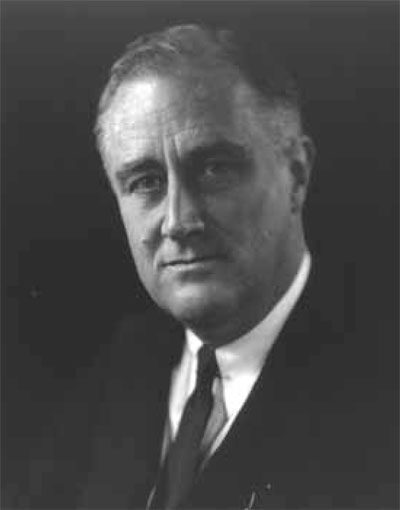
Franklin Delano Roosevelt won the 1932 presidential election in a landslide, collecting 472 electoral votes to just 59 for the incumbent Herbert Hoover. The platform of the Democratic Party, whose ticket Roosevelt headed, declared, "We believe that a party platform is a covenant with the people to be faithfully kept by the party entrusted with power." It called for a 25 percent reduction in federal spending, a balanced federal budget, a sound gold currency "to be preserved at all hazards," the removal of government from areas that belonged more appropriately to private enterprise and an end to the "extravagance" of Hoover's farm programs. This is what candidate Roosevelt promised, but it bears no resemblance to what President Roosevelt actually delivered.
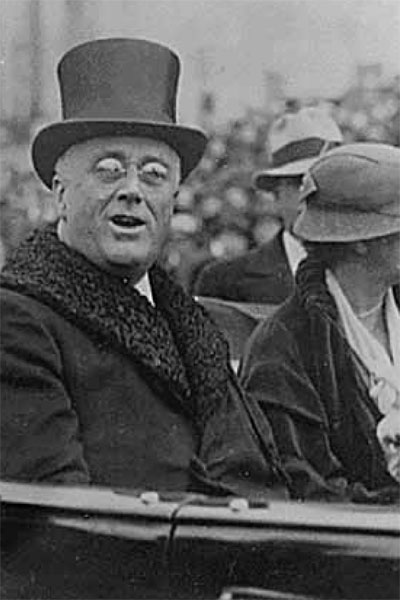
Washington was rife with both fear and optimism as Roosevelt was sworn in on March 4, 1933 — fear that the economy might not recover and optimism that the new and assertive president just might make a difference. Humorist Will Rogers captured the popular feeling toward FDR as he assembled the new administration: "The whole country is with him, just so he does something. If he burned down the Capitol, we would all cheer and say, well, we at least got a fire started anyhow."[16]
Roosevelt did indeed make a difference, though probably not the sort of difference for which the country had hoped. He started off on the wrong foot when, in his inaugural address, he blamed the Depression on "unscrupulous money changers." He said nothing about the role of the Fed's mismanagement and little about the follies of Congress that had contributed to the problem. As a result of his efforts, the economy would linger in depression for the rest of the decade. Adapting a phrase from 19th century writer Henry David Thoreau, Roosevelt famously declared in his address that, "We have nothing to fear but fear itself." But as Dr. Hans Sennholz of Grove City College explains, it was FDR's policies to come that Americans had genuine reason to fear:
In his first 100 days, he swung hard at the profit order. Instead of clearing away the prosperity barriers erected by his predecessor, he built new ones of his own. He struck in every known way at the integrity of the U.S. dollar through quantitative increases and qualitative deterioration. He seized the people's gold holdings and subsequently devalued the dollar by 40 percent.[17]
Frustrated and angered that Roosevelt had so quickly and thoroughly abandoned the platform on which he was elected, Director of the Bureau of the Budget Lewis W. Douglas resigned after only one year on the job. At Harvard University in May 1935, Douglas made it plain that America was facing a momentous choice:
Will we choose to subject ourselves — this great country — to the despotism of bureaucracy, controlling our every act, destroying what equality we have attained, reducing us eventually to the condition of impoverished slaves of the state? Or will we cling to the liberties for which man has struggled for more than a thousand years? It is important to understand the magnitude of the issue before us. ... If we do not elect to have a tyrannical, oppressive bureaucracy controlling our lives, destroying progress, depressing the standard of living ... then should it not be the function of the Federal government under a democracy to limit its activities to those which a democracy may adequately deal, such for example as national defense, maintaining law and order, protecting life and property, preventing dishonesty, and ... guarding the public against ... vested special interests?[18]
Crisis gripped the banking system when the new president assumed office on March 4, 1933. Roosevelt's action to close the banks and declare a nationwide "banking holiday" on March 6 (which did not completely end until nine days later) is still hailed as a decisive and necessary action by Roosevelt apologists. Friedman and Schwartz, however, make it plain that this supposed cure was "worse than the disease." The Smoot-Hawley tariff and the Fed's unconscionable monetary mischief were primary culprits in producing the conditions that gave Roosevelt his excuse to temporarily deprive depositors of their money, and the bank holiday did nothing to alter those fundamentals. "More than 5,000 banks still in operation when the holiday was declared did not reopen their doors when it ended, and of these, over 2,000 never did thereafter," report Friedman and Schwartz.[19]
Economist Jim Powell of the Cato Institute authored a splendid book on the Great Depression in 2003, titled "FDR's Folly: How Roosevelt and His New Deal Prolonged the Great Depression". He points out that "Almost all the failed banks were in states with unit banking laws" — laws that prohibited banks from opening branches and thereby diversifying their portfolios and reducing their risks. Powell writes: "Although the United States, with its unit banking laws, had thousands of bank failures, Canada, which permitted branch banking, didn't have a single failure ..."[20] Strangely, critics of capitalism who love to blame the market for the Depression never mention that fact.
Congress gave the president the power first to seize the private gold holdings of American citizens and then to fix the price of gold. One morning, as Roosevelt ate eggs in bed, he and Secretary of the Treasury Henry Morgenthau decided to change the ratio between gold and paper dollars. After weighing his options, Roosevelt settled on a 21 cent price hike because "it's a lucky number." In his diary, Morgenthau wrote, "If anybody ever knew how we really set the gold price through a combination of lucky numbers, I think they would be frightened."[21] Roosevelt also single-handedly torpedoed the London Economic Conference in 1933, which was convened at the request of other major nations to bring down tariff rates and restore the gold standard.
Washington and its reckless central bank had already made mincemeat of the gold standard by the early 1930s. Roosevelt's rejection of it removed most of the remaining impediments to limitless currency and credit expansion, for which the nation would pay a high price in later years in the form of a depreciating currency. Sen. Carter Glass put it well when he warned Roosevelt in early 1933: "It's dishonor, sir. This great government, strong in gold, is breaking its promises to pay gold to widows and orphans to whom it has sold government bonds with a pledge to pay gold coin of the present standard of value. It is breaking its promise to redeem its paper money in gold coin of the present standard of value. It's dishonor, sir."[22]
Though he seized the country's gold, Roosevelt did return booze to America's bars and parlor rooms. On his second Sunday in the White House, he remarked at dinner, "I think this would be a good time for beer."[23] That same night, he drafted a message asking Congress to end Prohibition. The House approved a repeal measure on Tuesday, the Senate passed it on Thursday and before the year was out, enough states had ratified it so that the 21st Amendment became part of the Constitution. One observer, commenting on this remarkable turn of events, noted that of two men walking down the street at the start of 1933 — one with a gold coin in his pocket and the other with a bottle of whiskey in his coat — the man with the coin would be an upstanding citizen and the man with the whiskey would be the outlaw. A year later, precisely the reverse was true.
In the first year of the New Deal, Roosevelt proposed spending $10 billion while revenues were only $3 billion. Between 1933 and 1936, government expenditures rose by more than 83 percent. Federal debt skyrocketed by 73 percent.
FDR talked Congress into creating Social Security in 1935 and imposing the nation's first comprehensive minimum wage law in 1938. While to this day he gets a great deal of credit for these two measures from the general public, many economists have a different perspective. The minimum wage law prices many of the inexperienced, the young, the unskilled and the disadvantaged out of the labor market. (For example, the minimum wage provisions passed as part of another act in 1933 threw an estimated 500,000 blacks out of work).[24] And current studies and estimates reveal that Social Security has become such a long-term actuarial nightmare that it will either have to be privatized or the already high taxes needed to keep it afloat will have to be raised to the stratosphere.
Roosevelt secured passage of the Agricultural Adjustment Act, which levied a new tax on agricultural processors and used the revenue to supervise the wholesale destruction of valuable crops and cattle. Federal agents oversaw the ugly spectacle of perfectly good fields of cotton, wheat and corn being plowed under (the mules had to be convinced to trample the crops; they had been trained, of course, to walk between the rows). Healthy cattle, sheep and pigs were slaughtered and buried in mass graves. Secretary of Agriculture Henry Wallace personally gave the order to slaughter 6 million baby pigs before they grew to full size. The administration also paid farmers for the first time for not working at all. Even if the AAA had helped farmers by curtailing supplies and raising prices, it could have done so only by hurting millions of others who had to pay those prices or make do with less to eat.
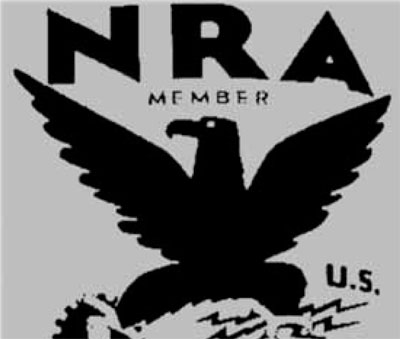
Perhaps the most radical aspect of the New Deal was the National Industrial Recovery Act, passed in June 1933, which created a massive new bureaucracy called the National Recovery Administration. Under the NRA, most manufacturing industries were suddenly forced into government-mandated cartels. Codes that regulated prices and terms of sale briefly transformed much of the American economy into a fascist-style arrangement, while the NRA was financed by new taxes on the very industries it controlled. Some economists have estimated that the NRA boosted the cost of doing business by an average of 40 percent - not something a depressed economy needed for recovery.
The economic impact of the NRA was immediate and powerful. In the five months leading up to the act's passage, signs of recovery were evident: factory employment and payrolls had increased by 23 and 35 percent, respectively. Then came the NRA, shortening hours of work, raising wages arbitrarily and imposing other new costs on enterprise. In the six months after the law took effect, industrial production dropped 25 percent. Benjamin M. Anderson writes, "NRA was not a revival measure. It was an antirevival measure. ... Through the whole of the NRA period industrial production did not rise as high as it had been in July 1933, before NRA came in."[25]
The man Roosevelt picked to direct the NRA effort was General Hugh "Iron Pants" Johnson, a profane, red-faced bully and professed admirer of Italian dictator Benito Mussolini. Thundered Johnson, "May Almighty God have mercy on anyone who attempts to interfere with the Blue Eagle" (the official symbol of the NRA, which one senator derisively referred to as the "Soviet duck"). Those who refused to comply with the NRA Johnson personally threatened with public boycotts and "a punch in the nose."
There were ultimately more than 500 NRA codes, "ranging from the production of lightning rods to the manufacture of corsets and brassieres, covering more than 2 million employers and 22 million workers."[26] There were codes for the production of hair tonic, dog leashes, and even musical comedies. A New Jersey tailor named Jack Magid was arrested and sent to jail for the "crime" of pressing a suit of clothes for 35 cents rather than the NRA-inspired "Tailor's Code" of 40 cents.
In "The Roosevelt Myth", historian John T. Flynn described how the NRA's partisans sometimes conducted "business":
The NRA was discovering it could not enforce its rules. Black markets grew up. Only the most violent police methods could procure enforcement. In Sidney Hillman's garment industry the code authority employed enforcement police. They roamed through the garment district like storm troopers. They could enter a man's factory, send him out, line up his employees, subject them to minute interrogation, take over his books on the instant. Night work was forbidden. Flying squadrons of these private coat-and-suit police went through the district at night, battering down doors with axes looking for men who were committing the crime of sewing together a pair of pants at night. But without these harsh methods many code authorities said there could be no compliance because the public was not back of it.[27]
Roosevelt next signed into law steep income tax increases on the higher brackets and introduced a 5 percent withholding tax on corporate dividends. He secured another tax increase in 1934. In fact, tax hikes became a favorite policy of Roosevelt for the next 10 years, culminating in a top income tax rate of 90 percent. Sen. Arthur Vandenberg of Michigan, who opposed much of the New Deal, lambasted Roosevelt's massive tax increases. A sound economy would not be restored, he said, by following the socialist notion that America could "lift the lower one-third up" by pulling "the upper two-thirds down."[28] Vandenberg also condemned "the congressional surrender to alphabet commissars who deeply believe the American people need to be regimented by powerful overlords in order to be saved."[29]
Alphabet commissars spent the public's money like it was so much bilge. They were what influential journalist and social critic Albert Jay Nock had in mind when he described the New Deal as "a nation-wide, State-managed mobilization of inane buffoonery and aimless commotion."[30]
Roosevelt's Civil Works Administration hired actors to give free shows and librarians to catalog archives. It even paid researchers to study the history of the safety pin, hired 100 Washington workers to patrol the streets with balloons to frighten starlings away from public buildings, and put men on the public payroll to chase tumbleweeds on windy days.
The CWA, when it was started in the fall of 1933, was supposed to be a short-lived jobs program. Roosevelt assured Congress in his State of the Union message that any new such program would be abolished within a year. "The federal government," said the president, "must and shall quit this business of relief. I am not willing that the vitality of our people be further stopped by the giving of cash, of market baskets, of a few bits of weekly work cutting grass, raking leaves, or picking up papers in the public parks." Harry Hopkins was put in charge of the agency and later said, "I've got four million at work but for God's sake, don't ask me what they are doing." The CWA came to an end within a few months but was replaced with another temporary relief program that evolved into the Works Progress Administration, or WPA, by 1935. It is known today as the very government program that gave rise to the new term, "boondoggle," because it "produced" a lot more than the 77,000 bridges and 116,000 buildings to which its advocates loved to point as evidence of its efficacy.[31]
With good reason, critics often referred to the WPA as "We Piddle Around." In Kentucky, WPA workers catalogued 350 different ways to cook spinach. The agency employed 6,000 "actors" though the nation's actors' union claimed only 4,500 members. Hundreds of WPA workers were used to collect campaign contributions for Democratic Party candidates. In Tennessee, WPA workers were fired if they refused to donate 2 percent of their wages to the incumbent governor. By 1941, only 59 percent of the WPA budget went to paying workers anything at all; the rest was sucked up in administration and overhead. The editors of The New Republic asked, "Has [Roosevelt] the moral stature to admit now that the WPA was a hasty and grandiose political gesture, that it is a wretched failure and should be abolished?"[32] The last of the WPA's projects was not eliminated until July of 1943.
Roosevelt has been lauded for his "job-creating" acts such as the CWA and the WPA. Many people think that they helped relieve the Depression. What they fail to realize is that it was the rest of Roosevelt's tinkering that prolonged the Depression and which largely prevented the jobless from finding real jobs in the first place. The stupefying roster of wasteful spending generated by these jobs programs represented a diversion of valuable resources to politically motivated and economically counterproductive purposes.
A brief analogy will illustrate this point. If a thief goes house to house robbing everybody in the neighborhood, then heads off to a nearby shopping mall to spend his ill-gotten loot, it is not assumed that because his spending "stimulated" the stores at the mall he has thereby performed a national service or provided a general economic benefit. Likewise, when the government hires someone to catalog the many ways of cooking spinach, his tax-supported paycheck cannot be counted as a net increase to the economy because the wealth used to pay him was simply diverted, not created. Economists today must still battle this "magical thinking" every time more government spending is proposed — as if money comes not from productive citizens, but rather from the tooth fairy.
Roosevelt's haphazard economic interventions garnered credit from people who put high value on the appearance of being in charge and "doing something." Meanwhile, the great majority of Americans were patient. They wanted very much to give this charismatic polio victim and former New York governor the benefit of the doubt. But Roosevelt always had his critics, and they would grow more numerous as the years groaned on. One of them was the inimitable "Sage of Baltimore," H. L. Mencken, who rhetorically threw everything but the kitchen sink at the president. Paul Johnson sums up Mencken's stinging but often-humorous barbs this way:
Mencken excelled himself in attacking the triumphant FDR, whose whiff of fraudulent collectivism filled him with genuine disgust. He was the 'Fuhrer,' the 'Quack,' surrounded by 'an astonishing rabble of impudent nobodies,' 'a gang of half-educated pedagogues, nonconstitutional lawyers, starry-eyed uplifters and other such sorry wizards.' His New Deal was a 'political racket,' a 'series of stupendous bogus miracles,' with its 'constant appeals to class envy and hatred,' treating government as 'a milch-cow with 125 million teats' and marked by 'frequent repudiations of categorical pledges.'[33]
The American economy was soon relieved of the burden of some of the New Deal's worst excesses when the Supreme Court outlawed the NRA in 1935 and the AAA in 1936, earning Roosevelt's eternal wrath and derision. Recognizing much of what Roosevelt did as unconstitutional, the "nine old men" of the Court also threw out other, more minor acts and programs which hindered recovery.
Freed from the worst of the New Deal, the economy showed some signs of life. Unemployment dropped to 18 percent in 1935, 14 percent in 1936, and even lower in 1937. But by 1938, it was back up to nearly 20 percent as the economy slumped again. The stock market crashed nearly 50 percent between August 1937 and March 1938. The "economic stimulus" of Franklin Delano Roosevelt's New Deal had achieved a real "first": a depression within a depression!
The stage was set for the 1937-38 collapse with the passage of the National Labor Relations Act in 1935 — better known as the "Wagner Act" and organized labor's "Magna Carta." To quote Sennholz again:
This law revolutionized American labor relations. It took labor disputes out of the courts of law and brought them under a newly created Federal agency, the National Labor Relations Board, which became prosecutor, judge, and jury, all in one. Labor union sympathizers on the Board further perverted this law, which already afforded legal immunities and privileges to labor unions. The U.S. thereby abandoned a great achievement of Western civilization, equality under the law.
The Wagner Act, or National Labor Relations Act, was passed in reaction to the Supreme Court's voidance of NRA and its labor codes. It aimed at crushing all employer resistance to labor unions. Anything an employer might do in self-defense became an "unfair labor practice" punishable by the Board. The law not only obliged employers to deal and bargain with the unions designated as the employees' representative; later Board decisions also made it unlawful to resist the demands of labor union leaders.[34]
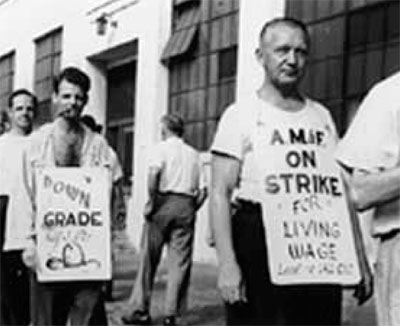
Armed with these sweeping new powers, labor unions went on a militant organizing frenzy. Threats, boycotts, strikes, seizures of plants and widespread violence pushed productivity down sharply and unemployment up dramatically. Membership in the nation's labor unions soared: By 1941, there were two and a half times as many Americans in unions as had been the case in 1935. Historian William E. Leuchtenburg, himself no friend of free enterprise, observed, "Property-minded citizens were scared by the seizure of factories, incensed when strikers interfered with the mails, vexed by the intimidation of nonunionists, and alarmed by flying squadrons of workers who marched, or threatened to march, from city to city."[35]
From the White House on the heels of the Wagner Act came a thunderous barrage of insults against business. Businessmen, Roosevelt fumed, were obstacles on the road to recovery. He blasted them as "economic royalists" and said that businessmen as a class were "stupid."[36] He followed up the insults with a rash of new punitive measures. New strictures on the stock market were imposed. A tax on corporate retained earnings, called the "undistributed profits tax," was levied. "These soak-the-rich efforts," writes economist Robert Higgs, "left little doubt that the president and his administration intended to push through Congress everything they could to extract wealth from the high-income earners responsible for making the bulk of the nation's decisions about private investment."[37]
During a period of barely two months during late 1937, the market for steel — a key economic barometer — plummeted from 83 percent of capacity to 35 percent. When that news emblazoned headlines, Roosevelt took an ill-timed nine-day fishing trip. The New York Herald-Tribune implored him to get back to work to stem the tide of the renewed Depression. What was needed, said the newspaper's editors, was a reversal of the Roosevelt policy "of bitterness and hate, of setting class against class and punishing all who disagreed with him."[38]
Columnist Walter Lippmann wrote in March 1938 that "with almost no important exception every measure he [Roosevelt] has been interested in for the past five months has been to reduce or discourage the production of wealth."[39]
As pointed out earlier in this essay, Herbert Hoover's own version of a "New Deal" had hiked the top marginal income tax rate from 24 to 63 percent in 1932. But he was a piker compared to his tax-happy successor. Under Roosevelt, the top rate was raised at first to 79 percent and then later to 90 percent. Economic historian Burton Folsom notes that in 1941 Roosevelt even proposed a whopping 99.5-percent marginal rate on all incomes over $100,000. "Why not?" he said when an advisor questioned the idea.[40]
After that confiscatory proposal failed, Roosevelt issued an executive order to tax all income over $25,000 at the astonishing rate of 100 percent. He also promoted the lowering of the personal exemption to only $600, a tactic that pushed most American families into paying at least some income tax for the first time. Shortly thereafter, Congress rescinded the executive order, but went along with the reduction of the personal exemption.[41]
Meanwhile, the Federal Reserve again seesawed its monetary policy in the mid-1930s, first up then down, then up sharply through America's entry into World War II. Contributing to the economic slide of 1937 was this fact: From the summer of 1936 to the spring of 1937, the Fed doubled reserve requirements on the nation's banks. Experience has shown time and again that a roller-coaster monetary policy is enough by itself to produce a roller-coaster economy.
Still stinging from his earlier Supreme Court defeats, Roosevelt tried in 1937 to "pack" the Supreme Court with a proposal to allow the president to appoint an additional justice to the Court for every sitting justice who had reached the age of 70 and did not retire. Had this proposal passed, Roosevelt could have appointed six new justices favorable to his views, increasing the members of the Court from 9 to 15. His plan failed in Congress, but the Court later began rubber-stamping his policies after a number of opposing justices retired. Until Congress killed the packing scheme, however, business fears that a Court sympathetic to Roosevelt's goals would endorse more of the old New Deal prevented investment and confidence from reviving.
Economic historian Robert Higgs draws a close connection between the level of private investment and the course of the American economy in the 1930s. The relentless assaults of the Roosevelt administration — in both word and deed — against business, property, and free enterprise guaranteed that the capital needed to jump-start the economy was either taxed away or forced into hiding. When FDR took America to war in 1941, he eased up on his anti-business agenda, but a great deal of the nation's capital was diverted into the war effort instead of into plant expansion or consumer goods. Not until both Roosevelt and the war were gone did investors feel confident enough to "set in motion the postwar investment boom that powered the economy's return to sustained prosperity."[42]
This view gains support in these comments from one of the country's leading investors of the time, Lammot du Pont, offered in 1937:
Uncertainty rules the tax situation, the labor situation, the monetary situation, and practically every legal condition under which industry must operate. Are taxes to go higher, lower or stay where they are? We don't know. Is labor to be union or non-union? . . . Are we to have inflation or deflation, more government spending or less? ... Are new restrictions to be placed on capital, new limits on profits? ... It is impossible to even guess at the answers."[43]
Many modern historians tend to be reflexively anti-capitalist and distrustful of free markets; they find Roosevelt's exercise of power, constitutional or not, to be impressive and historically "interesting." In surveys, a majority consistently rank FDR near the top of the list for presidential greatness, so it is likely they would disdain the notion that the New Deal was responsible for prolonging the Great Depression. But when a nationally representative poll by the American Institute of Public Opinion in the spring of 1939 asked, "Do you think the attitude of the Roosevelt administration toward business is delaying business recovery?" the American people responded "yes" by a margin of more than 2-to-1. The business community felt even more strongly so.[44]
In his private diary, FDR's very own Treasury Secretary, Henry Morgenthau, seemed to agree. He wrote: "We have tried spending money. We are spending more than we have ever spent before and it does not work. ... We have never made good on our promises. ... I say after eight years of this Administration we have just as much unemployment as when we started ... and an enormous debt to boot!"[45]
At the end of the decade and 12 years after the stock market crash of Black Thursday, 10 million Americans were jobless. The unemployment rate was in excess of 17 percent. Roosevelt had pledged in 1932 to end the crisis, but it persisted two presidential terms and countless interventions later.
How was it that FDR was elected four times if his policies were deepening and prolonging an economic catastrophe? Ignorance and a willingness to give the president the benefit of the doubt explain a lot. Roosevelt beat Hoover in 1932 with promises of less government. He instead gave Americans more government, but he did so with fanfare and fireside chats that mesmerized a desperate people. By the time they began to realize that his policies were harmful, World War II came, the people rallied around their commander-in-chief, and there was little desire to change the proverbial horse in the middle of the stream by electing someone new.
Along with the holocaust of World War II came a revival of trade with America's allies. The war's destruction of people and resources did not help the U.S. economy, but this renewed trade did. A reinflation of the nation's money supply counteracted the high costs of the New Deal, but brought with it a problem that plagues us to this day: a dollar that buys less and less in goods and services year after year. Most importantly, the Truman administration that followed Roosevelt was decidedly less eager to berate and bludgeon private investors and as a result, those investors re-entered the economy and fueled a powerful postwar boom. The Great Depression finally ended, but it should linger in our minds today as one of the most colossal and tragic failures of government and public policy in American history.
The genesis of the Great Depression lay in the irresponsible monetary and fiscal policies of the U.S. government in the late 1920s and early 1930s. These policies included a litany of political missteps: central bank mismanagement, trade-crushing tariffs, incentive-sapping taxes, mind-numbing controls on production and competition, senseless destruction of crops and cattle and coercive labor laws, to recount just a few. It was not the free market that produced 12 years of agony; rather, it was political bungling on a grand scale.
Those who can survey the events of the 1920s and 1930s and blame free-market capitalism for the economic calamity have their eyes, ears and minds firmly closed to the facts. Changing the wrong-headed thinking that constitutes much of today's conventional wisdom about this sordid historical episode is vital to reviving faith in free markets and preserving our liberties.
The nation managed to survive both Hoover's activism and Roosevelt's New Deal quackery, and now the American heritage of freedom awaits a rediscovery by a new generation of citizens. This time we have nothing to fear but myths and misconceptions.
Eighty years after the Great Depression began, the literature on this painful episode of American history is undergoing an encouraging metamorphosis. The conventional assessment that so dominated historical writings for decades argued that free markets caused the debacle and that FDR's New Deal saved the country. Surely, there are plenty of poorly informed partisans, ideologues and quacks that still make these superficial claims. Serious historians and economists, however, have been busy chipping away at the falsehoods. The essay you have just read cites many recent works worth careful reading in their entirety.
At the very moment this latest edition of "Great Myths of the Great Depression" was about to go to press, Simon & Schuster published a splendid new volume I strongly recommend. Authored by the Foundation for Economic Education's senior historian and Hillsdale College professor, Dr. Burton W. Folsom, the book is provocatively titled "New Deal or Raw Deal? — How FDR's Economic Legacy Has Damaged America." It's one of the most illuminating works on the subject. It will help mightily to correct the record and educate our fellow citizens about what really happened in the 1930s.
Another great addition to the literature, appearing in 2007, is "The Forgotten Man: A New History of the Great Depression" by Amity Shlaes. The fact that it has been a New York Times bestseller suggests there is a real hunger for the truth about this period of history.
While Americans may be unlearning some of what they thought they knew about the Great Depression, that's not the same as saying we have learned the important lessons well enough to avoid making the same mistakes again. Indeed, today we are no closer to fixing the primary cause of the business cycle — monetary mischief — than we were 80 years ago.
The financial crisis that gripped America in 2008 ought to be a wake-up call. The fingerprints of government meddling are all over it. From 2001 to 2005, the Federal Reserve revved up the money supply, expanding it at a feverish double-digit rate. The dollar plunged in overseas markets and commodity prices soared. With the banks flush with liquidity from the Fed, interest rates plummeted and risky loans to borrowers of dubious merit ballooned. Politicians threw more fuel on the fire by jawboning banks to lend hundreds of billions of dollars for subprime mortgages.
When the bubble burst, some of the very culprits who promoted the policies that caused it postured as our rescuers while endorsing new interventions, bigger government, more inflation of money and credit and massive taxpayer bailouts of failing firms. Many of them are also calling for higher taxes and tariffs, the very nonsense that took a recession in 1930 and made it a long and deep depression.
The taxpayer bailouts of agencies such as Fannie Mae and Freddie Mac, as well as a growing number of private firms in the early fall of 2008, represent more folly with a monumental price tag. Not only will we and future generations be paying those bills for decades, the very process of throwing good money after bad will pile moral hazard on top of moral hazard, fostering more bad decisions and future bailouts. This is the stuff that undermines both free enterprise and the soundness of the currency. Much more inflation to pay these bills is more than a little likely, sooner or later.
"Government," observed the renowned Austrian economist Ludwig von Mises, "is the only institution that can take a valuable commodity like paper, and make it worthless by applying ink." Mises was describing the curse of inflation, the process whereby government expands a nation's money supply and thereby erodes the value of each monetary unit — dollar, peso, pound, franc or whatever. It often shows up in the form of rising prices, which most people confuse with the inflation itself. The distinction is an important one because, as economist Percy Greaves explained so eloquently, "Changing the definition changes the responsibility."
Define inflation as rising prices and, like the clueless Jimmy Carter of the 1970s, you'll think that oil sheiks, credit cards and private businesses are the culprits, and price controls are the answer. Define inflation in the classic fashion as an increase in the supply of money and credit, with rising prices as a consequence, and you then have to ask the revealing question, "Who increases the money supply?" Only one entity can do that legally; all others are called "counterfeiters" and go to jail.
Nobel laureate Milton Friedman argued indisputably that inflation is always and everywhere a monetary matter. Rising prices no more cause inflation than wet streets cause rain.
Before paper money, governments inflated by diminishing the precious-metal content of their coinage. The ancient prophet Isaiah reprimanded the Israelites with these words: "Thy silver has become dross, thy wine mixed with water." Roman emperors repeatedly melted down the silver denarius and added junk metals until the denarius was less than one percent silver. The Saracens of Spain clipped the edges of their coins so they could mint more until the coins became too small to circulate. Prices rose as a mirror image of the currency's worth.
Rising prices are not the only consequence of monetary and credit expansion. Inflation also erodes savings and encourages debt. It undermines confidence and deters investment. It destabilizes the economy by fostering booms and busts. If it's bad enough, it can even wipe out the very government responsible for it in the first place and then lead to even worse afflictions. Hitler and Napoleon both rose to power in part because of the chaos of runaway inflations.
All this raises many issues economists have long debated: Who or what should determine a nation's supply of money? Why do governments so regularly mismanage it? What is the connection between fiscal and monetary policy? Suffice it to say here that governments inflate because their appetite for revenue exceeds their willingness to tax or their ability to borrow. British economist John Maynard Keynes was an influential charlatan in many ways, but he nailed it when he wrote, "By a continuing process of inflation, governments can confiscate, secretly and unobserved, an important part of the wealth of their citizens."
So, you say, inflation is nasty business but it's just an isolated phenomenon with the worst cases confined to obscure nooks and crannies like Zimbabwe. Not so. The late Frederick Leith-Ross, a famous authority on international finance, observed: "Inflation is like sin; every government denounces it and every government practices it." Even Americans have witnessed hyperinflations that destroyed two currencies — the ill-fated continental dollar of the Revolutionary War and the doomed Confederate money of the Civil War.
Today's slow-motion dollar depreciation, with consumer prices rising at persistent but mere single-digit rates, is just a limited version of the same process. Government spends, runs deficits and pays some of its bills through the inflation tax. How long it can go on is a matter of speculation, but trillions in national debt and politicians who make misers of drunken sailors and get elected by promising even more are not factors that should encourage us.
Inflation is very much with us but it must end someday. A currency's value is not bottomless. Its erosion must cease either because government stops its reckless printing or prints until it wrecks the money. But surely, which way it concludes will depend in large measure on whether its victims come to understand what it is and where it comes from. Meanwhile, our economy looks like a roller coaster because Congresses, Presidents and the agencies they've empowered never cease their monetary mischief.
Are you tired of politicians blaming each other, scrambling to cover their behinds and score political points in the midst of a crisis, and piling debts upon debts they audaciously label "stimulus packages"? Why do so many Americans want to trust them with their health care, education, retirement and a host of other aspects of their lives? It's madness writ large. The antidote is the truth. We must learn the lessons of our follies and resolve to fix them now, not later.
To that end, I invite the reader to join the education process. Support organizations like FEE and the Mackinac Center that are working to inform citizens about the proper role of government and how a free economy operates. Help distribute copies of this essay and other good publications that promote liberty and free enterprise. Demand that your representatives in government balance the budget, conform to the spirit and letter of the Constitution and stop trying to buy your vote with other people's money.
Everyone has heard the sage observation of philosopher George Santayana: "Those who cannot remember the past are condemned to repeat it." It's a warning we should not fail to heed.



