

 Font size:
Case studies of how school districts in Michigan's largest county are responding to competition from charter schools and public "schools-of-choice"
"Public education is a monopoly, and monopolies don't work."
With these words, spoken before a 1993 joint session of the Michigan Legislature, Gov. John Engler signaled his support for the innovative concept of charter schools and shortly thereafter, Michigan became the fourth state to adopt a charter school law. Today, nearly 50,000 children—or three percent of the public school student population—are in more than 170 charter schools across the state.
Charter schools are government-funded schools that operate under performance-based contracts with state universities, local school districts, intermediate school districts, or community colleges. They came on the Michigan scene when state lawmakers passed, and Gov. Engler signed, legislation to introduce limited competition and parental choice into Michigan's public school system.
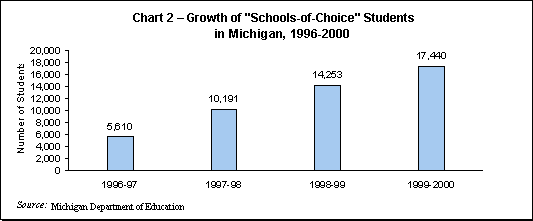
In 1996, the Michigan Legislature gave parents and students an even greater range of choices within the public school system through the "schools-of-choice" program, which allows children to attend other public schools in their own and neighboring districts. Although fewer than 18,000 students were able to take advantage of this opportunity in 1999-2000, it is offering families some additional educational options for their children.
This report seeks to ascertain whether increased competition among Michigan public schools has improved educational opportunities for children, and whether competition encourages or discourages schools to respond to the needs and demands of students and parents. The research presented relies upon information from the Wayne County Regional Educational Service Agency—the intermediate school district of Wayne County—and data provided in state-generated publications. Because empirical data do not and cannot demonstrate the "attitudinal" shift that competition has created in the public school system, anecdotal data also were gathered through interviews with district superintendents and charter school principals to illustrate, confirm, or test contentions made about choice programs.
The evidence suggests that those who seek to improve education for Michigan children should embrace competition among schools, rather than fear it. Competition has provided a powerful incentive for improvement while expanding the ability of parents to choose the school that best meets the needs of their children. Contrary to the claims of those who oppose competition in education, there is very little evidence to suggest that competition has harmed the cause of better education for Michigan children.
While neither the charter schools nor public "schools-of-choice" take fullest possible advantage of the opportunities for improvement offered by competition, they are having a substantial impact on the public school system. As former Highland Park Superintendent John Stendt stated, "Competition has forced us to be more consumer-oriented."
Charter schools and public "schools-of-choice" are beginning to replace the "assignment system"—whereby children are assigned to a particular government school based on where they live—with school choice, where parents have the right, freedom, and ability to choose the safest and best schools for their children.
Charter schools and "schools-of-choice" programs represent "incentive-based" education reform. Previous reforms relied on either rules- or resource-based efforts, such as new mandates or increased funding. Instead of repeating failed attempts to reform education through new rules or additional resources, charter schools and public "schools-of-choice" introduce a market-oriented incentive—competition—to encourage traditional public schools to improve.
The report notes how, for districts such as Dearborn and Inkster, competition has convinced school officials that making parents happy is not just good public relations anymore; it means survival and prosperity.
The debate over how best to improve education for Michigan children should include discussion of the results that current, limited competition has produced thus far in Michigan. Three previous studies of charter schools and public "schools-of-choice" in Michigan have concluded that the incentives of competition have had an overall beneficial effect on public education. One researcher exclaimed, "The debate over whether to have more choice in the public schools in this country is essentially over. The positive parts of choice are just too powerful."
The report concludes with recommendations for expanding parental choice in education and thereby increasing the positive impact competition is having on Michigan public schools. Lifting the legislatively imposed cap on the number of university-authorized charter schools in the state would provide more Michigan families with greater opportunities within the public system, while expanding the public "schools-of-choice" program to include all schools also will create greater educational opportunities for children. Policy-makers also should work to repeal or reform many of the onerous statutes and regulations that unfairly hamper public schools trying to compete in a new environment of school choice. Finally, Michiganians should eliminate discriminatory language from the state constitution that in effect financially penalizes parents who choose private schools for their children.
In 1993, Michigan Gov. John Engler announced to a joint session of the state legislature that, "Public education is a monopoly, and monopolies don't work." With these words, he signaled his support for the innovative concept of charter schools and shortly thereafter, Michigan became the fourth state in the nation to pass a charter school law.1 Just six years later, in 2000, nearly 50,000 students were attending over 170 charter schools across the state. Then in 1996, the governor and legislature passed public "schools-of-choice" legislation, which gave parents and students a greater range of choices within the government school system.
What do charter schools and the public "schools-of-choice" program do? This report focuses on one of the most important functions that charter schools and public "schools-of-choice" currently serve with regard to the debate over education reform: They are "competing" for the "business" of parents and students. They present the traditional public school monopoly with its first serious challenge. While neither the charter-school nor the "schools-of-choice" program takes fullest possible advantage of the reforming power of competition, both are nevertheless forcing public schools to improve. When families are empowered with choices—even limited ones—in where their children are educated, schools must begin to treat parents and students as customers to be served rather than as a captive audience.
Because charter school funding depends on the ability of these schools to attract and retain pupils, charter schools that fail to provide what parents want ultimately will go out of business to make way for schools that do. The "schools-of-choice" program is also forcing traditional public schools to compete for students because they can now choose from many participating government schools. Proponents of school choice maintain that this is the very dynamic missing from the government school monopoly, a dynamic that ensures accountability to parents and students.
Charter schools and the "schools-of-choice" program are the beginning of replacing the "assignment system"—whereby children are assigned to a particular government school based on where they live—with school choice. With school choice, government recognizes and respects parents' right, freedom, and ability to choose the safest and best schools for their children. With school choice, bad or unsafe schools will not survive. Under the assignment system, these types of schools never go away.
The Michigan charter law allows anyone who wishes to do so to establish an agreement (a charter) with an authorizing agency for purposes of creating a new, semi-autonomous, government-funded school. An initial charter can last as long as 10 years, with a mandatory review at least every seven years. Local school districts, intermediate school districts, community colleges, and state universities can authorize charter schools in Michigan.
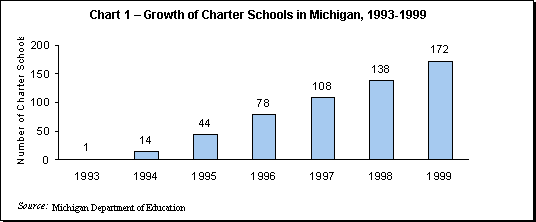
An appointed board of directors governs each charter school, and the board cannot include charter-school employees. State aid follows charter-school students according to a state-aid formula and the per-student spending of the district in which the charter school resides. The charter-school law essentially allows groups to set up new schools to compete with existing districts for students. One hundred seventy-two charter schools were in operation in Michigan by the fall of 1999, a 25-percent increase from the previous year (see Chart 1).
The more modest public "schools-of-choice" program allows students to transfer between government schools in the same local district, to government schools in the same intermediate school district, or to government schools in other intermediate districts if those districts are contiguous to the ones students are leaving.2 Participation in the "schools-of-choice" program is limited because districts control whether or not they participate. Fewer than 18,000 students were utilizing the government "schools-of-choice" program in 1999 (see Chart 2). Lack of participation by most districts and other legislatively imposed restrictions continue to prevent many students from choosing alternative public schools.
Many states have followed the example of Michigan over the years. There are more than 36 states with charter-school laws on the books and public-school choice is becoming the rule instead of the exception in most states.3
In short, these initiatives made competition the most significant educational reform of the 1990s as well as a catalyst for change in the 21st century. Charter schools and public "schools-of-choice" mean parents now have greater flexibility in choosing government-funded schools for their children. A quasi-"market" in public education has begun to develop in Michigan. Yet despite ever-increasing demand for more choices, less than five percent of the school-aged population are able to choose alternative public schools (see Chart 3).
The research presented below relies upon empirical data from the Wayne County Regional Educational Service Agency (Wayne RESA)—the intermediate school district of Wayne County, Michigan—and data provided in state-generated publications. Because empirical data do not and cannot demonstrate the "attitudinal" shift that competition has created, anecdotal data also were gathered through interviews with district superintendents and charter school principals to illustrate, confirm, or test contentions made about competition in education.
The report focuses on the impact of competition in the Wayne RESA because it offers in microcosm the best, most diverse example available in the state. Wayne RESA is Michigan's largest intermediate school district and contains 34 urban and suburban school districts. It has more than 50 public school academies (charter schools) and also contains 10 school districts that chose to participate in the "schools-of-choice" program in 1998-99, the latest year for which data are available. Wayne RESA districts vary from very large to very small in size and from "best-in-the-state" to clearly dysfunctional in quality. Thus, the Wayne RESA makes an excellent subject for assessing the impact of limited competition in education and provides a snapshot of what may be occurring across the state.
It is important to understand how and why the main thrust of education reform has focused on providing choice for parents and students and thereby introducing competition into the state education system. The reason is that over the past several decades, traditional school reforms—imposing new rules and providing greater resources—have failed to significantly improve education for children.
Rules-based reforms include such things as extending school days and the school year, changing teacher certification and school accreditation requirements, imposing national and state testing, enacting stricter dress codes, and the like. Research has shown that these reforms, while causing marginal improvements, have failed to turn around a large-scale decline in education. More drastic city or state "takeovers" of failing schools and districts, legislative proposals such as "Outcome-Based Education," "Goals 2000," and other regulatory regimes have been and still are being tried, with the same disappointing results.
A typical, recent example of the kind of futility encountered by rules-based reform efforts came to light in the fall of 1999 when The Detroit News released a special report entitled "Grading Metro Detroit Schools." This report analyzed all 83 school districts in Wayne, Oakland, and Macomb counties based on 12 key educational factors.4 The study revealed Oakland County's Birmingham School District as the Detroit Metro area's top-performer. Meanwhile, Wayne County's Inkster Public Schools ranked a poor 76th out of 83 districts.
Yet, the Inkster district had been the focus of one of America's most common reform efforts: the establishment of "strict" accreditation standards as a way of ensuring academic excellence. The News reported that half of all Inkster schools "have met rigorous standards of North Central Association (NCA) accreditation, which examines long-term plans, teacher credentials and other items." Meanwhile, only 15 percent of Birmingham schools—the top district in the area for academic achievement—had received NCA accreditation. In other words, one of the worst school districts had a higher level of accreditation than the best. The average ACT score among Birmingham students was 24.0 on a 36-point scale, while the average Inkster student scored 15.1.5
This is just one of many examples too numerous to list here, in which new or tougher rules and requirements had little or no impact because they failed to deal with the systemic problem in government schools. While additional rules are a politically expedient and popular means of addressing a problem, they have little or no correlation with improved academic achievement.
Resource-based reforms have attempted to improve schools. They include such measures as increased funding, new textbooks, wiring schools for Internet access, renovating or updating school facilities, reducing class sizes (more teachers per pupil), and other measures that require greater financial expenditures.
Scholars have studied the relationship between per-student spending and achievement test scores since the publication of the Equality of Educational Opportunity (better known as "The Coleman Report") in 1966.6 Coleman, a leading sociologist, concluded that factors such as per-pupil spending and class size do not have a significant impact on student achievement scores.
Yet, despite this and subsequent findings, many lawmakers and educators continue to believe that additional resources and funding will somehow eventually solve the problems within the education system.
Economist Erik Hanushek and others have replicated Coleman's study and even extended it to international studies of student achievement, and the finding of 31 years of research is clear: Better education cannot be bought. There are schools, states, and countries that spend a great deal of money per pupil with poor results (such as the United States), while others spend much less and get much better results.7
However, lawmakers tend to ignore the evidence. In Michigan, the legislature continues to increase school funding in the hope of improving education. Expressed in current dollars, revenues for Michigan government education increased by nearly 250 percent between 1977 and 1997, from $4 billion to $14.3 billion.8
The Detroit News special report previously cited reminded readers that although "[s]ome of the biggest spenders [among school districts] finished in the top 10 . . . there is no consistent link between a district's spending per child and student performance."9
Once again, the top-ranking school district in Metro Detroit, Birmingham, spends $9,997 per student (4th-highest spending district in Metro Detroit), while Inkster Public Schools in Wayne County spends nearly as much, or $9,715 per student (5th-highest spending district in Metro Detroit). The difference of $282 certainly cannot account for the wide disparity in academic outcomes between the two districts. Eleventh-graders in Birmingham score an aggregate of 91.5 points on the math, reading, science, and writing tests of the Michigan Educational Assessment Program (MEAP) while Inkster students score only 26.8 points.10
The Kansas City (Missouri) School District provides the perfect illustration of the inefficacy of increasing resources to improve academic and social outcomes. In 1985, a federal judge directed the district to devise a "money-is-no-object" educational plan to improve the education of black students and encourage desegregation. Local and state taxpayers were ordered to fund this experiment.
The result: Kansas City spent more money per pupil, on a cost-of-living adjusted basis, than any of the 280 largest school districts in the United States. The money bought 15 new schools, an Olympic-sized swimming pool with an underwater viewing room, television and animation studios, a 25-acre wildlife sanctuary, a zoo, a robotics lab, field trips to Mexico and Senegal, and higher teachers' salaries. The student-to-teacher ratio was the lowest of any major school district in the nation at 13-to-1. By the time the experiment ended in 1997, costs had mounted to nearly $2 billion.
Yet, test scores did not rise. And there was less student integration than before, rather than more.11 In May 2000, the Missouri Board of Education officially removed accreditation status from the district for failing to meet any of 11 performance standards. The loss of accreditation means the district has two years to raise test scores, improve graduation rates and make progress in other areas or face the prospect of a takeover by the state.12
While resource allocation and management are very important, changes in these areas have failed repeatedly to improve the quality of education delivered by public schools. Yet, putting more money into government education continues to be a popular reform measure, one particularly important to special-interest groups that benefit from increased expenditures.
The inability of rules- and resource-based reforms to significantly improve academic achievement has forced lawmakers, educators, and parents to look at other means of effecting reform. Instead of manipulating the laws or adding more money, policy-makers are introducing competition into the system by empowering parents with choice. This new dynamic compels schools to either improve or risk going out of business. In a limited manner, incentive-based reforms include public school choice through charter schools and public "schools-of-choice" programs, while more expansive programs include choice among private schools, as well as public schools, through vouchers or tuition tax credits.
Proponents of incentive-based reforms argue that just as businesses respond to heightened levels of competition by making better products, schools will respond to competition by delivering higher-quality education. They believe that assigning children to schools based on where they live is like a business monopoly situation, in which consumers in a particular geographical area can buy a product from only one source. The business/school has no incentive to deliver a quality product because no competitor is pushing it to do so.
Advocates of such reforms suggest that just as consumers improve the products they purchase by exercising their judgment of value in choosing one product over another, parents will be able to improve education by applying their own values and priorities in selecting a school. In this way, schools will be supplied with a needed market incentive that would drive continuous quality improvement.
Recent research indicates that incentive-based reforms have had greater success than changing the rules or increasing resources. For example, Harvard economist Caroline Minter Hoxby has found that areas with greater public school choice have higher student test scores and higher graduation rates, but lower per-student spending.13
In a different study, Hoxby found that competition among private and public schools also benefits public schools. She found that higher rates of private-school enrollment result in higher educational attainment and graduation rates among public-school students and higher teacher salaries among public-school teachers, even after controlling for factors such as area income, family structures, and other variables.14
In 1988, the Mackinac Center for Public Policy embarked on an intensive research and education effort to demonstrate the effectiveness of incentive-based reforms.15 But it wasn' t until the mid-1990s, when charter school and public "schools-of-choice" legislation were adopted in Michigan, that it became possible to measure the impact of competition in education.
The Michigan Public School Academies (charter schools) program has been the subject of three previous evaluations. Each of these evaluations offered both positive and negative judgments, but all three acknowledged the beneficial influence of competition from charter schools and public "schools-of-choice" on government schools.
The first report, conducted by Jerry Horn and Gary Miron of The Evaluation Center at Western Michigan University (hereafter referred to as the "Western Michigan Report"), was released in January 1999.16 Commissioned by the Michigan Department of Education, it focused on 51 charter schools from all areas of the state except southeastern Michigan (the greater metropolitan Detroit region). Data were collected between October 1997 and December 1998.
The Western Michigan Report found that many traditional public school districts responded to the new competition for students by offering new programs such as all-day kindergarten and before- and after-school programs. Many districts also increased the amount of adult supervision of playgrounds, stepped up efforts to communicate with and involve parents, and placed greater emphasis on foreign languages and MEAP test results. Most tellingly, the Western Michigan Report stated that "the greatest impact of the [charter schools] is that they are forcing more accountability upon the traditional public schools."17
In February 1999, Public Sector Consultants (a private Michigan corporation, specializing in policy research; opinion polling; and health, environmental, educational and economic analysis) and Maximus Inc. (a public-sector consulting firm) released a report also commissioned by the Michigan Department of Education. The report (hereafter referred to as the "PSC Report"), which focused on southeastern Michigan Public School Academies, examined the financial impact of competition from charter schools and whether charter schools spurred innovation among traditional public schools.18
The PSC Report concluded that school districts that lose more than five percent of their students to charter schools would incur a negative financial impact. However, the report found no evidence of districts in the study area actually facing a financial crisis because of charter schools. The PSC Report did find evidence that charters were spurring traditional public schools to offer more innovative programs, to be more responsive to parents and students, and even to participate in the "schools-of-choice" program.19
In October 1999, a team of Michigan State University researchers released the third report, an evaluation of both the charter-school and the "schools-of-choice" programs (hereafter referred to as the "MSU Report").20 The MSU Report recommended expanding the charter-school program because that program had widened the range of options available to parents and had forced traditional public schools to be more responsive to parents.
The MSU Report also noted that many affluent districts had chosen to avoid participation in the "schools-of-choice" program and expressed concern about the "social sorting" of students. The study recommended: a) creating a uniform admissions policy for charter schools; b) making contingency plans for the possible failure of existing districts; c) providing more information about schools to the public; and d) granting additional financial support to charter schools. Professor Gary Sykes, one of the authors of the MSU Report, noted that "The debate over whether to have more choice in the public schools in this country is essentially over. The positive parts of choice are just too powerful."21
Not everyone, however, is convinced of the benefits of competition. Luigi Battaglieri, president of the Michigan Education Association (MEA), believes that charter schools have failed to demonstrate any clear superiority over their peers in traditional government schools on achievement tests, and in some cases have actually done worse. "When the charter schools were touted to us they were supposed to be pedagogical innovations," Battaglieri told WKAR's program "Off The Record" in late 1999. "There haven't been any pedagogical innovations, there has simply been replication of the good programs . . . that have been working in public schools," he said.22 Competition, Battaglieri stated, has not had any demonstrable effect on quality, and it may actually be doing harm.
It is true that charter-school students in Michigan have sometimes scored lower in certain categories and grades than students in traditional government schools. Charter school officials note, however, that many students entering their schools are students who were not doing well in traditional public schools. In addition, most charter schools are still relatively new. These facts make it understandable that test scores at charter schools might not measure up to scores at traditional public schools, especially at first. But it is untrue that test score results have always favored students in traditional schools. For example, 1999 statewide results of the MEAP test showed higher-than-average scores for 5th and 8th grade charter-school students in writing and science.23
However, Battaglieri's contention that competition is having no impact and could actually do harm is the issue addressed in this report: Does competition created through charter schools and the "schools-of-choice" program improve educational opportunities for Michigan children?
In 1999, the Wayne County Regional Educational Service Agency (Wayne RESA) had 34 public school districts with 670 schools, more than 50 charter schools, and 169 private schools.
A total of 349,678 students attended traditional public schools in Wayne County during the 1998-99 school year, with approximately half (173,792) of these students attending Detroit Public Schools.24 During the 1998-99 school year, 14,493 Wayne County students attended charter schools, many of which have waiting lists.25 If Wayne County's charter schools comprised a separate, independent school district, that district's student population would make it the 7th largest in the state.
In addition, 2,125 students chose alternative public schools in Wayne RESA during the 1998-99 school year under the "schools-of-choice" program. The number of "schools-of-choice" transfers is limited by the supply of empty seats in existing districts and the willingness of districts to participate in the program. Only 10 of the 34 Wayne RESA districts chose to participate in the "schools-of-choice" program in 1998-99. 26
The districts decide how many children they will accept and at which grade levels and schools. The demand for these transfers often exceeds the supply, so schools hold an impartial lottery to determine which students will be given the chance to transfer. Interviews with Wayne RESA superintendents revealed that additional districts are considering participating in the "schools-of-choice" program in the future and that some districts are considering expanding their participation.
Both charter schools and the public "schools-of-choice" program have enabled thousands of Wayne County parents to choose their children's schools for the first time, even though their choices remain limited to certain schools within the government system.
As the following examples illustrate, competition has inspired different responses in different districts. Some districts have met the challenge with improved services, others have had to absorb the "opportunity costs" of failing to attract additional students. Some districts have made changes to prepare for the possibility of additional competition in the future, while some are taking a more reactive approach.
The impact of increased competition has been uneven, to be sure, and some districts have responded better than others. Nevertheless, the introduction of incentive-based reform is having an overall positive impact for students—even in school districts that have yet to be directly impacted by competition. These districts are responding positively due to the mere potential for increased competition for students.
The unfolding experiment with charter schools evokes powerful feelings from both charter school and traditional government school operators. Just as one might expect from rivals in business, both charter school principals and traditional public school superintendents are likely to feel that competition is "unfair" to them. Many charter school principals complain that they do not receive the same level of funding as do traditional public schools and that they do not have facilities provided for them. Superintendents often complain that charters educate younger students to avoid the high costs of high school education and that they are not required to provide all of the same services.
Despite these complaints, many superintendents expressed positive views about competition with charter schools. Some superintendents admitted that charter schools had forced them to pay closer attention to parents. "We are not ABC, CBS, and NBC anymore," said one superintendent, implying that public schooling used to be as unassailable as the old "Big Three" television networks. No longer is this the case: "If you see the Huns coming, you need to man the towers," another superintendent commented.
The response of the Dearborn City School District demonstrates the kind of positive impact competition can have on traditional government schools and the benefits of competition for children.
Dearborn is a large urban district with nearly 16,000 students. A "first ring suburb," it lies adjacent to the city of Detroit. Dearborn receives a relatively high level of state assistance, but has more serious problems than elite suburbs. Approximately 35 percent of Dearborn students are economically disadvantaged, qualifying for the federal free- or reduced-lunch program, a poverty rate seven times higher than that of the nearby Livonia district.27 As a destination for many Arab immigrants, Dearborn assimilates a large number of limited-English-speaking students into its schools.
In 1991, a publication called Public Schools USA evaluated the Dearborn district and other districts around the country to serve as a reference for parents. Observers interviewed for this publication had a number of negative things to say about the Dearborn district. Parents complained of not being involved in curriculum development or other important aspects of school affairs. A former PTA officer was quoted as saying "I was never asked for input, nor do I know of any other PTA people who were asked for input." Another observer opined that "the curriculum is in an overall downward slide." Most condemning of all, one observer interviewed for the report said, "If I were moving to this area, I would never, ever purchase a home in Dearborn."28
It is therefore understandable that, beginning in the early 1990s, Dearborn would experience a dramatic increase in the level of competition for students. By the end of the decade, four charter schools were operating within the Dearborn district, with additional charters in the adjoining Melvindale and Detroit districts. The adjoining Dearborn Heights district also serves as another option for students because of the "schools-of-choice" program.
When interviewing Dearborn officials today, one might expect to hear complaints about the "lack of fairness" of competition, or perhaps the argument that choice programs drain money and students from traditional districts, making it "impossible" for them to turn themselves around. This is not the case, however.
According to Dr. Jeremy Hughes, superintendent of the Dearborn City School District, "We welcome competition. The reforms we've enacted would not have happened, at least not as fast, without competition." Rather than waiting for students to leave the district for charter schools or neighboring districts, Dearborn began preparing to compete for students "when the ink was barely dry on the charter school legislation," says Hughes. Rather than falling into a cycle of decline, Dearborn City Schools have risen to the challenge of competition in the 1990s. Due to these aggressive efforts, Dearborn enrollment has increased from 14,229 in 1994-95 to 16,263 in 1998-99.29
Dr. Hughes believes that charter and traditional government schools compete "on a level playing field." For example, he points out that while charter schools do not provide transportation for their students—a common complaint from superintendents of traditional public schools—neither do they receive transportation funds. The state of Michigan holds charter schools to the same financial standards as traditional government schools, as well as requiring them to adhere to the same academic standard: Charter-school students must take the Michigan Educational Assessment Program exams.30
According to Dr. Hughes, the key to competing in this new environment was the creation of a "Theme Schools and Academies Program." The administration believed the best way to deal with competition from charter schools was to take the initiative: Give parents what they want so they will not seek it outside the district's schools.
The district leadership recognized that different parents desire different programs for their children. The appeal of charter or private schools to parents often lies in the school's particular approach to education. The Theme Schools and Academies Program allows existing Dearborn schools to develop specialized programs to satisfy the diverse preferences of parents and students.
The program's offerings include character education, creative arts, engineering technology, extended school year, multi-age classes, gifted and talented, history and others. Parents have the opportunity to send their children to a particular "theme school" if they find it desirable, and can likewise avoid a particular theme if they find it undesirable. In other words, Dearborn has created a mechanism for a degree of parental choice in education within the context of a government school district.
Dr. Hughes is confident that Dearborn can attract and retain students in a competitive environment. In fact, many programs that a charter school might offer are already available to students in Dearborn schools. A brief description of Dearborn's Academies and Theme Schools can be found in Appendix II.
Dr. Hughes also notes that by allowing parents to choose their children's curriculum, the Dearborn model avoids conflict between parents and school administrators. For instance, the Dearborn model gives those parents who desire character education the chance to have their children participate in a "character education theme school" while allowing others to avoid this instruction and choose another.
The Dearborn experience shows that school districts that respond to the needs and demands of students and parents will improve and thrive in a competitive environment, depending on the attitude and approach of school leaders.
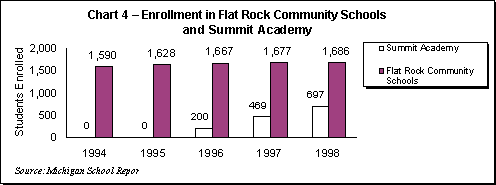
It would be expected that a larger school district like Dearborn could more easily absorb the financial impact of losing a few hundred students to competing schools. A smaller district with fewer than 2,000 students, like Flat Rock Community Schools, however, might not survive even a small exodus of students to a charter school or surrounding public "school-of-choice."
Flat Rock, a district located well to the south of Detroit, is home to one of the state's largest charter schools, Summit Academy. With a student population of 1,686, Flat Rock's enrollment ranks 32nd out of the 34 Wayne County districts. Flat Rock received a middling $6,405 per-student state foundation grant and 17.4 percent of its students qualified for the federal free- and reduced-lunch program during the 1998-99 school year.31
Founded by teacher Alison Cancilliari with the assistance of former Flat Rock superintendent Michael Witucki, Summit Academy has steadily increased student enrollment, serving 697 students during the 1998-99 school year (see Chart 4). It has added a grade level each year with the advancing students and intends to provide full K-12 education in the 2000-01 school year. Emphasizing technology and multi-age learning, Summit has proven to be popular enough with parents to draw students from seven surrounding school districts including Flat Rock.
A small district and a large charter school—more than one-third the size of the host district—sounds like a recipe for disaster for the host school district. But according to Gerald Peregord, superintendent of Flat Rock Community Schools, "Charter schools are having an impact. I have never been able to say it's a negative one."
In fact, Flat Rock enrollment has increased in recent years despite the opening of Summit Academy. In 1993-94, before Summit opened, Flat Rock enrolled 1,583 students; by the 1998-99 school year the district had nearly 1,700 students. Peregord insists that Flat Rock schools are "totally packed." Yet, he regularly loses students to Summit and even grants 10 to 12 state-aid waivers per year to allow children to transfer to other districts, explaining that "we don't own these children."
Peregord views the financial impact of area charter schools on his district as negligible. He points out that when a charter-school student takes his state foundation grant with him, while Flat Rock loses this money, it also is no longer responsible for educating that student. This is not to say that Peregord is in complete agreement with charter schools. He is not, and remains skeptical of some aspects of Michigan's charter-school legislation. Nonetheless, he described the financial impact on his district as "a wash."32
But the evidence suggests that it is not "a wash." Summit Academy has relieved the Flat Rock school district from some potentially serious facility and financial problems. Increased student enrollment in the small district required the building of a new school to the tune of more than $18 million in order to accommodate 600 students. Taxpayer expense would have dramatically increased if Summit Academy had not absorbed much of this growth in student population. Because charter schools are unable to seek public money through millages and bonds for capital expenditures, they must fund such projects through private means. Instead of being "a wash," the Summit Academy saved the citizens of Flat Rock from having to further increase their taxes.
The public "schools-of-choice" program has had very limited impact on school districts, primarily because only those districts that wish to participate do so. The ability of districts to restrict competition severely limits the good it might otherwise do. Yet, the "schools-of-choice" program is important because it has increased educational options for some families.
A closer look at the Wayne RESA district of Highland Park provides greater insight as to how one district responded to increased competition through the public "schools-of-choice" program.
Highland Park: "Schools-of-Choice" Turn "Skimming" Argument Upside-Down
A small community surrounded by Detroit, Highland Park has experienced a substantial decline in enrollment over the course of the 1990s. In the 1993-94 school year, Highland Park had 5,112 students. But by 1997-98, the district's enrollment had fallen to only 3,629 students.
The largest decline in Highland Park enrollment occurred before the advent of public "schools-of-choice" legislation. In an interview, Superintendent John Stendt attributed the decrease in enrollment to changes in housing patterns and adult education laws, saying that charters have not yet had a significant impact on his district's enrollment.
In the fall of 1996, the Highland Park district created the Career Academy, a young adult education program. This program was designed to serve students from Highland Park and the surrounding area by attracting students through the public "schools-of-choice" option. Opening with 609 students, the academy concentrated on meeting the needs of high school dropouts by providing career assistance. Unlike other adult education programs, the Career Academy focuses on specific job-related training rather than high school equivalency, allowing students to earn employment-related skill certificates. Offerings include courses in nursing, computer information systems, computer repair, and automotive technology. These courses are open to any Wayne County resident aged 16-19 years old.33
Critics of competition in education often raise the argument that choice will allow some schools to "skim" the best students, leaving the worst behind. The Highland Park adult education program does the opposite: The "choosers" are students who have dropped out or been expelled from other districts, especially Detroit. Superintendent Stendt has not heard any complaints from Detroit or other districts which "lost" these students to Highland Park. He replied, "They didn't want those students anyway, so it was no great loss to them."34
The multi-year loss of students before 1996 encouraged Highland Park to consider what student needs were not being met within, and beyond, the district. In response, the district created a program that assists students in developing employment skills where they were previously neglected.
Superintendent Stendt also noted that the prospect of increased competition encouraged Highland Park to make program changes and to extend after-school programs in an effort to retain and attract students from neighboring school districts. "Everyone has gotten used to having choices. We don't have just three television networks, three automobile companies, or three types of ice cream," Stendt stated. "Competition has forced us to be more consumer-oriented."35
The experience of Highland Park is one example of how competition has improved opportunities for students. The Career Academy did not exist prior to the implementation of the public "schools-of-choice" legislation. It required increased competition to spur Highland Park to create a program that is meeting the needs of students who had been neglected under the previous system.
Not all school districts are responding to competition like Dearborn, Flat Rock, and Highland Park. A few districts are even crying foul—claiming to be "victims" of competition. They believe that competition has exacerbated rather than resolved problems within their districts. The 1,700-student Inkster Public Schools is one Wayne RESA district claiming such harm. Although choices are still very limited, Inkster has lost many students to competing public schools, charter schools, and private schools. Inkster faces the very real possibility of "going out of business."
In the 1960s, Inkster enrolled nearly 5,000 students, supported a large marching band, and was home to many competitive sports teams. But by 1999, Inkster's enrollment had fallen to just 1,749 students. Inkster was in such dire financial shape that the district cancelled participation in spring sports in 1999. In addition, Inkster left its employees without health insurance for a time in 1999 because the district failed to pay its premiums on time. In addition, administrators and teachers were stunned to receive pink slips in May 1999, although many of them were recalled for the start of the new school year.36
The Inkster situation attracted national attention in U.S. News and World Report and Education Week after the Detroit Free Press and The Detroit News ran stories concerning the possible closure of the district's schools. Reports placed the blame for a financial crisis in the district at the feet of charter schools in Inkster and neighboring districts. All accounts asserted that Inkster was a "victim of competition."
Six charter schools have sprouted in Inkster or right on its border, enticing more than 500 students out of the district's schools. Inkster school-board member Rev. George Williams believes charter-school competition has hurt the district. "We know they're flooding us with charter schools, and the state knows it's not fair. But a little district like Inkster—who cares? You can close up, just split up the kids and send them to other schools." 37
One charter school that has attracted students from Inkster City School District is King Academy. Located in the heart of the city and mere blocks from district schools, King Academy opened its doors in September 1997 with 105 students and served 221 students in the 1998-99 school year.
King Academy believes that parental involvement is key to a child's success in the classroom. Principal Elmira Mosley emphasizes that parent-teacher cooperatives are very attractive to families who choose her school. King Academy even tries to bring parents into the classroom to teach for a day in an effort to increase their involvement.
Mosley expressed concern that area charter schools were being blamed for hurting the Inkster district, rather than being seen as the solution to long-standing deficiency in the quality of education Inkster offers. "I place the interests of students above the interests of schools," she stated.38
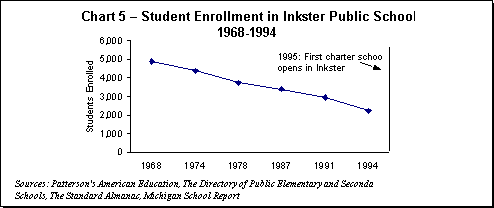
Evidence also suggests that Inkster is not a "victim of competition." Empirical data show Inkster was well down the road to closure before competition was introduced in the district. Chart 5 presents the enrollment trend for the Inkster school district between 1968 and 1994. No charter school or other choice program existed in Inkster before 1995. Inkster declined from 4,900 students in 1968 to around 2,223 in 1994-95, a total decline of 54 percent.
This 26-year enrollment decline demonstrates that families were leaving the Inkster school district long before the emergence of any formalized choice program. During this period of decline, parents were exercising "traditional school choice," whereby families moved residences to preferred communities or sent their children to private schools. Parents who were without the financial means to relocate or pay tuition at a private school resorted to "illegal school choice," whereby they falsely claimed residency in a school district in which they do not reside in order for their children to attend a school of their choice.
When parents have only the traditional options—move to a new neighborhood or cheat the system—alternatives to the local government school are primarily left to wealthy families who can afford to pay tuition at a private school. This is a cause of much economic segregation, as wealthier families congregate around desirable schools, leaving behind the less wealthy, who have no choices at all. This is what has happened in Inkster, where, today, 70 percent of all students are considered economically disadvantaged.39
Other factors have also contributed to the decline of Inkster: low student test scores, political instability on the Inkster school board, financial mismanagement, and racial tensions within the community. One source of unrest has been the fact that interim Superintendent Terry Boguth is the fifth person to lead the district in the last four years.40
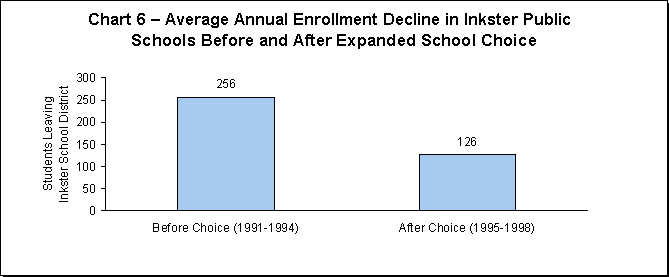
If competition did not cause Inkster's woes, as the evidence suggests, did it speed up the process? Close examination reveals that Inkster's enrollment decline substantially slowed after the introduction of competition. Inkster first began to experience the effects of competition in the 1995-96 school year when the first charter school was established in the area. The public "schools-of-choice" program began to affect the district in the following year when barriers between districts were lowered and students were allowed to attend government schools outside Inkster's borders. Essentially, any enrollment loss before the 1995-96 school year arose from factors other than expanded choice.
In the years immediately preceding the introduction of competition—between 1991 and 1994—Inkster lost 767 students (dropping from 2,975 students to 2,178 students). This translates to an average loss of 256 students per year. In the years between 1995 and 1998, Inkster enrollment declined by an average of 126 students per year (dropping from 2,171 students to 1,799 students). Hence, the charge that competition accelerated the decline of Inkster's student enrollment is false. In fact, the introduction of greater choice and competition correlates with a slowed rate of enrollment decline (chart 6 demonstrates this trend).
Yet journalists writing on the Inkster situation noted the number of charter schools in the area and the number of Inkster students attending them and implicitly assumed that if the charter school and "schools-of-choice" programs did not exist that those students would be enrolled in Inkster. But as the data demonstrate, this is not necessarily the case: Parents were choosing schools other than Inkster's long before choice programs existed.
Inkster's current plight—both academically and financially—is not a recent phenomenon, brought on by more educational choices for local families. The introduction of competition in the district merely served to expose the degree to which parents remained unhappy with their government-run schools. Charter schools and public "schools-of-choice" gave parents and students alternatives to the schools in the failing district. As a result, the school district may very well go out of business.
There seems to be some promise for Inkster, however. Superintendent Boguth says "Our goal now is to make ourselves so competitive that it doesn't matter how many charters there are here."41 In February 2000, in an attempt to avoid a state takeover, Inkster signed a contract with Edison Schools, a private, for-profit company that operates schools throughout the country.42 Only time will tell whether or not Edison can rescue the district. However, it required a competitive environment to force action to be taken, where before a bad situation was allowed to fester.
Regardless of whether choice and competition compels Inkster to improve or close its doors, making way for better educational opportunities, one outcome is certain: The current state of affairs will no longer be permitted. Either result will be better for the children assigned to the Inkster Public Schools.
Charter schools and the public "schools-of-choice" programs are beginning to replace the "assignment system"—whereby children are assigned to a particular government school based on where they live—with school choice, where parents have the right, freedom, and ability to choose the safest and best schools for their children.
These programs represent incentive-based education reform. Instead of repeating the failed attempts to reform education through new rules or additional resources, these reforms use a market-oriented incentive—competition—to encourage traditional public schools to improve.
Although fewer than five percent of Michigan's public school students are able to take advantage of these options, competition for students among Michigan's K-12 schools has improved educational opportunities for children and encouraged schools to respond to the needs and demands of families. For some districts, making parents happy is not just good public relations anymore; it has come to mean survival and prosperity.
While neither the charter schools nor public "schools-of-choice" take fullest possible advantage of the opportunities for improvement offered by competition, they are having a substantial impact on the public school system. Contrary to the claims of those who oppose competition in education, there is very little evidence to suggest that competition has harmed the cause of better education for our children.
Although the purpose of incentive-based reforms is to improve the overall quality of education by forcing schools to compete for students, a potentially negative effect of competition is that schools and districts may run into financial problems or even go out of business. Inkster Public Schools represents such an example. Is this an acceptable outcome of school choice and competition?
To answer this question it is beneficial to observe the private sector of our economy where choice and competition is the norm rather than the exception. In this arena, businesses fail every day for a variety of reasons. Rarely, however, do they go out of business because they attract too many customers. Most will close because they do not provide a desired product or because other suppliers provide a superior service. Of course other factors may lead to the closure of a business, but the key is that competition offers consumers with choices. Choices force a business to please customers or risk losing them to someone who will. As a result, it is ultimately the consumer who benefits from competition between multiple suppliers of a service or product.
In a competitive education marketplace, behavior of consumers and suppliers will be the same, if not more so because of the importance people place on education. Schools that provide high-quality education for children will attract and retain students, while schools that do not will likely lose students. In such an environment, it should be expected that schools that fail to provide an education (service) that students and parents (consumers) want or value will go out of business. Other schools may close because their service is inferior to that which is provided by other suppliers of education.
In the assignment system, the supplier is sovereign. With school choice, the consumer is sovereign. Allowing parents to choose how and where their children are educated, while not a panacea, will force schools to treat families like customers to be served rather than as a captive audience. No longer will children be trapped in underperforming schools like Inkster Public Schools. Instead, they will have increased opportunities to find a better or safer school that meets their individual needs.
The evidence is clear: School choice and competition put pressure on low-performing districts to improve their academic performance. Students in failing districts have largely already been "left behind" by people who can afford to choose between better government schools and private schools. Choice programs are providing alternative school options to parents who otherwise could not afford them, while forcing districts to respond to student needs and parental desires.
Traditional public schools not only can survive competition; they also can thrive in it. Government schools have considerable advantages, including higher levels of taxpayer support, taxpayer-provided facilities, and funding for transportation and other services. In a more competitive environment, schools of all types will have strong incentives to provide parents and students what they want and need. No longer will schools be able to provide substandard service to children who cannot escape. Increased competition will force all schools to improve for all children.
The positive effects of competition among Michigan public schools noted by this report as well as previous studies of charter schools lead to several recommendations for encouraging further improvements in education for Michigan children.
1. Remove the cap on the number of charter schools state universities can authorize.
The benefits of competition to public education from charter schools is directly related to the bold steps taken by many state universities to authorize the majority of charter schools throughout the state. However, the benefits of charter-school competition continue to be impeded by the legislative limitation placed on the number of charter schools they can authorize. The charter school option should be available to more Michigan children, which will further improve the education of our children.
The Michigan Legislature should remove the 150-school limitation imposed on universities and allow for the expansion of charter schools. It should also consider the creation of an additional authorizing entity (perhaps a statewide charter school commission) and allow current charter schools to utilize multiple sites under one charter.
2. Expand the public "schools-of-choice" program to include all public schools and require districts to release state funding for exiting students.
Choices for students among traditional public schools and districts remain extremely limited. Significant barriers continue to prevent children from choosing an alternative public school, particularly when the assigned district refuses to release state funding (known as the "foundation grant") for a student to attend an alternative public school in a different district.
The Michigan Legislature should remove the barriers that prevent children from choosing among all public schools. No child should be denied the opportunity to attend a safer or better public school. In addition, if an alternative public school will accommodate additional students, districts should be forced to allow the state foundation grant to follow every student who chooses to leave their assigned school district.
3. Exempt public schools from onerous statutes and regulations.
Public policy should free traditional public schools from burdensome regulations to help them better compete with charter and private schools. If teachers and administrators are granted the freedom to adapt to the diversity of students who come before them, they will be better able to provide an array of educational programs that will address the varied ways children learn.
The greatest form of accountability is "consumer sovereignty," not "political accountability" through more rules. Therefore, the Michigan Legislature should craft education policy that holds schools accountable to parents and relieves teachers and administrators from onerous statues and regulations.
4. Eliminate discriminatory language from the state constitution that penalizes parents' choice of private schools.
The next logical step for improving K-12 education in Michigan would be to expand school choice by providing financial relief for parents who choose private schools for their children. Allowing Michigan families more choices in how and where their children are educated means that parents and students—as consumers—can further improve the public schools while educational opportunities expand for all children.
Under the current system, parents who choose to send their children to a private school must pay twice—once in taxes for government schools they do not use and again in tuition for the school they do use. This financial penalty prevents the majority of Michiganians from exercising their rights as parents, as it is only the wealthy who are able to afford such financial choices.
Article VIII, Section 2 of the 1963 Michigan constitution—added by amendment in 1970—prevents the majority of Michigan parents from choosing the safest and best school for their children by prohibiting tuition vouchers or tax credits for K-12 education. Michigan voters should remove this amendment that impedes wider choice and competition among all Michigan schools—government and private.
Public School District |
School Year |
|||
|
|
1995-1996 |
1996-1997 |
1997-1998 |
1998-1999 |
Allen Park |
3,120 |
3,179 |
3,238 |
3,245 |
Crestwood |
2,887 |
2,930 |
2,949 |
3,052 |
Dearborn |
14,957 |
15,592 |
15,878 |
16,263 |
Dearborn Heights |
2,214 |
2,358 |
2,423 |
2,491 |
Detroit |
173,749 |
175,798 |
174,730 |
173,557 |
Ecorse |
1,342 |
1,323 |
1,259 |
1,199 |
Flat Rock |
1,628 |
1,667 |
1,677 |
1,686 |
Garden City |
5,243 |
5,367 |
5,412 |
5,428 |
Gibraltar |
2,692 |
2,740 |
2,690 |
2,819 |
Grosse Ile |
2,059 |
2,022 |
2,067 |
2,060 |
Grosse Pointe |
8,158 |
8,395 |
8,468 |
8,582 |
Hamtramack |
2,946 |
3,236 |
3,367 |
3,468 |
Harper Woods |
1,093 |
1,096 |
1,098 |
1,086 |
Highland Park |
3,359 |
3,734 |
3,629 |
3,606 |
Huron |
2,025 |
1,872 |
1,943 |
2,005 |
Inkster |
2,171 |
1,982 |
1,799 |
1,749 |
Lincoln Park |
5,603 |
5,651 |
5,675 |
5,555 |
Livonia |
17,825 |
18,098 |
18,346 |
18,348 |
Melvindale |
2,209 |
2,232 |
2,235 |
2,247 |
Northville |
4,724 |
4,911 |
4,971 |
5,117 |
Plymouth Canton |
15,424 |
15,800 |
15,835 |
16,202 |
Redford Union |
5,128 |
5,056 |
4,964 |
4,967 |
River Rouge |
2,352 |
2,352 |
2,546 |
2,550 |
Riverview |
2,039 |
2,085 |
2,085 |
2,122 |
Romulus* |
3,968 |
3,487 |
4,093 |
4,131 |
Southgate |
4,218 |
4,373 |
4,328 |
4,487 |
South Redford |
3,383 |
3,472 |
3,449 |
3,447 |
Taylor |
11,655 |
11,703 |
11,600 |
11,466 |
Trenton |
3,209 |
3,234 |
3,261 |
3,215 |
Van Buren |
6,040 |
6,179 |
6,188 |
6,258 |
Wayne-Westland |
14,992 |
15,151 |
15,135 |
14,928 |
Westwood |
2,132 |
2,194 |
2,196 |
2,218 |
Woodhaven |
4,626 |
4,678 |
4,707 |
4,763 |
Wyandotte City |
4,770 |
4,879 |
5,025 |
5,005 |
Source: Michigan Department of Education, 1998 and 1999 School Reports. |
||||
* The Romulus district embarked upon an Alternative Education program during the 1996-97 school year. This school was located within the Detroit Public School District and ultimately closed under order from the state. The enrollment figures above do not include the 1,589 students enrolled in the alternative program during the 1996-97 school year. |
||||
Creative Arts
Integration of art, music, drama and movement with the core curriculum.
The Science Theme School
An elementary school emphasizing science, using science themes as a backdrop in core curriculum lessons.
Allied Health Technologies Academy
A high-school program geared for students interested in pursuing a career in the medical sciences.
Character Education Theme School
The Dearborn Public Schools surveyed parents, the community, business and religious leaders to determine the core values of the community. The values most reported were: Honesty, Integrity, Courtesy, Responsibility, and Respect for Self and Others. This elementary theme school builds upon these values in order to develop a strong sense of character.
Academy of Engineering Technology
A high school program emphasizing math, science and technology using state of the art computers, robotics and other technical equipment.
Extended School Year Program
A program at three elementary schools provides a six-week summer vacation and shorter and more frequent breaks throughout the year. The program hopes to raise student achievement by promoting retention of knowledge with the need for less review.
Greenfield Village and Henry Ford Museum Theme School
An elementary program emphasizing a historical theme and the use of resources from the Henry Ford Museum and the Greenfield Village.
The School-To-Work Academy
An alternative program to a traditional high school emphasizing modern technology in order to allow students to make a successful transition from school to work.
The Gifted and Talented Enrichment Theme School
An elementary program designed to meet the needs of gifted students while raising expectations for all students.
The Multi-Age Theme School
Student-centered curriculum organized around multi-aged classrooms.
Ventures in Partnerships Theme School
A middle school based upon Dearborn's business-school partnership program. Students work with business and have interviews, write resumes and produce work that is demanded in entry-level positions.
Source:Dearborn Public Schools
Public Act 362 of 1993 amends the Michigan School Code of 1976 to create a new type of public school in Michigan called a 'public school academy,' or charter school.
Public Act 180 of 1996 amends the Michigan School Code of 1976 to permit inter-district schools of choice within Intermediate School Districts (ISDs), which are political boundaries drawn around a group of districts. Public Act 119 of 1999 modified the "schools-of-choice" program to allow students to transfer across ISD boundaries.
U.S. Department of Education. The State of Charter Schools 2000: Fourth-Year Report, January 2000.
"Grading Metro Detroit Schools," The Detroit News, 24 October 1999; available on the Internet at https://www.detroitnews.com
See The Detroit News' "Grading Metro Detroit Schools" database at http://data.detnews.com/grades/index.hbs.
James S. Coleman. Equality of Educational Opportunity (Washington D.C.: Government Printing Office, 1966).
Eric A. Hanushek and Dongwook Kim. "Schooling, labor force quality, and economic growth." Working Paper 5399, National Bureau of Economic Research, December 1995.
Report Card on American Education: A State-by State Analysis 1976-1999 (Washington, D.C.: American Legislative Exchange Council, March 2000), pp. 44-45.
Mark Hornbeck and Jodi Upton. "Money won' t buy success for schools," The Detroit News, 24 October 1999; available on the Internet at https://www.detroitnews.com/specialreports/1999/schoolgrade/lead/lead.htm.
See The Detroit News' "Grading Metro Detroit Schools" database at http://data.detnews.com
Paul Ciotti. "Money and School Performance: Lessons from the Kansas City Desegregation Experiment," Policy Analysis No. 298, Cato Institute, 16 March 1998.
Dirk Johnson, "'F' for Kansas City Schools Adds to the District's Woes," The New York Times, 3 May 2000.
Caroline Minter Hoxby. "Does Competition Among Public Schools Benefit Students and Taxpayers?" Working Paper No. 4979, National Bureau of Economic Research, 1994.
Caroline Minter Hoxby. "Do Private Schools Provide Competition for Public Schools?" Working Paper No. 4978, National Bureau of Economic Research, 1994.
See www.mackinac.org for a complete listing of all Mackinac Center for Public Policy research on incentive-based reforms in education.
Jerry Horn and Gary Miron. Evaluation of the Michigan Public School Choice Academy Initiative (The Evaluation Center, Western Michigan University, February 1999); available on the Internet at www.mde.state.mi.us/reports/psaeval9901/psaeval.shtml.
Ibid., p. xxiv.
Nick Khouri, et al. Michigan's Charter School Initiative: From Theory to Practice (Public Sector Consultants Inc. and Maximus, Inc., February 1999); available on the Internet at www.mde.state.mi.us/reports/psaeval9901/psaeval.shtml.
Ibid., pp. 86 and 89.
David Arsen, David Plank, and Gary Sykes. School Choice Policies in Michigan: The Rules Matter (Michigan State University, October 1999); available on the Internet at http://edtech.connect.msu.edu/policy/center/choice/default.asp.
"Charters need tweaking, report finds: House takes up debate on the number of schools," Detroit Free Press, 26 October 1999; available on the Internet at www.freep.com/news/education/qchart26.htm.
Michigan Education Association President Luigi Battaglieri, interview on WKAR's "Off the Record" television program, 10 September 1999; available on the Internet at www.wkar.org.
Michigan Association of Public School Academies; available on the Internet at www.charterschools.org.
Wayne County Regional Educational Service Agency; data available on the Internet at www.wcresa.k12.mi.us.
Ibid.
Michigan Department of Education. 1999 Michigan School Report; available on the Internet at www.mde.state.mi.us/reports/msr/.
Michigan Department of Education. 1999 Michigan School Report; available on the Internet at www.mde.state.mi.us/reports/msr/.
Charles Hampton Harrison. Public Schools USA: Comparative Guide to School Districts (Peterson's Guides Inc., 1991).
Ibid., 1999 Michigan School Report.
Interview with Dr. Jeremy Hughes, superintendent of Dearborn City School District, August 1999.
Michigan Department of Education. 1999 Michigan School Report; available on the Internet at www.mde.state.mi.us/reports/msr/.
Interview with Gerald Peregord, superintendent of Flat Rock Community Schools, August 1999.
Highland Park Career Academy Web site, available on the Internet at www.netib.com/GLO/HIG18414/index.htm?page1.
Interview with John Stendt, superintendent of Highland Park Public Schools, September 1999.
Ibid.
Sheryl James. "Victim of Choice," Detroit Free Press 14 June 1999, available on the Internet at www.freep.com/news/education/qink14.htm.
Ibid., James.
Interview with Elmira Mosley, principal of King Academy, August 1999.
Qualification for the Free or Reduced Lunch program constitutes the official definition of which students are economically disadvantaged. Inkster figure is derived from the 1999 Michigan School Report; available on the Internet at www.mde.state.mi.us/reports/msr/.
Lynn Schnaiberg. "Facing an Uncertain Future Under Choice," Education Week, 29 September 1999; available on the Internet at www.edweek.org/ew/ewstory.cfm?slug=05ink.h19.
Lynn Schnaiberg. "Facing an Uncertain Future Under Choice," Education Week, 29 September 1999; available on the Internet at www.edweek.org/ew/ewstory.cfm?slug=05ink.h19.
Michigan Education Report, "Inkster turns to private firm to manage schools," spring 2000; available on the Internet at www.EducationReport.org .
Acknowledgments
The authors wish to thank the public and charter school officials who voluntarily shared their experiences. The authors also acknowledge the assistance of Mackinac Center Communications Specialist Samuel Walker and Managing Editor of Publications David Bardallis.
About the Authors
Matthew Ladner, founder and president of Capitol Research and Consulting, received his Ph.D. in political science from the University of Houston. Dr. Ladner's research projects include studying legislative voting patterns, the competitive contracting of government services, special education services, and school choice programs.
Matthew J. Brouillette, a former junior-high and high school teacher, is director of education policy at the Mackinac Center for Public Policy. He is the author of numerous Mackinac Center Viewpoint commentaries on education as well as several studies, including Unused Capacity in Privately Funded Michigan Schools, The Impact of School Choice on School Employee Labor Unions, and School Choice in Michigan: A Primer for Freedom in Education.
Mr. Brouillette received his bachelor of arts degree in U.S. history and secondary education from Cornell College in Iowa, his master of education degree in graduate education from Azusa Pacific University in California, and his master of arts degree in history from the University of San Diego.