

 Font size:
As school choice heads for the 2000 ballot in Michigan, it is important for citizens to
understand how proposals including K-12 vouchers and tuition tax credits will affect the
school employee unions that exert such a powerful influence on the state’s public
school system.
This study examines union membership rates among Michigan’s public, charter, and
private school teachers and found that while teachers in every public school district are
represented by-and pay dues to-a union, only 5 out of 139 charter and 2 out of over one
thousand private schools employ unionized workforces.
The study concludes that school employee unions-including the Michigan Education
Association and the Michigan Federation of Teachers-have powerful political and financial
incentives to spend millions of dollars to prevent more parents from being able to choose
non-unionized charter or private schools for their children.
As education reform proposals such as K-12 tuition vouchers and tax credits are debated across Michigan, it is important to assess how increased school choice will impact children, teachers, and others with a vested interest in education.
This Mackinac Center for Public Policy study examines the unionization rates of teachers in traditional government, charter, and private schools to determine how school choice might affect school employee labor unions, including the Michigan Education Association and the Michigan Federation of Teachers.
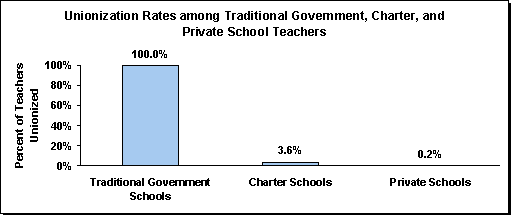
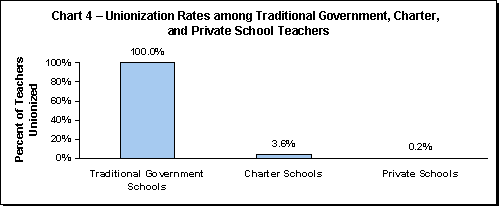
The findings of this study reveal that unions have powerful financial incentives to maintain the current barriers to school choice, including the Michigan constitutional ban on K-12 tuition vouchers and tax credits. Nearly 9 out of 10 school children attend public schools with unionized teachers. However, unions have been mostly unsuccessful in their attempts to organize teachers in charter and private schools, where few employees are willing to join a union or pay dues. To date, only 5 of Michigan's 139 charter schools are unionized and only 2 out of the 782 private schools surveyed were found to have unionized teachers (see chart).
School employee labor unions have traditionally opposed proposals to expand the number of charter schools or provide families with tuition tax credits or vouchers to help them afford alternatives to unionized government schools. To union officials, expanded school choice may mean a reduction in their organizations' income and political power as greater numbers of low- and middle-income families choose to send their children to charter and private schools with non-unionized workforces. Union officials likewise understand that if families are allowed to effectively choose from among an expanded array of alternative, non-unionized schools, so are dues-paying school employees.
This study shows that union officials have strong financial and political incentives to spend millions of dollars to prevent parents from simply being able to choose the safest and best schools for their children.
To understand why school employee labor unions are likely to spend millions of dollars to maintain Michigan's constitutional ban on K-12 tuition vouchers and tax credits, it is important to assess how school choice might affect the financial and political power of the Michigan Education Association (MEA) and the Michigan Federation of Teachers (MFT).
This Mackinac Center study examines the unionization rates of teachers in Michigan's three formal systems of education: traditional government schools; charter schools; and private schools. Because the ability to attract, retain, and increase membership is critical to the financial power and political influence of any labor union, the purpose of this research was to determine the current rates of unionization among teachers and illustrate how a shift of students and teachers to non-unionized schools might impact school employee labor unions.
The findings of this study reveal that school employee labor unions have organized only a tiny fraction of Michigan charter and private school teachers, but they have unionized all of Michigan's traditional government school teachers. These facts demonstrate that school employee unions including the MEA and MFT have strong incentives to maintain the status quo and oppose efforts to expand parents' ability to choose the safest and best schools for their children. In the short term, school choice may negatively affect the financial and political power of school employee labor unions if more students' and teachers' move from unionized to non-unionized schools. In the long term, however, school choice could benefit unions that commit to changing the way they organize teachers and influence government schooling in Michigan.
It is important to use terms that accurately convey relevant distinctions among the three types of schools discussed in this study. All three school types serve the public, but only two types commonly have been called "public schools." This study uses terms that distinguish among the three types of schools based on how they are funded and how they are controlled. The three types include "private schools" and two types of tax-funded "government schools." The term "traditional government school" identifies a tax-funded public school with a politically elected school board; "charter school" identifies a tax-funded public school created under the state's public school academy law; and "private school" identifies a privately funded and operated school that is independent of the government-run system.
The Mackinac Center for Public Policy conducted research to determine teacher unionization rates in Michigan's three primary systems of schooling: traditional government schools, charter schools, and private schools.
Data on Michigan's traditional government schools are taken from an August 1998 Mackinac Center study entitled Collective Bargaining: Bringing Education to the Table.1 This study analyzed 583 Michigan school labor contracts and recommended eight major improvements to help teachers, schools, and students. The research conducted for this project provided the information necessary to establish rates of unionization for teachers in traditional government schools.
Data on Michigan's charter school teachers were collected through the chartering agencies of the 139 charter schools currently operating in Michigan. The 22 charter school authorizers include nine public universities, one community college, eight intermediate school districts, and four local school districts.
Data on teacher unionization rates in Michigan private schools were collected from 782 schools, or 73.9 percent of all private schools in Michigan.2 Information was collected through the Michigan Association of Non-public Schools, the Association of Independent Michigan Schools, the Lutheran Schools-Wisconsin Synod, the Michigan Conference of Seventh Day Adventists, and the Michigan Association of Christian Schools. These associations represent a total of 737 private schools in Michigan. An additional 45 independent private schools were surveyed by the Mackinac Center via telephone to determine teacher unionization rates in schools not belonging to any association.
This study draws no conclusions about the unionization rates of teachers in the 26.1 percent of private schools that were not surveyed. The authors did, however, identify and survey those private schools with the greatest potential for teacher unionization (i.e., large and/or nonsectarian schools), and found that none of them were unionized.
Traditional government schools have the highest teacher unionization rates of any of the three school systems in Michigan. Today, union contracts are in effect in every Michigan school district.3
Michigan's two major school employee labor unions, the MEA and the MFT, have grown markedly in terms of financial strength and political power since the mid-1960s. Much of their growth and influence can be attributed to the fact that teachers or other government school employees who refuse to pay union dues or agency fees can be immediately terminated under the "union security" clauses negotiated into MEA and MFT labor contracts. Such clauses, agreed to by school boards, have contributed to a virtual union monopoly of employee representation in Michigan's traditional government schools. (see "Union Politicization of Michigan's Traditional Government Schools" for more details.)
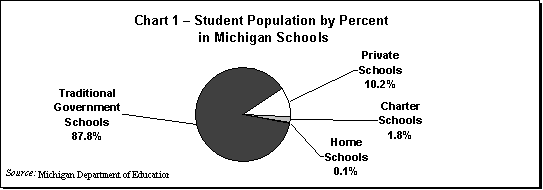
While labor unions hold sway over the workforce in the state's K-12 traditional government schools, the schools themselves also monopolize Michigan's student population partly because of the school assignment system, whereby children are assigned to a particular government school based on arbitrary political or geographical boundaries. Unionized government schools enroll over 87 percent of the state's student population while private schools educate less than 11 percent (see Table 1 and Chart 1).
Labor unions clearly have a powerful influence over Michigan's traditional government schools and the students who are assigned to them, but how do labor unions affect and influence charter and private schools? Are teachers in these schools-of-choice receptive to unionization?
| Table 1 Michigan — Student Population by School Type | |
| School Type | Student Population |
| Traditional Government | 1,660,1884 |
| Private | 193,4885 |
| Charter | 34,0006 |
| Home | 2,2697 |
| Total Number of Students | 1,889,945 |
Charter schools are government-funded schools that operate with more autonomy and somewhat less regulation than do traditional government schools. They are funded on a per-pupil basis from the state School Aid Fund, which means that the more students they attract, the more state funding they receive. Renewal of charter school contracts is also based on student academic performance. In contrast, traditional government schools could continue to receive some tax money even if every single student left for an alternative school.
Since a charter school's state funding relies solely on the number of students it is able to attract, charter school administrators must carefully weigh the competence of their teachers. Poor teaching will eventually result in fewer parents choosing to send their children to the charter school—or even a revocation of the school's license to operate. As a result, teachers are usually employed on an at-will basis, without the opportunity for tenure. Charter school administrators and teachers alike accept considerable risks when their school's funding is ultimately contingent on parental satisfaction and student performance.
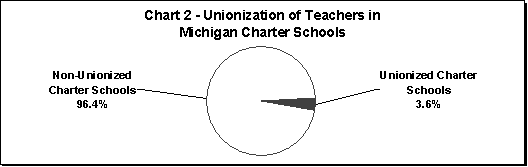
One might assume that charter school teachers are ideal targets for union organizing due to their relative lack of job security compared to their traditional government school counterparts. But this has not proven to be the case. In the 1998-99 school year, only 3.6 percent of Michigan charter schools had union collective bargaining agreements in place. No teachers from schools chartered by public universities (110 out of 139 schools, or 79.1 percent)8 have been organized by a labor union. Table 2 and Chart 2, opposite, show that the vast majority of charter schools remain free of labor union influence. Furthermore, the only unionized charter schools are those chartered by unionized entities.
In light of the fact that charter school teachers lack tenure and risk dismissal if they fail to contribute to student achievement as judged by the schools, why are charter school teachers reluctant to seek or accept labor union representation?
According to research conducted by the Phoenix-based Center for Market-Based Education, Arizona charter school teachers are willing to trade job security for more teaching flexibility, less paperwork- and higher pay.9 The Center found that beginning charter school teachers earn an average of six percent more than beginning teachers in traditional government schools. A study of California teachers had similar findings: The average starting salary for charter school teachers there is $27,200, compared to $25,500 for teachers in traditional government schools. A comprehensive study of Michigan charter school teacher pay would be useful, but it has yet to be conducted.
Teacher and former union representative James Morris echoed the sentiments of many of his charter school colleagues when he wrote to his state assemblyman that, "I have far more rights working in a public charter school that I ever did working & at a traditional school."10
Standard union contracts establish teacher salaries based on years of service plus the number of college credits earned beyond a bachelor's degree. In contrast, non-unionized charter schools tend to calculate salaries according to a more diverse range of factors including teacher expertise, experience, education, student achievement, and other criteria. In addition, charter school teachers are often able, through performance-based incentives, to increase their salaries faster than traditional government school teachers bound by rigid collective bargaining agreements. One Arizona administrator believes that this ensures accountability: "[S]tudents pass the exams, or the teachers don't have jobs! This is all the incentive we need to get and keep the most qualified teachers."11
In spite of charter school teachers' disinclination to seek or accept labor union representation, unions have made limited attempts to organize them. But these teachers continue to reject more than accept the overtures of union officials.12 Part of the reason for their disinterest in unionization may be the different economic incentives present in charter schools. Charter schools must attract and retain students primarily through attracting and retaining high-performing and competent teachers. Collective bargaining agreements almost always prohibit basing teacher pay on performance or other objective and subjective factors that indicate qualification and excellence.
These limitations of collective bargaining agreements are recognized by many as a primary hindrance to schools' ability to attract and retain the most qualified teachers. The Task Force on Federal Elementary and Secondary Education Policy of the 20th Century Fund explained it this way:
The organizations—the unions and professional associations—to which teachers belong have protected their weakest members rather than winning rewards for their strongest.
The collective bargaining process, moreover, has not only made it difficult to encourage promising teachers or dismiss poor ones, it has forced many of the best to leave teaching for more financially rewarding work. The result is that the quality of teaching suffers.13
The often rigid and prohibitive work rules established in the standard collective bargaining agreements of traditional government schools may end up driving many teachers into charter schools. To high-performing teachers, the freedom to innovate and the potential for greater financial rewards in charter schools could outweigh the job security and schedule-based salaries included in union-negotiated contracts.
The labor unions' demonstrated failure to organize and influence Michigan's charter school teachers provides a clue to understanding union opposition to lifting the legislatively imposed cap on the number of charter schools public universities can authorize. Each time a teacher chooses to leave a traditional government school for a charter school, a labor union loses a dues-paying member. The short-term financial self-interests of unions and the growth of charter schools are thus incompatible with one another. For the sake of their organizational strength and influence, unions have strong incentives to oppose efforts to allow parents more charter alternatives to the traditional government schools.
| Table 2 — Unionization in Michigan Charter Schools Listed by Chartering Body | ||
| Chartering Body | Number of Schools | Number of Schools with Unionized Teachers |
| Public Universities | 110 | 0 |
| Community Colleges | 1 | 0 |
| Intermediate School Districts | 16 | 3 |
| Local School Districts | 12 | 2 |
| All Schools | 139 | 5 |
| Sources: Michigan Association of Public School Academies and the Mackinac Center for Public Policy | ||
According to the state Department of Education, 193,488 Michigan students attended private schools in the 1997-98 school year, or less than 11 percent of the state's total student population.14 Eighty-seven percent of these private schools are sectarian; only 13 percent have no religious affiliation.
Unions have the same financial incentives to oppose private school choice as they do to oppose charter school choice: Only 2 out of 782 private schools have teachers bound by union collective bargaining agreements.
The largest representative organization of private schools in the state is the Michigan Association of Non-public Schools (MANS). MANS is a coalition of Catholic schools, Lutheran-Missouri Synod schools, and Christian Schools International. In total, MANS represents 540 schools with approximately 137,000 students.15
Glen Walstra, executive director of MANS, says that the unions' primary focus on issues related to compensation and terms and conditions of employment is incompatible with the mission of the 540 MANS schools. While teacher pay and job security are always of great concern, they are not enough to push teachers toward unionization, according to Walstra:
Unionism doesn't drive private education. Our people [teachers and administrators] have made up their minds that money is not the primary reason they do their jobs. Service to the child and the school are more important. They view their jobs as being a ministry.16
Students in most of these schools are being educated by religious organizations with centuries-old educational traditions. According to Walstra, at no time have teachers in MANS schools been organized by any modern labor unions.
The executive directors of four other private school associations representing a total of 197 schools also reported no unionized teachers in their schools.17 According to MFT officials, teachers in only two private schools have been successfully organized by their labor union. The MEA refused to provide information regarding its success in organizing private schools; however, a sampling of 45 schools with a potential for unionization revealed no MEA collective bargaining agreements in place.18
Union officials understand that organizing private school teachers is much more difficult than organizing traditional government school employees. Therefore, it is likely that labor unions will continue to oppose legislation and ballot initiatives that allow families—and also teachers—to have greater educational opportunities and freedom to choose private schools for their children.
Although school employee labor unions are free to organize teachers in any school system, labor unions lack influence in charter and private schools and dominate the traditional government schools. A brief look at the history of public-sector unionization in Michigan is instructive. It will provide insight into how school employee labor unions have politicized Michigan's government schools and how school choice threatens to break up their monopoly.
The passage of the Public Employment Relations Act (PERA) in 1947 permitted government employees, including government school teachers, to organize for the first time into unions and engage in collective bargaining. Prior to PERA's passage, it was illegal for government entities to recognize or bargain with a public-sector union.19
The modern era of aggressive teacher unionization, however, did not begin until 1965, when the Michigan Legislature amended PERA with Public Act (PA) 379.20 PA 379 eliminated the penalties levied against public employees who illegally went on strike. Prior to the passage of PA 379, striking government employees were deemed to have terminated their employment. Though these new amendments to PERA did not legalize strikes by government employees, they substantially weakened the ability of public employers to withstand the pressure from union-initiated work stoppages.21 By 1967, 36 school districts did not open school on time due to striking teachers.22 PA 379 granted school employee labor unions extensive power over schools and students.
Prior to the 1960s, the MEA and its national affiliate, the National Education Association, were broad-based professional associations of educators that included teachers, administrators, professors of education, and virtually anyone else with a professional interest in education. Over the past several decades, however, these professional organizations have transformed themselves into labor unions for various classifications of school personnel, including non-teachers. Their primary focus on professional development shifted to issues related to school employee compensation and terms and conditions of employment—a natural development for any labor union. This fact is also demonstrated by the MFT's affiliation with the AFL-CIO, an industrial labor union for truck drivers, postal workers, plumbers, and others.
From 1963 to 1993, school employee labor union membership more than tripled from 963,720 to over 3,100,000.23 This dramatic increase in unionized public school employees coincided with the passage of state laws giving school employee labor unions the power to demand recognition as exclusive bargaining agents for all teachers in newly formed bargaining units.
The success of the school employee labor unions in influencing traditional government schools has coincided with today's highly politicized system of schooling. The effect of public-sector unionization on these schools is important for understanding why the MEA and MFT have strong incentives to oppose school choice.
Mandatory collective bargaining laws including PERA have granted unions tremendous power to control and influence many crucial school policies. Union political operatives, using teacher dues, are involved at all levels of school politics, governance, and finance. They contribute campaign funds to candidates who promise to pursue union interests. They lobby the legislature, where appropriations are made and where laws are passed. They participate in school board elections and school board proceedings. They help establish the criteria for who may or may not become a teacher. They are involved in the selection procedure for school district superintendents. In fact, the provisions in the typical collective bargaining agreement between unions and school districts are all-encompassing and affect the day-to-day operations of local schools in many ways.
The politicization of government schools has been exacerbated by school employee labor unions. As noted previously, in order to teach in Michigan's government schools, one must contribute a portion of one's paycheck to a labor union. Although teachers are often not informed of their right to resign from a union and not pay dues for political activities, unions are able to use members' money to financially support candidates who promise to support union interests. Both the MEA and MFT have helped to successfully elect Democratic and Republican candidates to the Michigan Legislature.
Once in office, union-backed public officials enact policies that benefit government employees and labor unions, including approval of labor contracts that force teachers to financially support the labor union whether or not they agree with its policies; maintain and promote compulsory unionism; increase tax-funded wages and benefits for government employees; and oppose privatization, even when non-union, private-sector workers can provide better services at lower cost to taxpayers.
The tendency of school employee labor unions to politicize education has contributed to a $13 billion annual state and local tax bill to fund Michigan's traditional government schools. Despite routine complaints by labor unions that education is underfunded, traditional government school funding has continually increased since 1990. Fiscal Year 2000 marks the third consecutive year that the state spends more on K-12 government schooling than it does on the entire general fund budget.24
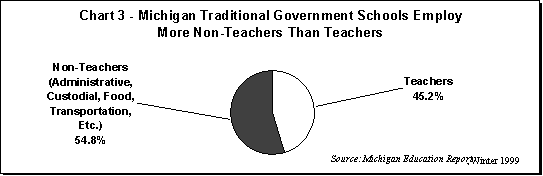
Salaries and benefits for school employees account for the largest portion of these funds. However, the majority of Michigan government school employees are actually non-teachers— that is, cooks, janitors, bus drivers, and other non-instructional staff. Teachers comprise only 45.2 percent of all Michigan government school personnel, the lowest percentage of any state (see Chart 3). Among all states, teachers average 52.1 percent of government school employees. Michigan is one of only seven states whose schools employ more non-teachers than teachers.25
School non-instructional personnel also belong to labor unions and must pay dues as a condition of their employment. Unions use the dues of both teachers and non-teachers for many things, including collective bargaining, lobbying elected officials, contributing to political candidates' campaigns for office, defending members in legal trouble, advancing political or social agendas that are often unrelated to education, and other activities.
The MEA, Michigan's largest school employee union, has benefited the most from the symbiotic relationship between government schools and public-sector unionization. From September 1, 1997, to August 31, 1998, the MEA's operating budget was over $86 million. Of that amount, $45,396,267 was garnered from dues-paying members. Salaries and benefits for MEA employees for the same period were over $31 million.26
MEA officials' salaries are generous. In the year beginning in September 1997, MEA President Julius Maddox received over $175,000 in salary alone (excluding benefits)— more than 3.5 times the average salary received by the Michigan teachers his union represents. This salary placed Mr. Maddox in the top one percent of American income-earners. Including Mr. Maddox, 110 of MEA's 297 staff members received over $100,000 in salary and expenses during the same one-year period.28
The MEA also derives non-dues income from union-owned operations. For example, the MEA receives large sums of taxpayer money each year through school district health-insurance payments to the Michigan Education Special Services Association (MESSA), the MEA's wholly owned insurance subsidiary. This arm of the MEA brought in $360 million in 1992 premiums alone29 and claims more than 73 percent of Michigan's public school districts as "customers."30 Despite comparable and less expensive alternatives to MESSA coverage, the MEA bargains its own health insurance into district contracts.
The financial strength and political power of school employee labor unions is not limited to Lansing. It also consists of local power, which comes from the election of union-friendly school board members and the help of the voting and persuasive power of a large union membership.
Van Buren Public Schools Trustee Thomas Bowles cites the MEA's influence on the Michigan Association of School Boards (MASB) as a primary reason for chairing an alternative school board member organization for government, charter, and private schools, the Michigan School Board Leaders Association (MSBLA). MASB positions tend to mirror MEA policies, but MSBLA emphasizes that, "Parents are the ultimate guardians of their children's education" and "[c]hildren are more important than the system."31
As shown above, public-sector unionization has allowed school employee labor unions to monopolize the delivery of traditional government education in the state of Michigan. The politicization of traditional government schools has created a system that the MEA and MFT have strong financial and political incentives to preserve. Barring a change in the way the unions relate to teachers and administrators, their future success and influence depends on their ability to maintain control of, and resist changes to, this politicized system.
School Choice Threatens to Negatively Affect the Financial and Political Power of School Employee Labor Unions
School employee labor unions' failure to organize teachers in Michigan private and charter schools—and their dominance in traditional government schools—give them powerful financial incentives to oppose school choice. Nearly 9 out of 10 school children attend traditional government schools with dues- and fee-paying unionized teachers. However, unions have been mostly unsuccessful in their attempts to organize teachers in charter and private schools, where few employees are interested in joining a union or paying dues. To date, only 5 of Michigan's 139 charter schools are unionized and only 2 out of the 782 private schools surveyed were found to have unionized teachers (see Chart 4).
The financial strength and political influence of school employee labor unions is directly related to their ability to acquire and retain dues-paying members. To the unions, a loss of members represents a loss of financial and political power. School employee labor unions understand that if families are allowed to choose among a greater number of non-unionized schools, then dues-paying government school employees will be able to do the same. It is reasonable to expect that, out of organizational self-interest, unions will attempt to maintain the financial and political barriers that prevent families from choosing charter and private schools. This is one reason why unions are likely to spend millions of dollars to oppose the removal of Michigan's constitutional ban on K-12 tuition vouchers and tax credits and the enactment of proposals that expand parental school choice.
David Denholm of the Public Service Research Foundation in Virginia concludes that the competition created by school choice is the single greatest threat to the union monopoly of traditional government schools and teachers. In The Impact of Unionism on the Quality of Public Education, Denholm states that
[U]nions & oppose reforms that are contrary to the union's self interest as an organization. Anything that would lessen the power of the union or reduce the union's membership is automatically opposed. This is the central reason for union opposition to any proposals which would introduce competition into public education. The unions realize that because of political influence, their ability to organize public education is greatly enhanced, but that they have virtually zero ability to organize in private education. Anything that would move students, and therefore teaching jobs, from the public to the private sector meets strenuous union resistance.
Unions have not been successful at organizing the employees of charter and private schools. Expanded school choice will probably lead to a reduction of union income and political power as greater numbers of low- and middle-income families choose to send their children to schools with non-unionized workforces. Preservation of school employee union power and influence therefore requires union officials to defend the system they now dominate, and resist the growth of schools in which they have been unable to gain a foothold.
La Rae Munk, Collective Bargaining: Bringing Education to the Table (Mackinac Center for Public Policy, 1998), accessible by Internet at https://www.mackinac.org/article.asp?ID=791.
According to the 1998 Michigan Education Directory, there were 1,058 private schools during the 1998-99 school year. A total of 782 private schools were surveyed for this study.
Munk, n 1 supra, pp. 6-7.
John S. Barry and Rea S. Hederman, Jr., Report Card on American Education: A State by State Analysis, 1976-1998 (American Legislative Exchange Council, 1998) Table 1.6, p. 20, accessible by Internet at www.alec.org.
Michigan Department of Education, March 1999, accessible by Internet at www.state.mi.us/mde/reports/numberofnpschools.htm.
Michigan Association of Public School Academies, March 1999, accessible by Internet at www.charterschools.org.
Michigan Department of Education, n 5 supra. The number of home schooled children in Michigan is underrepresented because home school families are not required to report to the Michigan Department of Education. According to the Home School Legal Defense Association, there are more than 55,000 home schooled students in Michigan.
Michigan Association of Public School Academies, "Charter Schools Across Michigan," January 1999.
Lewis Solomon and Mary Gifford, "Teacher Accountability in Charter Schools," Brief Analysis No. 285 (National Center for Policy Analysis and CEO America, March 1999), accessible by Internet at www.ncpa.org/ba/ba285.html; and Charter School Wage and Incentive Survey (Center for Market-Based Education, fall 1998), accessible by Internet at http://www.azschoolchoice.org
Anna Bray Duff, "Unions Target Charter Schools," Investor's Business Daily, May 11, 1999, p. A1.
Solomon and Gifford, n 9 supra.
Phone interview with Daniel Quisenberry, president of Michigan Association of Public School Academies and phone survey of charter school principals, March 1999.
As cited in David Denholm, The Impact of Unionism on the Quality of Public Education (Public Service Research Foundation, April 1994), p. 3.
Michigan Department of Education, n 5 supra.
Phone interview with Glen Walstra, Executive Director of Michigan Association of Non-Public Schools, March 1999. Walstra reports that 94,000 students attend Catholic schools, 22,000 attend Lutheran-Missouri Synod schools, and 21,000 attend Christian Schools International.
Id.
The Association of Independent Michigan Schools represents 28 schools; the Lutheran Schools-Wisconsin Synod has 51 schools; the Michigan Conference of Seventh Day Adventists has 53 schools; and the Michigan Association of Christian Schools represents 65 schools.
A Mackinac Center phone survey of 9 Baptist, 4 Jewish, 19 unaffiliated religious, 10 private secular, and 3 boarding schools revealed that no teachers were unionized.
>OAG, 1947-48, No 29, p. 170; OAG, 1947-48, No 496, p. 380; OAG, 1951-52, No 1368, p. 205.
Charles M. Rehmus and Evan Wilner, The Economic Results of Teacher Bargaining: Michigan's First Two Years (Institute of Labor and Industrial Relations, University of Michigan), no. 6 of The Research Papers, 1968, p. 2.
Munk, n 1 supra, p. 8.
Rehmus and Wilner, n 20 supra, pp. 3-4.
Denholm, n 13 supra, p. 2.
Governor Engler's Fiscal Year 2000 Budget Recommendation, First in the 21st: A Budget for Michigan's Taxpayers, Overview, p. A-5, accessible by Internet at www.state.mi.us/dmb/budget/fy2000/b00_a.htm.
"Michigan Teachers Get Smallest Slice of the Personnel Pie," Michigan Education Report, Winter 1999, p. 5, accessible by Internet at www.educationreport.org/article.asp?ID=1574.
From Form LM-2 filed with the U. S. Department of Labor by Michigan Education Association (November 25, 1998).
Form LM-2, n 26 supra, Schedule 9; National Education Association, Estimates of School Statistics, 1997-1998; and the Employment Policy Foundation, Washington, D. C.
Form LM-2, n 26 supra, Schedule 10.
Andrew Bockelman and Joseph P. Overton, Michigan Education Special Services Association: The MEA's Money Machine (Mackinac Center for Public Policy, 1993), p. 4, accessible by Internet at www.mackinac.org/article.asp?ID=8.
Munk, n 1 supra, Appendix II, pp. 57-73. Out of the 583 school districts studied, 427 districts had MESSA benefits included in their collective bargaining agreement.
See Michigan School Board Leaders Association Website, www.msbla.org.
Denholm, n 13 supra, p. 7.
The authors gratefully acknowledge the assistance of several Mackinac Center staff members. Mackinac Center Research Interns Kelly Stevens and Brandi Marzec helped with data collection, organization, and fact checking. Policy Writer and Editor David Bardallis provided invaluable editing assistance
Former junior-high and high school teacher Matthew J. Brouillette is assistant director of education policy at the Mackinac Center for Public Policy and managing editor of the Center's quarterly education journal, Michigan Education Report. He received a bachelor of arts degree in U. S. history and secondary education from Cornell College in Iowa, a master of education degree in graduate education from Azusa Pacific University in California, and a master of arts degree in history from the University of San Diego.
Jeffrey R. Williams, a Michigan native, is a writer, researcher, and adjunct scholar with the Mackinac Center for Public Policy and lives in Oberlin, Ohio. As a policy analyst for the Buckeye Institute for Public Policy Solutions in Dayton, Ohio, he completed studies in 1998 on the costs of K-12 education and the progress of the Cleveland school choice program.