Font size:
Nearly one million Michigan workers are forced to financially support a union in order to keep their jobs. Although federal law permits unions and employers to force workers to pay for union representation in the workplace, the law does not extend to forcing workers to pay unions for representation in the political arena. Over three-fourths of union workers are not aware that they do not have to fund their unions' political, social, and ideological agendas. This report documents the developing law surrounding compulsory union dues in Michigan, shows workers how to exercise their rights to a dues refund, presents positive union strategies for making workers aware of their rights, and calls for executive action by the governor. 28 pp.
Nearly one million Michigan workers are forced to pay hundreds of millions of dollars in annual labor union dues in order to keep their jobs. Unions spend a portion of this dues money on worker representation within the workplace, but much is also spent in support of political, social, and ideological goals outside the workplace.
Few workers realize that they have the legal right to withhold payment of dues money that is not spent on legitimate worker representation.
Why are workers forced to pay union dues? The 1935 National Labor Relations Act enacted a national policy of compulsory, institutionalized unionism. Three privileges conferred to unions by the Act subordinate the rights of individual workers to the "common good" of collective bargaining groups. Those privileges are
• exclusive representation (protects unions from competition and deprives individual workers of the right to represent themselves);
• union security (permits a union and an employer to agree that workers who don't join the union will lose their jobs); and
• mandatory bargaining (forces employers to bargain with specific unions and dictates the topics of bargaining).
One effect of these privileges is that workers are forced to financially support the union in order to keep their jobs. A worker covered by a collective bargaining agreement may not effectively "opt out" to represent himself or herself to the employer.
U.S. Supreme Court and other judicial decisions have established two important protections for union workers:
• the right to receive a financial breakdown of how the union spends its funds and the right to challenge the figures, and
• the right to withhold payment of that portion of union dues which is spent on the union’s political, social, and ideological goals. (The amount spent on collective bargaining, contract administration, and grievance processing must still be paid.)
Only a fraction of union members are aware of these so-called Beck rights. Widespread awareness and enforcement of Beck rights would probably have at least two related effects:
• hundreds of dollars per year in savings to individual workers, and
• millions of dollars less in annual labor union income that is now used to fund political, social, ideological, and other activities unrelated to collective bargaining.
Perhaps even more important to workers than money saved would be the greater exercise of freedoms of speech and association under Beck. Workers who object to their unions’ funding of political, social, and ideological activities should not be forced to fund those activities. The law and union contracts still force workers to pay for union representation in the workplace in order to keep their jobs. This does not extend to forcing workers to pay their unions for representation in the political, social, or ideological arenas.
Union leaders need not fear worker awareness of Beck rights. Workers are capable of making dues choices bearing in mind both their own and their unions’ interests and priorities. Progressive unions should act now to apprise their members of their rights and of how dues money is spent. Avoiding this disclosure cannot last forever, and delaying it further will only damage union credibility and will invite intervention by the courts, legislatures, or other government bodies.
Neither unions, employers, nor government have done a good job informing workers of their Beck rights. Michigan Governor John Engler should issue an Executive Order to increase Beck rights awareness through notices in state public sector workplaces (including schools), and in workplaces of private sector firms that contract with state government. The Michigan Employment Relations Commission should standardize and streamline its procedures for advising and assisting Beck objectors.
Beck rights are a triumph for individual rights over the political weight of union leaders. Greater awareness and enforcement of those rights will help labor unions return to their roots of genuine service to workers and respect for personal freedom, democratic government, and voluntary cooperation.
Samuel Gompers once wrote that "there may be here and there a worker who for certain reasons unexplainable to us does not join a union of labor. This is his right, no matter how morally wrong he may be. It is his legal right and no one can or dare question his exercise of that legal right."1 George Meany, long-time president of the AFL-CIO, later said of Gompers on this issue, "He founded the American Federation of Labor on the bedrock of voluntarism. Lenin called it a ‘rope of sand.’ Gompers retorted that this rope of sand would prove more powerful than chains of steel. He believed with his whole soul in personal freedom, in democratic government and in the ultimate triumph of voluntary human cooperation over any form of compulsion or dictatorship."2
Modern union leaders have largely abandoned these views. Rather than embracing the traditions of liberty and individual freedom that propelled unions to the forefront of our society, modern unions have shed these early roots in favor of compelled union membership and forced dues. Moreover, contemporary unionism has strayed from its original purpose of representing the interests of union members and their overall well-being. Instead, unions seem to be caught up in national political campaigns, social movements, and various ideological crusades funded directly by the dues coerced from rank-and-file members who may be personally opposed to these causes.
One of the best kept secrets in modern day labor relations is that union members working under a labor union contract have the right to protect their freedoms of speech and association by requesting and receiving a partial refund of union dues. The suppression of these rights is maintained by government inaction and what has been called a "conspiracy of silence" involving employers, unions and governmental agencies.
Labor unions will not divulge the secret for fear of losing union income, membership, and political clout. Employers will not intercede because they view the secret as an internal union matter, or because they are afraid of angering the union. Government agencies and courts are slow to respond with information and definite rulings. Politicians seem incapable of reaching a consensus because of long-standing divisions among political parties. News media have not widely publicized the issue.
Workers covered by a union security forced dues requirement are not required to financially support their unions’ political candidates or ideological causes to which the workers object. (Union security provisions generally refer to those clauses of a labor contract, agreed to by a union and an employer, that protect the union’s status.) Workers may be entitled to a refund of that portion of their dues used for purposes not related to collective bargaining activities, contract administration, or grievance processing, according to the 1988 U.S. Supreme Court decision in Communication Workers of America v Beck.3 Virtually all public and private sector workers compelled to pay union dues in order to hold their jobs have constitutional or statutory rights to limit dues payments to collective bargaining activities.
Under American labor relations laws as interpreted by the courts, no employee represented by a union can be required to be a union member. A worker may be compelled to pay union dues and fees when a collective bargaining contract between his or her employer and the union requires that all employees either join the union or pay union fees. The most that a nonmember can be compelled to pay is a so-called agency fee that equals the share of what the union can prove is its costs of collective bargaining, contract administration, and grievance processing. The cost of these core union services rarely equals full dues payments.
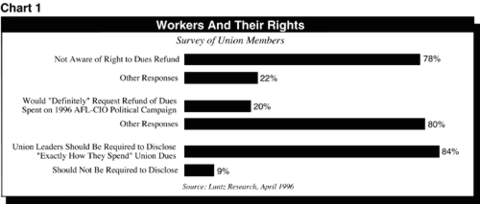
Freedoms of speech and association are important and fundamental employee rights. Many workers do not fully enjoy these freedoms simply because they do not know they have the right to withhold union dues payments expended on political or other nonchargeable activities. An April 1996 Luntz Research survey4 of 1,000 union members revealed that 78% of union members surveyed were not aware of their right to receive a dues refund under Beck for the portion of their monthly union dues spent on political election activities. One out of five union members said that they would "definitely" request a refund in lieu of participating in the coerced support of the AFL-CIO’s $35 million political campaign5 witnessed during the 1996 election. By an 84% to 9% margin, union members in the survey said their union leaders should be required to disclose "exactly how they spend" union dues. (See Chart 1.)
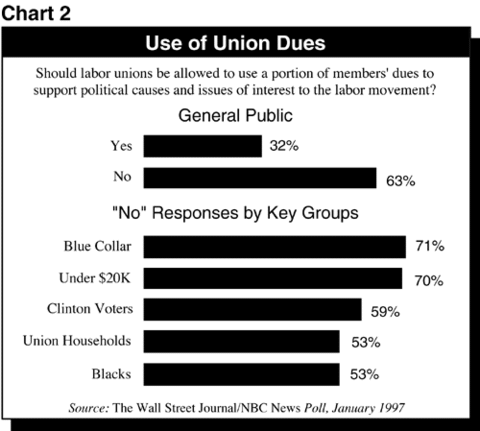
A January 25-27, 1997, Wall Street Journal/NBC News poll indicated that by a margin of 53% to 32% union households believe that labor unions should not be allowed to use a portion of members’ dues to support political causes and issues of interest to the labor movement. The general public, by a spread of 63% to 32%, believes that worker dues should not be used for these purposes. (See Chart 2.)
"Beck rights" is the shorthand denomination for the rights of all nonunion members employed pursuant to union security agreements to not pay certain periodic payments of dues and initiation fees. This paper examines the following:
• Beck developments including the legislative framework under which the law was developed and the provisions of current law which laid the groundwork for court action in the Beck case;
• a legal analysis of significant court and regulatory cases prior to and after Beck was issued;
• the difficulties in enforcing Beck rights;
• the impact on workers, employers, and unions of enforcing these rights in Michigan; and
• the need for an executive order by Michigan’s governor.
The purpose of this study is to increase knowledge of Beck rights and options among workers, employers, and unions. Armed with more complete knowledge, union members can consider the needs and priorities of their unions and still act in their own best interest to exercise greater freedoms of speech. Employers can avoid certain risks by learning more about Beck rights, and there are positive strategies for unions in dealing with Beck issues.
In a national political experiment designed to balance the power between labor and management, Congress enacted compulsory, institutionalized unionism via the National Labor Relations Act (NLRA) in 1935. The public policy announced in that Act continues today and is based on the assumption that the public interest is best served by having employees organized by labor unions. The glue that holds the policy together consists of special powers, privileges and immunities granted to labor union organizers and officials, such as the power to privately tax workers in the form of mandatory dues for the right to work.
Based on the assumption that unions were good for everyone, special features of the law were created to protect unionization at the expense of individual employee rights. Three particularly burdensome provisions of federal law are exclusive representation, union security, and mandatory collective bargaining. These provisions often work in combination to trap employees in an environment in which their individual rights are subordinated in favor of the so-called "collective good."
When a union is selected to represent employees in an "appropriate" unit of workers, the union alone has the legal authority to speak for all employees, including those who neither voted for nor joined the labor organization. No other union, individual or representative may negotiate terms and conditions of employment, and the individual employee is effectively deprived of the opportunity to represent his or her own interests.
This is known as the doctrine of exclusivity which the U.S. Supreme Court upheld in a 1944 case, J.I. Case v NLRB. 6
Under the doctrine of exclusivity, the interests of union officials win out over the interests of nonunion workers. The NLRA and related labor laws are usually portrayed as benefiting employees, but the laws take away legally and practically an individual’s right to price his or her own labor and to work under conditions which are personally agreeable. The sale of an employee’s labor is a private, nongovernmental activity. Unions are voluntary, private organizations clothed by law with the legal power to advance their interests, even when the union’s interests conflict with the personal goals of those employees whom they exclusively represent.
Collective bargaining, by its nature and without exception, involves a trade off of individual interests so that the group as a whole may benefit. Unions typically defend exclusivity by promoting it as a principle of majority rule and analogizing it with congressional elections. A member of the House of Representatives represents all citizens in a district, not just those who voted for the representative, so the argument goes.
The democratic majority rule argument may sound good, but in a union only setting it is not an apt comparison. Unions are private institutions. They make decisions in private, nongovernmental matters. They are private organizations operating in the workplace that are granted exclusive bargaining status by government. In other countries, notably France, exclusivity is not mandatory and several unions may compete in the same workplace. Majority rule is less burdensome to individual workers in places where exclusivity is not mandated.
Freedom for individual employees demands a bright line of distinction between private and governmental actions. Individuals should be empowered to make choices in accordance with their best interests—to go along with the majority or not—exercising either choice without penalty. But under the NLRA, collective bargaining contracts penalize a worker who refuses to side with the majority under threat of losing his or her job. Exclusive representation is equivalent to granting governmental coercive power to unions, even in circumstances where an individual employee might be harmed.
As a quid pro quo for the right of exclusivity, the union is required to represent all employees in the bargaining unit, whether or not they are union members, fairly, in good faith, and without hostility or discriminatory or arbitrary conduct.
This is known as the union’s duty of fair representation, and it is a federal obligation that was judicially created, dating back to the 1944 Railway Labor Act (RLA) case of Steele v Louisville & Nashville Railroad. 7 There the Court held that the Railway Labor Act implicitly "expresses the aim of Congress to impose on the bargaining representative . . . the duty to exercise fairly the power conferred upon it in behalf of all those for whom it acts, without hostile discrimination against them." 8
Almost ten years later, the Supreme Court applied the fair representation principles developed in the RLA cases to the NLRA. 9 In 1962 the NLRB decided Miranda Fuel Co., 10 holding that a breach of the duty of fair representation amounted to an unfair labor practice under the NLRA. The Board decided that "Section 7 [of the NLRA] . . . gives employees the right to be free from unfair or irrelevant or invidious treatment by their exclusive bargaining agent in matters affecting their employment." 11
Beck rights are founded on this theory of the union’s breach of the duty of fair representation.
Union security provisions generally refer to those clauses of a labor contract which protect the union’s status under the agreement. Such contract clauses are not compelled under the law, but they are allowed to be negotiated between an employer and a union. They bind individual employees only when an agreement is reached between a worker’s employer and union.
Union security provisions are frequently classified as either open shop, agency shop or union shop. An open shop exists when there is no union security clause. The agency shop, common in government employment, does not require union membership but does require the payment of a union representation or service fee. The union shop requires union membership in good standing for continued employment.
A union shop requires employees to join the union within a specified period of time and remain members "in good standing." Thus, an employee need not be a member of the union to be hired. (The so-called closed shop, which required an employee to be a member of the union in order to be hired, was outlawed by the enactment of the Taft-Hartley amendments in 1947.) As a condition of continued employment, however, the employee must join the union within a designated period—30 days for industry generally, 60 days for railroad and airline employees, and 7 days for construction work. Under the law, the requirement to "join a union" and to remain a member "in good standing" under a union shop clause has largely meant that the employee must tender regular dues and initiation fees.
An employee who refuses to voluntarily join the union or to pay dues under a union security agreement must be discharged upon the union’s request to the employer. Nonetheless, an employee who offers to pay dues and the appropriate fees but is denied union membership for any reason has satisfied the prerequisites of the law under a union shop proviso. Such an employee cannot be discharged because of his or her non-membership in the union.
The Supreme Court in NLRB v General Motors Corp. defined the extent of union membership that could be required under the NLRA’s authorized union shop agreements. 12 The Court held that the law in Section 8(a)(3), allowing the employer and the union to condition continued employment of the employee on union membership, was limited to requiring the payment of union membership fees. 13 Thus an employee who pays union fees as a nonmember is entitled to keep his or her job as if he or she were a full member. So long as union fees are paid, the employee cannot be discharged for any other union-imposed obligation. 14 The only obligation for membership that can be placed upon an employee under Section 8(a)(3) is financial membership. The Court held that the term "membership" is, at its core, financial support of a union. 15
The union shop agreement is an exception to the freedom granted an employee under the NLRA, Section 8(a), to join or not join a labor organization. Adoption of the union shop between an employer and a union is made subject to state law under Section 14(b) of the Taft-Hartley amendments of 1947. Thus the union shop, the agency shop, and other forms of union security provisions are lawful, provided that they are not prohibited by state statute. Twenty-one states, mostly in the South and West, have enacted laws prohibiting labor agreements that compel union membership. 16 States with such laws are commonly referred to as right-to-work states. Michigan is not a right-to-work state.
Unions justify imposing mandatory financial burdens on all workers, whether members or not, on the theory that unions must represent all workers in the bargaining unit by law. Therefore, the protections and benefits the union negotiates benefit all, and it is only fair that each employee pay for the costs of this representation. This is the so-called "free rider" argument.
Unions will not often acknowledge that they lobbied for and ultimately won the right of exclusive representation. This is an important institutional goal because it immunizes the labor movement from competition from other organizations and persons desiring to become workplace employee agents. Without exclusive representation, there could be no free riders because employees would retain the choice of whether to be represented or not. The burdens unions claim resulting from exclusive representation ring hollow in light of their overriding institutional interests to be free from competition. Forced dues payments are equally likely to catch so-called "free riders" as "forced riders"—those employees whose individual interests are sacrificed for the sake of the collective good. "Forced rider" workers are compelled to subsidize union activity and contribute to policies and decisions that they may find harmful.
Union exclusive representation and the ensuing process of collective bargaining gives the union the right to negotiate with management the terms and conditions of employment. Employers are required by law to meet with the union and discuss its proposals in good faith, as long as the proposals are among the mandatory subjects of bargaining.
Mandatory subjects of bargaining are those labor topics that by law must be negotiated by labor and management when insisted upon by either party. In addition to wages and hours of work, mandatory subjects include fringe benefit programs, seniority, discipline and other issues related to employment. Union security arrangements are among mandated subjects. 17
Unions customarily seek some form of guarantee that employees either become full union members or pay some representation fee (usually the equivalent of membership dues and initiation fees) to the union. Under the standard of good faith bargaining, employers will usually agree to these terms.18 Employers may consider union security provisions to be a no-cost issue item that can be traded for economic concessions of greater apparent value to the employer. The employer sometimes believes its business might be injured by rejecting the union demand. In either case, the employer becomes the enforcer for the payment of compulsory union dues because it will discharge an employee at the union’s request for a worker’s failure to pay dues according to the agreement. An employer can be charged with an unfair labor practice if it complies with a union request to discharge an employee, if the employer has reason to believe that the union failed to follow proper notification and fee objection procedures.
Bargaining in good faith requires the parties to meet at reasonable and convenient times; to meet with minds open to persuasion and a view toward reaching agreement; avoid "surface" bargaining, which occurs when parties present proposals on a "take it or leave it" basis; 19 and taking no employer actions designed to weaken the union’s status as the exclusive bargaining agent while negotiations are in progress.
"Good faith" is generally evaluated by assessing the compromises and concessions made by the parties during the negotiating period. 20 The employer’s duty includes the obligation to supply the union with information upon request that is "relevant and necessary" to allow the union agents to bargain intelligently and effectively. The employer is not compelled to surrender confidential or proprietary information such as its profits and losses, but it can be required to do so if it claims at the bargaining table that it is financially unable to meet the union’s demands.
The employer’s duty to bargain precludes it from taking "unilateral action," i.e., changing the terms or conditions of employment without the union’s accession. For example, this means that the employer cannot put a wage increase into effect until the union agrees, unless the employer has a demonstrated past practice of granting periodic pay raises as a matter of course. The commission of an unfair labor practice, even a technicality, is often relied on to show a lack of good faith bargaining.
The government’s subjective judgment of the content and course of collective bargaining distinguishes this process from the principles of common law commercial contracts.
Laws providing for exclusive representation, union security, and mandated forced bargaining distort the American contractual system and convert it into a governmentally sanctioned, supervised, and oftentimes coerced system that neglect the principles of private, voluntary exchange. Allowing individual workers to withhold a portion of union dues under the Beck decision is a minor remedy for the abuses wrought by compulsory collective bargaining. Permitting the employee discretion to withhold dues that would otherwise be spent on the union’s political, religious or social agenda acknowledges that there are boundaries to collective action. Beck is a recognition that there are limits in our society as to what citizens can compelled to do: that we are a nation dedicated to defending freedom and individual liberty.
Although there are some notable exceptions, the law has generally been slow to recognize individual rights when they conflicted with the policy of institutional unionism that was enacted in the National Labor Relations Act. Union power and prestige grew at an enormous rate for many decades. Union security clauses became the norm. Legislative developments and case precedent from the United States Supreme Court began to chip away at this power base as individual rights reemerged as a significant consideration, especially in areas of labor law where unions’ power was nearly absolute.
Machinists v Street 21 was the first U.S. Supreme Court case imposing limitations on a union’s use of nonmember fees collected under a union shop agreement pursuant to the authority of Section 2, Eleventh of the Railway Labor Act (RLA). 22 In Street, employees who were members of the union under a union-shop clause complained that the union was compelling them to pay dues that were used to support political and ideological activities with which the employees disagreed.
The Georgia state courts enjoined enforcement of the union security clause, holding that Section 2, Eleventh violated the United States Constitution to the extent that it compelled the employees to finance objectionable political causes. 23
The United States Supreme Court thereafter declined to rule on the constitutional issues. Instead, the Court concluded that legislative history clearly established that Section 2, Eleventh prohibited unions from expending an employee’s fees on political causes once the employee had informed the union of his or her objection to such expenditures. Because the use of employees’ fees to finance political programs was not a use that defrayed collective bargaining expenses, the statutory purpose did not justify compelling employees to fund political causes that they opposed.
One year after Street, the Court in Railway Clerks v Allen 24 broadened the rule it developed in Street by holding that a dissenting employee need not state each particular political cause that he or she was opposed to financing. Instead, employees would be protected by objecting to the use of their fees for any political endeavor.
The Court in Street and Allen only restricted the union’s expenditures of fees on political causes. In another RLA case, Ellis v Railway Clerks, the Court addressed other impermissible uses of dissenting nonmembers’ agency fees. 25 The Ellis Court developed a test that asks "whether the challenged expenditures are necessarily or reasonably incurred for the purpose of performing the duties of an exclusive bargaining representative."
In Ellis, the dissenting employees challenged a variety of union-related activities. Applying the test, the Court found that:
1. the union’s national convention was properly chargeable against objector’s fees because it guided the union’s collective bargaining approach and dictated the union’s effectiveness in negotiating labor agreements;
2. the financing of union publications was allowable to the extent that articles discussed activities or events that the union could properly fund out of the general treasury but not political event announcements; and
3. the use of objecting employees’ fees to finance activities aimed at organizing the employees of other employers was prohibited as too attenuated and unnecessary to eliminate the problem of free riders.
Thus the Court in Ellis held that lobbying activities, organizing efforts, and certain union publications were not reasonably necessary to implement the union’s duties as an exclusive representative.
The Court has also applied its general limitation on union dues collected from public sector employees. Michigan citizens have been at the forefront of developing this law and standing up for the exercise of their Constitutional rights.
Abood v Detroit Board of Education 26 is the first case involving union security arrangements in government employment. In this case, Detroit public school teachers who were opposed to public sector unionism challenged the constitutionality of agency fee clauses and the use of the collected fees to finance political and ideological causes. The agency shop clause in the collective bargaining agreement was enforceable under Michigan state law, the Public Employee Relations Act (PERA), which specifically authorized agency shop arrangements.
Relying on its prior decision in Street, the Court upheld the validity of the state-authorized agency shop clause but additionally held that the First and Fourteenth Amendments to the U.S. Constitution prohibited unions from using objecting employees’ dues to finance political or ideological causes unrelated to collective bargaining. The Court established the principle that the U.S. Constitution—not a statute such as the RLA—bars public sector unions from imposing mandatory dues for political purposes when a union member objects.
Chicago Teachers Union v Hudson 27 is the Supreme Court public employee case which most thoroughly sets forth the constitutional requirements for union reduced fee procedures in an agency shop.
• First, nonmembers must be given adequate information about the basis for the representation fee to enable them to know the propriety of the dues calculated prior to the time for objection. 28 The Court reasoned that although the employee retains the burden of objecting, the union keeps the burden of disclosure because of its greater access to such information. 29 The Court acknowledged that while "absolute precision" in the union’s calculations was not practically possible, it nevertheless found that this disclosure must include the identification of "the major categories of expenses, as well as verification by an independent auditor." 30
• Second, the procedure must place 100 % of the dissenters’ representation fees in an interest-bearing escrow account unless the initial disclosure includes a CPA’s verification of expenses. If the fee schedule is verified by a CPA, the union may place in escrow only that portion of expenditures which an objector could reasonably challenge, and the union may retain the remainder. 31
• Finally, the procedure must provide for a "reasonably prompt decision by an impartial decisionmaker" to confirm the nature of the challenged union expenditures and to guarantee that the dues have been used for permissible purposes. 32
The Court went on to rule that the internal procedures of the union were constitutionally inadequate because all three steps of the review of challenges were fully controlled by the union and its officials. 33 The union bears the burden of justifying contested expenditures (those not clearly allocated to either collective bargaining or ideological purposes) promptly and through an impartial decisionmaker. 34 The Court suggested that two procedures would satisfy this requirement: prompt judicial or administrative review or an expeditious arbitration by a neutral arbitrator (not of the union’s unrestricted choice). 35
Despite the rulings in Abood and Hudson, the Court had to revisit the subject of defining the limits to permissible union expenditures as recently as 1991 in Lehnert v Ferris Faculty Association. 36 The Court in Lehnert held that the public sector union representing faculty members could not charge objecting dissenters for the costs of the union’s lobbying efforts and political activities. Despite the union’s argument that the lobbying and political activities were aimed at increasing public funding and support of teaching, the Court concluded that the First Amendment precluded the union from charging dissenters for these practices because these activities were too attenuated to justify compelled support.
In the landmark decision, Communication Workers v Beck, 37 the Court held that for workers covered by the NLRA—which includes most private sector workers—the "financial core" obligations of membership are limited to union activities "germane to collective bargaining, contract administration, and grievance adjustment." 38 The Court held that the union could not collect dues from objecting employees for the costs of organizing employees of other employers, lobbying for labor legislation, or participating in social, charitable, or political events.
The Court in Beck recognized that the NLRA and RLA are essentially equivalent. 39 Consequently, the Court believed that the two sections of the law permitting union shop agreements were enacted for the same purpose and that they should be interpreted in a parallel manner. Therefore, the NLRA should also be interpreted to prohibit extracting and expending funds collected from nonmembers on activities unrelated to collective bargaining, contract administration and grievance adjustment.
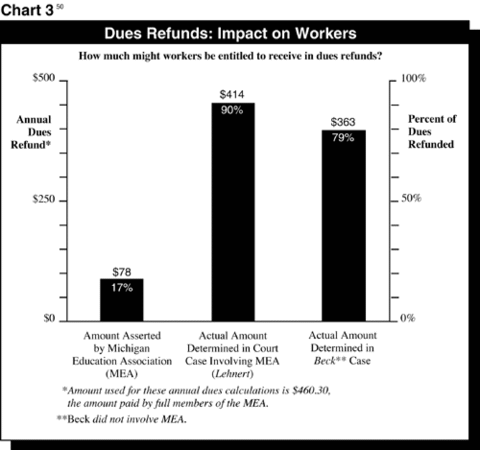
In the Beck case, about 79% of the dues normally collected could not be legitimately charged to objecting nonmembers. The district court in Lehnert (the Ferris State University case) found that 90% of dues were being spent in furtherance of nonchargeable activities and applied to public sector unionism the principles embodied in Beck. 40
Where a union security clause exists, the expenditure of dues over the objection of a nonmember-unit employee violates the duty of fair representation that the union owes to the dissenting employee. Activities such as organizing employees of other employers, lobbying for labor legislation, or participating in social and political events cannot be charged to the employee exercising rights pursuant to Supreme Court precedent.
The National Labor Relations Board (NLRB) has been slow to enforce and protect union nonmembers’ Beck rights. After sitting on hundreds of employee unfair labor practice charges since the Supreme Court’s 1988 Beck decision, the NLRB in 1995 issued its lead case decision in interpreting the Supreme Court’s eight-year-old ruling.
In California Saw and Knife Works, 41 the Board held that if a nonmember employee chooses to file a Beck objection, the employee must be apprised by the union of the following information:
The employee’s right to be a union nonmember;
The percentage of the reduction in fees for objecting members;
The basis for the union’s calculation;
The right to challenge these figures. 42
The purpose for providing the objectors with this information is to allow an employee to decide whether there is any reason to mount a challenge to the union’s dues reduction calculations. 43 Also, when a union seeks to require an objecting employee to pay dues under a union security clause, reasonable procedures must be available for filing challenges to the amounts charged. Any procedures not shown to be arbitrary, discriminatory, or in bad faith will satisfy the union’s obligations under Beck.
The Board in interpreting the NLRA has refused to extend all of the procedural safeguards required under the Hudson ruling, which is limited to public employees. The cases and law are developing, and employee rights may be expanded based upon the decisions of higher reviewing courts or internal interpretations by the Board itself. The filing of additional employee cases will aid the Board in examining various factual situations to further clarify the law. 44
While each of the three major Supreme Court cases deals with a different segment of the workforce (Lehnert with the rights of public employees under the Constitution, Ellis with railway and airline employees under the RLA, and Beck with the rights of most other employees under the NLRA), the principles behind employee dues protections are essentially the same. The legal theories supporting these cases vary slightly, and the procedural requirements are different, but the underlying principle is that union dissenters cannot be compelled to contribute monetary support to those activities which are not germane to the union’s function within the workplace.
Since the Supreme Court’s 1988 decision, Beck enforcement has been nearly nonexistent. Congress has taken no action to codify the protection of nonmember employee rights, despite two failed attempts. The NLRB has operated at a snail’s pace enforcing Beck protections. If employees are left to seek redress with only private litigation, the realization of Beck rights will be slow, expensive, and nonexistent for most.
In April 1992, President Bush provided the impetus for a renewed focus on the rights of nonmember employees by signing Executive Order 12800. 45 The purpose of this Executive Order was to inform employees working for federal contractors that they have individual rights and discretion to control union political contributions generated from dues. The principal requirement of the president’s order was the mandatory posting of signs at the work sites of federal contractors informing employees of their rights regarding payment of fees to the union.
The full text of Executive Order 12800 read as follows: 46
Notice to Employees
Under Federal Law, employees cannot be required to join a union or maintain membership in a union in order to retain their jobs. Under certain conditions, the law permits a union and an employer to enter into a union-security agreement requiring employees to pay uniform periodic dues and initiation fees. However, employees who are not union members can object to the use of their payments for certain purposes and can be required to pay their share of union costs relating to collective bargaining, contract administration, and grievance adjustment.
If you believe that you have been required to pay dues and fees used in part to support activities not related to collective bargaining, contract administration, or grievance adjustment, you may be entitled to a refund and to an appropriate reduction in future payments.
The notice also advised employees to contact the Division of Information at the National Labor Relations Board for further information and gave the Board’s address in Washington, D.C.
President Bush indicated that his intention in signing the order was to "strengthen the political rights of American workers from being compelled against their will to pay union or agency dues in excess of what is actually used for collective bargaining purposes and contract administration." The primary purpose of this Executive Order was to enforce the protections of the Beck decision by "clarifying and bringing up to date requirements for labor organizations to account for how workers’ dues are spent."
At one point, White House officials estimated that President Bush’s Beck order could cut off as much as $2.4 billion annually in union money available for political activities. Union officials, however, disputed that figure as wildly inflated, contending that unions spend less than $1 billion yearly on political and other such activities. 47
Although Bush’s Executive Order was a step in the right direction of advancing worker knowledge, it was short-lived. Within a month of assuming office in 1993, President Clinton rescinded the Bush Executive Order as "distinctly anti-union" on the grounds that it failed to notify workers of any other rights protected by the NLRA. 48 Even if this argument is accepted, a simple solution would have been to widen the scope of Executive Order 12800 to include other worker rights, but this was not done. President Clinton has not proposed an alternative to Executive Order 12800 and there seems little likelihood that he will do so. The present policy will tend to keep workers uninformed of their rights to a refund of compulsory union dues.
After seven years of notable absence from deciding Beck cases, the National Labor Relations Board (NLRB), the enforcing federal agency for the NLRA, has recently started to carry out the Supreme Court’s Beck decision in a series of cases outlined in the previous section. The Board has not gone as far as the federal courts in applying to private sector unions the same procedural requirements imposed on public employee unions because the Board does not view Beck rights as Constitutional in nature.
Nevertheless, the NLRB provides essential safeguards that preserve employee interests because the Board’s proceedings are fast, inexpensive, and the charging party is not required to hire an attorney. This offers many benefits to an individual employee who can ill afford the time and money to pursue a lawsuit against a union that disregards Beck rights. Unlike the courts, the NLRB can provide a labor forum that acts to balance the powerful resources available to the union against the individual employee. The Board typically employs only "make-whole" remedies that are designed to effectuate the policies of the NLRA. Reinstatement of a discharged worker and back pay are the most common examples of make-whole remedies used by the Board.
It remains to be seen if the Board will adopt broader protections in enforcing Beck rights. A lack of voluntary union compliance to Beck standards will promote employee unfair labor practice charges. Some unions presumably will continue to litigate the boundaries of what constitutes germane collective bargaining activities, attempting to keep chargeable versus nonchargeable expenses as broad as possible. As this occurs, the Board will be compelled to further refine union obligations to nonmembers.
Beck rights established by the U.S. Supreme Court and the administrative agencies of government are not self-enforcing. In the absence of a union’s voluntary compliance with Beck standards, it may be necessary for an employee to seek relief through the courts, the Michigan Employment Relations Commission (MERC), or the NLRB. This is the least desirable way to pursue employee rights but it may be the only way to secure them if unions do not comply voluntarily with the law.
The best way to secure worker Beck rights is by voluntary cooperation between the worker and his or her union. Workers who wish to know how their dues money is being spent may request that information in writing from the union. (See Appendix A for a sample letter.) Workers who wish to receive a refund of dues money spent on union political, social, or ideological causes may inform their union in writing that they are exercising their rights as a Beck objector. (See Appendix B for a sample letter.)
If a union fails to provide employees with the required Beck information, including the procedures for filing objections, or if an employee challenges the agency fee calculation, he or she may commence a lawsuit in federal court for breach of the union’s duty of fair representation. In addition to a private lawsuit, the aggrieved employee may file an unfair labor practice with the NLRB, which has offices located in both Detroit and Grand Rapids, or, if the employee works in the public sector, charges may be filed with the Michigan Employment Relations Commission which has offices in Lansing and Detroit. Although procedures in these two agencies differ somewhat, they both require that the charge be filed within six months of the alleged unfair labor practice.
The NLRB has an information officer on call throughout operating hours, and the Board has slowly improved the accuracy and availability of information regarding Beck rights. The NLRB also has free written materials that offer a general outline of all worker rights under the NLRA. MERC currently has no policy that standardizes information and no written materials to inform workers of their right to become nonmembers of a union. According to one MERC official, the information given in response to an information request regarding union withdrawal and dues rebate may vary based upon who a person speaks to at MERC. (Addresses and telephone numbers of these agencies are included in Appendix C.)
Unions tend to downplay both the likely impact of educating rank-and-file members of their right to a refund of union political expenditures, and the probable effects of enforcing Beck rights in the courts and administrative agencies. Union claims in this area may be a little suspect considering that they are a primary force in suppressing and distorting knowledge of Beck rights. If the exercise of Beck rights continues to receive greater legal attention and workers receive a growing body of truthful information on the subject, a number of contemporary trends will change the face of unionism.
Widespread knowledge of Beck rights will cause union members to consider the advantages and disadvantages of exercising the right to a dues rebate and a reduced agency fee. The decision of whether to exercise Beck rights is very much a matter of individual choice.
Under the RLA and NLRA case law, a union can compel employees to resign from the union in order to exercise their Beck rights. The employees continue to remain fully covered by the terms of the collective bargaining agreement and the union is bound to represent the nonmembers through its duty of fair representation. For example, a union cannot refuse to handle grievances filed by a Beck objector simply because he or she is a nonmember, and courts are willing to more closely examine duty of fair representation cases where nonmember status is an issue. In exchange for services that the union must offer to the nonmember, the employee must continue to pay "financial core" dues to the union, thus sharing in the costs of representation but avoiding those expenditures which are not germane to collective bargaining.
Given the substantial power the union has to affect an employee’s working conditions, it may be to the employee’s advantage to have a say in the way that the union exercises its authority. The only effective way to do that is to become or remain a union member and participate in its governance. Those rights of participation are almost always limited to union members. Depending on the employee’s level of interest in union affairs, union members can participate in critical decisions about negotiation strategies and goals, how the collective bargaining agreement will be enforced and which grievances should be taken to arbitration. Participating in strike votes, ratification or rejection of contract terms, and the election of union officers are important rights of union membership that many Beck objectors must forgo.
Exercising Beck rights in the workplace has other effects. Peer pressure and bullying from within union ranks often discourages members from exercising Beck rights. Exercising Beck rights by objecting to paying full union dues may create an uncomfortable working environment and tension among coworkers who support the union’s political and ideological causes. Other members may feel that the Beck objector is shirking the full payment of dues while accepting the benefits of union representation, even though this is untrue because nonmembers must pay for exactly those services the union renders according to the duty of fair representation. More often than not, the primary reason that rank-and-file union members are discouraged from exercising Beck rights is simply because they are pressured to avoid "rocking the boat."
Beck rights can be resolved only on an individual basis. Whether to become a core financial member is a personal choice—one which may stand primarily on principle. Beck rights stand for a very important principle, and the individual who exercises these rights usually does so on principle. In Beck the Supreme Court recognized that the principles of individualism and the ability to control one’s own political, social and moral choices should not be undermined by policies favoring collective bargaining and unionization.
Benefits received by nonmembers must be considered for a full appreciation of the rights recognized by Beck. Nonmembers escape the union’s ability to fine workers for violating the union’s constitution and bylaws. Escaping internal union rules and disciplinary actions may be a significant plus for some employees. Working during an authorized strike without penalty is a common example. A union member who crosses the picket line may face fines and other disciplinary proceedings, while a Beck objector is free to join strikers or work through a labor dispute based on his or her own choice and personal needs. The Supreme Court has held that an employee may resign from the union at any time in order to avoid the force of such disciplinary rules, but resignation only works prospectively and must precede the acts for which the union member may be disciplined. 49
Another major benefit to an employee who exercises Beck rights is that refunded dues money translates into an immediate pay raise. Although this may not increase each paycheck significantly, the total rebate can grow large over many years. Political and ideological expenditures out of these average union dues could presumably be as high as 79% (as in Beck) or even 90% (as in Lehnert). The union member who exercises Beck rights could save this money. For instance, an employee paying an annual union fee of $672 could, if the nonchargeable expenditures were as high as in Lehnert, receive a rebate of about $600. Likewise, an employee paying $250 annually could receive a rebate of $100 if the nonchargeable expenditures were determined to be 40%. There are many rebate variables which make precise figures difficult to estimate. (See Chart 3.) 50
The Employment Policy Foundation of Washington, D.C., estimates that the average local union member in 1995 in a non-right-to-work state pays approximately $425 in dues annually. Professor James Bennett of George Mason University calculated that the average annual dues for 1987 was $672. 51
On the other hand, the dues rebate may be smaller. The Michigan Education Association (MEA) claims that only 17.29% of its dues is allocated to nonchargeable expenditures. A full dues paying member pays $460.30 annually; the reduced fee paid by core members is $380.71 (less a $3.00 allowance for potential disputed chargeable costs). The MEA’s accounting procedures are currently under legal attack, however, and the Association has so far refused to reveal the underlying documentation to prove that its accounting procedures are legitimate. 52
A substantial benefit inuring to Beck objectors and full union members is the requirement that the union account for its expenditures and inform the represented employees of how their dues money is being spent. This has been one of the greatest complaints of union members—that they are in the dark regarding how the union spends their money. Beck rights shed light on this issue by forcing the union to account for expenditures. Full union members are aided by being able to challenge the union’s fiscal discretion and influence the direction of their union. Active union members are thereby able to more fully participate in the union’s internal proceedings, providing additional democratic oversight to the operation of their union. This is a healthy development in union affairs and is long overdue. Perhaps the entire Beck issue could have been avoided had the unions voluntarily disclosed financial information to the rank-and-file, instead of vigorously resisting full disclosure.
Many employees may exercise their Beck rights because they want the freedom to spend their own money on the political causes, issues and candidates they wish to support and not those dictated by their union. Should workers who enjoy hunting be forced to pay dues which support political candidates who oppose firearm ownership? The list of possible objections is endless. That is why it is important to leave personal political decisions to individuals and not to presume that a union (or any other group) has the right to make those decisions for workers.
The NLRA has deprived union members of their most fundamental civil liberties through compulsory dues and a lack of accountability. Beck rights are a triumph for individual rights over the political weight of union leaders and they represent a giant step toward worker political emancipation.
Union leaders may view the exercise of Beck rights as their worst nightmare. This need not be the case. Unions currently have a workplace monopoly which enables them to collect dues through compulsory union security agreements. A voluntary membership and dues system would avoid Beck problems completely and return unions to the true service organizations they were originally envisioned to be.
The current union approach of suppressing information and confusing members regarding Beck rights risks alienating rank-and-file members and ruining union credibility. In the short run, there is little doubt that unions will experience a loss of revenue, a potential loss of members, and significant expenses in bookkeeping procedures and litigation expenses necessary to resolve Beck complaints.
The 1994 Current Population Survey (CPS) 53 determined that there are 960,600 active union members employed in the state of Michigan. According to the Luntz survey findings that only 22% of union members know of their Beck rights, it can be presumed that around 493,000 Michigan private sector union members do not know of their reduced dues rights under the Beck decision, and some 257,000 Michigan public sector employees are likewise unaware of their Constitutional rights under similar U.S. Supreme Court cases. Assuming the Luntz Research findings are accurate, a tremendous 750,000 Michigan union members or agency fee payers are not aware of their Beck rights, and approximately 384,000 Michigan union members would be very likely to exercise those rights if they were made aware of them. 54 The unions face the possibility that they may lose these many members which would reduce their income and bargaining strength.
Union leaders seem frightened by the potential loss of their coercive power to extract mandatory dues money for partisan or political purposes. Union officials have downplayed the impact of Beck and have predicted that the number of nonmember employees stepping forward to object will be negligible. Union attorneys optimistically predict that 80% to 90% of collected dues can be shown to be used for collective bargaining purposes. 55
The potential Beck cost to unions is difficult to predict because of the uncertainty of the variables involved. Assuming only one-third the number of union members predicted by Luntz would pursue a refund, and using a union claim that only 20% of union dues may be refundable, Michigan unions face an annual potential payout of over $10 million to workers exercising their Beck rights. 56 The actual payout could be much higher.
If union leaders were truly confident that they spend most dues-generated revenue in accordance with Beck, there would be no reason to suppress information regarding these rights. It is disingenuous for unions to argue on the one hand that Beck rights are meaningless while fighting Beck objectors every step of the way. It is evident that more widespread knowledge of Beck rights will result in more workers seeking refunds and future reduced dues, and that is probably the heart of the unions’ fears.
Pursuing a "hear no evil, see no evil" strategy will hurt the union movement in the long run. The secret cannot be bottled up forever. Beck is the law of the land, and it is here to stay. To the extent that unions avoid or delay compliance with Beck, they stand to alienate their rank-and-file who will eventually learn of the union’s efforts to keep employees in the dark. As employees become more informed of Beck rights, unions risk losing credibility for the current strategy of silence, suppression, and delay.
Unions have control over this situation. A better course of action for the unions would be to recognize Beck’s implications and adopt a policy that no union dues will be used for political activities without the express written consent of members and nonmembers alike. Unions should provide an annual detailed financial accounting to each member, outlining the preceding year’s expenditures. Those unions that refuse to adopt these policies risk future actions from the legislature, the NLRB, and the courts, all of which could set and regulate internal union policies.
Employers of union workers should not continue to ignore Beck issues. They have a legitimate stake in communicating Beck safeguards to workers as a shared acknowledgment that protecting nonmembers’ rights is essential. Protection of a nonmember employee’s rights is the duty of both the employer and the union.
There are legal reasons why an employer should ensure that employees know their Beck rights. Where a union contract includes a dues check-off provision—a voluntarily signed authorization by the employer to permit deduction of union dues from the employee’s wages—the employer may become caught between the union’s demand for dues payments and the dissenting employee’s dispute regarding the proper amount of dues. When an employer enforces the collective bargaining agreement against the individual member on behalf of the union, it risks relying on the union’s accounting calculations and procedures. If these are defective, the employer violates the employee’s rights by discharging the employee.
This situation risks conflict and liability for an employer. An employer can guard against this by actively insuring that Beck opportunities are known by the employees and that adequate procedural safeguards are adhered to prior to taking any action enforcing the union security agreement.
Michigan citizens have been a catalyst in establishing Constitutional protections in this area of law (both Abood and Lehnert were Michigan cases); yet, these hard won rights are going almost unrealized because of the lack of information available to employees working under compulsory union arrangements. It is time to make workers aware of their rights under applicable Supreme Court decisions and to make it possible for them to exercise these rights freely. Unions, the NLRB, the current national administration, and employers have kept workers uninformed of their basic civil and human rights. The situation is unlikely to change and it warrants executive branch leadership and attention.
Governor Engler should intervene with an Executive Order. The order should notify state public employees (including school employees) and private employees working for contractors on state-funded projects of their statutory and First Amendment Constitutional rights to limit dues payment to collective bargaining functions. President George Bush’s 1992 Executive Order mandated that federal contractors post notices at their work sites informing union members of their Beck rights. Governor Engler should follow suit as a practical and effective way to protect the rights of Michigan citizens.
The Governor, acting as Chief Executive Officer of Michigan, has the Constitutional authority in Article V, Sections 1, 2 and 8 and the Michigan State Constitution to require the posting of Beck information notices on all public and private workplaces throughout the state. This Executive Order would not seek to change the laws, but rather to implement the laws according to statutory and U.S. Constitutional dictates. No separation of powers problem is presented.
An Executive Order is a legitimate, responsible, and necessary exercise of gubernatorial authority. 57 President Bush’s Executive Order 12800 could be used as a model for an Executive Order issued by the Governor, but Governor Engler should also direct MERC to implement a policy to further carry out his directives. MERC should prepare for this by standardizing its policy to inform workers of their rights pursuant to the proper Supreme Court precedents, and the agency should further develop written materials that can inform and assist workers attempting to exercise their rights to reduced dues.
An Executive Order protecting the political freedom of Michigan workers would establish Michigan as a "beacon of light" for the rest of the United States. It would build upon and support the recent 1994 Michigan state legislation amending the Michigan Corporate Campaign Finance Act requiring labor unions to obtain affirmative annual consent from union members before automatically deducting political contributions from employee payrolls. 58 This law is now in operation as a result of the approval of the United States Court of Appeals for the Sixth Circuit. 59 Governor Engler is reported to have praised the ruling as an extension of "worker democracy." 60
Governor Engler’s intervention in the Beck arena would undoubtedly be an extension of worker democracy. Some special interests might complain that this is harassment, but those who experience the real harassment and obstruction are Michigan workers who try to exercise their right to refuse to fund political causes with which they disagree. Any question of whether they would exercise a Beck right can be settled right here in Michigan.
The great majority of union members are not aware of their Beck rights to receive a refund of dues money spent on political and other causes to which they may object. Workers who wish to exercise Beck rights may inform their union and ask for the appropriate refund.
Labor unions which do not cooperate with Beck requests may in the long run damage union credibility with members and the public, and may invite interference from the legislature, courts, or NLRB.
Governor Engler, through the issuance of a Beck-type gubernatorial Executive Order can accomplish for Michigan workers what their unions, employers, and lawmakers have not done for them—inform them of their political rights by mandating the posting of appropriate notices in their workplaces. This will enable Michigan workers to get the legal facts and to protect their jobs, income, and union dues from political exploitation.
"To compel a man to furnish contributions of money for the propaganda of opinions which he disbelieves," wrote Thomas Jefferson in 1779, "is sinful and tyrannical." Michigan can and should be the place where Jefferson’s admonition is heeded.
today’s date here
union president’s name
union address
Dear Sir or Madam:
As a full dues paying member of the union, I am requesting detailed financial information from you relative to union spending this year on matters both related and unrelated to our bargaining agreement. I would like an accounting of all expenses, including political expenditures, support or contributions to charitable, religious or ideological causes, lobbying activities, and other non-collective bargaining expenses.
This information will enable me to fully participate in the determination of the union’s spending policies and to assure myself that spending is consistent with our unit’s overall best interests. This information will also assist me in deciding whether I wish to become a Beck financial core member at some future time.
I would appreciate a prompt response to my request. Please advise me as to when this information will be forthcoming should there be any delay in sending it to me.
Sincerely,
your name
your home address
your company’s name
your work location
today’s date here
union president’s name
union address
Dear Sir or Madam:
In accordance with the U.S. Supreme Court’s decision in Patternmakers v NLRB, I hereby resign my membership with the union, (Insert Union Name), effective immediately.
Furthermore, I wish to exercise my rights pursuant to Communication Workers v Beck, and declare myself to be a Beck objector. Pursuant to the Supreme Court’s Beck decision, I object to the use of my dues money being used for any purpose other than those related to collective bargaining, contract administration and grievance processing in my immediate bargaining unit. Any fees that are not related to these financial core activities should be immediately deducted from my dues, pursuant to the procedures outlined by the U.S. Supreme Court.
I also desire to exercise my rights to a full accounting performed by an independent auditor, a reasonably prompt opportunity to challenge any fees before an impartial decisionmaker, and insist that any disputed fees be placed in escrow pending a final determination as to the appropriateness of any asserted charges.
Please provide me with an accounting as soon as possible. Until such time as an accounting is provided to me, please escrow all of my dues that are not subject to an immediate rebate. Additionally, if there will be any delay in obtaining a full accounting, please advise me as to when this information will be forthcoming.
I would appreciate a prompt response to my request.
Sincerely,
your name
your home address
your company’s name
your work location
For further information, the following agencies should be contacted:
Public sector employees:
Michigan Employment Relations Commission (MERC)
1200 6th St., 14th Floor
Detroit, MI 48226
Telephone: (313) 256-3540
Private sector employees:
National Labor Relations Board
Region 7
Patrick V. McNamara Federal Building
477 Michigan Ave., Room 300
Detroit, MI 48226-2569
Telephone: (313) 226-3200
The National Labor Relations Board may also be contacted in Washington, D.C. ContactDave Parker, Director of Information, at (202) 273-1991, or fax (202) 273-1789.
All employees:
Mackinac Center for Public Policy
Department of Labor Policy
119 Ashman St.
P. O. Box 568
Midland, MI 48640
Telephone: (989) 631-0900
The author wishes to thank William Maze, labor policy research assistant for the Mackinac Center for Public Policy; D. Mark Wilson, Rebecca Lukens fellow in labor policy at the Heritage Foundation in Washington, D.C.; and David Kendrick, program director for the National Institute for Labor Relations Research in Springfield, Virginia, for their expertise and invaluable assistance in the preparation of this study.
1 Florence Calvert Thorne, Samuel Gompers—American Statesman 24 (1957) quoted in A. Samuel Cook, The Case for a Maryland Right-To-Work Law, (Maryland Business for Responsive Government, 1996) at 17.
2 George Meany, Foreword to Samuel Gompers, Seventy Years of Life and Labor (1957) quoted in A. Samuel Cook, The Case for a Maryland Right-To-Work Law, (Maryland Business for Responsive Government, 1996) at 17.
3 487 US 735 (1988).
4 National Survey of Union Members, The Luntz Research Companies—ABB Union Survey (Americans for a Balanced Budget), April 29, 1996, at 5.
5 This dollar amount is conservative and pertains only to the AFL-CIO's contributions to the U.S. House election campaign. Total estimates range between $95 and $100 million including union PAC money. Rutgers University economist Leo Troy estimated that in-kind expenditures—for mailings, printings and other uses of union facilities—could have reached $500 million. Wash Times, Mar 25, 1996. See also, Big Labor: Big Loser Det News, Nov 7, 1996. In the 1994 election, the Michigan Education Association PAC was the third largest contributor to Michigan "statewide candidates, legislative candidates, judicial candidates and local candidates" according to Common Cause—Michigan. 1994 PAC Study (Common Cause—Mich) Apr-May 1995.
6 321 US 332, 64 S Ct 576, 88 L Ed 762 (1944). See also Order of R.R. Telegraphers v Railway Express Agency, 321 US 342, 64 S Ct 582 (1944); Caterpillar Inc. v Williams, 482 US 386 (1987).
7 323 US 192, 65 S Ct 226, 89 L Ed 173 (1944).
8 Id at 202-203.
9 Ford Motor Co. v Huffman, 345 US 330 (1953).
10 140 NLRB 181 (1962).
11 Id at 185.
12 373 US 734, 83 S Ct 1453, 10 L Ed 2d 670 (1963).
13 Id at 742.
14 Id at 743.
15 Id at 742.
16 Alabama, Arizona, Arkansas, Florida, Georgia, Idaho, Iowa, Kansas, Louisiana, Mississippi, Nebraska, Nevada, North Carolina, North Dakota, South Carolina, South Dakota, Tennessee, Texas, Utah, Virginia, and Wyoming, Lab Rel Rep LRX 730:319-20.
17 See NLRB v General Motors Corp., supra note 12.
18 It must be emphasized, however, that good faith bargaining does not require the employer to agree to union security provisions. Cf. Overnight Transportation Co., 307 NLRB 666 (1992).
19 General Electric Co., 150 NLRB 192 (1964), enf'd 418 F 2d 736 (2nd Cir 1969), cert denied 397 US 965. This type of bargaining is also referred to as Boulwarism from the name of the negotiator who developed it. See James G. Baker, Negotiating a Collective Bargaining Agreement: Law and Strategy—A Short Course for Non-Labor Lawyers, Lab L J, Apr 1996, at 257-258.
20 Cf., supra notes 12 and 18.
21 367 US 740 (1961).
22 Id at 742-744.
23 The United States Supreme Court in Railway Employees' Dep't. v Hanson, 351 US 225 (1955), held that although Section 2, Eleventh was Constitutionally valid on its face, it was subject to Constitutional limitations because it preempted state laws, and therefore, constituted "governmental action on which the Constitution operated." By contrast, Section 8(a)(3) of the NLRA does not preempt state authority because of the application of Section 14(b) which allows states to prohibit union security agreements.
24 373 US 113 (1963).
25 466 US 435, 104 S Ct 1883, 8 L Ed 2d 428 (1984).
26 431 US 209 (1977).
27 475 US 292 (1986).
28 Id at 306.
29 Id at 306.
30 Id at 307 n18.
31 Id at 305, 310.
32 Id at 309.
33 Id at 308.
34 Id at 307.
35 Id at 308 n21.
36 500 US 507, 111 SCt 1950 (1991).
37 Supra note 3.
38 Id at 745.
39 Id at 2649.
40 Lehnert v Ferris Faculty Ass'n, 643 F Supp 1306, 1327-1330 (WDMich. 1986), aff'd, 881 F.2d 1388 (1989), modified, 500 US 507 (1991). In Lehnert, the district court held that 81% of the FFA's activities were properly chargeable to the plaintiffs. Thus, out of $24.80 in union dues allocated to the FFA, $20.09 were chargeable. Id at 1327. However, only 3.4% of the MEA's portion of dues were chargeable, amounting to $7.18 out of $211.20 were properly chargeable. Id at 1329. Likewise, only 2.75% of the NEA portion of dues were chargeable, reducing the NEA's portion to $1.32. Id at 1330.
41 320 NLRB No 11 (December 20, 1995).
42 Id at 233.
43 Id at 240.
44 See Weyerhaeuser Paper Co., 320 NLRB No. 12 (1995), [unions must notify current employees of their Beck rights if they were not informed of those rights at the time they entered the bargaining unit]; IUS, Local 444 (Paramax Systems Corporation), 322 NLRB No. 1 (1996), [union must provide dissenting employee with a breakdown of its major categories of expenditures or differentiate between chargeable and nonchargeable expenses]; Production Workers Union, Local 707 (Mavo Leasing Co.), 322 NLRB No. 9 (1996), [union is required to tender notice of Beck rights to nonmember unit employees before it can subject employees to monetary obligations imposed by a union security provision or seek to cause their discharge for failure to pay dues]; Laborers' International Union, Local 265 (Fred A. Nemann Co.), 322 NLRB No. 47 (1996), [union need not provide employee with financial information to allow an objector to decide whether to mount a dues reduction challenge where the union has waived for the employee all requirements for dues payments]; United Brotherhood of Carpenters, Local 943 (Oklahoma Fixture Co.), 322 NLRB No. 142 (1997), [union's use of a charitable dues payment alternative does not relieve it of its obligation to provide the employee and other objectors with Beck related financial information].
45 Exec Order No 12800, 57 Fed Reg 12,985 (1992), repealed.
46 Ibid.
47 See Richard L. Berks, Bush Fires a Shot at Union Political Spending, NY Times, Apr 19, 1992.
48 Exec Order No 12836, 58 Fed Reg 7045 (1993).
49 Pattern Makers' League of North America v NLRB, 473 US 95, 105 S Ct 3064, 87 L Ed 2d 68 (1985).
50 Chart 3 illustrates the situation for a typical union member, not just for MEA members. Individual workers' dues may be higher or lower than the amounts shown; individual unions may demonstrate higher or lower percentages of dues spent on political, social, ideological, and other refundable activities.
51 The Story on Union Dues and Partisan Politics, 2 Fact & Fallacy 11 (Employment Policy Foundation, Washington, DC), Dec 1996, at 2.
51 James Bennett, Private Sector Unions: The Myth of Decline, 12 J Lab Res 1 (1991), cited in Fact & Fallacy, Ibid.
52 See Bromley v Michigan Education Association-NEA, Nos 94-1164/1210 (6th Cir Apr 26, 1996). It should also be noted that the Ferris Faculty Association (FFA)—the challenged union in Lehnert where 90% of the collected dues were wrongfully charged to nonmembers—was an affiliate of the MEA and NEA. See supra note 36 at 512.
53 Barry T. Hirsch and David A. Macpherson, Union Membership and Earnings Data Book 1994: Compilations from the Current Population Survey 24 (1995).
54 The Luntz survey found that 20% of union members said that they would "definitely" request a refund, while an additional 20% said that they would be "very likely." Only 38% of the union members surveyed responded saying that they were either "somewhat unlikely" (29%) or "very unlikely" (9%) to request a refund. Supra note 4 at 5.
55 Union Lawyers Grapple With Beck Compliance: Right to Work Forces Map Out Battle Plans, Daily Labor Rep. (BNA) No. 131 at A-1 (July 8, 1988).
56 A sample calculation is as follows: Luntz and CPS figures suggest that 384,000 Michigan union members would be very likely to exercise Beck rights. Assume that only one-third that number (128,000) actually would do so. Assume average annual union dues of $425 (Employment Policy Foundation). Assume only 20% of union dues are refundable. Multiplying these figures yields over $10 million.
57 Cf. House Speaker v Governor, 443 Mich 560, 506 NW2d 190 (1993); Soap & Detergent Ass'n v Natural Resources Commission, 415 Mich 728, 330 NW2d 346 (1982).
58 Mich Comp Laws Ann ß 169.255(6) (West Supp 1996-1997).
59 Michigan State AFL-CIO v Miller, Nos 95-1397/1858 (6th Cir Jan 7, 1997).
60 Automatic Deduction for Mich. PACs Barred, School Reform News (Heartland Institute, Palatine, IL.), Apr 1997, at 4.