Font size:
The U. S. Supreme Court's 1988 landmark decision Communication Workers v. Beck established the rights of employees working under union contracts to pay only those union dues or fees necessary to cover the costs of a union's employee representation duties. However, the majority of Michigan's nearly one million union workers are unaware of their rights under the Beck decision for the simple reason that their unions neglect to inform them. This report shows how "paycheck protection" legislation would help safeguard worker Beck rights by requiring unions to obtain up-front, written approval from individual workers each year before they could spend the dues money on political or other non-workplace-related activities. The report recommends that Michigan policy makers adopt a paycheck protection proposal to help union workers enjoy their freedoms of speech and association as they refrain from involuntarily contributing money to union causes with which they disagree.
In 1988, the U. S. Supreme Court decided the landmark case Communication Workers v. Beck, which established the rights of employees working under union contracts to pay only those union dues or fees necessary for performance of a union’s employee representation duties. Under Beck, fees to support union expenditures unrelated to workplace representation, such as political, social, or charitable contributions, are not mandatory.
Although these "Beck rights" of union workers are well established as a matter of American labor policy, they go largely unrealized in practice for the following reasons:
Most workers simply do not know that they have these rights;
Workers who are aware of these rights are forced to make the sometimes-untenable choice of resigning from their union in order to exercise them;
Workers do not have recourse to an effective legal enforcement mechanism if their Beck rights are denied them by their employer or union; and
Unions, who don’t agree with the exercise of Beck rights, often engage in a variety of tactics to delay and frustrate workers who wish to limit their dues payments.
Several states, including Idaho and Washington, have enacted a measure known as "paycheck protection" to remedy these deficiencies in Beck rights enforcement. Paycheck protection safeguards worker rights by requiring unions to obtain up-front, written approval from individual workers before they spend dues money on political or other non-workplace-related activities.
Michigan has taken a significant, though limited, step in this area by enacting Public Act 117 of 1994. Under this legislation, individual workers must give their consent each year before payroll dues deductions can be used for political action fund contributions. Full paycheck protection would extend these requirements to cover all union non-workplace-related dues expenditures.
Paycheck protection is not a cure-all for workers who are trapped in compulsory union arrangements because the law grants to unions privileges that subordinate workers’ individual rights to the "collective good" of the union membership. Paycheck protection is, however, a more balanced pro-worker approach:
All workers are notified of their option to contribute or withhold dues money;
All employees continue to be represented by the union;
All workers are compelled to pay for union representation services from which they benefit; and
The union is able to continue spending on matters it deems important—but only with dues money consciously and voluntarily contributed by its dues payers.
The concept of paycheck protection is popular among workers, even those who recently voted against a proposal in California because of certain concerns and criticisms raised by opponents. But paycheck protection, understood as a positive step toward fulfilling the promise of the Beck decision, withstands these concerns and criticisms.
Michigan should build upon Public Act 117 and enact full paycheck protection reforms to safeguard the individual rights of the state’s nearly one million union workers.
Union workers across America are beginning to reclaim control over the hard-earned fruits of their labor as a pro-employee legal reform known as "paycheck protection" challenges union leaders in state after state to become more accountable to their rank-and-file members.
Paycheck protection allows union workers to make their own political, social, and moral choices about how their dues are spent—without having to sacrifice their economic interests as union members. Under paycheck protection, unions are required to get permission from individual workers before spending dues money on political campaigns and other non-workplace-related activities.
The time is ripe for Michigan's union workers to enjoy the fullest legal protection of their right to make their own choices concerning how their dues are spent. Paycheck protection is simply a matter of fairness, union accountability, and the fulfillment of a promise the U. S. Supreme court made to America's union workers in 1988.
A decade ago, the U. S. Supreme Court established what are now known as "Beck rights" in the landmark decision Communication Workers v. Beck.1 Beck rights dictate that workers cannot be forced under union contracts to pay any dues or fees beyond those necessary for the performance of the union's employee representation duties.
In other words, any worker who objects to his union's use of his dues money for purposes not directly related to collective bargaining is entitled to a refund of that portion of his dues. Beck rights are a triumph of individual rights over the political weight of union leaders.
Although the Beck rights of union workers are well established as a matter of American labor policy, they go largely unrealized in practice for the following four reasons:
Most workers simply do not know that they have these rights;
Workers who are aware of these rights are forced to make the
sometimes-untenable choice of resigning from their union in order to exercise them;
Workers do not have recourse to an effective legal enforcement mechanism if their Beck
rights are denied them by their employer or union; and
Unions, who don't agree with the exercise of Beck rights, often engage in a variety of tactics to delay and frustrate workers who wish to limit their dues payments.
Each of these four issues is considered below.
Freedoms of speech and association are important and fundamental employee rights protected by the Beck decision. Many workers, however, do not fully enjoy these freedoms because they are not aware that they have the right to withhold the portion of their dues expended on political, social, or other nonchargeable activities to which they object.
Neither unions nor employers recognize sufficient incentive to inform workers of these rights. Union leaders do not want to do anything that would risk losing precious dues money, and employers do not want to do anything that will antagonize the union leaders and possibly cause labor unrest.
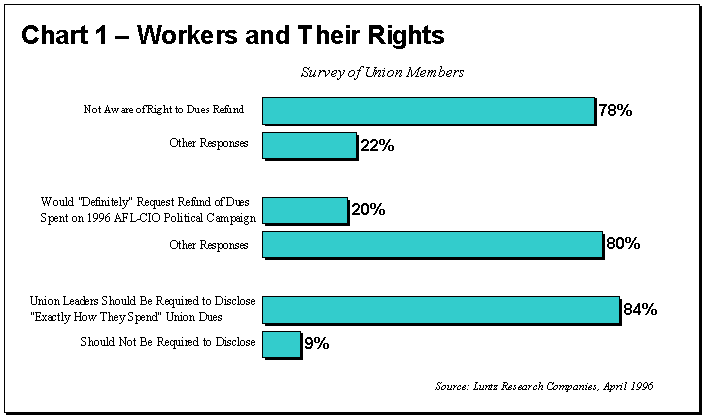
An April 1996 survey2 of 1,000 union members revealed that a full 78 percent were not aware of their Beck rights (see Chart 1 on page 5). One out of five union members surveyed said that, given the chance, they would "definitely" request a dues refund rather than be coerced into contributing to the AFL-CIO's $35 million 1996 political campaign. And 84 percent of those surveyed said their union leaders should be required to disclose "exactly how they spend" union dues.
Michigan unions claim that their members are fully apprised of their Beck rights; however, a recent radio campaign designed to inform workers of these rights was met with an avalanche of thousands of requests for more information. The radio ads, sponsored by the Michigan Chamber of Commerce and the Michigan affiliate of Associated Builders and Contractors, Inc., gave out a phone number to listeners in Flint, Saginaw, Bay City, and Grand Rapids interested in finding out about their rights under Beck.
In the eastern Michigan campaign, over 1,400 respondents asked for information packets explaining how to limit their dues payments to collective bargaining expenses only and request refunds for any dues already spent on non-bargaining activities. In total, over 3,000 Beck information packets were mailed out as a direct result of the ad campaign (many callers requested multiple packets). The western Michigan campaign enjoyed similar success, with listeners there requesting nearly 1,000 information packets.
If union workers are already aware of their rights as unions claim, why did thousands of them request basic information after hearing the radio ads? The response to the radio campaign is hard evidence that Michigan unions have neglected to inform workers of their rights, and it is also consistent with the Mackinac Center for Public Policy's experience in answering hundreds of calls from Michigan workers curious about Beck rights. To satisfy the demand for Beck information, this radio campaign should be expanded to reach every union dues payer in the state.
The secret of Beck rights cannot be bottled up forever. Unions that pursue a "see no evil, hear no evil" strategy with regard to Beck will only hurt the labor movement in the long run. By avoiding or delaying compliance with Beck, union leaders stand to lose credibility with rank-and-file members who will eventually learn of the efforts to keep them in the dark. Employers that remain silent about their employees' rights will likewise only alienate their workforces and breed distrust.
Employees who eventually learn of their Beck rights and want to exercise them are routinely required by their unions to resign their memberships. Because the Beck decision did not address whether an employee can be required to resign from his union in order to exercise his rights, unions impose this condition to discourage their members from pursuing Beck opportunities. Unions should, however, rethink this policy: It makes little sense to force people out when the strength of the labor movement is declining rapidly.
Forced resignation is a powerful deterrent to employees seeking to exercise their rights. Given a labor union's legally enforced status as exclusive employee representative, an employee's sole means of control is to influence his union's internal processes. The only effective way to do that is for him to become or remain a union member and participate in its governance. Depending on the employee's level of participation, he can influence critical decisions about negotiation strategies and goals, how the collective bargaining agreement will be enforced, and which grievances should be taken to arbitration. Participation in strike votes, ratification or rejection of contract terms, and union elections are also important rights of union membership that many Beck objectors must forgo.
Exercising Beck rights in the workplace has other effects. Peer pressure and bullying from within union ranks often discourages members from exercising their rights. Employees who object to paying full union dues may experience an uncomfortable working environment and tension among coworkers who support the union's political and ideological causes. Other members may feel that Beck objectors want to shirk the full payment of dues while accepting the benefits of union representation.
In truth, however, nonmembers must pay for exactly those services the union renders according to the duty of fair representation to all dues payers. More often than not, the primary reason that rank-and-file union members do not exercise Beck rights is simply because they are pressured to avoid "rocking the boat" by engaging in a disloyal act against union leadership interests.
Beck rights are not self-enforcing: It takes action on an employee's part to secure his rights. When a union resists an employee's attempts to hold it accountable, that employee must then turn to government labor regulatory agencies or the civil courts for help.
Governmental enforcement of Beck rights, however, has been virtually nonexistent. The National Labor Relations Board (NLRB), which enforces Beck rights, has timidly approached its duty. For example, it took the NLRB over seven years from the Beck decision to issue its first case explaining its policy.3 Even then, the NLRB refused to extend4, and continues to deny, all of the procedural safeguards required under a similar U. S. Supreme Court case which extended dues protections to public employees.5
Outgoing NLRB Chairman William Gould even denounced California's Proposition 226—a ballot initiative designed to help workers limit their dues payments—as "deeply flawed" on constitutional and policy grounds.6
The U. S. Department of Labor has been similarly disinclined to honor Beck rights. President Bush required federal contractors, through the oversight of the Department of Labor, to post Beck notices to their employees, but President Clinton rescinded this action as one of his first official acts in office.
Such attitudes and actions from government officials and agencies do not bode well for workers who must rely on these institutions to neutrally and faithfully protect their rights against employer and union abuses.
Another difficulty in Beck enforcement arises from the structure of the law itself. The NLRB is not granted general regulatory authority over all industries, so it acts only on charges filed by individuals.7 Unions therefore often avoid Beck compliance by honoring their employees' individual rights only after charges have been filed and the NLRB "cops" show up. Employees left to seek redress through this system alone will not enjoy, on any large-scale basis, the rights which are fundamental to their union obligations.
Congressional hearings have demonstrated that workers often experience union coercion and intimidation once they try to assert their rights under the Beck decision. Many workers testified about the harassment and intimidation tactics some unions use to try to silence Beck objectors.8
Many unions also thwart the exercise of Beck rights by putting obstacles in the way of workers. They may, for example, limit the time of year when objections can be made, require annual renewal of objections, or acknowledge receipt of Beck objections only when selected union officials are notified in writing. It is a classic runaround designed to wear down the average worker and cause him to abandon his personal employment rights.
Employees must file a charge with the NLRB to remedy these unfair labor practices. While a courageous individual employee may ultimately prevail over his union, this possibility is not much of a deterrent to unions committed to delaying or discouraging the exercise of Beck rights.
Labor unions simply have no specific, immediate interest in apprising workers of their Beck rights or cooperating with them to process Beck requests: Quite the contrary, since refunding money to objecting workers means reduced union discretionary funds.
It took a law to create this problem; it will take a law to help remedy it.
"Paycheck protection" refers to those labor reform efforts initiated at the state level which are designed to ensure maximum protection of workers' rights under Beck. Paycheck protection—coupled with rigorous enforcement of the Beck decision—guarantees to all workers forced to pay union dues their right to make their own decisions about contributing to their union's political, social, and charitable causes.
Paycheck protection avoids the practical problems present in the Beck decision while carrying out its promise. Generally, paycheck protection is simple and straightforward and puts all affected persons on clear notice as to what is required.
However, paycheck protection is not a cure-all for those workers who are trapped in compulsory union arrangements. The law grants privileges to unions that subordinate the individual rights of workers to the "collective good" of the union membership. One of these privileges, which paycheck protection would balance out, is the union security agreement.
Under union security agreements, employers agree to terminate any worker who refuses to pay union dues or fees. Paycheck protection does not end this dues obligation, but it does effectively free workers to withhold payment of dues money that is not spent on legitimate worker representation.
Nor does paycheck protection necessarily resolve all dues disputes between unions and employees. Workers who decide to withhold the percentage of their dues that the union admits are unrelated to collective bargaining may decide to challenge the union figures for accuracy.
U. S. Supreme Court and other judicial decisions have established important rights in this area.
First, nonunion members must be given adequate information about the basis for any representation fee the union charges them.9 Workers who wish to object to their fee assessments must be able to first determine if the assessments are objectionable. The framework paycheck protection language on page 12 provides the basis for the exercise of these rights.
Second, the procedure for a worker's union fee challenge requires that 100 percent of the disputed fee be placed into an interest-bearing escrow account, unless the initial disclosure includes a CPA's verification of expenses. If a CPA verifies the fee schedule, the union may escrow only that portion of expenditures that a worker could reasonably challenge.10
Finally, the procedure must provide for a "reasonably prompt decision by an impartial decision maker" to confirm the nature of the challenged union expenditures and to guarantee that the dues have been used for permissible purposes.11
The U. S. Supreme Court has recently ruled that forced-union-fee payers who dispute their assessed fees need not first exhaust a union-controlled arbitration procedure before taking their disputes to a judicial forum.12 The Court held that there is no legal basis for compelling an objector who does not agree to arbitration to submit a dispute to that process, and that a federal court could serve as the "impartial decision maker," provided that the litigation was expeditiously pursued.
Thus, Beck-type rights continue to be necessary to assist workers to test the validity of the unions' dues calculations.
Under paycheck protection proposals—which may come via law or ballot referendum—unions that compel dues and fees from workers must secure from each a prior, voluntary, written authorization to use any dues for non-collective bargaining activities. Workers are permitted to automatically shield their Beck dues up-front when dues are collected, instead of having to jump through hoops to recover those dues after they have been extracted.
Paycheck protection treats all workers equally, union members and nonmembers alike, in their right to decide whether or not to support the union's nonbargaining agenda without sacrificing their right to vote on critical workplace economic decisions. Votes to ratify a collective agreement or authorize a union strike affect union "nonmembers" as well; they should not be deprived of their right to decide matters which directly impact their opportunities for workplace improvements.
Paycheck protection is not "anti-union" but rather a more balanced pro-worker approach:
All workers are notified of their option to contribute or withhold dues money;
All employees continue to be represented by the union;
All workers are compelled to pay for union representation services from which they
benefit; and
The union is able to continue spending on matters it deems important—but only with dues money consciously and voluntarily contributed by its dues payers.
Paycheck protection is fair to unions because they will continue to be able to solicit money for their nonbargaining agenda, using the power of persuasion. What would change is the current presumption that unions have the right to make those decisions for workers—a presumption which clashes with a union's need to respect the personal freedom, democratic governance, and voluntary cooperation of the people it claims to represent.
A number of states have either adopted paycheck protection reforms or are looking into the possibility of introducing them to voters or legislatures. The language of these paycheck protection proposals may vary from state to state according to the purposes to be accomplished. For example, California's narrowly defeated campaign reform initiative, Proposition 226, sought to prohibit employers and unions from withholding pay or using dues for political purposes without prior written consent from employees.
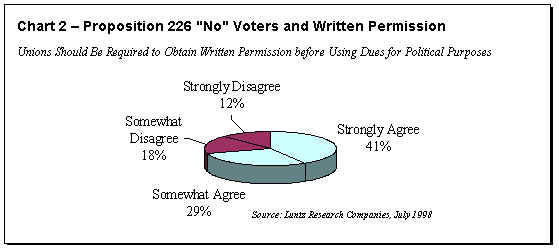
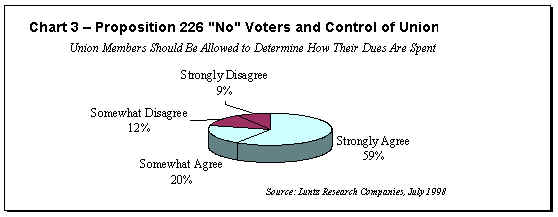
Though Proposition 226 failed, exit polls revealed that voters overwhelmingly supported the concept of paycheck protection (see Charts 2 and Chart 3, pages 9 and 10). This suggests that the sponsors of 226 will take their case to the voters again for the next election.
In 1992, the state of Washington passed Initiative 134, which prohibits public sector unions from using "agency shop" dues (those collected from objecting employees) for political purposes without the written permission of those public employees. In 1997, Idaho passed a law that permits union political action committees to accept donations from dues check-off authorizations only if employees give annual written consent. Wyoming passed its version of paycheck protection in 1998.
In Oregon, a measure to afford workers greater freedom to authorize political contributions will be on the November 1998 ballot as Initiative 59.
All of these states so far have focused only on "political contributions" and have thus missed an opportunity under Beck to give workers choices over an entire range of union spending, including social, ideological, and charitable causes. Political spending may be the largest component of union dues expenditures, but it is by no means the sole source of union spending beyond collective bargaining expenses.
The U. S. Supreme Court identified, in Lehnert v. Ferris Faculty Association,13 seven other examples of union expenses not chargeable to Beck objectors:
Lobbying, unless necessary to ratify or fund the collective bargaining agreement that is applicable to a nonmember;
Public relations activities;
Litigation not specifically on behalf of the nonmember's bargaining unit;
Expenditures related to illegal strikes;
Expenditures related to organizing the employees of other employers;
Union "members only" benefits such as prepaid legal insurance; and
Expenditures related to portions of union publications reporting on the above categories.
When an employee challenges the legitimacy of union spending, it is incumbent upon the union to prove that that particular spending is related to contract administration, collective bargaining, or grievance handling. Political and ideological expenditures out of average union dues could presumably be as high as 79 percent (as in Beck) or even 90 percent (as in Lehnert).
Michigan is a prime candidate for the enactment of worker paycheck protection for two reasons.
One is that, at 18 percent, Michigan has the highest percentage of forced dues-paying private workers in the country—nearly double the national average. When government employees are included, Michigan ranks third nationally with 23 percent of its total workforce subject to union dues requirements.
That translates into big-dollar refunds. Assume each union worker's average annual dues to be $425. If just 20 percent of that money is spent on union activities unrelated to workplace representation, almost one million Michigan workers could keep $82 million of their dues money annually just by withholding permission from their union to spend it on politics and controversial social causes. That's a potentially significant pay increase for each objecting employee, especially if consent is withheld over several years.
The second reason paycheck protection is a winning issue in Michigan is one of precedent. Michigan citizens have secured, in two historic U. S. Supreme Court cases,14 similar Beck-style rights for government employees. And Public Act 117,15 passed by the state Legislature in 1994 and upheld in federal court,16 already requires Michigan unions to gain written authorization from dues payers prior to taking automatic payroll deductions for political action fund contributions.
The following language is offered as an example of the maximum paycheck protection available to workers in keeping with the principles of the Beck decision. This suggested language avoids focusing on union political activities as the only category available to an employee objecting under Beck principles, and presents the core concepts of a desirable paycheck protection proposal:
A labor organization accepting payment of any dues or fees from an employee as a condition of employment pursuant to an agreement authorized by law must annually secure from each employee prior, voluntary, written authorization for any portion of such dues or fees which will be used by the labor organization for activities not necessary to collective bargaining, contract administration, and grievance adjustment.
When written authorization is requested by a labor organization, it shall account for and report fees and expenses in such detail as necessary to allow employees to determine the proportionate costs of collective bargaining, contract administration, and grievance adjustment, and the costs of other activities.
Some employers may be concerned that an annual written authorization by each employee will create an unwieldy paperwork burden and substantial costs to account for a worker's decision to withhold funds. This need not be the case. The language below is offered as a simple and understandable example for documenting a worker's choice. Please note that the underlined text in bold is variable; changes will be necessary according to the individual name of the worker, which union he is in, the amount of his dues, and so on.
A labor organization may solicit and obtain funds from you for political, ideological, social, or charitable events or activities, lobbying for legislation, organizing employees of other employers, or other activities that are not collective bargaining, contract administration, or grievance processing on an automatic basis, including but not limited to a payroll deduction plan, only if you affirmatively consent in writing to the contribution at least once every calendar year.
Your dues or fees for membership in, or union representation from, the Acme Labor Union are four-hundred-twenty-five dollars and zero cents ($425.00) for the year beginning 01/01/98 and ending 12/31/98.
Eighty-five dollars and zero cents ($85.00, or 20%) of your dues or fees may be used for political, ideological, social, or charitable events or activities, lobbying for legislation, organizing employees of other employers, or other activities that are not collective bargaining, contract administration, or grievance procession only if you voluntarily consent below.
Under state and federal law, you do not have to pay this amount. This amount will be subtracted from the dues or fees you owe if you do not sign this form to have your dues or fees used for organizing employees of other employers, lobbying, or participating in political, social, charitable, or other ideological activities that are not related to collective bargaining, contract administration, or grievance processing.
I, John Doe, voluntarily authorize Acme Labor Union to use $85.00 (20%) of my dues or fees for political, ideological, social or charitable events or activities, lobbying for legislation, organizing employees of other employers, or other activities that are not collective bargaining, contract administration, or grievance processing.
_____________________________ ____________ Employee Signature Date cc: Your Employer
Your Union President
Employees deserve the fullest possible protection of their Beck rights. Therefore, the state of Michigan should adopt a paycheck protection proposal by way of law or ballot initiative as soon as practicable. Paycheck protection—coupled with rigorous enforcement of Beck rights—will more fully safeguard worker freedoms of speech and association when requesting and receiving a partial refund of involuntarily taken union dues.
Labor unions and some business groups have criticized paycheck protection for different reasons. This appendix lists some of the most common criticisms and offers a response to each.
1. "Paycheck protection is a business-motivated effort to silence workers by depriving them of their voice in the political process."
Paycheck protection merely respects each employee’s individual right to decide if he wants money deducted from his paycheck for non-workplace union activities. Paycheck protection does not inhibit a union’s ability to solicit contributions and donations voluntarily by convincing workers that the union’s political activities are in their best interests. Union politics are not necessarily compatible with those of individual employees, who should have ultimate control over their own money.
2. "Paycheck protection is unfair if it is not applied to corporations or other membership organizations that spend money in politics."
Labor unions are granted by federal law, and sometimes state law, a unique "taxing" power not available to any other organization, which enables them to end the livelihood of any worker who refuses to or cannot pay union dues and fees. Corporations can neither force individuals to invest in them nor prevent them from selling their stock when those individuals disagree with corporate political spending. The coercive power of a union exercising a discharge action makes this concern an "apples and oranges" comparison.
3. "Paycheck protection will interfere with the employee’s other payroll deductions, such as those for health care, 401(k) plans, or United Way charitable contributions."
Paycheck protection applies only to union dues paid through payroll deduction, any part of which will be used by the union for political campaigns or for social causes that an employee may deem objectionable. As such, it will have no bearing upon other matters such as voluntary charitable contributions or any other category of payroll deduction unrelated to mandatory union dues.
4. "Paycheck protection doesn’t go far enough in relieving an employee from the coercive aspects of compulsory unionism."
While paycheck protection does not address all facets of the special powers, privileges, and immunities granted to labor unions under the law, it does make a positive impact in enabling workers to control the expenditures of some of their dues. Any move toward greater employee freedom and increased union accountability represents a more balanced approach under the labor laws and, as a matter of public policy, is worthy of widespread support. Paycheck protection must be coupled with rigorous enforcement of Beck rights.
5. "The procedures of written annual consent from each employee make it virtually impossible for labor unions to collect dues sufficient enough to allow them meaningful participation in political affairs."
There is no doubt that annual written consent will dramatically change the ways unions currently relate to their dues payers. But from a worker’s perspective, this change is totally positive. Unions will have to use the power of persuasion in direct dealings with employees to convince them that their money is worthy of contribution to the union. While unions may find this more cumbersome, the recent successful attempt by the Michigan Education Association to get its members signed up as PAC contributors demonstrates that written permission and face-to-face solicitation is a workable system.
A corollary to this criticism of paycheck protection is this: Any union that finds itself unable to persuade members to voluntarily provide funds for meaningful political participation should ask itself whether it is truly acting in the best interests of workers.
6. "Paycheck protection laws won’t work because the unions who disagree with them will find ways to circumvent them."
Undoubtedly, some unions will attempt to circumvent the intent of paycheck protection by raising money from union employees by other means. Unfortunately, laws alone cannot insulate employees against every potential union effort to maximize dues collection. Laws alone are not guarantors of liberty: Individuals must be allowed to take personal responsibility for their freedom.
The paycheck protection measure proposed in this report would allow workers the freedom to preserve their civil rights without sacrificing their economic interests or infringing upon the speech or association rights of other union members. It would guarantee a worker’s right to withhold his dues at their source, before they are transmitted to the union. Prudent regulation of the collection process will do far more to prevent union misuse than will simply attempting to regulate how unions may spend the dues after they have been collected.
487 U. S. 735 (1988).
National Survey of Union Members, The Luntz Research Companies – ABB Union Survey (Americans for a Balanced Budget), April 29, 1996.
California Saw and Knife Works, 320 NLRB 224 (1995), enf’d. ___ F3d ___, Docket No. 96-1246 (Jan. 14, 1998).
See e.g., Teamsters Local 738 (E.J. Brach Corp.), 324 N.L.R.B. No. 180 (1997); Laborers’ International Union, Local 265 (Fred A. Newmann Co.), 322 N.L.R.B. No. 47 (1996).
Chicago Teachers Union v. Hudson, 475 U. S. 292 (1986).
See National Labor Relations Board Press Release (R-2285) dated April 24, 1998.
Section 10(b) of the National Labor Relations Act.
Hearings on Mandatory Assessment of Union Dues, Before the Subcommittee on Employer – Employee Relations, 104th Cong., 2nd Sess., (Mar. 18, 1998, and Apr. 18, 1996).
Hudson, 475 U.S. at 306.
Id. at 305, 310.
Id. at 309.
Air Line Pilots Assoc. v. Miller, U.S. Sup. Ct., No. 97-428, May 1998.
500 U.S. 507 (1991).
Lehnert v. Ferris Faculty Association, 500 U. S. 507 (1991); Abood v. Detroit Board of Education, 431 U. S. 209 (1977).
1994 PA 117; MCLA 169.255, Et. seq.
Michigan State AFL-CIO v. Miller, 103 F3d 1240 (CA 6, 1997).