


 Font size:
Most introductory economics textbooks warn students in the first chapter of several economics fallacies, including the fallacy of composition. A fallacy of composition occurs when someone claims that something is true for everyone in a group based on it being true for some part of the group.
This fallacy of composition has been used recently to argue that electricity competition is a failure everywhere because of its failure in certain markets. Most would agree than the attempts to introduce electricity competition in some states, such as California and Maryland, have resulted in higher prices than would have occurred without the regulatory changes. But can we conclude from that evidence that Michigan’s introduction of electricity competition has also resulted in higher prices for Michigan customers? Unfortunately, some are attempting to make that fallacious argument while ignoring direct evidence that argues otherwise.
The American Public Power Association recently issued a report entitled "Retail Electric Rates in Deregulated and Regulated States: A Ten Year Comparison." The promotional material circulated by the group is entitled "Retail Rates Have Risen Faster in Deregulated States." It concludes:
States that implemented retail choice electric plans were generally high-cost states, and the hope was that competition by electric suppliers would result in lower rates … but that did not happen.
The Michigan Public Service Commission sets up another variation on this fallacy by ranking states according to electricity rates and identifying them as "regulated" and "restructured" in its annual "Status of Electric Competition in Michigan" report, while ignoring the wide differences in electric restructuring efforts with widely differing results.
As an initial matter, the characterization of state electricity markets as "deregulated" and "regulated" is misleading from the start, because all states have maintained substantial regulation of electricity markets. One could argue California and some other "deregulated" states are more heavily regulated today than when they were "regulated." It is also notable that the APPA report somehow defines Ohio and Pennsylvania, two states with lower-than-average electricity rates, as "regulated" states even though they have both allowed electricity choice for several years.
The APPA report correctly points out that a major cause of these increases is that many of the states with electricity restructuring forced utilities to sell generation assets, so now they are at the mercy of the wholesale market. That is a major cause of rate increases in those states. But Michigan’s restructuring did not make the same mistake — Michigan utilities were not required to divest any generating capacity. In other words, the problem the report identified is not restructuring per se, but rather that other states foolishly forced utilities to sell generation assets. The APPA report misleadingly includes Michigan with states that made that costly error.
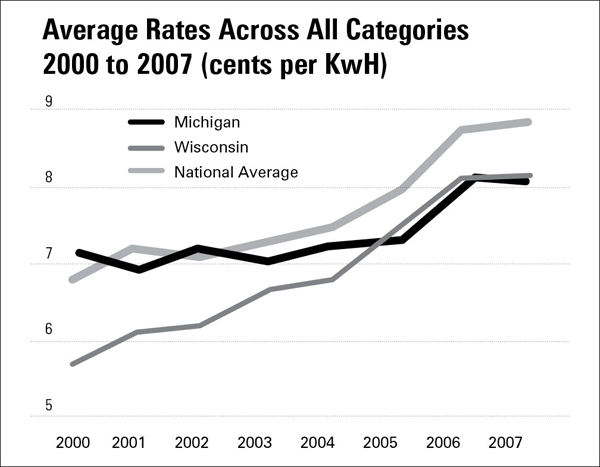
Rather than lump Michigan with states that blundered in implementing their restructuring, a direct assessment is available for measuring the impact of electricity restructuring on rates in Michigan. In 2000, the year restructuring was adopted, Michigan rates were the highest in the region and higher than the national average. By 2003, Michigan rates were below the national average, demonstrating the fallacy of composition that restructuring always results in larger rate increases. Meanwhile, rates in Wisconsin were well below the Michigan rates and the national average in 2000. Wisconsin briefly experimented with choice, but restored monopoly power to big utilities, and now the gap between Michigan and Wisconsin rates has completely closed.
Michigan’s electricity choice program could certainly be improved. More can be done to level the playing field between the big utilities and new suppliers. But rates in a competitive market in Michigan, for all its shortcomings, have risen more slowly than the national average, and attempts to argue otherwise can only be based on economic fallacies.
#####
Theodore Bolema, an attorney and faculty member at the Central Michigan University College of Business Administration, is an adjunct scholar of the Mackinac Center for Public Policy, a research and educational institute headquartered in Midland, Mich. Permission to reprint in whole or in part is hereby granted, provided that the author and the Center are properly cited.

The Mackinac Center for Public Policy is a nonprofit research and educational institute that advances the principles of free markets and limited government. Through our research and education programs, we challenge government overreach and advocate for a free-market approach to public policy that frees people to realize their potential and dreams.
Please consider contributing to our work to advance a freer and more prosperous state.


